Why You Miss People Who Hurt You

It is degrading to miss the person who injured you. You might be wondering yourself, why do I miss them when they hurt me? That question can make one doubt himself, feel guilty, or even get angry at him/herself. But this is no more, or less, psychological an experience than it appears.

The fact that you miss a person who has hurt you does not mean that the harm was not real, neither does it imply that you are romanticizing the pain and forgetting what actually took place. Neither does it imply that you are yearning back to the pain. I mean by that that there is something more than logic responding, your nervous system, and emotional brain.

The emotional and physical brain makes a human being attached and not the rational mind. The fact that a relationship turns unhealthy does not make that system to switch off. It clings to familiarity, emotional investment, moments together and the significance you had previously attached to the individual. It happens that though your rational brain knows why this relationship was bad, your emotional brain is still mourning the loss.

Starting the healing process is as simple as ceasing to judge yourself in not missing them and realizing what you feel is attempting to process. The pull becomes less hard with time, safety, and self-compassion. What used to be confusing becomes clearat one does not miss the pain but is shedding an attachment that had a role to play, though it may have been toxic.

1. The Brain Bonds Before It Judges

1. Attachment Is About Connection, Not Fairness

Connection is what motivates human attachment, as opposed to the healthiness or equality of the relationship. The brain releases the chemicals such as dopamine and oxytocin when emotional intimacy is created among them through intimacy, vulnerability, or through a high frequency of interaction. These generate a sense of comfort, safety and familiarity of emotion. Gradually the brain becomes used to that individual as a relief and emotional crutch.

2. How Everyday Moments Build Attachment

Attachment grows in ordinary, repeated moments:

  • good morning messages

  • calls after work

  • evening tea

  • feeling understood in daily life

It is these trivial habits that condition the nervous to anticipate the appearance of someone. Brain is not logical, but pattern: emotional damage does not necessarily wipe out attachment.

3. Why Attachment Remains Even When It Becomes Painful

The emotional brain will grab what is familiar to it just as we grab our comfort food when we are under stress. You might wish to send them text messages when you feel overwhelmed, consider them even when you are just sitting and missing them the most during night-time- the time when the relationship used to be the most alive.

4. What You’re Really Missing

You are not missing how they hurt you. You are missing:

  • the emotional habit

  • their role in your daily rhythm

  • the sense of belonging your system learned

This is why longing can exist even after you understand the relationship was unhealthy.

5. What Longing Actually Means

Desire does not mean that the suffering was justified. It is an indication that your brain is untraining an attachment that you once depended on. Your nervous system develops new configurations with time and experience of constant safety. What seemed impossible to give was less and less hard, more natural and less difficult to hold on.

2. Intermittent Care Creates Stronger Attachment

1. Why They Don’t Look “Bad” All the Time

Most of the painful relationships are not harmful at any given time. Sometimes the individual listens, consoles you, or makes you feel very deeply understood. At other periods they draw back, condemn, overlook, or put you to the question of your value.
This back and forth does not bring clarity, it brings about emotional confusion.

2. Living According to Their Mood

Over time, the relationship begins to depend on their emotional state. You may find yourself thinking:

  • If I say the right thing today, maybe they’ll be kind again.

  • They were loving yesterday—maybe this time it will last.

Because the warmth is unpredictable, it feels especially powerful when it appears.

3. How the Brain Becomes Conditioned

Such inconsistency conditions the emotional brain to pay attention to the positive moments as opposed to doubting the bad. The nervous system does not inquire about the repeated occurrence of the pain, but awaits the next occurrence of love.
This benevolence is more precious, just due to the fact that it is not obligatory.

4. What You Actually Miss

Frequently it is not the relationship itself which you miss, but the potential which you retained. You mourn the incarnation of them that was responsive, kind and emotionally available, the one that manifested itself frequently enough to keep the hope alive.
Releasing will mean mourning over that hope and that may be more difficult than mourning the human.

5. Why This Is Not Your Fault

This insight minimizes self-blame. You were not “too attached.”
You were reacting to an order which conditioned your nervous system to gum through the thick and thin. The attachment was in fact conditioning.

3. Familiar Pain Feels Safer Than Unknown Peace

1. How Childhood Patterns Shape Safety

In case your childhood was marked by emotional inconsistency, neglect, or invalidation, your nervous system might have been conditioned to perceive this to be normal. You might have unconsciously thus taken in messages like:

  • love means waiting

  • It means adjusting yourself

  • love means staying quiet or earning attention

These early experiences shape what your body later recognizes as connection.

2. Why Healthy Love Can Feel Uncomfortable

This may manifest as intolerance in the adult life in the form of stable and consistent relationships. Reliable and calm, emotional, and available individuals will be dull, strange, and even unsafe.
Meanwhile, when relationships become emotionally turbulent you can experience it as intense, meaningful, or real not because it is a healthy relationship, but because it is the kind of relationship that your nervous system tells you it is.

3. The Lack of any Familiarity, not the Person.

A familiar pattern is lost with the end of a painful relationship as well as is the person. Even malicious familiarity may be secure as compared to the unfamiliar. This is the reason why you will miss a person who abused you more than a person who was good to you.

4. What You’re Really Learning

You might not miss them as they suited you. You might overlook them since your nervous system is yet to be taught a new meaning of safety. Healing does not have to do with pushing yourself to heal more quickly, but rather about learning to teach your system gradually that, with no anxiousness, self-abandonment, or fear, relationships can be calmed, respectful, and emotionally secure.

5. How Change Happens Over Time

Over time, there may be stability, familiarity and secure connection making what previously was foreign start to be secure. And that which was once, though hurtful, normal, may finally begin to slip.

4. You Miss the Version of Yourself You Were

1. Missing the Role You Played

Sometimes it is not the other person that you miss, it is the image of yourself that you were in the relationship.
You can afford not to have been the one who made the attempt and waited and appeared and did more than you got. It is painful, but that could have provided you with a sense of purpose, identity, or value, in emotion.

2. Missing the Intensity

You even might be deprived of that emotion life the relationship gave. Great emotional moods may render life significant, melodramatic, and vivid. Once such intensity has gone, the silence that remains may seem hollow or disturbing.
This is not that the relationship was healthy but rather it took up a high emotional space.

3. Why Letting Go is Like Losing Yourself.

Breaking-up the relationship may seem like losing a part of yourself, particularly when you had built your thoughts, habits, future plans, or sense of self around it. It is not merely a relational loss, but rather an existential loss. You are being challenged to recreate yourself minus the struggle, the story and the hope that used to make you what you were.

4. Grieving the Versions of You

People we do not only grieve, versions of ourselves:

  • the hopeful self
  • loyal self
  • the self who had hoped he would finally be safe in love.

Healing is to respect those versions with compassion and then giving oneself a chance to become someone different someone who does not have to be hurt to experience reality and does not have to suffer to feel connected and significant.

5. Missing Is Not the Same as Wanting Them Back

1. Missing Is Not Proof the Relationship Was Healthy

Craving one’s presence does not imply that the relationship was safe and going back is the most appropriate choice. It is just that your emotional system is functioning in the manner in which it is programmed to- process loss.

2. Logic and the Nervous System Don’t Move Together

When a connection ends, the mind and body don’t immediately align with logic. Your nervous system is losing:

  • a relationship

  • a familiar habit

  • emotional stimulation

  • a known pattern of relating

Feelings of longing, sadness, or nostalgia are not signals to go back—they are signs that attachment is slowly unraveling.

3. Why Memories Appear Suddenly

Memories can be replicated in the ordinary activities of life, at night or when revived by something. Such times do not imply that you have not healed. They do not refer to your system as integrating the past, but avoiding it.

4. What Healing Actually Looks Like

Healing is not forgetting, blocking out, or minimizing what the relationship meant. Healing is:

  • remembering without being pulled back

  • holding the truth of what you felt and what you know

  • choosing distance with clarity, not denial

5. What Changes With Time

Over time, the ache softens. Memories lose their emotional charge. What once felt like a command to return becomes a passing thought. This is not weakness—it is growth.

6. Why Logic Alone Doesn’t Stop the Ache

1. Knowing and Longing Can Coexist

You may intellectually understand that the relationship was unhealthy and still long deeply for the person. This can feel confusing or discouraging, but it is a natural human response.

2. Two Parts of the Brain

The thinking brain holds logic, reasoning, and insight.
Attachment lives in the emotional and bodily brain, where memories are stored as feelings, sensations, and patterns.

3. Why the Body Reacts

Even when the mind understands, the body may respond with heaviness in the chest, restlessness, or sudden longing. These are not signs of going backward—they show the nervous system releasing an attachment that once felt necessary.

4. Healing Is More Than Understanding

Awareness explains the experience but doesn’t always calm the body. Healing happens through nervous system regulation, self-compassion without shame, and repeated experiences of safe, emotionally available relationships.

5. What Changes Over Time

With consistent safety, the emotional brain learns what the thinking brain already knows:
connection does not have to hurt to be real.
Longing softens because the system no longer needs it to feel secure.

7. What Helps When You Miss Someone Who Hurt You

  • Name the truth gently: “I miss the connection, not the harm.”

  • Allow the feeling without judgment: Missing is a feeling, not a decision.

  • Strengthen your present safety: Consistent routines, supportive people, grounding practices.

  • Grieve fully: Closure comes from processing, not suppressing.

  • Redefine love: Over time, emotional consistency will begin to feel more comforting than intensity.

A Closing Thought

You can talk it over mentally that the relationship was unhealthy, but you still long to have the person. This may be confusing or even demoralizing, but it is a very normal human reaction.

Logic, reasoning and insight are the functions of the thinking brain. This is the place where you realize, “This did not work out well with me.
Attachment, however, exists in the emotional and bodily brain where the memories are stored in the form of sensation, feeling and pattern of emotion.

And this is why your body might continue to need to respond with tightness in the chest, restlessness or a sudden rush to miss them. Such reactions do not indicate that you are going regressive. They indicate that it is a gradual release of an attachment that you once needed by your nervous system.

Knowledge does not work wonders. No sense has a way of making you know what you are going through but that does not necessarily soothe the body. The process of healing occurs by regulating the nervous system, with self-compassion devoid of shame, and by repetition in safe and consistent, emotionally available relationships.

Over time, the emotional brain learns what the thinking brain already knows:
connection does not have to hurt to be real.

FAQs — Why You Miss People Who Hurt You

1. Why should I miss someone who abused me?

You can lose the emotional connection, familiarity and the pattern of attachment and not the actual treatment. Our nervous system develops strong ties even in unfaithful or malicious relationships.

2. Does the fact that one misses another person imply that the relationship was good?

No — it does not mean that the relationship was healthy when one misses a person. It is possible to have emotional attachment and grief even when the experience was detrimental.

3. What is a trauma bond?

A trauma bond is a psychological attachment resulting when the abuse and new positive experiences are repeated in contact and your brain has learned to stand by the unpredictability.

4. Why can it be more difficult to let go of good ones?

Random acts of positivity bring intermittent positive reinforcement, which leaves a stronger impression of attachment than regular acts of kindness would.

5. Can it be normal to miss another person after leaving him?

Yes – – even when the relationship is finished the nervous system can be in withdrawal and desire familiarity.

6. Why is it that serene and emotional safety is so strange?

In case the early attachment was inconsistent or neglected, the emotional system might view stability as something foreign or uncomfortable.

7. Are there any such things as trauma bonds in friendship or simply in romantic relationships?

Trauma bonds are possible in any type of relationship, not only romantic relationships, when one person gets emotionally dependent despite abuse.

8. Are the absence of them that I desire them?

Not necessarily. You will not miss the pain or the presence of the other person, but the bond, comfort, hope and identity associated with the relationship.

9. Which theory of attachment (psychological) is applicable?

The John Bowlby theory of attachment demonstrates that human beings are designed to seek relationships to ensure their safety and survival in life, however, inconsistent, or painful.

10. What is so difficult about heartbreak, body-wise?

Separations cause emotional pain which results in brain activation of similar areas as those of physical pain- since loss of attachment is perceived by the nervous system as a threat.

11. Is it possible to be trauma bonded and not abused?

Trauma bonding is generally associated with harmful relationships, but neglect, inconsistency, or emotional volatility also can be unhealthy attachment.

12. What is the time taken to miss them?

No specific timeline exists, and the healing, regulation, new safe experience, and time are the factors that would help to restore equilibrium.

13. How is the difference between love and attachment?

Love within healthy relationships is not something to worry about, and attachment within harmful relationships is usually something to be addictive and uncertain.

14. Can therapy help with this?

Yes, therapy and treatment in particular, trauma-informed or attachment-based treatment could serve to unpack patterns and establish emotional safety.

15. Does it make one weak when he or she misses someone?

No — the feeling of missing someone who hurt you is not a moral weakness, it is a human emotional process. It is a part of the unraveling of old patterns in the brain with time.

Written by Baishakhi Das

Counselor | Mental Health Practitioner
B.Sc, M.Sc, PG Diploma in Counseling


Reference 

This topic performs well due to rising searches around men’s mental health, workplace stress, and burnout recovery. Combining emotional insight with practical steps increases engagement and trust.
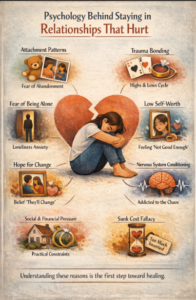
Psychology Behind Staying in Relationships That Hurt

It is a question that persists among many individuals as to why a person would continue to be in a relationship that brings in emotional hurt or neglect. It is a matter of mere words, it appears that it is not so complicated, and when it hurts, one should leave. Psychology however demonstrates that maintaining is hardly weakness. They are aware that they are being hurt, they can feel it in over and over disappointments, need denials and emotional lack of companionship. Leaving is not only a logical process; it is also an emotional process and a process of the nervous system.

In the everyday life, this usually appears in the form of excuse-making over rudeness, clinging to tiny surfaces of tenderness, or wishing that things could go back to their old ways. Pain is familiar to a number of people since the relationships they had in early stages of life taught them that love is inconsistent or emotionally taxing. The unknown may be unsafe in comparison with what is familiar.

The fear of being alone, self-doubt and social pressure may silently hold people back. They could downsize the needs over the years, evade conflict, and modify themselves to the relationship. Knowledge of these patterns can be used to find an alternative to self-blame of self-compassion-and the initial step to recovery and better relationships.

1. Attachment Patterns Formed in Childhood

The experiences of being close to someone in our adulthood are influenced by our first relationships. The attachment theory states that the manner in which our emotions, needs, and distress were addressed by caregivers was a template to love and connection that would be kept as an internal record.

  • In anxious attachment,
    relationships usually make life worryful and prone to thinking. The fear of being deserted can be very strong due to a delay in the response, a change in the tone, or distance in nature. Human beings can be in painful relationships, as the fear of losing an individual being felt more than the pain of remaining. They can be over-giving, people-pleasing or bury their needs to ensure that the relationship remains alive.
  • In the avoidant attachment,
    emotional distance may seem normal. Such one can manifest itself in everyday communication (reducing self-importance, not talking deeply or too closely). Negligence or emotional unavailability is not necessarily experienced as an issue since an early teaching of independence and emotional self-reliance was a source of defense.
  • Fearful-avoidant attachment

    tends to be confusing in push-pull fashion. Someone might want to be intimate, reassured, and close, but when he or she does, he/she will feel overwhelmed and unsafe. In real life, this might present itself as the desire to connect and then withdraw after emotional experiences, initiating fights after intimacy, or being ambivalent about remaining or leaving.

In cases where love during childhood was absent, or lacking, or conditional, the nervous system learns to be vigilant. Emotional instability can be comfortable to adults, whereas stability can be alien and even boring. What is familiar may become familiar as right, even in cases where it is painful, not because it is healthy, but because it is familiar.

Knowing these patterns of attachment makes individuals understand that their relationship problems are not personal failures, but acquired emotional reactions, and that such patterns can be addressed with understanding and secure connection.

2. Trauma Bonding and Intermittent Reinforcement

Trauma bonding is one of the potent psychological traps, as a cycle of emotional pain, after which there is a short period of affection, apology, or hope. In our everyday lives, this can be in form of constant quarrels, emotional withdrawal, and offensive behavior, followed by brief bursts of kindness, vows to change, or extreme intimacy. Such brief good moments may be a relief and very significant following a period of pain.

This tendency operates based on the intermittent reinforcement, which is the same psychological process that is observed in gambling. Since love and care cannot be forecasted, the mind will be preoccupied with the next good time to occur. The doubt leaves an individual emotionally engaged even in a case where the relationship is largely torturous.

The brain releases dopamine when one chooses to reconcile, an apology, a loving message or even when you physically get closer to a person, this is what creates a feeling of relief and emotional reward. It can even be a relief, as love. The bond becomes even stronger with time, and the reason is not that the relationship is healthy, but due to the conditioning of the nervous system to find some relief against distress.

As time passes, the relationship turns less about caring about each other and more about suffering in that quest to expand on those short periods of intercourse. Knowing about trauma bonding can make people understand that they are not addicted to an individual, it is just that they have gotten stuck in a strong cycle of psychology, which can be freed with awareness, safety, and support.

3. Fear of Loneliness and Abandonment

To a great number of individuals, the prospect of being alone is more terrifying than living in emotional distress. Loneliness may trigger profound survival anxiety, particularly in the persons who were conditioned at their early years of life that they are loved and needed and are chosen. Solitude will not only be uncomfortable, but unsafe.

This fear manifests itself in daily life in silent forms such as, at least I am not alone or this is a lot better than nothing. Individuals can remain at such relationships when they feel unnoticed or emotionally deprived just because the company of a person is better than being lonely. Common practices, communications, or even complaints may seem as comforting as nothing at all.

The relationship eventually becomes an antidote to loneliness and not a place of actual connection. The feeling needs gradually grow smaller, self-esteem is bound to the presence of the relationship, and suffering is accepted to not be alone. Coming to terms with this fear can make individuals realize that survival is frequently about being strong, rather than being weak, and that learning to feel safe on your own is a strong move towards healthier relationships.

4. Low Self-Worth and Internalized Beliefs

People who stay in hurtful relationships often carry internalized beliefs such as:

  • “I don’t deserve better”

  • “This is the best I can get”

  • “Love always hurts”

Such beliefs might be a result of criticism experienced in the past, emotional neglect or repeated invalidation. The normalization of pain and healthy love may be strange and undeserving over time.

5. Hope for Change and the “Potential” Trap

People tend to stay in the agonizing relationships due to the fact that they are in love with whom the individual would be, rather than with whom he/she would remain to be all the time. They desperately cling to the memories of how things used to be in the start or to the few occasions when the partner takes care, is warm or understanding. In everyday life, this manifests itself as waiting until the better side of the individual comes back and that love, patience or sacrifice will one day result in an enduring change.

Mental images like the ones that state that they have not always been that way or that they will change in case one loves them sufficiently can have one emotionally involved even after being disappointed many times. With every minor change or a note of apology, hope is strengthened, although the general trend is the same.

This is psychologically reinforced by cognitive dissonance. The mind is torn between two painful truths at the same time that someone is both loved and hurting at the same time many times. The mind dwells on potential, intentions or promises in the future instead of current conduct to minimize this inner conflict. Hope is developed as a coping mechanism.

This might overtime make people become tolerant to some circumstances that they would never recommend other people to tolerate. Knowing this tendency can assist in moving the focus off of what one may be to how the relationship actually is day after day- and knowing it it tends to happen can be the first step to change.

6. Nervous System Conditioning

The nervous system of a person might become dysregulated when he/she lives in the state of chronic emotional stress and gets used to the level of tension, uncertainty, or emotional ups and downs. With time, the body gets to be on high alert. In everyday life, this can manifest itself in the form of constantly anticipating a conflict, overthinking the approach or mannerism, or being anxious when there would be nothing to be bad.

Consequently, disorder and emotional instability come to be normal and predictable, stable, steady relationships may become foreign or even dangerous. Others refer to healthy relationships as being boring not that it is not a connection, but due to the fact that a nervous system is not used to being calm.

That is why individuals might be uncomfortable in steady respectful relationships there is no adrenaline, no emotional hunt, and no necessity to remain hyper-vigilant. The body mixes passion with passion and indifference with apathy. The healing process consists of gradually reconditioning the nervous system to perceive safety, balance and emotional expression as indicators of authentic connection and not threat.

7. Social, Cultural, and Practical Pressures

Beyond internal psychology, external factors also play a role:

  • Societal expectations around marriage or commitment

  • Fear of judgment, especially for women

  • Financial dependence or shared responsibilities

  • Concern for children or family reputation

These pressures can reinforce endurance over emotional safety, making leaving feel like failure rather than self-preservation.

8. Emotional Investment and the Sunk Cost Fallacy

And the longer a relationship spans the more difficult it may be to quit. In the long run, common memories, emotional commitment, sacrifices, habits, and even a collective identity form a sense of duty. The concept of leaving can be daunting, because one learns to live in the day, routine, family ties, dreams and aspirations, and it seems that they lose a part of themselves in the process.

In this case, the sunk cost fallacy becomes influential. One might be tempted to believe that he/she has already devoted so much of his/her time, love, and effort to it, and, by departing, he/she will only render it pointless. The history of investment starts justifying the current suffering. Rather than inquiring about the healthiness of the relationship at the moment, the question is how much has been lost already.

This in real life can manifest itself in terms of staying a little more, hoping that things will get better to make the hard work worth it. Endurance is not an indicator of psychological well being. Surviving is not an indication of strength or love. The process of healing starts when individuals give themselves permission to select emotional safety and self-respect in place of the stress to make past hurt count.

Moving Toward Healing

Remaining in a painful relationship does not imply that one is weak. In more instances, it refers to the fact that they had to learn to survive on the basis of attachment, hope and perseverance. These tendencies used to make them feel secure, related or less isolated-although now they are painful. What appears as a case of staying too long to the external world is in most cases an internal struggle to defend the self emotionally.

It starts with consciousness during healing. Self-blame gives way to self-compassion when individuals see the reason why they remain. Awareness introduces the spaciousness to challenge traditional patterns and hear emotional requirements and envision relationships that are not because they are familiar but safe. Through this, change can be effected not by coercion, but through enlightenment and nurturing.

Helpful steps include:

  • Exploring attachment patterns through therapy

  • Learning nervous system regulation

  • Rebuilding self-worth and boundaries

  • Redefining love as safety, consistency, and emotional presence

Closing Thought

You do not hang about because you are mended. It remain because sometime in your life your brain and body have come to realize that love came with conditions. You were taught to adapt, wait, bear the pain, and hope, as these were the methods used to enable you to feel a part of or not so lonely. What seems to be endurance in these days was in the past a survival.

When love was forced to wait, or to keep still, or to sacrifice oneself, your system had been taught to believe that work is equal to value. You might have been taught to downplay your requirements, question your emotions, or hold that pangs are just part of intimacy. This can over time make emotional anguish, familiar to the self protection, unfamiliar or even egoistic.

Love should not be made to undermine you. It is not to get you to doubt your value, think on toes or dismiss your emotional reality. Healthy love gives you room to be safe, consistent and care about each other- it does not necessitate you to vanish and keep the relationship alive.

Making a choice is not to give up on oneself. It is not abandoning and losing love. Appreciating the fact that emotional well-being is important. It is the silent gesture of coming back to yourself after having spent years in remaining where you were not noticed. And with that decision, healing commences–not with a dramatic climax, but with an honest, sincere start.

Frequently Asked Questions (FAQ)

1. What provokes people to remain in relationships that are harmful to them?

Since psychological aspects such as attachment styles, fear of abandonment, trauma bonding, and conditioning of the nervous system can make leaving more dangerous than remaining.

2. Does that make one weak to remain in a painful relationship?

No. It is frequently a survival mechanism that is based on previous experiences, unfulfilled emotional needs, and acquired coping mechanisms.

3. What is trauma bonding?

Trauma bonding refers to an emotional bonding derived by the presence of pain and release that the short moments of affection strengthen the attachment in spite of the harm.

4. What is the impact of childhood on relationship in adulthood?

Premature relationships form inner models of affection and protection, which affect the way proximity, discord, and emotional demands are fulfilled in adulthood.

5. How does the attachment theory contribute to unhealthy relationships?

Styles of attachment (anxious, avoidant, fearful-avoidant) influence the way individuals react to intimacy conflict, and emotional availability.

6. What is so addictive about emotional unpredictability?

Intermittent reinforcement stimulates the release of dopamine which the brain becomes preferentially conditioned to seeking relief following distress like addictive behavior.

7. What is so strong about the fear of loneliness?

The loneliness may trigger the deepest of deep-seated survival fears, in part because of the tendency to equate self-worth with being chosen or needed.

8. What is cognitive dissonance within relationships?

It is the emotional uncomfortable nature of loving someone who makes someone suffer, usually being solved by holding onto hope, or possibility as opposed to reality.

9. When do healthy relationships get boring?

The nervous system can regulate itself in a way that considers love as something intense, and calmness and consistency become strange and unsafe.

10. What is sunk cost fallacy in relationships?

One of the beliefs is that breaking away would be a waste of time and effort put in even in the case where the relationship is bad.

11. Is that the unlearnability of such patterns?

Yes. Attachment and nervous system patterns can be cured with awareness, therapy, and safe relationships.

12. Is it necessary to love someone and tolerate pain?

No. Healthy love is about emotional safety, mutual respect and consistency- not self erasure and endurance.

13. Why do individuals wish that their partner should change?

The emotional investment, early bonding and the inability to accept loss or disappointments often lead to hope.

14. Is self-selection equivalent to self-sacrifice?

No. Making a choice in favor of oneself is an expression of self-respect and recovery, but not desertion.

15. In cases where is it appropriate to seek professional assistance?

Repeated patterns are used when the emotional pain seems too great, and it is not possible to get out of the situation despite the persistent harm.

Written by Baishakhi Das

Counselor | Mental Health Practitioner
B.Sc, M.Sc, PG Diploma in Counseling


Reference

  1. American Psychological Association (APA) – Relationships & Attachment
    https://www.apa.org/topics/relationships

  2. Psychology Today – Attachment Theory
    https://www.psychologytoday.com/intl/basics/attachment

  3. Psychology Today – Trauma Bonding
    https://www.psychologytoday.com/intl/basics/trauma-bonding

  4. National Institute of Mental Health (NIMH) – Mental Health & Relationships
    https://www.nimh.nih.gov/health/topics

  5. Harvard Health Publishing – Stress & the Nervous System
    https://www.health.harvard.edu/staying-healthy/understanding-the-stress-response

  6. The Gottman Institute – Healthy vs Unhealthy Relationships
    https://www.gottman.com/blog/category/relationships/

  7. Cleveland Clinic – Trauma Responses
    https://my.clevelandclinic.org/health/diseases/trauma

  8. Mind UK – Emotional Well-being & Relationships
    https://www.mind.org.uk/information-support/relationships/

  9. APA Dictionary of Psychology – Cognitive Dissonance
    https://dictionary.apa.org/cognitive-dissonance

  10. Why Emotionally Unavailable People Feel So Familiar

This topic performs well due to rising searches around men’s mental health, workplace stress, and burnout recovery. Combining emotional insight with practical steps increases engagement and trust.

Why Emotionally Unavailable People Feel So Familiar

Emotionally unavailable partners, or those who are poor communicators, inept at expressing their feelings, and who are remote and avoid being vulnerable seem to repel and attract people many times. What is especially baffling about this trend, however, is not just the emotional pain that it produces, but the profound, almost magnetic familiarity that accompanies it. It might even go to the point of feeling strangely right at an atavistic level when the relationship feels lonely, uncertain, or otherwise unfulfilling.

By the time the emotional unavailability seems familiar, it can be assumed that it reflects the experience in relationships acquired at an early age and does not reflect the intention maingained during adulthood. Before we have words to perceive it, our emotional brain developed in early stages. In the case that the love during the growing up was irregular, distant emotionally, or unstable, the nervous system accustoms itself to that beat. Then as adults we can be fooled into thinking that emotional sanity is ordinary and normalcy is abnormal.

This acquaintance is not equivalent to the toddler being healthy in its dynamic. What is familiar to the mind usually attracts attention, despite familiarity being caused by unfulfilled needs, affective void, or the need to struggle to reach out. Emotionally unavailable partners are subconsciously able to start old attachment styles, which causes the feeling of that being love when in actual sense it is just a repetition of previous emotional responses.

With time, this trend may support the idea that intimacy should be fought, emotional desire is excessive, or that one can never be sure of love. It is unconsciously possible that because their nervous system is still working on the basis of an old emotional schema, the person is still going back to the same type of relationships, even though the person may not even be liking such treatment. The process of healing commences when we acknowledge the fact that familiarity is usually a memory and not necessarily an indicator of emotional security and gauge of compatibility.

Familiarity Is Not the Same as Safety

We are connected to our nervous system and this is not how it is supposed to be, it is connected to what is familiar. The body, in the early relationships, and particularly with care givers learns its way to relate much earlier than the mind can tell its name. In the event of the occurrence of emotional distance, inconsistency, or silence, the nervous system will respond by becoming hypervigilant, self-reliant, or ever sensitive to the slightest changes in other people. With time, these states develop to be the baseline of relationship safety in the body.

Due to such conditioning predictability even painful can be regulating. The nervous system identifies the rhythm of uncertainty, waiting, or emotional withdrawals and understands it as normal. Emotionally available, consistent relationships, on the contrary, do not produce the same well-known survival reactions. Connection with calmness deprives the body of adrenal, scanning/investigating or emotional work and thus, the connection may first seem as flat or boring or even unsafe.

This is not a failure of judgment or indication of a bad boundary; it is an acquired response of the nervous system. Healing is about lightly re-orginating the body to be accepting of steadiness, presence and reciprocal emotional availability. Over time, time, and awareness, dullness may start to be stabilizing, and excitement may be noticed as dysregulating. Growth in this sense does not so much require the ability to make an alternate choice based on willpower as it does involve training the nervous system to realize that the calm connection is not something to be scared of, but is instead some sort of protection.

Early Attachment Shapes Adult Attraction

The attachment theory can be used to explain this pull in a more relational level. A child does not cease the need to be connected when the people near them become emotionally invalid, unavailable or overwhelmed and instead, they learn to adapt to sustain that relationship. That adaptation can be in the form of reducing personal needs, excessive self-reliance, overfunctioning in others, or hyper-responsiveness to any indication of approval or non-approval. These plans will not be an option, but a process of survival-driven attachment being developed in early relationships.

These patterns of avoidance are unconsciously triggered by emotionally unavailable partners in the adulthood. This is automatically detected by the nervous system and reacted in line with the tone of emotion: easier attempt, longer wait, uncertainties bearing, wishing that someday someone will be paid the difference. This activation usually forms the intensity of the bond rather than the mutual intimacy. What can be perceived to be chemistry is often rekindling of attachment wounds which can be seen as unresolved.

Since these dynamics reflect early stages of relationship experiences, they become familiar and alluring even in the presence of pain. Acquaintance with each other is equated with compatibility and yearning with love. Attachment theory re-interprets this experience as kind: the attraction toward emotionally unavailable partners is not the result of a lack of understanding, but a recollection of the unmet developmental needs. The healing process starts after awareness substitutes self-blame and as the new relationship experiences gradually train the system of attachment, it is marked by consistency, responsiveness, and emotional availability, and not emotional distance, as the predictors of healthy connection.

The Hope of “Earning” Love

Emotionally unavailable individuals tend to trigger a strong inner discourse: If I make more effort, love more, or become someone better, they will finally decide in my favor. This ideology does not solely refer to the current relationship. Most of it is often anchored in childhood experiences in which love was conditional that is, given out of accomplishment, emotional frugality or care giving and not just being there.

Playing an ancient emotional scene, the mature self in these dynamics unconsciously enters a role with which he or she is familiar. The affair turns out to be a place of struggle and not reciprocity. It is the fact that the bond is not sustaining that makes hope live, but rather due to the fact that the nervous system is pursuing a very late-in-life repair. What makes the story exist is the impossibility of the other person being available; in case they were there in full, the fantasy of being a chosen one at last will not be the motivator to the bond anymore.

This is the reason why the process of letting go can be disproportionately painful. It is not only a person who is being grieved upon, but a possibility, the possibility of the moment when love will finally come with no conditions. This conceptualization makes the attraction compassionate. The weakness and low self-worth is not the pull but it is an effort of the psyche to oversee an unfinished emotional narrative. Curing starts at the time to realize that desire inwardly and, in the course of time, in relations where love is given and not gained.

Emotional Unavailability Feels Intense

Passion or chemistry between two individuals is often confused with the highs and lows that are caused by inconsistency. With affection being interchangeable, in one place the next, the nervous system goes hyper-aroused. The stress hormones such as cortisol are released by the body together with the reward chemical in the brain, dopamine. This mixture produces tension, concentration and emotional sharpness.

Since it gives relief after anxiety sets in upon reconnecting, the brain associates intimacy to reward. With time, the cycle may become exciting or even addictive, and this may cement the assumption that the relationship is abnormally intense and meaningful. What happens is actually a kind of intermittent reinforcement, that is, the mechanism that reinforces habit loops. Love is not what is happening with the nervous system, but uncertainty.

Conversely, these dramatic physiological fluctuations are not provoked by consistent and emotionally responsible relationships. The absence of anxiety and relief cycles will then be perceived by the body as monotonous or unenthusiastic. Knowing this will give a distinction between authentic connectivity and nervous system stimulation- and will enable intensity to be perceived not as an expression of love, but as an indicator of dysregulation in need of repair, not of seek and pursue.

Repetition as an Attempt to Heal

The reasons as to why human beings replicate patterns that they are used to are psychological in nature that the mind is automatically trying to resolve unaddressed pain. Childhood traumatic experiences with feelings leave internal patterns of love and connection, which the psyche will revert to, hoping to have a variation. When one finds themselves attracted to emotionally unavailable individuals then they are usually trying to do it right this time to eventually get the attunement, validation, or emotional intimacy they previously lacked.

But, unintentionally, repetition does not create repair in it, but reenactment. The same mode of attachment is aroused, the same unfulfilled requirements aroused and the same disappointment ensues. The depth of the exhaustion surrounding the wound is what changes not the wound itself. The process of healing starts with these patterns becoming conscious i.e. when winning unavailable love is no longer the focus and instead one should experience the loss of what they never got and learn to select relationships that are responsive, consistent and emotionally safe in the present.

Why Emotional Availability Can Feel Unfamiliar

The relationships whose foundations are based on consistency, responsiveness and mutual vulnerability create healthy and emotionally available relationships. The manifestation of care and affection is in the expected, trustworthy terms and enables the nervous system to relax instead of being alert. To someone raised in the atmosphere of emotional detachment or intermittency, this sort of steadfastness may be strange–and the strange is generally interpreted as threateningness.

Owing to the fact that the nervous system has been conditioned to equate association with effort, uncertainty or emotional waiting, a calm presence might be interpreted as a deficiency of attraction. No chasing with feelings in it, no anxiety rush, no melodramas of highs and lows to point out importance. Rather than being excited, the body can be restless, uncomfortable or inattentive. This reaction does not say there is a gap in the relationship but it is the nervous system acquiring a new language of safety.

By waiting, contemplation and corrective relational experiences, the body will be able to re-learn that stability does not mean nothingness, stability is not empty, it does not mean that calmness and composure are non-existent. What used to seem flat may start to get grounding. According to this, treatment does not imply reaching out, but increasing the normative capacity of the nervous system to experience consistency, emotional presence, mutual care as real signs of love.

Breaking the Pattern

An essential reframe is the first step towards healing: since familiarity does not translate to compatibility. Feelings of naturalness or magnetism have often been generated by the previous emotional conditioning, rather than that of the day by safety or mutual consideration. Once this differentiation has gone conscious, then individuals will be able to start doubting the pattern of attraction, without necessarily putting themselves down.

  • Developing emotional awareness helps identify when attraction is driven by anxiety, longing, or old attachment wounds rather than genuine connection.

  • Exploring attachment patterns brings clarity to why certain dynamics feel compelling and others feel uncomfortable or flat.

  • Learning to regulate the nervous system reduces the pull toward intensity and unpredictability, making space for steadier forms of connection.

  • With regulation, calm no longer signals danger; it begins to signal safety.

  • Over time, the body learns that emotional availability does not require chasing, proving, or self-abandonment.

With this transition taking place, safety may now become familiar instead of foreign. It does not mean that consistency is dull. This is the beauty of emotional availability, which is not the reconstruction of old injuries, but the contributes to growth, confidence, and the authentic intimacy.

In Closing

Unavailable individuals are familiar to us not because they fit into our lives but because they reflect what we have been taught regarding the aspects of love and attachment, and emotional affiliation. These dynamics are familiar to the nervous system even in the event that they are painful, as they reflect past relational experience. familiarity, in this, means no more than memory, than wisdom.

As this fact is grasped, the trend starts to unravel. Conscious choice is generated once there is awareness to break the unconscious repetition. We can start making a choice of relationships based on emotional presence, reliability, security, and mutual support rather than be dragged by strength, distance, or desire. This does not happen instantly; it takes time as the nervous system gets used to the fact that being close to someone does not mean being hurt and that relationship does not have to be worked out.

Familiarity is a memory.
Learning is something new and is healing.

Frequently Asked Questions (FAQ)

  1. What is meant by emotionally unavailable?


It is a person struggling with the development and sustenance of emotional proximity and connection in relations.

2. What is the familiarity with emotionally unavailable people?

They mirror trends of early attachment, rather than healthy attachment. Familiarity is the same as the known emotional templates, not safety, on the nervous system.

3. What does the attachment theory tell us about the patterns of relationships?

The level of interactions during early caregiving determines the internal beliefs influencing self and other relation expectations or behavior in adulthood.

4. Which are the adult attachment styles of the principal types?

Secure, anxious/preoccupied, avoidant /dismissive and disorganized/fearful-avoidant.

5. What defines anxious-preoccupied attachment?

There is a great need to be close and become very afraid of being abandoned and sensitive to emotional signals.

6. What is avoidant attachment?

prefer to keep aloof, want to be independent, and repress closeness.

7. What is the fearful-avoidant (disorganized) attachment?

Ambivalent wish to be near and fear of the proximity, which can be in most cases based on cacophonic or disorderly care giving.

8. Reliable or not, Is attachment style modifiable?

Yes – with self knowledge, positive relationships, and treatment, the attachment styles may change.

9. Why do dissonant relationships seem desperate?

The emotional presence and absence become causes of stress and reward cycles, which result in ups and downs that are exciting.

10. Are intensity and healthy chemistry equivalent?

No -intensity may be the response of the nervous system to the unforeseeable, not real emotional safety.

11. Is it possible to be emotionally unavailable in a relationship and not in the other one?

Yes — the dynamics occurring in the attachment correlate with behaviors of partners and the existing capacity of emotional regulation.

12. So, what is initially uncomfortable about emotional availability?

It is opposite of initial emotional conditioning, and as such the nervous system might perceive serene intimacy as something alien or dangerous.

13. What is the role of emotional safety in maintenance of a stable relationship?

Emotional safety implies that the partners can be weak, trust and care about each other and be able to react with understanding and care.

14. Does that really imply that an emotionally unavailable person does not care?

Not always, on the contrary, it can be the result of the acquired coping methods, the fear of exposing oneself, or of being hurt in the past.

15. What are effective actions in the direction of a healthier relationship?

Creating awareness of patterns, analyzing attachment histories, teaching emotional control, and finding supportive relationships or therapy.

Written by Baishakhi Das

Counselor | Mental Health Practitioner
B.Sc, M.Sc, PG Diploma in Counseling


Reference

👉 What It Really Means to Be Emotionally Unavailable (Healthline) — a comprehensive article with FAQs, signs, and guidance on understanding and addressing emotional unavailability:
https://www.healthline.com/health/emotionally-unavailable

Attachment Styles Explained Through Daily Relationship Behavior

This topic performs well due to rising searches around men’s mental health, workplace stress, and burnout recovery. Combining emotional insight with practical steps increases engagement and trust.

Attachment Styles Explained Through Daily Relationship Behavior

Attachment styles are not theoretical mental categories- they silently determine the ways we write, debate, pull away, relate and love in a daily basis. They determine whether we will follow up or not, whether we will lean in or shut down in the course of conflict. They are patterns formed at a young age, which is founded upon the feelings of safety, visibility and support as we experienced deepest relationships, particularly in times of distress. As treatment was regular, we got to know that connection is secure. Whenever it was unpredictable, far, or too much, we adapted to it in a manner that could enable us to survive.

These initial relational prototypes never fade away as age advances. They will persistently shape our adult relationships, friendships, and even how we work, in the way we request assistance, accept feedback, establish boundaries, or manage emotional intimacy. Such patterns often become automatic and we do not realize that we are reacting to past and not to present.

The discussion of the attachment styles based on my everyday behavioral patterns assists in changing the narrative of What is wrong with me to What happened to me-and how did I learn to cope? It is this realization that brings us out of the self-blaming mode into the self-compassing mode, out of the unconscious mode, into the conscious healing mode. Once we become aware of our patterns we can have the strength to react differently, establish safer relationships and gradually establish emotional safety we have not experienced previously.

1. Secure Attachment: Comfort in Connection and Independence

Individuals who have secure attachment usually feel safe during intimacy and at ease with the distance. They hope that the relationship does not fade away due to distance alone, lack of agreement and dissimilarity. To them, intimacy is not bulky but solid, and independence does not express rejection.

Daily relationship behaviors often include:

  • Communicating needs openly and directly, without excessive fear of being rejected or abandoned

  • Tolerating disagreements and misunderstandings without assuming the relationship is at risk

  • Feeling emotionally connected without needing constant reassurance or validation

  • Respecting boundaries—both their own and those of others—without guilt or defensiveness

  • Valuing consistency, reliability, and emotional presence more than dramatic highs or intensity

Safe attachment does not imply flawless relationships and conflict free-ness. It involves the ability of emotional regulation, responsibility in conflict situations, healing ruptures thoughtfully, and hope that through caring, the connection can be rebuilt. Secure attachment in its core is the ability to feel safe enough to be real, imperfect, and emotionally present in relationships.

2. Anxious Attachment: Seeking Reassurance to Feel Safe

When early care was intermittent at times warm, at times cold, or unpredictable, then the development of anxious attachment will occur. Love was tentative in such places and therefore the nervous system came to be vigilant to any alterations in proximity. Emotional safety is something as adults that is frequently associated with closeness, reassurance, and responsiveness of others.

Daily relationship behaviors may include:

  • Overthinking texts, tone, or response time, and reading meaning into small shifts in communication

  • Needing frequent reassurance to feel emotionally secure and connected

  • Experiencing intense fear of abandonment during conflict, silence, or physical distance

  • Struggling to tolerate emotional uncertainty or ambiguity in relationships

  • Prioritizing the relationship over personal needs, boundaries, or self-care

Basic to the point, anxious attachment is not neediness or emotional frailty. It is a nervous system that is formed by uncertainty, one that is always searching its safety and contact. Through perception, emotional control and repeated relational encounters, this trend can become softer–enabling proximity to become soothing instead of devouring.

3. Avoidant Attachment: Valuing Independence Over Emotional Exposure

Avoidant attachment is common to situations where emotional needs were rejected, skipped or discouraged. When intimacy was received with indifference, criticism, emotional inaccessibility, the nervous system got to know that relying on others was unsafe. Consequently intimacy in adulthood may be overwhelming, intrusive or even threatening to the autonomy of a person.

Daily relationship behaviors may include:

  • Feeling uncomfortable with emotional dependence, vulnerability, or expressions of need

  • Pulling away or creating distance when relationships become emotionally close or intense

  • Minimizing feelings or explaining them away through logic, distraction, or self-control

  • Preferring self-reliance and independence over asking for or receiving support

  • Shutting down, going silent, or becoming emotionally detached during conflict

Avoidant attachment does not deal with being indifferent, unconcerned or not wanting to relate. It is a defensive mechanism, it is a strategy where emotional security is of the highest priority, and proximity is restricted. Under responding avoidance patterns may be altered with the help of gentle realization and secure relation-experience in which connection may become less threatening and more supportive with time.

4. Fearful-Avoidant (Disorganized) Attachment: Wanting Closeness but Fearing It

This style is commonly referred to as fearful-avoidant or disorganized attachment, and it is usually formed in the environments in which parents were both comforting, as well as frightening. A lesson contradicted by experienced closeness was learnt by the nervous system when it was the same individual who was not supposed to be painful that became painful. Connection turned, therefore, into something much sought and feared, and generated a continued internal struggle.

Daily relationship behaviors may include:

  • An intense desire for emotional closeness followed by sudden withdrawal or shutdown

  • Push–pull dynamics, where one moves toward connection and then abruptly pulls away

  • Difficulty trusting others, while also doubting one’s own feelings and perceptions

  • Emotional highs and lows, often linked to shifts in closeness or perceived safety

  • A fear of intimacy existing alongside an equally strong fear of abandonment

This trend indicates a nervous system that is torn between desire and self-defense, a desire to be connected with and the self-defense against harmful things. The recovery process often means gradual establishment of safety, predictability, and trust in oneself and as one becomes accustomed to it, it will become easier to be close without becoming disruptive.

Attachment Styles Are Adaptations, Not Flaws

The attachment styles are ways of surviving and the way they are developed depends on the early relational experiences. They are not negative aspects of our personalities or fixed labels, but acquired behaviors, which were being used to keep us safe and in touch. And that they were instructed, they may also be disinstructed, softened and cured.

Healing does not entail being different or coerced to be a different person. It implies gradual building of inner and contact safety. It involves:

  • Building emotional awareness—recognizing triggers, needs, and underlying feelings without judgment

  • Learning safe, honest communication that allows needs to be expressed without fear or collapse

  • Developing nervous system regulation so closeness, distance, and conflict feel more manageable

  • Practicing secure behaviors consistently, even when they feel unfamiliar or uncomfortable at first

Attachment patterns may change with wisdom, sensitive empathy, and over and over again, through times of secure connection. Through time, the relationships may change to anxiety and avoidance and confusion to trust, steadiness and emotional safety. Healing is not the perfection, but about making progress, patient and the strength to be present.

Final Reflection

The way you engage in relationships in your day to day life is not accidental. They come out as a silent yet a strong narrative of how you were taught to remain connected, remain safe and remain loved in relationships that have defined you. All patterns, such as drawing nearer and drawing away, or both, once had their reason.

The first thing to do before rewriting that story is to understand it. You have a choice when you get to know the origin of your responses. And with such a decision comes the potential of healthier relationships, more trust, relationships based on safety, authenticity, and even care instead of survival.

Frequently Asked Questions (FAQ)

1. What are attachment styles?

Attachment styles are ways of relating with others which we form early in life depending on the way our care givers reacted to our emotional requirements. These trends determine our ways of interacting, communicating, and managing intimacy during adulthood.

2. Do attachment styles remain constant?

No.
<|human|>No. Attachment styles are not genetic. They are able to evolve with time with awareness, safe relationships, and emotional regulation.

3. Which are the primary attachment styles?

There are four most widely discussed styles, which are secure, anxious, avoidant, and fearful-avoidant (disorganized).

4. Is it possible to possess more than one attachment style?

Yes. Different attachment practices may be exhibited by people in various relationships, or change styles with stress, trauma, or relationship processes.

5. What is the impact of attachment style on romance?

They affect our need expression, conflict management, close seeking, distance responsiveness, and safety or threat of intimacy.

6. Are the attachment styles relevant in the friendships and work relationships?

Yes. Patterns of attachment also define the manner in which we seek assistance, power, limits and feedback reactions within the workplace and social context.

7. What is the cause of anxious attachment?

Anxious attachment is frequently a result of inconsistent caregiving, when the emotional support was inconsistent, and the person was more likely to experience abandonment.

8. What is the etiology of avoidant attachment?

Avoidant attachment is mostly developed as a consequence of dismissing, minimizing, or discouraging emotional needs, where the child learns to depend on self as opposed to depending on others.

9. What is fearful-avoidant (disorganized) attachment?

It evolves when the caregivers were both comforting and frightening to be ambiguous in the intent to be close to them, and it results in push-pull relations.

10. Does being anxious attachment mean being needy?

No. It is not a weak or emotional dependency, rather the nervous system in search of security and reassurance.

11. Do avoidant individuals seem to be emotionally devoid?

No. Avoidant people have a high capacity to feel but have been taught in some ways to maintain or keep their feelings inside them so that they do not become overwhelmed.

12. Is therapy the means of changing attachment styles?

Yes. Attachment healing can be facilitated by attachment-oriented therapy, trauma-informed treatment and regular secure relationships.

13. What is meant by earned secure attachment?

It means creating protective attachment in the adult life with the help of self-work, therapy, and good relationships- even in case early attachment was not safe.

14. What is the duration of healing of the attachment patterns?

The process of healing is non-linear, and different in every individual. Advances are based on awareness, safety, consistency, and regulation of the nervous system.

15. And what is the initial step of attachment healing?

Self-awareness. The knowledge of your patterns, minus self-deprecation is the basis of change and healthier relationship.

Written by Baishakhi Das

Counselor | Mental Health Practitioner
B.Sc, M.Sc, PG Diploma in Counseling


References:

  1. John Bowlby – Attachment and Loss
    https://www.simplypsychology.org/bowlby.html

  2. Mary Ainsworth – Attachment Theory & Strange Situation
    https://www.simplypsychology.org/mary-ainsworth.html

  3. American Psychological Association (APA) – Attachment
    https://www.apa.org/monitor/julaug03/attachment

  4. Levine, A. & Heller, R. – Attached
    https://www.attachedthebook.com

  5. National Institute of Mental Health – Relationships & Mental Health
    https://www.nimh.nih.gov/health/topics/mental-health

  6. Psychology Today – Attachment Styles Overview
    https://www.psychologytoday.com/us/basics/attachment

  7. Siegel, D. J. – Interpersonal Neurobiology & Attachment
    https://drdansiegel.com

  8. Why You Feel Safe With Someone but Still Fear Commitment

This topic performs well due to rising searches around men’s mental health, workplace stress, and burnout recovery. Combining emotional insight with practical steps increases engagement and trust.
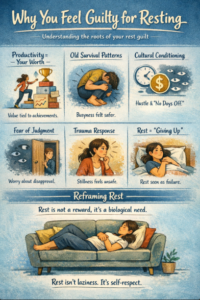
Why You Feel Safe With Someone but Still Fear Commitment

You feel calm around them.
You are softening your body, not holding it together.
Your nervous system does not over drive.
You do not have to act like you are yourself, you do not have to pretend, do not have to think carefully before saying the words so as to remain accepted.

The relationship is easy. Silence doesn’t feel awkward. Presence feels grounding.

And yet, as the relationship is flowing in the direction of commitment: labels, future planning, emotional permanence, there is a feeling deep within you that is pulling away. Not in a dramatic but in a timorous way. A tightening in the chest. A sudden urge for distance. An idea which is incompletely elaborable: I need space.

This internal conflict is even very perplexing.

Whom can be so safe, and, at the same time, so frightening?

The fact is that such experience is much more widespread than one may care to admit- and has little to do with not liking a person enough, inability to get emotionally involved, lack of depth. It is so frequently the nervous system reacting to a history that it remembers in some way.

Being relaxed around a person is a means that your body is confident in the moment.
Being afraid of commitment is that your body would be in doubt of what would happen in case the moment turns permanent.

To most people, intimacy with time has been succeeded by some form of loss, disappointment or emotional hurts. And as a relationship begins to grow into anything more, the system that had been protecting you takes action once again and slowly drags you back, not to destroy love, but to save you the pain that this system had learned to fear.

It’s not a lack of desire.
A protective pause.

And knowing that difference has the power of transforming your image of yourself and your relationships completely.

Safety and Commitment Are Not the Same to the Nervous System

To feel safe with a person it is as though your body is not under imminent danger. Your muscles are being relaxed, your breath is being huffed up, your nervous system is calmed down to the present moment. One does not have to be on watch, to look around and guard against possible emotional attack.

To be afraid of being committed, though, usually implies that your nervous system has learned to perceive intimacy over the years as a threat. It is not that it is wrong today, but the history of your body has demonstrated to you that whatever is safe today might turn painful later. The promise of sustainability, addiction and emotional vulnerability- and in the case of a trauma-forming nervous system, the promise can cause fear.

To most individuals and most especially to the ones with relational trauma, safety lies in the present. The present seems to be manageable. But dedication is to the future and the future is to remember loss, abandonment, emotional uncertainty or betrayal. And you may say in your head, This man is good. this is well, says your body, What happens when you are fixed?

This is why fear may also manifest itself in safe, loving relationships. It is not about the individual opposite you, it is a record of what has been locked up under the conscious mind.

The mind is forgetful of what your body will recall.
And it is not responding to logic, but to the habits of surviving that it had learnt long before.

When Safety Was Once Conditional

In case your background was such that love was not always there, conditional, emotionally intermittent, or was followed by abandonment, criticism, or neglect, your nervous system was taught a valuable lesson that connection was not to be trusted.

It had also learned that without warning one could have love taken away.
Pain may come after that intimacy.
Clinging was to be at risk of loss or hurt of feeling.

So your body adapted. It aroused the alertness, self-defensive and suspiciousness towards protracted intimacy. Although love may be good at that time, your nervous system will remain on alert of what is yet to happen. It is not pessimism it is experience-conditioned survival intelligence.

This may manifest itself in form of being safe with someone as an adult but not able to commit fully. Your head might desire intimacy, but your body is recalling the moment when love was something that had its consequences. To cause a distance, or hesitation, or doubt,–not to destroy happiness, but in order that a sort of hurt familiarity might be averted.

What you previously used to survive with, now presents itself as fear.
And knowing this is the initial healing of it.

Connection is good–but never lasts.

Thus, when a relationship begins to become more serious, the body is ready to be hit- even in case the individual is gentle.

This isn’t self-sabotage.
It is self-defense through experience.

Fear of Commitment Is Often Fear of Loss

It is not the fear of commitment that many people have.
They are afraid of commitment as it used to be.

They are afraid of relying on someone and be betrayed when that support runs out.
They are afraid to open up to others only to find themselves abandoned after they are completely observed.
They are afraid of losing their independence, reducing their demands, scopes or selfhood in order to preserve a relationship.
They are afraid of repeating some emotional trauma they had endured in the past without knowing it.

Commitment requires a faith in the continuity: the faith that care will be there, that relationship will no longer break down, that affection will be drawn away when it is most needed. Trauma disrupts this belief. It reminds the nervous system that nothing is ever to be expected particularly people.

Even in the safe, stable, and gentle relationships, the nervous system can remain sensitive. It does not respond to reassurances as such, but it responds to regularities acquired with time. And with devotion comes the murmuring question, the accustomed, a reassuring question:

What happens in the case I become attached and it gets hurty again?

This question does not indicate the rejection of love.
It is a resonance of a wound that is not yet healed that this may be the case.

Emotional Safety Can Feel Boring to a Trauma-Wired Brain

When disorder was a natural part of childhood, order may be alien even disturbing.

And once your early relationships were characterized by uncertainty, emotional ups and downs or continuous tension, what your brain came to know was intensity as connection. Love was emphatic, desperate, or emotional. Adrenaline, anxiety and hypervigilance turned accordingly to be attachment signals.

Stability, however, lacked an explicit point of reference. In case a relationship seems stable, dignified, and emotionally secure, your nervous system might not and cannot respond as it used to learn about love. It has the comfort, but not the hurry. Safety, but not the spike.

This discongruence might produce guilt and framing doubt:
Why should I be drawing out of a person who does me well?
“What’s wrong with me?”

Nothing is wrong with you.

The lack of disorder does not imply the lack of contact. It is an experience of novelty to your nervous system. It is the education that love does not need to be passionate so that it is real, and that being quiet does not mean being dangerous or dull.

It is not an absence of love, it is just a nervous system getting used to a new language, the language where there is peace instead of survival, safety instead of fear.

Commitment Means Being Seen Long-Term

Dedication does not consist of picking a person.
It is being comfortable to be known- day in day out, in depth, and with time.

This type of intimacy is intensely revealing to those who have been conditioned to survive by remaining emotionally closed/low maintenance or by not having needs. Being seen in their entirety may become a danger instead of a relief when your safety previously relied on not demanding much, not occupying space, and not being dependent.

Independence in such situations was not a personality characteristic, it was defense. The needs were reduced to prevent disappointment. All the emotions were kept private to avoid repulsion. When commitment is the call to collective vulnerability, emotional dependence, long-lasting presence, then the nervous system will rebel.

Safety now seems manageable. You can appear, unite, love and then withdraw back into you. However, having your vulnerabilities, gaps, and needs noticed over time can be horrifying. It implies remaining open without knowing the consistency with which you will be received.

This is not the fear of not wanting to be close.
It is the part of knowing, of knowledge, learning to know that being well-known does not necessarily mean being wounded.

Healing Isn’t Forcing Yourself to Commit

Healing does not involve forced relationships; it does not involve committed relationships just to show that you are growing. Stress can only inform the nervous system that intimacy entails submergence.

Healing is knowing your styles of attachment- not judging them as being dysfunctional but realizing that they were your survival mechanisms in the past. It is to hear with interest rather than pounce judgment on fear and letting it tell you everything without giving it the last word.

It implies training to be able to tolerate proximity over time: remaining longer, revealing more, noticing that it is possible to feel safe without needing to withdraw. This is not a rush process, since trust is developed by repetitions of consistency.

Most of all, the healing is in establishing security within yourself and not solely putting the responsibility of security on any other human being. When you discover how to self-calm, establish limits and respect your pace, relationships cease to be a challenge to your sense of self-sufficiency.

There is no need to hurry to make a commitment to show that you are healed.
The process of healing involves the choice of your own pace.

You Are Not Broken for Wanting Safety and Space

It is possible to care about a person and have time.
Can be safe and be scared at the same time.
You might desire to love so much, but you are not prepared to commit it.

These experiences are not contradictions–they are indications. They are the manifestations of a nervous system striving to adjust the desire to connect with a conditioned necessity to protect.

The fear of commitment is not something bad or wrong. It’s information. It narrates an account of how propinquity once charged you and how your flesh remains to protect against. This fear does not necessarily have to turn into avoidance as long as it is approached with compassion rather than judgment, both towards yourself, and towards others. It can soften.

Fear starts to slip its knots with time, patience, comprehension, and repeated experiences of safety. Not a single time, but gradually, in the ways that are bearable and natural.

Since it is not about forcing yourself to be there and going beyond your capabilities.
The idea is to train your nervous system to relax, every time, it is possible to remain safe.

Frequently Asked Questions (FAQ)

1. Am I emotionally safe enough to be afraid of commitment?

Yes. Present moment emotional safety and fear of long term attachment may coincide particularly when the nervous system links long term proximity to previous pain.

2. Does commitment phobia imply that I do not love the individual enough?

No. The fear to commit is usually based on self-defense, rather than on absence of love or interest.

3. Are attachment styles connected with fear of commitment?

Yes. It is typically linked to avoidant or fearful-avoidant attachment patterns that were developed in the early relationships.

4. Why will commitment cause anxiety even in healthy relationships?

Since commitment is a form of future vulnerability, dependency, and emotional exposure, which can be marked off as unsafe by trauma.

5. Does childhood experience influence adult commitment phobias?

Absolutely. The inconsistency, conditional, or unpredictable caregiving has a significant effect on the response of the nervous system to proximity in adulthood.

6. Why is it so that calm is even dull or even uncomfortable?

When chaos was a childhood way of life then the brain can equate intensity with love and confuse stillness with emotional distance or danger.

7. Does this mean that they are emotionally unavailable?

Not necessarily. Most individuals afraid of commitment are emotionally rich and loving but apprehensive because of the wounds in relationships in the past.

8. Is there something that can be done to overcome fear of commitment?

Yes. Fear can be managed by using trauma-informed therapy, attachment-based therapy, and somatic approaches to establish relational safety.

9. Am I obliged to make myself get over the fear?

No. Coerced commitment may cause more distress of the nervous system. The healing process occurs through consensual intimacy.

10. What do I do when I am not sure that my fear is intuitition or trauma?

The emotion of intuition is so peaceful and serene; the fear caused by trauma is so pressing, disorienting, and connected to the past and not to the facts on the ground.

11. Is fears of commitment manifested strictly after relationships get serious?

Yes. Most find it okay to date casually but find it tricky when emotional permanence or planning of future is introduced.

12. Does it require space so that I will never be able to commit?

No. Requirement of space usually implies that your system is self-regulating. Safety and awareness can make capacity to commit increase.

13. Is it possible that a supportive partner would help decrease this fear?

Yes–but the partner cannot be depended upon alone in the work. In-house safety and self-regulation are a necessity.

14. Is commitment phobia here to stay?

No. It is an acquired reaction, not a personality. As a person heals, the nervous system is able to adapt.

15. What is the purpose of mending the fear to commit?

Not being overbearing to remain, but teaching your nervous system to allow intimacy to be safe with time.

Written by Baishakhi Das

Counselor | Mental Health Practitioner
B.Sc, M.Sc, PG Diploma in Counseling


References 

Attached – Amir Levine & Rachel Heller
https://www.attachedbook.com

  1. The Body Keeps the Score – Dr. Bessel van der Kolk
    https://www.besselvanderkolk.com/resources

  2. Polyvagal Theory – Dr. Stephen Porges
    https://www.polyvagalinstitute.org

  3. Adult Attachment Theory – Psychology Today
    https://www.psychologytoday.com/us/basics/attachment

  4. Trauma and the Nervous System – NICABM
    https://www.nicabm.com

  5. Somatic Experiencing – Peter A. Levine
    https://traumahealing.org

  6. Why You Feel Guilty for Resting

This topic performs well due to rising searches around men’s mental health, workplace stress, and burnout recovery. Combining emotional insight with practical steps increases engagement and trust.

Why You Feel Guilty for Resting

You finally sit down. The work is paused. Your body asks for stillness.
And then—guilt arrives.

It doesn’t come loudly. It creepily creeps in being nearly responsible, like it is being motivated. A tightness in your chest. A restlessness in your hands. There is a faint desire to look into your phone, organize something, be useful once again.

There is a hushed voice that says: You ought to be doing something.
Another says: you have not yet deserved this.
Soon rest ceases to be a care, and begins to be an error.

You look through to-do lists that cannot be seen. Your flesh does not permit to rest. You even stand up in stillness–you are stiffening–you are waiting to be judged–you are waiting.

This is not a personal vice of guilt. It’s learned.

It was taught when rest was disregarded, discouraged or only permitted when fatigued. Where productivity equaled acceptance and slacking equaled lagging. Your nervous system eventually internalized a belief: you should not rest unless you have a reason to.

And then when you stop, your body will feel as though you are violating some unspoken rule. The guilt does not lie in the fact that you are lazy but rather because you were trained to associate the value with performance.

Rest didn’t fail you.
You have been taught to distrust it.

1. Productivity Was Tied to Your Worth

Most of us grew up in such circumstances where we received praise only when we have achieved something, rather than when we are present. Love was conditional-it was when you did something right, acted like an adult and when you met expectations. Useful, responsible, capable, you were appreciated. Being there, lying down, or being a patient hardly ever received equal warmth.

It was the results that made Rest popular.

Gradually, mute, your system was taking a lesson it still studies to-day:
When I fail to be productive, then I am not safe. Provided that I am not performing, I am not appreciated.

This was not a belief that had been developed through logic, it was developed through repetition. By taking chances when doing more resulted in less criticism. When being fatigued was rejected. When it became dangerous to slow down since it could result in disappointment, withdrawal, or shame.

And this way, you no longer sleep knowing that it is something safe to your body.
It interprets it as danger.

Your heart races. Your mind searches for tasks. Guilt is raised, not that rest is evil, but that inertia is against the survival tactic that used to serve your defense.

And it is not a malfunctioning of your body.
It’s remembering.

2. Rest Triggers Old Survival Patterns

To individuals, who had grown up in changeable or emotionally taxing conditions, being busy was not a choice, it was a means to survive. Being busy implied having to be on the alert. Acting in a certain way; in any way, it gave some degree of control over the circumstances where not much could be controlled. Movement meant vigilance. Busyness meant readiness.

In such places, it may feel unsafe to slack. There was tension left by silence. Silentness increased the intensity of feelings. Thus the body got used to being in a state of motion, as motion was more comfortable than rest.

Rest removes distraction.
It deprives it of the doing it is always doing that keeps deeper feelings at bay.
And in case the body eventually slows down what has been put on hold finally starts to emerge, grief, fear, anger, loneliness, unmet needs.

That is why rest may seem oppressive rather than relaxing.

Conscience usually comes to the rescue in the form of guilt. It draws you out of doing nothing, back to familiarity. Higher is the fear which lurks beneath that guilt:
When I take a break, something will overtake me.
A memory. A feeling. One thing you did not even have room to withhold at the time.

Your body is not against taking rest the reason is that it is not broken.
It is fighting against it because rest used to imply exposure-unsafely.

3. Capitalism Trained You to Ignore Your Body

Our culture is the one which glorifies fatigue. Hustle is praised. Burnout is the trophy of pride. Busyness is synonymous with importance, commitments, worthiness. Rest, however, is treated with suspicion, which can only be permitted in case it can be justified, optimized, or transformed into a better productivity in the future.

This framing silently redefines our relationship with ourselves.

It teaches a folly involving danger:
your body is no guide, but a hindrance.
There was something to get at, to conquer, to smother.

Fatigue becomes weakness. To make it slow is to make failures. Listening to the end is like running in a race which has no finish line.

And when your body wants to rest, with its heaviness and headaches, loss of concentration, emotional bombardment, your mind does not listen to it and say it is wisdom. It hears it as a flaw. And it responds with shame.

You say yourself that you ought to be stronger. More disciplined. More motivated. You overrule the signal and not respect it.

But it is your body that is betraying you.
It’s communicating.

And the embarrassment you experience is not an indication that you are doing something wrong, it is rather a sign of a culture that trained you to feel distrust of your needs.

4. You Learned to Anticipate Judgment

Most people sleep even when nobody is around just in case someone may come in and frown on them. Your muscles remain half-corded, your brain on the alert, as though you had to protect your sleep at any hour. You are not entirely at ease you keep watch of yourself.

This is internalized policing.

After some time, the voices of parents, teachers, bosses, and the society move in. You have no longer to rely on external pressure; it is in you. Before it occurs, you expect to be judged. You put yourself in the right beforehand. You hurry your sleep, excuse it or make it take a pass.

In a sense even solitude is performative, something that you can only do under specific circumstances.

It is not really the guilt over rest.
It concerns the perceived outcomes of being caught taking a break.

Being labeled lazy. Irresponsible. Ungrateful. Falling behind. Losing approval. Losing worth.

Your nervous system got to know that visibility and rest is the same as risk. So the guilt comes in and tells you to go back into the world of productivity where you are safe being approved.

Nothing is wrong with you.
You are reacting to rules which have been written when you were still young.

5. Rest Feels Unsafe When You’re Trauma-Conditioned

Controlled nervous system will enable rest to be nourishing. Stillness is a feeling of ease in that state. The body is able to relax without fear and the rest does not disturb but invigorates.

The manifestation of dysregulated nervous system stillness is extremely different. Having clustering to be formed by a chronic stress, unpredictability or emotional danger, calm does not feel safe, it feels alien. And unaccustomed, to the nervous system, is often dangerous.

Rest may be very uncomfortable in case you use your system to fight, fly or freeze. The quiet is too loud. It is the slackening that is exposing. Your body will remain on edge anticipating the next thing that will go wrong.

Guilt comes in to play in such situations as a form of coping. It creates urgency. It starts you again into action, into action, into habits of doing, into habits of acting, which even when they are wearying are familiar. Motion is safer than inactivity since it is the way your nervous system is accustomed to.

This is not a deficiency in discipline or attentiveness.
It is a nervous system doing just what it had been trained to do to survive.

Not by trying to make yourself relax does Rest become healing; but gradually by degrees your body is learning that motion is not again a threat.

6. You Confuse Rest with Giving Up

Most individuals assume that rest involves ceasing to be- no longer to move forward, to become out-of-shape, to become so old-fashioned or obsolete. Rest becomes confused when he starts giving up and assumes that slowing down entails that one will never get going again.

But rest is not quitting.
It’s repair.

It is rest that enables the stretched muscles, overstrained minds and exhausted nervous systems to adjust. It is not the contrary of effort, but it is that which makes effort possible.

Effort is gradually consumed without rest. You continue, yet more blurred, less tolerant, less good. What once was meaningful becomes encumbrant. Burnout does not come in one moment, it comes gradually in the lack of rest.

Through rest, labor becomes long-term. You come back with greater capacity not by having forcibly imposed yourself but by having given yourself rest. Creativity resurfaces. Focus sharpens. Motivation is not pressurizing but rather a choice.

Rest does not deprive you of something.
It returns to you all that constant doing wears.

By resting you do not end up behind.
You disintegrate by never giving up.

Reframing Rest

You do not work to get rest.
Neither is a reward after surviving or work.
Is a biological need, and as fundamental as breathing, hydration, and safety.

There is no need to have your body take leave. It does not ask you to demonstrate that you have done enough, toiled enough, and donated enough. The fact that one needs a rest is not a sign of moral incompetence, it is a physiological indicator.

You do not have to explain it to someone.
No need to tell you why you are tired.
You do not have to make rest out of self-improvement or efficiency.

Nor do you at all have to be entirely shattered to have a right to it.

You can only learn that it is too late to take care of your body. It is gentleness, consistent, which makes one strong, not weak, which Rest has proposed before.

You may have a break with no excuse.
Granted the liberty to be pitifully tired.

Rest is not indulgence.
It is the self-respect in its most elementary form.

A Gentle Reminder

Feeling guilty about taking a break does not imply that you do not have discipline and motivation. It implies that you were conditioned, either directly or indirectly, to disown yourself so that you can fit in. To conquer your needs, forget about your constriction and continue running even when your body wanted you to quit.

You had heard that the approval was gained by forcing through. That care was conditional. The reason of such pausing must have been.

The process of healing commences with breaking the pattern.

When you can afford to rest–no excuse, no reasons, no conversion of rest to productive employment. When you stick with the pain to demonstrate to your body that nothing horrible occurs when you pursue yourself.

This is not easy work. It is contrary to years of conditioning. However, at every moment of permitted rest the message which your nervous system carries is rewritten.

Because rest isn’t laziness.
It isn’t weakness.
Isn’t it failure.

Rest is self-respect.

Frequently Asked Questions (FAQ)

1. Why do I feel guilty where I know I have to have rest?

Guilt is learnt, not logical. The nervous system of your body can possibly relate rest to danger, judgment, or losing value because of earlier conditioning.

2. Does being guilty of resting make one lazy?

No. Laziness is more of a moral than a psychological diagnosis. Guilt around rest tends to be an indication of chronic stress, trauma conditioning, or self-worth that is based on productivity.

3. Would childhood experiences have any implication on my rest as an adult?

Yes. Childhood experiences define brain reaction. In case of insecurity, lack of attention, or disapproval, even though you were not resting, your body can still have a response of protection by remaining still.

4. And why sometimes will rest make me anxious?

Rest removes distractions. When the body goes slow, they can bring forward repressed emotions and thoughts causing anxiety rather than relief.

5. What does being internalized surveillance mean?

It is when the outer authority (parents, teachers, bosses, society) is internalized. You spy and evaluate yourself even in the absence of a person.

6. What does the hustle culture do to rest guilt?

Hustle culture puts the value of productivity equal to the value of worth and makes burnout a matter of course that people should learn to view rest as a sign of weakness unless it increases output.

7. Do you really need rest to be mentally healthy?

Yes. The nervous system, emotional processing, cognitive enhancement, burnout and depression prevention are under the control of Rest.

8. Why do I not feel safe in my immobility?

An unregulated nervous system can perceive calmness as a new experience. Stillness may be an intimidator in case of your body is trained to fight, fly or freeze.

9. Is guilt a coping mechanism?

Often, yes. The feeling of guilt may force you to resume doing what you are doing because of emotional exposure, uncertainty and the old memories that are awakened when you take a break.

10. Will taking a break make me demotivated and undisciplined?

No. Rest is a proponent of sustainable motivation. Devoid of rest, discipline becomes depletion and burnout.

11. What is the difference between rest and avoidance?

Rest is deliberate recovery. Avoidance is the evading of responsibility. Trauma-informed rest restores the capacity and not diminishes it.

12. Is it possible to treat rest guilt without treatment?

Others are able to do so through awareness, practices of regulating the nervous system and through self-compassion. This process can be fastened and intensified with the help of therapy.

13. What does rest find to be safer?

Start small. Pausing, grounding activities, routine habits, and self- affirming self-talk re-train the nervous system.

14. How come I need to earn my rest?

Since most systems are encouraging performance, and not humanity. You had been taught that rest must be justified and not as a need to be respected.

15. What is my main point which I should keep in mind?

Rest is not a reward.
Is not laziness.

Rest is self-respect.

Written by Baishakhi Das

Counselor | Mental Health Practitioner
B.Sc, M.Sc, PG Diploma in Counseling


References 

  1. van der Kolk, B.The Body Keeps the Score
    https://www.besselvanderkolk.com/resources/the-body-keeps-the-score

  2. Polyvagal Theory (Stephen Porges) – Nervous system regulation
    https://www.polyvagalinstitute.org

  3. American Psychological Association (APA) – Stress & burnout
    https://www.apa.org/topics/stress

  4. World Health Organization (WHO) – Burnout as an occupational phenomenon
    https://www.who.int/news/item/28-05-2019-burn-out-an-occupational-phenomenon

  5. Tricia Hersey (The Nap Ministry) – Rest as resistance
    https://thenapministry.com

  6. Cleveland Clinic – Effects of chronic stress on the body
    https://health.clevelandclinic.org/effects-of-stress-on-the-body

  7. Procrastination Nobody Talks About

This topic performs well due to rising searches around men’s mental health, workplace stress, and burnout recovery. Combining emotional insight with practical steps increases engagement and trust.

Procrastination Nobody Talks About

The majority believes that procrastination is a matter of laziness, time wastage or lack of discipline.
It isn’t.

In the case that it is just a productivity problem, such tips as planners, reminders, deadlines, or just try harder will fix all the problems. But to most individuals, those tools do not work- or they do work temporarily and then fail thereafter. The reason is that procrastination is typically quite unrelated to effort and everything to do with brain perceptions of discomfort.

Procrastination is not much of a product issue.
It is much more commonly an emotional regulation issue- and that is what no one speaks about.

When a task elicits unpleasant feelings such as anxiety, self doubt, fear of failure, fear of being judged or even fear of success, the mind seeks a quick fix. Putting the task off will decrease that emotional agony in the present, although it will lead to increased stress in the future. Psychologically, procrastination is not a vice; it is a form of coping mechanism.

That is, individuals do not procrastinate because it does not matter to them.
Their indecisiveness is due to the emotional insecurity of care.

No disciplining, motivating, time-management tips would bring any permanent change before that emotional layer is figured out and dealt with.

Procrastination Is an Emotional Avoidance Strategy

Procrastination is not about being at its most fundamental level, avoiding work.
It is about evading uncomfortable states of being in the inside.

When something makes one fearful of failure, fearful of success, self-doubting, feeling of shame, perfectionism, or overwhelmedness the experience itself is not just cognitive, but emotional and physiological. The body clams up, the mind gets clamorous and the task begins to seem heavier than it is. At that point, it is not the brain that concentrates on long-term consequences; it focuses on emotional safety.

There the brain finds reprieve.

Procrastination offers that relief, at least in the short run, by assisting the individual to avoid the uncomfortable feeling that is the task. Avoidance helps to decrease the anxiety in the short-run which trains the brain that postponing is effective. This is the reason why it may be oddly satisfying to procrastinate, although it will bring you stress in the future.

It is not something by chance, or even careless, to scroll on the phone, to clean the house, to sleep, to organize or to do something that is perceived as easier. These behaviors are foreseeable, common and lower-risk in terms of their nature. They relax the nervous system and make one feel in control. Psychologically, they act as self-comforting actions.

What is actually going on is a calculation of the nervous system:
This is something not quite comfortable at present. How can I make it stop?”

The solution lies in evading- not that the individual lacks discipline, but rather it is the brain that is opting to be comfortable in the present by not pursuing long-term objectives, which may involve short-term emotional discomfort. The process will still feel unsafe of initially commencing, regardless of the significance or importance of the goal, until the emotional charge surrounding the task is lessened.

.

The Nervous System’s Role (Not Willpower)

When something is perceived to be a threat, it is not perceived as a neutral activity in the brain, but rather as a stressor. Although the danger is not physical, the nervous system still reacts with a sense of something significant being endangered: self-esteem, safety, acceptance, and ability. This automatically triggers the threat system of the brain which is commonly referred to as the fight, flight or freeze system.

During a fight response, the individual can seem prolific on the surface, via over planning, fixation on details, re-writing and re-writing, or attempting to manipulate all the results. It is not done due to clarity, but due to anxiety and the necessity to avoid making mistakes.

The system is displaced in the direction of the source of discomfort in a flight response. This appears as avoidance, distraction, procrastination or continually delaying the task till later on. Similar to complete relief on the distance.

When there is a freeze response, the system fails. The individual might be in a given state of being stuck, blank in the mind, numb or cannot get moving even when the individual desires. This has commonly been confused as laziness whereas it is the overload of the nervous system.

Most frequently procrastination is as a result of freeze or flight rather than the absence of a motivation or interest. In reality, individuals would delay most activities that they do when they are concerned with them.

That is why it is not easy to force oneself to say just do it. When the nervous system is not regulated, the brain is not able to reach the part of the brain required to think, plan, and make decisions in order to act. Motivation should not be preceded by calm, but the reverse.

Perfectionism: The Socially Accepted Form of Procrastination

Perfectionism does not postpone work as standards are great.
It postpones work as self-worth is pegged on performance.

Achievement becomes a part of identity and any work becomes a mute measure of worth. When one does something badly, it does not really seem like a typical mistake but rather a failure in person. It is dangerous to begin in that emotional scenario. The mind is taught that it is not safer to start out, than to start out bad.

In case the state of doing badly is not emotionally safe, the brain delays the action.

This is the reason why perfectionistic procrastination always sounds logical on the surface. It hides evading in the pretext of preparation, high standards or responsibility.

Examples of common perfectionistic procrastination thoughts are:

When I am not capable of doing it perfectly, then I should not do it yet.

  • “I need to feel ready first.”
  • I will begin when I get my head straight.

These thoughts develop the illusion that the self would be confident, calm and completely prepared in the future. But that is not often the case, since clarity and confidence tend to follow the initiation, rather than precede it.

By doing this, readiness turns into a psychological illusion, that is, the readiness that helps to justify avoidance and protect an individual against the risk of failing to achieve something, appearing to be seen, and possibly failure.

Procrastination and Shame Cycles

The little known fact is that procrastination becomes a self-perpetuating psychological cycle, with each recurrence making it increased with time.

First, the task is delayed. Short-term relief is achieved by eliminating the immediate discomfort. But that relief doesn’t last. Very soon, the feeling of guilt and shame starts starting to appear: I should have done this already, why I cannot simply get myself together?

This leads to self-criticism. Rather than approaching the task, the mind goes in and assaults the self:
“What’s wrong with me?”
Everybody is able to cope, why not me?

Such ideas enhance emotional suffering further. There is increased anxiety, loss of self-confidence and the task has become heavier than previously. In a bid to get out of this heightened uncomfortable situation, the nervous system opts once more to avoid it, this time procrastination emerges as the escape mechanism.

The task in itself changes psychologically over time. It ceases to be merely work, but it begins to possess an emotional tint: shame, dread and self-distrust. It is no longer a task but rather an emotional meaning behind it.

That is why it is more difficult to start the later.
Not that you are not as good as you once were, but that the job now symbolizes all that you have been telling yourself about your value, discipline and skills.

Procrastination Can Be a Learned Survival Response

To most individuals, the problem of procrastination did not start at the adult stage, but earlier.

When you were raised in a place where mistakes were corrected instead of punished, expectations were vague or kept changing, you never felt like you were doing enough or doing too much, you never felt as much achievement as it caused you to feel pressure, and your nervous system developed an association, making it think that action causes emotional pain.

In these environments, neutrality was not trying. It was risky.
To be seen was to be criticized.
Errors were an embarrassment, a critique or a denial of favor.

The nervous system became adapted with time. It came to understand that it was safer not to act, not to attempt, or not to take time than to go all the way. Avoidance minimized exposure to emotion. Procrastination was adopted to deal with threat, not intentionally, but automatically.

Therefore when the same emotional stimuli occur later in life like a deadline, a review, a boss, a demanding task the body reacts like it is in that former setting. The reaction of stress takes place without the logic being given a chance to respond.

In this regard, procrastination is not a vice or a deficiency of character.
It is an acquired survival skill- a skill that at one time served the purpose of ensuring emotional safety, but which at present stands in the way of development.

Why Motivation Advice Often Fails

Discipline, routines, rewards and accountability are covered by the majority of productivity advice. These strategies are effective in the eyes of some individuals.

However, their only work is done when there is emotional safety.

As the nervous system becomes relaxed and secure, structure may aid action. The same tools take the form of pressure when it does not. Scripted practices are stifling. Responsibility is embarrassing. Rewards feel undeserved. Punishment becomes self-discipline.

As long as the deeper layers are not addressed, including fear, shame, the self-worth based on performance, and dysregulation of the nervous system, the productivity tools begin to make people exhausted instead of empowered. Every unsuccessful experience strengthens a traumatic thought: I am not a good person when it comes to consistency.

The same belief will create another barrier emotionally, so the succeeding attempt will be more difficult.

It is a more humane and truer fact.

  • You’re not inconsistent.
  • Not unmotivated.
  • You’re not broken.

You are emotionally overcharged–you attempt to operate some mechanism that requires result without having provided security.

What Actually Helps (That Isn’t Talked About Enough)

1. Lower the emotional cost of starting
Don’t ask, “Can I finish this?”
Ask, “Can I tolerate 2 minutes of this?”

2. Separate identity from output
Your worth is not on trial because a task exists.

3. Name the feeling before the task
Instead of forcing action, acknowledge:
“I’m avoiding because I feel anxious / unsure / afraid of messing up.”

Awareness reduces internal threat.

4. Focus on safety, not pressure
Calm precedes action. Not the other way around.

A Reframe Worth Remembering

You are not lazy and that is why you procrastinate.
You delay by procrastination because the mind is attempting to shield you against pain of which it is not yet conscious how to deal.

This is not a logical or intentional protection but an automatic protection. What the brain is engaged in is the best thing it has learned to do; it has minimized emotional suffering, prevented danger, and maintained a feeling of safety. The nervous system focuses on the short-term relief rather than long-term consequences even in cases where avoidance results in long-term stressors.

In this case, procrastination is not a personal failure.
It is communication.

It’s an indicator that something within requires taking care of -fear that has not been called by name, shame that has not been de-fanged, pressure that has not been diffused, expectations that are too weighty to bear by themselves.

Once you begin to see procrastination as a friend and listen to it attentively, then things are different. You do not impose yourself into anything by feeling guilty or punishing yourself but by giving room to knowing and controlling.

And there transformation can be witnessed, not by coercion and embarrassment, but by comfort, understanding, and slow building of confidence in oneself.

Frequently Asked Questions (FAQs)

1. Is being a procrastinator the same as being a lazy person?
No. Laziness means indifference. The cause of procrastination is normally emotional distress, anxiety, or fear- usually with something that is of importance to the individual.

2. Why do I put off on significant jobs?
Due to the fact that important tasks are usually emotional, fear of failure, judgment, or self-worth assessment stimulates the threat system of the brain.

3. Is it possible that anxiety causes procrastination?
Yes. One of the most widespread underlying causes of procrastination is anxiety, in particular, performance anxiety and anxiety-driven avoidance.

4. Is mental health associated with procrastination?
Anxiety, depression, ADHD, perfectionism, and chronic stress are some of the most common disorders that are related to procrastination, which is not a diagnosis.

5. Why does procrastination have a relieving effect?
Avoidance leads to less emotional distress in the short-term, which strengthens the behavior neurologically by learning through relief.

6. Why should it be more difficult the more I take to begin?
Due to the fact that the feeling of guilt, shame, and self-criticism piled up as time passes, making the task emotionally heavier.

7. Are perfectionism and procrastination one and the same thing?
Yes. Perfectionism is known to procrastinate, as errors are not perceived as risky, and self-esteem is linked to success.

8. So why not just be disciplined does not work with me?
The dysregulated nervous system makes discipline interventions ineffective. Sustained action cannot take place without emotional safety.

9. What is the association between the nervous system and procrastination?
Fight, flight, or freeze reactions to perceived emotional threat are often manifested in procrastination.

10. Are childhood experiences able to affect procrastination?
Yes. The early experiences of high criticism, penalties on errors or lack of consistency in expectations can result in avoidance being a safety measure.

11. Is it a deliberate action to procrastinate?
Usually not. It is a safety reaction that is automatic and not a conscious choice.

12. Is action preceded by motivation?
Not always. Emotional regulation often leads to action rather than motivation.

13. What can I do to minimize procrastination, without criticizing myself?
By managing emotional triggers, reducing the pressure to deliver, and focusing on safety instead of productivity.

14. Does procrastination have permanency?
No. After the underlying emotional patterns have been known and controlled, the procrastination can also be greatly minimized.

15. How can procrastination be seen in a kind of manner?
As an indicator, not a defect, of unmet emotional needs or unconquered fear.

Written by Baishakhi Das

Counselor | Mental Health Practitioner
B.Sc, M.Sc, PG Diploma in Counseling


References 

  1. Steel, P. (2007). The Nature of Procrastination: A Meta-Analytic and Theoretical Review.
    Psychological Bulletin
    https://doi.org/10.1037/0033-2909.133.1.65

  2. Sirois, F. M., & Pychyl, T. A. (2013). Procrastination and the Priority of Short-Term Mood Regulation.
    European Review of Social Psychology
    https://doi.org/10.1080/10463283.2013.760835

  3. Pychyl, T. A. (2013). Solving the Procrastination Puzzle.
    Penguin Random House
    https://www.procrastination.ca

  4. Gilbert, P. (2010). Compassion Focused Therapy.
    Routledge
    https://compassionatemind.co.uk

  5. van der Kolk, B. (2014). The Body Keeps the Score.
    Penguin Books
    https://www.besselvanderkolk.com

  6. Sapolsky, R. M. (2004). Why Zebras Don’t Get Ulcers.
    Holt Paperbacks

  7. Brown, B. (2012). Daring Greatly.
    Gotham Books
    https://brenebrown.com

  8. The Cost of Always Being the Strong One

This topic performs well due to rising searches around men’s mental health, workplace stress, and burnout recovery. Combining emotional insight with practical steps increases engagement and trust.

The Cost of Always Being the Strong One

People come to you when everything goes wrong.
You remain composed when things are out of control and even when your own chest is tight.
You are a good listener, able to listen without interruption, a good non-judgemental holder of space, a problem-solver who is quiet enough to have your own feelings on the backburner.

And nobody seems to see when you are tired–because you have perfected concealing it.

It is commonly endorsed as resilience, maturity, or emotional intelligence to be the strong one. Your composure and steadiness is the admiration of people. However, under the admiration, there is an emotional price that is seldom realized. When strength becomes a role rather than a choice, it gradually becomes a burden, a burden that you bear without any more than an expression, without any protest, because that is what you are supposed to bear.

Your own strength, previously your safeguard, and formerly your strength, starts to suck you out. And not because you are weak, but because the greatest nervous system, the strongest system, must rest and have care and be supported.

The Invisible Contract of Strength

Most individuals grow up to be the strong one at a young age not necessarily of their choice, but due to circumstances. Grit was not an option; rather it was a coping mechanism of survival.

  • You learned that you must not cry as it was the reliance of others that demanded you not to cry and express yourself, as it was unsafe or inconvenient.
  • learned to contain emotions, instead of displaying them and turn feelings into something that could be controlled, and not shared.
  • You were taught that you could postpone meeting your needs–sometimes forever–because keeping it together was the first before you put in your clothes.

This gradually leads to the establishment of an unwritten agreement with the world: I will remain calm in order to make other people feel safe.
You are the one that sticks, the one that can be depended on, the one that does not disintegrate at least not before anyone can notice.

With time, strength ceases to be a characteristic one draws and a character one lives within. And identities and those which are founded on survival are difficult to get out of, even when they have begun to cost you, your rest, your tenderness, and your feeling of being taken care of.

Emotional Labor Without Rest

Being the strong one can be doing all the time emotional work, the work that goes unseen, unpaid, and unrecognized.

  • You also control your emotions so that you do not disturb other people and learn to make your pain as insignificant as possible to make their life comfortable.
  • Take on the burden of other people without offloading your own, to be the vessel that holds the unhappy feelings that no one can express.
  • You are the safe haven of the rest of them but you seldom get heard.

Slowly your nervous system is kept in a kind of silent watchfulness–in a permanent state of alertness, in an intermittent state of rest. You are held in position even when you are not in motion, trying to figure out what is going to happen next.

This is not draining you emotionally because you are weak, but this is not the purpose of human beings to shoulder emotional burden alone. Connection is to be two-way. The exhaustion is not a vice when the support is flowing in one way only: it is a biological and emotional phenomenon.

When Support Becomes One-Directional

Powerful individuals are commonly believed to be fine. Their silence is interpreted as the fact that nothing is amiss, and their quietness is perceived as power instead of the struggle.

  • No one, then, looks deep in–enquiries are superficial–asked at all.

  • we are silent, therefore, thinking that it is stable and that we are not talking about pain, that it is not there.
  • Your limits are hardly ever questioned, as it is believed that you can do more, be more, take more.

Gradually, the requesting of assistance can gradually cease to occur, not because the need has been fulfilled, but because it no longer feels necessary to strain others, or because there are times when assistance has come at all when it has been requested. Needs are privatised, expectations are reduced and self-sufficiency is the surest way out.

Isolating emotionally is created gradually, not with a bang, but with a whimper, in the name of being independent. At first sight, it can seem to be strength. On the one hand, it can be rather like being alone with too much to be carried.

The Hidden Grief of the Strong

It is sorrowful to be the strong one–sorrow that is not much spoken, and is seldom named, and has to be borne by the individual.

  • Sorrow in the embrace that you did not have at the time you needed it the most.
  • The sweetness which you had delayed, and said you would sleep by and by, and feel by and by, and be by and by.
  • Sorrow over the weakness you ingested, knowing since you were young that weakness can be neither safe nor desirable to express.

Accomplishing this sadness, there might also be guilt in desiring rest as though fatigue is a personal vice. Shame can be experienced in being tired when you are managing everything. And confusion may come to rest in where nothingness appears despite doing everything and keeping it all together.

But emotional exhaustion is not failure–it is a message. A silent communication of your nervous system requesting you to be noticed, nurtured and given to take a break after carrying too much far too long.

Strength Is Not the Absence of Need

Emotional suppression is not a strength.
It is not being quiet, accepting whatever, or doing it by any means.
Emotional honesty is the real strength and that is the strength to be truthful to what is in your heart.

It is permitting oneself to say, without any explanation or apology:

  • “I’m not okay today.”
  • “need support too.”
  • “I don’t have to earn rest.”

The process of healing starts with strength being loose instead of hard, with stamina being soft as well as strong, with self-reliance allowing connection. You do not need to work hard to earn your safety, when you permit yourself to be grasped, not to grasp others, your nervous system comes to understand that you do not need to work hard to get safety. There are cases when it is just received.

Relearning Balance

When you are the strong, ask yourself–ask him–ask me–ask him:

And when I am not okay, where did I get to know that I always have to be okay?
What will I be when I cease to act out resilience and permit myself to exist?
What do you think it would be like to have that same care, patience and understanding given to me with the same free hand that I so readily dispense to others?

Such questions are not to be answered in a short period. They are entreaties to observe that which has long been carried.

  • Resting does not make you lose your power.
  • Do not shrink into ineptitude by seeking assistance.
  • It is not being a human that disappoints anyone.

Power was not supposed to entail self-abandonment. It was to be combined with tenderness, support and rest.

A Reframe Worth Remembering

You are not so tough in that you can take everything and not break.

You are tough since you evolved-because you studied to live in places where you needed to be strong before you were prepared to be strong.

  • Now you may have something new.
  • Connection over endurance.
  • Support over silence.
  • Power.

When you rest you do not lose your strength. It evolves. It is something that you live on, not something that you pay on.

FAQs

1. Why is it so emotionally exhausting to be the strong one?

Since it is a matter of constant emotional control, personal needs repression, and one-sided aid, exhausting the nervous system in the long run.

2. Does emotional exhaustion mean one is weak?

No. Emotional exhaustion is a biological and mental reaction to the stress and to unmet emotion needs over a long period of time.

3. Why do powerful individuals hardly obtain support?

They are presumed to be fine and that is why other people forget that they need to be cared about and have emotional check-ins.

4. Is there a role of childhood experiences that forms the strong one?

Yes. Strength is taken by many as an early survival tactic in an emotionally unsafe or demanding environment.

5. What is emotional labor?

Emotional labor is the process of controlling emotions – yours and those of other people – to ensure stability, comfort or harmony.

6. What is the impact of emotion suppression on mental health?

It exerts more stress, emotional numbness, anxiety, burnout, and may lead to depression in the long run.

7. Why has it happened that tough individuals are guilty of taking a break?

Since being useful, enduring, or responsible has already associated the self-worth of the person, rest might feel unworthy.

8. What is it like to experience nervous system exhaustion?

Constant fatigue, emotional detachment, irritability, hyper vigilance, inability to relax or being empty.

9. Is it always healthy to be independent?

Not when it covers emotional isolation. The capacity to be assisted is also a part of healthy independence.

10. How can powerful individuals embark on seeking assistance?

Their small steps can help them: first naming their feelings, selective sharing, and reminding themselves that support is not their responsibility.

11. What does it mean by trauma-informed strength?

Power which is flexible, emotional integrity, rest and relationship as opposed to perpetual effort.

12. Do we need therapy among people who are always strong?

Yes. In therapy there is a safe space where suppressed emotions are relieved and learning reciprocal care re-learned.

13. Why is it that being strong causes burnout?

The continuous self-control in the absence of emotional discharge is too much to the mind and body.

14. What is your ratio of strength and softness?

Trying to be vulnerable, demarcating boundaries and providing yourself with the kind of care you provide to others.

15. How do you begin healing the emotional fatigue?

Not being ashamed of feeling tired and allowing yourself to require assistance.

Written by Baishakhi Das

Counselor | Mental Health Practitioner
B.Sc, M.Sc, PG Diploma in Counseling


✅ Reference

  1. American Psychological Association – Stress & Burnout
    https://www.apa.org/topics/stress

  2. National Institute of Mental Health – Coping With Stress
    https://www.nimh.nih.gov/health/topics/stress

  3. Polyvagal Theory & Nervous System Regulation – Dr. Stephen Porges
    https://www.polyvagalinstitute.org

  4. Emotional Labor & Mental Health – Psychology Today
    https://www.psychologytoday.com/us/basics/emotional-labor

  5. Trauma and the Body – Bessel van der Kolk
    https://www.traumaresearchfoundation.org

  6. Feeling Behind “Not Good Enough”

This topic performs well due to rising searches around men’s mental health, workplace stress, and burnout recovery. Combining emotional insight with practical steps increases engagement and trust.
Feeling Behind “Not Good Enough”

It is a silent thought, a thought that hardly a person speaks about at a certain point in life:

“I’m not good enough.”

It does not necessarily come in the form of a theatrical meltdown or a high-volume self-doubting situation. In practice more frequently it creeps in unobtrusively and presents itself as an outwardly productive or responsible behavior. It can present itself as overworking to demonstrate its value, people-pleasing to evade rejection, procrastination because of fear of failure, or a general worry of being found out as a scammer even when it can be seen that it is capable.

Otherwise, this thought is veiled with perfectionism or self-criticism that is initially feels encouraging to you, as it drives you to perform better, exert more, be better. However, as time goes, this internal pressure gradually destroys the self-worth, and in its place, the confidence is substituted with fatigue and the trust in self is substituted with doubt.

The point to note is that, the experience of not being good enough is not an individual failure or character flaw. It is a mental process, a pattern, and in most cases, these patterns were formed in early age and reinforced by experience, relationships and social expectations and misinterpreted as a lack of confidence or competence.

In order to remedy it, we must go beyond outward conduct and self-occurrence and have a look at what is occurring under the surface.

1. “Not Good Enough” Is Rarely About Ability

There are numerous individuals who find themselves battling the sense of incompetence but in actuality, they are capable, intelligent, and emotionally competent. They may possess abilities, competence, and even external authentication, but people feel like they are not good enough. The reason is that it is not often a failure in capability. Rather it is the way the brain has been conditioned to assess safety, belonging and self worth.

Psychologically, competence is not the main concern of the mind. It is preoccupied with survival.

So it doesn’t ask:

  • “Am I capable?”
  • It asks:
  • “Am I safe, accepted, and valued?”

Once the acceptance, particularly during initial relationships, is perceived as conditional, then the brain will start identifying value as performance. Love, approval or attention are something one feels deserved not innate. This builds within it an internal perception that one needs to prove, achieve or live up to expectations in order to be valued.

Subsequently, even competent people can be left constantly feeling under competent not due to their ineptitude, but simply because their nervous system was taught that it is necessary to earn a place by performance.

2. Conditional Love and Early Programming

Among the most potent and the most neglected sources of inadequacy feeling is the conditional validation through childhood. As long as care, love, or emotional security was tied to some behavior, performance or emotional control, then the growing nervous system learned to tie love to performance.

Depended on when love, attention, or praise is required:

  • being well-behaved
  • achieving results
  • meeting expectations
  • not communicating hard, troublesome, and awkward feelings.

the child did not consciously believe that there is something wrong with the environment. Rather the mind evolved by creating a strong internal law:

I am supposed to be worthy when I do something right.

This conviction is not instilled in the mind, but in the nervous-system system. It sets an internal score board that never stops running – it measures behavior, tracks reactions and assesses whether one is doing enough to remain accepted.

The brain still searches to find indicators of approval or disapproval even in adulthood when the original environment is no longer the same:

  • Did I say the right thing?
  • Was I impressive enough?
  • Did I disappoint someone?

This self-monitoring constantly is mistaken with insecurity or having low confidence. Or, more accurately, it is survival learning the system which is created to preserve connection preventing the emotional loss.

3. The Inner Critic Is a Protective Voice, Not an Enemy

That terrible voice within that says:

  • “You should be better.”
  • “Others are ahead of you.”
  • “Don’t mess this up.”

is usually weighted down with misunderstanding. The majority efforts are making it silent, arguing with it or being ashamed to have it at all. Yet psychologically, the critic within did not evolve to your detriment, he evolved to your advantage.

The inner critic develops in early life as a defense against rejection, shame, punishment or failure. It thinks that, through keeping you alert, self-critical and striving at all times, it can assist you to escape emotional pain. To its reasoning, pressure is safety.

In the eyes of the nervous system, criticism is safer than getting taken unawares.

The issue does not lie in the presence of the inner critic. The problem is that:

  • it never renews its strategy.
  • is not aware that things have changed.
  • it knows not when you are now more familiar, more mature, more able.

So it proceeds to push, threaten and squeeze tighter- even after the real threat has passed. What at one time served to sustain your life now holds you in the fear, self-doubt and emotional exhaustion.

The process of healing does not start by fighting with the inner critic, but by knowing the reasons behind why it had learnt to talk that way in the first place.

4. Social Comparison Hijacks the Brain

The contemporary world makes inadequacy feelings significantly heavier with social comparison at all times. Although comparison is a common human behavior, the brain has never been created to handle the magnitude and frequency of occurrence of the act today.

The development of the human brain was such that it was developed to compare itself in small and familiar groups where context, mutual struggle and real life interactions could be seen. To-day however, the brain is expected to compare:

  • your behind-the-scenes life
  • and highlights of other people carefully edited.
  • This disproportion fills the nervous system.

Instead of causing motivation or development, constant comparison leads to the brain turning on the system of threat-detection that uses the same mechanism that identifies danger. When the brain thinks of others as being in front, it fails to give it out as a neutral information. It interprets it as risk.

Comparison results in most cases in lieu of inspiration:

  • shame
  • self-doubt
  • emotional apathy or closure.

A more profound level of interpretation of a fall behind by the brain is that it is a possible loss of belonging. And to a social nervous system, to lose belonging is very unsafe, almost the danger of being killed.

That is why comparison does not only damage confidence; it causes a disturbance in the emotional security.

5. Trauma and Emotional Neglect Amplify the Belief

The second belief is that I am not good enough, which is particularly widespread in the group of people who experienced in their childhood:

emotional neglect

variable or irregular care giving.

chronic criticism

minor nullification of feelings, needs or perceptions.

In such settings, lack of emotional sensitivity usually becomes more harmful than direct injury. When the emotions of the child are disregarded, downplayed, or misinterpreted, the child does not result in concluding that there is something wrong with the caregivers. Rather the growing psyche assimilates a much more agonistic conviction:

“Something about me is wrong.”

This ideology does not stay in childhood. Gradually it becomes incorporated into self-concept the prism through which experiences, relationships, even achievements are perceived. Success feels fragile. Connection feels uncertain. Acceptance feels temporary.

The nervous system is usually on alert even in secure supportive surrounding later in life. It still searches signals of rejection, disapproval, abandonment, not that danger exists, but that it has been taught to expect danger.

This is not oversensitivity. It is the print of a nervous system that is developed under not fulfilled emotional needs, and it is still attempting to defend itself.

6. Why Achievements Don’t Heal the Feeling

Many people carry the belief:

“Once I achieve more, I’ll finally feel enough.”

It is reasonable and even inspirational. However, in practice, success without emotional security does not even cure the sense of inadequacy, it simply does not pay much attention to it.

When success is attained, it may offer temporary relief, confirmation, or power. However, since the belief about the worth is the same, the relief is not permanent. The mind instantly puts the bar higher again, in quest of the next goal, next demonstration, next assurance.

The fundamental dogma is not changed:

  • worth is still conditional
  • rest still feels undeserved
  • success is still so very precarious and can be stolen.

Consequently, even the major achievements can be empty or distressing. Success may create more pressure, rather than confidence, -Now I have to keep it up.

That is why the struggles of many high-achievers are silent:

  • chronic anxiety
  • emotional emptiness
  • imposter syndrome
  • fear of being revealed when there is a show of competency.

Achievement is reduced to a treadmill instead of a fulfillment unless the deeper drive behind safety and unconditional self-worth is met.

7. Healing Begins with Safety, Not Self-Improvement

The postulation of non-goodness cannot be cured by being better, more robust or successful. It is cured being made safer in oneself. Once safety is achieved, it is not necessary to earn self-worth anymore.

Psychological healing does not mean forcing the change, but rather letting it gradually loosen. It involves:

  • the innermost critic being observed without being obeyed as of course.
  • validation of self-correction where self-correction was formerly the rule.
  • value to be divided off performance, productivity or approval.
  • the perfect regulation of the nervous-system, being peacefully constructed by unity and care.

The inner need to repair, demonstrate or defend starts to reduce as the security level rises. There is no longer a need to ensure that the system remains on high alert.

With time, the internal question is automatically changed. Instead of asking:

“How can I fix myself?”

a more profound, more sympathetic question arises:

What went on that taught my system I was not enough?

This reversal redefines everything not due to a problem being solved but because the individual is not being handled as the problem.

8. You Were Never Broken—You Adapted

A sense of being not good enough is not being weak, failure or lacking. It is evidence of adaptation. What your nervous system did was what it was supposed to do, it learned how to survive in a place where safety, love, consistency or validation was not so sure.

The mind also adapted through alertness, self monitoring and protection. Essays like overthinking, perfectionism, people-pleasing or emotional withdrawal were not weaknesses; they were clever reactions to situations which demanded carefulness.

What used to assist you to cope, no longer need be needed at this moment-but that is no fault in it. It only implies that your system has not yet been demonstrated that there is another way of being safe.

and that can be unlearned that had been learned. Awareness rather than self-blame, compassion rather than judgment, support rather than isolation, and these allow the nervous system to update its beliefs progressively.

You were never broken. You adjusted–and the first step towards healing is to be understood.

A Reframe Worth Remembering

You are not feeling insufficient since you are being underprivileged, broken, or lagging.

You are not good enough since your nervous system has been conditioned to believe that being worthy of living means being worthy of survival, and it was taught at a very young age. It discovered that to be accepted, loved, or safe, one had to be on his or her guard, act, or correct himself.

Such a belief could seem very real as it was needed at one time. But necessity is not truth.

and that belief, as powerful and perennial and persuasive as it may be, is not the truth of yourself. It is an acquired reaction, rather than an identity.

The nervous system, with the help of awareness, compassion and safety may learn something new:
that worth is not earned,
conditioned belonging is not,
and you were always enough.

Frequently Asked Questions (FAQs)

1. Why do I feel “not good enough” even when I’m doing well?

Because this feeling is rarely about ability. It is rooted in how your nervous system learned to associate worth with safety, acceptance, or performance—often early in life.

2. Is feeling “not good enough” a sign of low self-esteem?

Not always. Many people with this feeling are capable and confident in skills but struggle with conditional self-worth, not low ability.

3. Can childhood experiences really affect adult self-worth?

Yes. Early emotional environments shape attachment, nervous-system responses, and core beliefs about worth and belonging.

4. What is conditional love in psychology?

Conditional love occurs when affection or approval depends on behavior, achievement, or emotional compliance rather than being freely given.

5. Why does my inner critic feel so harsh?

The inner critic often develops as a protective mechanism to prevent rejection, shame, or failure—not to hurt you.

6. Is the inner critic bad or harmful?

It becomes harmful when it goes unexamined, but originally it formed to keep you safe in emotionally uncertain environments.

7. Why doesn’t success or achievement make me feel enough?

Because achievement doesn’t address the underlying belief that worth must be earned. Without emotional safety, success feels temporary and fragile.

8. Is this related to imposter syndrome?

Yes. Imposter syndrome often emerges from conditional self-worth and fear of losing belonging despite competence.

9. How does social media increase feelings of inadequacy?

It encourages constant comparison between your real life and others’ curated highlights, activating the brain’s threat system.

10. What role does emotional neglect play?

Emotional neglect teaches the child that their feelings don’t matter, often leading to the belief that something is inherently wrong with them.

11. Is this feeling a trauma response?

It can be. Chronic emotional invalidation, criticism, or inconsistency can leave trauma imprints even without obvious abuse.

12. Can this belief be unlearned?

Yes. With awareness, nervous-system regulation, therapy, and self-compassion, these patterns can change.

13. What does “healing through safety” mean?

It means creating internal and external conditions where the nervous system no longer feels threatened—rather than trying to “fix” yourself.

14. Do I need therapy to heal this?

Therapy can be very helpful, especially trauma-informed or attachment-based approaches, but healing can also begin through awareness and supportive relationships.

15. What’s the most important thing to remember?

You were never broken. You adapted. And adaptation can be gently unlearned.

Written by Baishakhi Das

Counselor | Mental Health Practitioner
B.Sc, M.Sc, PG Diploma in Counseling

References 

  1. Bessel van der KolkThe Body Keeps the Score
    https://www.besselvanderkolk.com/resources/the-body-keeps-the-score

  2. John Bowlby – Attachment Theory Overview
    https://www.simplypsychology.org/attachment.html

  3. Kristin Neff – Self-Compassion Research
    https://self-compassion.org/the-research/

  4. Pete Walker – Complex PTSD & Inner Critic
    https://www.pete-walker.com/shrinkingInnerCritic.htm

  5. Stephen Porges – Polyvagal Theory
    https://www.polyvagalinstitute.org/whatispolyvagaltheory

  6. APA – Trauma and Stress-Related Disorders
    https://www.apa.org/topics/trauma

Why Your Brain Won’t Stop Replaying Past Conversations

This topic performs well due to rising searches around men’s mental health, workplace stress, and burnout recovery. Combining emotional insight with practical steps increases engagement and trust.

Why Your Brain Won’t Stop Replaying Past Conversations

Have you ever lay in bed or sitting there when suddenly you hear yourself conversing with someone in the past like your previous conversation? Something you said. Something that you wish you could have said. A tone you’re now questioning. The act recurs over and over, but it is not always comfortable, regrettable, or nervous. This is aggravated by the fact that these thoughts normally come when all the other things are silent at night, when you are taking a rest, or when you are supposed to be having a peaceful moment and you find yourself alone with your inner talk.

Such an experience is so widespread–and it does not mean that something is wrong with you. It is an indication that the brain attempts to defend, process and meaning making around social experiences. These moments come back into your mind to find meaning, closure, or reassurance, particularly when a conversation had been emotionally charged or unresolved. Instead of it being a weakness, this replay shows a very human desire to fit in, to be heard, and to feel emotionally secure in all our relationships with other people.

1. The Brain Is Wired for Social Survival

Humans are social beings. Thousands of years ago, being part of a group was the guarantee of protection, safety and existence. Due to this evolutionary output, the brain allocates additional significance to the social engagement, particularly to the ones, which are awkward, emotionally significant, or unbroken. We are in a state of constant scanning of signals to do with approval, denial, and relationship.

The brain is stressed when a conversation is confusing or uncomfortable, which is why it is important. The replaying of it is the manner in which the brain engages in an effort to comprehend and avoid pain in the future in a social context. The questions under the loop are silent, such as:
“Did I say something wrong?”
“Was I misunderstood?”
Will this alter the perception they have of me or change our relationship?

2. Unfinished Emotional Processing

Most of the discussions are cut short before feelings are well worked out. At the moment, you can suppress your emotions to be polite, calm, or emotionally restrained, particularly when you feel you are not safe, inconvenienced or inappropriate to express them. Those emotions are repressed by your body so that you can get through the interaction.

With time when the nervous system ultimately lets go, the emotions that have been repressed start to appear. That is the reason why the mind re-plays the dialogue in the silent times. The replay is not of the words spoken but of the unspoken emotions which were there, linked to the words, ready to be recognized, comprehended, and discharged.

3. Rumination: When Thinking Turns into a Loop

Rereading conversations could slowly degenerate into rumination a mental cycle in which the brain is continually processing the same incident without having a conclusion or a relief. This repetitive thinking can be a cause of more emotional distress instead of relief. Rumination usually presents itself in association with:

Anxiety
Low self-esteem
A history of trauma
Perfectionism

The mind continues to spin around the same thoughts appearing to replay details and imagine different solutions and events, hoping that at some point the explanation or relief will suddenly come. Sadly enough, this loop is not always answered, the loop only extends the emotional distress.

4. The Inner Critic Takes Over

In these mental acting games, most individuals become cruel and critical to themselves:

“Why did I say that?”
“I sounded stupid.”
“They must think badly of me.”

There is nothing true about this inner critic the criticism is based on the fear. It is attempting to shield you against rejection or embarrassment that might come later, although it is a painful way. This voice frequently expresses historical experiences in which a person was probably criticized, shamed, or punished instead of being patient and understanding. In the course of time, the mind gets to condition itself to pre-erect self, with the hope that the self-criticism will help to stop the external criticism, although it does not necessarily do good.

5. The Nervous System and the “Threat Response”

Psychologically, it is common to relate the re-enactment of conversations to the nervous system being in a high level of alertness. Your system, when subjected to any kind of emotional threat (rejection, conflict, embarrassment, or disapproval), finds it hard to settle down and achieve a relaxed, controlled state. The body and mind remains alert even after the scenario has been experienced.

In reaction the brain re-plays the situation, trying to theorize it and avoid such an emotional injury in future. This circularity is not meant to happen–this is survival by default because the human mind needs to feel safe and secure.

6. Trauma and Emotional Memory

In the case of persons who suffered emotional or relationship trauma, the replays may run deeper. The previous experiences of misunderstanding, being criticized, dismissed, or feeling unsafe may be triggered by old conversations. When this happens it does not mean the mind is reacting to the current interaction alone it is reacting to past emotional records.

It is not really a replay of this conversation. It is a question of what the moment will be embodying in its emotional aspect echoing old wounds that are not yet completely healed or recognized.

What Actually Helps

  • Name what you’re feeling, not just what you said
    (e.g., embarrassment, hurt, fear of rejection)
  • Gently interrupt the loop
    Try grounding techniques like slow breathing or noticing physical sensations.
  • Practice self-compassion
    Ask yourself: “What would I say to a friend in this situation?”
  • Accept imperfection
    No conversation is ever flawless. Human connection doesn’t require perfection—only presence.
  • If it’s persistent, therapeutic support can help uncover deeper patterns behind rumination and emotional looping.

A Reframe Worth Remembering

Your mind is not repeating some old discussions to torment or torment you. It is attempting – in many cases clumsy and unsuccessful – to keep you safe, to make sense out of what has occurred, to get you to feel secure and to belong. These emotional circles are the result of a profound human desire to fit in, to be comprehended and not to be hurt emotionally.

When you receive these thoughts with curiosity, not criticism, that is, by asking yourself questions like “What was I feeling?” and not What is wrong with me? the loop starts getting unstuck. Not instantly. Not completely. But gradually, gradually enough to make breathing room in your head.

And in some cases, that pity suffices to allow that dialogue to finally subside and does not have to be repeated to be listened to.

Frequently Asked Questions (FAQ)

1. Why do old conversations replay in my mind?
Because the brain tries to process unresolved emotions, social uncertainty, or perceived threats related to connection and belonging.

2. Is replaying conversations a sign of anxiety?
It can be associated with anxiety, but not everyone who replays conversations has an anxiety disorder.

3. Why does this happen more at night?
At night, distractions reduce and the nervous system slows down, allowing suppressed thoughts and emotions to surface.

4. Is this the same as overthinking?


Yes, it’s a form of overthinking, often linked specifically to social interactions and emotional safety.

5. What is rumination?
Rumination is repetitive thinking about past events without reaching resolution or relief.

6. Can trauma cause conversation replaying?
Yes. Emotional or relational trauma can make the brain more sensitive to social cues and perceived rejection.

7. Why am I so self-critical during these replays?
The inner critic often develops from past experiences where mistakes were judged harshly rather than met with understanding.

8. Do perfectionists replay conversations more?
Yes. Perfectionism increases fear of mistakes and social evaluation, fueling mental loops.

9. Is my brain trying to fix something?
Yes. The brain is attempting to prevent future emotional harm by analyzing past interactions.

10. Does replaying conversations mean I did something wrong?


Not necessarily. Often, it reflects emotional sensitivity rather than actual mistakes.

11. How can I stop replaying conversations?
Gentle grounding, naming emotions, self-compassion, and nervous system regulation help reduce the loop.

12. Should I distract myself when this happens?
Temporary distraction can help, but emotional acknowledgment leads to longer-term relief.

13. Can mindfulness help?
Yes. Mindfulness helps you observe thoughts without getting pulled into them.

14. When should I seek therapy?
If replaying conversations interferes with sleep, work, or emotional well-being, therapy can be helpful.

15. Will this ever stop completely?
The goal isn’t complete elimination but reducing intensity and responding with compassion instead of fear.

Written by Baishakhi Das

Counselor | Mental Health Practitioner
B.Sc, M.Sc, PG Diploma in Counseling


Reference 

This topic performs well due to rising searches around men’s mental health, workplace stress, and burnout recovery. Combining emotional insight with practical steps increases engagement and trust.