During the day, your mind may feel manageable. You stay busy—distracted by work, conversations, responsibilities, and constant stimulation. Activity gives your thoughts direction and structure. But at night, when the world grows quiet and external demands fade, that structure disappears. In the stillness, your thoughts suddenly become louder. Memories replay without warning, worries multiply, and questions you avoided all day begin to surface, one after another. Sleep feels distant—not because your body isn’t tired, but because your mind doesn’t know how to slow down.
Night-time overthinking isn’t a weakness, a bad habit, or a lack of discipline. It’s often a psychological response rooted in how the brain processes stress, safety, and unresolved emotional experiences. When the day ends, your brain finally has the space it didn’t have before—to process what was postponed, suppressed, or emotionally unfinished.
In the absence of distractions, the mind turns inward. Thoughts that were held back by busyness seek resolution. If your nervous system has been under stress, the quiet of night can feel unfamiliar rather than soothing, causing the mind to stay alert instead of restful. Overthinking becomes the brain’s way of trying to protect you—by reviewing, analyzing, and anticipating—especially when it senses uncertainty.
This is why overthinking so often peaks at night. It’s not that your problems suddenly appear after dark. It’s that, for the first time all day, your mind is finally being heard.
1. The Brain Finally Has Space to Process
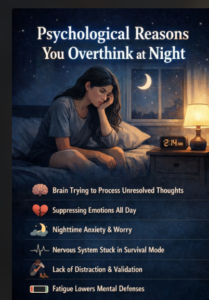
Throughout the day, tasks, conversations, screens, and responsibilities keep your mind externally focused. There is always something demanding attention—something to respond to, fix, or complete. This constant engagement leaves little room for reflection. At night, however, those distractions disappear. The external world quiets, and the brain naturally shifts inward, turning its attention to what has been left unprocessed.
Thoughts you postponed during the day—unresolved conflicts, unexpressed emotions, unfinished decisions, and lingering doubts—finally surface. With no immediate task to anchor your focus, the mind begins to revisit these experiences, searching for meaning or resolution. Overthinking, in this sense, isn’t your mind attacking you or trying to sabotage your rest; it’s your mind asking for attention when there is finally enough silence to listen.
2. Suppressed Emotions Rise When You Slow Down
Many people cope with emotional discomfort by staying busy. Productivity becomes a survival strategy—a way to avoid feeling what hasn’t been processed. During the day, there’s little space to pause, reflect, or emotionally register experiences. But when night arrives and activity slows, the emotional system no longer has distractions to hide behind.
Suppressed emotions such as sadness, fear, guilt, loneliness, or even unacknowledged anger begin to surface. These feelings don’t arrive gently; they emerge all at once because they’ve been waiting. The mind then tries to manage this emotional flood by thinking—analyzing situations, replaying conversations, imagining outcomes, or worrying excessively. Overthinking becomes an attempt to stay in control of emotions that were ignored or postponed during the day.
3. Anxiety Is Louder at Night
Anxiety thrives in uncertainty, and night naturally brings more of it. The environment is quieter, darker, and less predictable. There are fewer external cues of safety—fewer people awake, less activity, and limited immediate reassurance. As a result, the brain becomes more vigilant, scanning for potential threats.
This is why worries often take the form of:
-
“What if something goes wrong?”
-
“if I made the wrong decision?”
-
“What if the future doesn’t work out?”
At night, the mind shifts into anticipatory mode. It tries to protect you by rehearsing possible dangers and preparing for imagined problems. Unfortunately, this hyper-alertness keeps the nervous system activated, making rest feel difficult.
4. The Nervous System Stays in Survival Mode
If you live with chronic stress, unresolved trauma, or long-term emotional responsibility, your nervous system may rarely experience a sense of true safety. Even when your body is physically resting in bed, your internal system may remain on guard.
Overthinking is often a sign that the nervous system hasn’t transitioned from fight-or-flight into rest-and-digest mode. The mind stays active because it doesn’t yet feel safe enough to power down. Instead of settling, it continues monitoring, anticipating, and analyzing—mistaking mental activity for protection.
5. Night Removes External Validation
During the day, interactions and responsibilities provide constant feedback. You’re needed, productive, responsive, and engaged. These external signals help stabilize your sense of self. At night, when those roles pause, that validation disappears.
In the quiet, the mind often turns inward and begins self-evaluating:
- “Am I doing enough?”
- “I falling behind?”
- “Why am I like this?”
Without external reassurance, overthinking fills the emotional gap left by silence. Rather than offering comfort, the mind becomes self-critical, searching for answers to questions rooted in insecurity and self-doubt.
6. Fatigue Weakens Mental Boundaries
As the day wears on, mental and emotional energy declines. When you’re tired, your brain’s ability to regulate and filter thoughts becomes weaker. The internal voice that usually says, this thought isn’t helpful right now, loses strength.
As a result, a single thought can quickly spiral into:
- replaying past mistakes,
- predicting worst-case futures,
- questioning your worth, competence, or choices.
This isn’t over-dramatization or negativity—it’s cognitive fatigue. A tired brain struggles to maintain perspective, making thoughts feel heavier and more convincing than they actually are.
7. Overthinking as a Form of Control
For many people, thinking feels safer than feeling. Emotions can feel unpredictable and overwhelming, while thoughts create a sense of structure. Overthinking offers the illusion of control—the belief that if you analyze enough, anticipate enough, or prepare enough, you can prevent pain.
At night, when control feels limited and vulnerability increases, the mind leans more heavily on thinking as protection. Unfortunately, this strategy often backfires. Instead of reducing distress, it amplifies it—keeping the mind alert and the body tense, long after rest is needed.
Overthinking, then, is not a failure of self-control. It’s a protective response that has stayed active for too long.
Why Telling Yourself “Just Sleep” Doesn’t Work
Overthinking isn’t a switch you can turn off through willpower. It isn’t a bad habit that disappears because you command it to. It’s a signal—one your mind uses to communicate unmet emotional needs such as processing, reassurance, safety, or expression. When these needs go unaddressed, the mind keeps returning to them, especially in the quiet of night.
Telling yourself to “just sleep” often creates internal pressure. Instead of calming the system, it sends the message that your thoughts are a problem to be eliminated. The brain responds by becoming more alert, not less—because unresolved thoughts don’t disappear when they’re ignored.
Trying to silence your thoughts without understanding them often makes them louder. The mind resists being shut down when it feels unheard. Real rest begins not when thoughts are forced away, but when the nervous system feels safe enough to let go—when thoughts are acknowledged, emotions are allowed, and the need beneath the overthinking is gently met.
What Actually Helps With Night-Time Overthinking
Healing doesn’t come from forcing sleep. It comes from helping the nervous system feel safe.
Helpful approaches include:
- Gentle grounding (slow breathing, body awareness)
- Writing down thoughts to release mental load
- Creating a consistent night routine that signals safety
- Allowing emotions without immediately analyzing them
- Therapy to process unresolved emotional patterns
A Gentle Reframe
If you overthink at night, it doesn’t mean you’re broken, weak, or incapable of rest. It means your mind has finally been given space—space it didn’t have during the noise and demands of the day. In that quiet, your inner world begins to speak. What you’re experiencing isn’t a failure of control; it’s a request for understanding.
Your thoughts are not the enemy. They are signals pointing toward emotions, needs, or experiences that haven’t yet been acknowledged. When met with compassion rather than resistance, they soften. When met with control or judgment, they often grow louder.
Rest doesn’t begin when thoughts disappear.
It begins when your mind feels safe enough to let go—safe enough to trust that it doesn’t have to stay alert, analyze everything, or protect you through constant thinking. That sense of safety is built through gentleness, patience, and allowing yourself to be human, even in the quiet of the night.
Frequently Asked Questions (FAQ)
1. Why do I overthink more at night than during the day?
At night, external distractions reduce, giving your mind space to process unresolved thoughts and emotions that were postponed during the day.
2. Is night-time overthinking a sign of anxiety?
Often yes. Anxiety tends to intensify at night due to uncertainty, reduced reassurance, and a heightened sense of vulnerability.
3. Can overthinking at night be linked to trauma?
Yes. Trauma and chronic stress can keep the nervous system in survival mode, making it hard for the mind to fully relax at night.
4. Why does my mind replay past events when I try to sleep?
When the brain is quiet, it revisits unfinished emotional experiences, attempting to process or make sense of them.
5. Does night-time overthinking mean I’m mentally weak?
No. It’s a protective psychological response, not a weakness or lack of discipline.
6. Why doesn’t telling myself to “stop thinking” help?
Because overthinking is a signal, not a switch. Suppressing thoughts often increases mental arousal rather than calming it.
7. Can fatigue make overthinking worse?
Yes. Cognitive fatigue weakens mental boundaries, allowing thoughts to spiral more easily at night.
8. Is overthinking a form of control?
For many people, yes. Thinking can feel safer than feeling, creating an illusion of control over uncertainty or emotional pain.
9. Why do my worries feel more realistic at night?
At night, the brain’s emotional regulation is lower, making thoughts feel more intense and believable.
10. Can suppressed emotions cause night-time overthinking?
Absolutely. Unexpressed emotions often surface when activity slows and the mind turns inward.
11. Does overthinking affect sleep quality?
Yes. It keeps the nervous system activated, making it harder to fall asleep or stay asleep.
12. Can routine help reduce night-time overthinking?
A consistent, calming night routine can signal safety to the nervous system and reduce mental alertness.
13. Is night-time overthinking common?
Very common. Many emotionally aware and high-functioning individuals experience it.
14. When should I seek professional help?
If overthinking regularly disrupts sleep, daily functioning, or emotional wellbeing, therapy can be very helpful.
15. Can night-time overthinking be healed?
Yes. With emotional processing, nervous system regulation, self-compassion, and support, it can significantly reduce over time.
Written by Baishakhi Das
Counselor | Mental Health Practitioner
B.Sc, M.Sc, PG Diploma in Counseling
Research
Understanding rumination and worry (night-time repetitive thinking in anxiety & depression research) — National Institutes of Health (NIH)
The mind after midnight: nighttime wakefulness and cognition — NIH article on how night affects brain activity and sleep processes
Sleep anxiety and its causes — Cleveland Clinic overview on how anxiety and sleep are connected
Why anxiety can be worse at night — Sleep Foundation expert guide on night-time anxiety causes and sleep interference
Circadian rhythms & introspective thought at night — Medium psychological discussion on why the brain becomes more self-referencing after dark
You’re Not Lazy — You’re Emotionally Exhausted
This topic performs well due to rising searches around men’s mental health, workplace stress, and burnout recovery. Combining emotional insight with practical steps increases engagement and trust.