
That moment you hear your name in a noisy room—what made it stand out? Discover the perception processes that filter our world and shape every choice you make.
Introduction
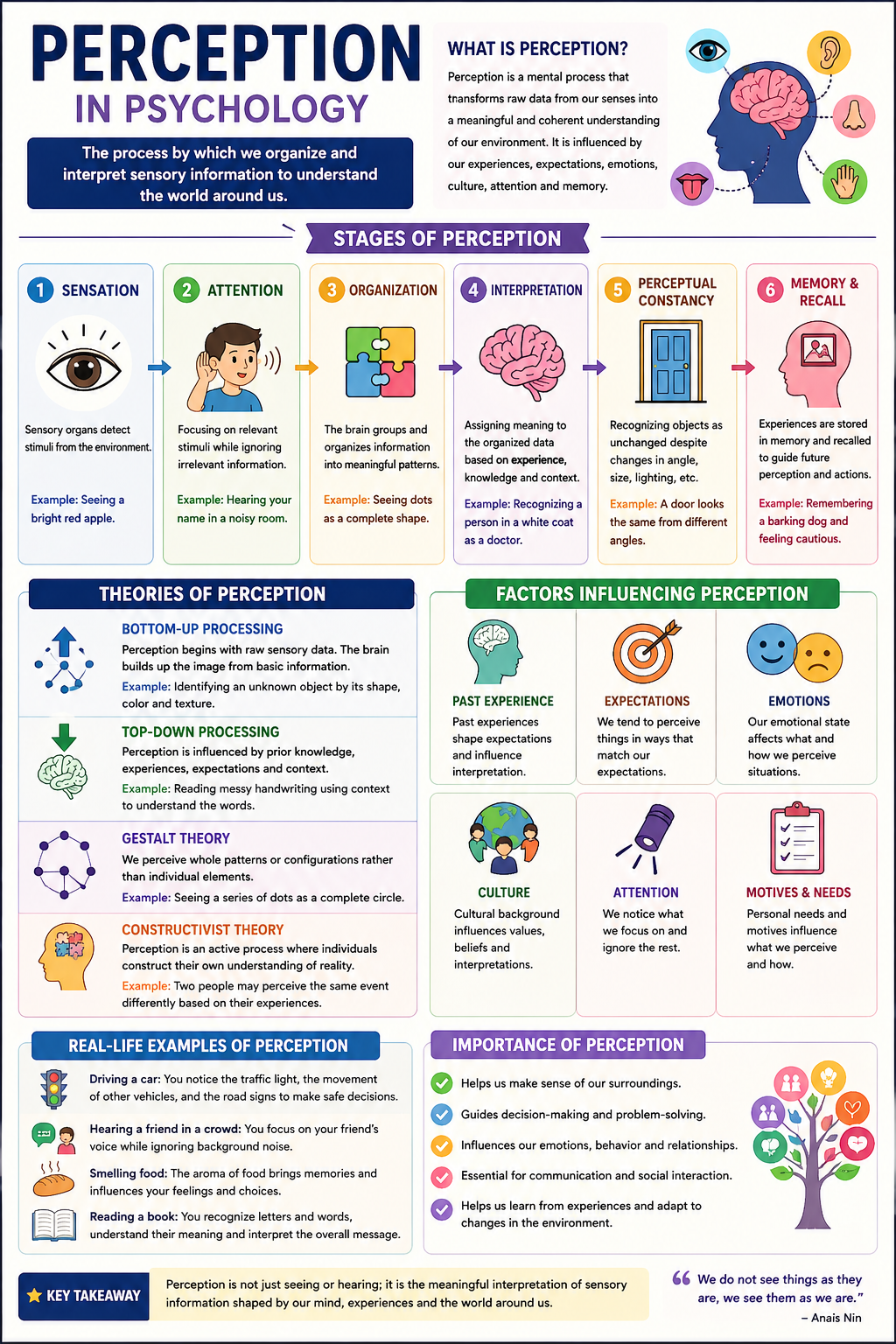
Perception is the complex cognitive process through which humans interpret, organize, and make sense of sensory information received from the environment to create a meaningful experience of the world around them. It is not just passive reception but an active process influenced by the interplay of sensory inputs and cognitive factors, such as previous knowledge, expectations, emotions, cultural background, and attention.
In real life, perception enables individuals to become consciously aware of objects, relationships, and events, allowing them to respond appropriately. For example, when walking down a busy street, a person perceives the colors and shapes of traffic lights, the sounds of vehicles, and the movement of other pedestrians, integrating all this information to navigate safely. Similarly, when smelling freshly baked bread, the sensory input triggers a recognition of its aroma, evoking memories and feelings that influence the desire to eat.
Expanded Definition of Perception
Perception is essentially the mental process that transforms raw data from the senses into a coherent and usable understanding of one’s surroundings. This involves organizing sensory stimuli into recognizable patterns, interpreting their meaning based on context and prior experience, and forming a conscious awareness of the environment.
For example, reading text on a page involves perceiving the shapes of letters and words, interpreting their linguistic meaning based on learned language rules, and understanding the overall message. Another daily example is hearing a friend’s voice in a crowded room—using selective attention, the brain filters relevant sounds and interprets them while ignoring background noise.
Thus, perception acts as a filter between objective reality and an individual’s internal representation of the world. Because it is shaped by subjective influences and cognitive processes, different people may experience and interpret the same stimuli differently, underscoring the personalized nature of perception.
Stages of Perception
Perception is a multi-stage process through which sensory information is transformed into meaningful experiences. The major stages are as follows:
-
Sensation
- This is the initial stage where sensory organs (eyes, ears, skin, nose, tongue) detect stimuli from the environment.
- Sensory receptors respond to stimuli like light, sound waves, pressure, odor molecules, and taste compounds.
- Example: When you see a bright red apple, your eyes detect the color and shape as raw data.
-
Attention
- Focuses on selecting relevant stimuli from the environment while filtering out irrelevant or distracting information.
- Selective attention allows you to concentrate on one conversation in a noisy room or spot a friend in a crowd.
- Example: Hearing your name mentioned at a busy party while tuning out other noise.
-
Organization
- The brain organizes incoming sensory data into recognizable patterns, grouping elements based on factors like similarity, proximity, continuity, and closure (Gestalt principles).
- It sorts shapes, sounds, and textures into meaningful units.
- Example: Seeing a series of dots and perceiving them as a complete circle instead of separate elements.
-
Interpretation
- The brain assigns meaning to the organized data by integrating it with past experiences, knowledge, emotions, and expectations.
- This stage can be subjective; different people may interpret the same stimuli differently.
- Example: Seeing a person in a white coat and interpreting them as a doctor based on cultural knowledge.
-
Perceptual Constancy
- The tendency to recognize objects as unchanged despite changes in sensory input such as lighting, angle, distance, or context.
- This helps maintain a stable perception of the environment.
- Example: Recognizing a door is rectangular even when viewed from an angle that makes it appear trapezoidal.
-
Memory and Recall
- Experiences obtained through perception are stored in memory.
- Later, this stored information is recalled to help interpret future stimuli and guide behavior.
- Example: Remembering that a dog barked aggressively previously informs how you perceive and react to dogs in the future.
Perception is thus a dynamic interaction between sensory input and cognitive processes, enabling humans to navigate, understand, and respond to their environment effectively.
This expanded model incorporating memory and recall reflects the complexity and adaptability of human perception, making it not merely a snapshot but an ongoing, evolving process shaped by experience.
Theories of Perception
-
Bottom-Up Processing
- This theory suggests that perception begins with raw sensory data flowing from sensory organs to the brain.
- It is data-driven and works by building perception from the details received through senses without prior knowledge influencing it.
- For example, when encountering an unfamiliar object, your brain pieces together sensory input like shape, color, and texture to identify it.
-
Top-Down Processing
- Here, perception is shaped by prior knowledge, experiences, expectations, and context.
- The brain uses cognitive factors to interpret sensory data, sometimes filling in missing gaps or interpreting ambiguous information.
- For example, when reading messy handwriting, past knowledge and the context help you understand the words despite unclear letters.
- Top-down processing works in tandem with bottom-up, influencing what we attend to and how we make sense of stimuli.
-
Gestalt Theory
- This theory highlights that humans perceive entire patterns or configurations, not just individual elements.
- Principles like proximity, similarity, closure, and continuity show how parts are grouped into wholes.
- A classic example is perceiving a series of dots arranged in a circle as a complete circle rather than separate dots.
-
Constructivist Theory
- Perception is an active process constructed by combining sensory input with memory, experience, and context.
- It is subjective and influenced by learning and culture.
- For instance, cultural background may affect how gestures or signs are perceived in communication.
-
Ecological Theory (Direct Perception)
- Proposed by James Gibson, this theory argues that the environment provides rich sensory information that humans directly perceive without needing cognitive interpretation.
- The focus is on “affordances,” or the possibilities for action that the environment offers.
- For example, the perception of a chair as something to sit on happens directly through sensory interaction with it, without complex mental processing.
Summary
These theories together show perception as a combination of sensory inputs, cognitive interpretations, and environmental interactions. Bottom-up and top-down processing especially highlight how perception is both data-driven and influenced by prior knowledge, making them foundational concepts in understanding how we perceive our world. The Gestalt, Constructivist, and Ecological theories further explain the holistic, subjective, and environment-driven aspects of perception.
Perceptual Mechanisms
-
Selective Attention
Selective attention is the cognitive mechanism that filters incoming sensory information to focus on the most important or relevant stimuli while ignoring distractions. This process helps prevent sensory overload and enables effective interaction with the environment. For example, in a noisy café, you can focus on the conversation with your friend, tuning out background chatter.
-
Perceptual Set
A perceptual set is a mental predisposition to perceive or interpret stimuli in a particular way based on prior experiences, expectations, emotions, and cultural context. It acts as a filter that influences how new sensory information is processed. For instance, if someone has recently seen a lot of scary movies, they might interpret ambiguous noises at night as something threatening.
-
Depth Perception
Depth perception is the ability to perceive the world in three dimensions and judge distances between objects. It relies on visual cues such as binocular disparity (the difference in images between the two eyes), motion parallax, relative size, texture gradients, and shadows. This mechanism is essential for tasks like driving, catching a ball, or walking without bumping into objects.
-
Perceptual Constancies
Perceptual constancies allow us to recognize objects as stable and unchanging despite variations in sensory input caused by changes in lighting, distance, angle, or movement. Key types include size constancy, shape constancy, and color constancy. For example, a door is perceived as a rectangle whether it is open or closed, near or far, even though the retinal image changes.

These mechanisms ensure that perception is efficient, coherent, and meaningful, allowing humans to effectively interpret and engage with their complex and dynamic environments.
TABLE
| Stage | Description | Example |
|---|---|---|
| Sensation | Detecting stimuli | Seeing a red apple |
| Attention | Focusing on stimuli | Hearing your name in noise |
| Organization | Grouping information | Seeing dots as a shape |
| Interpretation | Giving meaning | Recognizing a doctor |
| Constancy | Stability of perception | Door looks same from angle |
Examples of Perception
-
Visual Perception:
When driving, visual perception allows a person to read traffic lights, recognize road signs, monitor the movement of other vehicles, and estimate distances on the road. For example, a driver uses visual cues to notice when a pedestrian is about to cross or when a traffic light changes from green to red, enabling timely and safe responses.
-
Auditory Perception:
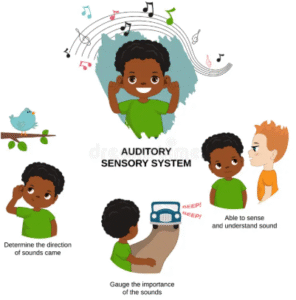
In a crowded and noisy environment like a party or café, auditory perception enables a person to focus on specific sounds, such as hearing their name being called or recognizing familiar voices, despite background noise. This ability is a demonstration of the “cocktail party effect,” allowing selective attention to auditory stimuli.
-
Tactile Perception:
When touching a hot surface, such as a stove, tactile perception registers the high temperature through skin sensors, triggering a reflexive action such as quickly pulling away the hand to avoid burns. This immediate sensory input combined with perceptual processing ensures safety.

-
Social Perception:
During conversations, social perception allows interpretation of nonverbal cues like facial expressions, body language, and tone of voice to infer emotions and intentions. For example, perceiving a friend’s smile and relaxed posture as indicators of friendliness or comfort, while recognizing crossed arms and averted gaze might be interpreted as discomfort or disinterest.
These examples illustrate how perception integrates sensory input and cognitive processing to help individuals navigate and understand various aspects of everyday life effectively.
Importance and Applications of Perception
Perception is fundamental in helping humans navigate, understand, and interact with their environment. It organizes sensory information into meaningful experiences, enabling effective responses to the world around us.
-
Navigating and Understanding Environment:
Perception allows individuals to detect and interpret stimuli such as sights, sounds, and smells to move safely and efficiently. For example, perceiving the speed and distance of an oncoming vehicle helps avoid accidents. It also enables recognizing familiar places and objects, which guides everyday actions.
-
Influencing Decision-Making and Social Interactions:
Perception shapes how people make judgments and decisions by interpreting situations and the behavior of others. Social perception, such as reading facial expressions and body language, is crucial in communication and building relationships. Misinterpretations can lead to misunderstandings or conflicts.
-
Usefulness in Various Fields:
- Psychology: Understanding perception helps explain human behavior, cognitive function, and mental health challenges.
- Marketing: Marketers use perception principles to influence consumer choices, brand recognition, and advertising effectiveness.
- Education: Teaching methods leverage perception theories to design materials that enhance learning and retention.
- Interface Design: UI/UX professionals apply perceptual principles to create intuitive digital and physical interfaces for better user experiences.
-
Awareness of Perception’s Subjectivity:
Recognizing that perception is subjective—shaped by personal experiences, culture, and emotions—improves communication and conflict resolution. It fosters empathy by appreciating that people may view the same situation differently.
In summary, perception is not only the gateway to sensory experience but also a critical factor influencing cognition, behavior, and social dynamics, making its understanding vital in diverse practical contexts.
Conclusion
Perception is a vital cognitive process through which humans interpret and organize sensory information, creating a meaningful experience of the surrounding world. It is an active process influenced by both raw sensory input and cognitive factors such as prior knowledge, expectations, and attention. The stages of perception—sensation, attention, organization, interpretation, and perceptual constancy—work together to filter and make sense of incoming stimuli. Theories like Bottom-Up and Top-Down processing, Gestalt, Constructivist, and Ecological approaches provide diverse perspectives on how perception operates, highlighting the balance between sensory data and mental frameworks. Perceptual mechanisms, including selective attention, perceptual set, depth perception, and perceptual constancies, ensure efficient and coherent interpretation of stimuli.
Perception’s importance extends across daily life, influencing navigation, decision-making, social interactions, and various professional fields such as psychology, marketing, education, and technology design. Awareness of perception’s subjective nature can help improve communication and reduce conflicts, emphasizing empathy and understanding. Understanding perception equips us to better comprehend human behavior, optimize environments, and enhance interpersonal interactions, reflecting its foundational role in cognition and experience.
Frequently Asked Questions (FAQs)
1. What is perception in psychology?
Perception is the process by which the brain organizes and interprets sensory information to understand the environment.
2. What are the stages of perception?
The main stages are sensation, attention, organization, interpretation, and perceptual constancy.
3. What is the difference between sensation and perception?
Sensation is the detection of stimuli, while perception is the interpretation of those stimuli.
4. What is bottom-up processing?
It is a data-driven process where perception starts with sensory input.
5. What is top-down processing?
It is influenced by prior knowledge, expectations, and experiences.
6. What is Gestalt theory in perception?
It explains how humans perceive whole patterns instead of individual parts.
7. What is selective attention?
It is the ability to focus on important stimuli while ignoring distractions.
8. Why is perception important in daily life?
It helps in decision-making, communication, and understanding the environment.
9. Can perception be different for different people?
Yes, perception is subjective and influenced by experience, culture, and emotions.
10. What are examples of perception?
Examples include recognizing faces, hearing voices in noise, and interpreting body language.
References
- Study.com. (2014). Perception in Psychology | Definition, Importance & Types.
- Wikipedia. (2002). Perception.
- Verywell Mind. (2005). Perception: The Sensory Experience of the World.
- Bruner, J. S. (Year). The Role of Perception in Defining Reality.
- Gestalt Psychology principles.
- Gibson, J. J. (Ecological Theory of Perception).
- Cognifit.com. (2025). Perception- Cognitive ability CogniFit.
- Lumen Learning. (2011). Introduction to Perception.
- Verywell Mind
👉 https://www.verywellmind.com/what-is-perception-2795002 - Study.com
👉 https://study.com/learn/lesson/perception-psychology.html - Lumen Learning
👉 https://courses.lumenlearning.com/ - James J. Gibson
👉 https://www.britannica.com/biography/James-J-Gibson - Language Development in Children: Stages, Theories (Why child not speaking clearly at age 2)
This article is written for knowledge purposes, aiming to help readers understand the topic better and gain useful insights for learning and awareness.
We often spend so much time trying to change our circumstances that we forget to understand our own emotional responses to them.