

Unconscious drives and early attachments quietly direct much of our behavior—Psychodynamic theory explains how to trace symptoms back to their developmental roots.
Introduction
Psychodynamic theory was developed by Sigmund Freud in the late 19th and early 20th centuries during his clinical work treating patients with psychological disorders. Freud’s curiosity about the unconscious mind led him to discover that many psychological problems originated from unconscious conflicts, often rooted in early childhood experiences. His work laid the foundation for psychoanalysis, a therapeutic method aimed at uncovering these unconscious influences through talk therapy, dream interpretation, and free association.
Freud introduced a structural model of the mind comprising the conscious, preconscious, and unconscious levels. He believed the unconscious was particularly powerful in shaping behavior because it held desires, fears, and memories that individuals were unaware of but that strongly influenced emotions and actions.
His theory evolved over decades and sparked further development in psychology, influencing various psychodynamic approaches today, including object relations and ego psychology. Freud’s psychodynamic theory remains foundational, highlighting the role of unconscious processes and early experiences in shaping human behavior and mental health.
Core Components of Personality
Freud identified three main parts of the personality:
Id
The id is the most primitive part of the personality, present from birth and entirely unconscious. It operates on the pleasure principle, meaning it seeks immediate gratification of all desires, wants, and needs. If these needs are not met, the individual experiences anxiety or tension. The id is impulsive and selfish, driven by instinctual biological drives such as hunger, thirst, and sexual desire, without consideration for reality or social appropriateness. Example: Imagine you are extremely hungry during an important meeting. Your id urges you to leave instantly and eat, ignoring social rules or consequences.
Ego
The ego develops from the id during infancy and functions mainly in conscious and preconscious levels. It operates on the reality principle, acting as a rational mediator that balances the impulsive demands of the id with the constraints of the external world and moral standards imposed by the superego. The ego uses logical thinking, problem-solving, and decision-making to satisfy the id’s desires in socially acceptable ways. It also employs defense mechanisms like repression or denial to manage conflicts and anxiety. Example: While feeling hungry, your ego reminds you that leaving the meeting abruptly is inappropriate. Instead, it suggests waiting for a break before eating.
Superego
The superego emerges around the age of five as a result of internalizing parental and societal values, functioning as the moral conscience. It strives for perfection by enforcing ethical standards and ideals, punishing the ego with feelings of guilt or shame when behavior falls short of these standards. The superego consists of two subsystems: the conscience (which punishes bad behavior) and the ego ideal (which rewards good behavior). It often conflicts with the id, placing strict demands to inhibit impulsive urges and encouraging socially appropriate behavior. Example: You may feel guilty for even thinking about leaving the meeting because it violates professional behavior standards, this feeling comes from the superego.
Interaction
These three components are in constant interaction, shaping thoughts, feelings, and behaviors. The ego tries to satisfy the id’s desires realistically while fulfilling the superego’s moral expectations, often facing tension and conflict in balancing these demands. For example, feeling angry (id) might be suppressed by the superego’s moral rules, with the ego mediating a socially acceptable response. Example: Suppose a friend insults you. Your id might push you to retaliate aggressively (immediate reaction), but your superego reminds you being aggressive is wrong and could harm your friendship. The ego tries to balance these urges by advising you to respond calmly and constructively, preserving the relationship.
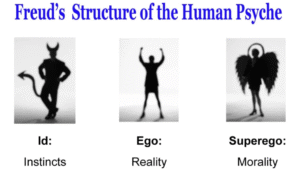
This dynamic interplay influences personality development and mental health, with disruptions potentially leading to psychological distress.
Unconscious Mind and Childhood Influence
Freud emphasized that much of human behavior is controlled by the unconscious mind, a vast reservoir of hidden desires, memories, and emotions that are not accessible to conscious awareness. These unconscious contents include repressed feelings, painful memories, and instinctual drives that are too threatening or anxiety-provoking to be consciously acknowledged. Despite being outside of awareness, the unconscious exerts a powerful influence on thoughts, emotions, and behaviors.
Childhood experiences are crucial in shaping the unconscious mind. Early relationships, especially with caregivers, create foundational patterns of attachment, emotional regulation, and self-concept. Conflicts or traumatic events in childhood may be repressed into the unconscious but continue to affect personality development and interpersonal relationships throughout life. For example, unresolved childhood anxiety about abandonment may unconsciously affect adult relationships by causing fears of rejection or clinginess.
Defense mechanisms, such as repression, denial, and projection, operate unconsciously to protect the individual from psychological distress by keeping unacceptable impulses or memories out of conscious thought. However, these repressed contents can manifest indirectly through dreams, slips of the tongue (Freudian slips), and neurotic symptoms.
Freud’s psychodynamic therapy aims to bring these unconscious contents into conscious awareness, helping individuals understand how past experiences influence current behavior and emotional difficulties. By resolving unconscious conflicts, people can achieve greater emotional insight and healthier functioning.
In modern psychology, the unconscious is recognized not only as a repository of repressed material but also as a functioning cognitive system that processes information automatically and efficiently, guiding much of human thought and behavior outside conscious control.
Thus, the unconscious mind and childhood experiences together form a dynamic foundation that shapes personality, motivations, and patterns of behavior throughout life.
Defense Mechanisms
Defense mechanisms are unconscious psychological strategies used by the ego to protect itself from anxiety, internal conflicts, or uncomfortable thoughts and feelings. They work by distorting or denying reality in various ways, allowing individuals to cope with stress and maintain emotional stability.
Common Defense Mechanisms:
- Repression: The unconscious blocking of unacceptable thoughts or traumatic memories from conscious awareness. For example, a person who experienced childhood trauma may have no memory of it but still exhibits anxiety symptoms.
- Denial: Refusing to accept reality or facts, instead acting as if a painful event or emotion does not exist. For instance, someone diagnosed with a serious illness might deny the severity of the condition.
- Projection: Attributing one’s own undesirable feelings or impulses onto others. For example, a person who feels hostile may accuse others of being hostile toward them.
- Sublimation: Channeling unacceptable impulses into socially acceptable activities, such as turning aggressive drives into sports or artistic creativity.
- Displacement: Redirecting emotions from a threatening target to a safer substitute. For instance, a worker angry at their boss may go home and take out frustration on family members.
- Reaction Formation: Acting in a way contrary to true feelings. A person who feels insecure might behave excessively confident or boastful.
- Rationalization: Creating logical but false explanations to justify unacceptable feelings or behaviors, such as blaming external factors for personal failures.
- Regression: Reverting to behaviors typical of an earlier developmental stage when faced with stress, such as throwing tantrums or seeking comfort objects
These mechanisms help reduce psychological distress by managing conflicts among the id, ego, and superego. However, excessive reliance on defense mechanisms can lead to maladaptive behavior and unresolved emotional issues. Psychodynamic therapy aims to bring these unconscious defenses to awareness to promote healthier coping and emotional growth.
Psychosexual Stages of Development
Sigmund Freud proposed that personality develops through five psychosexual stages, each focused on different erogenous zones where the child’s libido (sexual energy) is concentrated. He believed that unresolved conflicts or frustrations during any stage could lead to fixation, which manifests as specific personality traits or behavioral issues in adulthood. The stages are as follows:
Oral Stage (Birth to 18 months)
The focus is on the mouth—activities like sucking and biting provide pleasure. Fixation from unresolved issues (e.g., early or late weaning) may result in oral behaviors in adulthood such as smoking, nail-biting, overeating, or excessive talking.
Anal Stage (18 months to 3 years)
The libido centers on bowel and bladder control during toilet training. Fixation can lead to an anal-retentive personality (obsessive, orderly, and stubborn) or anal-expulsive personality (messy, disorganized, and rebellious).
Phallic Stage (3 to 6 years)
Pleasure focuses on the genitals, and children experience the Oedipus complex (boys’ desire for their mother and rivalry with father) or Electra complex (girls’ desire for their father and envy of the mother). Resolution leads to identification with the same-sex parent and development of the superego. Unresolved conflicts can cause difficulties with authority and sexual dysfunction.
Latency Stage (6 years to puberty)
Sexual impulses become dormant, and energy is directed toward socialization, learning, and developing new skills. There is little psychosexual development during this period.
Genital Stage (Puberty onwards)
Sexual urges reawaken and are directed toward peers of the opposite sex. Successful navigation leads to mature, healthy adult relationships. Fixation or unresolved conflicts at earlier stages may result in difficulties in forming intimate relationships.

Freud stressed that early satisfaction and frustration during these stages shape adult personality and behavior, with each stage building upon the resolution of the previous one. Fixations lead to neuroses and maladaptive behaviors that psychodynamic therapy aims to address.
Therapeutic Application of Psychodynamic Theory
Psychodynamic therapy is a form of depth psychology aimed at uncovering and resolving unconscious conflicts and defense mechanisms that influence a person’s emotional difficulties and behaviors. The therapy operates on the idea that by bringing these unconscious processes into conscious awareness, clients can gain insight, achieve self-understanding, and experience lasting psychological change.
Key Techniques:
- Free Association: Clients are encouraged to speak freely about whatever comes to mind, without censorship or judgment. This process helps reveal unconscious thoughts, feelings, and conflicts that influence behavior.
- Dream Analysis: Dreams are interpreted as symbolic expressions of unconscious desires and conflicts. Analyzing dreams provides access to hidden emotional material that can be explored and understood.
- Interpretation: The therapist listens to the client’s verbal and nonverbal cues and offers interpretations that link current symptoms or behaviors to unconscious motives and past experiences. This helps clients connect their present struggles to deeper psychological roots.
- Examination of Defense Mechanisms: Therapists identify defense mechanisms clients use to cope with internal conflicts and anxiety. By bringing these unconscious defenses into awareness, clients can understand their role and reduce reliance on maladaptive coping.
- Transference Analysis: Clients often project feelings about significant others onto the therapist. Exploring these transference reactions helps uncover unresolved issues from past relationships that affect current behavior.
- Working Through: The client and therapist repeatedly address and explore unconscious conflicts and patterns over time, facilitating emotional insight and behavioral change.
Goals and Benefits:
- Enhance self-awareness and understanding of unconscious influences on thoughts, emotions, and behaviors.
- Resolve internal conflicts and reduce symptoms like anxiety, depression, and relationship difficulties.
- Improve emotional regulation and coping strategies by recognizing and modifying defense mechanisms.
- Promote personal growth, healthier relationships, and greater psychological resilience.
Psychodynamic therapy is applicable to a range of mental health issues, including mood disorders, personality disorders, anxiety disorders, and trauma-related problems. It often requires a longer-term commitment compared to brief therapies but can lead to profound and enduring change by addressing the root causes of psychological distress rather than just symptoms.
Conclusion
Psychodynamic theory, developed by Sigmund Freud, offers a profound understanding of human behavior by emphasizing the role of unconscious processes, early childhood experiences, and internal psychic conflicts. It highlights the dynamic interplay among the id, ego, and superego in shaping personality, and how unresolved conflicts during psychosexual stages can influence adult behavior. Defense mechanisms serve as unconscious strategies to protect the ego from anxiety, while psychodynamic therapy aims to uncover these hidden conflicts and promote lasting emotional insight and healing. Despite evolving psychological paradigms, psychodynamic theory remains foundational in mental health practice, providing valuable tools for exploring the depths of the human mind and fostering personal growth through increased self-awareness.
Frequently Asked Questions (FAQs)
1. What is psychodynamic theory?
Psychodynamic theory explains human behavior through unconscious processes and early childhood experiences.
2. Who developed psychodynamic theory?
Psychodynamic theory was developed by Sigmund Freud.
3. What are the three parts of personality?
The three parts are the id, ego, and superego.
4. What is the role of the unconscious mind?
The unconscious mind stores hidden desires, memories, and emotions that influence behavior.
5. What are defense mechanisms?
Defense mechanisms are unconscious strategies used to reduce anxiety and protect the ego.
6. What are the psychosexual stages of development?
They are oral, anal, phallic, latency, and genital stages.
7. What is the id in psychology?
The id is the primitive part of personality that seeks immediate gratification.
8. What is the ego in psychology?
The ego balances reality with the desires of the id.
9. What is the superego?
The superego represents moral values and conscience.
10. How does psychodynamic therapy work?
It helps uncover unconscious conflicts through techniques like free association and dream analysis.
References
- Sigmund Freud
👉 https://www.britannica.com/biography/Sigmund-Freud - Simply Psychology
👉 https://www.simplypsychology.org/psychodynamic.html - American Psychological Association
👉 https://www.apa.org/topics/personality - Verywell Mind
👉 https://www.verywellmind.com/what-is-psychodynamic-theory-2795426 - The Psychology of Care: Inside the Minds of Certified Nurses Balancing Empathy, Burnout, and Healing
This article is written for knowledge purposes, aiming to help readers understand the topic better and gain useful insights for learning and awareness.