
Discipline Children is not about control or fear—it’s about teaching skills, building connection, and raising emotionally intelligent humans.
Introduction
Parenting in the modern world comes with new challenges, new pressures, and new information. Yet one truth has remained constant across decades of child development research:
Parenting in the modern world comes with new challenges, new pressures, and a constant stream of information. Yet one truth has remained remarkably consistent across decades of child development research: children thrive in environments that balance warmth, emotional connection, and firm boundaries.americanspcc+1
This balance is at the heart of Positive Discipline.
Positive Discipline is not permissive parenting.
It is not harsh or authoritarian.
Is it not based on fear, punishment, threats, or shame.
Instead, it is a respectful, evidence-informed approach rooted in:
- Developmental psychology
- Attachment theory
- Neuroscience of stress and regulation
- Social-emotional learning
- Adlerian principles of belonging and contribution positive discipline
This article blends scientific insight with a warm, parent-friendly tone, offering both the “why” behind Positive Discipline and the “how” you can use it in everyday life.
The Foundations of Positive Discipline (Discipline Children)
1.1 What Positive Discipline Really Means
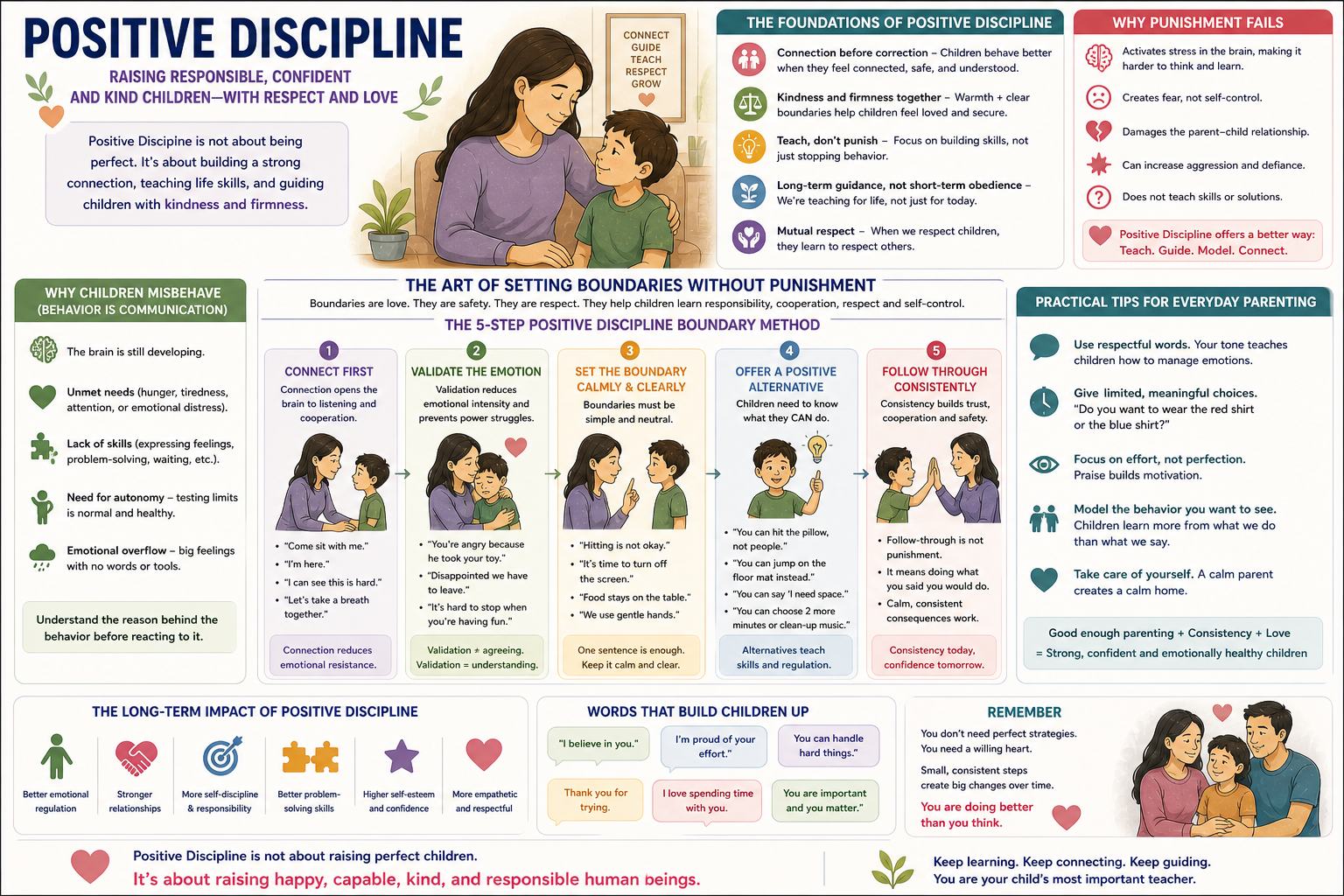
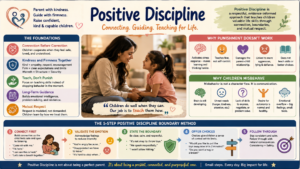
Positive Discipline is built on five essential pillars:
-
Connection before correction: Children are more likely to cooperate when they feel safe, loved, and understood. Emotional connection calms the stress system in the brain, making learning possible.parentingchaos+1
-
Kindness and firmness at the same time
-
Kind = empathy, respect, encouragement
-
Firm = clear expectations and predictable limits
When warmth is combined with structure, children feel both loved and secure.ffew
-
-
Teaching rather than punishing: Instead of asking, “How do I stop this behavior right now?”, Positive Discipline asks:
“What skill does my child need to learn here?” -
Long-term guidance, not short-term obedience: Fear-based discipline (Discipline Children) may create instant compliance, but it does not build emotional intelligence, problem-solving, or resilience.
-
Mutual respect: Respect is not demanded; it is modeled. When children are treated with dignity, they gradually learn to treat others the same way.

1.2 Why Punishment Fails (According to Science)
Punishment can sometimes stop behavior in the moment, but research shows it has negative long-term effects on brain development, behavior, and relationships.
Here is why:
-
Punishment activates the stress response: Yelling, threats, and physical punishment activate the amygdala (the brain’s alarm center), making it harder for children to think, learn, or reflect.
-
It Teaches fear, not self-control: Children learn to avoid you or hide their behavior, rather than developing internal self-regulation.
-
Punishment harms the parent–child relationship: Over time, children may become more secretive, anxious, or defiant, because the relationship feels unsafe rather than supportive.
-
It can increase aggression: Studies consistently show that harsh discipline (Discipline Children) is linked to more aggression, lying, and oppositional behavior in children.
-
Punishment does not teach skills: It may stop a behavior, but it does not show the child what to do instead.
Positive Discipline (Discipline Children) offers a healthier alternative: Teach. Guide. Model. Connect.
1.3 Why Children Misbehave (The Developmental Psychology Behind Behavior)
Misbehavior is not a character flaw. It is communication.
Some common reasons children “act out” include:
-
The brain is still developing: Skills like impulse control, emotional regulation, and complex reasoning develop well into adolescence.
-
Unmet needs: Hunger, fatigue, sensory overload, need for attention, or emotional distress often show up as “misbehavior.”
-
Lack of skills: Children may not yet know how to express anger, negotiate, wait, or problem-solve in healthy ways.
-
Desire for autonomy: Testing limits is normal, healthy, and important for developing independence.
-
Emotional overflow: Children feel big emotions but lack the words and strategies to manage them.
Understanding why a child behaves a certain way is essential before deciding how to respond.
The Art of Setting Boundaries Without Punishment (Discipline Children)
Boundaries are love. These are safety.Boundaries are respect.
They teach children: Responsibility, Cooperation, Respect, Emotional control, Safety, Independence
But boundaries must be set with compassion and clarity.
In Positive Discipline, boundaries are: Clear, Consistent, Calm, Predictable, Respectful
Not: Threats, Yelling, Punishment, Shame, Manipulation
The 5-Step Positive Discipline Boundary Method (Discipline Children)
This is the heart of setting effective boundaries without punishment.
STEP 1: Connect First: Connection opens the brain to listening and cooperation.
Examples:
- “Come sit with me.”
- “I’m here.”
- “can see this is hard.”
- “Let’s take a breath together.”
Connection reduces emotional resistance.
STEP 2: Validate the Emotion: Validation reduces emotional intensity and prevents power struggles.
Examples:
- “You’re angry because he took your toy.”
- “Disappointed we have to leave.”
- “It’s hard to stop when you’re having fun.”
Validation ≠ agreeing.
Validation = understanding.
STEP 3: Set the Boundary Calmly & Clearly: Boundaries must be simple and neutral.
Examples:
- “Hitting is not okay.”
- “It’s time to turn off the screen.”
- “Food stays on the table.”
- “We use gentle hands.”
Parents often talk too much during boundaries.
One sentence is enough.
STEP 4: Offer a Positive Alternative: Children need to know what they can do.
Examples:
- “You can hit the pillow, not people.”
- “Can jump on the floor mat instead of the couch.”
- “You can say ‘I need space.’”
- “Can choose two more minutes of play or clean-up music.”
Alternatives teach regulation.
STEP 5: Follow Through Consistently
- Consistency = trust
- Consistency = cooperation
- Consistency = emotional safety
Follow-through does NOT mean punishment.
It means holding the limit with calm confidence.
Examples:
- Turn off the screen.
- End the activity if hitting continues.
- Remove unsafe items.
- Pause play until calm returns.
Real-Life Boundary Examples (All Ages)
Below are practical, detailed examples for each developmental stage.
Toddlers (1–3 years): Boundaries for Big Feelings
Scenario: Toddler hits during play
- Connection: “You’re having big feelings.”
- Validation: “Are angry.”
- Boundary: “I won’t let you hit.”
- Alternative: “Hands can squeeze my hands or hit a pillow.”
- Follow-through: Move child away if needed, calmly.
Why it works: Toddlers need physical guidance, modeling, and repetition.
Scenario: Refusing to wear clothes
Parent: “I know you don’t want clothes right now. But your body needs to stay warm.
Red shirt or blue shirt?”
Choices restore toddler autonomy.
Preschoolers (3–5 years): Boundaries for Independence
Scenario: Refusing to clean up
- “Cleaning up is hard after fun.”
- “But toys must be cleaned before TV.”
- “Should we start with blocks or dolls?”
- “Let’s do it together for 2 minutes.”
Preschoolers need structured choices.
Scenario: Whining
“You’re upset, but whining hurts my ears.
Let’s try again with a calm voice.”
This teaches emotional communication.
School-Age Children (6–12 years): Boundaries for Responsibility
Scenario: Homework refusal
- “Homework feels boring today.”
- “It happens before screens.”
- “Break first or start now?”
- “I’ll help with the first two problems.”
The boundary is the routine, not punishment.
Scenario: Sibling arguments
“Both of you want to be heard.
One talks, one listens.
Then switch.”
Teach conflict resolution, not blame.
Teens (13–18 years): Boundaries with Respect, Not Control
Scenario: Curfew negotiation
- “I know you want more freedom.”
- “Curfew is 9 PM for now, for safety.”
- “We can revisit it next month based on responsibility.”
- “Text me if plans change.”
Teens respond to respect + negotiation, not control.
Natural and Logical Consequences (Non-Punitive Discipline)
Consequences are helpful when they are: Related, Respectful, Reasonable, Revealed in advance
Not: Revenge, Shame, Harsh, punishment, Fear-based
Natural Consequences
These happen naturally without parental intervention.
Examples:
- Child forgets lunch → feels hungry briefly
- They doesn’t wear jacket → feels cold
- Child doesn’t do homework → teacher consequences
Natural consequences teach responsibility efficiently.
Logical Consequences
Parent creates a consequence linked to the behavior.
Logical:
If a child throws food → mealtime ends.
Logical:
If a child misuses a toy → the toy is put away.
Logical consequences are not punishments.
They are teaching tools.
Everyday Situations: How to Discipline Without Punishment (Discipline Children)
Here are 15 common real-life situations and how to respond positively.
1 When your child screams
Parent: “I hear you’re upset.
Use your calm voice and I’ll listen.”
2 Hitting siblings
“I won’t let you hit.
Say ‘I don’t like that.’
Let’s practice.”
3 Lying
“You were scared to tell the truth.
Thank you for telling me now.
Let’s solve the problem together.”
4 Stealing
“You wanted it very much.
Next time, ask or save for it.
Let’s return it together.”
5 Talking back
“You can be angry.
But speak respectfully.
Try again.”
6 Refusing to listen
“I need your eyes before I speak.
Thank you.
Now we can talk.”
7 Throwing toys
“Throwing hurts things.
You can throw the soft balls only.”
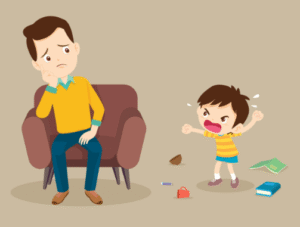
8 Tantrums
“Your feelings feel big.
I’m here.
Let it out.”
9 Screen addiction
“Screen time ends at 7.
You can choose a book or a puzzle now.”
10 Not sharing
“You don’t have to share immediately.
But you can take turns.”
11 Backtalk during frustration
“I hear your anger.
Let’s take a breath and try again.”
12 Making a mess
“Oops! Messes happen.
Let’s clean together.”
13 Homework meltdown
“Let’s break this into small steps.
Which part should we start with?”
14 Sibling rivalry
“Both feelings matter.
Let’s listen one at a time.”
15 Unsafe behavior in public
“I won’t let you run.
Hold my hand or stay by the cart.”
Parent Emotional Regulation (The Most Important Skill)
Children borrow our regulation.
- If we stay calm, they learn calm.
- We explode, they learn to explode.
Here are tools every parent needs:
1 Pause before reacting: A deep breath regulates your nervous system.
2 Walk away if needed: Say: “I need a moment. I’ll be right back.”
3 Use a calm tone on purpose: Lower volume = higher cooperation.
4 Rephrase your thoughts:
Not: “He’s doing this to annoy me.”
But: “He’s struggling and needs help.”
5 Repair after mistakes: “I’m sorry I yelled. I love you. I’m working on staying calm.”
Repair builds trust.
Building a Positive Discipline Home Environment (Discipline Children)
1 Create predictable routines: Routines reduce misbehavior significantly.
2 Use visual charts: Great for ages 2–10.
3 Use connection rituals: 5-minute morning cuddles
Bedtime conversations
“Special time”
4 Reduce overstimulation: A calm home environment supports regulation.
5 Encourage independence: Give small responsibilities daily.
Long-Term Benefits of Positive Discipline (Discipline Children)
Research shows children raised with this approach:
- Have stronger emotional intelligence
- Are more responsible
- Perform better academically
- Have better relationships
- Learn real self-discipline
- Show lower aggression
- Have higher self-esteem
- Become respectful adults
Punishment shapes behavior through fear.
Positive Discipline shapes behavior through security, understanding, and skill-building.
Final Thoughts (Discipline Children)
Positive Discipline is not about perfection.
It is about being: Present, Patient, Consistent, Respectful, Emotionally aware
Setting boundaries without punishment teaches children:
- How to regulate emotions
- Handle frustration
- How to communicate
- To respect others
- How to make good decisions
When children feel safe, respected, and understood, they naturally become:
- cooperative
- confident
- resilient
- responsible
- emotionally intelligent
Positive Discipline doesn’t just change behavior —
it transforms the entire parent–child relationship.
Frequently Asked Questions (FAQs)
1. What is positive discipline (Discipline Children)?
Positive discipline is a parenting approach that teaches behavior through connection, respect, and guidance instead of punishment.
2. Does positive discipline mean no rules (Discipline Children)?
No, it includes clear boundaries with kindness and consistency.
3. Why is punishment harmful for children (Discipline Children)?
Punishment can create fear, reduce trust, and does not teach proper behavior.
4. How do you discipline a child without punishment (Discipline Children)?
By setting boundaries, teaching skills, and using logical consequences.
5. What are logical consequences in parenting (Discipline Children)?
They are consequences directly related to the child’s behavior, used to teach responsibility.
6. How can parents stay calm during conflict (Discipline Children)?
By pausing, breathing, and responding instead of reacting.
7. What is the difference between punishment and discipline (Discipline Children)?
Punishment focuses on control, while discipline focuses on teaching.
8. At what age can positive discipline be used (Discipline Children)?
It can be used from infancy through teenage years.
9. Can positive discipline improve behavior (Discipline Children)?
Yes, it builds emotional intelligence and long-term self-control.
10. What are the benefits of positive discipline (Discipline Children)?
Better relationships, emotional regulation, and responsible behavior.
Reference
- Harvard Center on the Developing Child
👉 https://developingchild.harvard.edu/ - American Academy of Pediatrics
👉 https://www.healthychildren.org/ - Centers for Disease Control and Prevention
👉 https://www.cdc.gov/ncbddd/childdevelopment/ - Language Development in Children: Stages, Theories (Why child not speaking clearly at age 2)
This article is written for knowledge purposes, aiming to help readers understand the topic better and gain useful insights for learning and awareness.
Pingback: How to Set Healthy Boundaries in Relationships