
“Raise confident, kind kids— positive parenting starts with small moments of connection.”
Introduction
Children are not born with emotional skills—they learn them through daily interactions with parents, caregivers, and their environment. Every moment of connection, communication, and guidance shapes how they understand feelings, manage frustration, and build relationships.
Positive parenting supports this growth by creating an environment where children feel safe, understood, and valued. Instead of using control or punishment, it focuses on empathy, connection, and consistent guidance. When children feel emotionally secure, they become more confident, cooperative, and resilient.
In today’s fast-paced world, children face various emotional challenges. A supportive parenting approach helps them develop self-regulation, empathy, problem-solving abilities, and healthy behaviour.
This article introduces simple and effective positive parenting strategies that strengthen emotional intelligence and nurture well-rounded, emotionally strong children.
What Is Positive Parenting?
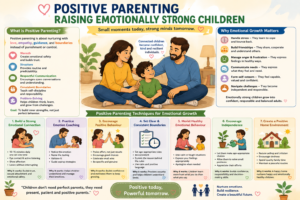
Positive parenting is an evidence-based approach backed by decades of developmental and psychological research. It emphasises warmth, structure, respectful communication, consistent boundaries, and problem-solving instead of punishment. This approach recognizes that children learn best through connection, empathy, and guidance—not fear or control.
Warmth creates emotional safety. When children feel loved and understood, they are more open to learning, cooperating, and expressing their feelings.
Structure provides predictability, helping children feel secure and confident as they navigate daily routines.
Respectful communication teaches children how to express themselves without shame or fear. When adults speak calmly and listen actively, children learn to do the same.
Consistent boundaries help children understand expectations, develop self-discipline, and feel secure within clear limits.
Problem-solving encourages children to think through challenges, make responsible choices, and learn from mistakes—building lifelong resilience.
Unlike traditional parenting approaches focused on obedience, positive parenting aims to develop a child’s inner strengths. The goal is not to create “perfect behaviour,” but to nurture essential emotional skills such as:
- Self-control: managing impulses and big emotions
- Empathy: understanding others’ feelings and perspectives
- Confidence: believing in their abilities and developing healthy self-esteem
- Emotional awareness: recognising and naming their own feelings
- Secure attachment: trusting that caregivers are reliable, supportive, and emotionally available
These skills lay the foundation for healthy relationships, strong mental well-being, and positive behaviour throughout childhood, adolescence, and adulthood. Positive parenting shapes children not just for the present—but for life.
Why Emotional Growth Matters
Emotional development plays a crucial role in shaping a child’s overall growth and well-being. It influences how children:
- Handle stress – They learn how to stay calm, cope with pressure, and bounce back from challenges.
- Build friendships – Healthy emotional skills help them share, cooperate, and understand others’ feelings.
- Manage anger and frustration – Children learn to express strong emotions in safe, respectful ways rather than through aggression or withdrawal.
- Communicate needs – They become better at expressing what they feel, want, or find difficult, reducing behavioural outbursts.
- Form self-esteem – Positive emotional experiences help children feel capable, valued, and confident in their abilities.
- Navigate challenges independently – Over time, they develop resilience, problem-solving skills, and a sense of responsibility.
When children grow up in an environment of supportive, positive parenting, they are more likely to become confident, responsible, and emotionally balanced adults. They learn to understand their emotions, connect with others, and face life’s ups and downs with strength and empathy.
Positive Parenting Techniques for Emotional Growth
1. Build a Strong Emotional Connection
Children thrive when they feel emotionally safe and connected to their caregivers. A strong bond becomes the foundation for trust, cooperation, and healthy emotional growth.
How to build connection:
- Offer daily one-on-one time (10–15 minutes): Even a short, focused interaction strengthens your relationship.
- Make eye contact while talking: It shows that you are truly present.
- Show affection: Hugs, gentle touch, and kind words reassure your child that they are loved.
- Listen without interrupting: Children feel respected when their words are valued.
Why it works:
Strong connection creates secure attachment, which reduces behavioural issues, boosts self-esteem, and builds emotional resilience.
2. Practice Emotion Coaching
Emotion coaching helps children recognise, understand, and manage their feelings—skills essential for emotional intelligence.
Steps:
- Notice the emotion: Identify when your child is sad, angry, or overwhelmed.
- Name the feeling: “It seems like you’re frustrated.”
- Validate it: “It’s okay to feel that way.”
- Guide coping strategies: Deep breathing, hugs, quiet time, or talking it out.
Benefits:
Children learn emotional vocabulary, better self-regulation, and empathy toward others.
3. Model the Behaviour You Want to See
Children learn far more from what adults do than what they say. Your behaviour becomes their emotional blueprint.
Model:
- Calm communication during disagreements
- Problem-solving instead of reacting impulsively
- Respectful behaviour toward others
- Healthy emotional expression such as talking about feelings instead of suppressing them
Remember:
Kids mirror adults. When you regulate your emotions, they learn to regulate theirs.
4. Use Positive Reinforcement
Praise motivates children and encourages them to repeat positive behaviour. It works better than punishment and builds confidence.
Try:
- “I like how you waited patiently.”
- “You cleaned your toys! That shows responsibility.”
Tip:
Use specific praise, not vague “good job.”
Positive reinforcement helps children understand what behaviour is expected and appreciated.
5. Set Clear, Age-Appropriate Boundaries
Boundaries give children a sense of safety and structure. They help children understand limits and develop self-discipline.
Tips:
- Keep rules simple and consistent.
- Explain the reason behind a rule.
- Offer choices to promote independence (e.g., “Blue shirt or red shirt?”).
- Give gentle reminders instead of harsh reactions.
Example:
Instead of saying, “Don’t shout!”
Try: “Use your indoor voice, please.”

6. Encourage Problem-Solving
Teaching problem-solving empowers children and builds resilience.
Steps:
- Identify the problem
- Brainstorm solutions together
- Let the child choose a solution
- Allow natural consequences (when safe)
This process helps children learn responsibility, think critically, and handle challenges more independently.
7. Maintain Routines and Structure
Predictability lowers anxiety and helps children feel secure. Routines provide stability, especially during transitions.
Important routines:
- Bedtime
- Mealtimes
- Homework
- Screen time
When routines are consistent, children know what to expect and handle emotions more effectively.
8. Practice Calm Discipline
Positive discipline focuses on teaching rather than punishing. It guides children toward better choices without damaging trust.
Methods:
- Redirection: “Let’s try this instead.”
- Logical consequences: Related to the behaviour, not random punishment.
- Time-in: Sitting with the child to calm down, instead of isolating them.
- Do-overs: Giving children a chance to try again in the right way.
Note:
Yelling, threatening, or hitting increases anxiety and harms emotional development.
9. Encourage Independence
Children grow emotionally when they are allowed to try new things, make mistakes, and learn from them.
Ways to foster independence:
- Age-appropriate chores and tasks
- Letting them make small decisions
- Allowing safe attempts before stepping in
Independence builds confidence, problem-solving skills, and maturity.
10. Create an Emotion-Friendly Home Environment
A child’s environment deeply affects their emotional well-being. A calm, supportive home nurtures healthy emotional development.
Include:
- A calm-down corner with pillows, coloring books, or sensory tools
- Family time to strengthen bonds
- Open conversations about feelings—through stories, play, or check-ins
- Low-stress mornings and bedtime routines to reduce daily conflict
Such environments help children feel understood, secure, and emotionally supported.
Long-Term Benefits of Positive Parenting
Children raised with positive parenting often show a wide range of long-term emotional, social, and behavioural strengths. As they grow, they tend to develop:
- Better emotional control – They can manage anger, frustration, and stress more effectively because they have learned healthy ways to express their feelings.
- Higher self-esteem – Consistent encouragement and emotional support help children feel confident, capable, and valued.
- Stronger communication skills – Children raised with respect and open dialogue learn to express their thoughts clearly and listen to others with understanding.
- Reduced behavioural problems – With guidance, structure, and emotional safety, children are less likely to engage in aggression, defiance, or impulsive behaviour.
- Empathy and kindness – Positive parenting teaches children to consider others’ feelings, show compassion, and build meaningful relationships.
- Better academic performance – Emotionally secure children focus better, handle school challenges calmly, and develop stronger problem-solving skills.
- Healthier relationships in adolescence and adulthood – Children who grow up with warmth, respect, and cooperation tend to build healthier friendships and romantic relationships later in life.
Conclusion
Positive parenting is not about perfection—it’s about being present, patient, and genuinely connected with your child. When parents approach everyday moments with empathy, structure, and consistent communication, they create an environment where emotional growth naturally flourishes. Children learn to understand their feelings, trust their caregivers, and develop the resilience needed to navigate life’s challenges.
Every moment of connection, understanding, and kindness shapes a child’s inner world. These small yet meaningful interactions build confidence, emotional intelligence, and a strong sense of security. Positive parenting doesn’t just change behaviour—it strengthens bonds, transforms relationships, and lays the foundation for lifelong well-being.
FAQ
1. What is positive parenting?
Positive parenting focuses on empathy, connection, and guidance instead of punishment.
2. Why is positive parenting important?
It helps children develop emotional strength, confidence, and healthy behaviour.
3. What are examples of positive parenting?
Emotion coaching, praise, setting boundaries, and calm discipline.
4. Does positive parenting spoil children?
No, it teaches responsibility and self-control.
5. How does it improve behaviour (Positive Parenting)?
Children feel understood and cooperate more.
6. What is emotion coaching (Positive Parenting)?
Helping children understand and manage emotions.
7. Can positive parenting reduce tantrums?
Yes, it improves emotional regulation.
8. Is it backed by research (Positive Parenting)?
Yes, it is supported by psychological research.
9. Can it be used for all ages (Positive Parenting)?
Yes, with age-appropriate strategies.
10. When should I seek help (Positive Parenting)?
If behaviour or emotions become difficult to manage.
Reference
-
American Academy of Pediatrics – Behaviour & Development
https://www.aap.org/en/patient-care/behavioral-health/ -
American Psychological Association – Child Mental Health
https://www.apa.org/topics/children -
UNICEF – Early Childhood Development
https://www.unicef.org/early-childhood-development -
CDC – Child Development Milestones
https://www.cdc.gov/ncbddd/childdevelopment/index.html - Screen Addiction in Children
yourwebsite.com/screen-addiction-children - Contact Us
This article is written for knowledge purposes, aiming to help readers understand the topic better and gain useful insights for learning and awareness.

Pingback: Impact of Parental Conflict on Child Development
Pingback: How to Improve Parent–Child Communication