
“If your mind often jumps to the worst, assumes the worst, or believes the harshest version of events, cognitive distortions may be shaping how you see yourself and your life.”
Our thoughts influence how we feel, how we behave, and how we experience the world around us. But sometimes, the mind creates patterns that feel true — even when they are not. These inaccurate or irrational ways of thinking, known as cognitive distortions, can shape our perception in unhelpful ways.
When these distorted thoughts become frequent, they can intensify stress, anxiety, depression, self-doubt, and even relationship conflicts. The reassuring part is that cognitive distortions are learned habits, which means they can also be unlearned.
By becoming aware of these thinking errors and understanding how they operate, we can challenge them, reframe our thoughts, and develop a more balanced, emotionally healthy mindset.
Below are ten common cognitive distortions that many people experience — and how each one impacts mental well-being.
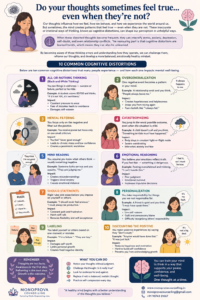
All-or-Nothing Thinking (Black-and-White Thinking)
This distortion makes you see the world in two extremes — success or failure, perfect or terrible, all good or all bad. There is no space for “in-between,” nuance, or gradual improvement.
Detailed Example: A student scores 85/100 and thinks, “If it’s not 100, it’s worthless.” Parent thinks, “If I lose my temper once, I’m a bad parent.”
Why It Happens: Often rooted in perfectionism, childhood expectations, or fear of judgment.
Deeper Impact:
— Constant pressure to excel
— Fear of mistakes leads to avoidance
— Damages self-esteem because perfection is impossible
— Can lead to procrastination (“If I can’t do it perfectly, I won’t start”)
Overgeneralization
One negative event becomes a pattern in your mind. You believe a single setback predicts your entire future.
- Detailed Example: A relationship ends, and you think, “People always leave me. I will never be loved.”
- Why It Happens: The brain tries to “protect” you by assuming danger based on limited evidence.
- Deeper Impact:
— Creates hopelessness and helplessness
— Fuels depressive thinking patterns
— Stops people from trying again or taking healthy risks
— Encourages beliefs like “I always fail” or “Nothing ever works out for me”

Mental Filtering
You filter out positive experiences and highlight the negative ones — like seeing life through a dark lens.
- Detailed Example: You receive praise from your boss but focus only on the one suggestion for improvement.
- Why It Happens: Humans have a natural “negativity bias.” The brain pays more attention to threats or criticisms.
- Deeper Impact:
— You feel “never good enough”
— Leads to chronic stress, dissatisfaction, and low confidence
— Difficult to celebrate achievements
— Creates a pessimistic worldview
Catastrophizing
You immediately jump to the worst possible outcome, even when the situation is mild.
- Detailed Example: A child doesn’t pick up the phone and the parent thinks, “Something terrible must have happened.”
- Why It Happens: Linked to anxiety, fear conditioning, and past trauma where worst-case scenarios were real.
- Deeper Impact:
— The body stays in constant fight-or-flight mode
— Severe overthinking
— Inability to make decisions because everything feels risky
— Intensifies anxiety disorders and health anxiety
Mind Reading
You assume you know what others think — usually something negative — without checking the facts.
- Detailed Example: Someone looks serious, and you assume, “They are judging me.”
- Why It Happens: Stems from insecurity, past rejection, or fear of conflict.
- Deeper Impact:
— Creates unnecessary misunderstandings
— Prevents open communication
— Triggers social anxiety
— Causes emotional distance in relationships
Emotional Reasoning
You believe your emotional reactions reflect truth.
If you feel fear → something is dangerous.
You feel guilty → you must have done wrong.
- Detailed Example: Feeling overwhelmed and thinking, “I can’t handle this,” even though you have handled similar situations before.
- Why It Happens: Emotions are powerful and immediate; the brain assumes they must be facts.
- Deeper Impact:
— Poor judgment
— Difficulty separating feelings from reality
— Emotional burnout
— Increases impulsive decisions
Should Statements
These are rigid rules and expectations you impose on yourself or others.
“I should…”
“Must…”
“They ought to…”
Detailed Example:
“I should never feel anxious.”
“Must always be productive.”
Why It Happens: Often learned from strict upbringing, cultural expectations, or internalised pressure to meet standards.
Deeper Impact:
— Constant guilt, shame, or frustration
— Harsh self-talk
— Strained relationships due to unrealistic expectations
— Reduces flexibility and self-acceptance
Personalization
You take responsibility for things you are not responsible for.
Also you blame yourself for events outside your control.
- Detailed Example: A friend is quiet, and you think, “I must have upset her.”
- Why It Happens: Common in people with low self-esteem, people-pleasing tendencies, or childhood environments where they felt overly responsible.
- Deeper Impact:
— Excess guilt
— Emotional exhaustion
— Over-apologizing
— Difficulty setting boundaries
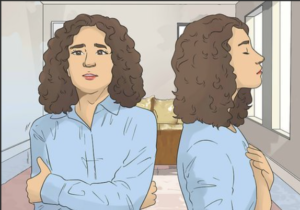
Labeling
Instead of describing a mistake, you label your entire identity negatively.
- Detailed Example: Instead of “I made a mistake,” you say, “I’m useless.”
- Why It Happens: Black-and-white thinking combined with low self-esteem.
- Deeper Impact:
— Deep emotional wounds
— Identity becomes tied to failure
— Prevents personal growth or change
— Can lead to depression or learned helplessness
Discounting the Positive
You dismiss your strengths, efforts, or accomplishments as unimportant or accidental.
- Detailed Example: A client compliments your hard work, and you say, “It was nothing.”
- Why It Happens: Common in people with imposter syndrome, low confidence, or a history of invalidation.
- Deeper Impact:
— Chronic low self-worth
— Difficulty recognising progress
— Loss of motivation to improve
— Dependence on external validation
How Cognitive Distortions Affect Mental Health
When these thinking errors occur repeatedly, they begin to shape how we interpret the world. Over time, cognitive distortions can:
- Intensify stress and anxiety by making situations seem more threatening or overwhelming than they truly are
- Fuel depression by reinforcing hopeless, negative beliefs about oneself, others, and the future
- Increase self-criticism as the mind focuses more on flaws than strengths
- Create or worsen relationship conflicts due to misinterpretations, assumptions, and emotional overreactions
- Reduce problem-solving abilities because distorted thinking limits perspective and blocks rational decision-making
Gradually, these patterns form a negative mental filter, making it harder to see possibilities, strengths, or balanced viewpoints. Distorted thinking doesn’t just affect mood — it influences behaviour, relationships, productivity, and overall emotional well-being. The more these patterns go unchallenged, the more automatic they become, quietly shaping daily life in ways we often don’t recognize.
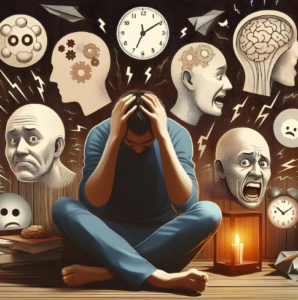
How to Challenge Cognitive Distortions
Recognising cognitive distortions is the first step, but learning how to challenge and reframe them is what truly strengthens emotional well-being. Here are five effective, research-backed strategies that help reshape unhelpful thought patterns:
1. Identify the Distortion
Begin by noticing the thought that is causing stress, anxiety, or a strong emotional reaction.
Ask yourself:
“What exactly am I thinking? Which distortion does this resemble?”
Being able to name the distortion (like catastrophizing or personalization) reduces its power and brings clarity.
2. Examine the Evidence
Challenge the thought by evaluating the facts.
Ask yourself:
“Is this thought based on evidence, or is it driven by feelings and assumptions?”
Look for proof for and against the thought. This helps separate reality from emotional interpretation.
3. Replace With Balanced Thoughts
Once you recognise the distortion, replace the extreme or irrational thought with a more realistic, compassionate one.
Example:
Instead of: “I always fail.”
Try: “I struggled today, but that doesn’t define my ability. I can learn and improve.”
This creates a shift from negativity to growth-oriented thinking.
4. Practice Self-Compassion
Treat yourself the way you would treat someone you care about.
Self-compassion involves:
— Acknowledging your feelings without judgment
— Accepting that mistakes are part of being human
— Speaking to yourself with gentleness instead of criticism
This reduces guilt, shame, and self-blame — the emotions that often fuel cognitive distortions.
5. Reframe the Situation
Look at the situation from a broader or more neutral perspective.
Ask yourself:
“How else can I view this? What is another possible explanation?”
Reframing doesn’t deny the problem — it allows you to see alternative viewpoints instead of being stuck in a single negative interpretation.
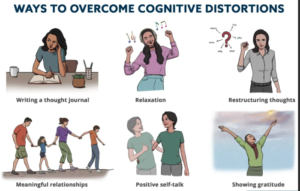
Final Message
Cognitive distortions are a normal part of human thinking — everyone experiences them from time to time. What matters is not eliminating them completely, but becoming aware of when they show up. When you learn to notice your unhelpful thinking patterns, you begin to take back control of your emotional responses instead of letting automatic thoughts dictate how you feel.
By practising mindful awareness, showing yourself self-compassion, and using cognitive reframing, you gradually train your mind to respond with clarity rather than fear, balance rather than extremes, and understanding rather than self-criticism. With consistent effort, these small shifts can build a calmer, clearer, and more resilient inner world — one that supports emotional well-being, healthy relationships, and a stronger sense of self.
Frequently Asked Questions (FAQs)
1. What are cognitive distortions?
Cognitive distortions are irrational or biased thinking patterns that negatively affect how we perceive situations.
2. Why do cognitive distortions happen?
They develop from past experiences, beliefs, and the brain’s tendency to simplify information.
3. Can cognitive distortions cause anxiety?
Yes. They increase overthinking, fear, and stress, contributing to anxiety and depression.
4. What is an example of cognitive distortion?
Catastrophizing—assuming the worst possible outcome without evidence.
5. How can I identify cognitive distortions?
By noticing negative automatic thoughts and questioning their accuracy.
6. Can cognitive distortions be changed?
Yes. With awareness and cognitive restructuring techniques.
7. What therapy helps with cognitive distortions?
Cognitive Behavioral Therapy (CBT) is highly effective.
8. Do cognitive distortions affect relationships?
Yes. They can cause misunderstandings, assumptions, and emotional reactions.
9. How long does it take to change thinking patterns?
It varies, but consistent practice leads to gradual improvement.
10. Is it normal to have cognitive distortions?
Yes. Everyone experiences them—it’s part of human thinking.
Reference
American Psychological Association. (n.d.). Psychology topics. https://www.apa.org
National Institute of Mental Health. (n.d.). Mental health information. https://www.nimh.nih.gov
Beck Institute. (n.d.). Cognitive behavioral therapy resources. https://beckinstitute.org
Verywell Mind. (n.d.). Cognitive distortions overview. https://www.verywellmind.com
Monoprova Counselling, (2026), “About Us”,
Monoprova Counselling, (2026), “Contact Us”,
This article is written for knowledge purposes, aiming to help readers understand the topic better and gain useful insights for learning and awareness.
Pingback: The 5-Minute Habit That Can Improve Your Mental Health
Pingback: Why Do We Feel Nervous Before Important Events?