
“Self-esteem and self-confidence: two forces that look the same but build your life from the inside out.”
Introduction
Most people use the terms self-esteem and self-confidence interchangeably. But psychologically, they are not the same. Understanding the difference is crucial if you want to build genuine emotional strength, healthier relationships, and lasting mental well-being.
In therapy, I often meet people who appear confident on the outside — they speak well, achieve goals, and seem socially active — but internally, they struggle with self-worth, fear of judgment, and feelings of “not being enough.” This happens because confidence and esteem develop differently, serve different purposes, and require different healing paths.
In this detailed guide, you’ll learn exactly what sets them apart, how to assess your own levels, and how to improve both in a balanced way.
What Is Self-Esteem?
Self-esteem refers to your internal sense of worth. It’s the emotional foundation that shapes how you view yourself, how you judge your value, and how you believe others perceive you.
It answers the question:
“Do I believe I am worthy, lovable, and enough?”
Key Features of Self-Esteem:
- Deeply rooted and long-lasting
- Formed through childhood experiences, relationships, and internal beliefs
- Impacts how you handle failure, criticism, and rejection
- Influences emotional resilience and mental health
- Connected to self-respect, identity, and personal boundaries
Healthy Self-Esteem Looks Like:
- You accept yourself despite imperfections
- Treat yourself with compassion
- You don’t tie your worth to achievements
- Maintain boundaries without guilt
- You can handle criticism without breaking down
Low Self-Esteem Looks Like:
- Constant self-doubt and negative self-talk
- Feeling “not good enough” compared to others
- Fear of rejection or abandonment
- Difficulty saying “no”
- Seeking validation to feel valued
- Sensitivity to criticism
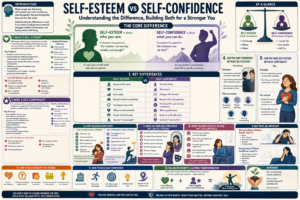
Self-esteem is who you believe you are at your core.
What Is Self-Confidence?
Self-confidence refers to your belief in your abilities and skills. It’s about how capable you feel in specific areas like work, academics, relationships, or social situations.
It answers the question: “Do I believe I can do this?”
Key Features of Self-Confidence:
- Task-specific and can vary from situation to situation
- Learned through experience, practice, and accomplishment
- Visible through behaviour and performance
- Influences decision-making and risk-taking
- Easier to build through training and skill development
Healthy Self-Confidence Looks Like:
- You believe you can learn new skills
- Take initiative and try new things
- You set and achieve goals
- Bounce back after setbacks
- You trust your abilities without arrogance
Low Self-Confidence Looks Like:
- Fear of trying because of possible failure
- Hesitating to speak up
- Avoiding challenges
- Over-relying on others
- Underestimating your abilities
Self-confidence is what you think you can do.
Key Differences Between Self-Esteem and Self-Confidence
Though connected, they are far from identical. Here’s a breakdown:
| Self-Esteem | Self-Confidence |
| Sense of self-worth | Sense of ability |
| Emotional | Behavioural |
| More stable | Changes with situation |
| Rooted in beliefs and identity | Rooted in skills and experience |
| Developed early in life | Developed through learning and practice |
| Affects emotional health | Affects performance |
| Harder to build quickly | Easier to build with action |
| Internal (“I am enough”) | External (“I can do this”) |
A person can be confident but have low self-esteem — and vice versa.
Can You Have Confidence Without Self-Esteem? Absolutely.
This is more common than people realize.
For example:
- A successful teacher may deliver powerful lectures but still feel unlovable in relationships.
- Skilled college student may top exams yet feel worthless when comparing themselves to others.
- A CEO may appear bold in meetings but secretly fear rejection or failure.
These people are highly confident in skills but low in inner worth.
This creates:
- emotional insecurity
- people-pleasing
- perfectionism
- burnout
- fear of vulnerability
They perform well but suffer internally.
Can You Have Self-Esteem Without Confidence? Yes.
Some people feel fundamentally worthy and secure in who they are, but they may lack confidence in certain areas.
For example:
- A person may love and value themselves but fear public speaking.
- Someone may have strong self-worth but avoid trying a new skill.
These individuals are emotionally healthy but may hesitate in performance-based situations.
How Childhood Shapes Self-Esteem and Self-Confidence
Self-Esteem Is Built Through:
- consistent love
- emotional validation
- being accepted as you are
- secure attachment
- support during failures
- respectful communication
When parents are critical, dismissive, or unpredictable, children internalize:
“I am not enough.”
Self-Confidence Is Built Through:
- encouragement to try new things
- celebrating effort, not results
- opportunities to learn
- freedom to experiment
- guidance without overprotection
When children aren’t allowed to try, they internalize: “I can’t do this.”
Signs You Have High Confidence but Low Self-Esteem
This is called the performance–worth gap.
You may notice:
- You achieve a lot but still feel insecure
- Fear others discovering your “flaws”
- You take criticism personally
- Depend on praise to feel good
- You feel empty after success
- Hide your struggles
- You feel like an imposter
This can lead to anxiety, perfectionism, and burnout.
Signs You Have High Self-Esteem but Low Confidence
You may notice:
- You know your worth but avoid new challenges
- Don’t doubt your identity but hesitate in skills
- You prefer staying in your comfort zone
- Worry about failing even though you respect yourself
- You struggle with assertiveness
This can limit growth but doesn’t harm emotional health.
Why Self-esteem and self-confidence Are Important for Mental Well-Being
To thrive emotionally and professionally, you need both:
Having Confidence Without Esteem Leads To:
- burnout
- anxiety
- poor boundaries
- emotional dependence
- fear of failure
Having Esteem Without Confidence Leads To:
- missed opportunities
- limited professional growth
- fear of trying new things
To live a balanced, resilient life, self-worth and self-belief must work together.
How to Build Genuine Self-Esteem (Therapist-Backed)
1. Practice Self-Compassion: Replace self-criticism with validation and kindness.
2. Challenge Negative Core Beliefs: Identify internal beliefs like:
- “I am not enough.”
- “No one will accept me.”
Then dispute them.
3. Build Healthy Boundaries: Saying “no” is a powerful way to honour your worth.
4. Stop Comparing Yourself: Comparison creates insecurity, even when you’re achieving a lot.
5. Surround Yourself With Respectful People: Esteem grows in emotionally safe environments.
6. Heal Past Experiences: Therapy helps address childhood wounds that shaped your self-image.
7. Practice Identity-Affirming Habits: For example:
- positive affirmations
- gratitude journaling
- self-acceptance exercises
- Self-esteem is slow but deep work.
How to Build Strong Self-Confidence (Skill-Based)
Start Small and Master One Skill: Confidence grows through action.
Set Achievable Goals: Break tasks into smaller steps.
Track Your Progress: Seeing improvement boosts self-belief.
Face Your Fears Gradually: Expose yourself to challenges step-by-step.
Learn New Skills Continuously: Skill development builds capability.
Celebrate Small Wins: Acknowledging success strengthens confidence.
Improve Body Language: Posture, eye contact, and tone directly influence confidence.
Confidence grows faster than esteem because it’s experience-based.
The Ideal Zone: High Self-Esteem + High Self-Confidence
When both are strong, life becomes more balanced:
You Are Able To:
- take risks without fear
- handle failure with resilience
- navigate relationships with clarity
- perform well without pressure
- make decisions confidently
- enjoy success without self-doubt
This combination creates emotional stability, inner peace, and personal power.
How Self-esteem and self-confidence Work Together
Think of self-esteem and self-confidence like the roots and branches of a tree:
- Self-esteem is the root. It supports your identity, emotional health, and self-worth.
- Confidence is the branch. It allows growth, action, and skill development.
Roots without branches = strong identity but no outward impact
Branches without roots = big achievements but unstable emotional life
A healthy life requires both.
Final Thoughts
Self-esteem and self-confidence may sound similar, but they shape completely different aspects of your life. Confidence helps you perform, while esteem helps you feel valued.
If you build both intentionally, you become emotionally stronger, more resilient, and more capable of navigating life’s challenges.
You don’t need to be perfect — you only need to understand yourself and take small, consistent steps toward growth.
Frequently Asked Questions (FAQs)
1. What is the difference between self-esteem and self-confidence?
Self-esteem is your sense of self-worth, while self-confidence is your belief in your abilities.
2. Can someone have confidence but low self-esteem?
Yes. A person can perform well but still feel insecure internally.
3. Can Self-esteem and self-confidence be improved?
Yes. Through self-compassion, therapy, and changing core beliefs.
4. How is Self-esteem and self-confidence built?
Through practice, skill development, and repeated success experiences.
5. Why is Self-esteem and self-confidence important?
It affects emotional health, relationships, and how you view yourself.
6. Why do I feel confident in work but insecure in relationships?
Because confidence is situation-based, while self-esteem is deeper and more emotional.
7. What causes low Self-esteem and self-confidence?
Childhood experiences, criticism, rejection, and negative beliefs.
8. Can therapy help improve Self-esteem and self-confidence?
Yes. CBT and other therapies help change negative thinking patterns.
9. How long does it take to build Self-esteem and self-confidence?
Confidence can improve relatively quickly with consistent action.
10. Which is more important: Self-esteem and self-confidence?
Both are important and work best together.
References
merican Psychological Association. (2026). Self-esteem. https://dictionary.apa.org/self-esteem
American Psychological Association. (2026). Self-confidence. https://dictionary.apa.org/self-confidence
National Institute of Mental Health. (2026). Mental health information. https://www.nimh.nih.gov/health
Mayo Clinic. (2026). Mental health and well-being. https://www.mayoclinic.org
Monoprova Counselling, (2026), “About Us”,
Monoprova Counselling, (2026), “Contact Us”,
This article is written for knowledge purposes, aiming to help readers understand the topic better and gain useful insights for learning and awareness.
“The topic has been explained with great clarity. Very useful for readers who are new to psychology.”