
Introduction
Have you noticed that you and your partner, friend, or family member keep having the same argument—over and over—even after talking about it many times? The surface topic may change, but the underlying pattern stays the same. Why arguments repeat is often less about stubbornness and more about deeper emotional, psychological, or communication problems in the relationship.
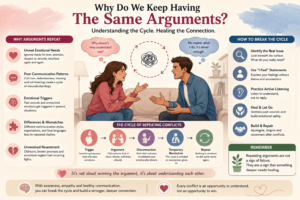
Repeating conflicts usually point to unmet needs, unresolved emotional wounds, communication gaps, or ingrained internal patterns. They’re a signal that something beneath the argument hasn’t been addressed. In this article, we unpack Why Arguments Repeat: the science behind recurring conflicts, common causes, and practical steps to break the cycle so disagreements lead to understanding rather than repetition.
1. Unmet Emotional Needs (Why Arguments Repeat)
When core needs (attention, appreciation, security, respect, affection, autonomy) aren’t named or met, complaints repeat because the underlying hunger stays unaddressed.
Example: One partner says “You never spend time with me,” but really means “I need to feel valued after work,” so they keep bringing it up until that specific need is met.
2. Poor Communication Patterns (Why Arguments Repeat)
Automatic, defensive responses get reinforced. Interrupting or blaming triggers the other’s defense, preventing problem-solving and training both to avoid honest exchange.
Example: A quick ask about groceries ends in “You never listen,” shutting down constructive talk.
Micro-intervention: Try a “pause-and-paraphrase” rule: after your partner speaks, pause 3 seconds and paraphrase their point before responding.
The Four Horsemen (Gottman Institute)
Psychologist John Gottman identified four behaviors that cause repeating conflicts:
- Criticism
- Defensiveness
- Contempt
- Stonewalling
If these show up often, arguments will keep looping.
3. Emotional Triggers From Past Experiences (Why Arguments Repeat)
The brain tags similar present events to painful past memories; the amygdala hijacks reason, producing disproportionate reactions that look like repeating conflicts.
Example: A partner left unchecked at a party triggers panic for someone abandoned as a child.
Micro-intervention: When you notice intensity, say aloud: “This is a trigger for me. I’m going to take five minutes to calm down and come back.”
4. Different Communication Styles (Why Arguments Repeat)
People naturally communicate differently:
- Some are expressive, others are reserved.
- Some want to resolve issues immediately; others need time to process.
- Some prefer logical discussion; others express emotion first.
When these different communication styles clash, conflicts repeat.
Example
Partner A wants to solve arguments instantly.
Partner B needs space to calm down.
Result → Cycle of frustration.

5. Mismatched Love Languages (Why Arguments Repeat)
Repetitive arguments often reflect different emotional languages.
One partner expresses love through acts of service, while the other needs words of affirmation.
Because they feel unloved in different ways, they keep having the same fight:
“You don’t care about me,”
“No, I’m always doing things for you!”
The issue is not love—it’s the miscommunication of love.
6. Power Struggles (Why Arguments Repeat)
In some relationships, conflicts keep repeating because both individuals are fighting for:
- Control
- Validation
- Dominance
- Freedom
- Decision-making power
This often shows up in long-term relationships, marriages, or parent–child dynamics. When the relationship becomes a tug-of-war instead of teamwork, arguments become repetitive.
7. Unresolved Resentment (Why Arguments Repeat)
Resentment is like a silent poison.
It comes from: Broken promises, Past mistakes, Betrayal, Feeling taken for granted, Lack of effort, Emotional neglect. When resentment builds up, even a small issue triggers a big argument—again and again—because the deeper issue was never healed.
Example: A canceled weekend plans after a past pattern of cancellations triggers a flood of anger.
Micro-intervention: Use the “Specific Apology” method: name the hurt, acknowledge its impact, and state one concrete corrective action.
8. Emotional Intensity and Dysregulation
Some people struggle with emotional regulation, meaning they: React quickly, Feel overwhelmed, Struggle to calm down, Interpret criticism strongly, Become defensive or shut down. When emotions rule instead of communication, conflicts escalate and repeat.
Example: A text misread as hostile escalates into a meltdown instead of a calm check-in.
Micro-intervention: Short regulation tools—box breathing (4-4-4-4 for 60 seconds) or grounding (5-4-3-2-1 sensory check)—before replying.
9. Avoidance of the Real Topic
Surprisingly, many conflicts become repetitive because both people avoid the real issue. Surface complaints provide safer territory than vulnerable topics. Avoidance preserves short-term peace but guarantees repetition because root issues aren’t addressed.
Example:
Fighting about dishes or phone usage might actually reflect the feelings: unsupported, unimportant, controlled, disconnected.
The argument keeps switching topics but the root emotion remains untouched.
10. Cognitive Distortions
Automatic negative thoughts distort intentions and amplify threats. These biased interpretations create patterns of accusations and defensive responses. Recurring conflicts often arise from thinking errors, such as:
- Mind reading: “I know you meant to hurt me.”
- Catastrophizing: “This means you don’t love me at all.”
- Overgeneralizing: “You always do this.”
- Personalizing: “Everything bad is my fault or your fault.”
These distortions change how people interpret situations, leading to unnecessary and repetitive conflicts.
11. Attachment Styles
Early attachment creates expectations about responsiveness. When expectations aren’t met, partners follow learned survival strategies—cling or withdraw—creating repeated friction.
Anxious Attachment
- Needs reassurance
- Overthinks
- Fears abandonment
→ Repetitive arguments about closeness, texting, reassurance.
Avoidant Attachment
- Avoids emotional intimacy
- Feels overwhelmed by emotional needs
→ Repetitive arguments about commitment, openness, communication.
Disorganized Attachment
-
Fearful of both closeness and distance
→ Relationship instability and explosive conflicts.
Attachment mismatches often create recurring patterns.
12. Lack of Conflict-Resolution Skills
Many people equate conflict with failure and lack tools to negotiate, apologize, or repair, so solutions are temporary and fights recur. Many people were never taught how to communicate needs, apologize, express emotions, compromise, set boundaries, handle anger. Without these skills, arguments may pause but never truly resolve.
Example: After arguing about chores, they stop talking for days rather than negotiate a schedule.
Micro-intervention: Practice a simple negotiation script: State need, propose one trade-off, and invite an alternative. Commit to one trial week.
13. Expecting the Other Person to Change
Belief that “they must change” removes agency from each person. Without self-led change, patterns persist because the environment doesn’t shift. Arguments repeat when both partners expect the other to: Fix everything, Apologize first, Read their mind, Take the initiative, Understand without explanation. This leads to a stalemate where no one changes behavior, so the conflict loops endlessly.
Example: Repeated “You need to be more romantic” statements with no behavior change.
Micro-intervention: Each partner chooses one small, trackable behavior they will change this month and shares progress.
14. Emotional Disconnection
Low-level disconnection erodes empathy and positive regard, making neutral actions seem hostile and causing repeated fights due to depleted relational “bank account.” When the emotional bond weakens, couples fight more often and about the same things.
Signs include:
- Feeling distant
- Reduced intimacy
- Less interest in each other
- Feeling like roommates
- No longer understanding each other’s emotions
Recurring fights are often a cry for emotional connection.
Example: Silent mornings without check-ins lead to escalating nightly complaints about feeling ignored.
Micro-intervention: Start a 7-day reconnection challenge: 3-minute morning check-ins and one small daily appreciation.
15. Stress, Fatigue, and External Pressure
Stress narrows cognitive bandwidth and reduces patience, turning minor differences into recurring flashpoints. Chronic stress also reduces capacity for repair. Outside pressures also fuel repeating conflicts: Work stress, Financial issues, Family responsibilities, Lack of sleep, Mental health struggles. When people are emotionally exhausted, small issues turn into repeating arguments.
Example: During tax season, both are irritable and old arguments resurface more easily.
Micro-intervention: Acknowledge the stress explicitly and agree to postpone major relationship talks until after the stressful period or set shorter, lower-stakes check-ins.
How to Break the Cycle of Repeating Arguments
1. Identify the Real Issue:
Ask yourself:
“What am I actually upset about?”
“Do I really need?”
“What emotion is underneath this?”
2. Speak in “I Feel” Statements
Replace: “You never listen.”
with: “I feel unheard when I talk and the TV is on.”
3. Practice Active Listening
- Don’t interrupt
- Validate their feelings
- Clarify before reacting
4. Heal Past Emotional Wounds: Old trauma creates new conflict. Therapy or counseling can help both individuals heal communication patterns.
5. Align Expectations : Discuss roles, responsibilities, and boundaries clearly.
6. Learn Your and Their Love Language : Often the conflict stops once emotional needs are met.
7. Manage Emotional Triggers
- Recognize your triggers
- Take breaks during arguments
- Practice emotional regulation
8. Build Repair Rituals : Healthy couples apologize, hug, and reconnect after conflict.
9. Improve Communication Skills: A few important skills:
- Reflective listening
- Assertive communication
- Conflict de-escalation
- Setting boundaries
10. Seek Professional Help if Needed: Recurring conflicts can be healed through relationship counseling, family therapy, or individual therapy.
Conclusion
Repeating arguments are not signs of a bad relationship—they are signs of unresolved emotional needs and miscommunication patterns. The good news is that once you understand the psychology behind recurring conflicts, you can break the cycle.
Relationships thrive not when there are no conflicts, but when conflict leads to understanding instead of repetition.
Reference
1. The Gottman Institute – Conflict Research
2. American Psychological Association (APA) – Relationships
https://www.apa.org/topics/relationships
3. Verywell Mind – Conflict and Communication
https://www.verywellmind.com/relationship-conflict-2302434
4. Greater Good Science Center – Emotional Triggers & Relationships
https://greatergood.berkeley.edu/topic/relationships
5.Emotional Abuse: Subtle Signs Many People Miss