
What if you could stay calm even when your emotions feel completely out of control? Discover the DBT skills that help thousands of people regulate emotions, reduce impulsive reactions, and build lasting emotional resilience.
Introduction
Emotions play a powerful role in our daily lives. They influence how we think, behave, make decisions, and connect with others. But for many people, emotions can sometimes feel overwhelming. Small triggers can turn into big reactions, mood swings may feel uncontrollable, and relationships can suffer because of intense emotional responses.
To help people manage this effectively, psychologist Marsha Linehan developed Dialectical Behavior Therapy (DBT)—a therapy system designed to help individuals regulate emotions, reduce impulsive behaviors, and build healthier coping skills.
This comprehensive guide explores DBT skills for emotional regulation, explaining the concepts in simple language with real-life examples, step-by-step techniques, and actionable strategies. Whether you’re a student, practitioner, parent, or someone wanting to improve your emotional health, this article will give you a deep and useful understanding.
What Is DBT?
Dialectical Behavior Therapy (DBT) is a specialized form of cognitive-behavioral therapy (CBT) designed to help individuals who experience intense emotions, impulsive behaviors, and difficulties in managing emotional distress. Today, DBT skills are widely used not only for treating mental health conditions but also for improving emotional resilience, relationships, and everyday coping.
The term “dialectical” refers to bringing together two seemingly opposite ideas—acceptance and change. Instead of choosing one over the other, DBT teaches that both can exist at the same time.
At the heart of DBT skills is a simple yet powerful principle:
- You can accept your emotions as they are, without judging or suppressing them.
- At the same time, you can learn practical DBT skills to change unhelpful thoughts, behaviors, and emotional reactions that no longer serve you.
This balance between acceptance and change helps people respond to life’s challenges with greater awareness, flexibility, and emotional control.
The Four Core DBT Skills
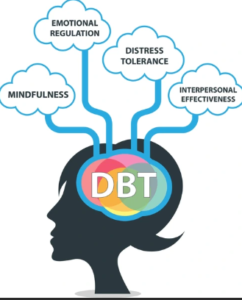
Dialectical Behavior Therapy is built around four evidence-based DBT skills modules, each targeting a different aspect of emotional and psychological well-being:
- Mindfulness – Learning to stay present and aware without judgment.
- Distress Tolerance – Managing crises and painful situations without making them worse.
- Emotional Regulation – Understanding, managing, and changing intense emotions in healthy ways.
- Interpersonal Effectiveness – Building healthier relationships, communicating assertively, and maintaining self-respect.
Together, these DBT skills provide a comprehensive toolkit for managing emotions, reducing impulsive behaviors, and improving overall mental well-being.
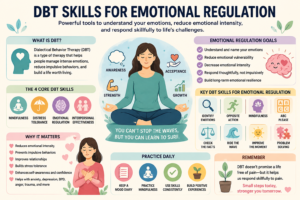
In this article, we’ll focus specifically on DBT Skills for Emotional Regulation—the techniques that help you understand your emotions, reduce emotional vulnerability, respond thoughtfully instead of reacting impulsively, and build long-term emotional resilience.
Why Emotional Regulation Is Important
Emotional regulation is the ability to understand, manage, and respond to your emotions in healthy and balanced ways. Rather than suppressing or ignoring difficult feelings, DBT skills teach you how to recognize emotions, understand their purpose, and respond thoughtfully instead of reacting impulsively.
Strong emotional regulation helps you:
- Understand what you’re feeling and why
- Identify and name emotions accurately
- Manage intense emotions in healthy ways
- Reduce emotional vulnerability
- Respond thoughtfully instead of reacting impulsively
- Make decisions based on values rather than temporary emotions
When emotional regulation is poor, emotions can quickly become overwhelming and interfere with daily life. People may experience:
- Frequent mood swings
- Impulsive decisions they later regret
- Anger outbursts or emotional explosions
- Anxiety, depression, or chronic emotional distress
- Unhealthy coping strategies, such as self-harm, substance use, emotional eating, or social withdrawal
- Ongoing conflicts in personal, family, or workplace relationships
Over time, these patterns can affect mental health, self-esteem, academic or work performance, and overall quality of life.
This is where DBT skills for emotional regulation become invaluable. By learning evidence-based techniques to identify emotions, reduce emotional vulnerability, and manage emotional reactions, individuals can develop greater resilience, improve relationships, and navigate life’s challenges with confidence. Whether you’re experiencing everyday stress or intense emotional difficulties, DBT skills provide practical, real-world strategies to help you regain emotional balance and build lasting psychological well-being.

Understanding Emotions Through DBT skills
Before learning DBT skills, it’s important to understand why emotions exist and the purpose they serve. In Dialectical Behavior Therapy, emotions are not viewed as the enemy. Instead, they are valuable signals that provide information, motivate action, and help us connect with others. The goal of DBT skills is not to eliminate emotions but to understand and regulate them in healthy, effective ways.
1. Emotions Give Us Important Information (DBT skills)
Every emotion has a purpose. Emotions act like an internal guidance system, helping us understand what is happening within us and around us.
For example:
- Fear warns us of potential danger and encourages us to protect ourselves.
- Anger signals that our boundaries may have been crossed or that something feels unfair.
- Sadness often reflects loss, disappointment, or the need for comfort and support.
- Joy reinforces positive experiences and motivates us to repeat them.
Learning to recognize these emotional signals is one of the first DBT skills for emotional regulation.
2. Emotions Motivate Us to Take Action (DBT skills)
Emotions prepare both the mind and body to respond to different situations.
For example:
- Fear encourages us to run away, stay safe, or protect ourselves.
- Anger motivates us to defend ourselves or address an injustice.
- Love inspires us to connect, nurture relationships, and build trust.
While these automatic responses can be helpful, they are not always appropriate. DBT skills teach you how to pause, evaluate the situation, and choose a response instead of reacting impulsively.
3. Emotions Help Us Connect With Others (DBT skills)
Emotions are also a powerful form of communication. Expressing feelings appropriately allows others to understand our experiences and strengthens relationships.
Healthy emotional expression can:
- Build empathy and understanding
- Strengthen trust and emotional intimacy
- Improve communication
- Foster deeper personal and professional relationships
One of the key goals of DBT skills is to help people express emotions in ways that strengthen relationships rather than damage them.
When Do Emotions Become a Problem? (DBT skills)
Emotions themselves are not harmful. Difficulties arise when emotional responses become overwhelming or difficult to manage.
Emotional dysregulation often occurs when:
- Emotions become too intense
- Feelings last longer than the situation requires
- Emotions lead to impulsive or harmful behaviors
- Emotional experiences are misunderstood, ignored, or interpreted inaccurately
When this happens, emotions can interfere with decision-making, relationships, work, and overall mental well-being.
This is where DBT skills for emotional regulation become invaluable. By learning practical techniques to understand emotional triggers, manage intense feelings, and respond more effectively, individuals can build greater emotional resilience, improve relationships, and navigate life’s challenges with confidence.
Key DBT Skills for Emotional Regulation
DBT offers several practical emotional regulation strategies. Here are the major ones, explained in detail.
1. Identify and Label Emotions
You cannot regulate emotions you cannot identify. Many people use vague terms like “bad,” “stressed,” or “upset.” DBT teaches clear emotional labeling.
Primary Emotions Include: anger, fear, sadness, joy, guilt, shame, disgust, love
Steps to Identify Emotions:
- Notice physical sensations: (heart racing, tight chest, sweaty palms)
- Observe your thoughts: (“They don’t care about me,” “I’m in danger”)
- Identify the trigger
- Name the emotion accurately: “I feel angry.” “Feel hurt.” “I feel anxious.”
Why This Helps:
When you name the emotion, the brain becomes calmer. This is known as “name it to tame it.”
2. Reduce Emotional Vulnerability: The ABC PLEASE Skills
DBT teaches that emotional regulation becomes easier when your body and life are in balance.
The acronym ABC PLEASE stands for:
A — Accumulate Positive Experiences
Do small things daily that bring joy: walking, listening to music, spending time with friends, cooking, reading, hobbies. Small doses of daily positivity make the brain more resilient.
B — Build Mastery
Do something daily that makes you feel competent: completing tasks, learning a skill, small achievements. This reduces helplessness and increases confidence.
C — Cope Ahead
Prepare yourself mentally for difficult situations.
Ask:
“What challenges might come up?”
“How will I handle them?”
This reduces impulsive reactions.
PLEASE Skills (Taking Care of the Body)
These skills reduce emotional vulnerability by taking care of your physical health.
- P — Physical Illness : Treat health issues. Don’t ignore symptoms.
- L — Balanced Eating: Avoid overeating, undereating, or emotional eating.
- E — Avoid Mood-Altering Substances: Reduce alcohol, drugs, or excessive caffeine.
- A — Balanced Sleep: Maintain proper sleep hygiene.
- S — Exercise: Movement reduces stress hormones and regulates emotions.
When the body is healthy, emotions become easier to manage.
3. Opposite Action: Changing Emotions by Changing Behavior
This is one of the strongest emotional regulation skills. When your emotion does not fit the facts or is too intense, you do the opposite of what the emotion urges you to do.
Examples:
Emotion: Fear
- Urge: Avoid
- Opposite Action: Approach gradually
Emotion: Anger
- Urge: Attack or shout
- Opposite Action: Speak calmly, walk away
Emotion: Sadness
- Urge: Isolate
- Opposite Action: Reach out, move, engage in activity
Emotion: Shame
- Urge: Hide
- Opposite Action: Make eye contact, speak openly
Why This Works: Behavior sends signals to the brain. When you act differently, emotions change automatically.
4. Check the Facts
Many emotional reactions are based on assumptions, not facts. DBT teaches a structured way to examine whether the emotion fits the situation.
Steps:
- Identify the emotion
- Identify the trigger
- Ask: “What are the facts?”
- Check for assumptions or distortions
- Ask: “Does my emotion fit the facts?”
If yes, use problem-solving.
No, use opposite action.
Example:
- Emotion: Anger
- Thought: “They ignored me purposely.”
- Facts: They were busy in a meeting.
- Better Response: Calm communication.
5. Mindfulness for Emotional Awareness
Mindfulness is the foundation of DBT. It teaches you to observe your emotions without judging them.
DBT Mindfulness Skills Include:
1.Observe: Notice emotions without reacting:
“I feel tightness in my chest.”
2. Describe: Put words to the experience:
“This is anxiety.”
3. Participate: Engage fully in the moment without avoiding.
4. Non-Judgmentally: Do not label emotions as “good” or “bad.”
5. One-Mindfully: Focus on one thing at a time.
6. Effectively: Do what works, not what feels comfortable.
Mindfulness stops emotional spirals before they intensify.

6. Build Positive Experiences (Short-Term & Long-Term)
Positive emotions balance negative ones.
Short-Term Positive Experiences:
- watching a movie
- talking to a friend
- enjoying food
- playing with pets
- listening to music
Long-Term Positive Experiences:
- building a career
- maintaining relationships
- learning long-term skills
- personal goals
- self-development
DBT encourages creating a “positive emotional bank.”
7. Reduce Emotional Intensity with the Wave Skill
Also known as “Ride the Wave.” Emotions are like waves—if you don’t fight them, they rise and fall naturally.
Steps:
- Notice the emotion
- Allow it to rise
- Observe without reacting
- Allow it to fall
- Let it pass naturally
This helps prevent:
- suppression
- impulsive reactions
- emotional overload
8. Use the PLEASE Skill for Preventing Emotional Spirals
As explained earlier, taking care of physical health reduces vulnerability.
Emotional dysregulation is more likely when you are: tired, hungry, sick, dehydrated, stressed, not exercising
Simple self-care strengthens emotional resilience.
9. Improve the Moment (IMPROVE Skill)
When emotions are too intense, DBT offers the IMPROVE technique:
- I — Imagery: Imagine calming scenes.
- M — Meaning: Find purpose in pain.
- P — Prayer: Connect to something larger (spiritual or moral).
- R — Relaxation: Breathing, meditation, body relaxation.
- O — One thing in the moment: Stay grounded.
- V — Vacation: Take a short break.
- E — Encouragement: Be kind to yourself.
This skill is very effective during emotional surges.

10. Problem Solving
When your emotion fits the facts, solve the problem instead of fighting the emotion.
Steps:
- Define the problem clearly
- Brainstorm solutions
- Evaluate pros and cons
- Choose the best option
- Apply the solution
- Review the outcome
This skill reduces helplessness and increases confidence.
Real-Life Examples of DBT Skills for Emotional Regulation
Learning DBT skills becomes much easier when you see how they can be applied in everyday situations. The following real-life examples demonstrate how different DBT emotional regulation skills can help you respond thoughtfully instead of reacting impulsively.
Example 1: Managing Anger in a Relationship
Situation: Your partner hasn’t replied to your messages for several hours.
Initial Emotion: Anger
Automatic Thought: “They don’t care about me.”
DBT Skills Used:
- Check the Facts: Consider alternative explanations. Your partner may be busy at work, driving, or in a meeting.
- Opposite Action: Instead of sending angry texts or making accusations, wait until you’ve calmed down and communicate respectfully.
- Mindfulness: Notice your racing thoughts and physical tension without acting on them immediately.
Outcome: Instead of escalating the conflict, you have a calm and honest conversation, leading to better understanding and a healthier relationship.
Example 2: Anxiety Before an Exam
Situation: An important exam is approaching.
Initial Emotion: Anxiety and fear
Automatic Urge: Avoid studying because it feels overwhelming.
DBT Skill Used:
- Opposite Action: Rather than avoiding the task, commit to studying for just 10 minutes. Once you begin, continuing often becomes much easier.
Outcome: Anxiety gradually decreases, confidence improves, and studying feels more manageable.
Example 3: Coping with Sadness After a Loss
Situation: You recently experienced the loss of a loved one or an important relationship.
Initial Emotion: Deep sadness
Automatic Urge: Withdraw from family and friends and isolate yourself.
DBT Skills Used:
- Build Positive Experiences: Engage in small enjoyable activities, such as taking a walk, listening to music, or spending time with supportive people.
- Ride the Wave: Allow yourself to experience sadness without fighting or suppressing it, knowing that emotions naturally rise and fall.
- PLEASE Skills: Prioritize sleep, balanced meals, physical activity, and overall self-care to reduce emotional vulnerability.
Outcome: Although grief remains, the intensity becomes more manageable over time, allowing healthy emotional healing and gradual re-engagement with daily life.
Example 4: Feeling Emotionally Overwhelmed at Work
Situation: Multiple deadlines, constant emails, and unexpected responsibilities leave you feeling overwhelmed.
Initial Emotion: Panic and emotional overload
Automatic Urge: Shut down, avoid work, or react impulsively.
DBT Skills Used:
- Mindfulness: Pause and notice your thoughts, emotions, and physical sensations without judgment.
- IMPROVE the Moment: Practice deep breathing, visualize a calming place, or take a brief mindful break before returning to work.
- Problem Solving: Prioritize tasks, break large projects into smaller steps, and focus on one task at a time.
Outcome: Stress becomes more manageable, emotions settle, and you regain a sense of control instead of becoming overwhelmed.
These examples demonstrate that DBT skills are not just techniques used in therapy sessions—they are practical life skills that can be applied to relationships, work, education, grief, anxiety, and everyday challenges. With regular practice, these DBT emotional regulation skills help reduce impulsive reactions, strengthen emotional resilience, and improve overall mental well-being.
Benefits of DBT Emotional Regulation Skills
Developing strong DBT emotional regulation skills can transform the way you respond to life’s challenges. Rather than being controlled by intense emotions, you learn to understand them, manage them effectively, and make decisions that align with your long-term goals and values.
With consistent practice, DBT skills can improve emotional well-being, strengthen relationships, and enhance overall quality of life.
1. Reduces Emotional Intensity
One of the primary benefits of DBT skills is learning how to manage intense emotions before they become overwhelming. Instead of feeling consumed by anger, anxiety, sadness, or frustration, you develop the ability to stay calm and respond thoughtfully.
2. Prevents Impulsive Behaviors
Strong emotions often lead to impulsive actions that people later regret. DBT emotional regulation skills help create a pause between emotion and action, allowing you to make healthier choices instead of reacting automatically.
3. Improves Stress Tolerance
Life is full of unexpected challenges. DBT skills increase your ability to cope with stress, uncertainty, and emotional discomfort without becoming overwhelmed or resorting to unhealthy coping strategies.
4. Strengthens Problem-Solving Skills
Rather than reacting emotionally to difficult situations, DBT teaches structured problem-solving techniques that help you evaluate situations objectively and choose effective solutions.
5. Improves Relationships and Reduces Conflict
Better emotional regulation leads to healthier communication, greater empathy, and fewer impulsive reactions. As a result, DBT skills can strengthen relationships with partners, family members, friends, and colleagues while reducing misunderstandings and conflict.
6. Builds Long-Term Emotional Resilience
Practicing DBT emotional regulation skills consistently helps you recover more quickly from setbacks, adapt to change, and handle future challenges with greater confidence and emotional stability.
7. Supports Mental Health Recovery
Research has shown that DBT skills can be highly effective for individuals experiencing:
- Anxiety disorders
- Depression
- Borderline Personality Disorder (BPD)
- Anger management difficulties
- Emotional dysregulation
- Self-harm behaviors
- Stress-related emotional difficulties
These skills are also valuable for anyone seeking to improve everyday emotional well-being, even without a diagnosed mental health condition.
8. Enhances Mindfulness and Self-Awareness
Mindfulness is a core component of DBT skills. As self-awareness grows, you become better at recognizing emotional triggers, understanding your reactions, and making intentional choices instead of acting on autopilot.
9. Improves Communication and Self-Control
By managing emotions more effectively, you can express your thoughts and feelings calmly, communicate your needs more clearly, and handle disagreements without escalating conflict. This leads to healthier interactions and stronger interpersonal relationships.
Who Can Benefit from DBT Skills?
Although DBT was originally developed to help individuals with intense emotional difficulties, DBT emotional regulation skills are beneficial for people of all ages and backgrounds. Whether you’re a student, parent, working professional, caregiver, or mental health practitioner, these practical skills can help you manage stress, improve emotional balance, strengthen relationships, and navigate life’s challenges with greater resilience and confidence.
Who Can Benefit from DBT Emotional Regulation Skills?
Although Dialectical Behavior Therapy (DBT) was originally developed to help individuals with Borderline Personality Disorder (BPD), its evidence-based techniques are now widely used to support people facing a broad range of emotional, behavioral, and mental health challenges. Today, DBT emotional regulation skills are used in clinical settings, schools, workplaces, and everyday life to improve emotional well-being and resilience.
DBT can be especially beneficial for individuals who experience:
- Borderline Personality Disorder (BPD) – Managing intense emotions, unstable relationships, and impulsive behaviors.
- Emotional Dysregulation – Learning to recognize, understand, and regulate overwhelming emotions.
- Anger Management Difficulties – Responding to frustration and conflict in healthier, more constructive ways.
- Anxiety Disorders and Panic Attacks – Reducing emotional reactivity and improving coping strategies during stressful situations.
- Depression – Managing persistent sadness, hopelessness, and emotional withdrawal while building positive experiences.
- Trauma and Post-Traumatic Stress Responses (PTSD) – Developing healthy coping mechanisms for distressing memories, emotional triggers, and heightened emotional reactions.
- Bipolar Disorder – Supporting emotional regulation and coping alongside appropriate medical treatment.
- Impulse Control Difficulties – Reducing impulsive behaviors by creating a pause between emotions and actions.
- Self-Harm or Suicidal Behaviors – Learning safer coping strategies to manage emotional pain and distress.
- Substance Use and Addiction – Replacing unhealthy coping mechanisms with healthier emotional regulation skills.
DBT Skills Are Valuable for Everyone
You don’t need a mental health diagnosis to benefit from DBT skills. These practical emotional regulation techniques can improve the lives of anyone who wants to handle stress more effectively, strengthen relationships, and respond to difficult emotions with greater confidence.
For example, DBT emotional regulation skills can help:
- Students coping with academic stress and exam anxiety
- Parents managing family responsibilities and emotional challenges
- Professionals dealing with workplace pressure and burnout
- Couples seeking healthier communication and conflict resolution
- Caregivers experiencing chronic stress and emotional fatigue
- Anyone looking to improve self-awareness, resilience, and emotional well-being
Because emotions are a natural part of everyday life, DBT skills are not just therapeutic techniques—they are lifelong skills that promote healthier thinking, better decision-making, stronger relationships, and greater psychological resilience. Whether you’re facing significant emotional difficulties or simply want to improve your emotional intelligence, learning DBT emotional regulation skills can help you navigate life’s challenges with greater balance, confidence, and self-control.
How DBT Emotional Regulation Skills Are Applied in Therapy
Learning DBT emotional regulation skills is more than simply understanding psychological concepts—it’s about practicing them consistently until they become part of everyday life. In DBT, therapy sessions focus on helping clients identify emotional patterns, develop healthier coping strategies, and apply new skills to real-life situations.
Rather than offering advice alone, therapists work collaboratively with clients to build practical DBT skills that can be used at home, at work, in relationships, and during stressful situations.
What Happens in a Typical DBT Session?
Although every treatment plan is personalized, a typical DBT session often includes the following components:
- Reviewing Weekly Diary Cards – Tracking emotions, urges, behaviors, and the use of DBT emotional regulation skills throughout the week.
- Analyzing Emotional Patterns – Identifying triggers, thoughts, behaviors, and situations that contribute to emotional distress or impulsive reactions.
- Learning New DBT Skills – Introducing evidence-based techniques such as mindfulness, opposite action, checking the facts, and distress tolerance.
- Practicing Real-Life Applications – Discussing recent situations and exploring how DBT skills could be applied more effectively in similar circumstances.
- Building Healthy Long-Term Habits – Reinforcing consistent practice so emotional regulation becomes a natural response over time.
- Role-Playing Difficult Situations – Practicing communication, boundary setting, and emotional regulation skills in a safe therapeutic environment before using them in everyday life.
- Homework and Skill Practice – Completing exercises between sessions to strengthen confidence and promote real-world application.
- Ongoing Support and Feedback – Reviewing progress, addressing obstacles, celebrating successes, and adapting strategies as needed.
Why Practice Between Sessions Matters
One of the unique strengths of DBT skills training is its emphasis on applying techniques outside the therapy room. Lasting emotional change happens through repeated practice in everyday situations—not just during weekly appointments.
Your therapist helps you recognize opportunities to use DBT emotional regulation skills when facing real-life challenges, such as:
- Managing conflict in relationships
- Coping with workplace or academic stress
- Responding to anxiety or panic
- Regulating anger during disagreements
- Handling disappointment, rejection, or criticism
- Navigating major life changes and uncertainty
With consistent practice, these skills become more automatic, making it easier to respond thoughtfully instead of reacting impulsively.
The Goal of DBT Therapy
The ultimate goal of DBT emotional regulation therapy is to help individuals build a life that feels meaningful, balanced, and worth living. By combining acceptance with positive change, DBT skills empower people to understand their emotions, reduce emotional suffering, strengthen relationships, and respond to life’s challenges with greater resilience, confidence, and emotional stability.
How to Practice DBT Emotional Regulation Skills on Your Own
While working with a trained therapist can be highly beneficial, many DBT emotional regulation skills can also be practiced independently. The key is consistency. Small, intentional actions repeated every day can gradually reshape how you respond to stress, manage emotions, and cope with life’s challenges.
Here are some practical ways to strengthen your DBT skills in everyday life:
1. Keep a Daily Mood Diary
Track your emotions, thoughts, behaviors, and triggers each day. Recording your experiences helps you identify emotional patterns, recognize recurring triggers, and monitor your progress over time.
2. Identify Emotional Triggers
Pay attention to the situations, people, thoughts, or events that consistently trigger strong emotional reactions. Greater awareness makes it easier to prepare for and manage difficult emotions before they become overwhelming.
3. Practice Mindfulness Every Day
Spend a few minutes each day observing your thoughts, emotions, and physical sensations without judgment. Regular mindfulness practice strengthens emotional awareness and reduces impulsive reactions.
4. Use Opposite Action When Emotions Become Intense
When your emotions urge you to avoid, withdraw, lash out, or give up, ask yourself whether acting in the opposite direction would be more helpful. This powerful DBT skill can gradually reduce the intensity of unhelpful emotional responses.
5. Observe Emotions Without Immediately Reacting
Instead of trying to suppress or escape uncomfortable emotions, notice them with curiosity. Remind yourself that emotions are temporary experiences that naturally rise and fall over time.
6. Build Positive Experiences
Schedule enjoyable and meaningful activities into your daily and weekly routine. Positive experiences help balance negative emotions and increase emotional resilience over time.
7. Practice the PLEASE Skills
Take care of your physical health by prioritizing adequate sleep, balanced nutrition, regular exercise, and appropriate medical care. Looking after your body reduces emotional vulnerability and makes emotional regulation easier.
8. Develop Problem-Solving Skills
When facing challenges, focus on finding practical solutions instead of becoming overwhelmed by emotions. Breaking large problems into smaller, manageable steps helps increase confidence and reduce stress.
9. Take Short Breaks When Overwhelmed
If your emotions become too intense, pause before reacting. Practice deep breathing, grounding exercises, or take a brief walk to allow your nervous system to settle before making important decisions.
Consistency Creates Lasting Change
Mastering DBT emotional regulation skills doesn’t happen overnight. Like learning any new skill, emotional regulation improves through regular practice. Small daily efforts gradually build healthier habits, greater resilience, and stronger emotional well-being over time.
Common Mistakes People Make When Practicing DBT Skills
Learning DBT skills is a process, and setbacks are a normal part of growth. Recognizing common mistakes can help you use these techniques more effectively and stay motivated during your emotional regulation journey.
1. Fighting Emotions Instead of Accepting Them
Many people believe they shouldn’t feel anxious, angry, or sad. Trying to suppress or eliminate emotions often makes them stronger. DBT teaches that emotions should first be acknowledged and accepted before deciding how to respond.
2. Waiting Until You Feel Motivated
A common misconception is that motivation must come before action. In reality, DBT skills encourage taking small, purposeful actions even when motivation is low. Consistent action often leads to increased motivation over time.
3. Relying on Unhealthy Coping Strategies
Avoidance, emotional outbursts, substance use, emotional eating, or social withdrawal may provide temporary relief, but they rarely solve the underlying problem. Replacing these habits with healthier DBT emotional regulation skills leads to more sustainable emotional well-being.
4. Neglecting Mindfulness Practice
Mindfulness is the foundation of all DBT skills. Skipping mindfulness makes it more difficult to recognize emotional triggers, pause before reacting, and choose effective coping strategies.
5. Ignoring Physical Health
Poor sleep, inadequate nutrition, chronic stress, illness, and lack of exercise can increase emotional vulnerability. Caring for your physical health is an essential part of emotional regulation and should never be overlooked.
Progress Matters More Than Perfection
Developing strong DBT emotional regulation skills is an ongoing journey rather than a destination. There will be days when using these skills feels easier and days when it feels more challenging. What matters most is continuing to practice with patience, self-compassion, and consistency. Over time, these small daily efforts can lead to meaningful improvements in emotional resilience, healthier relationships, and overall psychological well-being.
Conclusion
DBT emotional regulation skills provide practical, evidence-based techniques for understanding and managing emotions more effectively. By learning skills such as mindfulness, identifying emotions, Opposite Action, ABC PLEASE, Check the Facts, Ride the Wave, IMPROVE the Moment, and problem-solving, you can reduce emotional intensity, respond thoughtfully instead of reacting impulsively, and build lasting emotional resilience.
DBT doesn’t promise a life free of emotional pain, but it teaches you how to navigate difficult emotions with greater awareness, confidence, and self-control. With regular practice, these DBT skills can improve your emotional well-being, strengthen relationships, and help you lead a more balanced and fulfilling life.
Reference
-
American Psychological Association – DBT Overview
https://www.apa.org -
National Institute of Mental Health – Therapies
https://www.nimh.nih.gov -
NHS UK – DBT Information
https://www.nhs.uk -
Psychology Today – DBT Skills Explained
https://www.psychologytoday.com -
Verywell Mind – Emotional Regulation Techniques
https://www.verywellmind.com -
What Is CBT? A Simple Guide for Everyone
/what-is-cbt-guide -
Signs of a Toxic Relationship
/toxic-relationship-signs
Pingback: Sign of a Trauma Bond Psychology Backed Relationship Pattern
Pingback: Screen Addiction in Children: A Modern Parenting Crisis
Pingback: Invisible Signs of Depression Most People Ignore