
Introduction
Procrastination is not about laziness. It is a deep psychological behavior rooted in emotion, avoidance, fear, and brain chemistry. People procrastinate not because they don’t want to work, but because their brain wants to avoid discomfort, escape negative emotions, or seek temporary pleasure.
Whether you’re a student delaying assignments, a professional postponing deadlines, or someone who puts off life goals, procrastination can feel like an invisible force controlling your life. But once you understand the real psychology behind it, you can break the pattern with strategies that actually work.
This article explores the science of procrastination, the emotional and cognitive reasons behind it, and powerful evidence-based techniques to overcome it.
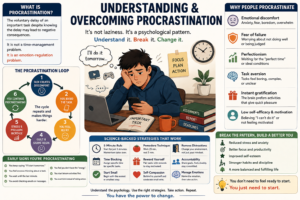
What Is Procrastination?
Procrastination is the voluntary delay of an important task despite knowing that the delay may lead to negative consequences. Almost everyone procrastinates occasionally, but when it becomes a repeated pattern, it can interfere with academic performance, work, relationships, and emotional well-being.
Although procrastination may look like a time-management problem, research suggests that emotion regulation plays an important role. People often delay tasks not because they do not understand what needs to be done, but because starting the task brings uncomfortable emotions such as anxiety, boredom, frustration, self-doubt, or fear of failure.
For example: You have an important report to complete. You know it is due tomorrow, but the thought of starting makes you feel overwhelmed. Instead of opening the document, you check social media, watch a video, or do something that feels easier. For a moment, you feel relieved.
Why does this happen?
The brain tends to move toward activities that provide immediate relief or reward and away from situations that feel uncomfortable. When avoiding the task reduces discomfort, that relief can reinforce the avoidance. Later, the approaching deadline creates guilt, stress, and anxiety, making the task feel even more difficult.
This creates what we can call the “Procrastination Loop”:
Uncomfortable task → Avoidance → Temporary relief → Guilt and stress → Greater pressure → More avoidance
Understanding this cycle is important because overcoming procrastination is not simply about creating a better schedule. It also involves learning to tolerate uncomfortable emotions, reduce avoidance, and take action even when motivation is low.
Why People Procrastinate: The Psychology Behind It
Procrastination rarely has a single cause. People may delay tasks because of uncomfortable emotions, fear of failure, perfectionism, low confidence, task aversion, difficulty with executive functioning, or a preference for immediate rewards. Understanding the reason behind the delay is important because different forms of procrastination require different strategies.
1. Emotional Discomfort
Many tasks trigger uncomfortable emotions such as anxiety, fear, boredom, frustration, or overwhelm. When starting a task feels unpleasant, avoiding it can provide immediate emotional relief.
For example: You need to make an important presentation, but you feel overwhelmed because you do not know where to begin. Instead of opening the presentation, you start scrolling through social media. Within minutes, the anxiety temporarily decreases.
Why does this happen?
Avoidance can provide short-term relief, which reinforces the tendency to avoid the task again in the future. The problem is that the relief is temporary—the task remains unfinished, and the resulting guilt or stress may make it even harder to start.
2. Fear of Failure
Fear of failure is another common reason people procrastinate. Thoughts such as “What if I fail?”, “What if people judge me?”, or “Maybe I am not capable enough” can make starting a task emotionally threatening.
For example: A student has to submit an assignment but worries that the work will not be good enough. Instead of submitting something imperfect, they keep postponing it.
Why does this happen?
Delaying the task temporarily protects the person from confronting the possibility of failure. In this sense, procrastination can become an avoidance strategy for protecting self-esteem.
3. Fear of Success
Although less commonly discussed, some people may also procrastinate when success itself feels uncomfortable.
For example: Someone receives an opportunity to apply for a better job but repeatedly delays submitting the application. They may worry that getting the position will bring greater responsibility, higher expectations, or increased visibility.
Why does this happen?
Success can sometimes create uncertainty about what comes next. For individuals who associate achievement with pressure or responsibility, avoiding the opportunity may feel safer than facing those changes.
However, fear of success should not be assumed whenever someone procrastinates. It is better understood as one possible psychological factor rather than a universal explanation.
4. Perfectionism
Perfectionism can make starting a task feel impossible because the person believes it must be done exceptionally well.
For example: A writer wants to create the “perfect” first paragraph, so they spend hours researching, reorganizing their ideas, and waiting for the right moment to begin. Eventually, very little gets written.
This can lead to:
- Overplanning
- Overthinking
- Excessive checking
- Delayed starts
- “All-or-nothing” thinking
Why does this happen?
When mistakes feel unacceptable, beginning a task creates pressure to perform perfectly. Avoiding the task temporarily protects the person from that pressure.
Sometimes the goal is therefore not to “do it perfectly”, but simply to “start with a first draft.”
5. Task Aversion
Some tasks are naturally more difficult to start because they are boring, complicated, frustrating, repetitive, or unclear.
For example: Cleaning a room, completing paperwork, studying a difficult chapter, or writing a long report may feel far less appealing than watching YouTube or checking social media.
Why does this happen?
People tend to be more motivated toward activities that feel rewarding or enjoyable in the present. When a task offers little immediate satisfaction and requires sustained effort, competing activities can become more attractive.
This is why a person may say:
“I know I need to do it, but I just don’t feel like doing it.”
The problem is not always a lack of knowledge about what to do. Sometimes it is difficulty tolerating the unpleasant experience of doing it.
6. Lack of Structure
When tasks have no clear starting point, deadline, or routine, they can become easier to postpone.
For example: “I need to study psychology this week” is vague. There is no specific time, topic, or starting action. As a result, it is easy to keep saying, “I’ll do it later.”
Why does this happen?
Ambiguous tasks require more planning and decision-making. A clear structure reduces this mental burden.
- Compare: “Study tomorrow.”
- with: “At 7 PM tomorrow, I will study Chapter 3 for 30 minutes.”
The second plan provides a specific behavioral cue and makes starting easier.
7. Low Self-Efficacy
Self-efficacy refers to a person’s belief in their ability to successfully perform a particular task.
When someone repeatedly thinks “I can’t do this,” “I’m not good at this,” or “I’ll probably fail anyway,” starting the task can become more difficult.
For example: A student who believes they are “bad at mathematics” may avoid opening their mathematics book even before attempting the problems.
Why does this happen?
Low confidence can reduce willingness to invest effort in a task. Avoidance then prevents the person from gaining successful experiences, which can further reinforce the belief that they are incapable.
Breaking the cycle often starts with small, achievable tasks that create evidence of competence.
8. ADHD and Executive Dysfunction
Procrastination can be particularly challenging for people with ADHD, where difficulties with executive functioning may affect task initiation, planning, organization, working memory, time management, and sustained attention.
For example: A person with ADHD may genuinely want to complete an assignment but struggle to transition from another activity, estimate how long the task will take, or organize the first steps.
Procrastination can also occur alongside anxiety, depression, trauma-related difficulties, and other mental health conditions. However, these conditions do not automatically cause procrastination, and procrastination alone cannot be used to identify a diagnosis.
Why does this matter?
When executive functioning is part of the problem, simply telling someone to “be more disciplined” may not be enough. External structure, breaking tasks into smaller steps, reminders, environmental changes, and professional support may be more useful.
9. Instant Gratification and the Reward System
One reason procrastination can feel so difficult is the competition between immediate rewards and delayed rewards.
Social media, games, entertainment, and other enjoyable activities provide immediate stimulation. In contrast, studying for an exam or completing a long report may require significant effort before any meaningful reward is experienced.
For example: You have two choices: spend 30 minutes finishing a difficult report or watch entertaining videos for 30 minutes. The video provides an immediate reward, while the benefit of completing the report may not appear until much later.
Why does this happen?
Human behavior is strongly influenced by reward and reinforcement. Immediate rewards can be more psychologically compelling than rewards that are delayed.
It is therefore misleading to describe this simply as “fast dopamine versus slow dopamine.” Dopamine is involved in motivation, learning, and reward-related processes, but procrastination cannot be explained by dopamine alone.
The more useful concept is immediate gratification versus delayed reward.
10. Decision Fatigue
Having to make too many decisions can increase mental strain and make task initiation more difficult.
For example: Instead of simply starting work, you spend 20 minutes deciding which task to do first, which method to use, where to work, what to study, and what resources to open. Eventually, you feel mentally tired and do nothing.
Why does this happen?
When the starting process involves too many choices, the task itself can feel more difficult. Creating routines, preparing materials in advance, and deciding priorities beforehand can reduce unnecessary decision-making.
11. Low Motivation
Many people wait to feel motivated before starting a task.
But motivation does not always come first.
For example: You may not feel like exercising, studying, or writing. However, after starting for just five minutes, the task may become easier to continue.
Why does this happen?
Taking action can create progress, and progress can increase motivation. This is particularly relevant to behavioral approaches, where changing behavior can gradually influence thoughts, emotions, and motivation.
- Instead of waiting for: “I feel motivated → I will start.”
- Try: “I will start → I may feel more motivated as I make progress.”
The key is not to wait until you feel ready. Sometimes, starting creates the feeling of readiness.
The Procrastination Cycle Explained
Procrastination often works like a repeating psychological loop. A task creates discomfort, avoidance provides temporary relief, and that relief makes avoidance more likely the next time a similar situation occurs. Over time, guilt, stress, and approaching deadlines add more emotional pressure, making the original task feel even harder.
Step 1 — A Task Creates Discomfort
The task may feel too difficult, boring, confusing, or emotionally threatening.
You may think: “I don’t know where to start.” “This feels too big.” “What if I can’t do it?”
The discomfort creates an urge to escape from the task.
Step 2 — You Avoid the Task
Instead of starting, you turn toward something easier or more enjoyable.
You might:
- Scroll through social media
- Watch YouTube
- Clean unnecessarily
- Check messages
- Take a nap
- Start another less important task
The important point is that avoidance does not remove the task—it only postpones it.
Step 3 — You Feel Temporary Relief
For a short time, you feel better.
The anxiety decreases. The pressure feels lighter. You may think: “I’ll do it later.”
This temporary relief is important because it can reinforce avoidance. Your brain learns that escaping the uncomfortable task makes you feel better—at least for the moment.
Step 4 — Guilt and Self-Criticism Begin
As time passes, you remember that the task is still unfinished.
You may start thinking: “I wasted so much time.” “Why do I always do this?” “I should have started earlier.”
Guilt and self-criticism can increase emotional discomfort, making the task feel even more threatening.
Step 5 — Stress and Pressure Increase
The deadline gets closer, and the consequences become more immediate.
What originally felt like a manageable task may now feel like an emergency.
For example, an assignment that could have been completed comfortably over three days may now need to be completed in one night.
Step 6 — The Cycle Repeats
The increased stress creates even more discomfort, which can trigger further avoidance.
Task → Discomfort → Avoidance → Temporary Relief → Guilt → Stress → More Avoidance
This creates the Procrastination Loop.
How Do You Break the Cycle?
The solution is not simply to create a better timetable. You also need to change what happens between discomfort and avoidance.
Instead of trying to eliminate every uncomfortable feeling, practise responding differently:
Notice the emotion → Accept the discomfort → Start with a tiny step → Continue before motivation arrives
- For example, instead of saying: “I need to finish this entire report.”
- say: “I only need to open the document and write the first sentence.”
The goal is to teach yourself that discomfort does not have to lead to avoidance.
Breaking procrastination therefore involves both behavioral action and emotional regulation. You do not need to feel completely ready, confident, or motivated before beginning. You need to learn that you can take action even while uncomfortable.
Different Patterns of Procrastination
Not everyone procrastinates for the same reason. One person may delay because they want everything to be perfect, while another may feel overwhelmed by the size of the task. Understanding your personal pattern of procrastination can help you choose a strategy that addresses the real problem.
1. The Perfectionist
The perfectionist delays because the task never feels good enough to begin.
For example: A student keeps rewriting the first page of an assignment because they want it to be perfect before moving forward.
What is happening?
The fear of making mistakes creates pressure, and postponing the task temporarily reduces that pressure.
2. The Overwhelmed Procrastinator
The overwhelmed procrastinator sees the task as too large, too complicated, or too many things at once.
For example: A person has ten pending work tasks and spends the entire morning worrying about them without starting any.
What is happening?
When the brain cannot identify a clear starting point, the entire workload can feel threatening. Breaking the task into smaller, specific actions can make it feel more manageable.
3. The Crisis-Maker
The crisis-maker repeatedly delays tasks because they believe they “work better under pressure.”
For example: A professional has a week to complete a report but waits until the night before the deadline because they believe urgency helps them focus.
What is happening?
A deadline creates urgency and temporarily increases arousal and attention. While this may sometimes produce a short burst of productivity, relying on last-minute pressure can increase stress, reduce quality, and create an exhausting cycle.
4. The Avoider
The avoider delays tasks because they fear failure, criticism, judgment, or uncomfortable emotions.
For example: Someone avoids opening an important email because they are worried it may contain criticism from their manager.
What is happening?
Avoidance provides immediate emotional relief. Unfortunately, the longer the person avoids the situation, the more threatening it may feel.
5. The Dreamer
The dreamer is full of ideas but struggles to turn those ideas into consistent action.
For example: Someone has several ideas for starting a business but spends more time imagining possibilities than creating a concrete plan or completing the first step.
What is happening?
The person may enjoy imagining the outcome but struggle with the repetitive, uncertain, or less exciting work required to achieve it.
The solution is often to move from “big vision” to “next action.”
6. The People-Pleaser
People-pleasers may struggle to say no and take on more responsibilities than they can realistically manage.
For example: A colleague agrees to help three coworkers while already having several deadlines of their own. Eventually, everything becomes overwhelming and tasks start getting postponed.
What is happening?
The underlying problem may not simply be poor time management. Difficulty setting boundaries can create an unrealistic workload, which eventually leads to avoidance and exhaustion.
Learning to say “no,” “not now,” or “I don’t have the capacity” can be an important part of breaking the pattern.
7. The Disorganized Procrastinator
This pattern is characterized by difficulty with planning, prioritizing, scheduling, or creating systems for completing tasks.
For example: A person has several deadlines but does not record them anywhere. They remember some tasks only when the deadline is approaching.
What is happening?
Without external structure, important tasks can easily be forgotten, delayed, or repeatedly reconsidered. Calendars, reminders, checklists, time blocking, and clearly defined priorities can reduce this problem.
Why Identify Your Pattern?
You may recognize yourself in more than one of these patterns, and your procrastination may change depending on the situation.
For example, you might be a perfectionist with work, an overwhelmed procrastinator with household responsibilities, and a crisis-maker with deadlines.
The purpose of identifying your pattern is not to label yourself. It is to understand what triggers your procrastination so you can choose the right strategy to change it.
5. Early Signs You’re Procrastinating
Procrastination does not always look like doing nothing. Sometimes it appears as constant planning, unnecessary busywork, checking your phone, or waiting to feel motivated before starting.
You may be procrastinating if:
- Repeatedly tell yourself, “I’ll start tomorrow.”
- Feel anxious or uncomfortable whenever you think about a task.
- Regularly wait until the last minute.
- Avoid opening emails, messages, or notifications because you are worried about what they contain.
- Keep telling yourself you do not have enough energy to start.
- Choose entertainment or easier activities before important tasks.
- Spend more time overthinking than taking action.
- Frequently underestimate how long a task will take.
- Keep preparing to start but rarely actually begin.
Recognizing these patterns early can help you interrupt the procrastination cycle before it turns into guilt, stress, and last-minute pressure.
Science-Informed Strategies to Beat Procrastination
There is no single technique that works for everyone. Effective strategies usually target the specific reason behind the procrastination—whether it is emotional discomfort, task aversion, perfectionism, poor structure, low confidence, or difficulty with task initiation.
1. Use the 5-Minute Start
Instead of telling yourself, “I have to finish this entire task,” commit to working on it for just five minutes.
For example: Instead of saying, “I need to write this entire report,” say, “I will open the document and work for five minutes.”
Why can this help?
The hardest part of procrastination is often starting. A very small commitment reduces the psychological barrier and makes the task feel less threatening. Once you begin, continuing may become easier—but the goal is to make starting manageable, not to rely on motivation suddenly appearing.
2. Break Tasks Into Micro-Steps
Large and vague tasks can create overwhelm. Make the first action as small and specific as possible.
Instead of: “Write the report.”
Try:
“Open the document.”
“Write the title.”
“Write the first sentence.”
Why does this work?
A smaller task requires less mental effort to initiate. Completing one small step can also create a sense of progress, making the next step easier to approach.
3. Use the 2-Minute Rule
If a task genuinely takes only a couple of minutes, consider completing it immediately instead of adding it to a growing list.
For example: If you need to send a short confirmation email that takes one minute, send it rather than postponing it.
Why can this help?
Small unfinished tasks accumulate and create mental clutter. Completing simple tasks immediately can prevent unnecessary task buildup.
However, do not use the 2-minute rule to avoid more important work by completing dozens of tiny tasks first.
4. Try the Pomodoro Technique
A common approach is: 25 minutes of focused work → 5-minute break
After several cycles, take a longer break.
For example: If studying for an exam feels overwhelming, commit to one 25-minute study session instead of thinking about studying for the entire evening.
Why can this help?
A defined work period creates a clear beginning and end. This can make sustained effort feel more manageable and reduce the temptation to constantly check distractions.
The exact timing does not have to be 25 minutes. Some people work better with 30-, 45-, or 50-minute periods.
5. Change the Environment, Not Just Your Intention
Sometimes the environment makes procrastination easier.
If your phone, social media, or television is constantly available, resisting the distraction requires repeated self-control.
Try:
- Keeping your phone outside the workspace
- Blocking distracting websites
- Turning off unnecessary notifications
- Keeping your desk organized
- Using headphones if they improve concentration
- Working somewhere associated with focused work
Why does this help?
Changing the environment changes the number of distractions you need to resist. Instead of relying entirely on willpower, you make the desired behavior easier and the distracting behavior harder.
6. Use Time Blocking
- Instead of writing: “Study today.”
- assign a specific period: “7:00–7:45 PM: Study Chapter 3.”
Why can this help?
A specific time reduces uncertainty about when the task will happen. It also reduces repeated decisions about what to do next.
7. Start With a Manageable Task
When you feel completely stuck, beginning with a small, clearly defined task can help create a sense of progress.
For example: If your entire room needs cleaning, start by clearing one surface rather than trying to clean everything at once.
Why can this help?
Visible progress can increase confidence and make the larger task feel more manageable. However, the goal is not always to start with the easiest task; sometimes starting with the most important task is better.
8. Use Healthy Rewards
Pairing effort with a reasonable reward can make difficult tasks more reinforcing.
For example: 30 minutes of studying → 10-minute walk or break or Finish one section of the report → make a cup of coffee
Why can this help?
Behavior that is followed by a rewarding consequence is more likely to be repeated. This is a basic principle of behavioral reinforcement.
The reward should support the goal rather than become another source of distraction. For someone who struggles to stop scrolling, using social media as the reward may simply extend the avoidance cycle.
9. Use Implementation Intentions
Implementation intentions turn vague intentions into specific IF–THEN plans.
- For example: “If it is 9 AM, then I will start writing the report.”
- Or: “If I feel like checking social media while studying, then I will write the urge down and continue for five more minutes.”
Why can this help?
The plan connects a specific situation with a specific response, reducing the need to make the decision again in the moment.
10. Set Clear Boundaries
Procrastination is sometimes made worse by having too many competing responsibilities.
Learn to protect your time by:
- Saying no to unnecessary commitments
- Limiting interruptions
- Defining work and rest periods
- Avoiding unnecessary multitasking
- Clarifying priorities
For example: If you are already managing several deadlines, accepting another non-urgent task may create additional overload.
Why does this matter?
A realistic workload makes consistent action easier. Boundaries are not about avoiding responsibility; they are about preventing an unrealistic accumulation of responsibilities.
11. Manage the Emotion Behind the Avoidance
Instead of asking only: “How can I manage my time better?”
ask: “What am I feeling when I think about this task?”
Is it:
- Fear?
- Anxiety?
- Boredom?
- Shame?
- Overwhelm?
- Frustration?
- Self-doubt?
Why can this help?
When you identify the emotion driving the avoidance, you can choose a more appropriate strategy.
For example:
Fear of failure → challenge unrealistic expectations
Overwhelm → break the task into smaller steps
Boredom → use structured work periods
Self-doubt → begin with an achievable task
The goal is not necessarily to eliminate the emotion before acting. It is to learn that you can act while experiencing discomfort.
12. Practise Self-Compassion
After procrastinating, many people respond with harsh self-criticism: “I’m so lazy.” “I always ruin everything.” “I have no discipline.”
This can increase shame and make the task feel even more threatening.
Instead, try: “I avoided this because it felt difficult. I can still take one small step now.”
Why can this help?
Self-compassion does not mean making excuses. It means responding to setbacks without unnecessary self-attack, making it easier to return to the task rather than becoming trapped in guilt.
13. Build Consistency With Tiny Habits
Start with actions that are small enough to repeat consistently.
For example:
- Read for 5 minutes
- Clean for 10 minutes
- Write one paragraph
- Study one concept
- Walk for 10 minutes
Why can this help?
Repeated small actions can gradually become routines. The focus shifts from completing a huge amount of work to building reliable behavior.
14. Use Accountability
Tell someone what you intend to accomplish and report your progress.
For example: Two students agree to study for one hour and message each other after completing the session.
Why can this help?
Accountability creates an external commitment and can reduce the likelihood of quietly abandoning the task.
15. Think About Your Future Self
Ask: “What will my future self thank me for doing today?”
For example: Completing half of an assignment tonight may make tomorrow significantly less stressful.
Why can this help?
Procrastination often involves choosing an immediate benefit—relief or entertainment—over a delayed benefit. Thinking about the future consequences can make the delayed reward more psychologically meaningful.
16. Protect Sleep, Nutrition, and Energy
Procrastination can become harder when you are physically and mentally depleted.
Poor sleep, exhaustion, irregular meals, and prolonged stress can affect attention, mood, decision-making, and self-regulation.
For example: Someone who slept only four hours may find it significantly harder to begin a demanding cognitive task than someone who is well rested.
This does not mean that poor sleep “causes” procrastination, but maintaining basic physical needs can make self-regulation easier.
17. Reduce Digital Distractions
Instead of trying to completely eliminate dopamine, focus on reducing highly distracting digital habits that interfere with your goals.
Try:
- App timers
- Do Not Disturb mode
- Phone-free work zones
- Removing unnecessary notifications
- Logging out of distracting websites
- Keeping social media away during focused work
Why can this help?
Reducing easy access to distractions lowers the number of competing behaviors available when you experience discomfort.
The term “dopamine detox” is often used online, but it is misleading. You do not need to “detox” dopamine. The practical goal is to change your environment and habits around distracting rewards.
18. Create a WIN List
Instead of focusing only on what remains unfinished, write down three to five things you have already accomplished.
For example:
- Completed two emails
- Studied for 30 minutes
- Exercised
- Finished one section of the report
Why can this help?
A WIN list shifts attention from constant self-criticism toward evidence of progress. It can help reduce the feeling that “I did nothing today.”
19. Reframe the Task
The way you describe a task to yourself can influence how you approach it.
- Instead of: “I have to do this.”
- Try: “I choose to do this because it is important to me.”
- Or: “I don’t need to finish everything right now. I only need to complete the next step.”
Why can this help?
Reframing can reduce resistance and connect the task with personal values or meaningful goals.
20. Consider Professional Support
When procrastination is persistent, severe, or connected with anxiety, depression, ADHD, perfectionism, trauma-related difficulties, or significant executive-function problems, professional support may be helpful.
Therapy can help address:
- Chronic avoidance
- Anxiety and fear of failure
- Perfectionism
- Executive-function difficulties
- Low self-efficacy
- Emotional regulation
- Unhelpful thinking patterns
Approaches such as CBT and behavioral interventions can provide practical strategies for changing avoidance patterns and building more effective behaviors.
Long-Term Strategies for Changing Procrastination Patterns
Procrastination is rarely solved by one productive day. Long-term change comes from repeatedly practising behaviors that make starting, continuing, and completing tasks easier.
1. Build Discipline Through Repeated Action
Motivation naturally fluctuates. Instead of waiting for motivation to appear, create routines that make action more predictable.
For example: Studying at the same time each evening can reduce the number of decisions involved in getting started.
Discipline is not about forcing yourself to work constantly. It is about following through on planned actions even when motivation varies.
2. Create Identity-Based Goals
- Instead of: “I want to read more.”
- Try: “I am someone who reads every day.”
The goal becomes connected to the kind of person you want to become rather than a single outcome.
3. Build Predictable Routines
A consistent routine can reduce uncertainty around when and how tasks should be completed.
For example: Wake up → breakfast → study/work → break → exercise → evening routine
Predictability can reduce the number of decisions required throughout the day.
4. Reduce Decision Fatigue
Prepare important decisions in advance.
For example:
- Plan tomorrow’s priorities tonight
- Prepare study materials beforehand
- Decide your first task before ending the workday
- Keep frequently used items in predictable places
This makes starting easier when the next day begins.
5. Celebrate Progress, Not Perfection
Long-term change does not require perfect consistency.
If you planned to work for one hour but managed only 20 minutes, that is still evidence that you took action. Progress creates a sustainable habit more effectively than constant self-criticism.
6. Balance Effort With Reward
Healthy productivity does not mean working continuously.
Alternate periods of focused effort with meaningful breaks, enjoyable activities, exercise, social connection, and rest. The goal is to create a sustainable pattern rather than depending on extreme pressure.
7. Challenge Negative Self-Talk
Notice thoughts such as: “I can’t do this.” “I’m too far behind.” “There is no point starting now.”
Replace them with a more actionable thought: “I don’t have to solve everything. I’ll start with step one.” The goal is not forced positivity. It is replacing unhelpful thinking with something realistic and action-oriented.
8. How Procrastination Can Affect Mental Health
Procrastination and mental health can influence each other. Repeated avoidance may contribute to stress, guilt, self-doubt, and reduced confidence, while anxiety, depression, burnout, and other difficulties may also make task initiation harder.
Chronic procrastination may be associated with:
- Increased stress
- Anxiety
- Shame and guilt
- Lower self-esteem
- Sleep difficulties
- Reduced academic or work performance
- Emotional exhaustion
- Greater psychological distress
For example: A student repeatedly postpones studying, feels guilty, stays awake late to catch up, sleeps poorly, and then struggles to concentrate the next day. The resulting stress makes future studying even more difficult.
This can create a cycle in which procrastination increases distress, and distress makes procrastination more likely.
Breaking the cycle early can therefore support both productivity and emotional well-being.
How to Help Students, Professionals, and Teens Overcome Procrastination
Different groups may need different strategies because their environments, responsibilities, and developmental needs are different.
For Students
Students may benefit from:
- Breaking assignments into smaller steps
- Using realistic study schedules
- Reducing digital distractions
- Studying with an accountability partner
- Asking teachers for clarification when tasks are unclear
- Setting specific study times
Example: Instead of “study for the exam,” create a plan such as “7:00–7:30 PM: revise Chapter 2 and answer five practice questions.”
For Working Professionals
Professionals may benefit from:
- Time blocking
- Clear priority lists
- Project management systems
- Reducing workplace distractions
- Delegating appropriate tasks
- Setting boundaries around unnecessary meetings or requests
The focus should be on prioritizing important work rather than simply staying busy.
For Teenagers
Teenagers may need a combination of structure and emotional support.
Helpful strategies include:
- Predictable routines
- Reasonable digital boundaries
- Breaking schoolwork into manageable tasks
- Emotional awareness
- Supportive parenting
- Encouraging independence
- Focusing on progress rather than constant criticism
Parents should avoid reducing every instance of procrastination to laziness. It may sometimes reflect overwhelm, anxiety, perfectionism, executive-function difficulties, or uncertainty about where to begin.
When to Seek Professional Help
Occasional procrastination is normal. Professional support may be worth considering when procrastination becomes persistent and significantly interferes with daily functioning.
Consider seeking help when procrastination contributes to:
- Repeatedly missing important deadlines
- Academic failure or serious work difficulties
- Risk to employment or education
- Severe anxiety or distress
- Persistent avoidance
- Major disruption to daily responsibilities
- Significant sleep problems
- Feeling unable to control the pattern
- Emotional crises or worsening mental health
A therapist can help identify what is maintaining the procrastination cycle and develop individualized strategies for emotional regulation, behavioral change, executive functioning, and underlying mental health concerns.
The goal is not simply to become more productive. It is to understand why you are avoiding, change the pattern, and build a way of functioning that is sustainable for your mental health.
Conclusion
Procrastination is not a personal flaw or a sign that you are simply lazy. It is a psychological pattern influenced by emotions, thoughts, habits, motivation, and behavior—and it can be changed.
The first step is understanding what is keeping you stuck. Is it fear of failure? Perfectionism? Overwhelm? Boredom? Low confidence? Difficulty with executive functioning? Once you understand the pattern, you can choose strategies that address the real problem rather than simply telling yourself to “try harder.”
Breaking procrastination does not require becoming perfectly disciplined overnight. It starts with small actions, realistic routines, emotional awareness, and consistent practice.
You may not always feel motivated. You may still feel anxious, bored, or uncertain when you begin. That is okay.
You don’t need to feel ready to start.
You just need to take the next small step.
Reference
-
American Psychological Association (APA) – Procrastination psychology
https://www.apa.org -
Harvard Business Review – Productivity & behavioural science
https://hbr.org -
Verywell Mind – Research-backed mental health resources
https://www.verywellmind.com -
Psychology Today – Emotional reasons behind procrastination
https://www.psychologytoday.com - What Is CBT? A Simple Guide for Everyone
- Contact Us