
Joint Family Pressure: Introduction
Motherhood in India is often idealized as a sacred, fulfilling, and naturally joyful experience. Pregnancy and childbirth are traditionally celebrated through rituals, family gatherings, and social blessings. Throughout this period, new mothers are often surrounded by expectations of happiness, gratitude, and emotional strength.However, beneath these celebrations lies a reality that remains largely unspoken: many new mothers experience emotional distress, anxiety, and depression after childbirth. When this vulnerable phase unfolds within a joint family system, joint family pressure can sometimes intensify emotional distress rather than provide the expected sense of support and security.
India’s joint family structure is traditionally perceived as a strong support system for new mothers, offering shared childcare, emotional backing, and practical assistance. Yet, for many women today, joint family living can also become a source of emotional pressure, loss of autonomy, criticism, and silence around mental health struggles. In some households, expectations surrounding childcare, household responsibilities, recovery, and family traditions may create significant psychological stress. Consequently, these stressors can contribute to postpartum depression (PPD), postpartum anxiety, and emotional exhaustion, particularly when adequate emotional support is lacking.
This article explores how joint family dynamics and joint family pressure can influence postpartum mental health in India. It examines cultural expectations, family power hierarchies, gender norms, autonomy, and the silence surrounding maternal mental health, while also discussing practical pathways toward healing, family support, and culturally sensitive interventions.

Joint Family Pressure: Understanding Postpartum Mental Health
Joint Family Pressure: What Is Postpartum Mental Health?
Postpartum mental health refers to a woman’s psychological and emotional well-being after childbirth. The postpartum period can involve significant physical, hormonal, emotional, and social changes, and experiences can vary widely from one mother to another. While some emotional changes are considered temporary and expected, others may be indicative of a mental health condition for which professional support may be required.
Postpartum mental health concerns can include:
- Blues — a common, short-lived period of mood changes, tearfulness, irritability, or emotional sensitivity after childbirth
- Postpartum depression (PPD) — a more persistent condition involving symptoms such as low mood, loss of interest, guilt, hopelessness, or difficulty functioning
- Anxiety — excessive or persistent worry, fear, restlessness, or physical symptoms of anxiety
- Postpartum obsessive-compulsive symptoms — intrusive, unwanted thoughts and repetitive behaviors that can cause significant distress
- Psychosis — a rare but severe psychiatric emergency that can involve confusion, hallucinations, delusions, or marked changes in behavior
Among these conditions, postpartum depression is an important and frequently underrecognized maternal mental health concern in India. However, postpartum mental health should not be reduced to depression alone. Early recognition of a range of emotional and psychiatric symptoms can help mothers receive appropriate assessment, support, and treatment when needed.
Joint Family Pressure: Symptoms of Postpartum Depression
Postpartum depression can affect a mother’s mood, thoughts, behavior, relationships, and ability to manage everyday responsibilities. Common symptoms may include:
- Persistent sadness or emotional emptiness
- Frequent or excessive crying
- Irritability, anger, or feeling easily overwhelmed
- Persistent fatigue, low energy, or changes in sleep
- Feelings of worthlessness, guilt, or inadequacy as a mother
- Difficulty bonding with or feeling emotionally connected to the baby
- Loss of interest or pleasure in activities that were previously enjoyable
- Feelings of hopelessness or thoughts of self-harm or death
In a joint family setting, these symptoms may sometimes be misunderstood as weakness, laziness, disobedience, lack of gratitude, or simply “hormonal drama.” A mother’s experience may be invalidated by such interpretations, and professional help may consequently be delayed or avoided. As a result, genuine symptoms of postpartum depression may remain unnoticed or untreated for longer than they should.
The Joint Family System in India: A Cultural Overview
The joint family system in India typically involves multiple generations living together or maintaining closely interconnected family roles, with parents, adult children, daughters-in-law, grandchildren, and sometimes other relatives sharing the same household. Traditionally, this structure has been associated with:
- Shared responsibilities and household support
- Collective decision-making within the family
- Financial and practical security
- Cultural continuity and intergenerational relationships
For a new mother, a supportive joint family can provide valuable practical assistance, including help with childcare, household responsibilities, meals, and recovery after childbirth. In this sense, family involvement can be an important protective factor during the postpartum period. However, the presence of family support does not automatically mean that a mother feels emotionally supported.
Joint Family Pressure: Changing Realities
Contemporary joint-family dynamics can vary considerably across households. In some families, close intergenerational involvement may coexist with limited emotional privacy or differing expectations about motherhood. Potential challenges may include:
- Reduced emotional intimacy despite physical proximity
- Greater involvement in women’s personal, reproductive, and parenting decisions
- Conflicts between traditional beliefs and evidence-based healthcare recommendations
- Power imbalances between elders and daughters-in-law
- Limited privacy and reduced autonomy during postpartum recovery
These dynamics do not mean that joint families are inherently harmful. Rather, the psychological impact depends on the quality of relationships, level of autonomy, emotional safety, communication, and availability of genuine support within the household. When family involvement becomes controlling, critical, or dismissive, it can add to postpartum stress and may increase vulnerability to anxiety, depression, and emotional exhaustion.
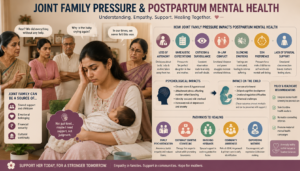
How Joint Family Pressure Impacts Postpartum Mental Health
1. Loss of Autonomy After Childbirth
After childbirth, some women may experience a significant reduction in autonomy over their bodies, routines, and parenting decisions. In a joint family, decisions about breastfeeding, diet, sleep, medical care, postpartum recovery, and the baby’s upbringing may involve several family members. When a mother’s preferences are repeatedly dismissed or overridden, she may begin to feel that she has little control over important aspects of her own life.
This perceived loss of control can contribute to frustration, helplessness, anxiety, and emotional withdrawal. However, it is important not to assume that family involvement itself is harmful; the psychological impact depends largely on whether the mother’s choices are respected and whether support is offered collaboratively.
2. Unrealistic Expectations of the “Ideal Daughter-in-Law”
Postpartum women may face expectations to:
- Resume household responsibilities before they are physically or emotionally ready
- Adjust to family expectations without expressing distress
- Prioritize household needs over their own recovery
- Remain grateful for family “support,” even when that support feels controlling
When rest is interpreted as laziness or emotional distress is dismissed as overreaction, mothers may suppress their needs rather than communicate them. Over time, this pattern of emotional invalidation can increase psychological distress and make it more difficult to seek timely support.
3. Constant Surveillance and Criticism
In some joint-family environments, new mothers may feel closely observed in everyday activities—how they feed or hold the baby, what they eat, how they dress, when they sleep, or how they care for their child. Although advice may sometimes be well-intentioned, frequent unsolicited criticism can undermine a mother’s confidence and create a sense that she is constantly being evaluated.
This can contribute to:
- Heightened anxiety and self-doubt
- Fear of making mistakes
- Reduced confidence in parenting abilities
- Emotional exhaustion and persistent stress
When criticism becomes chronic, it may make the postpartum period feel less emotionally safe and can compound existing vulnerability to anxiety or depression.
4. Mother-in-Law and Daughter-in-Law Conflict
Conflict with in-laws can become an important source of stress during the postpartum period, particularly when there are disagreements about childcare, household responsibilities, health practices, or family roles. Power differences between an older family member and a new mother may make it difficult for the woman to express disagreement or establish boundaries.
When conflict is persistent and emotional support is limited, mothers may feel trapped, unheard, or isolated—even while living in a crowded household. In this context, the problem is not simply the presence of in-laws but the quality of the relationship, level of conflict, and availability of emotional safety and respect.
5. Silencing of Emotional Expression
In some families, openly expressing postpartum distress may be interpreted as:
- Disrespectful
- A sign of weakness
- Something shameful
- A threat to family harmony
Women may instead be encouraged to “adjust,” “compromise,” or simply tolerate their distress. While these responses may be intended to preserve family harmony, they can discourage help-seeking and delay recognition of clinically significant symptoms. As a result, emotional distress may remain hidden until symptoms become more severe.
6. Pressure to Produce a Male Child
Although attitudes are changing, son preference continues to affect some families and communities in India. When a woman gives birth to a girl, she may experience blame, disappointment, emotional neglect, or increased scrutiny. Such gender-based pressure can compound the physical and emotional demands of postpartum recovery.
Importantly, responsibility for a baby’s sex does not lie with the mother. Yet, when harmful gender expectations are directed toward her, they can undermine self-worth, increase emotional distress, and contribute to an environment in which postpartum depression or anxiety may be more difficult to recognize and address.
7. Lack of Spousal Emotional Support
A husband or partner can play a critical role in protecting postpartum mental health. However, in some joint-family households, a partner may assume that other family members are already providing sufficient support. Alternatively, he may avoid conflict by consistently siding with parental authority, leaving the mother feeling emotionally unsupported.
What matters is not simply whether family members are physically present, but whether the mother feels heard, respected, protected, and emotionally supported. Consistent partner support can help reduce the impact of family stress, whereas isolation within a crowded household can intensify feelings of loneliness and helplessness.
Joint Family Pressure: Psychological Mechanisms at Play
The effects of joint family pressure on postpartum mental health are not always immediate or straightforward. Psychological distress can develop through several interconnected pathways, particularly when a mother experiences prolonged criticism, limited autonomy, emotional invalidation, or inadequate support.
Attachment Stress
Postpartum depression, anxiety, and chronic family stress can make it more difficult for a mother to remain emotionally available and responsive when she is overwhelmed. This does not mean that a mother with postpartum depression cannot bond with her baby. Rather, persistent distress, exhaustion, and intrusive thoughts may interfere with opportunities for positive interaction and make bonding feel more difficult.
With appropriate emotional and professional support, many mothers can strengthen their relationship with their infants and develop a secure, responsive bond.
Chronic Stress Response
Ongoing criticism, interpersonal conflict, lack of privacy, and a persistent sense of being unsafe or powerless can maintain a state of heightened psychological stress. Over time, this may contribute to sleep disruption, irritability, anxiety, emotional exhaustion, and difficulties with coping.
It is more accurate to understand this as a chronic stress pathway rather than suggesting that family pressure alone directly causes depression. Postpartum mental health is influenced by multiple biological, psychological, social, and environmental factors, and family stress can be one important contributing factor.
Identity Loss and Role Overload
The transition to motherhood can involve major changes in identity, relationships, routines, and responsibilities. In a joint family, a woman may additionally feel pressure to meet expectations associated with being a daughter-in-law, wife, and mother simultaneously.
When her individual needs, aspirations, and emotional experiences are consistently overlooked, she may begin to feel that her identity has been reduced to family roles. This identity loss and role overload can contribute to low self-worth, emotional exhaustion, and difficulty adjusting to the postpartum period.
Joint Family Pressure: Impact on the Child
Maternal mental health can influence the early parent–child relationship and aspects of child development. When postpartum depression or significant maternal distress remains untreated, research has associated it with difficulties in mother–infant interaction, attachment, emotional regulation, and aspects of cognitive and behavioral development.
However, these outcomes are not inevitable. Children are influenced by multiple factors, including the quality of caregiving, family relationships, socioeconomic circumstances, and access to support. Early identification and treatment of maternal mental health difficulties, together with responsive caregiving and a supportive family environment, can help reduce potential negative effects.
Therefore, addressing joint family pressure is not only about improving a mother’s psychological well-being. Creating an emotionally safe and supportive environment can also contribute to healthier parent–child relationships and more positive family outcomes across generations.
Joint Family Pressure: Why Postpartum Mental Health Remains Ignored in Joint Families
Despite growing awareness of maternal mental health, postpartum distress can remain hidden within family systems where emotional suffering is normalized or difficult to discuss. Several factors may contribute to this silence:
- Mental health stigma — Psychological symptoms may be viewed as a personal weakness or something that should remain within the family.
- Normalization of female suffering — Mothers may be expected to tolerate exhaustion, pain, and emotional distress as simply part of motherhood.
- Limited mental health literacy — Family members may not recognize persistent anxiety, depression, intrusive thoughts, or emotional withdrawal as signs that professional help may be needed.
- Overemphasis on family reputation — Concerns about “what people will say” can discourage women from discussing distress or seeking counseling.
- Limited routine screening and referral — When postpartum mental health is not consistently assessed during maternal and postnatal care, symptoms may go unidentified.
Consequently, a mother may continue to function outwardly while experiencing significant internal distress. Recognizing these barriers is an important first step toward creating a family environment in which asking for help is viewed as a sign of self-care rather than failure.
Pathways to Healing: What Can Help?
Reducing joint family pressure does not necessarily require separating from the family. In many cases, meaningful change can begin with better communication, shared responsibility, clearer boundaries, and greater emotional support for the mother.
1. Family Psychoeducation
Psychoeducation can help family members understand postpartum depression, anxiety, intrusive thoughts, emotional changes, and warning signs that require professional attention. It can also reduce blame and encourage a more empathetic response to the mother’s needs.
2. Culturally Sensitive Counseling
Counseling should recognize the mother’s cultural and family context while still supporting her psychological needs, autonomy, and healthy boundaries. A culturally responsive approach can help women navigate family expectations without dismissing the importance of their individual well-being.
3. Involving Husbands and Partners
Partners can provide an important source of emotional and practical support during postpartum recovery. Listening without judgment, sharing childcare and household responsibilities, supporting appropriate medical care, and advocating for the mother when family conflicts arise can reduce feelings of isolation and helplessness.
4. Community-Level Awareness
Community-based healthcare providers can help identify postpartum mental health concerns early. ASHA workers, Anganwadi workers, auxiliary nurse midwives (ANMs), and primary healthcare providers can contribute to awareness, basic identification of concerns, appropriate referrals, and follow-up within the community.
5. Empowering Mothers
Supporting a mother’s recovery means giving her space to express emotions, rest adequately, participate in decisions about her care and baby, and ask for help without shame. Small changes in autonomy and daily support can make the postpartum environment more psychologically safe.
Policy and Healthcare Recommendations
Improving postpartum mental health requires action beyond the individual level. Maternal healthcare systems and communities can strengthen prevention and early intervention by:
- Integrating mental health screening and assessment into postnatal care
- Training frontline maternal and child health workers to recognize common perinatal mental health concerns
- Establishing clear referral pathways for mothers who require psychological or psychiatric support
- Normalizing counseling and mental health referrals as part of comprehensive maternal healthcare
- Promoting public awareness campaigns that address postpartum mental health stigma and encourage early help-seeking
Together, these measures can help shift postpartum mental health from a private family concern to an important component of maternal and public health.
Conclusion
Joint families in India can provide meaningful practical and emotional support during the postpartum period. However, when joint family pressure involves persistent criticism, limited autonomy, emotional invalidation, or inadequate support, the same family environment can become a significant source of psychological stress for a new mother.
Therefore, postpartum mental health should be understood not only as a medical concern but also within its family, social, and cultural context. Supporting a mother requires more than ensuring that her physical needs are met; it also means respecting her voice, emotional experiences, recovery, privacy, and role in decisions concerning herself and her baby.
Breaking the silence around postpartum mental health requires empathy, education, early identification, accessible professional support, and healthier family communication. Most importantly, seeking help should not be viewed as a failure to fulfill the responsibilities of motherhood or family life. Supporting a mother’s mental health does not undermine tradition—it can help build healthier relationships, more supportive families, and better outcomes for future generations.
References
-
-
World Health Organization. (2022). Perinatal / Maternal mental health — WHO guidance and overview.
https://www.who.int/teams/mental-health-and-substance-use/promotion-prevention/maternal-mental-health. -
Upadhyay, R. P., Chowdhury, R., Waheed, S., et al. (2017). Postpartum depression in India: a systematic review and meta-analysis. Journal of Affective Disorders, 218, 39–46. Full text (PMC):
https://pmc.ncbi.nlm.nih.gov/articles/PMC5689195/ . -
Fisher, J., Cabral de Mello, M., Patel, V., Rahman, A., Tran, T., Holton, S., & Holmes, W. (2012). Prevalence and determinants of common perinatal mental disorders in women in low- and lower-middle-income countries. Bulletin of the World Health Organization, 90(2), 139–149. Full text (PMC):
https://pmc.ncbi.nlm.nih.gov/articles/PMC3302553/ . -
Patel, V., Saxena, S., Lund, C., Thornicroft, G., Baingana, F., Bolton, P., … & Herrman, H. (2018). The Lancet Commission on global mental health and sustainable development. Lancet, 392(10157), 1553–1598. (Commission overview relevant to mental-health burden and system responses.) PDF / PubMed:
https://pubmed.ncbi.nlm.nih.gov/30314863/ — or Lancet page (commission full text). -
Stewart, D. E., & Vigod, S. (2016). Postpartum depression. New England Journal of Medicine, 375, 2177–2186. DOI page / PubMed:
https://www.nejm.org/doi/full/10.1056/NEJMcp1607649. -
Husain, N., et al. (2024). Efficacy of a culturally adapted, cognitive behavioural therapy-based intervention for postnatal depression in British South Asian women (ROSHNI-2). The Lancet. Full text / article page:
https://www.thelancet.com/journals/lancet/article/PIIS0140-6736(24)01612-X/fulltext. - Hormonal Changes After Pregnancy & Their Impact on Mental Health
-