
For many men, mental health struggles do not always look like sadness or tears. Instead, they may appear as anger, emotional numbness, workaholism, isolation, addiction, or even unexplained physical complaints. Behind these behaviors, there can be unspoken stress, loneliness, shame, trauma, or emotional exhaustion. Real Stories can help us recognize these less visible signs and understand that struggling does not make a man weak.
Social expectations around masculinity—“be strong,” “don’t talk,” and “handle it yourself”—can make it difficult for men to acknowledge what they are going through or seek support. Through real-life inspired stories, this article explores common mental health experiences among men and shows how awareness, professional support, and small, consistent changes can create a path toward healing.
Real Stories 1: “I Didn’t Know I Was Depressed Because I Was Still Functioning”
– Rakesh, 38, Corporate Professional
Rakesh had a stable job, a family, and financial security. From the outside, everything looked fine. Inside, he felt empty, irritable, and disconnected. He worked long hours, avoided emotional conversations, and snapped at his wife and children.
He didn’t identify as “depressed” because he was still going to work and meeting responsibilities. It was only after recurring headaches, insomnia, and a panic episode that he sought help.
Turning Point
In therapy, Rakesh realized he was experiencing high-functioning depression. He had learned early in life that emotions were weakness, so he coped by suppressing them.
What Helped
- Psychoeducation about male depression
- Learning emotional language
- Weekly therapy sessions
- Setting boundaries at work
Outcome
Over time, Rakesh reported feeling more present, less irritable, and emotionally available to his family. His biggest realization: “I wasn’t broken—I was exhausted from pretending I was okay.”
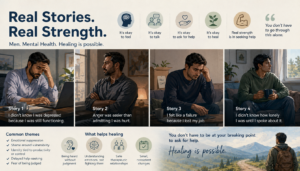
Real Stories 2: “Anger Was Easier Than Admitting I Was Hurt”
– Imran, 42, Small Business Owner
Imran was known for his temper. Family members described him as “short-fused” and “controlling.” What no one saw was his unprocessed childhood trauma—a violent home and constant emotional invalidation.
Whenever he felt criticized or ignored, his nervous system reacted as if he was under threat. Anger became his shield.
Turning Point
After his marriage reached the brink of separation, Imran agreed to counseling—reluctantly.
What Helped
- Trauma-informed therapy
- Understanding anger as a secondary emotion
- Learning grounding and regulation skills
- Exploring childhood emotional neglect
Outcome
Imran didn’t “lose” his anger—he learned to understand it. His reactions softened, and his relationships became less conflict-driven. “Anger was protecting me. Once I felt safe, I didn’t need it as much.”
Real Stories 3: “I Felt Like a Failure Because I Lost My Job”
– Suman, 35, IT Professional
When Suman was laid off during an economic downturn, his self-worth collapsed. He stopped socializing, avoided family gatherings, and felt deep shame. He believed: “If I’m not earning, I’m nothing.”
His anxiety increased, sleep reduced, and he began withdrawing emotionally from his partner.
Turning Point: A friend encouraged him to speak to a counselor, framing it not as weakness but as support.
What Helped
- Challenging identity tied only to productivity
- Career counseling combined with emotional support
- Routine building during unemployment
- Normalizing grief around job loss
Outcome
Suman eventually found new work, but more importantly, he rebuilt a healthier sense of self not solely tied to income. “Losing my job broke my confidence—but rebuilding it changed my life.”
Real Stories 4: “I Didn’t Know How Lonely I Was Until I Spoke About It”
– Arjun, 29, Single, Living Alone
Arjun rarely talked about his feelings. He spent most evenings scrolling on his phone, gaming, or watching shows. Didn’t feel sad—just numb and disconnected.
He believed loneliness was something “weak people” complained about.
Turning Point
During a health checkup, the doctor asked about stress and sleep. For the first time, Arjun admitted he felt invisible.
What Helped
- Normalizing male loneliness
- Group therapy sessions
- Building offline social routines
- Learning to initiate emotional conversations
Outcome
Arjun didn’t suddenly become extroverted, but he developed meaningful connections. “Loneliness wasn’t the absence of people—it was the absence of connection.”
Common Themes Across These Real Stories
Despite different backgrounds, these men shared common experiences:
- Emotional suppression
- Shame around vulnerability
- Identity tied to productivity or control
- Delayed help-seeking
- Fear of being judged
And common healing factors:
- Being heard without judgment
- Understanding emotions, not fighting them
- Safe therapeutic relationships
- Small, consistent lifestyle changes

Why These Real Stories Matter
Men often don’t seek help until:
- Relationships break down
- Physical symptoms appear
- Anger becomes unmanageable
- Burnout sets in
Sharing real stories reduces stigma and sends a powerful message: You don’t have to reach a breaking point to ask for help.
A Message to Men Who Are Struggling
- You don’t need to have the “right words.”
- Don’t need to be falling apart.
- You don’t need to do this alone.
Mental health recovery is not about becoming someone else—it’s about becoming more yourself, with support.
Final Thought
These stories are not about dramatic transformations. They are about men choosing honesty over silence, support over isolation, and healing over endurance.
you can Also Read
7 Signs You Need to Talk to a Therapist — Don’t Ignore These
Top 7 Tools Men Can Use to Track Their Mental Wellness