
What Is Cognitive Behavioral Theory?
Cognitive Behavioral Theory (CBT) is based on a simple but powerful idea:
Thoughts → Emotions → Behaviors
This model explains that human emotions and actions do not arise directly from situations or events, but from the meaning we assign to those experiences. When something happens, the mind instantly interprets it through thoughts—often automatic, habitual, and outside conscious awareness. These thoughts then trigger emotional reactions, which in turn influence behavior.
For example, the same situation can lead to very different outcomes:
- One person may interpret an event as a challenge, leading to motivation and problem-solving.
- Another may interpret the same event as a threat or personal failure, leading to anxiety, sadness, or avoidance.
CBT highlights that emotions feel immediate and uncontrollable, but they are actually cognitively driven. By identifying and examining these underlying thoughts, individuals can understand why they feel the way they do and why they respond in certain patterns.
This principle is central to CBT because it shows that lasting emotional change becomes possible when thinking patterns change. When thoughts become more realistic, balanced, and flexible, emotional responses naturally soften, and behaviors become healthier and more adaptive.
The CBT Triangle: Thoughts, Emotions, Behaviors
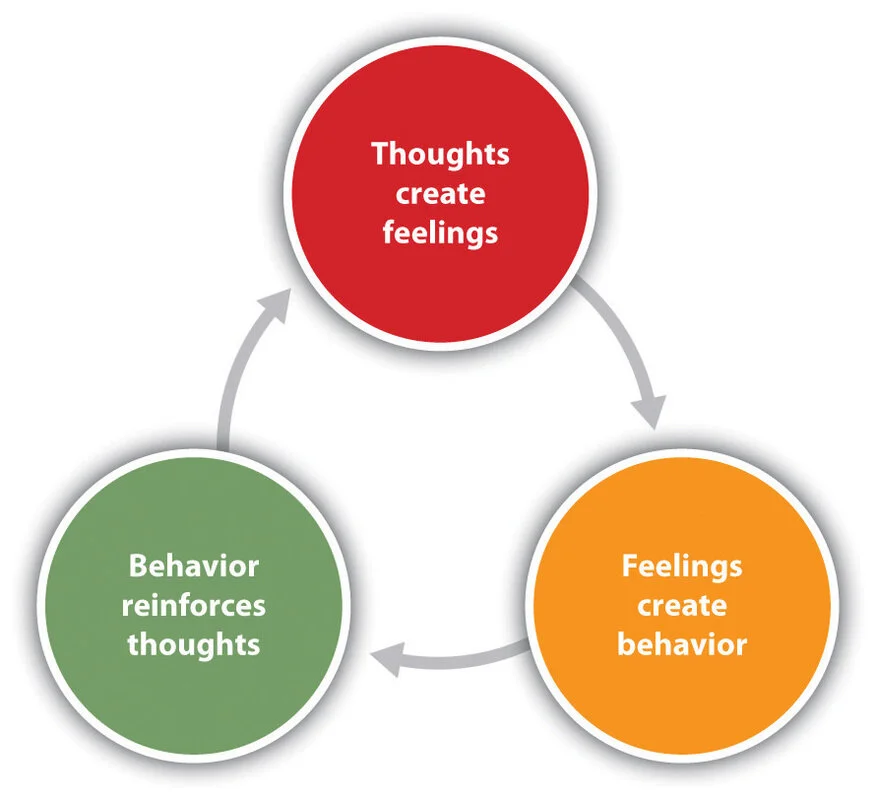
At the heart of Cognitive Behavioral Therapy (CBT) lies the cognitive triangle, a model that explains the constant interaction between thoughts, emotions, and behaviors.
- Thoughts – What we tell ourselves about a situation
- Emotions – How those thoughts make us feel
- Behaviors – How we act in response to those feelings
These three components are deeply interconnected. A change in one automatically influences the others. Negative or distorted thoughts can intensify emotional distress, which then drives unhelpful behaviors. In turn, those behaviors often reinforce the original thoughts, creating a self-maintaining cycle.
Example- You don’t receive a reply to your message. (Situation)
- Thought: “I’m being ignored. I don’t matter.”
- Emotion: Sadness, anxiety, insecurity
- Behavior: Withdrawal, overthinking, repeated checking, avoidance
Here, the emotional pain does not come from the lack of a reply itself, but from the meaning attached to it. The behavior that follows—withdrawal or avoidance—can further reinforce the belief of being unimportant, strengthening the cycle.
Now consider an alternative interpretation:
- Thought: “They may be busy or haven’t seen it yet.”
- Emotion: Mild concern or neutrality
- Behavior: Waiting calmly, continuing daily activities
This shift in thought leads to a completely different emotional experience and behavioral response, even though the situation remains unchanged.
The cognitive triangle illustrates a key CBT principle: by changing the way we think about a situation, we can change how we feel and how we behave. This understanding empowers individuals to break unhelpful cycles and respond to life with greater emotional balance and flexibility.
Why Thoughts Have So Much Power Over Emotions
Thoughts act like mental filters that shape how we interpret events, people, and ourselves. The same situation can feel very different depending on whether it is viewed as a threat, a failure, a challenge, or a learning experience. In CBT, this is a key idea: it is not the event alone that creates emotion, but the meaning the brain assigns to it.
The brain does not respond to facts in a purely objective way. Instead, it responds to interpretation, prediction, and personal memory. This is why a critical comment, for example, may feel motivating to one person but deeply rejecting to another. Past experiences, core beliefs, and emotional learning all influence how a person processes the same event.
CBT emphasizes that emotions may feel automatic, but they are often shaped by underlying cognitive processes. Thoughts can appear so quickly and familiar that people accept them as truth without questioning them. These rapid judgments are often influenced by cognitive distortions such as catastrophizing, mind reading, all-or-nothing thinking, or overgeneralization. When these patterns repeat often enough, they begin to feel normal.
Over time, repeated thoughts strengthen emotional pathways in the brain and influence coping styles, self-esteem, and behavior. A person who repeatedly thinks, “I am not good enough,” may begin to feel anxious, avoid challenges, and interpret setbacks as proof of failure. In contrast, someone who thinks, “I can handle this step by step,” is more likely to feel calmer, stay engaged, and recover more quickly from stress.
This is why CBT places so much importance on identifying, examining, and restructuring thoughts. By changing the way events are interpreted, people can change not only how they feel, but also how they respond.
Automatic Thoughts: The Hidden Drivers
Automatic thoughts are immediate, involuntary cognitions that arise in response to internal or external stimuli. They are typically rapid, brief, and highly accessible to awareness, yet they often occur before deliberate reflection can take place. In cognitive behavioral theory, these thoughts are considered a central link between situations and emotional responses because they shape how an event is interpreted rather than simply how it is objectively experienced.
From a psychological perspective, automatic thoughts are not random. They are strongly influenced by earlier learning experiences, including parenting, attachment patterns, trauma, reinforcement histories, and broader socialization processes. Over time, repeated experiences contribute to the formation of schemas, or deeper cognitive structures, which organize perception and guide interpretation. As a result, a neutral event may be appraised as threatening, rejecting, or humiliating depending on the person’s underlying beliefs.
Common automatic thoughts often reflect core themes of inadequacy, danger, rejection, or failure, such as:
- “I’m not good enough.”
- “Something bad will happen.”
- “People will reject me.”
- “I must not fail.”
These thoughts can activate emotion rapidly and powerfully because the brain responds to perceived meaning, not merely to external facts. Consequently, automatic thoughts may evoke anxiety, shame, anger, sadness, or hopelessness, and they may also influence behavior through avoidance, withdrawal, reassurance seeking, or overcompensation. In CBT, identifying these thoughts is a critical first step in understanding emotional distress and modifying maladaptive patterns of coping.
Cognitive Distortions: When Thinking Becomes Unhelpful
CBT identifies cognitive distortions—systematic errors in thinking that intensify emotional distress.
Cognitive distortions are habitual errors in thinking that cause people to interpret situations in inaccurate, exaggerated, or unbalanced ways. In CBT, these distortions are important because they intensify emotional distress and maintain unhelpful behavior patterns. They often operate automatically and feel convincing, even when they are not based on facts.
All-or-Nothing Thinking
This distortion involves viewing situations in extreme, black-and-white terms.
“If I fail once, I’m a failure.”
There is no room for learning, growth, or partial success. This type of thinking fuels perfectionism, shame, and fear of mistakes, often leading to avoidance or overcompensation.
Catastrophizing
Here, the mind immediately jumps to the worst possible outcome.
A small problem is perceived as a disaster, and the ability to cope is underestimated. This distortion keeps the nervous system in a constant state of alert, strongly linked to anxiety and panic responses.
Mind Reading
Mind reading occurs when we assume we know what others are thinking—usually something negative—without evidence.
Beliefs like “They think I’m incompetent” or “They don’t like me” increase social anxiety, self-doubt, and withdrawal, even in neutral or supportive situations.
Overgeneralization
In overgeneralization, one negative experience is seen as a never-ending pattern.
A single rejection, mistake, or failure becomes “This always happens to me.” This distortion promotes hopelessness and reduces motivation to try again.
Emotional Reasoning
Emotional reasoning involves treating feelings as facts.
“I feel anxious, so something bad must be happening.”
This reinforces fear-based thinking and prevents reality testing, especially in anxiety and depression.
Together, these cognitive distortions magnify emotional pain by repeatedly reinforcing negative interpretations of reality. They also drive maladaptive behaviors such as avoidance, withdrawal, reassurance-seeking, or self-criticism, which further strengthen the original distorted beliefs. CBT works by helping individuals identify these distortions, question their accuracy, and replace them with more balanced and realistic ways of thinking.
How Thoughts Shape Different Emotions
In Cognitive Behavioral Therapy (CBT), emotional difficulties such as anxiety, depression, and anger are understood through the interaction between thoughts, emotions, and behaviors. Each emotional state is maintained by specific thinking patterns that trigger predictable emotional and behavioral responses.
Anxiety
- Thought: “I can’t handle this.”
- Emotion: Fear, panic, intense worry
- Behavior: Avoidance, reassurance-seeking, over-preparation
In anxiety, the mind overestimates danger and underestimates personal coping ability. The thought “I can’t handle this” creates a sense of threat, activating the body’s fear response. Avoidance and reassurance-seeking may reduce anxiety temporarily, but they reinforce the belief that the situation is truly dangerous, keeping the anxiety cycle alive.
Depression
- Thought: “Nothing will change.”
- Emotion: Hopelessness, sadness, emptiness
- Behavior: Withdrawal, inactivity, loss of motivation
Depressive thinking is often marked by hopelessness and negative expectations about the future. When the mind repeatedly tells itself that improvement is impossible, emotional energy diminishes. Withdrawal and inactivity then reduce positive experiences, further confirming the belief that nothing will change.
Anger
- Thought: “I’m being disrespected.”
- Emotion: Rage, frustration, resentment
- Behavior: Aggression, conflict, verbal outbursts
Anger is frequently driven by interpretations of threat, injustice, or disrespect. When situations are automatically viewed as personal attacks, emotional arousal increases rapidly. Aggressive or confrontational behaviors may provide momentary relief but often escalate conflict and reinforce hostile beliefs.
How CBT Helps
CBT helps individuals identify these automatic thoughts, examine their accuracy, and replace them with more balanced interpretations. By intervening at the level of thinking—before emotions intensify—CBT reduces emotional reactivity and supports healthier behavioral choices.
Instead of reacting automatically, individuals learn to respond thoughtfully, breaking cycles of anxiety, depression, and anger before they escalate.
Core Beliefs: The Root of Emotional Patterns
Beneath automatic thoughts lie core beliefs—deeply held assumptions about the self, others, and the world.
Examples:
- “I am unlovable.”
- “The world is unsafe.”
- “I must be perfect to be accepted.”
Core beliefs develop early and strongly influence emotional reactions. CBT works to gradually modify these beliefs through evidence-based questioning and behavioral change.
How CBT Helps Change Emotional Responses
CBT does not aim to eliminate emotions.
It helps people respond to emotions differently by changing unhelpful thinking.
Key CBT Techniques
- Thought monitoring
- Cognitive restructuring
- Reality testing
- Behavioral experiments
- Skill-building (problem-solving, emotion regulation)
As thinking becomes more balanced, emotions naturally become more manageable.
CBT in Everyday Life
CBT is not only for therapy rooms. It applies to daily experiences:
- Handling criticism at work
- Managing relationship conflicts
- Coping with stress and uncertainty
- Reducing overthinking and self-criticism
By learning to question thoughts instead of accepting them as facts, emotional freedom increases.
Misconceptions About CBT
A common misconception is that CBT ignores emotions or tries to dismiss them. In reality, CBT takes emotions seriously and recognizes them as meaningful responses; the goal is to understand the thinking patterns that help generate and maintain those emotional reactions.
Another misunderstanding is that CBT is simply “positive thinking.” CBT does not ask people to replace negative thoughts with unrealistic optimism. Instead, it encourages balanced, evidence-based thinking that is more accurate and more helpful than distorted or overly harsh interpretations.
People also often assume that thoughts are fully conscious and deliberate. In fact, many of the thoughts that shape mood and behavior are automatic, learned over time, and outside immediate awareness. CBT helps people identify these rapid thoughts, examine their accuracy, and develop healthier ways of responding.
Example: If a student gets one low mark on a test, an automatic thought might be, “I’m a failure.” That thought can trigger shame, anxiety, and avoidance. CBT would help the person question that thought and replace it with a more balanced one, such as, “I struggled on this test, but one result does not define my ability.”
Why CBT Is So Effective
CBT is effective because it works at the level of thought patterns that often drive emotional distress. Instead of focusing only on symptoms, it helps people identify and change the underlying beliefs, assumptions, and automatic thoughts that shape how they feel and behave.
It is also highly structured and goal-oriented, which makes it practical and easy to apply in everyday life. People do not just talk about their problems in CBT; they learn specific tools to recognize triggers, challenge unhelpful thoughts, and respond in more adaptive ways.
Another reason CBT is so effective is that it teaches self-help skills. Over time, individuals learn how to observe their thinking, test their assumptions, and make healthier choices on their own. This is why CBT is often described as helping people become their own therapist.
CBT is also strongly supported by scientific research, which has shown its usefulness across a wide range of psychological concerns. Its combination of structure, skill-building, and evidence-based methods makes it one of the most widely used therapeutic approaches today.
Example: Someone who constantly thinks, “I’ll mess this up,” may feel anxious and avoid trying. CBT helps that person notice the thought, evaluate whether it is accurate, and replace it with a more realistic one, such as, “I may feel nervous, but I can prepare and handle this step by step.”
Final Reflection
Life will always bring situations we cannot control. We may not be able to stop difficult emotions from appearing, but we can learn to understand the thoughts behind them. CBT teaches us that thoughts are not facts, and that changing the way we think can transform the way we experience life.
For a stronger closing line, you can end with:
When thoughts change, emotions soften, behavior shifts, and new possibilities begin.
Frequently Asked Questions (FAQ)
1. How does CBT explain emotions like anxiety or depression?
CBT explains that emotions such as anxiety or depression are not caused directly by situations, but by thoughts and interpretations about those situations. When thoughts are negative, rigid, or catastrophic, they trigger intense emotional reactions and unhelpful behaviors.
2. Why do emotions feel automatic if they are driven by thoughts?
Thoughts often occur very quickly and outside conscious awareness, which makes emotions feel sudden and uncontrollable. CBT helps slow down this process so thoughts can be identified and evaluated.
3. How does CBT help with anxiety?
CBT helps people recognize anxious thoughts like “I can’t handle this”, challenge their accuracy, and test alternative perspectives. This reduces fear and gradually decreases avoidance and reassurance-seeking behaviors.
4. Can CBT help with depression and lack of motivation?
Yes. CBT targets hopeless thoughts such as “Nothing will change” and encourages small, meaningful behavioral changes. As thinking becomes more balanced and activity increases, mood often improves.
5. How does CBT address anger issues?
CBT helps identify interpretations related to threat or disrespect, examine evidence for those beliefs, and develop calmer, more assertive responses. This reduces emotional escalation and interpersonal conflict.
6. Is CBT about positive thinking?
No. CBT focuses on realistic and balanced thinking, not forced positivity. The goal is accuracy and flexibility, not denial of problems.
7. How long does CBT take to work?
CBT is usually short- to medium-term. Many people notice changes within a few weeks, especially when skills are practiced consistently outside sessions.
Reference
-
American Psychological Association – Cognitive Behavioral Therapy overview
https://www.apa.org/ptsd-guideline/patients-and-families/cognitive-behavioral -
National Institute of Mental Health – Psychotherapies and CBT
https://www.nimh.nih.gov/health/topics/psychotherapies -
Aaron Beck – Cognitive model of emotional disorders
https://www.simplypsychology.org/cognitive-therapy.html -
World Health Organization – Psychological treatments for mental disorders
https://www.who.int/publications/i/item/WHO-MSD-MER-16.4 - Piaget’s Cognitive Development Theory
This article is written for knowledge purposes, aiming to help readers understand the topic better and gain useful insights for learning and awareness.
Pingback: Information Processing Theory: How Memory Works
Pingback: Learned Helplessness Theory in Psychology
Pingback: Why Arguments Keep Repeating in Relationships
Pingback: Piaget’s Theory of Cognitive Development: 4 Stages Explained