
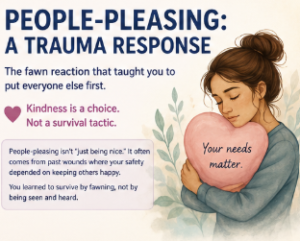
“Think you’re ‘just nice’? Chronic people pleasing can be a trauma response — the fawn reaction that taught you to put everyone else first. Learn how it erodes your sense of self and how trauma-informed boundaries can help you heal.”
If you constantly prioritize others, avoid conflict, and dread disappointing people, you may not be choosing that behavior — you learned it as a survival strategy. For many, people pleasing is the aftermath of childhood emotional wounds: conditional love, unpredictable caregivers, or the unspoken message that safety depended on keeping others calm. Over time this pattern calcifies into the fawn response — an automatic, fear-driven reaction that prioritizes appeasement over authenticity. The consequences go beyond occasional awkwardness. Chronic people-pleasing erodes your sense of self, fuels anxiety and burnout, and leaves relationships unbalanced and one-sided.
This article unpacks how people pleasing forms in early attachment wounds, explains why it often persists into adulthood despite healthier circumstances, and maps its effects on mental health and interpersonal life. Most importantly, it offers trauma-informed, practical steps you can start using today — from nervous-system regulation and boundary experiments to communication scripts and therapy approaches — so you can gradually tolerate discomfort, name your needs, and rebuild reciprocal, honest connections. Read on to understand the roots of your people-pleasing, recognize when it’s driven by trauma, and begin reclaiming a life where kindness is a choice, not a survival tactic.
What Is People Pleasing?
People pleasing is a consistent behavioral pattern in which someone habitually puts others’ needs, comfort, or approval ahead of their own. It’s more than being considerate — it’s an orientation toward other people that shapes decisions, emotions, and identity.
Key characteristics
- Excessive need for approval, praise, or validation.
- Difficulty saying “no,” even when requests are unreasonable or harmful.
- Fear of conflict, criticism, or rejection that drives avoidance or compliance.
- Over-responsibility for others’ emotions (trying to fix, soothe, or prevent others’ discomfort).
- Suppressing or minimizing one’s own needs, feelings, preferences, or opinions.
- Over-apologizing, over-explaining, or self-effacing behavior to reduce perceived threat.
- Chronic people-pleasers often take blame to keep the peace or to feel useful.
How it shows up in daily life
- Agreeing to extra work, favors, or emotional labor despite stress or burnout.
- Staying in unhealthy relationships or friendships to avoid abandonment.
- Changing opinions, preferences, or appearance to match others’ expectations.
- Policing tone and body language constantly to keep others comfortable.
- Avoiding asking for help or advocating for fair treatment.
- Feeling empty or resentful when kindness isn’t reciprocated.
Psychological drivers
- Fear-based learning: past experiences taught that approval = safety.
- Identity fusion: self-worth becomes tied to usefulness and pleasing others.
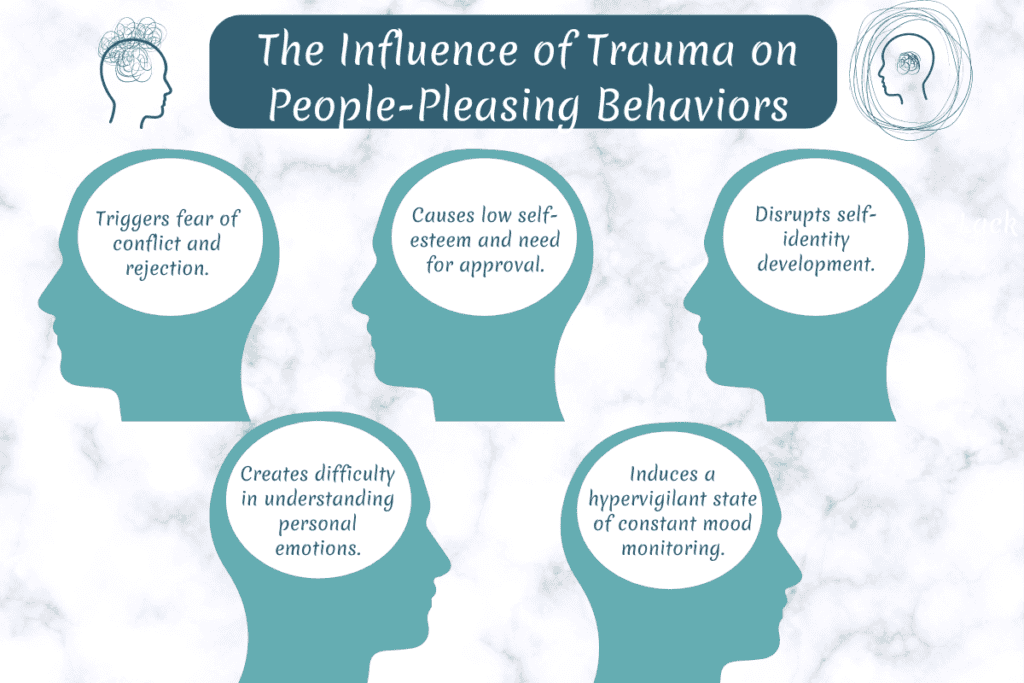
- Hypervigilance: constant monitoring of social cues to predict threat.
- Low interoceptive awareness: difficulty noticing or trusting internal needs and emotions.
- Conditional self-esteem: self-value depends on external validation rather than internal standards.
Short-term benefit, long-term cost
- Benefit: People pleasing often achieves immediate safety — reduced conflict, temporary approval, and social acceptance.
- Cost: Over time it produces burnout, loss of authenticity, anxiety, resentment, and impaired relationships because true needs and boundaries are ignored.
When people-pleasing is adaptive vs. problematic
- Adaptive: Choosing to be helpful out of genuine care, with boundaries preserved (choice-based).
- Problematic: Compulsive, fear-driven pleasing that sacrifices one’s health, values, or voice (trauma-based).
Quick self-check questions
- Do you feel anxious when you imagine someone being disappointed by you?
- You say “yes” more often than you want and then feel resentful?
- Do you change your preferences to fit in or avoid attention?
- You struggle to identify what you want or feel without checking others first?
If you answered yes to several items, this pattern may be entrenched and worth exploring — the good news is that people-pleasing is learnable and reversible with trauma-informed strategies, boundary practice, and self-compassion.
Trauma and Survival Responses
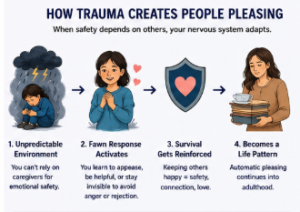
Trauma—especially relational or developmental trauma—rewires how the nervous system evaluates and responds to threat. Beyond fight, flight, and freeze, clinicians now recognize a fourth survival strategy: the fawn response. Fawning means appeasing, placating, or submitting to others to neutralize danger, often by becoming overly helpful, agreeable, or self-sacrificing.
For a child in an unpredictable or emotionally unsafe household, quickly smoothing over anger or minimizing their own needs could be the most reliable route to safety and connection. Over time the nervous system encodes that appeasement equals survival, so in adulthood those patterns can persist automatically: you smile when you want to protest, say yes when you want to refuse, or shoulder responsibility for others’ feelings to avoid conflict. Importantly, people-pleasing is not a moral failing or weakness; it’s an adaptive strategy that once protected you but now may limit your emotional health and relationships.
Trauma reshapes threat responses. Alongside fight, flight, and freeze, the fawn response—appeasing or submitting to avoid harm—often develops in emotionally unsafe childhoods. What began as adaptation can become chronic people-pleasing in adulthood.
How Trauma Creates People Pleasing
People pleasing rarely appears out of nowhere. For many, it grows from childhood survival strategies shaped by unpredictable caregiving, role reversal, or anxious attachment. Below are three common developmental paths that foster chronic people-pleasing, with brief examples and practical steps to begin changing the pattern.
Childhood emotional insecurity
Children who grow up where love feels conditional or caregivers are emotionally unpredictable learn to treat the social environment like a minefield. Instead of exploring their preferences or testing limits, they learn to “read the room” constantly: scanning for signs of anger, silence, or withdrawal and adjusting their words, tone, and behavior to keep tension from rising. When a parent’s affection or approval depends on pleasing them, the child internalizes the practical rule: keep others happy to stay safe. Over time that pattern becomes automatic—choices are filtered through what will avoid upset rather than what reflects the child’s authentic wants.
Vignette: A seven-year-old notices her mother’s mood shift when a guest criticizes the meal. She quickly apologizes and offers to clear the table; the guest smiles and the mother relaxes. The child learns that placating reduces danger and earns approval.
Practical takeaways:
- Reflective prompt: When did you first remember changing yourself to calm someone else? Noting the context helps trace the pattern.
- Small boundary experiment: Practice pausing before agreeing to a request—count to four, then respond. That tiny pause teaches your nervous system that a short discomfort doesn’t equal danger.
- Reframe practice: Replace self-blame thoughts (“I must keep them happy”) with compassionate facts (“I did what kept me safe then; I can choose differently now.”)
Parentification and emotional responsibility
Parentified children take on adult emotional labor: consoling upset caregivers, mediating fights, or becoming the household “peacemaker.” The role communicates early and often that other people’s feelings are the child’s job, while the child’s needs are secondary or irrelevant. This disproportionate responsibility creates beliefs such as “I must fix others to be loved” and “my needs are selfish.” Because these roles are rewarded—through praise, relief, or restored calm—the child learns competence at caretaking at the cost of internal signals that identify their own needs.
Vignette: A teen learns to defuse arguments between parents by changing the subject or promising to help later. The household peace depends on their intervention, and they grow up believing their worth equals usefulness.
Practical takeaways:
- Boundary script: Use short, safe phrases like “I can’t solve that right now, but I care about you” to hold distance without abrupt rejection.
- Self-check: Schedule a weekly 10-minute check-in with yourself—name one need, one feeling, and one small action that meets that need.
- Therapy focus: In counseling, explore role reversal dynamics and practice shifting responsibility back to the appropriate adult.
Fear-based attachment patterns
People pleasing is tightly connected to attachment dynamics. Children raised with inconsistent caregiving often develop anxious or fearful-avoidant attachment—patterns that prioritize connection while simultaneously fearing closeness. The result is a chronic readiness to sacrifice authenticity to preserve bonds: you may flatter, accommodate, or conceal your real feelings because the possibility of rejection feels unbearably risky. As adults, these attachment fears translate into hypervigilance around perceived slights, extreme sensitivity to tone or silence, and a readiness to appease rather than risk honest disagreement.
Vignette: An adult partner notices their spouse’s short text and immediately apologizes for imagined fault, rearranges plans, and over-explains — not because something definite happened, but because the fear of potential rejection is intolerable.
Practical takeaways:
- Anchor practice: Build a brief, calming routine (deep breaths, grounding touch, a mantra) to use when you notice rejection anxiety so you can tolerate uncertainty without immediately smoothing things over.
- Communication rehearsal: Prepare one direct, low-stakes statement to express preference (e.g., “I’d prefer X; can we compromise?”) and practice it aloud until it feels less threatening.
- Attachment work: Learn about your attachment style, and in therapy or structured self-work, practice graded exposure to small risks (e.g., voicing a minor preference) while tracking outcomes to show that connection often survives honest expression.
Signs of Trauma-Based People Pleasing
Not all people pleasing stems from trauma. When it does, however, the pattern is usually intense, automatic, and costly. Trauma-related people-pleasing shows up with a set of recognizable signs that go beyond occasional kindness.
- Intense anxiety when setting boundaries — even small refusals trigger racing thoughts, bodily tension, or dread because your nervous system expects threat.
- Guilt after saying “no” — boundaries feel like moral failures rather than healthy self-care, so you punish yourself with shame.
- Over-explaining decisions — you offer excessive justifications to reduce perceived risk and prevent others’ disapproval.
- Difficulty identifying personal needs — prolonged adaptation to others makes your own preferences, desires, and bodily signals fuzzy or unfamiliar.
- Resentment followed by self-blame — you may feel angry that your needs are ignored, then immediately minimize or apologize for that anger.
- Emotional exhaustion and burnout — constant monitoring and emotional labor deplete capacity for work, joy, and connection.
- Feeling valued only for usefulness — you equate worth with how much you do for others rather than with who you are.
- Hypervigilant outward calm — externally you look easy-going or agreeable, while internally you’re scanning for threats and rehearsing responses.
How this differs from non‑trauma people pleasing
Social or cultural people pleasing may be habit-driven (politeness, social norms) but not accompanied by extreme anxiety, identity loss, or chronic shame. Trauma-based patterns are rooted in survival learning and therefore feel involuntary, urgent, and shame-laden.
Reader prompt (quick self-check)
Which two items on this list feel most familiar to you? Write them down and notice what physical sensations or thoughts appear when you think about saying “no” to someone this week.
Psychological Cost of People Pleasing
When people pleasing becomes a habit, it does more than make you agreeable — it slowly erodes who you are. Rooted often in early survival strategies, trauma-based people pleasing trades authentic wants for approval, leaving you anxious, exhausted, and stuck in one-sided relationships. Below are three common costs—loss of identity, chronic anxiety and burnout, and unbalanced relationships—each with a short example and practical step to start reclaiming yourself.
Loss of self‑identity
When survival depended on adapting to others’ moods and demands, you may have gradually set aside your own preferences, values, and desires. Over years this becomes internalized: choices are filtered through “what will make them happy” rather than “what do I want?” The result is a vague or missing sense of self—hobbies fade, career decisions bend to others’ expectations, and you find it hard to answer simple questions like “what do you want for dinner?” without checking someone else first.
Vignette: At family gatherings, you always take the seat someone else wants, choose the movie they prefer, and smile through conversations you find boring. When asked what you enjoy, you shrug because you’ve learned to prioritize others’ tastes so long you can’t easily access your own.
Practical takeaway:
Identity re-connection exercise: once a week, spend 10 minutes listing three things you like, three you disliked as a child, and one small activity you’ll try this week that’s just for you. Treat this as data-gathering, not a performance.
Chronic anxiety and burnout
Constantly scanning other people’s faces, tones, and likely reactions keeps the nervous system in a low-grade, persistent alarm state. That hypervigilance consumes energy and creates chronic physiological stress—sleep problems, muscle tension, irritability, and difficulty concentrating. Over time this sustained activation contributes to emotional exhaustion, greater susceptibility to depression, and lower capacity for work, creativity, and close connection.
Vignette: You accept extra shifts and emotional favors at work and home to avoid disappointing people. By midweek you’re depleted, snapping at loved ones, and needing long recoveries that never fully restore you.
Practical takeaway:
Micro-regulation practice: build a 60-second grounding routine (three slow breaths, feeling feet on the floor, naming one sensory detail) to use before and after interactions where you otherwise overextend. Small regulatory habits protect energy and reset your nervous system.
Unbalanced relationships
People pleasing creates a relational economy where your usefulness is the currency. Weak or porous boundaries invite partners, friends, and colleagues who expect high accommodation and give little in return. Over time you may find yourself in one-sided relationships with emotionally unavailable or controlling people who exploit your tendency to placate, creating cycles of resentment and deeper withdrawal.
Vignette: A friend calls only when they need a favor; you rearrange plans to help because saying no feels risky. The pattern repeats until you feel used and ashamed for resenting them.
Practical takeaway:
Reciprocity check: for one week, notice the give-and-take in three relationships. If requests and support are more than 70% one-sided, plan one small boundary (e.g., “I can’t help tonight; can we find another time?”) and observe the response. Track outcomes to challenge the assumption that setting limits ruins relationships.
Why People Pleasing Is So Hard to Stop
People pleasing is hard to stop because it worked—sometimes literally saving you from conflict, abandonment, or punishment. Those early successes trained your nervous system to equate appeasement with safety, so the habit persists even after the original danger has passed. Today, saying “no” can still trigger fear, guilt, shame, or a sense of threat because your body treats relational risk like physical danger. That’s why willpower alone usually fails; healing requires learning safety at the body level through gradual exposure, regulation practices, and compassionate self-reframing.
Quick practical step: next time you feel the urge to comply, pause and place a hand on your chest for three slow breaths before responding—this small regulation trick interrupts automatic appeasement and teaches your nervous system there’s no immediate threat.
Healing People Pleasing Patterns
Healing people pleasing begins by treating the pattern as a trauma response, not a character flaw. That shift reduces shame and opens a path to change.
Recognize it as a trauma response
Reframe the story you tell about your behavior: “This kept me safe once; it was adaptive.” Naming the survival function removes self-blame and creates room for curiosity. Practices: write a short compassionate note to yourself describing when pleasing first helped you feel safe; repeat a grounding affirmation before difficult conversations (for example, “I did what I needed to survive. I can learn new ways now.”).
Learn to tolerate discomfort
Boundaries often trigger the nervous system because they introduce uncertainty and possible disapproval. Healing uses graded exposure: start with small, low-risk boundary experiments and increase difficulty as your tolerance grows. Practical steps: practice saying a micro-no (one sentence) in low-stakes situations, pair each attempt with a 60-second regulation routine (three slow breaths, feet on the floor), and journal the actual outcome versus your feared outcome. Over time you’ll train your body to accept discomfort as manageable, not dangerous.
Reconnect with personal needs
Chronic people pleasing blurs internal signals. Rebuilding interoceptive awareness and preferences is a core recovery task. Try these prompts weekly: Current emotional state: ; Primary unmet need: ; One kind action for myself this week: . Experiment with “preference practices” — choose between two equally safe options (what to eat, what to wear) and notice any tension; practice asserting that choice aloud. Small consistent acts of self-attunement rebuild access to your wants and values.
Use therapy and trauma‑informed support
Professional support accelerates change by offering regulation tools, processing attachment wounds, and providing a corrective relational experience. Effective approaches include EMDR, sensorimotor psychotherapy, somatic experiencing, and attachment-focused therapies; cognitive-behavioral techniques and skills training (assertiveness, communication scripts) are also helpful. In therapy, work on pacing exposure to boundaries, mapping family roles (parentification, conditional approval), and practicing new responses with the therapist’s support.
Practical roadmap (starter sequence)
- Week 1: Reframe one self-critical belief into a compassionate fact and do a 60‑second grounding routine daily.
- 2nd Week: Attempt one micro-boundary (a brief, polite “no”) in a low-stakes context; note the outcome.
- Week 3: Complete the weekly needs prompt and schedule one self-directed activity.
- Ongoing: Consider trauma-informed therapy or a support group to practice limits safely.
Remember: people pleasing is a learned survival strategy that can be unlearned. Recovery is gradual and non-linear; compassion, small exposures, nervous-system regulation, and relational support create the conditions for lasting change.
Healthy Care vs People Pleasing
| Healthy Care | Trauma-Based People Pleasing |
|---|---|
| Choice-based | Fear-based |
| Includes self | Self-neglect |
| Has boundaries | Boundary collapse |
| Reciprocal | One-sided |
| Flexible | Compulsive |
Conclusion
People-pleasing is rarely “just niceness.” Often it’s a survival strategy learned in unsafe relationships — and that makes it understandable, not shameful. Healing doesn’t mean becoming selfish; it means relearning that your needs, feelings, and boundaries are safe. With self-compassion, small boundary experiments, and trauma‑informed support, you can rebuild a firmer sense of self and create relationships that value you for who you are.

FAQ
Q1. What does people pleasing mean in psychology?
People-pleasing refers to a pattern of prioritizing others’ needs over one’s own to gain approval, avoid conflict, or prevent rejection.
Q2. How is people pleasing related to trauma?
In many cases, people-pleasing develops as a trauma response, especially after childhood emotional neglect, abuse, or unstable caregiving.
Q3. What is the fawn response?
The fawn response is a trauma-based survival reaction where a person appeases or pleases others to avoid perceived threat or harm.
Q4. Is people pleasing always caused by trauma?
No. Some people-pleasing is learned socially, but chronic, fear-driven people-pleasing is often trauma-related.
Q5. What kind of trauma leads to people pleasing?
Common causes include emotional neglect, verbal abuse, parentification, conditional love, and unpredictable caregivers.
Q6. How does people pleasing affect mental health?
It is linked to anxiety, burnout, resentment, depression, low self-worth, and emotional exhaustion.
Q7. Why do people pleasers feel guilty when they say no?
Because the nervous system associates boundaries with danger, rejection, or abandonment based on past experiences.
Q8. Is people pleasing linked to attachment styles?
Yes. It is commonly associated with anxious and fearful-avoidant attachment patterns.
Q9. How can I tell if my people pleasing is trauma-based?
Signs include intense fear of conflict, identity confusion, emotional hypervigilance, and feeling valued only when useful.
Q10. Why is people pleasing hard to stop?
Because it once worked as a survival strategy. The body remembers it as a way to stay safe.
Q11. Does healing mean becoming selfish?
No. Healing means learning healthy boundaries while still being caring and empathetic.
Q12. Can therapy help with people pleasing?
Yes. Trauma-informed therapy helps regulate the nervous system and rebuild a sense of safety around boundaries.
Q13. What are healthy alternatives to people pleasing?
Assertive communication, self-validation, boundary-setting, and reciprocal relationships.
Q14. How long does it take to heal people pleasing patterns?
Healing is gradual and non-linear. Progress depends on safety, support, and self-compassion.
Q15. Can people pleasing return under stress?
Yes. Under stress, old trauma responses may resurface, but awareness allows conscious choice instead of automatic reaction.
🔗 Reference
-
Walker, P. (2013). Complex PTSD: From Surviving to Thriving
https://pete-walker.com/fourFs_TraumaTypologyComplexPTSD.htm -
Van der Kolk, B. (2014). The Body Keeps the Score
https://www.besselvanderkolk.com/resources/the-body-keeps-the-score -
Cleveland Clinic – Trauma Responses Explained
https://health.clevelandclinic.org/fight-flight-freeze-fawn -
National Institute of Mental Health – Trauma & Stress
https://www.nimh.nih.gov/health/topics/post-traumatic-stress-disorder-ptsd -
Psychology Today – People-Pleasing and Trauma
https://www.psychologytoday.com/us/basics/people-pleasing - Fully Functioning Person: Psychological Meaning
- Monoprova Counselling (2026), “About Us”, Available at https://monoprovacounselling.in/
This article is written for knowledge purposes, aiming to help readers understand the topic better and gain useful insights for learning and awareness.
Pingback: Type A vs Type B Personality Theory: Description in Details
Pingback: How to Set Healthy Boundaries in Relationships
There is a big difference between suppressing an emotion and regulating it. One pushes the experience away; the other helps us understand and manage it.