
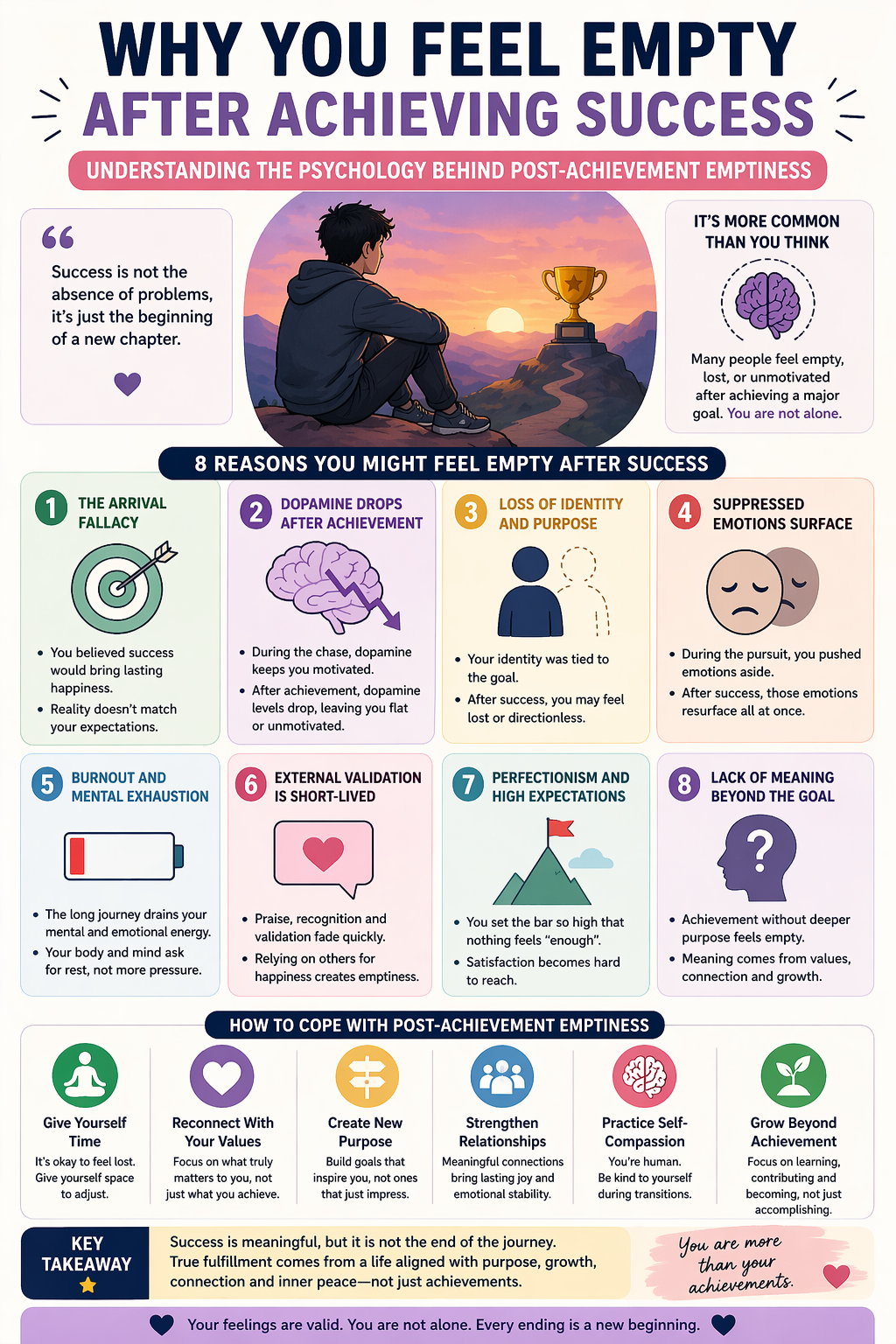
Achieving a long-awaited goal is supposed to bring happiness, satisfaction, and a sense of completion. From a young age, we are taught—explicitly and implicitly—that success is the destination where joy finally lives. We imagine that once we reach that milestone, life will feel lighter, more secure, and emotionally fulfilling. Yet for many people, the moment after success feels unexpectedly quiet, heavy, or emotionally flat.
Instead of excitement, there may be a strange emptiness, numbness, or even sadness. Some describe it as feeling “lost” or disconnected, as if something important has ended rather than begun. This emotional crash can be confusing and guilt-inducing—“I worked so hard for this, so why don’t I feel happy?” Because society rarely talks about the emotional aftermath of success, people often suffer in silence, believing something is wrong with them.
In reality, this experience is far more common than we realize and has deep psychological and neurobiological roots. The human mind thrives on pursuit, meaning, and emotional connection—not just achievement. When a goal is reached, the structure, motivation, and identity that once organized daily life can suddenly disappear, leaving an inner void. Understanding why this happens allows us to normalize the feeling, reduce self-blame, and learn how to relate to success in a healthier, more fulfilling way—one that supports long-term emotional well-being rather than momentary highs.
1. The “Arrival Fallacy”
Psychologists describe a common cognitive trap known as the arrival fallacy—the belief that once we reach a particular milestone, we will finally feel permanently happy, fulfilled, or complete. We tend to imagine success as an emotional finish line, assuming that all stress, self-doubt, or dissatisfaction will dissolve the moment we “arrive.”
During the pursuit of a goal, the brain remains energized by anticipation, hope, and forward momentum. Having something to chase gives structure to our days and meaning to our struggles. This sense of direction often keeps us emotionally engaged and motivated, even during difficult phases.
However, once the goal is achieved, that motivational fuel suddenly disappears. The excitement fades faster than expected, and the mind confronts an uncomfortable truth: life has not magically transformed. Daily responsibilities, emotional struggles, and unresolved inner conflicts still exist. The gap between what we expected to feel and what we actually feel can be jarring.
This emotional mismatch often manifests as emptiness, disappointment, or emotional flatness—not because the achievement was meaningless, but because happiness was placed entirely in the future. The arrival fallacy reminds us that fulfillment is not found in a single moment of success, but in ongoing meaning, connection, and inner alignment throughout the journey.

2. Dopamine Drops After Achievement
While working toward a goal, your brain actively releases dopamine, the neurotransmitter closely linked to motivation, reward, and drive. Dopamine is not just the “pleasure chemical” as it is often described; it is more accurately the chemical of anticipation. It fuels focus, persistence, and the excitement of moving closer to something desired.
During the pursuit phase, small wins, progress, and even the hope of success trigger dopamine spikes. This is why striving toward a goal often feels energizing and emotionally engaging. The brain is wired to enjoy the chase more than the finish line.
Once the goal is achieved, however, the brain no longer has something to anticipate. Dopamine levels drop sharply because the reward has already been received. This sudden neurochemical shift can leave you feeling flat, unmotivated, emotionally blank, or even mildly depressed—despite everything looking “perfect” from the outside.
Importantly, this does not mean the achievement was empty or that something is wrong with you. It simply reflects how the brain’s reward system is designed. Without a new source of meaning, curiosity, or growth, the mind struggles to sustain emotional momentum. Understanding this helps normalize post-achievement emptiness and highlights the importance of cultivating ongoing purpose rather than relying on a single success for emotional fulfillment.
3. Loss of Identity and Purpose
Many people unconsciously tie their sense of identity to the goals they are pursuing. Over time, the goal becomes more than a task—it becomes who they are. Statements like “I am the one preparing for exams,” “I am building my career,” or “I am chasing this dream” provide structure, direction, and a clear sense of self. Daily routines, decisions, and even self-worth start revolving around this single pursuit.
When the goal is finally achieved, that identity quietly dissolves. The role that once defined you no longer exists in the same way. Without a new purpose to replace it, the mind can experience a sudden sense of emptiness or disorientation. It may feel as though a part of you is missing, even though you have technically “succeeded.”
This is why the simple question “What now?” can feel surprisingly heavy. It is not just about choosing the next goal—it is about redefining who you are beyond achievement. For some, this transition triggers anxiety, restlessness, or a sense of inner void. Learning to build a more flexible identity—one rooted in values, relationships, and personal growth rather than a single goal—can help transform this empty space into an opportunity for deeper self-discovery.
4. Suppressed Emotions Surface
During intense goal-pursuit phases, the mind often operates in survival mode. Emotions such as loneliness, fear, self-doubt, grief, exhaustion, or even unresolved trauma are pushed aside to stay focused and productive. There is little emotional space to process feelings because all energy is directed toward “getting through” and reaching the finish line.
Achievement removes this distraction. Once the pressure lifts, the mind finally has room to feel. Suppressed emotions begin to surface, sometimes all at once. Because they were never consciously acknowledged, they may not appear as clear emotions but instead show up as emptiness, emotional numbness, restlessness, or unexplained sadness. This can feel confusing—especially when success should feel joyful. In reality, the emptiness is often a signal that your emotional world is asking to be seen and processed.
5. External Validation vs. Internal Fulfillment
Goals driven mainly by external validation—such as money, status, praise, comparison, or social approval—often feel rewarding only briefly. External rewards provide a short emotional high, but they fade quickly once the applause stops or the recognition becomes normal.
Without internal meaning, personal values, or emotional connection, success can feel strangely hollow. You may look accomplished from the outside yet feel disconnected on the inside. True fulfillment tends to come from goals aligned with inner values—growth, purpose, contribution, connection, or authenticity. When success lacks this inner alignment, emptiness often replaces excitement.
6. Burnout Disguised as Emptiness
Chronic stress, overwork, and prolonged self-pressure can quietly lead to burnout. During the pursuit phase, adrenaline and determination keep you going despite exhaustion. But once the goal is achieved, the body finally feels safe enough to stop pushing.
At this point, the nervous system reveals its true state—fatigue, emotional dullness, low motivation, and mental heaviness. What feels like emptiness may actually be burnout asking for rest and recovery. Instead of celebration, the body demands stillness. Without proper rest, this emptiness can deepen into prolonged emotional exhaustion.
7. Perfectionism’s Hidden Cost
For perfectionists, achievement rarely brings peace. The mind is trained to focus on flaws, what could have been better, or what comes next. Even after success, thoughts like “This isn’t enough,” “Others have done more,” or “I should feel happier” quickly take over.
The goalpost keeps moving. Satisfaction gets postponed indefinitely, and joy is never fully allowed to settle. Over time, this creates a persistent sense of inner emptiness—no matter how many goals are achieved. Perfectionism replaces fulfillment with constant self-pressure, making success feel emotionally unrewarding instead of nourishing.
Pingback: Sign of Emotionally Neglected Even If Your Parents Loved You