Introduction
Cognitive psychology is the science that deals with the cognitive phenomena that include perception, attention, memory, language, thinking, problem-solving, and decision-making. It tries to cognize how human beings learn, perceive, remember and retrieve information and how the cognitive processes affect the behavior and feelings. Cognitive psychology as opposed to behaviorism studies the inner processes of the mind as opposed to observable behavior.
As an example, consider a mental health blog post that you are reading. The words are initially perceived by your brain via your eyes (perception). You pay your attention to the text regardless of the noise in the background (attention). You remember the related information you have read before (memory), you know what sentences mean (language comprehension) and you think about the material critically (reasoning and problem-solving). The interaction of mental processes is also complex to explain cognitive psychology at work.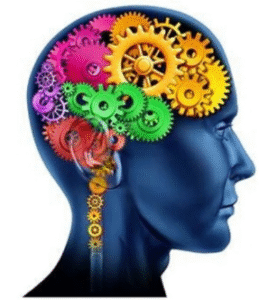
Eyewitness memory can also be considered another real-life example. Having observed something, a man is able to recollect specifics because of recalling the information which has been stored, however, this memory may be distorted and under the pressure or when the next questions are phrased in a certain way, it proves how cognitive activity influences perceptions and memory.
A therapist in the counseling profession applies cognitive processes in listening to nonverbal and verbal cues of clients, memorizing past sessions, reasoning about client issues, and problem-solving to come up with effective therapy approaches. These illustrations show how cognitive psychology can be used to explain the psychological processes behind the daily experiences and work practice.
Domains of Cognitive Psychology
The core domains of cognitive psychology include the following:
- Perception: The arrangement of the sensory information, interpretation, and meaning. To give an example, whenever you know a face in a crowd or understand the tone of voice of a client, then it is a perceptual process.
- Attention: The capacity to direct the mental resources towards certain stimuli to the exclusion of distractions. An example is to pay attention to a counseling conversation when there is background noise.
- Memory: This involves encoding, storage and retrieval of information. This consists of sensory memory, working memory to store temporarily and long-term memory of facts and events.
- Language: Interpreting, processing and producing spoken and written language. Following therapy dialogues or writing blogs relies on cognition of language.
- Learning: This is the process of gaining new knowledge and abilities through experience, or through study or teaching. The acquisition of new counseling methods is a cognitive process of learning.
- Problem-solving and Decision-making: The working out of strategies to solve the problems and make decisions based on the assessment of information. These domains are used to plan the therapy sessions or daily activities.
- Reasoning and Intelligence: Rational thinking, inferences and application of knowledge. Thinking is involved in analyzing the behavior of a client or creating theories of psychology.
These domains interplay in daily life, such as when reading a blog, remembering a therapy technique, or planning one’s day.
History of Cognitive Psychology
- The foundations of cognitive psychology are traced to antique philosophy but was defined as a scientific field in the middle of the 20th century.
- Introspection dominated the initial psychology followed by behaviorism which dismissed the inner mental state in favor of visible behaviors.
- Dissatisfaction with behaviorism increased in the 1950s-60s over its inability to describe complex mental processes such as language and memory.
- The Cognitive Revolution was a reinvention of the scientific study of mental mechanisms occasioned by new computer science metaphors of information processing.
- Classical theorists are George A. Miller (memory capacity), Noam Chomsky (language acquisition critiques of behaviorism), Jerome Bruner (perception and learning) and Ulric Neisser (popularized cognitive psychology).
- Schools of research around Harvard and elsewhere led to growth, which included neuroscience, computer science, linguistics, and philosophy.
Major Theories and Models
Key cognitive theories include:
Information Processing Model is a classical theory in cognitive psychology, which describes the nature of cognition as a set of successive steps in which information flows. It compares the process of human thought to that of computers. In this model, the way information is can be thought of as cognition:
-
Encoded
First, the environment sends through the senses, the information that is detected is encoded into a form that can be processed by the brain. As an illustration, when one is looking at a page, the eyes need to convert light into neural messages.
- Stored
The information is temporarily stored in various systems of memory as an encrypted form. It is first received by the senses in sensory memory (raw sensory input on a short-term basis (several seconds or less). It is the next stage, short-term/working memory where it is manipulated and processed. Lastly, the key information is stored in long-term memory to be stored more permanently.
-
Retrieved
The information stored in the long-term memory on the occasion of need is retrieved back into working memory where it is used in the thinking process, problem solving or making decisions.
The model acknowledges that cognitive processing is complex interaction like attention (what information to pay attention), rehearsal (to maintain information in short term memory) and encoding plans (arranging information in a manner that facilitates the storage) of the information.
The fact that information processing may be serial (one step at a time) and parallel (several processes running concurrently) is also important and is determined by the nature of the tasks. As an example, when a person reads, the brain is able to recognize letters and interpret the meaning of the words together with comprehending the grammatical structure.
This model is very applicable in the study of memory formation, strategies in problem solving, language comprehension and learning. Indicatively, learning a second language entails encoding words, rehearsing them in the working memory and storing them in the long-term memory.
Schema Theory
Schema theory proposes that humans arrange knowledge in their mind in the form of mental frameworks known as schemes that are patterns that depict concepts and their connection. The schemas are used to help perceive, interpret, and remember new information. To illustrate, a schema of having a therapy session will make you predict the behaviors of the client and how the session is going to run, thus it will be simpler to process and react to new information during the counseling process.
The schemas affect memory and attention due to their expectations. They are also useful to fill the gaps on lack of information but at times, may cause biases or perceptional errors.
Cognitive Dissonance Theory
Cognitive dissonance theory was invented by Leon Festinger; it is used to explain instances where individuals develop a sense of discomfort whenever they harbor contradictory beliefs or when their behavior conflicts with beliefs. This unease impels them to minimize inconsistency, which is usually achieved through belief transformation or justification of acts. As an illustration, a counselor may have a dissonance when he/she holds evidence-based practices but sometimes relies on the unproved methods causing them to change their practices or beliefs.
Working Memory Model
The working memory model, introduced by Alan Baddeley, makes the concept of a short-term memory more specific by splitting it into several components:
- Central Executive: It is the control system that determines attention to and organizes psychological processes.
- Phonological Loop: Interprets verbal and auditory messages (such as repeating instructions of a client).
- Visuospatial Sketchpad: Processes visual and spatial data (such as understanding body language of a client).
- Episodic Buffer: This is where the information within domains is integrated and connected to the long-term memory.
This model describes the way individuals store and process information temporarily in order to perform relevant and complicated tasks like reasoning and understanding.
Dual-Coding Theory
Dual-coding theory is the theory that was developed by Allan Paivio and postulates that people have two different systems of stimulus processing of information: verbal system and nonverbal imagery system. The information that is encoded visually and verbally improves learning and memory. To illustrate, written explanations written on diagrams can be used in therapy or teaching, and these are better understood and remembered.
Social Cognitive Theory
According to the social cognitive theory proposed by Albert Bandura, people learn in a social environment by observing and imitating. It lays emphasis on cognitive processes including attention, memory and motivation in learning. Self-efficacy (belief in one’s abilities) is one of the fundamental ideas that may determine the way people approach challenges and continue learning or changing their behavior.

Multi-Store Model of Memory
The presented model, which is suggested by Atkinson and Shiffrin, separates memory into three stores:
- Sensory Memory: Stores the sensory impressions in a very short time.
- Short-Term Memory: Limited capacity system The short term memory has a limited capacity to hold information between 20-30 seconds.
- Long-Term Memory: Permanent and infinite repository of knowledge and experience.
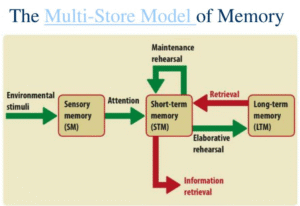
Information flows through these stores in a sequential manner where attention is the gateway to short term memory and rehearsal to the transfer to the long term memory.
Cognitive Behavioral Models
The cognitive behavioral models focus on the role dysfunctional thinking patterns play in emotions and behaviors. The concept behind Cognitive Behavioral Therapy (CBT) is that mental health can be enhanced by altering maladaptive thoughts. Cognitive theory has found practical relevance in the treatment process and models such as the Cognitive Triad by Aaron Beck indicate that negative perceptions about the self, the world and the future are the causes of depression and anxiety.
Research Methods and Experiments
Cognitive psychology employs various scientific methods to understand mental processes:
- Laboratory Experiments: Experiments are strongly controlled environments in which variables are manipulated and their effect on behavior is examined, e.g. the capacity of memory or the Stroop effect in which the meaning of a word can interfere with the recognition of a color.
- Field Experiments: Research on social interaction or interventions in real life.
- Natural Experiments: The study of the effects following the occurrence of naturally occurring events without control.
- Self-Reports and Case Studies: Gathering introspective information or individual studies to study cognition.
- Neuropsychological Techniques: Scanning the brain and capturing neural activity in order to connect mental processing to brain regions.
- Computer Simulations: AI and model simulations to simulate cognitive processes.
Two central measures in experiments are accuracy (correctness of responses) and response time, which help delineate underlying cognitive mechanisms.
Cognitive Psychology in Daily Life Examples
- Episodic memory can be seen when a client prefers something or when he or she has had issues in the past.
- Selective attention is maintained by spending focus on noisy online sessions.
- Decision-making and reasoning are used in problem-solving on a daily schedule or therapy.
- Language cognition is associated with writing blog posts or understanding therapy languages.
- Cognitive learning is manifested through learning new psychotherapeutic techniques.
- The perception of emotions of clients depends on the observation of their faces.
For example, a mental health professional integrates perception (reading client cues), memory (retaining theory knowledge), attention (focusing on sessions), language (communication), problem-solving (therapy planning), and reasoning (psychological analysis) to conduct effective counseling and content creation.
Conclusion
This critical synthesis reports the fields of cognitive psychology, the history of its development, the key theoretical perspectives, research methodology, and applications. It creates a vivid image of the inner mental functioning and its impact on daily life and the practice. This knowledge is necessary to psychologists and educators and people, who are interested in the science of human thought and behavior. In case of further expansion or illustration, they can be attached accordingly as to a given focus.
References:
Anderson, J. R. (2015). Cognitive Psychology and Its Implications (8th ed.). Worth Publishers.
Matlin, M. W. (2013). Cognition (8th ed.). Wiley.
Eysenck, M. W. (2012). Fundamentals of Cognition (2nd ed.). Psychology Press.
Neisser, U. (1967). Cognitive Psychology. Appleton-Century-Crofts.
Miller, G. A. (1956). The Magical Number Seven, Plus or Minus Two: Some Limits on Our Capacity for Processing Information. Psychological Review, 63(2), 81-97.
Baddeley, A. D. (2003). Working Memory: Looking Back and Looking Forward. Nature Reviews Neuroscience, 4(10), 829–839.
Festinger, L. (1957). A Theory of Cognitive Dissonance. Stanford University Press.
Bandura, A. (1986). Social Foundations of Thought and Action: A Social Cognitive Theory. Prentice-Hall.
Tulving, E. (1983). Elements of Episodic Memory. Oxford University Press.
FAQ
1. What is cognitive psychology?
Cognitive psychology is the study of mental processes such as perception, memory, attention, and problem-solving.
2. What are the main domains of cognitive psychology?
The main domains include perception, attention, memory, language, learning, reasoning, and decision-making.
3. Why is cognitive psychology important?
It helps us understand how people think, learn, and behave in everyday life.
4. What is the cognitive revolution?
The cognitive revolution was a shift in psychology during the 1950s–60s that focused on studying mental processes instead of just behavior.
5. What is the information processing model?
It explains how the brain encodes, stores, and retrieves information, similar to a computer system.
6. What is working memory in cognitive psychology?
Working memory is a short-term system that temporarily holds and processes information.
7. What is schema theory?
Schema theory suggests that people organize knowledge into mental frameworks that help interpret information.
8. What is cognitive dissonance?
It is the mental discomfort experienced when a person holds conflicting beliefs or behaviors.
9. How is cognitive psychology used in daily life?
It helps in learning, decision-making, problem-solving, and understanding behavior.
10. What are research methods in cognitive psychology?
Methods include experiments, case studies, brain imaging, and computer simulations.
Written by Baishakhi Das
Counselor | Mental Health Practitioner
B.Sc, M.Sc, PG Diploma in Counseling
REFERENCE
- Ulric Neisser
👉 https://www.britannica.com/science/cognitive-psychology - American Psychological Association
👉 https://www.apa.org/monitor/nov01/cogpsych - Simply Psychology
👉 https://www.simplypsychology.org/cognitive.html - National Library of Medicine
👉 https://www.ncbi.nlm.nih.gov - Language Development in Children: Stages, Theories (Why child not speaking clearly at age 2)
This article is written for knowledge purposes, aiming to help readers understand the topic better and gain useful insights for learning and awareness.