Chapter 1
The first note arrived on the morning the city went quiet.
It was mid-November, the kind of raw, steel-cold day that pressed sound flat against sidewalks. Nora found the envelope wedged under her door, the flap tucked but not sealed, the white too bright against the smudged gray mat. No address, no stamp. Her name on the front was printed in a hand that tried too hard to be ordinary—block letters, all the same height, a child’s careful imitation of adult neatness.
Inside, a single sheet:
MOVE YOUR PLANTS AWAY FROM THE HEATER. THEY’RE DYING.
Nora looked up. The Philodendron’s leaves were browning at the edges. The rubber plant’s newest stalk was a limp question mark.
She moved them. She told herself the maintenance guy had left the note. She told herself anyone could see the leaves were crisping if her blinds were open. She told herself not to tell herself anything—just be late and go to work.
By the time she reached the subway, she’d half forgotten it. Everyone down there moved like ghosts in the fluorescent wash. Her reflection blurred against the window opposite; the train pulled in, and a line of people inhaled as one.
She took a seat, clutched her tote, stared at the scrolling ads she’d seen a thousand times, and pretended not to notice the feeling of being watched. Some mornings it was a whisper; some mornings it pressed a palm between her shoulder blades and pushed, pushed, pushed.
She told herself it was New York. The city always watched back.
At lunch, she remembered the note. “Weird,” said Kal, not looking up from his screen. “Maybe your super’s just…involved.”
“Involved?”
Kal shrugged. “Plants are political now.”
Nora laughed. She had a good laugh for office air—light, agreeable, the kind that could bounce around cubicles without denting anyone’s mood. She had learned that laugh, and the nod that came with it, and the Julianne Moore smile that said I care, just not enough to bleed. It was a career skill.
By five, she’d answered forty-three emails, rejected two app designs the client would later resurrect, and re-shelved her worry in the neat little closet she’d built for it. On the platform home, she almost missed the second note.
Same envelope. Same hard white. Same block letters.
WEAR THE SCARF YOUR SISTER BOUGHT YOU. IT’S GOING TO GET COLDER.
Nora stared at it until the letters swam. The scarf was folded in a drawer; she hadn’t told anyone about it. She had a sister who liked expensive things, who made up for emotional distance with cashmere. The scarf had a bruise-purple sheen and made Nora’s neck itch, but it had been a nice thought, a rare attempt at warmth, and Nora had kept it like a secret.
She looked at the people waiting near her. A man in a coat that shone at the seams. A woman scrolling through her phone with two manicured thumbs. A teenager in a puffer jacket, eyes flitting in small quick arcs like a bird’s. No one looked at her. Everyone looked at everyone. No one did.
She put the note back in the envelope. She got on the train. She didn’t sit.
When she got home, she checked the hallway camera by the elevator—a useless, plastic eye that had never worked. Her building’s super, a man named Guido whose name did not fit him at all, shrugged. “We put the order in,” he said. “Still waiting.”
“For a year?”
“For three,” he said, and winked, as if they were playing a game that did not need rules.
Nora went upstairs. She pulled the scarf from her drawer, held it to her throat, and felt the itch before it touched skin. She folded it carefully and put it back.
She slept badly. Every sound had an aftersound. Every shadow had intent.
Chapter 2
On the third day, there was no envelope. Instead, there was a smudge on her mirror, a streak in the shape of a finger at the lower right corner. She had cleaned the mirror two nights ago, compulsively, dragging a squeegee down the glass until the last mist line disappeared. She had stood back and admired the invisible—look how clean—and flicked off the light.
Now the smudge caught the weak morning sun and bloomed.
She didn’t touch it. She leaned close. The oil pattern spiraled outward like a whorl. She pressed her own finger alongside it, checking for match, and told herself the patterns of the living always look like coincidences.
At her desk, her email pinged. Subject: NORA—POST SCHEDULE. It was from the client. She opened it. There were the usual demands moved forward, the deadline retagged as ASAP, the sigh of a brand that never slept. At the bottom was a line that made no sense: Also, you left your scarf on the train. The purple one.
She reread it twice. She hadn’t worn the scarf. She’d left it in the drawer and dreamed of it coiling in the dark like a thin, friendly snake.
She typed: Don’t think so! Different Nora?
She deleted the exclamation points. She retyped them, then deleted one.
The client responded in under a minute: Oh lol ignore—wrong chain.
Wrong chain. Wrong Nora. Wrong she. Still, the scarf moved through her mind like a thought that wasn’t hers.
When she left that evening, the sky was the color of an old bruise, and a damp snow began before she reached the corner. She watched it become rain before it hit the ground. At the bodega, she bought milk, bread, and a basil plant she didn’t need.
“Bad week,” said the clerk, sliding the basil across. “Everyone buying green things.”
“It’s November,” Nora said. “We’re pretending.”
The clerk smiled, then glanced at the door. The bell hadn’t rang. It did anyway. A man in a blue cap stepped in and sidled past the counter, nodding at no one, a ripple without an origin. Nora fought the urge to look at him again.
The bell rang properly as she left. She listened to the sound collapse behind her and felt the particular relief of closing a door between herself and something unsorted.
On the fourth day, she left the plants by the window, a respectful distance from the heater. She wore the purple scarf for ten minutes to test her skin. The itch bloomed. She took it off. She put it in her tote. She told herself she would take it to a tailor to ask if it could be lined. She told herself it was too nice to return. She told herself to stop telling herself.
In the hallway, the light flickered. Nora paused and counted the beats: two up, three down, two up. She didn’t know why she counted, or what knowing would protect.
The envelope was under her door again when she came home.
THE DOORFRAME SWELLS WHEN IT RAINS. SAND IT DOWN OR IT’LL STICK.
She could not pretend that was something a stranger saw through blinds. She could not pretend it was from Guido. She could only open the door, step in, and listen.
Silence is not the absence of sound; it’s a registry of small sounds straining to be born. The radiator hissed like something containing something else. The fridge thumped. The upstairs neighbor’s television bled down a laugh track, then a gunshot, then applause. Nora stood in the middle of her living room, scarf in hand, and felt the thin membrane between her life and other people’s lives go thinner.
“Okay,” she said to the empty room, softly, like admitting that a thing existed.
Her phone vibrated on the counter. A text from an unknown number: Purple suits you.
She didn’t scream. The scream rose, assessed the room, saw there was nowhere to go, and sat down inside her like a guest who refused to leave.
She typed: Who is this?
Three dots. No reply. Three dots. No reply.
She put her phone facedown and stood very still, as if stillness could undo the fact of being seen.
That night, she turned off the lights and sat on the floor beside the couch, where the windows were higher. She ate bread and milk like a child in a fairy tale who had wandered into the wrong forest and committed to acting normal. She fell asleep against the wall and dreamed the dream she had as a teenager: a house with no corners. All the rooms were round, and no matter where she turned, there was nowhere to pin her back.
Chapter 3
She told Kal because he was the kind of person who said things like We’ll fix this even when he couldn’t.
His face did a complicated thing as she spoke—a tightening around the eyes, a widening of the mouth. He wanted it to be nothing. He wanted to be able to say, It’s a prank. It’s your super. It’s your sister being controlling. He wanted to pull a thread and watch her anxiety unravel neatly at his feet.
“Let’s get the cops,” he said finally.
“And say what? That someone noticed my plants and my doorframe? That somebody likes my scarf?”
“That somebody texted you.”
“And what would they do?”
Kal opened his hands: I don’t know, but we’ll have done something.
Nora shook her head. “If there’s a somebody.”
“There’s a somebody,” Kal said. “It’s not the weather.”
“Maybe it is.” Nora thought of the smudge on the mirror. The way it had looked like the beginning of a fingerprint and the end of a spiral. “Maybe everything leaves a pattern if you keep your eyes open too long.”
Kal reached across the table and touched her knuckles. “Okay,” he said. “Then close them sometimes.”
She didn’t tell her sister. She didn’t tell anyone else. She blocked the number. She ordered a wedge for the door. She Googled “how to sand a swollen door” and watched a bearded man remove grief from wood as if it had been waiting there all along to be smoothed.
She slept with the lights on. Then off. Then on again. In the quiet salt of four a.m., her brain stacked thoughts and knocked them down: The first note. The second. The scarf. The smudge. The text. The door. The world.
On the seventh day, she decided to be unreasonable. She wore the scarf all day, let it work its itch under her collar like a punishment she’d chosen. She took the long way home, made three extra turns, stopped to look into three random windows on streets she never walked. She bought a lemon pastry and threw it away. She crossed against the light. She behaved as if randomness could confuse intention, as if the city could lose track of her if she acted like someone else.
When she reached her building, the elevator was out. She climbed the stairs, jacket unzipped, scarf loosened, and paused on the landing between three and four because the air changed there—the sweetness of someone’s laundry, the metallic bite of fresh paint. She listened. She heard a footstep that wasn’t hers.
She called out, “Hello?” because there are scripts we follow even when we don’t want to. The footstep paused. The hallway bulbs hummed. Nora wished for the elevator she always cursed.
On her mat: no envelope. Inside: the kitchen window cracked open an inch. She hadn’t opened it. She stood there and stared at that inch until it was the only thing in the room.
She checked the closets. The shower. The cabinet under the sink. She found a single torn thread on the couch, purple as a bruise, caught on the seam.
She closed the window and locked it. She stood with her palms on the cool, ribbed surface of the radiator like someone bracing for an impact that had already happened.
Her phone vibrated. No number. You looked different today. The scarf helps.
She typed who are you and didn’t send it. She typed stop and didn’t send it. She typed I will call the police and sent it, a prayer dressed as a threat.
The dots appeared. Disappeared. Appeared.
They won’t come in time.
She called 911. The operator was efficient and calm.
“Has he made threats?”
“Not explicitly.”
“Do you have an order of protection?”
“No.”
“Has he attempted to enter your apartment?”
She looked at the window latch. She thought of inches. “I don’t know.”
The operator sent a car. Two officers came. They were gentle and skeptical in equal measure, a skill honed over years of seeing too many real things and too many wrong impressions. They suggested a camera for her door. They suggested she tell her super. They suggested she find a friend to stay with.
“Can I stay with you for the night?” she texted Kal.
She packed a bag. As she zipped it, she felt something underneath the lining, the faintest bulge, like a bubble of air caught in paint. She slid her fingers under the fabric and pulled. Out came a single sheet of paper, folded twice. The same white. The same terrible block letters.
WE DON’T HAVE TO MAKE THIS A PERFORMANCE.
She put the paper back. She didn’t tell Kal. She went to his apartment and slept on the couch with the TV on mute, the rectangle of light flickering over the blinds like a faint, patient Morse code.
Chapter 4
The first time she saw him—saw a him she could attach to a narrative—was in the reflection of a window she had never noticed before.
She’d taken to walking home the long way, pairing streets the way you pair socks you hope will not be noticed as misfits. She cut down Maple, then left onto Grove, a narrow street that always felt like the backstage of another street. She passed a glass-fronted lobby, one of those sad attempts at modernity in a brick building that had given up. In the reflection, she saw herself and, hovering behind her shoulder like bad grammar, a man in a blue cap.
The cap made him feel like an idea. The rest of him refused to assemble into memorable pieces. Average height; coat not new but not shabby; face like the outline someone draws before the shading. He stopped when she stopped. When she turned her head to catch him properly, he turned too, exhibiting an exaggerated interest in a bicycle chained to a phalanx of poles.
She felt the old film trick of double exposure—two frames on top of each other, the man present and not present, blue cap anchoring the blur. She began to walk again. He did not overtake her; he did not retreat. He matched her pace as if measuring her mood.
At the corner, she slipped into a deli and pretended to examine olives. The clerk cut her a sample she did not want. The blue cap went past. She waited. She waited longer than made sense. She emerged and took a left instead of a right, then a right instead of another right, then went down a set of stairs to a basement bookstore whose door was always propped with a book that nobody wanted enough to steal.
She hid between True Crime and Memoir and felt the alphabet become a fort. When she finally climbed back to daylight, the city had shifted a degree—light thinner, air more intent.
The blue cap stood across the street, hands in pockets, head tilted as if considering the sky. He could have been anyone. He could have been a man waiting for a ride. He could have been the kind of person who liked to look up when the rest of the world looked down.
Nora went home.
In the elevator, a small elderly woman with a shopping trolley smiled at her scarf. “Lovely,” she said.
“It itches,” Nora said.
“That means it’s working,” the woman said, as if they were discussing faith.
On her mat: an envelope. She didn’t pick it up. She stepped over it. Inside her door, she leaned her back against the wood and slid down until she was sitting with her knees up, the way children sit when instructions are unclear. She reached under the lining of her bag and pulled out the note she hadn’t told anyone about. She read it again, as if repetition would change content.
Her phone vibrated. Good to see you in daylight.
She wrote: Why me?
The dots blinked.
Because you look back.
The answer stung in a place she could not locate.
Chapter 5
The camera arrived in a brown box that tried very hard to look like a solution. Kal came to install it. He swore in a comforting way when the screws wouldn’t bite, then swore more when they did. He joked about calling the blue-cap hotline. He brought takeout from the Thai place with the photo of an unconvincing elephant on the menu. They ate on the floor because moving chairs felt like admitting permanence.
“You can stay here again,” Kal said. “Or longer. I have a guest room with a plant I always kill. You can save it. It’ll be symbolic.”
Nora smiled. She wanted to say yes. She wanted to say no. She wanted to tell him that part of her could taste the attention in the air now, that leaving it, even for a night, would be like leaving a stove on and deciding to be somewhere else while it burned.
“I’ll be okay,” she said. “With the camera.”
The camera app sent her alerts: Motion detected. The alerts came when the hall lights flickered, when the upstairs neighbor came home, when dust motes performed their private ballets. They came at three a.m., four a.m., once at five-thirty when the milk truck’s vibration seemed to lift the building a hair off its foundation.
On a Wednesday, the alert came at 2:13 p.m. She was at her desk. The thumbnail image showed the hallway empty. She opened the live feed. The image jittered, then resolved: her door; her mat. An envelope on it. The frame widened, shuddered, and for a second she saw a hand, just the pale sweep of a wrist retreating left, the afterimage of a person who had learned how not to be recorded.
She ran to Guido’s office. He was watching a show on his phone and laughing like the laugh track was a thing to be obeyed. “Camera’s working,” she said.
“Finally,” he said, as if he had blessed the process. She showed him the feed. He shrugged. “You want I should wait on the stairs?”
“What would you do if—”
“Yell,” he said. “Loud yelling. I’m good at that.”
They walked the stairs together. The absence of a person felt like a presence that had just ducked behind a wall. On her mat, the envelope. She did not pick it up. Guido bent, looked at it like it might explode, then looked at her, as if she might.
“Want I should open?” he said.
“No,” Nora said. “Thank you.”
He nodded and retreated. She watched him retreat. He hummed the theme song of the show he’d been watching, a cartoonish march that sounded braver than it was.
Inside, she slid the envelope open with a butter knife like an amateur surgeon. The note said:
YOU DON’T HAVE TO BE AFRAID IN YOUR OWN HOME.
She sat with that one for a long time.
She thought of the house with no corners. She thought of blue caps. She thought of not being afraid as a request from someone who wanted to be invited in.
She called the police again. Different officers; same kindness, same limits. She considered a hotel, a sublet, a friend’s couch for a month. She considered moving. She considered never moving because moving gives a story a shape, and maybe shapelessness was its only defense.
That night, her phone buzzed.
We should talk where it’s quiet.
She blocked the number.
The phone buzzed again from a new number. I’ll be gentle.
She turned the phone off.
The room grew louder.
She turned it back on.
There were three more messages.
You will know me when you need to.
Don’t make this ugly.
I’m trying to be kind.
Kind. The word came like a splinter in a cake.
Chapter 6
On Friday, her sister called.
“Are you ignoring me?” the sister said, her voice a glitter of a life lived in rooms that always smelled like new paint.
“No.”
“You didn’t thank me for the scarf.”
“I did.”
“Not properly.”
“How properly should I—”
“I saw you on the train,” her sister said. “With it.”
Nora swallowed. “You were on the train?”
“I was in a car. You looked tired.”
“Why didn’t you say hi?”
“You were with a guy.”
Nora blinked. “No, I wasn’t.”
“You were talking to him. At least, your mouth was moving. Maybe you were talking to yourself. Don’t do that in public.”
Nora closed her eyes. She tried to drag the memory up like a fish. The day she’d worn the scarf. The day she’d leaned into the itch. She remembered the glass, how it had doubled the city, how her reflection had looked like a woman practicing expressions.
“I wasn’t with anyone,” she said.
“Okay,” her sister said, in the tone that meant Okay, and yet I don’t believe you. “Anyway, the scarf looks good.”
She hung up as if she were doing Nora a favor.
Nora sat on the edge of her bed and thought about how memory chooses its own facts. She thought about corners that aren’t corners. She thought about her mouth moving in glass.
When the next note came, it was under the pillow.
She stood in the doorway and looked at the bed as if it had sprouted teeth.
The envelope was cool when she picked it up, as if it had been in a different climate. The note inside was different. Not block letters. Handwriting. Slanted, elegant, bent to the right like a body leaning forward in a decision.
You will always be afraid until you step toward the fear. I can help.
She sat on the bed. She carded the purple scarf through her fingers, felt the itch rise just touching it, like a warning the body offers before the mind agrees. She put the scarf on. She tied it loosely, then tighter. She looked at herself in the mirror.
Her face looked like a face someone might choose, then decide it was too polite, then choose anyway. She thought: I am ordinary. Then: He chose me because I am ordinary. Then: He chose me because I think I am ordinary and he is offended by the lie that other people are allowed to keep their surfaces.
“Enough,” she told her reflection.
She left her apartment without her phone. She took the stairs, counting each step like it was a word in a prayer she’d translated from a language she didn’t speak. She exited onto the street and felt the city press itself lightly against her like a cat that likes you but doesn’t want to admit it.
She walked three blocks north, two west, one south, three east. She realized she was drawing a shape. She did not know what the shape was.
On Grove, she stopped in front of the glass lobby. She stared at her reflection until it became two people—her and the idea of her. She waited.
The man in the blue cap appeared in the reflection first, obligingly, like a stage direction followed. He stood a few paces behind, hands in pockets, head tilted in a way that said Isn’t the sky interesting? He didn’t look at her. He looked at the idea of looking away.
She turned slowly.
Up close, he was even harder to describe. Not handsome; not not handsome. A mouth that might have learned to smile at the right moments. Eyes the color of the city’s tap water—alive, functional, unremarkable. He took off his cap. Hair that needed a decision. He did not speak.
“Say something,” Nora said.
He tilted his head the other way. “You look good in purple,” he said, and the words were so ordinary that the space behind them seemed to open like a door.
“Why me?”
He smiled, and the smile did nothing. “Because you see things.”
“I didn’t see you.”
“You did,” he said warmly. “When it mattered.”
“We’re in public,” Nora said, to convince herself before it convinced him.
“Public is just private with better lighting,” he said. “Walk with me.”
“Where?”
“Somewhere with corners.”
She should have walked away. She should have shouted. She should have called Kal; she should have called anyone. She did none of those things. She began to walk because the part of her that wanted to face it—it being larger than a man—had decided it was done being pressed into a corner of a cornerless room.
They turned down a side street where the buildings leaned inward as if listening. He kept pace half a step behind, as if to reassure her he did not need to lead to belong. At a recessed doorway, he stopped. “Here,” he said.
It was a dead end. An old delivery alley long since repurposed as a storage place for the city’s forgotten items: a busted chair; a rolled rug damp forever; a painting of a ship with the sails painted too white. The only light came from a window above, where someone had hung a strand of Christmas bulbs in October and never remembered to take them down.
He faced her, and for the first time, he looked like a person with a plan.
“Nora,” he said, and hearing her name in his mouth was like hearing a secret spoken a beat too soon. “I’ve thought about this every day.”
She laughed once—the learned laugh—and it sounded like something breaking and then apologizing for the noise. “About what?” she said.
He stepped closer. Not so close she had to step back. Close enough for choice to feel like a decision.
“About changing what you are,” he said. “About helping you see.”
“See what?”
“That you aren’t at the center of anything,” he said, and the kindness went out of his voice. “That no one cares if you disappear or remain. That the only thing making you real is attention.”
“Yours,” she said. “Your attention.”
“Mine,” he agreed. “You feel alive because I have been watching. So we can end this in two ways. I stop, and you go back to feeling like air. Or I escalate, and you become interesting enough that you will never be able to pretend again.”
There was a smell in the alley—wet cloth, old paint, a bitter tang like failing batteries. She could hear footsteps on the main street like a tide that did not concern itself with inlets. She thought of all the advice columns that told women to scream, to run, to aim for the soft parts of an attack. She thought of herself as if she were a person in a story she did not want to read.
He reached into his coat pocket. She flinched. He brought out her purple scarf—her scarf, and yet in his hand now it looked deeper, a notch more intimate, like a bruise someone had decided to keep.
“You dropped this the other day,” he said. “Or I took it. Memory is malleable.”
She was wearing hers; his was a match. She looked down: the fabric at her throat was slightly different; the weave was looser; the itch had been replaced by a low hum.
“You’ve been…in my apartment,” she said. It wasn’t a question.
He smiled, the warm smile again, a trick that gave nothing. “We’ve been in each other’s lives,” he said. “Let’s not get legalistic.”
“Why?” she said, and she meant Why are you like this, and she meant Why me, and she meant Why now, and he heard all the meanings and dismissed them as irrelevant.
“You think your fear is sacred,” he said. “You think you can curate it and learn from it and become a better person. I’m here to tell you it’s currency. Spend it or lose it. Perform or vanish.”
“You want me to perform,” she said.
“I want to see what you do when there are corners,” he said softly. “Do you curl into them? Do you fight your way out? Do you make a door?”
She looked at the mouth of the alley. She looked at his hands. She looked at the strand of unseasonal bulbs above, one of which flickered, a mediocre star.
“Tell me your name,” she said.
“No,” he said gently. “Names are invitations.”
“And what is this?”
“A test,” he said. “Step toward me.”
She did not move. He waited. The waiting was the point.
“I will not hurt you,” he said. “Not that way.”
“That way,” she repeated.
“I will not touch you,” he clarified, “unless you ask.”
“You’ve touched everything,” she said, and tasted the intimacy of accusation.
He stepped back half a pace. “You like being seen,” he said. “Everyone does. They just don’t admit it. I’m a mirror. I make reality brighter. I make you a character. Thank me.”
“No,” Nora said, and she surprised herself with the word’s size. It took up the alley. It climbed the walls and hung from the bulbs like a new strand.
He tilted his head, as if curious about a small animal that had learned a trick. “That’s not refusal,” he said. “That’s play.”
“Then here’s refusal,” she said, and walked past him.
He did not grab her. He did not block. He moved with her, like a shadow that had remembered a lesson. He kept a pace behind, the assertion of presence more violent than any touch. At the mouth of the alley, she turned right, then left, then dove into a bar she’d never entered because it looked like a place where the light was prescription strength.
The bar was crowded enough to be anonymous, loud enough to be safe. She found a place near the middle, ordered a club soda, and stood with the glass decorating her hand like an alibi. She watched the door. He did not come in. He did not need to. The point had been made: he could bring corners wherever he liked.
She stayed an hour, then another. The bartender with a ring in his eyebrow asked, “You okay?” and she nodded in that way women nod when no is too expensive to buy. When she finally left, the night air felt like the aftermath of something.
Her phone buzzed. She had brought it after all. She did not remember putting it in her pocket.
You passed, the message read. Now you can be afraid in a new way.
Chapter 7
She did not call the police again. She did not tell Kal. She did not tell her sister, who would have interpreted fear as a lack of style.
She began to rearrange the room. Not for safety—safety was a mood, not a plan—but for control. She moved the couch to face the windows. She put the basil plant beside the radiator because someone had told her not to. She took the wedge off the door and put it back. She taped over the camera on her laptop. She left the camera by the door running and pretended it was a dog that would bark if the world misbehaved.
She practiced making noise: dropping a book, turning a chair, slamming a drawer with the rhythm of a person present at her own life. She wrote herself notes in thick, childish block letters: BUY MILK; TAKE TRASH; CALL MOM. She looked at them and felt both mocked and strengthened.
She wore the purple scarf. Not hers. The one from the alley. She wanted to know what it knew. When she put it on, the itch did not come. Instead came a sensation like a thought humming. When she took it off at night, she put it on the chair across the room, where it looked like a person sitting very still.
She waited for him to come again. He didn’t. He said so.
I won’t come again, the message read, days later. That would make this about me. It’s about you. Keep the scarf. Keep the habit. Keep the room with corners.
She typed: What do you get from this?
I get to be right, he wrote. I get to watch the spread.
Spread?
You’ll start seeing the watchers everywhere. You’ll start feeling how attention sutures you to the world. You’ll be better. Scarred, but better.
She turned the phone off for a week. The messages piled up on the other side like hunters waiting for dawn.
She walked different routes and found the same corners. She bought olives and ate them standing. She told Kal a version of the story with the edges sanded down, and he said, “You have to move,” and she said, “I have to live,” and they left it there, a sandbar neither of them wanted to test at high tide.
The notes stopped. The envelopes did not appear, and yet she lived as if they might at any second. This is how trauma teaches, she told herself—through expectation, through preparation that never finds its event.
Winter came in earnest and stayed too long. The basil died. The Philodendron thrived like spite. The scarf warmed and grew familiar and finally, one morning in February, began to itch again—just a little, like the memory of a decision.
She took it off and put it back in the drawer, where things that matter wait with things that don’t, and tell time.
Chapter 8
In March, the city woke from its long, bizarre sleep and pretended it had never needed rest. Nora went to a gallery opening with Kal and stood in front of photographs of women whose faces were entirely blurred except for their mouths.
“What do you think?” Kal asked.
“Either a brilliant metaphor or a brilliant mistake,” she said.
A woman with a notebook nodded as if Nora had spoken into her directly. “We love it,” the woman said.
On her way to the bathroom, Nora saw him.
No cap. No coat she recognized. He was across the room, speaking to a man in a blue suit that looked like a language he did not speak. He glanced up. Their eyes met and slid off each other like magnets held the wrong way.
She did not approach him. He did not approach her. They were two points that had decided proximity was passé. He raised a glass half an inch, the way you acknowledge a stranger whose dog you’ve pet. She raised hers in a way that could have meant I see you or I see through you or simply We occupy the same room on a Tuesday.
She went home alone and slept, and for the first time in months, she dreamed a room with corners that she had designed, angles she had placed where she wanted them, a bed that did not threaten teeth. In the dream, someone knocked. She opened the door. No one stood there. On the mat: an envelope addressed to Current Resident.
She woke and laughed. The laugh was not the office laugh; it was a sound she remembered from childhood, the one you make when you have scared yourself and then discovered you are, in fact, still here.
Chapter 9
Spring. The scarf stayed in the drawer. The plants organized themselves into a green conspiracy by the window. The doorframe swelled and un-swelled without getting stuck. The camera caught dust, people, shadows, nothing.
Occasionally, she felt him in the city, the way you feel a specific train beneath your feet before you hear it. She saw a blue cap on a boy and looked twice. She saw a reflection in a window and practiced not performing for it.
Her sister texted a photo of a bracelet. You should buy this, the text said. You need color. Nora wrote I have color and didn’t send it.
Kal asked if she wanted to move jobs. Nora asked if she wanted to move apartments. They made lists and tore them up without reading them.
One humid night in June, her phone vibrated with a number she didn’t recognize. She let it go to voicemail. The message was short.
“I’m done,” he said. “You did well.”
She listened again. And again. The “done” was flat. The “well” was almost fond. She thought of calling him back and saying You don’t get to write my ending. She did none of those things. She deleted the message. She emptied the trash. She held the phone until it cooled in her hand.
She went to the drawer. She took out the scarf. She went to the window and opened it the inch that had once been a theft. She held the scarf over the fire escape and let the night’s soft wind play with it. Then she tied it to the metal rail, a small flag in a country of concrete, purple against black.
In the morning, it was gone. There was no note. There was no message. There was the city, watching and not watching, and Nora, who put on a cotton shirt that did not itch, and left her apartment with her plants watered, her door sanded smooth, her corners placed where she liked them.
Chapter 10
Months later, in a restaurant where the napkins were too white to be honest, Nora met a man with careful eyes and an honest mouth, and she told him a story without naming names. He listened and did not tell her what she should have done. He asked one question: “When were you most afraid?”
“In the alley,” she said. “When he asked me to step toward him.”
“And when did it stop?”
“It didn’t,” she said, and smiled. “It changed shape.”
He nodded. The wineglass caught the room and broke it into soft pieces. Outside, the city’s eyes blinked, thousands of lids rising and falling in no pattern at all. Or in a pattern that only revealed itself if you watched long enough, and who would do such a thing, and why.
Later, on the way home, they passed a shop window darkened for the night, the glass layered with their images and the street’s reflections. Nora looked at herself. She kept walking.
Behind her, somewhere, a man in a blue cap might have been walking too. Or he might have been asleep in a quiet room with corners he had chosen. Or he might have been another story entirely, one that brushed against hers and kept going, like coats in a crowded doorway, like strangers recognizing each other by the shape of their fear and choosing not to speak.
Nora went upstairs. On her mat: nothing. Inside, in the drawer, space where the scarf had been, dust offering its slow, neutral benediction.
She watered the plants. She leaned her palms on the radiator. She listened to the city perform its endless play. And then she did something small and finally hers: she took a pen and wrote a note in careful block letters.
YOU’RE STILL HERE. KEEP GOING.
She slid it under her own door and went to sleep.
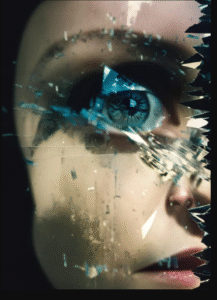
-Baishakhi Das


 –Baishakhi Das (MonoProva)