

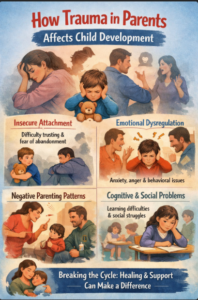
Trauma is not restricted to the person who is subjected to it directly, but the trauma can even spread generational. But once parents undergo unresolved trauma, it tends to affect their emotional well being, parenting style, relationships and family set up. These elements are important in determining the psychological, emotional and social growth of a child. Learning the impact of trauma on children in their parents is crucial to early intervention and healthier family relationships.
Understanding Parental Trauma
Parental trauma is an unpleasant or overwhelming experience that parents have undergone at various points in their lives. They can be the childhood mistreatment or neglect, family violence, the loss of loved ones, major illness, natural calamities, exposure to war or conflict or long emotional strains. These experiences may profoundly influence the feeling of security, identity and emotion regulation capabilities in an individual. In most instances, the effects of trauma may not be resolved, i.e. the parent is still affected emotionally, cognitively as well as behaviorally even after the traumatic experience has passed. Unresolved trauma may influence the perception of relationships, coping with stress, and reaction to difficulties in the daily life of the parents.
The psychological manifestations of trauma can include anxiety, depression, emotional numbness, and irritability, hypervigilance, or mistrust of other people. The parents can be caught in emotional hot spots, flashbacks or a sense of excessive stress, trying to even imagine why they are reacting that way. Such emotional battles may affect the way parents treat their children unconsciously. An example is that due to emotional overload, a parent might not be able to give sufficient attention, warmth or reassurance as a child should have in order to develop in a healthy way. Eventually, these trends could affect emotional security, behaviour, and social functioning of the child.
1. Effects on Emotional Responsiveness
Parents with unresolved trauma would not be able to respond sensitively to the emotional needs of their child. They could end up being emotionally detached, hyper sensitive or intermittently inconsistent. Children rely on the consistent emotional support to be safe. Children would not be able to share their feelings or build their confidence in seeking help in case of inconsistent emotional responsibilities.
2. Effect on Stress and Coping Style.
The trauma may influence the coping of the parents with stress and difficulties. Parents will respond by being either angry, avoiding, or developing more fear, or overprotective or controlling. Children will tend to pick up coping mechanisms by observing their parents. In case parents develop unhealthy coping patterns to deal with stress, their children might follow them which can impact their emotional and behavioural developments.
3. Influencing Parent-Child Communication.
Communication may be challenging at times because of trauma. Parents can either not speak about feelings or any stressful situation, or they can not listen actively to their child concerns. A lack of emotional communication may lead to poor ability of a child to comprehend and communicate about his or her feelings, which might result in poor emotional intelligence and development of relationships.
Attachment and Availability of Emotions.
Emotional availability is also one of the most important ways in which parental trauma impacts on child development. Parents provide emotional comfort, security of their children and advice. Parents can be unable to respond in a consistent and sensitive manner to the emotional needs of their child when they are overcome by their trauma.
This may lead to insecure attachment by children. Insecurely attached children might become trusting, abandonment phobic, or emotionally uncontrolling. Conversely, emotionally responsive parenting makes the children to feel more confident, resilient and learn to have healthy relationships with others.
Parenting Style and Behavior
Trauma may have a number of effects on parenting styles. Parents might end up being too protective and controlling because they are afraid that something bad might happen to their child. Others will grow to be emotionally distant or inconsistent due to the fact that they experience emotional closeness as isolating or instigating.
There are some instances when the parents who have witnessed severe or abusive parenting in their childhood may unconsciously recreate the same pattern, and this is called intergenerational transmission of trauma. The reason why this repetition takes place is not because parents desire to hurt their children but because unresolved traumas can influence beliefs on relationships, discipline and emotional expression.
Emotional Regulation and Modeling
Children figure out the ways of handling emotions mainly through watching their parents. Children who do not have many chances to acquire healthy coping skills might exist in a trauma-related scenario where parents are affected by traumatic events and have limited control over their emotions.
As an example, in case a parent often has anger, withdrawal and panic reactions, children can follow suit. In the long term, it has the potential of exposing the child to anxiety, behavioural issues, and stress management difficulties.
Effect on Cognitive and Social Development.
The impact that parental trauma has on cognitive and social development in a child is indirect. Home environment can be stressful and thus limit learning, communication and social interaction. Children who experience chronic parental stress are likely to lack concentration, experience poor performance in school or even lack friends.
Also, the family stress can trigger the system of stress response in a child. Critical early stress hormone activation may have an impact on brain development, memory and emotional processing.
Family Environment and Sense of Safety.
Children need to have something to hold on to in order to succeed. Parents with trauma might accidentally make volatile or stressful atmospheres. The constant fights, emotional alienation or outbursts of mood can cause children to feel unprotected or guilty to keep the family together.
Other children might end up caring to their parents a condition known as parentification. This may cause emotional load, untimely maturity and failure to concentrate on developmental needs of them.
Defensive Factors and Resilience.
Although these obstacles may be met, not every child of traumatised parents has unfavourable developmental outcomes. Parental trauma can be mitigated by a number of protective factors. These are favourable interactions with other caregivers, consistent family patterns, effective communication, and availability of mental health support.
Parents who realise that they are traumatised and seeking treatment can become much better parents. Parents can be assisted in the areas of therapy, psychoeducation, and emotional support to create healthier coping mechanisms and parent-child bonds.
Significance of Early Intervention.
It is important to recognise the effects and parental trauma early. Community support systems, educators, and mental health professionals are essential in the support of families. Approaches of trauma-informed parenting are aimed at explaining behaviour through the prism of emotional safety, empathy, and connexion instead of punishment.
It is possible to disrupt the intergenerational trauma cycle, by providing parents with coping mechanisms, emotional management techniques and parenting education and encouraging a healthier child growth.
Conclusion
Attachment patterns, parenting behaviour, emotional modelling, and family environment may deeply affect the emotional, social, and cognitive development of a child due to the effect of parental trauma. Nevertheless, trauma is not a predeterminant of destiny. Through education, counselling and reparation, parents are able to recover their past experiences, and provide healthy and secure homes that promote the growth and health of their children. The healing of trauma in parents is not only helpful to the parents but also an effective move towards producing strong and emotionally sound future generations.
Frequently Asked Questions (FAQs)
1. What is parental trauma?
Parental trauma is caused by distressing events that parents went through in the form of abuse, neglect, violence, loss, or serious illness, and still haunt them emotionally and psychologically.
2. What impact does the trauma of parents have on children?
Parenting behaviour, emotional, communication, and family stability may be affected by parental trauma, and therefore, have the potential to impact emotional, social, and psychological development of a child.
3. Are parents able to transfer trauma to their children?
Yes, the learned behaviour, emotional patterns, and parenting style can be transmitted to the next generation as a source of trauma. This is referred to as intergenerational trauma.
4. Are not all children of traumatised parents psychologically ill?
All children do not suffer adversely. Resilience can be fostered by protective factors like stable environments, supportive home and mental health support.
5. What is the contribution of parental trauma to attachment?
Emotional consistency can be a problem among traumatised parents and traumatised parents may not provide the children with the insecure attachment patterns that would influence the trust and emotional security.
6. What are the potential behavioural manifestations of children who experience parental trauma?
The children can be anxious, aggressive, withdrawn, low self-esteem, emotionally sensitive or have problems with social relationships.
7. What is the effects of parental trauma on emotional regulation among children?
Children acquire emotional management through observing their parents. In case the parents are unable to control emotions, the children can become affected by the same.
8. Does parental trauma influence academic performance of a child?
Yes, children who are subjected to chronic stress at home can have problems with concentration, learning and lower academic motivation.
9. How does communication contribute to the reduction of the effect of parental trauma?
The positive impact of parental trauma is minimised by open and supportive communication, which makes children feel safe, understood and emotionally secure.
10. Do therapy parents assist traumatised parents in parenting better?
Yes, therapy can assist parents to process trauma and acquire healthy coping strategies, as well as improve parent-child relationships.
11. What is parentification and how is it connected with trauma?
Parentification is whereby kids become caregivers to the parents. It may occur when parents are emotionally troubled because of trauma and emotional burden is put on children.
12. What can parents do to ensure that the trauma does not impact their children?
The parents will have an opportunity to undergo therapy, to engage in emotional regulation, to live by consistent schedules, and to establish positive relationships to shape a caring environment.
13. Is it possible that trauma can make an impact on the development of the brain in children?
Prolonged exposure to stress has the potential to affect the brain development, emotional processing and other stress response systems among children.
14. What protective variables are found to assist children in dealing with parental trauma?
Intense emotional attachment, favourable school climate, extended family support, and availability of mental health services contribute to the development of resilience in children.
15. At what point do parents seek professional help?
Parents are advised to request assistance in case of the trauma symptoms that impede the work in the daily routine, emotional regulation, personal relations, or parenting skills.
Written by Baishakhi Das
Counselor | Mental Health Practitioner
B.Sc, M.Sc, PG Diploma in Counseling
One Reply to “How Trauma in Parents Affects Child Development”