(National Supreme Sacrifice Day Special 18/02)
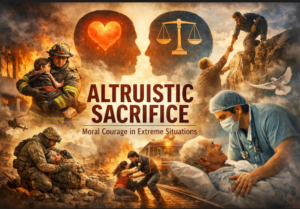
History is full of examples of people who made other people a priority, heroes who ran into burning homes, military representatives who risked their lives to protect civilians, parents who risked their life to save their children, and even strangers who appeared when needed. These acts which can be termed as supreme sacrifice transcend a normal helping behaviour. They are the ultimate altruism, which is based on profound psychological, moral, and evolutionary processes.
But why would one risk or even sacrifice his life to save others? Is it an instinct, a morality or social conditioning or something deeper within the psychology of man? This paper discusses psychological theory of the origins of altruistic sacrifice, based on prosocial behaviour, moral courage and collective survival instincts.
Understanding Altruism: Beyond Self-Interest
Altruism is essentially a term used to describe the act where a person performs a behaviour that solely aims at benefiting others at a personal sacrifice. The classical psychological theories used to believe that human beings are self-centred, but social psychological studies and evolutionary psychological studies indicate otherwise.
There is the spectrum of altruism:
- Low-cost altruism– assisting someone with bare minimum effort (e.g. giving directions)
- High-cost altruism – putting life/resource in danger.
- Extreme altruism (sacrifice) – taking or giving up one life in order to save others.
Supreme sacrifice is classified under the last category thus making it one of the most complicated human behaviours to explain.
Prosocial Behaviour: The Foundation of Sacrifice
Prosocial behaviour involves activities such as assistance, sharing, protection and cooperation. It is determined both by biology and culture.
Key Psychological Theories:
1. Empathy-Altruism Hypothesis (Batson)
According to this theory, empathy, which allows one to imagine what other person is undergoing, can result in truly altruistic actions.
- Empathy leads to individuals assisting at the expense of themselves when it is high.
- Emotional affinity supersedes sound self-preservation.
In very severe cases, like disasters, people tend to claim that they acted without thinking, being emotionally touched by the distress of other people.
2. Social Responsibility Norm
The society makes the society believe that they have a responsibility to assist the vulnerable or needy.
- Helping behaviour is supported by cultural values.
- Caregivers, soldiers, and doctors are some of the roles that are associated with moral expectations.
These norms when deep rooted can then encourage people to do things even under situations that are life-threatening.
3. Reciprocal and Kin Altruism
Evolutionarily, there are two possible scenarios that have not been explored:
Kin selection: We are more willing to make sacrifices on behalf of the family since this guarantees the survival of our genes.
Reciprocal altruism: Altruism benefits an individual by enhancing the chances of future altruism.
But even extreme altruism tends to extend beyond these explanations particularly when individuals do sacrifice strangers.
Moral Psychology: The Roots of Moral Courage
Moral courage refers to the readiness to be an advocate of ethical values under any circumstances even at the risk of social rejection, injury, or death.
1. Moral Identity
Individuals that perceive themselves as moral persons tend to perform bravely.
- The values such as justice, compassion, and duty are included in their self concept.
- These values are broken, and this leads to internal conflict.
In a severe case scenario, doing nothing can even be more psychologically difficult than losing life.
2. Cognitive Dissonance
People feel uncomfortable when they are in a scenario whereby their moral values are contravened by the action that they fail to take.
- Assistance alleviates mental anxiety.
- Sacrifice is an alternative of self-integrity.
3. Moral Elevation
It is possible to feel inspired to do the same things by watching an act of bravery or sacrifice.
- Heroism exposes individuals to prosocial tendencies.
- Leaves a wave of change in the society.
This is the reason why tales of sacrifice remain inspirational to generations.
Heroism: The Psychology of Extraordinary Action
Some individuals view heroism as something uncommon but the psychologists believe that given the right circumstances, all human beings can be heroes.
Characteristics of Heroes:
- High empathy
- Strong moral values
- Sense of responsibility
- The capability of responding to pressure.
Interestingly, most heroes do not consider themselves as extraordinary. They tend to say that they do what everyone would do implying that heroism is not as rare as we believe it to be.
The Role of Situational Factors
Not every sacrifice is done intentionally. A number of them take place in tense, stress-filled settings.
1. The Bystander vs Action Effect.
Although the effect of the bystander implies the smaller propensity to assist in groups, there are extreme cases that turn the opposite:
- Existence outweighs indecision.
- People assume responsibility voluntarily.
2. Time Pressure
People use instinct and internalised values when they have no time to think over the matter.
- Moral conditioning is usually manifested in quick decisions.
- Rational analysis is surpassed by emotional brain (limbic system).
3. Perceived Responsibility
Human beings tend to do things in a more responsible manner when they perceive personal responsibility.
- Role responsibility (e.g. police, military).
- Personal relationship with victims.
Collective Survival Instincts: Evolutionary Perspective
On the evolutionary perspective, a human being is a social animal whose survival is necessitated by cooperation.
1. Group Selection Theory
The groups that are cooperative and altruistic in nature, have bigger chances of survival.
- To get long-term survival, the group needs to be sacrificed.
- Promotes unity and trust
2. Emotional Wiring
It is biologically programmed in human beings to react when others are in distress.
- Mirror neurons are authenticated when we observe suffering.
- Gives rise to a self-motivated desire to assist.
3. Attachment and Bonding
- Good social ties enhance readiness to make sacrifices.
- The role is played by family, community and national identity.
- “We” overtakes the significance of “I”.
Psychological Traits Linked to Altruistic Sacrifice
Studies have determined that there are a number of characteristics that correlate with extreme prosocial behaviour:
- Compassion – the feeling of emotion toward others.
- Compassion- wish to reduce suffering.
- Self-efficacy- an opinion that one can help.
- Risk-taking ability- the readiness to take a risk.
- Moral conviction- high ethical beliefs.
Such characteristics are not in a vacuum, they are combined with situational and cultural factors.
Influences of Culture and Society.
Culture contributes a lot in determining the altruistic behaviour.
1. Collectivist Cultures
- In cultures which promote group harmony:
- People tend to put others higher in order of priority.
- Sacrifice is regarded as noble.
2. Narratives and Role Models
- Hero tales, martyr tales, and founder of caregivers build expectations in the society.
- Venerate the power of sacrifice.
- Offer behavioural prototypes.
3. Religious and Ethical Teachings.
- A lot of belief systems focus on selflessness, compassion and service.
- Enhance ethical incentives.
- Give meaning to sacrifice.
The Paradox of Self-Sacrifice
The most interesting feature of altruistic sacrifice is that it seems to be selfless but it can be accompanied with emotional compensation:
- Sense of purpose
- Emotional fulfillment
- Compliant with personal values.
This puts one in a paradox that, in fact, sacrificing oneself can be a very significant one to the individual.
What is the Time When Sacrifice is Risky?
Although altruism is mostly a good principle, there is moral and psychological concern when one goes too far in sacrificing:
- Action on impulse vs. thoughtful action.
- Social demands.
- Burnout of helping professions.
It is important to learn about these boundaries, particularly among such professionals as healthcare workers, counsellors, and emergency responders.
Mental Health and Society Implications.
The benefits of the promotion of prosocial behaviour are far-reaching:
1. Enhances Social Cohesion
- Develops loyalty and collaboration.
- Reduces conflict
2. Improves Mental Well-being
- Serving others makes one happier.
- Lowers stress and depression.
3. Encourages Resilience
Societies, which have high altruism, recuperate more quickly than crises.
Is it Teachable to Perform Altruistic Sacrifice?
Even though there are things that a person is born with, most can be fostered:
- The Guidance of empathy at an early age.
- Encouraging perspective-taking
- Promoting moral reasoning
- Providing role models
Families and educational systems are significant in producing the future generations who will be morally courageous.
Conclusion: The Human Capacity for Selflessness
Altruistic sacrifice is the greatest manifestation of the human potential. It is the place of emotion, morality, and evolution where people are forced to do what is not in their own best interest.
When there is no chance of survival, and fear and survival instincts prevail, others follow another route, which is based on empathy, courage, and a strong sense of responsibility. Such performances are not only good to recall that human beings are not simply motivated by self-preservation but also that they can be very selfless.
When we consider these psychological aspects on the occasion of National Supreme Sacrifice Day, we can see that heroes are not born, but they are made through experiences and values and the unseen strands of human relationship.
After all, sacrifice ability is in all of us. It is not a question whether man is capable of being altruistic or not, but it is a question when that altruism becomes so exceptional.
FAQs on Altruistic Sacrifice & Moral Courage
1. What is altruistic sacrifice in psychology?
Altruistic sacrifice can be defined as extreme prosocial action in which a person voluntarily jeopardises or sacrifices his own safety, well-being, or life to other people. It transcends ordinary helping and is more of moral dedication and action benefit of empathy.
2. What is the difference between altruism and prosocial behaviour?
- Prosocial behaviour: This can be any behaviour that aims at benefiting others (e.g., sharing, comforting).
- Altruism: A prosocial behaviour that is a subset, the motivation of which is selfless, and does not presuppose reward.
Any prosocial is altruism, but not all the prosocial acts are altruistic in nature.
3. What is the psychological motivation to extreme sacrifice?
Key factors include:
- Empathy (feeling others’ pain)
- Moral identity (identifying oneself as ethical)
- Sense of responsibility
- Emotional arousal in crises
- Internalized social norms
4. What is moral courage?
Moral courage is the skill to perform in line with personal values, even when this risks something, e.g. danger, censure, or loss. Sacrifice is the core of any sacrifice since each person values the morally right rather than the morally secure.
5. Is biological altruistic sacrifice?
Yes, partially. According to evolutionary psychology, it implies:
- Kin selection (defending family)
- Helping community survival (group survival instincts).
- Such brain processes as mirror neurons foster empathy.
Nevertheless, there is no way that science of biology can explain sacrifice to strangers.
6. Why do individuals make sacrifices to strangers?
This is explained by:
- Batson empathy-altruism hypothesis
- Moral principles and values
- Role models and social learning.
- Immediate emotional crisis psychology over personal interest.
7. What role then does the bystander effect play in such cases?
In general, the bystander effect decreases the helping behaviour among groups.
But in extreme situations:
- Urgency increases action
- A single person can affect the action of the group.
8. Is it possible to teach altruistic behaviour?
Yes. It can be developed through:
- Empathy training
- Moral education
- Perspective-taking exercises
Contact with role models and real life storeys of bravery.
9. Are selfless acts psychologically advantageous?
Even in the context of sacrifice:
- Increased sense of purpose
- Emotional fulfillment
- However, congruence to personal values.
- Increased psychological health.
10. Are there any possible instances of extreme altruism being bad?
Yes, if:
- It turns reckless and forms without risk evaluation.
- There is the social pressure on people to make sacrifices.
- Causes burnout in the helping professions.
- In prosocial roles, healthy boundaries are significant.
-
Written by Baishakhi Das
Counselor | Mental Health Practitioner
B.Sc, M.Sc, PG Diploma in Counseling
Reference Links (Credible Sources)
Here are some useful academic and psychological resources for deeper understanding:
-
Batson, C. D. (1991). The Altruism Question: Toward a Social-Psychological Answer
https://psycnet.apa.org/record/1991-97320-000 -
American Psychological Association – Prosocial Behavior
https://www.apa.org/monitor/2015/09/prosocial -
Greater Good Science Center (UC Berkeley) – Altruism & Compassion
https://greatergood.berkeley.edu/topic/altruism -
Zimbardo, P. – The Heroic Imagination Project
https://www.heroicimagination.org -
Evolutionary Basis of Altruism (Stanford Encyclopedia of Philosophy)
https://plato.stanford.edu/entries/altruism-biological/ - The Psychology of Healthy Eating: How Habits and Self-Regulation Shape Our Nutritional Choices
This article is written for knowledge purposes, aiming to help readers understand the topic better and gain useful insights for learning and awareness.