Behaviorism vs Cognitive Psychology

Understanding two major approaches to human behavior and the mind

https://ioannouolga.wordpress.com/wp-content/uploads/2018/08/behaviorism-cognitivism.gif?w=670

Introduction

Psychology has evolved through multiple schools of thought, each attempting to explain why humans think, feel, and behave the way they do. These perspectives developed in response to different questions—some focusing on what can be observed and measured, others exploring the invisible workings of the mind. Among these, Behaviorism and Cognitive Psychology stand out as two of the most influential—and contrasting—approaches in the history of psychology.

Behaviorism emerged in the early 20th century as a reaction against introspective methods. It argues that psychology should focus only on observable behavior and external consequences, because these can be scientifically measured and objectively studied. From this perspective, human behavior is shaped largely by the environment through learning, reinforcement, and punishment.

In contrast, Cognitive Psychology developed later, emphasizing that behavior cannot be fully understood without examining internal mental processes. It focuses on how people think, remember, interpret, problem-solve, and make meaning of their experiences. Cognitive psychologists view humans as active processors of information, whose beliefs, perceptions, and thoughts strongly influence emotions and actions.

Understanding the differences between behaviorism and cognitive psychology is essential for students, educators, therapists, and mental health practitioners, because these approaches influence how learning is taught, how behavior is managed, and how psychological difficulties are treated. Modern psychology increasingly integrates both perspectives, recognizing that behavior is shaped by external experiences and internal cognition working together, rather than by one alone.

What Is Behaviorism?

Behaviorism is a psychological approach that explains behavior as a result of environmental stimuli and learned responses. It argues that psychology should focus only on observable, measurable behavior, because behavior can be objectively studied, predicted, and controlled. From this viewpoint, internal mental states—such as thoughts, feelings, or intentions—are considered unnecessary for explaining behavior, as they cannot be directly observed.

Behaviorism emerged as a reaction against introspection-based psychology and aimed to make psychology a scientific, experimental discipline, similar to the natural sciences.

Key Contributors

  • John B. Watson – Founder of behaviorism; emphasized stimulus–response learning

  • B. F. Skinner – Developed operant conditioning; highlighted reinforcement and punishment

  • Ivan Pavlov – Discovered classical conditioning through conditioned reflexes

Each contributed to understanding how learning occurs through interaction with the environment.

Core Assumptions of Behaviorism

Behaviorism is based on several fundamental assumptions:

  • Behavior is learned, not innate
    Humans are not born with fixed behavioral patterns; behavior develops through experience.

  • Learning occurs through conditioning
    Repeated associations and consequences shape behavior.

  • Internal thoughts are not necessary to explain behavior
    Only observable actions are required for scientific explanation.

  • The environment shapes behavior
    External stimuli, rewards, and punishments determine how individuals act.

Key Concepts in Behaviorism

  • Classical Conditioning
    Learning through association between stimuli (e.g., Pavlov’s experiments).

  • Operant Conditioning
    Learning through consequences—reinforcement and punishment (Skinner).

  • Reinforcement and Punishment
    Consequences that increase or decrease behavior.

  • Stimulus–Response (S–R) Associations
    Behavior is seen as a direct response to environmental stimuli.

Example

A child studies more because good marks are rewarded.
→ The increased studying is explained through reinforcement, not through motivation, self-belief, or emotions.

From a behaviorist perspective, the reward strengthens the behavior, making internal thoughts unnecessary for explanation.

Key Insight

Behaviorism provides a clear, practical framework for understanding and modifying behavior, especially in areas like education, parenting, and behavior therapy. However, its focus on observable behavior alone is also what later led to the development of approaches—like cognitive psychology—that explore what happens inside the mind.

What Is Cognitive Psychology?

Cognitive psychology is a branch of psychology that focuses on how people process information—including thinking, reasoning, memory, attention, language, perception, and problem-solving. Rather than viewing humans as passive responders to external stimuli, this approach sees individuals as active processors of information who interpret, evaluate, and make meaning from their experiences.

Cognitive psychology emerged as a response to the limitations of behaviorism. Psychologists realized that understanding behavior requires exploring what happens inside the mind—how people think about situations, how they remember past experiences, and how they interpret the world around them.

Key Contributors

  • Jean Piaget – Explained how children’s thinking develops through distinct cognitive stages

  • Aaron Beck – Developed cognitive therapy, highlighting how thoughts influence emotions and behavior

Their work laid the foundation for understanding learning, development, and mental health through cognitive processes.

Core Assumptions of Cognitive Psychology

Cognitive psychology is built on several key assumptions:

  • Mental processes influence behavior
    What people think directly affects how they feel and act.

  • Thoughts, beliefs, and interpretations matter
    The same situation can lead to different behaviors depending on how it is perceived.

  • Humans actively construct meaning
    People are not passive learners; they organize and interpret information based on prior knowledge.

  • Behavior cannot be fully understood without understanding cognition
    Observable behavior is only one part of the picture—internal processes give it meaning.

Key Concepts in Cognitive Psychology

  • Schemas
    Mental frameworks that help organize and interpret information (e.g., beliefs about self or others).

  • Information Processing
    The way the mind encodes, stores, and retrieves information—often compared to a computer model.

  • Cognitive Distortions
    Inaccurate or biased thinking patterns that influence emotions and behavior.

  • Memory and Attention
    Processes that determine what information is noticed, remembered, or forgotten.

Example

A child avoids studying because they think, “I’m not smart enough.”
→ From a cognitive perspective, the behavior is explained by beliefs, self-perception, and thought patterns, not by rewards or punishment alone.

The problem is not just the behavior (avoiding study), but the underlying cognition shaping it.

Key Insight

Cognitive psychology helps us understand why behavior occurs, not just how it changes. By addressing thoughts, beliefs, and interpretations, this approach is especially valuable in education, counseling, and mental health interventions, where insight and emotional understanding are essential for lasting change.

Key Differences: Behaviorism vs Cognitive Psychology

Aspect Behaviorism Cognitive Psychology
Focus Observable behavior Internal mental processes
View of mind Not necessary to study Central to behavior
Learning Conditioning Information processing
Role of environment Primary influence Important but not sole factor
Role of thoughts Ignored Essential
Research methods Experiments, observation Experiments, models, self-report
Therapy focus Behavior change Thought + behavior change

Applications in Real Life

In Education

Both approaches strongly influence how teaching and learning are designed.

  • Behaviorism emphasizes observable performance.

    • Reward-based learning (grades, praise, stars)

    • Discipline systems with clear rules and consequences

    • Repetition and practice to build habits
      This approach is especially useful for classroom management, skill acquisition, and maintaining structure.

  • Cognitive Psychology focuses on how students think and understand.

    • Learning strategies (mnemonics, mind maps)

    • Problem-solving and critical thinking

    • Conceptual understanding rather than rote learning
      This helps students become active learners who understand why and how, not just what.

👉 Modern education blends both: reinforcement to motivate effort, and cognitive strategies to deepen understanding.

In Parenting

Parenting practices often reflect a mix of these two approaches.

  • Behaviorism in parenting involves:

    • Reinforcing good behavior (praise, attention, rewards)

    • Setting clear consequences for misbehavior

    • Consistency in responses
      This helps children learn boundaries and expectations.

  • Cognitive Psychology in parenting focuses on:

    • Understanding emotions behind behavior

    • Helping children identify self-talk (“I can’t do this”)

    • Supporting motivation, confidence, and emotional regulation

👉 Together, they allow parents to guide behavior while also nurturing emotional intelligence and self-esteem.

In Therapy

Therapeutic approaches clearly show the strengths of both perspectives.

  • Behaviorism contributes:

    • Behavior modification techniques

    • Exposure therapy for fears and phobias

    • Habit reversal strategies

  • Cognitive Psychology contributes:

    • Cognitive restructuring (challenging negative thoughts)

    • Changing maladaptive beliefs

    • Improving self-perception and emotional understanding

Modern therapies—especially Cognitive Behavioral Therapy (CBT)—integrate both approaches, targeting behavior change and thought patterns simultaneously for lasting mental health improvement.

Strengths and Limitations

Strengths of Behaviorism

  • Clear, measurable, and practical

  • Highly effective for habit formation

  • Widely useful in classrooms, parenting, and behavior therapy

Limitations of Behaviorism

  • Ignores emotions, thoughts, and meaning

  • Limited in explaining complex human behavior

  • Less effective for trauma-related or emotionally driven issues 

Strengths of Cognitive Psychology

  • Explains thinking, emotions, and meaning-making

  • Effective for anxiety, depression, and self-esteem concerns

  • Respects human agency, insight, and self-awareness

Limitations of Cognitive Psychology

  • Mental processes are harder to measure objectively

  • May overlook environmental and situational influences

  • Requires verbal ability and reflective capacity

Modern Perspective: Integration, Not Opposition

Today, psychology no longer treats behaviorism and cognitive psychology as opposing camps. Instead, they are understood as complementary perspectives.

  • Behaviorism explains how behavior is shaped through consequences and learning

  • Cognitive psychology explains why behavior happens through thoughts, beliefs, and interpretations

Integrated approaches recognize that behavior and cognition influence each other continuously.

Conclusion

Behaviorism and cognitive psychology offer two powerful lenses for understanding human behavior.
One focuses on what we do.
The other focuses on how we think.

Together, they provide a richer, more complete picture of human functioning.

Behavior can be shaped.
Thoughts can be changed.
And meaningful change happens when both are understood.

Frequently Asked Questions (FAQ)

1. What is the main difference between behaviorism and cognitive psychology?

Behaviorism focuses on observable behavior and external consequences, while cognitive psychology focuses on internal mental processes like thoughts and memory.

2. Who founded behaviorism?

Behaviorism was founded by John B. Watson.

3. Who are the major contributors to cognitive psychology?

Key contributors include Jean Piaget and Aaron Beck.

4. Why did behaviorists reject mental processes?

They believed thoughts and emotions could not be objectively measured and therefore should not be the focus of scientific psychology.

5. What does cognitive psychology focus on?

It focuses on thinking, memory, attention, perception, language, and problem-solving.

6. How does behaviorism explain learning?

Learning occurs through conditioning—via reinforcement, punishment, and stimulus–response associations.

7. How does cognitive psychology explain behavior?

Behavior is explained through beliefs, interpretations, schemas, and information processing.

8. Which approach is better for education?

Both are useful: behaviorism helps with discipline and habit formation, while cognitive psychology supports deep understanding and critical thinking.

9. Which approach is more effective in therapy?

Modern therapy combines both approaches, especially in Cognitive Behavioral Therapy.

10. Can behaviorism explain emotions?

No. One of its main limitations is ignoring emotions and internal experiences.

11. Can cognitive psychology explain habits?

Yes, but it may overlook the role of reinforcement and environment in habit formation.

12. Is behaviorism still relevant today?

Yes, especially in education, parenting, and behavior modification programs.

13. Is cognitive psychology more humanistic?

It is more person-centered than behaviorism, as it values thoughts, meaning, and insight.

14. Why are the two approaches integrated today?

Because behavior and cognition influence each other; understanding both leads to better outcomes.

15. What is the biggest takeaway from comparing these approaches?

Human behavior is best understood by combining external behavior patterns with internal mental processes.

Written by Baishakhi Das

Counselor | Mental Health Practitioner
B.Sc, M.Sc, PG Diploma in Counseling


Reference 

  1. Watson, J. B. (1913). Psychology as the Behaviorist Views It.

  2. Skinner, B. F. (1953). Science and Human Behavior.

  3. Piaget, J. (1952). The Origins of Intelligence in Children.

  4. Beck, A. T. (1976). Cognitive Therapy and the Emotional Disorders.

  5. American Psychological Association (APA) – Learning & Cognition
    https://www.apa.org

  6. McLeod, S. A. (2023). Behaviorism & Cognitive Psychology. Simply Psychology
    https://www.simplypsychology.org

  7. Anger Issues in Men: What’s Really Going On


Learned Helplessness Theory

https://upload.wikimedia.org/wikipedia/commons/thumb/9/9c/Shuttle_Box_Dog_Orange.png/330px-Shuttle_Box_Dog_Orange.png

Introduction

Learned Helplessness Theory explains how repeated exposure to uncontrollable and unavoidable negative experiences can gradually lead individuals to believe that their actions no longer make a meaningful difference.

Consequently, individuals start anticipating failure no matter how hard they struggle. This belief system continuously and steadily leads to passivity, lack of motivation, emotional distress, and distorted ways of thinking, even in cases when the actual change opportunities are presented. As a result, people end up not even trying, in most instances, not due to lack of ability but because they have been taught that it is pointless that they make efforts. Through this, helplessness becomes a vicious cycle, which eventually inhibits action, growth and adaptive coping.

In addition to that, the theory has significantly impacted psychology because it provides a simple and organized system through which individuals can explain why they cannot come out of destructive circumstances. Specifically, it has played a significant role in describing the conditions of depression, trauma-related disorders, anxiety, detachment at school, workplace burnout, and the psychological effects of chronic abuse or neglect over time.

Therapeutic Approach

As a therapeutic approach, this one emphasizes the fact that helplessness is not a genetic characteristic, but rather a learned behavior as a result of constant loss of control. Thus, and last, but not least, it points out that helplessness is something that can be reversed and taught out with the help of supportive interventions, empowering ones, and skill-based interventions.

It thus also highlights that helplessness can be learnt out by the use of supportive, empowering, and skills based intervention.

Origin of Learned Helplessness Theory

The theory was first proposed by Martin Seligman in the late 1960s, based on experimental research examining how animals and humans respond to situations where outcomes appear independent of their behavior.

Seligman’s work challenged the assumption that individuals always learn to act in their best interest.

The Classic Experiments

In the original experiments, dogs were repeatedly exposed to unavoidable electric shocks in situations where no escape was possible. At first, the animals were in distress and were trying to escape the shocks. But with time, they even ceased to make any attempts. Subsequently, dogs that were put in a different environment where escape appeared to be evident, did not take the initiative to escape even when that meant very little effort.

Key Observations

  • First, the dogs had learned that their actions were ineffective in influencing outcomes.

  • Second, this learning generalized to new situations, even when those situations were controllable.

  • Consequently, passivity gradually replaced active problem-solving behavior.

This pattern of learned passivity and expectation of failure became known as learned helplessness.

⚠️ Importantly, the dogs were not physically incapable of escaping. Rather, they were psychologically conditioned to expect failure, which prevented them from taking action.

Core Assumptions of Learned Helplessness Theory

Based on these findings, the Learned Helplessness Theory rests on three fundamental assumptions that explain how helplessness develops and persists.

1. Perceived Lack of Control

When individuals are repeatedly exposed to situations in which outcomes appear independent of their efforts, they begin to develop a belief that they have no control over what happens. Over time, this leads to the expectation:

“Nothing I do will change the result.”

As a result, motivation decreases and effort feels meaningless.

2. Generalization of Helplessness

Importantly, this belief does not remain confined to the original situation. Instead, it spreads to other areas of life, even when control and choice are actually available. For example, a person who feels helpless in one domain may begin to feel ineffective in relationships, work, or academics.

3. Expectancy of Failure

Finally, individuals begin to anticipate negative outcomes before taking action. Consequently, they experience reduced motivation, emotional distress, and impaired cognitive functioning. Problem-solving becomes more difficult, and avoidance often replaces effort.

Key Insight

Together, these assumptions explain why learned helplessness is not a lack of ability, but a learned belief system shaped by repeated experiences of uncontrollability. Therefore, understanding this process is essential for reversing helplessness and restoring a sense of agency.

The Three Components of Learned Helplessness

Learned helplessness affects individuals on motivational, cognitive, and emotional levels. Together, these components explain why people stop trying, struggle to think clearly, and experience deep emotional distress, even when change is possible.

1. Motivational Deficits

First and foremost, learned helplessness leads to significant motivational deficits. Individuals show a noticeable reduction in effort and initiative, often giving up quickly when faced with obstacles. Over time, challenges begin to feel overwhelming, and avoidance replaces active engagement.

  • Reduced effort and initiative

  • Giving up easily

  • Avoidance of challenges

As a result, individuals stop trying—not because they lack ability, but because effort feels pointless. Repeated experiences of failure teach them that action will not lead to improvement, weakening motivation further.

2. Cognitive Deficits

In addition to motivational changes, learned helplessness produces cognitive impairments that affect how individuals think, interpret situations, and solve problems. People may struggle to learn new responses or adapt to changing circumstances, even when solutions are available.

  • Difficulty learning new responses

  • Impaired problem-solving abilities

  • Persistent negative self-beliefs

Common thought patterns include:

  • “I’m incapable.”

  • “There’s no solution.”

  • “I always fail.”

Consequently, these distorted beliefs reinforce helplessness by convincing individuals that success is unattainable, further reducing effort and flexibility in thinking.

3. Emotional Deficits

Finally, learned helplessness is accompanied by profound emotional deficits. Persistent feelings of sadness, hopelessness, and anxiety often emerge. In some cases, individuals may also experience emotional numbness, where they feel disconnected from both positive and negative emotions.

  • Sadness and hopelessness

  • Anxiety and emotional numbness

  • Low self-worth and self-esteem

Importantly, these emotional responses closely resemble clinical depression, which explains why learned helplessness is strongly associated with depressive disorders and trauma-related conditions.

Integrative Insight

Taken together, these three components form a self-reinforcing cycle. Reduced motivation limits action, distorted thinking undermines confidence, and emotional distress deepens withdrawal. Therefore, effective intervention must address all three levels—restoring motivation, challenging cognitive distortions, and supporting emotional healing.

Learned Helplessness and Depression

Learned helplessness became a cornerstone in psychological explanations of depression. Many depressive symptoms—such as hopelessness, withdrawal, and low motivation—can be understood as consequences of perceived uncontrollability.

Later refinements introduced the concept of attributional style:

  • Internal (“It’s my fault”)

  • Stable (“It will never change”)

  • Global (“It affects everything”)

This pattern is especially linked to chronic depression.

Learned Helplessness in Real Life

1. Childhood and Parenting

  • Harsh criticism

  • Inconsistent discipline

  • Emotional or physical abuse

Children may learn that effort does not lead to safety or approval, shaping lifelong patterns of helplessness.

2. Education

Students who repeatedly fail despite effort may conclude:

“I’m bad at studying.”

This can lead to academic disengagement, not lack of ability.

3. Relationships

In abusive or controlling relationships, individuals may feel:

  • Trapped

  • Powerless

  • Unable to leave or seek help

Even when support becomes available, action feels impossible.

4. Workplace

  • Chronic micromanagement

  • Unfair evaluations

  • Lack of recognition

Employees may disengage, showing burnout and resignation rather than motivation.

Learned Helplessness and Trauma

Trauma—especially chronic or interpersonal trauma—strongly reinforces learned helplessness. When escape or resistance repeatedly fails, the nervous system adapts by shutting down effort as a survival strategy.

This explains why trauma survivors may:

  • Freeze instead of act

  • Struggle with decision-making

  • Feel powerless long after danger has passed

From Learned Helplessness to Learned Hopefulness

Later research, including Seligman’s own work, emphasized that helplessness is learned—and therefore unlearnable.

Key Interventions:

  • Restoring a sense of control

  • Teaching problem-solving skills

  • Challenging negative attributional styles

  • Encouraging small, successful actions

This shift led to the concept of learned optimism.

Therapeutic Implications

Cognitive Behavioral Therapy (CBT)

  • Identifies helpless beliefs

  • Challenges distorted attributions

  • Builds mastery experiences

Trauma-Informed Therapy

  • Emphasizes safety and choice

  • Avoids re-creating powerlessness

  • Respects the pace of the client

Counseling and Education

  • Reinforces effort–outcome connections

  • Focuses on strengths and agency

  • Uses gradual exposure to success

Strengths of the Theory

  • Explains passivity in depression and trauma

  • Strong empirical foundation

  • Practical applications in therapy, education, and social policy

Limitations of the Theory

  • Early animal research raised ethical concerns

  • Does not fully account for resilience

  • Overemphasis on cognition may underplay biological factors

Conclusion

The Learned Helplessness Theory reveals a powerful psychological truth:

When people learn that their actions don’t matter, they stop acting—even when change is possible.

Understanding learned helplessness allows psychologists, counselors, educators, and caregivers to replace resignation with agency, helplessness with hope, and passivity with empowerment.

Healing begins not with forcing action—but by restoring belief in control.

Frequently Asked Questions (FAQ)

1. What is Learned Helplessness Theory?

Learned Helplessness Theory explains how repeated exposure to uncontrollable and unavoidable negative experiences leads individuals to believe that their actions no longer influence outcomes, resulting in passivity and withdrawal.


2. Who proposed the Learned Helplessness Theory?

The theory was proposed by psychologist Martin E. Seligman, based on experimental research conducted in the late 1960s and early 1970s.


3. How does learned helplessness develop?

Learned helplessness develops when repeated failures or uncontrollable events teach individuals that effort does not lead to success, causing them to stop trying even when change is possible.


4. What are the main components of learned helplessness?

Learned helplessness involves three key components:

  • Motivational deficits (reduced effort and initiative)

  • Cognitive deficits (negative beliefs and poor problem-solving)

  • Emotional deficits (sadness, anxiety, hopelessness)


5. How is learned helplessness related to depression?

Learned helplessness is closely linked to depression because both involve hopelessness, passivity, low motivation, and negative thinking patterns, especially when individuals feel powerless over life events.


6. Can learned helplessness affect children and students?

Yes. In educational settings, repeated academic failure or harsh criticism can cause students to believe they are incapable, leading to academic disengagement and avoidance of challenges.


7. How does trauma contribute to learned helplessness?

Chronic trauma, abuse, or neglect often involves repeated loss of control, which reinforces helplessness and explains why trauma survivors may feel stuck, powerless, or unable to act, even after the threat has passed.


8. Is learned helplessness permanent?

No. Learned helplessness is not an inherent trait. Because it is learned, it can also be unlearned through therapy, supportive environments, skill-building, and experiences that restore a sense of control.


9. How is learned helplessness treated in therapy?

Therapeutic approaches such as Cognitive Behavioral Therapy (CBT) and trauma-informed counseling help individuals challenge helpless beliefs, rebuild confidence, and reconnect effort with positive outcomes.


10. Why is Learned Helplessness Theory important?

The theory helps explain why people remain stuck in harmful situations and provides a foundation for interventions aimed at restoring agency, motivation, and psychological resilience.

Written by Baishakhi Das
Counselor | Mental Health Practitioner
B.Sc, M.Sc, PG Diploma in Counseling


Reference 

  1. American Psychological Association – Learned Helplessness
    https://dictionary.apa.org/learned-helplessness

  2. Simply Psychology – Learned Helplessness
    https://www.simplypsychology.org/learned-helplessness.html

  3. Seligman, M. E. P. (1975). Helplessness: On Depression, Development, and Death
    https://psycnet.apa.org/record/1976-21548-000

  4. Verywell Mind – Learned Helplessness Explained
    https://www.verywellmind.com/what-is-learned-helplessness-2795326

  5. National Institute of Mental Health (NIMH) – Depression Overview
    https://www.nimh.nih.gov/health/topics/depression

  6. World Health Organization – Mental Health and Trauma
    https://www.who.int/teams/mental-health-and-substance-use

  7. Cognitive Behavioral Theory: How Thoughts Control Emotions


Information Processing Theory of Memory

Understanding How the Human Mind Takes In, Stores, and Uses Information

https://opentextbc.ca/introductiontopsychology/wp-content/uploads/sites/9/2013/11/a74de49aa1281b2a68a59837b882d879.jpg

Introduction

The Information Processing Theory of Memory explains memory as a systematic, step-by-step mental process, much like the way a computer handles information. According to this theory, the human mind is not a passive recipient of experiences; instead, it actively selects, organizes, encodes, stores, and retrieves information through a series of mental operations. All these control stages are very important in deciding what is to be remembered, how long it is to be retained and how it can be accurately recalled.

This theoretical approach marked a major shift in cognitive psychology, moving away from an exclusive focus on observable behavior toward the study of internal mental processes such as attention, perception, memory, and thinking. The theory has also enabled psychologists to better understand how learning takes place, why it can be forgotten and how it can be reinforced by pointing out that the process of learning is an active, effortful, and dynamic process rather than merely being exposed to the information.

Core Assumptions of the Information Processing Theory

The Information Processing Theory of Memory is grounded in several fundamental assumptions about how the human mind handles information. These assumptions explain why some information is remembered while other information is forgotten, and how learning can be improved.

1. The Mind Functions Like an Information System

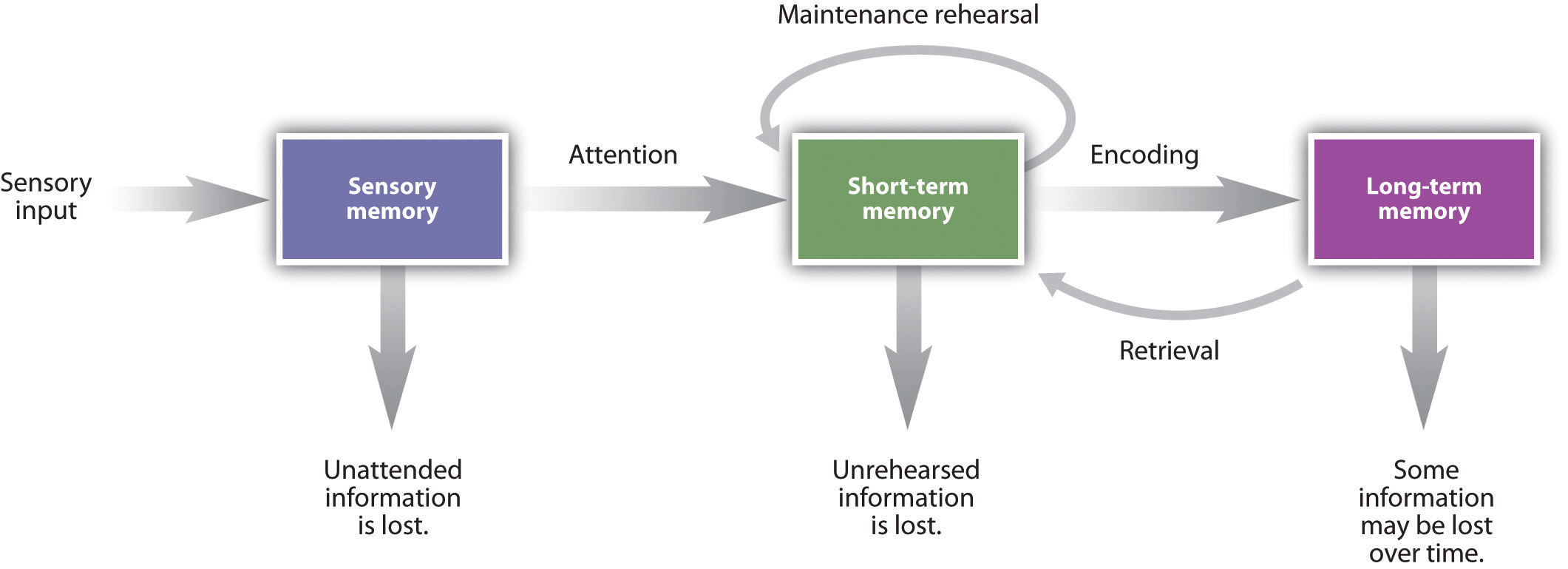
This theory assumes that the human mind operates in a way similar to an information-processing system, such as a computer. Information from the environment is first received as input through the senses, then processed and interpreted, stored in memory, and later retrieved as output when needed.
However, unlike a computer, the human mind is influenced by emotions, motivation, prior experiences, and meaning, which shape how information is processed.

This assumption emphasizes that memory is organized and systematic, not random.

2. Information Flows Through Distinct Stages

According to the theory, memory is not a single, unified structure. Instead, information moves through a series of distinct memory stages, each with its own function, capacity, and duration. These stages typically include:

  • Sensory memory – briefly holds incoming sensory information

  • Short-term (working) memory – actively processes information

  • Long-term memory – stores information for extended periods

Information must successfully pass through each stage to be retained. If processing fails at any stage—such as lack of attention in sensory memory or insufficient rehearsal in short-term memory—the information is likely to be lost.

3. Active Mental Effort Plays a Crucial Role

A central assumption of the Information Processing Theory is that learning and memory require active mental involvement. Memory retention depends heavily on cognitive efforts such as:

  • Attention – selecting relevant information

  • Rehearsal – repeating or reviewing information

  • Organization – structuring information meaningfully

  • Elaboration – connecting new information to existing knowledge

The deeper and more meaningful the processing, the stronger and more durable the memory. Simply exposing the mind to information is not enough; how the information is processed determines how well it is remembered.

The Three Main Memory Stores

According to the Information Processing Theory, memory is not a single container but a series of interconnected systems through which information must pass. Each store has a unique role in determining what we notice, what we keep, and what we remember long term.

1. Sensory Memory – The First Gateway

Sensory memory is the initial stage of memory, responsible for briefly holding raw information received from the senses. It acts as a buffer, allowing the brain a moment to decide what information is worth further processing.

Key Characteristics

  • Duration: Extremely brief (milliseconds to about 2 seconds)

  • Capacity: Very large (can register vast sensory input at once)

  • Level of awareness: Mostly unconscious

Sensory memory ensures that the world appears continuous and stable, rather than fragmented.

Types of Sensory Memory

  • Iconic memory: Visual input (images, shapes, words)

  • Echoic memory: Auditory input (sounds, speech)

Example

When you glance at a word and still “see” it for a split second after looking away, this is iconic memory in action. Similarly, when you briefly replay the last words someone said, that reflects echoic memory.

⚠️ Important Point:
Only information that receives attention moves from sensory memory to the next stage. Unattended information rapidly fades, preventing overload of the memory system.

2. Short-Term Memory (STM) – The Working Space

Short-term memory is the system where information is consciously processed and temporarily held. It functions as a mental workspace used for thinking, problem-solving, and decision-making.

Key Characteristics

  • Duration: Approximately 15–30 seconds without rehearsal

  • Capacity: Limited (about 7 ± 2 items)

  • Vulnerability: Easily disrupted by distraction or interference

Because of its limited capacity, STM cannot hold large amounts of information unless it is actively managed.

Processes in Short-Term Memory

  • Maintenance rehearsal: Repeating information to keep it active

  • Mental manipulation: Performing operations such as calculating, reasoning, or comparing

Example

Remembering a phone number just long enough to dial it depends on STM. If attention shifts or rehearsal stops, the number is quickly forgotten.

Without repetition or meaningful connection, information in STM decays rapidly.

3. Long-Term Memory (LTM) – The Knowledge Storehouse

Long-term memory is the final and most durable memory system. Information that reaches LTM has usually been deeply processed, making it more stable and accessible over time.

Key Characteristics

  • Duration: Hours to a lifetime

  • Capacity: Virtually unlimited

  • Organization: Structured around meaning, associations, and experiences

Long-term memory allows individuals to retain knowledge, skills, identities, and life experiences.

Types of Long-Term Memory

Explicit (Declarative) Memory

Consciously recalled information:

  • Episodic memory: Personal life events (first day of school)

  • Semantic memory: Facts and general knowledge (capital cities)

Implicit (Non-declarative) Memory

Unconscious or automatic memory:

  • Procedural memory: Skills (cycling, typing)

  • Conditioning and habits: Learned emotional or behavioral responses

How These Stores Work Together

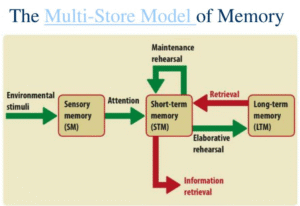
Information must pass sequentially through these memory stores:

  1. Sensory memory captures input

  2. Attention moves selected information into STM

  3. Meaningful processing transfers it to LTM

Failure at any stage can result in forgetting.

Key Insight

The effectiveness of memory depends not on how much information we encounter, but on how deeply and actively it is processed. Attention, rehearsal, and meaning are the bridges that carry information from momentary awareness to lasting memory.

https://www.simplypsychology.org/wp-content/uploads/Stages-of-Memory-1.jpg
Key Cognitive Processes in Information Processing Theory

The Information Processing Theory emphasizes that memory is shaped by how information is processed, not merely by exposure. Three core cognitive processes—encoding, storage, and retrieval—work together to determine whether information is remembered or forgotten.

1. Encoding – Making Information Meaningful

Encoding refers to the process of transforming incoming sensory information into a form that the brain can store. It is the first and most critical step in memory formation.

Information can be encoded at different levels:

  • Shallow encoding: based on surface features (sound, appearance)

  • Deep encoding: based on meaning, understanding, and connection

The theory strongly supports the idea that deeper processing leads to stronger memory.

Effective Encoding Strategies

  • Elaboration:
    Linking new information with existing knowledge or personal experiences
    Example: Relating a psychological concept to a real-life case

  • Organization:
    Structuring information into categories, outlines, or hierarchies
    Example: Grouping memory types under sensory, short-term, and long-term memory

  • Visualization:
    Creating mental images to represent information
    Example: Imagining a memory flow diagram

  • Mnemonics:
    Using acronyms, rhymes, or phrases to aid recall
    Example: Using keywords to remember theoretical stages

📌 Key Principle:
The more meaningful and connected the encoding, the more durable the memory trace.

2. Storage – Long term storage of Data.

Storage may be defined as the information that is stored in encrypted version over the period of time in such a way that it can be transferred to a later date in order to be used.

Factors Influencing Storage

  • Rehearsal:
    Repeating information strengthens memory traces

    • Maintenance rehearsal keeps information active

    • Elaborative rehearsal strengthens long-term storage

  • Emotional significance:
    Emotionally charged information is stored more strongly due to increased attention and arousal

  • Repetition and practice:
    Repeated exposure reinforces neural connections

  • Sleep and consolidation:
    Sleep plays a crucial role in stabilizing and integrating memories into long-term storage

Information in long-term memory is not stored randomly. Instead, it is organized into networks of meaning, associations, and schemas, making retrieval more efficient.

3. Retrieval – Accessing Stored Information

Retrieval is the process of bringing stored information back into conscious awareness when needed. Memory performance is often judged by retrieval success, but retrieval can fail even when information is still stored.

Factors Affecting Retrieval

  • Context:
    Memory is improved when retrieval conditions match encoding conditions
    (e.g., same environment or emotional state)

  • Cues and prompts:
    Hints, reminders, or associations can trigger recall

  • Strength of encoding:
    Well-encoded information is easier to retrieve

⚠️ Important Insight:
Failure to retrieve information does not necessarily mean it has been lost. Often, the issue lies in inadequate cues or weak access pathways, not in storage failure.

Integration of the Three Processes

Encoding, storage, and retrieval are interdependent:

  • Poor encoding leads to weak storage

  • Weak storage makes retrieval difficult

  • Effective retrieval reinforces future memory strength

Thus, memory is best understood as a dynamic, ongoing process, not a static record.

Key Takeaway

The Information Processing Theory highlights that memory success depends less on intelligence and more on how information is processed. Attention, meaning, emotional relevance, and repeated access determine whether information becomes a lasting part of memory.

The Role of Attention and Working Memory

Attention acts as a filter, deciding what information enters the system.
Working memory (an expanded view of STM) allows us to:

  • Focus

  • Plan

  • Solve problems

  • Regulate behavior

In counseling and education, attention difficulties directly affect learning and memory performance.

Strengths of Information Processing Theory

  • Explains how learning occurs, not just outcomes

  • Useful in education, therapy, and skill training

  • Supports practical techniques (rehearsal, chunking, mnemonics)

  • Empirically testable

Limitations of the Theory

  • Overly mechanical (human emotions are underemphasized)

  • Less focus on motivation and social context

  • Assumes linear processing, while the brain often works in parallel

Despite limitations, it remains a foundational cognitive theory.

Practical Applications

In Education

  • Chunking content improves retention

  • Active learning strengthens encoding

  • Repetition spaced over time enhances storage

In Counseling & Therapy

  • Trauma may disrupt encoding and retrieval

  • Anxiety overloads working memory

  • Cognitive interventions strengthen attention and processing

In Daily Life

  • Multitasking reduces memory accuracy

  • Meaningful learning lasts longer than rote memorization

Conclusion

The Information Processing Theory of Memory offers a powerful framework for understanding how humans learn, remember, and apply knowledge. Memory is not a single act but a dynamic process shaped by attention, meaning, and experience.

When information is actively processed, emotionally connected, and repeatedly accessed, it becomes part of long-term memory—supporting learning, decision-making, and personal growth.

Frequently Asked Questions (FAQ)

1. What is the Information Processing Theory of Memory?

The Information Processing Theory explains memory as an active, step-by-step mental process in which information is encoded, stored, and retrieved. It compares the human mind to an information system, emphasizing how attention and processing depth influence learning and recall.


2. What are the main stages of memory in this theory?

The theory proposes three main memory stores:

  • Sensory Memory – briefly holds sensory input

  • Short-Term (Working) Memory – temporarily processes information

  • Long-Term Memory – stores information for extended periods

Information must pass through each stage to be remembered.


3. Why is encoding considered the most important process?

Encoding determines how deeply information is processed. Meaningful encoding strategies such as elaboration, organization, and visualization create stronger memory traces, making information easier to store and retrieve later.


4. How does attention affect memory?

Attention acts as a filter. Only information that receives attention moves from sensory memory to short-term memory. Without attention, information quickly fades and is forgotten.


5. What role does sleep play in memory storage?

Sleep supports memory consolidation, the process by which newly learned information is stabilized and integrated into long-term memory. Lack of sleep can weaken storage and retrieval.


6. Does forgetting always mean memory loss?

No. Forgetting often reflects a retrieval failure, not loss of stored information. With proper cues or context, the memory may become accessible again.


7. How is this theory useful in education and counseling?

  • In education, it helps design effective learning strategies

  • In counseling, it explains how stress, anxiety, or trauma can disrupt encoding and retrieval

  • It supports techniques like repetition, chunking, and meaning-based learning


8. What is the main limitation of the Information Processing Theory?

The theory is sometimes criticized for being too mechanical, as it underplays emotional, social, and motivational influences on memory.

Written by Baishakhi Das

Counselor | Mental Health Practitioner
B.Sc, M.Sc, PG Diploma in Counseling


Reference 

  1. American Psychological Association (APA)
    https://www.apa.org/monitor/nov01/memory

  2. Simply Psychology – Information Processing Theory
    https://www.simplypsychology.org/information-processing.html

  3. National Institute of Neurological Disorders and Stroke (NINDS)
    https://www.ninds.nih.gov/health-information/public-education/brain-basics/brain-basics-memory

  4. OpenStax Psychology – Memory Chapter
    https://openstax.org/details/books/psychology-2e

  5. Cognitive Psychology Text (Educational Resource)
    https://www.coursera.org/learn/learning-how-to-learn

  6. Cognitive Behavioral Theory: How Thoughts Control Emotions