Language Development in Children: Stages, Theories (Why child not speaking clearly at age 2)

One of the most outstanding skills of human beings is language. It enables us to share thoughts, emotion, needs and ideas, and it is the key to cognitive, social, and emotional development. Language development is a complex dynamic process that depends on biological, psychological and environmental factors and takes place since the first cry of a baby to complex storytelling in a child.

This paper will cover the steps, theories, determining variables and importance of language development giving a holistic idea of how human beings acquire and perfect this vital practise.

What is Language Development?

Language development can be defined as the process by which human beings learn to perceive, produce and utilise words to communicate. It entails receptive language (understanding) and expressive language (speaking or language production).

It has a close association with other spheres of development like cognition, social interaction, and emotional regulation. Language is not about words alone, but it has grammar, syntax, pragmatics, and even non-verbal communication such as gestures and facial expressions.

Stages of Language Development

The language development is normally in a predictable order and though the speed is not always consistent among people.

1. Pre-linguistic Stage (0–12 months)

This is the initial stage of the foundation of language.

  • 0-2 months: Reflexive crying and cooing.
  • 2–6 months: Cooing and laughter
  • 6–9 months: Babbling (e.g., “ba-ba”, “da-da”)
  • 9-12 months: Willful communication (gestures, pointing)

At this age, infants get to learn the rhythms and patterns of language. Babbling plays an important role because it trains the vocal apparatus to speech.

2. One-Word Stage (12–18 months)

[Why child not speaking clearly at age 2]

It is also referred to as the holophrastic stage that uses one word, which is a complete thought.

  • Example: Milk can have a meaning of I desire milk.
  • Vocabulary development is sluggish (approximately 1050 words)

Children use much context, tone, and gestures as a means of communication.

3. Two-Word Stage (18–24 months)

Children start to combine two words in order to form simple sentences.

  • Examples: “Mommy go,” “more juice”
  • Telegraphic speech (leaving out less significant words)

An initial grasp of syntax and interrelations between the words is noted during this stage.

4. Telegraphic Speech (2–3 years)

Sentences are prolonged but do not contain grammatical marks.

  • Example: “Daddy go work”
  • Word explosion Rapid vocabulary expansion.

Children start to understand simple rules of grammar, but the mistakes are frequent.

5. Early Multiword Stage (3–5 years)

There is more complexity and structure of language.

  • Plural, tense and prepositions.
  • Greater use of questions and storeys.
  • Children begin to talk and tell storeys.

6. Later Language Development (5+ years)

  • Language is more perfected and advanced. The interpretation of metaphors, humour, and abstract ideas.Better grammar and vocabulary. The stage is extended to adolescence when language becomes more subtle. Language Development Theories.

There are various theories that are trying to state how a language is learned:

1. Behaviourist Theory (B.F. Skinner)

Learning of language is done by imitation, reinforcement and conditioning. Children imitate adults. Appropriate answers are reinforced.

  • Limit: Not entirely able to describe how new sentences are created.

2. Nativist Theory (Noam Chomsky)

Suggests that humans have an inborn capacity to pick up language. Came up with the concept of Language Acquisition Device (LAD). Lays stress on universal grammar.

  • Strength: describes how language is acquired very fast.
  • Limitations: Misunderestimates environmental impact.

3. Cognitive Theory (Jean Piaget)

Language development is associated with cognitive development. Children need to know ideas first before articulating the ideas. Thinking is manifested in language.

4. Social Interactionist Theory (Lev Vygotsky)

  1. Language evolves in the socialisation process.
  2. Plays up importance of caregivers and environment.
  3. Zone of Proximal Development (ZPD) Concept.
  4. According to this theory, in language learning, communication is significant.
  5. Key Components of Language

Language is a complicated mechanism that includes a number of components:

  • Phonology: The sounds of language.
  • Morphology: Words structure.
  • Syntax: Sentence structure
  • Semantics: Meaning of words
  • Pragmatics: Applications of language in a context.

The components are developed progressively and interact with other components. Aspects that determine the development of language.

There is no developmental language that takes place in a vacuum. It depends on a number of factors:

1. Biological Factors

  • Brain maturation
  • Genetic predisposition
  • Hearing ability

2. Cognitive Development

  • Memory, attention and perception.
  • Symbolic thinking

3. Social Interaction

  • Parent-child communication
  • Quality and quantity of language exposure.

4. Socioeconomic Status

  • Access to resources
  • Educational environment

5. Cultural Context

  • Language norms
  • Communication styles
  • The part of Caregivers in the development of a Language.

Caregivers are very important in the development of language capabilities:

  1. Children speech (motherese): Minimal, exaggerated speech.
  2. Reading stories
  3. Encouraging conversation
  4. Reaction to attempts of child to communicate.

The language acquisition is greatly improved by a stimulating and responsive environment.

Language Development and Psychology.

Language is much related to psychological processes:

1. Cognitive Development: Language assists in solving problems and reasoning.

2. Emotional Expression: Feelings are expressed using language by children, which minimises frustration.

3. Social Development: Through language, one can interact, build relationships and understand socially.

4. Identity Formation: Language adds to self concept and culture.

Common Language Development Disorders.

Other children can have delays or problems:

1. Speech Delay: Delayed speech onset, no other developmental problems.

2. Specific Language Impairment (SLI): Language problems even with intellectual ability.

3. Autism spectrum disorder (ASD): It is  a condition that manifests in infancy and is characterised by difficulties in social interaction, language skills, and communication.<|human|>Autism Spectrum Disorder (ASD)

Difficulties in interaction and communication.

4. Hearing Impairment: Impairs language perception/production. It is important to identify and intervene early so as to improve.

Bilingualism and Language Development.

To learn two or more languages may be helpful:

  • Improves mental malleability.
  • Enhances executive functioning.
  • Enhances sensitivity to culture.

Bilingualism does not confuse children, as it is contrary to myths. They are able to distinguish languages successfully.

Critical Period Hypothesis

According to this idea, language can be taught in the best time (early childhood).

  • It is more difficult to learn a language beyond the age of puberty.
  • Based on the instances of language deprivation.
  • This brings out the significance of early exposure.
  • Contemporary Views on the Development of Language.

Researchers today consider language development to be a multi factorial process that involves:

  • Biological readiness
  • Cognitive growth
  • Social interaction
  • Environmental input

There is no one theory which can explain language acquisition, but rather an integrated approach is preferred.

Knowledge of language development is critical in the development of:

  • Parents and caregivers
  • Educators
  • Counsellors and psychologists.
  • How to encourage the development of language.
  • Talk to children frequently
  • Read books daily
  • Encourage questions
  • Limit screen time
  • Create an environment full of language.

Conclusion

The process of language development is an amazing process, which makes a helpless baby to become a talking and thinking person. It does not only refer to acquiring of words but to cognition of the world, establishment of connexions and asserting identity.

Starting with the babbling sounds and progressing to the meaningful conversational levels, each of the language development stages is characterised by the complex interplay of biology, cognition, and the environment. This is not only valuable as caregivers, educators, and mental health professionals must facilitate this development as it is vital to their holistic development.

Ultimately, language is not just communication, but the basis of human interaction, thinking and culture.

FAQs on Language Development

1. What is language development?

Language development refers to the process through which children acquire knowledge of how to understand and use language to communicate such as speaking, listening, and social interaction.

2. How does language develop? What are the key phases of language development?

The major stages include:

  • Pre-linguistic stage
  • One-word (holophrastic) stage
  • Two-word stage
  • Telegraphic speech
  • Multi-word/advanced stage

3. When do children begin to talk?

The majority of children start speaking their first words at the age of 12 months, but the process of language comprehension begins long before that period in infancy.

4. What is the “vocabulary spurt”?

It is the fast learning of words which occur at an age of about 18 months to 2 years when children develop their vocabulary at rapid rates.

5. What do we have in the important theories of language development?

  • Behaviorist Theory (Skinner)
  • Nativist Theory (Chomsky)
  • Cognitive Theory (Piaget)
  • Vygotsky Social Interactionist Theory.

6. What is the role of environment in the development of language?

The environment such as the interaction of the caregivers, language exposure and social interaction is a key determinant of language skills.

7. What is so significant about language development?

The language development facilitates:

  • Cognitive growth
  • Emotional expression
  • Social relationships
  • Academic learning

8. Is bilingualism a delaying factor in language development?

No, bilingualism does not retard development. It is possible to learn two or more languages with children and even demonstrate cognitive benefits.

9. What are typical language development disorders?

  • Speech delay
  • Specific Language impairment (SLI)
  • Communication problems associated with autism.
  • Hearing-related issues
  • Early intervention is significant in favourable results.

10. What can parents do to encourage language development?

  • Communicate with children a lot.
  • Read books daily
  • Encourage questions
  • Receive communication efforts.

Written by Baishakhi Das

Counselor | Mental Health Practitioner
B.Sc, M.Sc, PG Diploma in Counseling


Reference

  1. Language Acquisition Overview

  2. Introduction to Language Development (PMC)

  3. Theories of Language Development (LibreTexts)

  4. Language Acquisition Theory (Simply Psychology)

  5. Language Development in Early Childhood (Potomac)

  6. Stages of Language Acquisition in Children

  7. Language Development 0–8 Years Guide

  8. Research Review on Language Development

  9. The Psychology of Care: Inside the Minds of Certified Nurses Balancing Empathy, Burnout, and Healing

This article is written for knowledge purposes, aiming to help readers understand the topic better and gain useful insights for learning and awareness.

How Parenting Styles Affect Personality Development

https://mamadocpediatrics.com/wp-content/uploads/2019/12/Final-Parenting-Styles.jpg

Personality does not develop in isolation. From the earliest moments of life, a child’s emotional world, beliefs, coping patterns, and sense of self are shaped through relationships—especially the relationship with parents or primary caregivers. Parenting styles play a crucial role in how children learn to trust, regulate emotions, relate to others, and view themselves.

This article explores how different parenting styles influence personality development, drawing from developmental psychology, attachment theory, and real-life behavioral patterns. As a mental health professional, you may notice these patterns daily—in children, adolescents, and even adults reflecting their early family experiences.

Understanding Parenting Styles: A Psychological Framework

The concept of parenting styles was systematically introduced by Diana Baumrind, who identified consistent patterns in how parents interact with their children. Later researchers expanded her work, but the core idea remains: parenting style reflects emotional climate, discipline methods, communication patterns, and expectations.

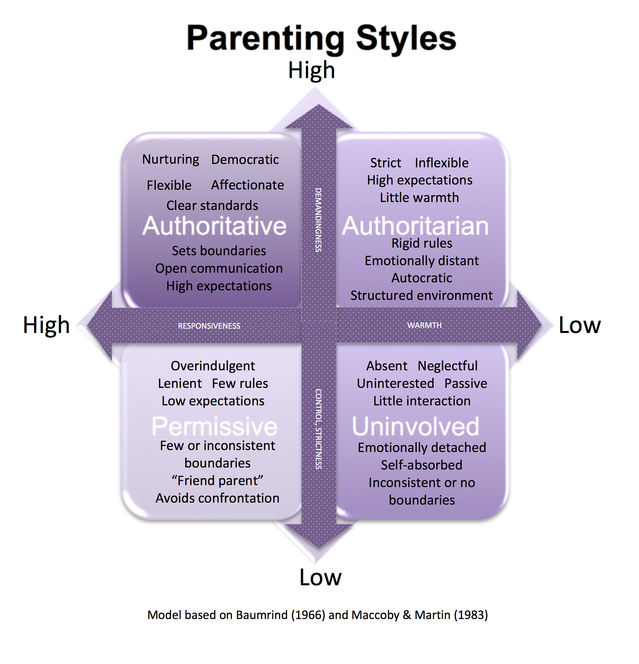
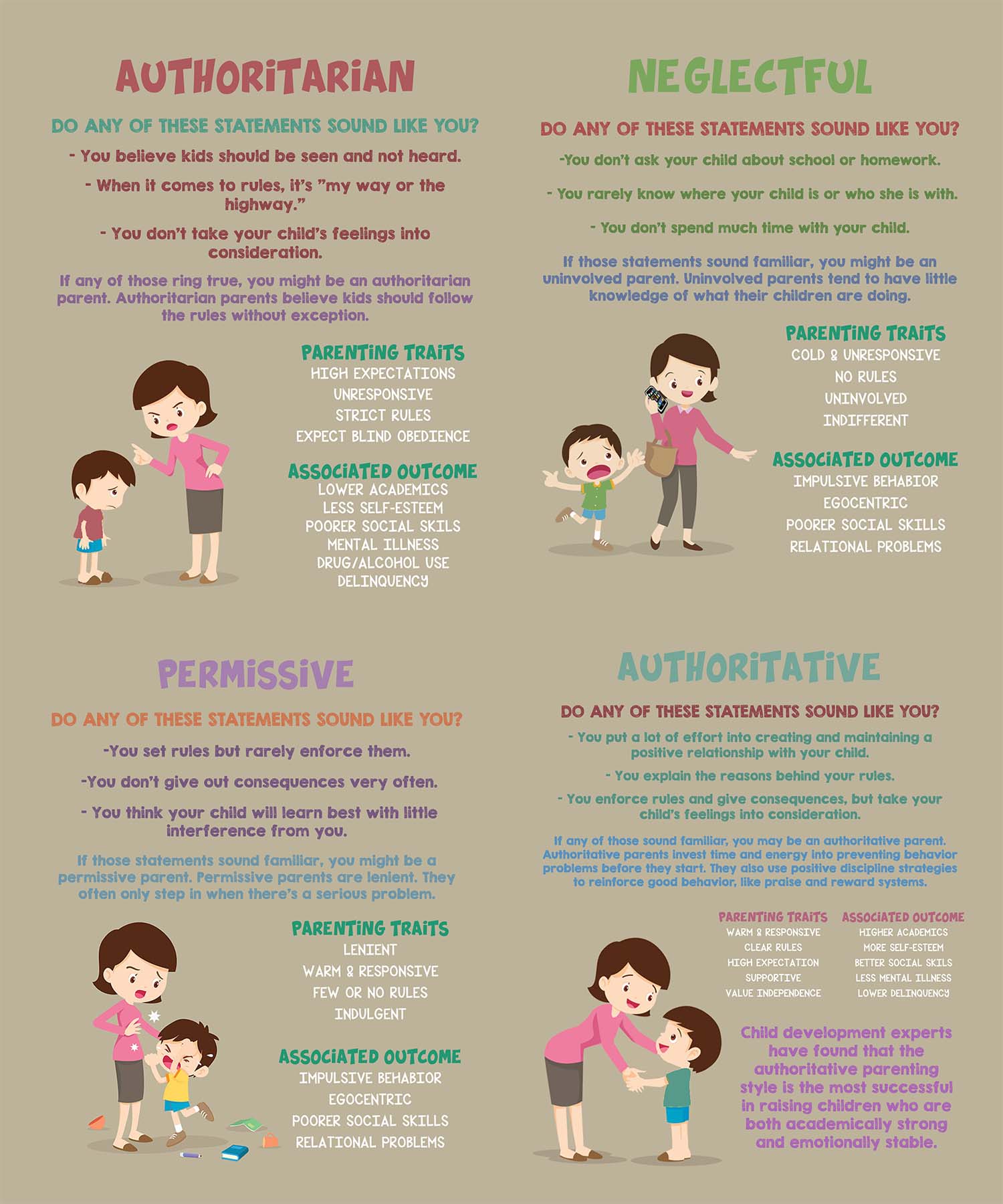
Parenting styles are generally classified into four main types:

  1. Authoritative

  2. Authoritarian

  3. Permissive

  4. Neglectful (Uninvolved)

Each style affects personality traits such as self-esteem, emotional regulation, independence, resilience, empathy, and interpersonal functioning.

Why Personality Development Is Sensitive to Parenting

Personality development is especially sensitive to parenting because the child’s brain, emotions, and sense of self are still under construction. In early life, children do not yet have the neurological capacity or psychological independence to regulate emotions, interpret experiences, or assign meaning on their own. Parents and primary caregivers therefore become the first emotional regulators, mirrors, and interpreters of the world.

Personality development involves several core psychological domains:

1. Emotional Regulation

Children are not born knowing how to calm themselves, manage anger, or tolerate frustration. They learn emotional regulation through co-regulation—when caregivers respond consistently to their emotional needs.

  • When parents soothe distress, label emotions, and model calm responses, children gradually internalize these skills.

  • When emotions are ignored, punished, or mocked, children may suppress feelings or become emotionally reactive.

Over time, these early experiences shape whether a person grows up emotionally resilient or emotionally dysregulated.

2. Self-Concept and Self-Worth

A child’s sense of “Who am I?” develops largely through parental responses.

  • When caregivers show acceptance, interest, and validation, children develop healthy self-worth.

  • When love feels conditional—based on obedience, achievement, or silence—children may internalize beliefs such as “I am not enough” or “I must earn love.”

These early self-beliefs often persist into adulthood, influencing confidence, perfectionism, people-pleasing, or self-criticism.

3. Social Competence

Parents are a child’s first social world. Through everyday interactions—play, conflict, affection, discipline—children learn:

  • How to communicate needs

  • How to handle disagreements

  • Whether relationships feel safe or threatening

Supportive parenting helps children develop empathy, cooperation, and assertiveness. In contrast, harsh or inconsistent parenting may lead to aggression, withdrawal, or fear of social judgment.

4. Coping Mechanisms

How parents respond to stress teaches children how to cope with challenges.

  • Emotionally available parents model problem-solving, flexibility, and help-seeking.

  • Emotionally unavailable or critical parents may unintentionally teach avoidance, emotional shutdown, aggression, or over-control.

These coping styles later show up in how adults handle failure, rejection, pressure, and loss.

5. Moral Reasoning

Children initially understand right and wrong not as abstract concepts, but through relationships.

  • When parents explain rules with empathy and reasoning, children develop internal moral values.

  • When discipline is based solely on fear or punishment, morality remains external—driven by avoidance rather than understanding.

This influences whether adults act from personal values or from fear of consequences and authority.

6. Attachment Patterns

Perhaps the most powerful influence of parenting is on attachment. According to John Bowlby, repeated interactions with caregivers form internal working models—deep mental and emotional templates about:

  • Whether others are trustworthy

  • Whether emotions will be met with care or rejection

  • Whether closeness is safe or risky

These internal working models guide how individuals later relate to:

  • Authority figures

  • Romantic partners

  • Conflict and criticism

  • Emotional intimacy and stress

Because these models develop before conscious memory, they often feel like “just the way I am”, even though they are learned patterns.

Why Early Parenting Has Long-Term Impact

Children are neurologically and emotionally dependent on caregivers. Their brains are highly plastic, meaning repeated emotional experiences literally shape neural pathways. What is experienced repeatedly becomes familiar, automatic, and internalized.

This is why:

  • Consistent emotional safety fosters secure, adaptable personalities

  • Chronic emotional neglect or fear can lead to anxiety, avoidance, or emotional numbness

Personality, then, is not simply a trait—it is the emotional memory of early relationships.

1. Authoritative Parenting: The Foundation of Psychological Health

Core Characteristics

  • High warmth and responsiveness

  • Clear rules and consistent boundaries

  • Open communication

  • Encouragement of independence

  • Discipline through reasoning, not fear

Impact on Personality Development

Children raised with authoritative parenting tend to develop:

  • Secure self-esteem – They feel valued and competent

  • Emotional intelligence – Emotions are acknowledged, not dismissed

  • Self-discipline – Internal regulation rather than fear-based compliance

  • Social confidence – Comfort in relationships and teamwork

  • Resilience – Ability to cope with failure and stress

Psychologically, this style supports secure attachment, allowing children to explore the world while knowing emotional support is available.

Adult Personality Outcomes

  • Balanced confidence

  • Healthy boundaries

  • Emotional expressiveness

  • Adaptive coping strategies

  • Stable relationships

Authoritative parenting is consistently associated with the most positive personality outcomes across cultures.


2. Authoritarian Parenting: Obedience Over Emotional Growth

https://static.toiimg.com/photo/121516512.cms

Core Characteristics

  • High control, low warmth

  • Strict rules with little explanation

  • Emphasis on obedience and authority

  • Punitive discipline

  • Limited emotional expression

Impact on Personality Development

Children raised in authoritarian environments often develop:

  • Low self-esteem – Love feels conditional

  • Fear-based compliance – Behavior driven by punishment avoidance

  • Poor emotional expression – Feelings are suppressed

  • High anxiety or anger – Emotional needs remain unmet

  • External locus of control – Reliance on authority for validation

Emotionally, children may learn that mistakes equal rejection, leading to perfectionism or rebellion.

Adult Personality Outcomes

  • Difficulty expressing emotions

  • Fear of authority or excessive submission

  • Rigid thinking patterns

  • High stress sensitivity

  • Relationship difficulties

While such children may appear “disciplined,” internally they often struggle with emotional insecurity.

3. Permissive Parenting: Freedom Without Structure

https://cdn.psychologytoday.com/sites/default/files/styles/image-article_inline_full_caption/public/field_blog_entry_images/2019-11/parenting_styles_bredehoft_www.overindulgence.org__1.jpg?itok=auCGvyiw

Core Characteristics

  • High warmth, low control

  • Few rules or inconsistent boundaries

  • Avoidance of conflict

  • Overindulgence

  • Child-led decision-making

Impact on Personality Development

Children raised under permissive parenting may develop:

  • Poor impulse control – Difficulty delaying gratification

  • Entitlement – Expectation that needs come first

  • Low frustration tolerance – Struggle with limits

  • Insecurity – Lack of structure creates emotional instability

  • Weak self-discipline – External regulation is missing

Though emotionally expressive, these children often feel unsafe due to unclear expectations.

Adult Personality Outcomes

  • Difficulty with responsibility

  • Struggles with authority and rules

  • Emotional impulsivity

  • Relationship instability

  • Poor stress tolerance

Warmth alone, without boundaries, does not foster emotional maturity.


4. Neglectful (Uninvolved) Parenting: Emotional Absence

https://osteopathygoldcoast.b-cdn.net/wp-content/uploads/2024/05/Understanding-Childhood-Emotional-Neglect.webp

Core Characteristics

  • Low warmth, low control

  • Emotional unavailability

  • Minimal involvement

  • Basic needs met, emotional needs ignored

  • Parent preoccupied with personal issues

Impact on Personality Development

This style has the most damaging psychological effects. Children often develop:

  • Low self-worth – Feeling unimportant or invisible

  • Emotional numbness or dysregulation

  • Attachment difficulties – Fear of closeness or abandonment

  • Poor social skills

  • High risk of depression and anxiety

Without emotional mirroring, children struggle to understand themselves.

Adult Personality Outcomes

  • Chronic emptiness

  • Avoidant or anxious attachment

  • Difficulty trusting others

  • Emotional detachment

  • Vulnerability to addiction or maladaptive coping

Emotional neglect is often invisible—but its psychological impact is profound.

Parenting Styles and Attachment Patterns

Parenting styles strongly influence attachment styles, which shape personality across the lifespan:

Parenting Style Common Attachment Pattern
Authoritative Secure
Authoritarian Anxious or Fearful
Permissive Anxious
Neglectful Avoidant or Disorganized

Attachment patterns later affect:

  • Romantic relationships

  • Conflict resolution

  • Emotional intimacy

  • Self-regulation

Cultural Context: Parenting in Indian Families

In many Indian households:

  • Authoritarian parenting is normalized as “discipline”

  • Emotional expression is often discouraged

  • Obedience is prioritized over autonomy

While cultural values matter, psychological research shows that emotional responsiveness combined with structure leads to healthier personality development, regardless of culture.

Modern Indian parenting is slowly shifting toward authoritative approaches—balancing respect, boundaries, and emotional attunement.

Can Personality Be Changed in Adulthood?

Yes—personality can change in adulthood. While early parenting experiences leave deep psychological imprints, they do not permanently lock a person into one way of thinking, feeling, or relating. Personality is shaped by experience, and the brain retains the ability to reorganize itself throughout life. This capacity for change is what makes healing possible.

What often feels like a “fixed personality” is actually a set of learned emotional patterns—ways of coping, relating, and protecting oneself that once made sense in childhood.

Why Change Is Possible

Early experiences shape personality because they are repeated and emotionally powerful—not because they are unchangeable. In adulthood:

  • The brain still shows neuroplasticity (the ability to form new neural pathways)

  • Adults can reflect, choose, and practice new responses

  • Emotional experiences can be reprocessed and updated

With the right conditions, old patterns can be replaced with healthier ones.

1. Therapy: Rewriting Emotional Templates

Psychotherapy provides a safe, consistent relationship where old patterns can be understood and transformed.

  • Therapy helps identify unconscious beliefs such as “I am unsafe,” “I don’t matter,” or “Closeness leads to pain.”

  • Through emotional processing, reflection, and corrective experiences, these beliefs gradually soften.

  • Over time, new ways of regulating emotions, setting boundaries, and relating to others develop.

Therapy is not about changing who you are—it is about freeing who you were meant to be.

2. Secure Adult Relationships

Healing does not happen only in therapy. Safe, emotionally responsive adult relationships also reshape personality.

  • Being heard, respected, and emotionally supported challenges old attachment wounds

  • Consistent care helps the nervous system learn that connection is not dangerous

  • Healthy conflict and repair build emotional flexibility

Over time, relationships can become corrective emotional experiences, replacing fear-based patterns with trust.

3. Self-Awareness: Making the Unconscious Conscious

Change begins with awareness.

  • Recognizing emotional triggers

  • Understanding recurring relationship patterns

  • Noticing automatic reactions rooted in the past

When patterns are seen clearly, they lose some of their power. Self-awareness creates a pause between old conditioning and new choice.

This is the moment where growth begins.

4. Emotional Re-Parenting

Emotional re-parenting involves learning to give yourself what was missing earlier:

  • Validation instead of criticism

  • Comfort instead of dismissal

  • Structure instead of chaos

  • Compassion instead of shame

Through practices such as self-soothing, emotional labeling, boundary-setting, and inner child work, individuals slowly internalize a supportive inner voice.

This process does not erase the past—but it reduces its control over the present.

From Survival to Choice

Many adult personality traits—people-pleasing, emotional withdrawal, perfectionism, anger, or numbness—were once survival strategies. In adulthood, they may no longer be necessary.

With insight and support:

  • Reactive patterns become responsive choices

  • Fear-driven behaviors become values-driven actions

  • Identity shifts from “This is who I am” to “This is what I learned—and I can learn differently.”

Key Takeaways

  • Parenting styles profoundly shape emotional and personality development

  • Authoritative parenting supports the healthiest outcomes

  • Emotional neglect can be as harmful as overt abuse

  • Personality reflects learned emotional patterns—not personal failure

  • Healing is possible at any stage of life

Final Reflection

Children do not need perfect parents—they need emotionally present adults who offer safety, guidance, and understanding. Small mistakes do not harm a child’s development; emotional absence and inconsistency do. When caregivers are responsive and willing to repair after missteps, children feel secure and valued.

Emotional presence helps children feel seen and accepted. Safety—both emotional and physical—allows them to trust their feelings and regulate stress. Guidance through clear, consistent boundaries teaches responsibility without fear, while understanding nurtures healthy self-worth.

Personality grows where connection meets consistency.
Connection provides emotional security; consistency builds trust. Together, they create a foundation for resilience, confidence, and healthy relationships.

Frequently Asked Questions (FAQ)

1. Do parents need to be perfect for healthy personality development?

No. Children do not need perfect parents. They need caregivers who are emotionally present, responsive, and consistent. Occasional mistakes are normal and do not harm development when followed by repair and reassurance.


2. What does “emotionally present parenting” mean?

Emotionally present parenting means being attentive to a child’s emotional needs—listening, validating feelings, and responding with empathy rather than dismissal, fear, or control.


3. How does consistency influence a child’s personality?

Consistency creates emotional safety. Predictable responses and boundaries help children develop trust, self-regulation, and confidence. Inconsistent caregiving can lead to anxiety, insecurity, or confusion.


4. Can emotional neglect affect personality even without abuse?

Yes. Emotional neglect—when a child’s feelings are repeatedly ignored—can strongly impact self-worth, attachment patterns, and emotional regulation, even if basic physical needs are met.


5. Is authoritative parenting really the healthiest style?

Research consistently shows that authoritative parenting—high warmth with clear boundaries—supports the most balanced outcomes in emotional regulation, self-esteem, and social competence.


6. If parenting was inconsistent or harmful, can personality still change later?

Yes. Through therapy, self-awareness, and secure adult relationships, individuals can unlearn maladaptive patterns and develop healthier personality traits over time.

Written by Baishakhi Das

Counselor | Mental Health Practitioner
B.Sc, M.Sc, PG Diploma in Counseling

Reference