
The Language of the Heart: How Mother Tongue Shapes Identity, Memory, and Emotion

International Mother Language Day (UNESCO) – A Psychological Perspective

The linguistic diversity and cultural heritage are celebrated in the world each year on the International Mother Language Day. However, our mother tongue is not only relevant in communication, it has an immense influence on the way we think, feel, remember and know ourselves. Language is not merely a means according to psychology, it is also closely connected to identity, thinking, and emotional life.

Mother Tongue and Linguistic Identity

Since childhood, language turns into one of the most powerful bases of identity. Welcome, security and inclusion are the words that a child overhears most of the time when it is first uttered. Psychologists refer to such linguistic self identity the sense of self which is developed based on the native language.

Speaking one’s mother tongue often brings:

  • A stronger sense of cultural belonging
  • Emotional security
  • Intergenerational connection
  • Continuity of traditions and values

When people are unable to use their native language, they may experience identity conflict, cultural disconnection, or even lowered self-esteem.

The Sapir-Whorf Hypothesis: Does Language Shape Thought?

The Sapir-Whorf Hypothesis, also known as linguistic relativity, suggests that the language we speak influences how we perceive reality.

For example:

  • Some languages have multiple words for emotions that other languages lack.
  • Certain cultures describe time spatially (ahead/behind) while others use vertical metaphors.
  • Emotional vocabulary richness can affect emotional awareness.

Although there is controversy over strong determinism, it is advocated by modern psychology that there are moderate positions:
Thought is not entirely governed by language, however, it determines how experience is perceived, how it is classified and interpreted.

To put it briefly, language offers us a conceptual system with the help of which we interpret the world.

Mother Language and Memory Encoding

Research in cognitive psychology shows that memories are often encoded in the language in which the event occurred.

This means:

  • Childhood memories are more vivid in one’s native language
  • People recall autobiographical events more easily when prompted in their mother tongue
  • Emotional memories feel closer and more sensory-rich in native language

This phenomenon is called language-dependent memory.

For bilingual individuals, switching languages can sometimes feel like switching mental worlds — each language unlocks different memories and emotional tones.

Emotional Processing in Native Language

One of the most fascinating findings in psychology is that emotions are processed differently across languages.

Studies show:

  • Swear words feel stronger in native language
  • Trauma narratives sound more emotionally intense in mother tongue
  • Therapy in native language often leads to deeper emotional expression
  • Decision-making in a second language can feel more detached and rational

This happens because the native language is tied to early emotional learning, family interactions, and attachment experiences.

In counselling psychology, therapists often encourage clients to express deep emotions in their mother tongue because it allows more authentic emotional access.

Language Loss and Psychological Impact

When languages disappear or are discouraged, the impact goes beyond culture — it affects mental health.

Language suppression can lead to:

  • Cultural grief
  • Identity confusion
  • Intergenerational disconnection
  • Loss of oral history and collective memory

Conversely, preserving mother languages strengthens:
Community cohesion
 Cultural pride
 Psychological resilience
Social inclusion

Why Mother Language Day Matters Psychologically

International Mother Language Day is not only about linguistic preservation. It is about protecting:

  • Emotional expression
  • Cultural identity
  • Cognitive diversity
  • Human connection

Every language carries a unique worldview. When a language survives, a way of understanding life survives with it.

Conclusion

The first lullaby, our first sense of belonging, first comfort, is in our mother tongue. It influences our ability to recall the past, experience the present and envisage the future.

Promoting mother languages is not only a cultural thing to do, but a psychological one.
The language we grow up with in most aspects becomes our memory, our heart and in a sense our mind.

FAQs: Mother Language, Identity, Memory & Emotion

1. Why is mother tongue important for psychological development?

Mother tongue supports emotional bonding, cognitive development, and identity formation because early learning happens through this language.

2. What is linguistic identity in psychology?

Linguistic identity refers to how a person’s sense of self, belonging, and cultural connection is shaped by the language they grow up speaking.

3. What does the Sapir-Whorf Hypothesis say about language?

It proposes that language influences how people perceive, categorize, and interpret the world.

4. Does language really shape thinking?

Research suggests language does not fully determine thought, but it guides attention, memory organization, and emotional interpretation.

5. What is language-dependent memory?

It means people recall events more easily when the language used during recall matches the language in which the memory was formed.

6. Why do emotions feel stronger in our native language?

Because the native language is learned in emotionally rich contexts like family, attachment, and childhood experiences.

7. Can therapy be more effective in one’s mother tongue?

Yes. Clients often express deeper emotions and trauma narratives more naturally in their native language.

8. Why do bilingual people sometimes feel different in different languages?

Different languages activate different emotional associations, social identities, and memory networks.

9. What psychological impact can language loss cause?

Language loss can lead to identity confusion, cultural grief, reduced belongingness, and intergenerational disconnection.

10. How does mother tongue affect children’s learning ability?

Education in mother tongue improves comprehension, confidence, and cognitive flexibility in early schooling.

11. Does using a second language reduce emotional bias?

Studies show people may make more rational and less emotionally driven decisions in a non-native language.

12. Why is International Mother Language Day important for mental health awareness?

It highlights the link between language, cultural belonging, emotional expression, and social inclusion.

13. Can language influence emotional vocabulary?

Yes. Languages with richer emotion words can help people identify and regulate feelings more accurately.

14. What role does language play in cultural memory?

Language preserves stories, rituals, meanings, and shared experiences that form collective psychological identity.

15. How can people preserve their mother tongue psychologically?

By using it at home, teaching children, writing, storytelling, and including it in education and therapy spaces.

Written by Baishakhi Das

Counselor | Mental Health Practitioner
B.Sc, M.Sc, PG Diploma in Counseling


Reference 

  1. UNESCO – International Mother Language Day
    https://www.unesco.org/en/days/mother-language

  2. American Psychological Association – Language and Cognition
    https://www.apa.org

  3. Boroditsky, L. (2011). How language shapes thought (Scientific American)
    https://www.scientificamerican.com/article/how-language-shapes-thought/

  4. Pavlenko, A. (2005). Emotions and Multilingualism
    https://doi.org/10.1017/CBO9780511584304

  5. Marian & Neisser (2000) – Language-dependent memory in bilinguals
    https://doi.org/10.1037/0278-7393.26.3.703

  6. NHS / Cross-cultural therapy research summaries
    https://www.nhs.uk

  7. UNICEF – Mother tongue-based education research
    https://www.unicef.org

  8. Why Fairness Feels Personal: The Psychology Behind World Day of Social Justice

This topic performs well due to rising searches around men’s mental health, workplace stress, and burnout recovery. Combining emotional insight with practical steps increases engagement and trust.
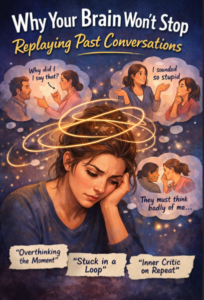
Why Your Brain Won’t Stop Replaying Past Conversations

Have you ever lay in bed or sitting there when suddenly you hear yourself conversing with someone in the past like your previous conversation? Something you said. Something that you wish you could have said. A tone you’re now questioning. The act recurs over and over, but it is not always comfortable, regrettable, or nervous. This is aggravated by the fact that these thoughts normally come when all the other things are silent at night, when you are taking a rest, or when you are supposed to be having a peaceful moment and you find yourself alone with your inner talk.

Such an experience is so widespread–and it does not mean that something is wrong with you. It is an indication that the brain attempts to defend, process and meaning making around social experiences. These moments come back into your mind to find meaning, closure, or reassurance, particularly when a conversation had been emotionally charged or unresolved. Instead of it being a weakness, this replay shows a very human desire to fit in, to be heard, and to feel emotionally secure in all our relationships with other people.

1. The Brain Is Wired for Social Survival

Humans are social beings. Thousands of years ago, being part of a group was the guarantee of protection, safety and existence. Due to this evolutionary output, the brain allocates additional significance to the social engagement, particularly to the ones, which are awkward, emotionally significant, or unbroken. We are in a state of constant scanning of signals to do with approval, denial, and relationship.

The brain is stressed when a conversation is confusing or uncomfortable, which is why it is important. The replaying of it is the manner in which the brain engages in an effort to comprehend and avoid pain in the future in a social context. The questions under the loop are silent, such as:
“Did I say something wrong?”
“Was I misunderstood?”
Will this alter the perception they have of me or change our relationship?

2. Unfinished Emotional Processing

Most of the discussions are cut short before feelings are well worked out. At the moment, you can suppress your emotions to be polite, calm, or emotionally restrained, particularly when you feel you are not safe, inconvenienced or inappropriate to express them. Those emotions are repressed by your body so that you can get through the interaction.

With time when the nervous system ultimately lets go, the emotions that have been repressed start to appear. That is the reason why the mind re-plays the dialogue in the silent times. The replay is not of the words spoken but of the unspoken emotions which were there, linked to the words, ready to be recognized, comprehended, and discharged.

3. Rumination: When Thinking Turns into a Loop

Rereading conversations could slowly degenerate into rumination a mental cycle in which the brain is continually processing the same incident without having a conclusion or a relief. This repetitive thinking can be a cause of more emotional distress instead of relief. Rumination usually presents itself in association with:

Anxiety
Low self-esteem
A history of trauma
Perfectionism

The mind continues to spin around the same thoughts appearing to replay details and imagine different solutions and events, hoping that at some point the explanation or relief will suddenly come. Sadly enough, this loop is not always answered, the loop only extends the emotional distress.

4. The Inner Critic Takes Over

In these mental acting games, most individuals become cruel and critical to themselves:

“Why did I say that?”
“I sounded stupid.”
“They must think badly of me.”

There is nothing true about this inner critic the criticism is based on the fear. It is attempting to shield you against rejection or embarrassment that might come later, although it is a painful way. This voice frequently expresses historical experiences in which a person was probably criticized, shamed, or punished instead of being patient and understanding. In the course of time, the mind gets to condition itself to pre-erect self, with the hope that the self-criticism will help to stop the external criticism, although it does not necessarily do good.

5. The Nervous System and the “Threat Response”

Psychologically, it is common to relate the re-enactment of conversations to the nervous system being in a high level of alertness. Your system, when subjected to any kind of emotional threat (rejection, conflict, embarrassment, or disapproval), finds it hard to settle down and achieve a relaxed, controlled state. The body and mind remains alert even after the scenario has been experienced.

In reaction the brain re-plays the situation, trying to theorize it and avoid such an emotional injury in future. This circularity is not meant to happen–this is survival by default because the human mind needs to feel safe and secure.

6. Trauma and Emotional Memory

In the case of persons who suffered emotional or relationship trauma, the replays may run deeper. The previous experiences of misunderstanding, being criticized, dismissed, or feeling unsafe may be triggered by old conversations. When this happens it does not mean the mind is reacting to the current interaction alone it is reacting to past emotional records.

It is not really a replay of this conversation. It is a question of what the moment will be embodying in its emotional aspect echoing old wounds that are not yet completely healed or recognized.

What Actually Helps

  • Name what you’re feeling, not just what you said
    (e.g., embarrassment, hurt, fear of rejection)
  • Gently interrupt the loop
    Try grounding techniques like slow breathing or noticing physical sensations.
  • Practice self-compassion
    Ask yourself: “What would I say to a friend in this situation?”
  • Accept imperfection
    No conversation is ever flawless. Human connection doesn’t require perfection—only presence.
  • If it’s persistent, therapeutic support can help uncover deeper patterns behind rumination and emotional looping.

A Reframe Worth Remembering

Your mind is not repeating some old discussions to torment or torment you. It is attempting – in many cases clumsy and unsuccessful – to keep you safe, to make sense out of what has occurred, to get you to feel secure and to belong. These emotional circles are the result of a profound human desire to fit in, to be comprehended and not to be hurt emotionally.

When you receive these thoughts with curiosity, not criticism, that is, by asking yourself questions like “What was I feeling?” and not What is wrong with me? the loop starts getting unstuck. Not instantly. Not completely. But gradually, gradually enough to make breathing room in your head.

And in some cases, that pity suffices to allow that dialogue to finally subside and does not have to be repeated to be listened to.

Frequently Asked Questions (FAQ)

1. Why do old conversations replay in my mind?
Because the brain tries to process unresolved emotions, social uncertainty, or perceived threats related to connection and belonging.

2. Is replaying conversations a sign of anxiety?
It can be associated with anxiety, but not everyone who replays conversations has an anxiety disorder.

3. Why does this happen more at night?
At night, distractions reduce and the nervous system slows down, allowing suppressed thoughts and emotions to surface.

4. Is this the same as overthinking?


Yes, it’s a form of overthinking, often linked specifically to social interactions and emotional safety.

5. What is rumination?
Rumination is repetitive thinking about past events without reaching resolution or relief.

6. Can trauma cause conversation replaying?
Yes. Emotional or relational trauma can make the brain more sensitive to social cues and perceived rejection.

7. Why am I so self-critical during these replays?
The inner critic often develops from past experiences where mistakes were judged harshly rather than met with understanding.

8. Do perfectionists replay conversations more?
Yes. Perfectionism increases fear of mistakes and social evaluation, fueling mental loops.

9. Is my brain trying to fix something?
Yes. The brain is attempting to prevent future emotional harm by analyzing past interactions.

10. Does replaying conversations mean I did something wrong?


Not necessarily. Often, it reflects emotional sensitivity rather than actual mistakes.

11. How can I stop replaying conversations?
Gentle grounding, naming emotions, self-compassion, and nervous system regulation help reduce the loop.

12. Should I distract myself when this happens?
Temporary distraction can help, but emotional acknowledgment leads to longer-term relief.

13. Can mindfulness help?
Yes. Mindfulness helps you observe thoughts without getting pulled into them.

14. When should I seek therapy?
If replaying conversations interferes with sleep, work, or emotional well-being, therapy can be helpful.

15. Will this ever stop completely?
The goal isn’t complete elimination but reducing intensity and responding with compassion instead of fear.

Written by Baishakhi Das

Counselor | Mental Health Practitioner
B.Sc, M.Sc, PG Diploma in Counseling


Reference 

This topic performs well due to rising searches around men’s mental health, workplace stress, and burnout recovery. Combining emotional insight with practical steps increases engagement and trust.