

A Deep Psychological Explanation of the Cycle Behind Ongoing Conflicts
Many couples share a frustrating experience: the same argument keeps coming back, even after apologies, discussions, or temporary resolutions. Although the topic may change—money, time, family, communication—the emotional fight feels identical. This repetition is not a sign that partners are immature or incompatible. Instead, it reflects unresolved psychological patterns operating beneath the surface of the relationship.
To understand why arguments repeat, we must look beyond words and focus on emotions, attachment needs, learned coping styles, and unmet expectations.
1. Repeated Arguments Are About Needs, Not Topics
At a surface level, couples argue about:
-
Time
-
Attention
-
Responsibilities
-
Trust
-
Boundaries
However, beneath these topics lie unmet emotional needs, such as:
When these needs r
- Emotional validation
- Psychological safety
- Attentive understanding
- Mutual respect
emain unmet, the mind keeps reusing the same conflict as a way to signal distress.
👉 Key insight:
Arguments repeat because the need behind them has not been addressed.
2. The Role of Attachment Styles
Attachment theory plays a central role in recurring conflicts.
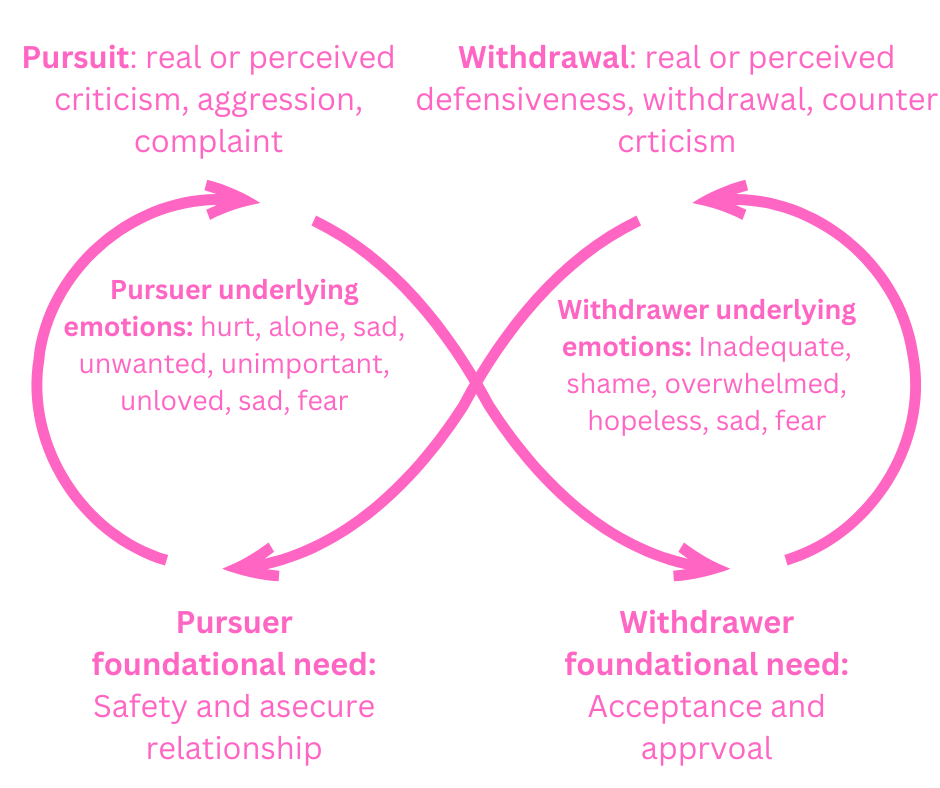
Common Pattern: The Pursue–Withdraw Cycle
-
One partner seeks closeness, reassurance, or discussion (anxious response)
-
The other retreats, shuts down, or avoids conflict (avoidant response)
This creates a loop:
-
The more one pursues → the more the other withdraws
-
The more one withdraws → the more the other escalates
Neither partner feels safe, heard, or understood.
👉 Over time, this pattern becomes automatic, not intentional.
3. Emotional Triggers from Past Experiences
Many arguments are not about the present moment, but about old emotional wounds being activated.
Common triggers include:
-
Childhood emotional neglect
-
Past relationship betrayal
-
Criticism or rejection experiences
-
Feeling controlled or abandoned earlier in life
When triggered:
-
The nervous system reacts as if the past is happening again
-
Logic shuts down
-
Emotional intensity increases rapidly
This is why couples often say:
“We keep fighting, but I don’t even know why anymore.”
4. Poor Repair, Not Poor Communication
Many couples communicate frequently—but repair poorly.
Repair refers to:
-
Taking responsibility
-
Acknowledging hurt
-
Offering emotional reassurance
-
Rebuilding safety after conflict
When repair is missing:
-
The argument ends, but the emotional injury remains
-
Resentment quietly accumulates
-
The same issue resurfaces later with greater intensity
👉 Unrepaired conflict always returns.
5. Cognitive Distortions That Fuel Repetition
Certain thinking patterns make arguments cyclical:
-
Mind reading: “You don’t care about me.”
-
All-or-nothing thinking: “You never listen.”
-
Personalization: “You’re doing this to hurt me.”
-
Catastrophizing: “This relationship is doomed.”
These distortions turn disagreements into threats to the relationship, making calm resolution nearly impossible.
6. Emotional Regulation Difficulties
When one or both partners struggle to regulate emotions:
-
Anger escalates quickly
-
Shutdown or stonewalling occurs
-
Defensive reactions replace listening
As a result:
-
The nervous system remains in fight-or-flight mode
-
Conversations become reactive rather than reflective
-
The same arguments repeat because regulation never occurs
7. Power, Control, and Unspoken Roles
Repeated arguments often hide struggles around:
-
Decision-making power
-
Emotional labor
-
Gender or cultural role expectations
-
Feeling dominated or invisible
When these dynamics are not openly discussed, they surface indirectly through repeated conflict.
8. Why “Solving the Problem” Doesn’t Work
Couples often try to:
-
Find logical solutions
-
Prove who is right
-
End the argument quickly
However, emotional problems cannot be solved logically.
What partners usually need instead:
-
Validation before solutions
-
Emotional safety before compromise
-
Understanding before agreement
Without this, solutions fail—and the argument returns.
9. How Repeating Arguments Affect Relationships
Over time, unresolved cycles lead to:
-
Emotional distance
-
Loss of intimacy
-
Chronic resentment
-
Feeling lonely within the relationship
-
Questioning the relationship’s future
Importantly, many couples who separate say:
“It wasn’t one big fight—it was the same fight over and over.”
10. Breaking the Cycle: What Actually Helps
1. Identify the Pattern, Not the Person
Shift from:
“You are the problem”
to
“This pattern is the problem.”
2. Name the Underlying Need
Ask:
-
“What am I really needing right now?”
-
“What fear is driving this reaction?”
3. Slow Down the Nervous System
-
Pause heated conversations
-
Return when emotions settle
-
Focus on regulation before resolution
4. Practice Repair Conversations
-
Acknowledge hurt
-
Validate emotions
-
Reassure commitment and care
5. Seek Professional Support
Couples therapy helps:
-
Identify unconscious patterns
-
Improve emotional safety
-
Teach regulation and repair skills
Conclusion
Arguments repeat in relationships not because partners are incapable, but because unmet emotional needs, unresolved wounds, and automatic patterns keep replaying. Until these deeper layers are addressed, the mind uses conflict as a signal for connection and safety.
Healing begins when couples stop asking:
“How do we stop fighting?”
and start asking:
“What is this fight trying to tell us?”
Frequently Asked Questions (FAQ)
1. Why do the same arguments keep repeating in relationships?
Arguments repeat because the underlying emotional need or unresolved issue is not addressed. Even if the topic changes, the same emotional trigger—such as feeling unheard, unsafe, or unvalued—keeps resurfacing.
2. Are repeating arguments a sign of incompatibility?
Not necessarily. Repeating arguments usually reflect unresolved emotional patterns, attachment styles, or communication cycles, rather than lack of compatibility.
3. What role do attachment styles play in repeated conflicts?
Attachment styles strongly influence conflict patterns. For example, an anxious partner may seek reassurance, while an avoidant partner may withdraw, creating a pursue–withdraw cycle that repeats over time.
4. Why do arguments feel emotionally intense even over small issues?
Small disagreements often activate old emotional wounds or past experiences, causing the nervous system to react as if there is a serious threat. This makes conflicts feel bigger than the situation itself.
5. Why doesn’t logical problem-solving stop repeated arguments?
Because most recurring conflicts are emotion-based, not logic-based. Without emotional validation and repair, solutions fail and the same argument returns.
6. How does emotional regulation affect relationship conflicts?
When emotional regulation is poor, partners react impulsively, shut down, or become defensive. Without regulation, healthy communication and repair are impossible, leading to repeated arguments.
7. Can repeated arguments damage a relationship long term?
Yes. Over time, unresolved conflict cycles can lead to emotional distance, resentment, reduced intimacy, and relationship burnout, even if love is still present.
8. How can couples break the cycle of repeating arguments?
Breaking the cycle involves:
Identifying the pattern, not blaming the person
Understanding the emotional need behind the conflict
Practicing emotional regulation and repair
Seeking professional help when needed
9. When should couples seek therapy for recurring conflicts?
Couples should seek therapy when:
The same arguments repeat without resolution
Conflicts escalate quickly
Emotional shutdown or withdrawal becomes common
Both partners feel unheard or hopeless
10. Can repeating arguments be a sign of trauma or past experiences?
Yes. Trauma, childhood neglect, or previous relationship wounds often contribute to automatic emotional reactions, making conflicts repeat even in otherwise healthy relationships.
Written by Baishakhi Das
Counselor | Mental Health Practitioner
B.Sc, M.Sc, PG Diploma in Counseling
Reference
American Psychological Association – Relationships & Conflict
https://www.apa.org/topics/relationshipsGottman Institute – Why Couples Fight Repeatedly
https://www.gottman.com/blogSimply Psychology – Attachment Theory in Relationships
https://www.simplypsychology.org/attachment.htmlNational Institute of Mental Health – Emotional Regulation
https://www.nimh.nih.gov/health/topicsWorld Health Organization – Mental Health and Relationships
https://www.who.int/teams/mental-health-and-substance-use- Cognitive Behavioral Theory: How Thoughts Control Emotions
- Attachment Theory: How Childhood Bonds Shape Adult Relationships