

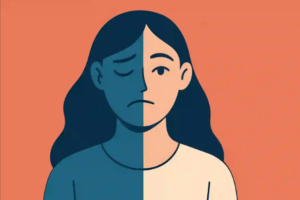
Many people believe that emotional pain should be obvious and visible—expressed through tears, emotional outbursts, breaking down, or openly seeking comfort. Society often equates real suffering with how loudly it is shown. So when someone experiences pain in a quieter way—feeling numb, detached, frozen, or emotionally blank—they begin to question themselves.
They may wonder why they aren’t crying, why they don’t feel angry, or why there is no sense of release. This absence of visible emotion can create deep self-doubt, shame, and the belief that something is “wrong” with them or that their pain isn’t valid enough.
But shutting down is not a failure of emotion. It is the nervous system’s way of protecting itself when feelings once felt unsafe, overwhelming, or useless to express. When the body learns that showing pain doesn’t bring comfort—or might even bring harm—it adapts by turning inward and going quiet. In that sense, shutting down is not a weakness at all. It is a trauma response, shaped by past experiences where survival mattered more than expression.
The Body Chooses Survival Over Expression
When emotional pain feels too intense, unpredictable, or unsafe to show, the nervous system automatically steps in to protect you. Rather than moving into the fight or flight response—where emotions come out through crying, arguing, or panic—the body may choose a quieter survival strategy. It shifts into freeze or collapse mode, slowing everything down to reduce emotional overload.
In this state, the mind may go blank, the body may feel heavy or disconnected, and emotions seem distant or muted. This isn’t a conscious choice—it’s an automatic response designed to keep you functioning when expressing pain feels risky.
This response is especially common when:
- You learned early in life that crying didn’t bring comfort, understanding, or support
- Showing emotions led to punishment, ridicule, minimization, or emotional abandonment
- You had to remain “strong,” mature, or composed in order to survive your environment
In these situations, your system learned that expressing pain didn’t lead to safety—it led to more hurt. Over time, shutting down became the safest option. It allowed you to endure, stay in control, and protect yourself when vulnerability wasn’t an option.
Emotional Numbness Is Not Emotional Absence
When you shut down, it may feel like emptiness, heaviness, or a kind of emotional flatness—as if your feelings have gone silent or distant. You might know intellectually that something hurts, yet feel unable to access the emotion itself. This doesn’t happen because you don’t care or because you are emotionally detached by nature.
It happens because your nervous system is trying to protect you by creating distance from feelings that once felt overwhelming, unsafe, or impossible to process. By turning down emotional intensity, your system gives you space to keep going when fully feeling everything might have been too much. This temporary disconnection is not a lack of emotion—it’s a protective pause, allowing you to survive when experiencing those feelings all at once would have felt unbearable.
This is often linked to:
- Dissociation – mentally distancing yourself from distress
- Emotional suppression – unconsciously blocking feelings to function
- Learned helplessness – believing expression won’t change the outcome
Your body is saying: “Feeling this fully might be too much right now.”
Why Crying Feels Impossible
Crying requires a sense of safety—both emotional and physical. Your nervous system needs to believe that releasing emotions won’t lead to punishment, rejection, shame, or abandonment. When that sense of safety is present, the body allows feelings to rise and move through naturally.
But if your past experiences taught you that vulnerability led to harm, your nervous system remains guarded. Even when your mind knows you are safe now, your body may not fully believe it yet. It operates based on learned survival patterns, not logic alone. As a result, emotions stay contained, tears feel stuck, and shutting down becomes the default response—not because you don’t want to feel, but because your system is still protecting you from what once hurt.
That’s why you might:
- Go numb during emotional conversations
- Feel detached during loss or conflict
- Shut down instead of reacting
This is not emotional coldness. It’s self-protection.
The Cost of Long-Term Shutdown
While shutting down once helped you survive, staying in this state for too long can lead to:
- Chronic emotional exhaustion
- Difficulty identifying your own feelings
- Feeling disconnected from others and yourself
- Guilt or shame for “not reacting normally”
Over time, unprocessed emotions don’t disappear—they settle in the body as tension, fatigue, or anxiety.
Healing Begins With Safety, Not Force
You cannot force yourself to cry or “open up” through willpower alone. Emotional expression isn’t something the body obeys on command. When the nervous system is in a protective state, it will resist vulnerability no matter how much you want to feel or release.
Healing begins when your nervous system gradually learns that feeling is no longer dangerous. This happens through repeated experiences of safety—being heard without judgment, allowed to feel without consequences, and supported rather than dismissed. With time, patience, and gentleness, the body starts to loosen its defenses. Emotions may return slowly, quietly, or in unexpected ways, but they return because safety has been restored—not because they were forced.
Helpful steps include:
- Gentle self-awareness instead of self-judgment
- Grounding practices that reconnect you to your body
- Safe relationships where emotions are welcomed, not dismissed
- Trauma-informed therapy that works with the nervous system
Crying may return gradually—or your healing may look quieter. Both are valid.
A Gentle Reminder
If you shut down instead of crying, it doesn’t mean you are broken, heartless, or emotionally unavailable. It doesn’t mean you lack depth or that your pain is somehow less real. It simply means your body learned—often very early on—that protecting yourself was more important than expressing what you felt.
Your nervous system adapted in the only way it could to keep you safe. That response helped you survive moments when vulnerability wasn’t met with care.
And now, with patience, compassion, and a growing sense of safety, your body can learn a new way. One that allows room for softness, for expression, for rest. There is no rush, no “right” way to heal—only a gradual return to feeling, at a pace that honors everything you’ve been through.
FAQ
1. Is shutting down an emotional weakness?
No. Shutting down is a nervous system survival response, not a character flaw or weakness.
2. Why do I feel numb instead of sad?
Emotional numbness often occurs when feelings feel too overwhelming or unsafe to process fully.
3. Is shutting down the same as dissociation?
It can include dissociation, but shutdown also involves emotional freezing and reduced responsiveness.
4. Why can’t I cry even when I want to?
Crying requires safety. If your body doesn’t feel safe, it may block emotional release.
5. Can trauma make emotions disappear?
Trauma doesn’t erase emotions—it suppresses access to them temporarily as protection.
6. Does this mean I’m emotionally unavailable?
No. It means your nervous system learned to guard emotions, not that you lack them.
7. Is shutdown linked to childhood experiences?
Yes. Emotional neglect, criticism, or punishment in childhood often condition shutdown responses.
8. Why do I go blank during emotional conversations?
Your nervous system may enter freeze mode to avoid perceived emotional threat.
9. Is shutting down the same as being calm?
No. Calm involves regulation; shutdown involves disconnection.
10. Can forcing myself to open up help?
Forcing vulnerability can backfire. Safety and patience are more effective.
11. How long does shutdown last?
It varies. For some it’s situational; for others it becomes a long-term pattern.
12. Does therapy help with shutdown responses?
Yes—especially trauma-informed and nervous-system-based therapies.
13. Will I ever feel emotions normally again?
Yes. With safety and support, emotional access often returns gradually.
14. Is shutdown related to depression?
It can overlap, but shutdown is primarily a trauma response, not a mood disorder.
15. What helps the most in healing shutdown?
Safety, self-compassion, body-based regulation, and supportive relationships.
Written by Baishakhi Das
Counselor | Mental Health Practitioner
B.Sc, M.Sc, PG Diploma in Counseling
Reference
-
National Institute of Mental Health – Trauma and Stress-Related Disorders
https://www.nimh.nih.gov/health/topics/post-traumatic-stress-disorder-ptsd -
Harvard Health – Understanding the Stress Response
https://www.health.harvard.edu/staying-healthy/understanding-the-stress-response -
The Polyvagal Theory (Dr. Stephen Porges) – Nervous System States
https://www.polyvagalinstitute.org -
American Psychological Association – Trauma and Emotional Responses
https://www.apa.org/topics/trauma -
Bessel van der Kolk, The Body Keeps the Score (Book Reference)
https://www.penguinrandomhouse.com/books/210006/the-body-keeps-the-score-by-bessel-van-der-kolk-md/ - Signs You Were Emotionally Neglected
This topic performs well due to rising searches around men’s mental health, workplace stress, and burnout recovery. Combining emotional insight with practical steps increases engagement and trust.