Introduction
The issue of healthy dieting has been a problem in the contemporary world even in the face of great awareness on nutrition and health. Human beings are usually aware of what they are supposed to eat but their eating habits in day-to-day activities are often in conflict with what they know. This knowledge- behaviour gap underscores the role of behaviour change psychology in the determination of the way people develop, maintain, or change their eating behaviour.
Healthy eating does not only depend on nutritional information and availability of healthy foods. Rather, it is strongly subjective to the mechanisms of psychology like habit formation, self-regulation, motivation and the influence of the environment. The interaction of these mechanisms to influence dietary choices in the long run is the focus of behaviour change psychology.
The Habit Formation Theory and Self-Regulation Theory are two significant psychological theories that are used to explain dietary behaviour. Habit formation is the explanation of how repetitive behaviours become automatic responses to surrounding conditions, whereas self-regulation theory is that of how people restrain their impulses, establish goals and watch their behaviour so that they can attain long-term health effects.
The knowledge gained with regard to such psychological processes is informative to individuals, health professionals and policy makers who seek to support sustainable healthy eating behaviours.
The Psychology Behind Eating Behaviour
There are a number of psychological, biological, and environmental factors that contribute to eating behaviour. Human beings can hardly base their food decisions solely on nutritional value. Rather, decisions are usually influenced by emotions, traditions, convenience, culture, and social pressure.
Psychologically, the eating behaviour can be explained by a number of processes:
- Automatic behaviour– Eating habits that are developed by repetition.
- Conscious decision-making– deliberate decisions regarding food.
- Emotional control – food coping.
- Environmental stimuli -presence, advertising, and social environment.
Food decisions that people make on a daily basis are not usually conscious. As an illustration, one might reach out to a sweet pastry in between working hours or get fast food after a long working day without thinking twice.
Due to this automatic nature, it is not always effective to just tell people to eat healthy. Rather, behaviour change involves the change of the psychological patterns that lead to the development of the habitual eating behaviour.
Habit Formation in Nutritional Choices
Understanding Habit Formation
The formation of habits is a natural psychological activity in the transformation of behaviour. Habit is a acquired behaviour that is subjected to repetition in a consistent environment to become automatic.
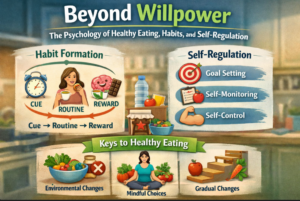
As per behavioural psychology, habits are developed where there is a cue-routine-reward loop:
- Cue- a stimulus that causes the behaviour.
- Routine- the behaviour itself.
- Reward – reward that reinforces the behaviour.
For example:
- Stimulus: Afternoon fatigue.
- Routine: Eating chocolate or sugary foods.
- Recompense: Temporary increase in energy and pleasure.
With time the behaviour becomes automatic because of the repeated exposure to this loop.
Habit Formation and Food Choices
Many nutritional behaviours operate through habit loops. Examples include:
- Drinking tea with biscuits every morning
- Snacking while watching television
- Ordering fast food during late-night work sessions
These behaviours are not always maintained by hunger but by being habitually associated with certain situations or states of emotions.
It has been proposed that developing a new habit may require a few weeks to few months depending upon the complexity of the behaviour and the level of repetition.
Take a case of substituting sweet drinks with water which can be a habit when one always adopts the same thing in any circumstance.
Strategies for Building Healthy Eating Habits
Behaviour change psychology suggests several strategies for developing healthier dietary habits.
1. Environmental Restructuring
Environment plays a powerful role in shaping habits. People are more likely to eat what is visible, accessible, and convenient.
Practical changes include:
- Keeping fruits and healthy snacks visible at home
- Reducing availability of junk food
- Preparing healthy meals in advance
When healthy options become the default choice, behaviour change becomes easier.
2. Implementation Intentions
Implementation intentions are specific action plans linking situations to behaviours.
Instead of setting a vague goal like:
“I will eat healthier.”
A more effective plan would be:
“If I feel hungry between meals, I will eat a fruit instead of processed snacks.”
This method strengthens the association between cues and healthier responses.
3. Gradual Behaviour Change
Sudden drastic changes in diet often fail because they conflict with established habits. Behavioural psychology recommends small incremental adjustments.
Examples include:
- Replacing sugary drinks with unsweetened beverages
- Adding one vegetable serving to daily meals
- Reducing portion sizes gradually
Small changes accumulate over time and are more sustainable.
Self-Regulation Theory and Eating Behaviour
Although habits are used to explain automatic eating behaviour, self-regulation theory is used to explain how people consciously influence themselves in order to attain long-term objectives.
Self-regulation means that one can monitor behaviour, control the impulses and stick to the goal-oriented behaviour.
Self-regulation in the nutrition context assists one to overcome temptations to unhealthy foods and adhere to dietary plans.
Key Components of Self-Regulation
Self-regulation theory typically includes three main components:
1. Goal Setting
Healthy eating behaviour often begins with setting clear goals such as:
- Reducing sugar intake
- Eating balanced meals
- Managing body weight
Goal clarity increases motivation and provides direction for behaviour change.
2. Self-Monitoring
Self-monitoring involves tracking one’s eating behaviour and evaluating progress.
Examples include:
- Keeping a food diary
- Using nutrition tracking apps
- Monitoring portion sizes
Self-monitoring increases awareness and helps identify patterns such as emotional eating or late-night snacking.
3. Self-Control
Self-control refers to the ability to resist immediate temptations in favour of long-term benefits.
For example:
Choosing a healthy meal instead of fast food requires delaying immediate gratification.
Self-control is influenced by several psychological factors including stress, fatigue, and emotional state.
Emotional and Cognitive Influences on Eating Behaviour
Eating behaviour is not purely physiological. Psychological states often influence dietary choices.
Emotional Eating
Food is a stress, anxiety, sadness, or boredom coping mechanism used by many people. This is referred to as emotional eating.
Comfort foods usually are rich in sugar, fat or carbohydrate substances since they bring about the dopamine reward system in the brain and cause a temporary emotional satisfaction.
Nevertheless, emotional feeding results in poor eating habits and health complications in the long run.
Cognitive Biases in Food Decisions
Several cognitive biases influence eating behaviour:
Present Bias
Human beings are more concerned with short-term gratification at the expense of the health benefits in the long run.
Indicatively, the present day might experience the consumption of dessert as a reward compared to happening future health dangers.
Optimism Bias
People tend to dismiss the fact that they are susceptible to diseases brought about by unhealthy eating.
This perception can lower the intentions to change the eating behaviour.
Decision Fatigue
People lose self-control especially after making numerous decisions during the day and make unthoughtful decisions when it comes to food.
This justifies the reason why unhealthy eating is a habit that takes place at late night.
Behavioural Interventions for Healthy Eating
Psychological research has developed several interventions to encourage healthier dietary behaviour.
1. Nudging
Nudging involves subtly altering environments to guide healthier decisions without restricting choices.
Examples include:
- Placing fruits near checkout counters
- Offering smaller plate sizes
- Displaying calorie information
These strategies influence behaviour through environmental cues rather than conscious effort.
2. Social Influence
Social norms and cultural practises have a great influence on eating behaviour.
Individuals have the tendency to reflect the food practises of their peers, family or social groups.
Group-based interventions are frequently utilised in promoting a positive change in behaviour as part of health promotion programmes.
3. Mindful Eating
Mindful eating encourages individuals to pay attention to hunger cues, taste, and satiety while eating.
Practicing mindfulness helps individuals:
- Reduce overeating
- Improve food awareness
- Develop healthier relationships with food
Mindfulness techniques have shown promising results in addressing emotional eating and unhealthy dietary patterns.
The Role of Motivation in Dietary Behaviour
Motivation is a very important aspect in maintaining healthy eating habits.
Psychologists make a difference between two principal types of motivation:
Extrinsic Motivation
Action that is motivated by some outside force or pressure i.e., diet in order to conform to societal norms.
Intrinsic Motivation
The internal satisfaction leads to behaviour as in eating healthy in order to feel energetic and enhance wellbeing.
The intrinsic motivation to change diet is more sustainable in the long term as opposed to external pressure.
Challenges in Maintaining Healthy Eating Behaviour
Although the people are aware and motivated, it is difficult to sustain healthy eating habits.
There are a number of psychological obstacles to this challenge:
Habit Strength
Powerful habits can silence individual will to eat healthy.
Environmental Triggers
Unhealthy eating is usually promoted by food advertising, availability of processed foodstuffs and by social gatherings as well.
Stress and Emotional Distress.
Stress lowers self-control and enhances favorability of comfort foods of high calorie content.
Lack of Immediate Rewards
Eating healthy does not always bring short-term satisfaction but long-term results, which makes it more difficult to sustain.
Promoting Sustainable Dietary Behaviour Change
Psychological interventions that involve the formation of habits as well as self-control should be used to help the client adopt organic dietary changes in the long run.
The strategies that work are:
- Building favourable food contexts.
- Promoting the habitual use.
- Enhancing personal control.
- Probing the sources of emotions.
- Encouraging intrinsic motivation.
Psychologists, counsellors and nutritionists constitute health professionals who have a significant role to play in helping individuals in sustainable behaviour change.
Conclusion
Healthy eating is not just an issue of will and knowledge. It is strongly influenced by psychological mechanisms such as habit development, self control, affective factors and external stimuli.
The formation of a habit gives an explanation of how the repetitive behaviours with regard to diet turn automatic and the theory of self-regulation underscores the importance of conscious regulation of impulses and goal of health.
Knowledge of these psychological processes enables individuals and health experts to develop more effective programmes of promoting healthy eating behaviour.
Sustainable behaviour change in nutrition can be realised by using a combination of habit-based interventions, self-regulation tricks, and supporting environments, and will eventually advance physical and psychological wellbeing.
Frequently Asked Questions (FAQs)
1. What is healthy eating behaviour change psychology?
Behaviour change psychology can be defined as a study of the psychology behind making people change and accept the healthier way to eat. It discusses motivation, formation of a habit, self-control and environmental factors, which influence food choices.
2. Why are people having a hard time keeping a healthy diet?
People find it difficult as the eating behaviour is affected by habits, emotions, association with the environment and social factors. Automatic habits and instant gratifications of unhealthy foods can be used even by those who are aware of what is healthy with the long-term health objectives.
3. What does it mean by becoming addicted to what you eat?
Habit formation is a term used to describe the development of eating behaviours as automatic reaction to some cues. As a case in point, consumption of snacks during television viewing may become a routine when one does the same at a given environment.
4. What is the eating behaviour habit loop?
There are three components of the habit loop:
- Cue: An inducement of the eating behaviour (e.g. boredom or stress)
- Routine: The behaviour as such (e.g., eating chips or sweets)
- Reward: The satisfaction or release which comes with eating.
This loop gains strength and becomes automatic with time.
5. What is the self-regulation theory of eating behaviour?
Self-regulation theory describes the ability of human beings to manage their impulses and behaviours in order to accomplish long-term objectives. In the eating behaviour it is setting dietary goals, food monitoring and self-discipline over eating to keep healthy.
6. What is the role of self-monitoring in enhancing diet?
Self-monitoring makes people more aware of their eating habits. Monitoring meals, snacks, and quantities can help people discover their poor eating habits and make a rational choice to change their diet.
7. What is emotional eating?
Emotional eating happens when people eat when they feel stressed, sad, bored or when they are anxious, instead of feeling hungry. It is mostly linked to the comfort foods that are rich in sugar and fat.
8. What are the methods of developing healthy eating habits?
It is possible to develop healthy habits through:
- Gradual incremental changes to diet.
- Planning meals in advance
- The availability of healthy food.
- Minimising unhealthy food stimuli.
- Habits require consistency and repetition.
9. What is the impact of the environment on eating behaviour?
Food preferences are very much affected by the environment. Some of the determinants that can promote or discourage healthy eating include the availability of foods, the size of portions, marketing and the social environment.
10. What is the importance of motivation in a healthy diet?
Motivation assists persons to maintain a long-term change in diet. In cases where individuals experience intrinsic motivations like the desire to have improved health or energy sources, these people will have a higher chance of staying healthy through eating.
Written by Baishakhi Das
Counselor | Mental Health Practitioner
B.Sc, M.Sc, PG Diploma in Counseling
Reference
-
World Health Organization – Healthy Diet
https://www.who.int/news-room/fact-sheets/detail/healthy-diet -
Harvard T.H. Chan School of Public Health – Nutrition Source
https://www.hsph.harvard.edu/nutritionsource -
National Institutes of Health – Eating Behavior Research
https://www.nih.gov -
American Psychological Association – Psychology of Eating
https://www.apa.org/topics/eating -
NHS – Healthy Eating Guidelines
https://www.nhs.uk/live-well/eat-well -
Centers for Disease Control and Prevention – Healthy Eating
https://www.cdc.gov/nutrition -
Frontiers in Psychology – Eating Behaviour Research
https://www.frontiersin.org/journals/psychology -
Behaviour Change for Better Health – National Institute for Health and Care Excellence
https://www.nice.org.uk/guidance -
British Psychological Society – Health Psychology Resources
https://www.bps.org.uk -
PubMed Research Database (Psychology & Nutrition Studies)
https://pubmed.ncbi.nlm.nih.gov/ - Breaking the Habit Loop: The Psychology Behind Quitting Smoking on National No Smoking Day