

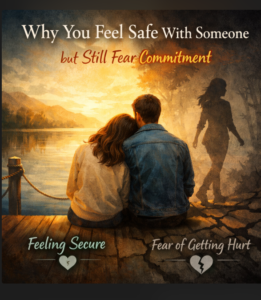
You feel calm around them.
You are softening your body, not holding it together.
Your nervous system does not over drive.
You do not have to act like you are yourself, you do not have to pretend, do not have to think carefully before saying the words so as to remain accepted.
The relationship is easy. Silence doesn’t feel awkward. Presence feels grounding.
And yet, as the relationship is flowing in the direction of commitment: labels, future planning, emotional permanence, there is a feeling deep within you that is pulling away. Not in a dramatic but in a timorous way. A tightening in the chest. A sudden urge for distance. An idea which is incompletely elaborable: I need space.
This internal conflict is even very perplexing.
Whom can be so safe, and, at the same time, so frightening?
The fact is that such experience is much more widespread than one may care to admit- and has little to do with not liking a person enough, inability to get emotionally involved, lack of depth. It is so frequently the nervous system reacting to a history that it remembers in some way.
Being relaxed around a person is a means that your body is confident in the moment.
Being afraid of commitment is that your body would be in doubt of what would happen in case the moment turns permanent.
To most people, intimacy with time has been succeeded by some form of loss, disappointment or emotional hurts. And as a relationship begins to grow into anything more, the system that had been protecting you takes action once again and slowly drags you back, not to destroy love, but to save you the pain that this system had learned to fear.
It’s not a lack of desire.
A protective pause.
And knowing that difference has the power of transforming your image of yourself and your relationships completely.
Safety and Commitment Are Not the Same to the Nervous System
To feel safe with a person it is as though your body is not under imminent danger. Your muscles are being relaxed, your breath is being huffed up, your nervous system is calmed down to the present moment. One does not have to be on watch, to look around and guard against possible emotional attack.
To be afraid of being committed, though, usually implies that your nervous system has learned to perceive intimacy over the years as a threat. It is not that it is wrong today, but the history of your body has demonstrated to you that whatever is safe today might turn painful later. The promise of sustainability, addiction and emotional vulnerability- and in the case of a trauma-forming nervous system, the promise can cause fear.
To most individuals and most especially to the ones with relational trauma, safety lies in the present. The present seems to be manageable. But dedication is to the future and the future is to remember loss, abandonment, emotional uncertainty or betrayal. And you may say in your head, This man is good. this is well, says your body, What happens when you are fixed?
This is why fear may also manifest itself in safe, loving relationships. It is not about the individual opposite you, it is a record of what has been locked up under the conscious mind.
The mind is forgetful of what your body will recall.
And it is not responding to logic, but to the habits of surviving that it had learnt long before.
When Safety Was Once Conditional
In case your background was such that love was not always there, conditional, emotionally intermittent, or was followed by abandonment, criticism, or neglect, your nervous system was taught a valuable lesson that connection was not to be trusted.
It had also learned that without warning one could have love taken away.
Pain may come after that intimacy.
Clinging was to be at risk of loss or hurt of feeling.
So your body adapted. It aroused the alertness, self-defensive and suspiciousness towards protracted intimacy. Although love may be good at that time, your nervous system will remain on alert of what is yet to happen. It is not pessimism it is experience-conditioned survival intelligence.
This may manifest itself in form of being safe with someone as an adult but not able to commit fully. Your head might desire intimacy, but your body is recalling the moment when love was something that had its consequences. To cause a distance, or hesitation, or doubt,–not to destroy happiness, but in order that a sort of hurt familiarity might be averted.
What you previously used to survive with, now presents itself as fear.
And knowing this is the initial healing of it.
Connection is good–but never lasts.
Thus, when a relationship begins to become more serious, the body is ready to be hit- even in case the individual is gentle.
This isn’t self-sabotage.
It is self-defense through experience.
Fear of Commitment Is Often Fear of Loss
It is not the fear of commitment that many people have.
They are afraid of commitment as it used to be.
They are afraid of relying on someone and be betrayed when that support runs out.
They are afraid to open up to others only to find themselves abandoned after they are completely observed.
They are afraid of losing their independence, reducing their demands, scopes or selfhood in order to preserve a relationship.
They are afraid of repeating some emotional trauma they had endured in the past without knowing it.
Commitment requires a faith in the continuity: the faith that care will be there, that relationship will no longer break down, that affection will be drawn away when it is most needed. Trauma disrupts this belief. It reminds the nervous system that nothing is ever to be expected particularly people.
Even in the safe, stable, and gentle relationships, the nervous system can remain sensitive. It does not respond to reassurances as such, but it responds to regularities acquired with time. And with devotion comes the murmuring question, the accustomed, a reassuring question:
What happens in the case I become attached and it gets hurty again?
This question does not indicate the rejection of love.
It is a resonance of a wound that is not yet healed that this may be the case.
Emotional Safety Can Feel Boring to a Trauma-Wired Brain
When disorder was a natural part of childhood, order may be alien even disturbing.
And once your early relationships were characterized by uncertainty, emotional ups and downs or continuous tension, what your brain came to know was intensity as connection. Love was emphatic, desperate, or emotional. Adrenaline, anxiety and hypervigilance turned accordingly to be attachment signals.
Stability, however, lacked an explicit point of reference. In case a relationship seems stable, dignified, and emotionally secure, your nervous system might not and cannot respond as it used to learn about love. It has the comfort, but not the hurry. Safety, but not the spike.
This discongruence might produce guilt and framing doubt:
Why should I be drawing out of a person who does me well?
“What’s wrong with me?”
Nothing is wrong with you.
The lack of disorder does not imply the lack of contact. It is an experience of novelty to your nervous system. It is the education that love does not need to be passionate so that it is real, and that being quiet does not mean being dangerous or dull.
It is not an absence of love, it is just a nervous system getting used to a new language, the language where there is peace instead of survival, safety instead of fear.
Commitment Means Being Seen Long-Term
Dedication does not consist of picking a person.
It is being comfortable to be known- day in day out, in depth, and with time.
This type of intimacy is intensely revealing to those who have been conditioned to survive by remaining emotionally closed/low maintenance or by not having needs. Being seen in their entirety may become a danger instead of a relief when your safety previously relied on not demanding much, not occupying space, and not being dependent.
Independence in such situations was not a personality characteristic, it was defense. The needs were reduced to prevent disappointment. All the emotions were kept private to avoid repulsion. When commitment is the call to collective vulnerability, emotional dependence, long-lasting presence, then the nervous system will rebel.
Safety now seems manageable. You can appear, unite, love and then withdraw back into you. However, having your vulnerabilities, gaps, and needs noticed over time can be horrifying. It implies remaining open without knowing the consistency with which you will be received.
This is not the fear of not wanting to be close.
It is the part of knowing, of knowledge, learning to know that being well-known does not necessarily mean being wounded.
Healing Isn’t Forcing Yourself to Commit
Healing does not involve forced relationships; it does not involve committed relationships just to show that you are growing. Stress can only inform the nervous system that intimacy entails submergence.
Healing is knowing your styles of attachment- not judging them as being dysfunctional but realizing that they were your survival mechanisms in the past. It is to hear with interest rather than pounce judgment on fear and letting it tell you everything without giving it the last word.
It implies training to be able to tolerate proximity over time: remaining longer, revealing more, noticing that it is possible to feel safe without needing to withdraw. This is not a rush process, since trust is developed by repetitions of consistency.
Most of all, the healing is in establishing security within yourself and not solely putting the responsibility of security on any other human being. When you discover how to self-calm, establish limits and respect your pace, relationships cease to be a challenge to your sense of self-sufficiency.
There is no need to hurry to make a commitment to show that you are healed.
The process of healing involves the choice of your own pace.
You Are Not Broken for Wanting Safety and Space
It is possible to care about a person and have time.
Can be safe and be scared at the same time.
You might desire to love so much, but you are not prepared to commit it.
These experiences are not contradictions–they are indications. They are the manifestations of a nervous system striving to adjust the desire to connect with a conditioned necessity to protect.
The fear of commitment is not something bad or wrong. It’s information. It narrates an account of how propinquity once charged you and how your flesh remains to protect against. This fear does not necessarily have to turn into avoidance as long as it is approached with compassion rather than judgment, both towards yourself, and towards others. It can soften.
Fear starts to slip its knots with time, patience, comprehension, and repeated experiences of safety. Not a single time, but gradually, in the ways that are bearable and natural.
Since it is not about forcing yourself to be there and going beyond your capabilities.
The idea is to train your nervous system to relax, every time, it is possible to remain safe.
Frequently Asked Questions (FAQ)
1. Am I emotionally safe enough to be afraid of commitment?
Yes. Present moment emotional safety and fear of long term attachment may coincide particularly when the nervous system links long term proximity to previous pain.
2. Does commitment phobia imply that I do not love the individual enough?
No. The fear to commit is usually based on self-defense, rather than on absence of love or interest.
3. Are attachment styles connected with fear of commitment?
Yes. It is typically linked to avoidant or fearful-avoidant attachment patterns that were developed in the early relationships.
4. Why will commitment cause anxiety even in healthy relationships?
Since commitment is a form of future vulnerability, dependency, and emotional exposure, which can be marked off as unsafe by trauma.
5. Does childhood experience influence adult commitment phobias?
Absolutely. The inconsistency, conditional, or unpredictable caregiving has a significant effect on the response of the nervous system to proximity in adulthood.
6. Why is it so that calm is even dull or even uncomfortable?
When chaos was a childhood way of life then the brain can equate intensity with love and confuse stillness with emotional distance or danger.
7. Does this mean that they are emotionally unavailable?
Not necessarily. Most individuals afraid of commitment are emotionally rich and loving but apprehensive because of the wounds in relationships in the past.
8. Is there something that can be done to overcome fear of commitment?
Yes. Fear can be managed by using trauma-informed therapy, attachment-based therapy, and somatic approaches to establish relational safety.
9. Am I obliged to make myself get over the fear?
No. Coerced commitment may cause more distress of the nervous system. The healing process occurs through consensual intimacy.
10. What do I do when I am not sure that my fear is intuitition or trauma?
The emotion of intuition is so peaceful and serene; the fear caused by trauma is so pressing, disorienting, and connected to the past and not to the facts on the ground.
11. Is fears of commitment manifested strictly after relationships get serious?
Yes. Most find it okay to date casually but find it tricky when emotional permanence or planning of future is introduced.
12. Does it require space so that I will never be able to commit?
No. Requirement of space usually implies that your system is self-regulating. Safety and awareness can make capacity to commit increase.
13. Is it possible that a supportive partner would help decrease this fear?
Yes–but the partner cannot be depended upon alone in the work. In-house safety and self-regulation are a necessity.
14. Is commitment phobia here to stay?
No. It is an acquired reaction, not a personality. As a person heals, the nervous system is able to adapt.
15. What is the purpose of mending the fear to commit?
Not being overbearing to remain, but teaching your nervous system to allow intimacy to be safe with time.
Written by Baishakhi Das
Counselor | Mental Health Practitioner
B.Sc, M.Sc, PG Diploma in Counseling
References
Attached – Amir Levine & Rachel Heller
https://www.attachedbook.com
-
The Body Keeps the Score – Dr. Bessel van der Kolk
https://www.besselvanderkolk.com/resources -
Polyvagal Theory – Dr. Stephen Porges
https://www.polyvagalinstitute.org -
Adult Attachment Theory – Psychology Today
https://www.psychologytoday.com/us/basics/attachment -
Trauma and the Nervous System – NICABM
https://www.nicabm.com -
Somatic Experiencing – Peter A. Levine
https://traumahealing.org - Why You Feel Guilty for Resting
This topic performs well due to rising searches around men’s mental health, workplace stress, and burnout recovery. Combining emotional insight with practical steps increases engagement and trust.
