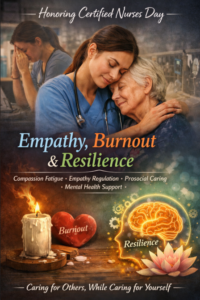
The Psychology of Care: Inside the Minds of Certified Nurses Balancing Empathy, Burnout, and Healing

Introduction

Certified Nurses Day goes beyond professional success and is more of a validation of the deep psychological acumen, emotional intelligence, and endurance that is necessary in nursing. Certified nurses are a group of medical professionals who have proven their higher level competency, yet more importantly than technical skills they are operating within a high-stress psychological environment on a daily basis.

The reason why nursing is all about care giving is caregiving psychology – the subject that studies the ways in which people show care, respond to hardship, and remain emotionally resilient under the pressure of difficult circumstances. Nurses are always facing pain, trauma, recovery, and in some cases death; hence, their profession is also one of the most emotionally facing.

The article discusses psychological aspects of nursing, including empathy, burnout, compassion fatigue, and prosocial behaviour, and attempts to identify how nurses manage their emotional reactions to maintain personal and patient outcomes.

1. Caregiving Psychology: The Foundation of Nursing

Caregiving psychology is the psychology of caring and supporting other people, particularly those in a vulnerable or diseased state. In nursing, caregiving is not merely a job, but a personality that is determined by the attachment theory, empathy, and prosocial motivation.

Psychologically speaking, the motivation behind care giving is:

  • Empathic concern – the skill of empathising with the patient.
  • Altruism- assisting without a reward.
  • Moral obligation – an internal sense of obligation.

Nurses tend to work in the context of what is referred by psychologists as a helper identity in which personal values are associated with well-being among others. Although this may be very profound, it may also lead to the susceptibility to emotional fatigue when there are no specific boundaries.

2. Empathy in Nursing: A Double-Edged Sword

Effective patient care is all about empathy. It is characterised by two significant elements:

  • Cognitive empathy – the ability to interpret a patient and see his thoughts.
  • Affective empathy- experiencing the emotions of a patient.

In nursing, empathy is enhanced:

  • Patient satisfaction
  • Treatment adherence
  • Recovery outcomes

This is in line with the prosocial behaviour as actions that help increase the common good.

Nonetheless, the overuse of affective empathy may result in emotional contagion in which the nurses take up the distress of patients. This can eventually lead to mental tension.

This is the reason the contemporary psychology focuses on empathy regulation the skill of establishing equilibrium between emotional involvement and professional non-involvement.

3. Empathy Regulation in High-Stress Caregiving Roles

The use of empathy is an essential skill that nurses should possess in the high-stress unit like ICUs, oncology wards, or emergency departments.

It involves:

  • Emotional boundary setting- having a separation between the self and the patient.
  • Cognitive restructuring – reworking painful events to minimise the effect of emotions.
  • Mindfulness – being here and now without being lost in the process.

As an example, rather than internalising the suffering that a patient is about to go through, a nurse can reframe the situation inside his or her mind as:

“I am not able to take away this pain, but I can lessen their suffering and to comfort them”.

This rotation hedges against empathic distress, which is an emotional sucking instead of a satisfaction-inspiring, type of helping.

4. Burnout in Healthcare Professionals

It is one of the most researched issues in the field of care giving, which is described as a state of exhaustion related to intense work stress that has been ineffective in its management.

Burnout is composed of three aspects according to the studies of psychology:

  • Emotional exhaustion- feeling fatigued and tired.
  • Depersonalization – acquisition of a cold-hearted or disillusioned attitude towards patients.
  • Less personal achievement- having a sense of ineffectiveness or inadequacy.

There is a lot of vulnerability among nurses because of:

  • Long working hours
  • High patient loads
  • Emotional demands
  • Lack of systemic support

Burnout is not a personal problem only, it is a manifestation of system problems in the healthcare setting.

5. Compassion Fatigue vs Burnout: Understanding the Difference

Fatigue and burnout are two different psychological concepts although they are commonly interchanged.

  • Compassion Fatigue
  • Has its origin in secondary traumatic stress.
  • The consequences of the continued exposure to the suffering of others.
  • The symptoms are emotional numbness, a lack of empathy, and intrusive thoughts.

Burnout

  • Arises as a result of prolonged occupational stress.
  • Connected with workload, organisational problems and the deficit of control.
  • These include fatigue and loss of concentration.

In simple terms:

  • Compassion fatigue = caring too much.
  • Burnout = tiredness due to overworking.

The two can coexist and this makes the burden on the psychological front heavier among the nurses.

6. Prosocial Behavior and Patient Care Outcomes

It is the foundation of nursing and can be described as voluntary activities aimed at doing good to others.

The social psychological research indicates that prosocial activity in healthcare results in:

  • Improved patient trust
  • Faster recovery rates
  • Improved interaction between provider and patient.

This is largely associated with the empathy altruism hypothesis, which implies that empathic care is inherently an invigorating factor in helping behaviour.

Certified nurses have a higher chance of demonstrating better levels of:

  • Clinical empathy
  • Ethical decision-making
  • Patient-centered care

Yet, to maintain the prosocial behaviour, there is need of psychological balancing. Unless there is adequate emotional control, aiding may result in empathic burnout.

7. The Role of Emotional Labor in Nursing

Nurses have a great deal of emotional work, which has been proposed by a sociologist, Arlie Hochschild.

Emotional labor involves:

  • Emotional control so as to be professional.
  • Being caring, calm and compassionate, even when stressed.

There are two types:

  • Surface acting- acting out emotions.
  • Deep acting – sincerely attempting to experience the need emotions.

The long surface acting is characterised by greater burnouts and deep acting may be more viable but still emotionally challenging.

8. Psychological Resilience in Certified Nurses

Nevertheless, it is possible to find a great number of nurses who show impressive psychological strength, stress adaptation, and recovery.

The major factors of resilience are:

  • Self-efficacy- a person believes that he/she can cope with challenges.
  • Skill of emotional regulation.
  • Social support systems
  • Meaning-making-purpose in care giving.

There is also the post-traumatic growth. According to some nurses, their personal development, growing empathy and enhanced emotional capacity have been experienced following challenging clinical experiences.

9. Coping Mechanisms and Mental Health Strategies

Nurses usually use different coping mechanisms in order to cope with psychological pressures of care giving:

  • Adaptive Coping
  • Relaxation and mindfulness methods.
  • Peer support and supervision.
  • Reflective practice
  • Work-life balance
  • Maladaptive Coping
  • Emotional suppression
  • Avoidance
  • Substance use

Adaptive coping should be strongly advocated through the provision of:

  • Mental health resources
  • Counseling services
  • Debriefing on a structured schedule.

10. The Importance of Organizational Support

Individual coping is also necessary, but the systemic change is necessary.

Psychological studies point at the role of:

  • Organisational justice –fair treatment, policies.
  • Perceived support – being valued by the institution.
  • Work autonomy- control over task.

A low rate of burnout and increased job satisfaction among nurses are observed in hospitals that focus on these factors.

11. Reframing Nursing Through a Psychological Lens

When we study nursing in terms of psychology, we can understand that a nurse is not merely a caregiver he or she is:

  • Emotional regulators
  • Crisis responders
  • Psychological sources of support.

Their job is constantly in contact with human suffering, and they should balance between solidarity and self-saving.

Conclusion

Certified Nurses Day is a strong reminder of the unseen psychological labour that nurses have to carry out in their daily lives. There is a complicated combination of empathy, emotional control, resilience, and prosocial motivation that should be found behind any clinical procedure.

As much as empathy is the motivation behind caregiving, it should be tempered with limits to avoid compassion fatigue. As much as performance is driven by dedication, systems should be used to avert burnout.

It is important to appreciate these psychological aspects not only to respect workers of nursing values, but also to safeguard their psychological state.

Since the health of the caregivers is eventually what defines the quality of care the caregivers offer.

And according to the caregiving psychology:

“You can not fill a cup which is empty-but, with a proper support, that cup may be filled with unparalleled medicine”.

FAQ 

1. What is Certified Nurses Day?

Certified Nurses Day is held as a reminder of those nurses who have been professionally certified, which shows their high level of knowledge, clinical skills, and dedication to quality patient care.

2. What is the psychology of caregiving in nursing?

Caregiving psychology is a discipline that focuses on the manner in which nurses offer emotional and physical assistance to the patient. It deals with empathy, attachment, altruism, and prosocial motivation, which facilitate the helping behaviour within the healthcare environment.

3. What is the significance of empathy in nursing?

Empathy improves patient satisfaction, trust and outcome of recovery. It enables nurses to empathise with patients by giving them insight into the emotional and physical experiences of patients and enhances patient-centred care.

4. What is compassion fatigue among the nurses?

Compassion fatigue- is the emotional, physical, and psychological burnout that comes as a result of extended contact with suffering patients. It is regarded as a professional risk factor in nursing.

5. What is the difference between compassion fatigue and burnout?

  • Compassion fatigue: A result of encountering the trauma of other people (secondary traumatic stress)
  • Burnout: Workload and constant stress in the workplace.

They both can be found simultaneous though they differ in their origin.

6. What are the compassion fatigue symptoms?

Common symptoms include:

  • Emotional numbness
  • Aggravated and careworn.
  • Sleep problems and fatigue
  • Reduced empathy
  • It may also impact on job performance and patient safety.

7. Why are nurses under a high risk of burn out?

Nurses face:

  • Long working hours
  • High emotional demands
  • Patient overload
  • Limited resources
  • Burnout has the capacity to decrease motivation, energy and quality care.

8. What is empathy regulation in medical care?

Empathy regulation can be defined as the capacity to mediate between the emotional engagement and professionalism. It eliminates empathic distress without compromising on compassionate care.

9. What is the impact of prosocial behaviour on patient outcomes?

Prosocial behaviour (helping actions) is improved:

  • Patient trust
  • Treatment adherence
  • Recovery rates

It is self-driven by empathy and altruism, which is the essence of nursing practise.

10. What can nurses do to make peace with compassion fatigue and burnout?

Strategies to consider are:

  • Meditation and stress relieving programmes.
  • Peer support (Code Lavender, etc.) programmes.
  • Psychological and counselling interventions.
  • Healthy work-life balance

Studies demonstrate psychological interventions to be able to decrease burnout and empathy fatigue by significant margins.

Written by Baishakhi Das

Counselor | Mental Health Practitioner
B.Sc, M.Sc, PG Diploma in Counseling


Reference

  1. Study on compassion fatigue in nurses (PMC):
    https://pmc.ncbi.nlm.nih.gov/articles/PMC10729325/

  2. Research on compassion fatigue, burnout & coping:
    https://pmc.ncbi.nlm.nih.gov/articles/PMC9835325/

  3. Empathy & compassion fatigue overview (AJNER):
    https://ajner.com/AbstractView.aspx?PID=2025-15-1-8

  4. Psychological interventions for empathy fatigue (Frontiers):
    https://www.frontiersin.org/articles/10.3389/fpubh.2022.952932

  5. Burnout & compassion fatigue in nursing (Curationis):
    https://curationis.org.za/index.php/curationis/article/view/1784

  6. Compassion fatigue theory (OJIN Nursing World):
    https://ojin.nursingworld.org

  7. Altruistic Sacrifice: The Psychology of Moral Courage in Extreme Situations

This article is written for knowledge purposes, aiming to help readers understand the topic better and gain useful insights for learning and awareness.
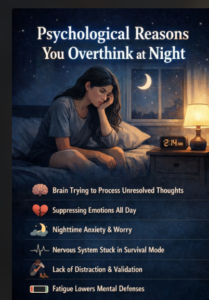
Reasons You Overthink at Night

During the day, your mind may feel manageable. You stay busy—distracted by work, conversations, responsibilities, and constant stimulation. Activity gives your thoughts direction and structure. But at night, when the world grows quiet and external demands fade, that structure disappears. In the stillness, your thoughts suddenly become louder. Memories replay without warning, worries multiply, and questions you avoided all day begin to surface, one after another. Sleep feels distant—not because your body isn’t tired, but because your mind doesn’t know how to slow down.

Night-time overthinking isn’t a weakness, a bad habit, or a lack of discipline. It’s often a psychological response rooted in how the brain processes stress, safety, and unresolved emotional experiences. When the day ends, your brain finally has the space it didn’t have before—to process what was postponed, suppressed, or emotionally unfinished.

In the absence of distractions, the mind turns inward. Thoughts that were held back by busyness seek resolution. If your nervous system has been under stress, the quiet of night can feel unfamiliar rather than soothing, causing the mind to stay alert instead of restful. Overthinking becomes the brain’s way of trying to protect you—by reviewing, analyzing, and anticipating—especially when it senses uncertainty.

This is why overthinking so often peaks at night. It’s not that your problems suddenly appear after dark. It’s that, for the first time all day, your mind is finally being heard.

1. The Brain Finally Has Space to Process

Throughout the day, tasks, conversations, screens, and responsibilities keep your mind externally focused. There is always something demanding attention—something to respond to, fix, or complete. This constant engagement leaves little room for reflection. At night, however, those distractions disappear. The external world quiets, and the brain naturally shifts inward, turning its attention to what has been left unprocessed.

Thoughts you postponed during the day—unresolved conflicts, unexpressed emotions, unfinished decisions, and lingering doubts—finally surface. With no immediate task to anchor your focus, the mind begins to revisit these experiences, searching for meaning or resolution. Overthinking, in this sense, isn’t your mind attacking you or trying to sabotage your rest; it’s your mind asking for attention when there is finally enough silence to listen.

2. Suppressed Emotions Rise When You Slow Down

Many people cope with emotional discomfort by staying busy. Productivity becomes a survival strategy—a way to avoid feeling what hasn’t been processed. During the day, there’s little space to pause, reflect, or emotionally register experiences. But when night arrives and activity slows, the emotional system no longer has distractions to hide behind.

Suppressed emotions such as sadness, fear, guilt, loneliness, or even unacknowledged anger begin to surface. These feelings don’t arrive gently; they emerge all at once because they’ve been waiting. The mind then tries to manage this emotional flood by thinking—analyzing situations, replaying conversations, imagining outcomes, or worrying excessively. Overthinking becomes an attempt to stay in control of emotions that were ignored or postponed during the day.

3. Anxiety Is Louder at Night

Anxiety thrives in uncertainty, and night naturally brings more of it. The environment is quieter, darker, and less predictable. There are fewer external cues of safety—fewer people awake, less activity, and limited immediate reassurance. As a result, the brain becomes more vigilant, scanning for potential threats.

This is why worries often take the form of:

  • “What if something goes wrong?”

  • “if I made the wrong decision?”

  • “What if the future doesn’t work out?”

At night, the mind shifts into anticipatory mode. It tries to protect you by rehearsing possible dangers and preparing for imagined problems. Unfortunately, this hyper-alertness keeps the nervous system activated, making rest feel difficult.

4. The Nervous System Stays in Survival Mode

If you live with chronic stress, unresolved trauma, or long-term emotional responsibility, your nervous system may rarely experience a sense of true safety. Even when your body is physically resting in bed, your internal system may remain on guard.

Overthinking is often a sign that the nervous system hasn’t transitioned from fight-or-flight into rest-and-digest mode. The mind stays active because it doesn’t yet feel safe enough to power down. Instead of settling, it continues monitoring, anticipating, and analyzing—mistaking mental activity for protection.

5. Night Removes External Validation

During the day, interactions and responsibilities provide constant feedback. You’re needed, productive, responsive, and engaged. These external signals help stabilize your sense of self. At night, when those roles pause, that validation disappears.

In the quiet, the mind often turns inward and begins self-evaluating:

  • “Am I doing enough?”
  • “I falling behind?”
  • “Why am I like this?”

Without external reassurance, overthinking fills the emotional gap left by silence. Rather than offering comfort, the mind becomes self-critical, searching for answers to questions rooted in insecurity and self-doubt.

6. Fatigue Weakens Mental Boundaries

As the day wears on, mental and emotional energy declines. When you’re tired, your brain’s ability to regulate and filter thoughts becomes weaker. The internal voice that usually says, this thought isn’t helpful right now, loses strength.

As a result, a single thought can quickly spiral into:

  • replaying past mistakes,
  • predicting worst-case futures,
  • questioning your worth, competence, or choices.

This isn’t over-dramatization or negativity—it’s cognitive fatigue. A tired brain struggles to maintain perspective, making thoughts feel heavier and more convincing than they actually are.

7. Overthinking as a Form of Control

For many people, thinking feels safer than feeling. Emotions can feel unpredictable and overwhelming, while thoughts create a sense of structure. Overthinking offers the illusion of control—the belief that if you analyze enough, anticipate enough, or prepare enough, you can prevent pain.

At night, when control feels limited and vulnerability increases, the mind leans more heavily on thinking as protection. Unfortunately, this strategy often backfires. Instead of reducing distress, it amplifies it—keeping the mind alert and the body tense, long after rest is needed.

Overthinking, then, is not a failure of self-control. It’s a protective response that has stayed active for too long.

Why Telling Yourself “Just Sleep” Doesn’t Work

Overthinking isn’t a switch you can turn off through willpower. It isn’t a bad habit that disappears because you command it to. It’s a signal—one your mind uses to communicate unmet emotional needs such as processing, reassurance, safety, or expression. When these needs go unaddressed, the mind keeps returning to them, especially in the quiet of night.

Telling yourself to “just sleep” often creates internal pressure. Instead of calming the system, it sends the message that your thoughts are a problem to be eliminated. The brain responds by becoming more alert, not less—because unresolved thoughts don’t disappear when they’re ignored.

Trying to silence your thoughts without understanding them often makes them louder. The mind resists being shut down when it feels unheard. Real rest begins not when thoughts are forced away, but when the nervous system feels safe enough to let go—when thoughts are acknowledged, emotions are allowed, and the need beneath the overthinking is gently met.

What Actually Helps With Night-Time Overthinking

Healing doesn’t come from forcing sleep. It comes from helping the nervous system feel safe.

Helpful approaches include:

  • Gentle grounding (slow breathing, body awareness)
  • Writing down thoughts to release mental load
  • Creating a consistent night routine that signals safety
  • Allowing emotions without immediately analyzing them
  • Therapy to process unresolved emotional patterns

A Gentle Reframe

If you overthink at night, it doesn’t mean you’re broken, weak, or incapable of rest. It means your mind has finally been given space—space it didn’t have during the noise and demands of the day. In that quiet, your inner world begins to speak. What you’re experiencing isn’t a failure of control; it’s a request for understanding.

Your thoughts are not the enemy. They are signals pointing toward emotions, needs, or experiences that haven’t yet been acknowledged. When met with compassion rather than resistance, they soften. When met with control or judgment, they often grow louder.

Rest doesn’t begin when thoughts disappear.
It begins when your mind feels safe enough to let go—safe enough to trust that it doesn’t have to stay alert, analyze everything, or protect you through constant thinking. That sense of safety is built through gentleness, patience, and allowing yourself to be human, even in the quiet of the night.

Frequently Asked Questions (FAQ)

1. Why do I overthink more at night than during the day?

At night, external distractions reduce, giving your mind space to process unresolved thoughts and emotions that were postponed during the day.

2. Is night-time overthinking a sign of anxiety?

Often yes. Anxiety tends to intensify at night due to uncertainty, reduced reassurance, and a heightened sense of vulnerability.

3. Can overthinking at night be linked to trauma?

Yes. Trauma and chronic stress can keep the nervous system in survival mode, making it hard for the mind to fully relax at night.

4. Why does my mind replay past events when I try to sleep?

When the brain is quiet, it revisits unfinished emotional experiences, attempting to process or make sense of them.

5. Does night-time overthinking mean I’m mentally weak?

No. It’s a protective psychological response, not a weakness or lack of discipline.

6. Why doesn’t telling myself to “stop thinking” help?

Because overthinking is a signal, not a switch. Suppressing thoughts often increases mental arousal rather than calming it.

7. Can fatigue make overthinking worse?

Yes. Cognitive fatigue weakens mental boundaries, allowing thoughts to spiral more easily at night.

8. Is overthinking a form of control?

For many people, yes. Thinking can feel safer than feeling, creating an illusion of control over uncertainty or emotional pain.

9. Why do my worries feel more realistic at night?

At night, the brain’s emotional regulation is lower, making thoughts feel more intense and believable.

10. Can suppressed emotions cause night-time overthinking?

Absolutely. Unexpressed emotions often surface when activity slows and the mind turns inward.

11. Does overthinking affect sleep quality?

Yes. It keeps the nervous system activated, making it harder to fall asleep or stay asleep.

12. Can routine help reduce night-time overthinking?

A consistent, calming night routine can signal safety to the nervous system and reduce mental alertness.

13. Is night-time overthinking common?

Very common. Many emotionally aware and high-functioning individuals experience it.

14. When should I seek professional help?

If overthinking regularly disrupts sleep, daily functioning, or emotional wellbeing, therapy can be very helpful.

15. Can night-time overthinking be healed?

Yes. With emotional processing, nervous system regulation, self-compassion, and support, it can significantly reduce over time.

Written by Baishakhi Das

Counselor | Mental Health Practitioner
B.Sc, M.Sc, PG Diploma in Counseling

Research 

Understanding rumination and worry (night-time repetitive thinking in anxiety & depression research) — National Institutes of Health (NIH)
The mind after midnight: nighttime wakefulness and cognitionNIH article on how night affects brain activity and sleep processes
Sleep anxiety and its causesCleveland Clinic overview on how anxiety and sleep are connected
Why anxiety can be worse at nightSleep Foundation expert guide on night-time anxiety causes and sleep interference
Circadian rhythms & introspective thought at nightMedium psychological discussion on why the brain becomes more self-referencing after dark

You’re Not Lazy — You’re Emotionally Exhausted

This topic performs well due to rising searches around men’s mental health, workplace stress, and burnout recovery. Combining emotional insight with practical steps increases engagement and trust.