How Birth Order Influences Personality

https://i.etsystatic.com/15493847/r/il/c4af4b/1307200366/il_570xN.1307200366_mis5.jpg

A Psychological Perspective with In-Depth Explanation

Birth order has long fascinated psychologists, parents, and researchers because siblings raised in the same family often develop strikingly different personalities, coping styles, and emotional patterns. Even when children share the same home, culture, and parenting values, their psychological experiences within the family are rarely the same. While genetics and environment play powerful roles in shaping personality, birth order adds another important psychological layer—influencing how children interpret attention, responsibility, competition, and belonging. Over time, these interpretations shape how individuals see themselves, relate to others, handle stress, and navigate the world.

The theory of birth order was first systematically explored by Alfred Adler, the founder of Individual Psychology. Adler believed that children are not shaped simply by objective family conditions, but by how they experience their position within the family. According to him, a child’s place among siblings creates unique emotional challenges and advantages, which influence motivation, self-concept, and interpersonal behavior. Birth order, in this view, affects the strategies children develop to gain significance, love, and a sense of belonging.

This article explains each birth order position in detail, exploring the typical strengths, challenges, and psychological patterns associated with first-borns, middle children, youngest children, and only children. At the same time, it is important to remember that birth order influences tendencies, not destiny. Personality remains flexible and is shaped continuously by life experiences, relationships, culture, and self-awareness. Understanding birth order is not about labeling people—but about gaining deeper insight into ourselves and others.

The Psychology Behind Birth Order

From a psychological standpoint, birth order influences how children interpret their place within the family system, and this interpretation affects several key developmental areas:

  • Parental attention – how much attention a child receives, when they receive it, and whether it feels secure or threatened

  • Expectations and responsibility – the level of pressure placed on a child to lead, comply, care for others, or achieve

  • Competition among siblings – how children compare themselves, seek uniqueness, or compete for recognition

  • Sense of belonging and significance – whether a child feels valued, noticed, and emotionally important within the family

Children are not passive recipients of these experiences. They adapt psychologically to their family role in order to secure love, attention, and emotional safety. Some learn to become responsible and dependable, others become agreeable peacemakers, while some rely on charm, independence, or achievement to feel valued. Over time, these early coping strategies become internalized patterns of thinking, feeling, and behaving, often solidifying into stable personality traits that continue to influence relationships and self-identity well into adulthood.

First-Born Child: The Responsible Leader

https://i0.wp.com/justaskyourmom.com/wp-content/uploads/2024/06/birth-order-traits-FB.jpg?resize=372%2C447&ssl=1

Psychological Environment

The first-born child begins life as the sole recipient of parental attention, care, and expectations. During this early period, they often experience a strong sense of importance and security. However, when a younger sibling is born, the first-born commonly goes through what psychologists describe as “dethronement”—a sudden shift from being the center of the family to having to share attention and resources. This experience can feel like a loss of status or security, even if parents remain loving. As a result, many first-borns adapt by becoming more compliant, responsible, or achievement-oriented in an effort to regain approval and maintain their sense of significance. This early transition plays a powerful role in shaping their personality.

Common Personality Traits

First-born children often develop traits that reflect their early responsibilities and expectations, such as:

  • A strong sense of responsibility and duty

  • Organized, disciplined, and rule-oriented behavior

  • Natural leadership tendencies

  • High achievement motivation

  • Emotional maturity that appears advanced for their age

These traits often emerge because first-borns learn early that reliability and competence bring positive attention.

Emotional Patterns

Emotionally, first-borns may carry an internal pressure to “do things right.” They often experience:

  • Pressure to be a role model for younger siblings

  • Fear of making mistakes or failing

  • Anxiety related to losing control or disappointing others

Because praise and attention may feel linked to performance, some first-borns begin to equate love with achievement, which can contribute to perfectionism and self-criticism.

In Adulthood

As adults, first-born individuals often:

  • Perform well in leadership, management, or authority roles

  • Are reliable, loyal, and conscientious in relationships

  • Take responsibility seriously in family and work settings

However, they may also struggle with rigidity, overcontrol, or difficulty relaxing and delegating. Learning to separate self-worth from performance is often an important part of their emotional growth.

Middle Child: The Diplomat and Negotiator

https://www.stuff4tots.com/wp-content/uploads/Middle-Child_Table2.jpg

Psychological Environment

Middle children often grow up feeling caught between siblings—no longer holding the privileges of the oldest, yet not receiving the special attention often given to the youngest. Because parental focus is frequently divided, middle children may perceive themselves as overlooked or less visible within the family. Psychologically, this experience encourages them to adapt by becoming highly aware of others’ needs and emotions. To maintain connection and belonging, they often learn to fit in, negotiate, and adjust—skills that foster strong social adaptability.

Common Personality Traits

As a result of this family position, middle children commonly develop traits such as:

  • Diplomatic and cooperative behavior

  • High emotional intelligence and social awareness

  • Flexibility and adaptability in changing situations

  • A strong sense of fairness and empathy

  • Independent thinking and problem-solving

They often carve out a unique identity by differentiating themselves from siblings rather than competing directly.

Emotional Patterns

Emotionally, middle children may develop:

  • Sensitivity to injustice or favoritism

  • A strong desire to be recognized for their individuality

  • Deep and meaningful peer relationships outside the family

They often learn early that connection is maintained through compromise, understanding others’ perspectives, and keeping harmony—sometimes at the cost of their own needs.

In Adulthood

In adult life, middle children often become:

  • Excellent mediators, negotiators, and team players

  • Loyal friends who value emotional balance and fairness

  • Socially skilled and adaptable in group settings

However, they may occasionally struggle with feeling unseen, undervalued, or unsure of their place, leading to periods of identity confusion. Learning to assert their own needs without fear of losing connection becomes an important part of their personal growth.

Youngest Child: The Charismatic Explorer

https://cdn.empoweringparents.com/attention-seeking-behavior.jpg

Psychological Environment

The youngest child typically grows up surrounded by older siblings and parents who are often more relaxed, experienced, and less rigid than they were with earlier children. Because much has already been “learned” by the family, the youngest may receive extra protection, indulgence, or leniency. Older siblings may also take on caregiving or directive roles. Psychologically, this environment encourages creativity, expressiveness, and social awareness, as the youngest learns to stand out and secure attention within an already established family system.

Common Personality Traits

Youngest children often develop traits that help them gain connection and recognition, such as:

  • Social and expressive communication style

  • Creativity and spontaneity

  • Willingness to take risks and explore new experiences

  • Strong sense of humor and playfulness

  • Attention-seeking behaviors

These traits often emerge as adaptive strategies to feel noticed and valued.

Emotional Patterns

Emotionally, youngest children may:

  • Use charm, humor, or charisma to gain approval

  • Avoid responsibility, especially if others tend to take charge

  • Fear not being taken seriously or being viewed as “the baby”

They often learn early that likability and emotional expressiveness are effective ways to build connection and maintain belonging.

In Adulthood

As adults, youngest children often grow into individuals who are:

  • Energetic, enthusiastic, and innovative

  • Comfortable in social settings with a strong interpersonal presence

  • Creative problem-solvers who bring fresh perspectives

However, they may struggle with discipline, consistency, or follow-through, especially in structured environments. They can also feel underestimated or dismissed, making it important for them to develop confidence in their competence alongside their natural charm.

Only Child: The Mature Individualist

https://ccy.jfcs.org/wp-content/uploads/2013/03/iS_000011653561Large21.jpg

Psychological Environment

Only children grow up in adult-centered environments without sibling rivalry or competition. They typically receive consistent, focused parental attention, which can foster security and emotional awareness. At the same time, the absence of siblings means fewer natural opportunities to practice sharing, negotiation, and conflict resolution in daily life. As a result, only children often become comfortable engaging with adults early on and may adopt more mature behaviors and communication styles than their peers.

Common Personality Traits

Only children frequently develop traits such as:

  • Emotional maturity and self-awareness

  • Strong self-reliance and independence

  • High achievement motivation

  • Comfort with solitude and self-directed activities

  • Well-developed verbal and communication skills

These traits often emerge from close interaction with adults and high parental involvement.

Emotional Patterns

Emotionally, only children may:

  • Develop perfectionistic tendencies

  • Feel intense pressure to succeed or meet expectations

  • Struggle with sharing control or delegating tasks

Because parental attention is often undivided, they may internalize high expectations, learning to equate success with approval.

In Adulthood

In adult life, only children are often:

  • Confident, self-directed, and internally motivated

  • Clear about their values and identity

  • Comfortable making independent decisions

However, they may sometimes struggle with collaboration, emotional vulnerability, or relying on others. Many only children are also deeply introspective, spending considerable time in self-reflection.

Important Moderating Factors

It is important to understand that birth order effects are not fixed or universal. Their influence depends heavily on context, including:

  • Age gaps between siblings

  • Gender roles and cultural expectations

  • Parenting style and emotional availability

  • Family stress, illness, or trauma

  • Blended, adoptive, or single-parent family structures

For example, a first-born with a large age gap may psychologically resemble an only child, while a middle child who assumes caregiving responsibilities may develop first-born–like traits. These moderating factors remind us that birth order shapes tendencies, but individual experience ultimately shapes personality.

What Birth Order Does Not Mean

It is important to approach birth order with balance and realism. Birth order influences tendencies, but it does not define a person’s full potential or future. Specifically, birth order:

Intellectual capacity is not fixed by birth order – it develops through a blend of genetic potential, education, cognitive stimulation, and access to opportunities

Mental health outcomes cannot be predicted by sibling position – psychological conditions arise from complex interactions among biology, environment, relationships, and life experiences

Personality is not permanently set by family position – it remains flexible and capable of change across the lifespan through growth, insight, and experience

Human personality remains plastic and adaptable, shaped by new experiences, self-awareness, therapy, meaningful relationships, and personal growth. Early patterns can be understood, questioned, and reshaped.

Clinical and Counseling Perspective

In counseling psychology, birth order is used as a framework for understanding, not a diagnostic tool. Exploring birth order can help therapists and clients gain insight into:

  • Core beliefs about worth, significance, and belonging

  • Repeated relationship patterns

  • Typical conflict styles and coping strategies

  • Emotional roles learned within the family system

When used thoughtfully, birth order offers valuable context about how early family dynamics influence adult behavior, emotional responses, and interpersonal choices—without reducing individuals to labels.

Final Thoughts

Birth order shapes how we adapt, not who we must become.

Each birth order position carries its own strengths, challenges, and emotional lessons. With awareness, individuals can:

  • Appreciate their inherent strengths

  • Heal outdated or limiting patterns

  • Break unconscious family roles

  • Develop a more flexible, authentic sense of self

Understanding birth order is not about comparison or categorization—it is about self-understanding, compassion, and psychological growth.

Frequently Asked Questions (FAQ)

1. What is birth order in psychology?

Birth order refers to a child’s position in the family (first-born, middle, youngest, or only child) and how this position influences psychological development, personality traits, and behavior patterns.

2. Who introduced the birth order theory?

The birth order theory was introduced by Alfred Adler, who believed personality is shaped by social context and early family experiences.

3. Does birth order really affect personality?

Birth order does not determine personality, but it can influence tendencies, coping styles, and interpersonal behaviors, especially in early life.

4. Are first-born children more responsible?

Many first-borns develop responsibility and leadership traits due to early parental expectations, but this is not universal and depends on family dynamics.

5. Why are middle children considered adaptable?

Middle children often learn flexibility and diplomacy as they navigate between older and younger siblings, helping them develop strong social skills.

6. Are youngest children always attention-seeking?

Not always. Youngest children may use charm or humor to connect, but many also become creative, confident, and socially skilled adults.

7. Are only children lonely or selfish?

No. Research shows only children are often emotionally mature, independent, and capable of strong relationships, though they may prefer autonomy.

8. Can birth order predict success in life?

Birth order alone cannot predict success. Motivation, opportunities, education, and emotional support play much larger roles.

9. Does birth order affect relationships?

Yes, it can influence communication styles, conflict handling, and emotional expectations in friendships and romantic relationships.

10. Can birth order effects change over time?

Yes. Personality is plastic and evolves with life experiences, therapy, self-awareness, and personal growth.

11. How do age gaps affect birth order influence?

Large age gaps can alter birth order effects. For example, a first-born with a large gap may function psychologically like an only child.

12. Does culture influence birth order traits?

Absolutely. Cultural expectations, gender roles, and parenting styles significantly shape how birth order traits develop.

13. Is birth order used in counseling or therapy?

Yes. Therapists use birth order as an exploratory tool to understand family roles, emotional patterns, and core beliefs—not as a label.

14. Can understanding birth order help with self-growth?

Yes. Awareness helps individuals recognize strengths, heal old patterns, and break unconscious family roles.

15. Is birth order more important than genetics?

No. Personality develops through an interaction of genetics, environment, relationships, and personal experiences—birth order is just one factor.

Written by Baishakhi Das

Counselor | Mental Health Practitioner
B.Sc, M.Sc, PG Diploma in Counseling


Reference Links


How Parenting Styles Affect Personality Development

https://mamadocpediatrics.com/wp-content/uploads/2019/12/Final-Parenting-Styles.jpg

Personality does not develop in isolation. From the earliest moments of life, a child’s emotional world, beliefs, coping patterns, and sense of self are shaped through relationships—especially the relationship with parents or primary caregivers. Parenting styles play a crucial role in how children learn to trust, regulate emotions, relate to others, and view themselves.

This article explores how different parenting styles influence personality development, drawing from developmental psychology, attachment theory, and real-life behavioral patterns. As a mental health professional, you may notice these patterns daily—in children, adolescents, and even adults reflecting their early family experiences.

Understanding Parenting Styles: A Psychological Framework

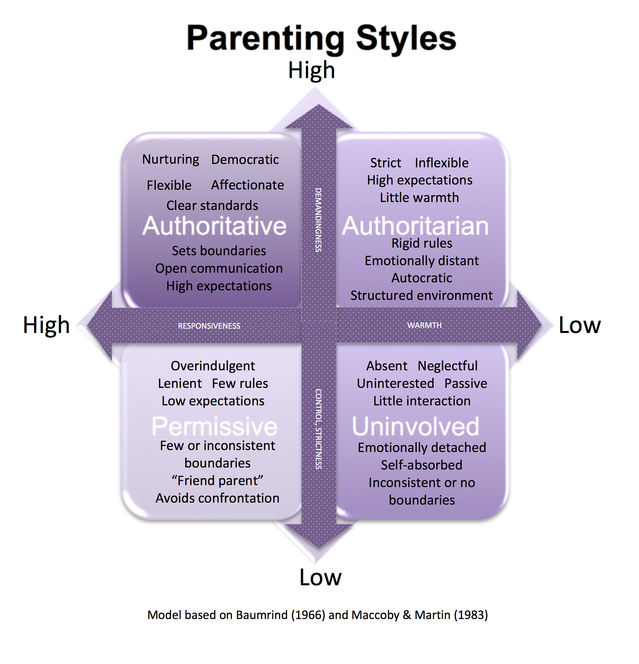
The concept of parenting styles was systematically introduced by Diana Baumrind, who identified consistent patterns in how parents interact with their children. Later researchers expanded her work, but the core idea remains: parenting style reflects emotional climate, discipline methods, communication patterns, and expectations.

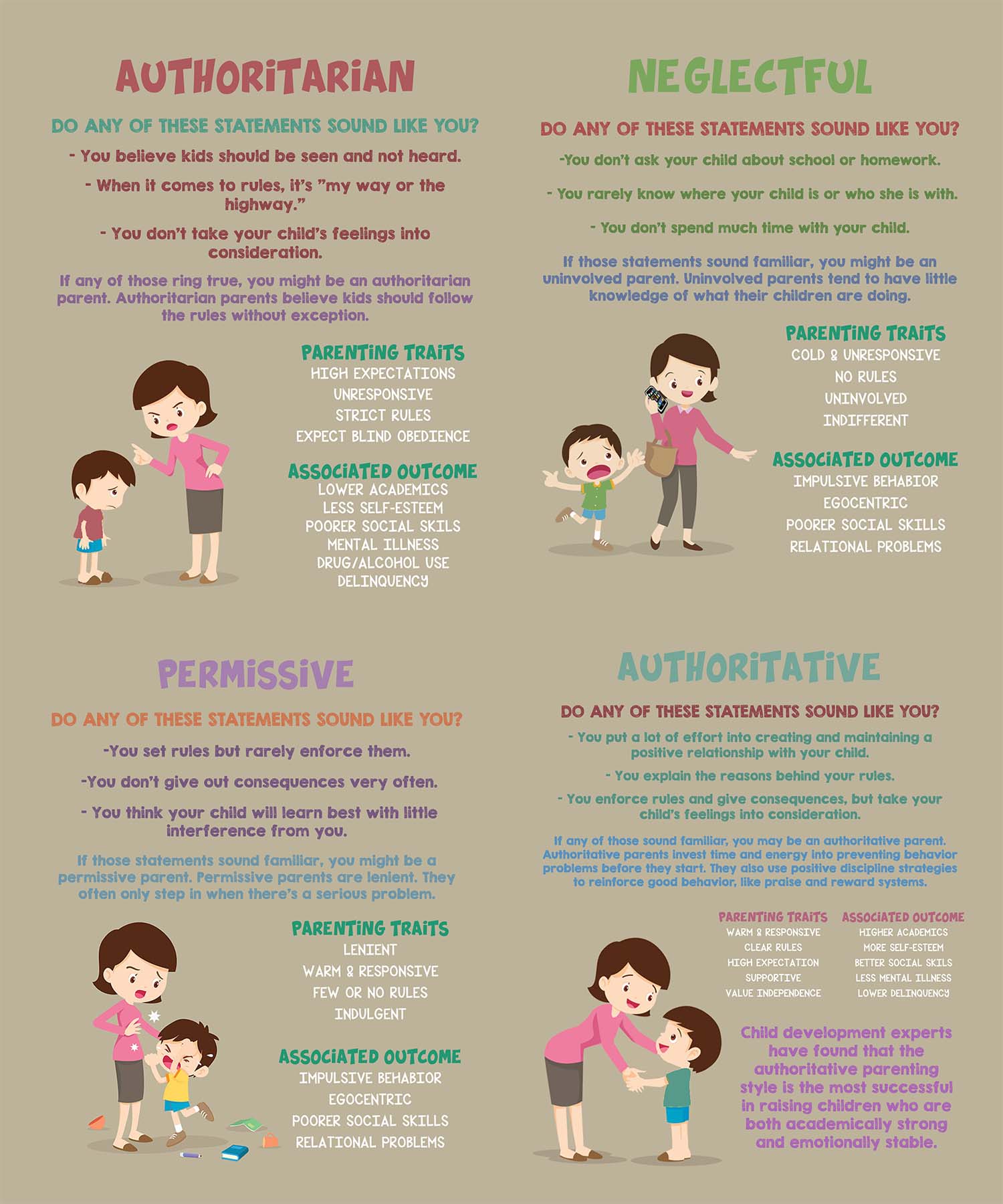
Parenting styles are generally classified into four main types:

  1. Authoritative

  2. Authoritarian

  3. Permissive

  4. Neglectful (Uninvolved)

Each style affects personality traits such as self-esteem, emotional regulation, independence, resilience, empathy, and interpersonal functioning.

Why Personality Development Is Sensitive to Parenting

Personality development is especially sensitive to parenting because the child’s brain, emotions, and sense of self are still under construction. In early life, children do not yet have the neurological capacity or psychological independence to regulate emotions, interpret experiences, or assign meaning on their own. Parents and primary caregivers therefore become the first emotional regulators, mirrors, and interpreters of the world.

Personality development involves several core psychological domains:

1. Emotional Regulation

Children are not born knowing how to calm themselves, manage anger, or tolerate frustration. They learn emotional regulation through co-regulation—when caregivers respond consistently to their emotional needs.

  • When parents soothe distress, label emotions, and model calm responses, children gradually internalize these skills.

  • When emotions are ignored, punished, or mocked, children may suppress feelings or become emotionally reactive.

Over time, these early experiences shape whether a person grows up emotionally resilient or emotionally dysregulated.

2. Self-Concept and Self-Worth

A child’s sense of “Who am I?” develops largely through parental responses.

  • When caregivers show acceptance, interest, and validation, children develop healthy self-worth.

  • When love feels conditional—based on obedience, achievement, or silence—children may internalize beliefs such as “I am not enough” or “I must earn love.”

These early self-beliefs often persist into adulthood, influencing confidence, perfectionism, people-pleasing, or self-criticism.

3. Social Competence

Parents are a child’s first social world. Through everyday interactions—play, conflict, affection, discipline—children learn:

  • How to communicate needs

  • How to handle disagreements

  • Whether relationships feel safe or threatening

Supportive parenting helps children develop empathy, cooperation, and assertiveness. In contrast, harsh or inconsistent parenting may lead to aggression, withdrawal, or fear of social judgment.

4. Coping Mechanisms

How parents respond to stress teaches children how to cope with challenges.

  • Emotionally available parents model problem-solving, flexibility, and help-seeking.

  • Emotionally unavailable or critical parents may unintentionally teach avoidance, emotional shutdown, aggression, or over-control.

These coping styles later show up in how adults handle failure, rejection, pressure, and loss.

5. Moral Reasoning

Children initially understand right and wrong not as abstract concepts, but through relationships.

  • When parents explain rules with empathy and reasoning, children develop internal moral values.

  • When discipline is based solely on fear or punishment, morality remains external—driven by avoidance rather than understanding.

This influences whether adults act from personal values or from fear of consequences and authority.

6. Attachment Patterns

Perhaps the most powerful influence of parenting is on attachment. According to John Bowlby, repeated interactions with caregivers form internal working models—deep mental and emotional templates about:

  • Whether others are trustworthy

  • Whether emotions will be met with care or rejection

  • Whether closeness is safe or risky

These internal working models guide how individuals later relate to:

  • Authority figures

  • Romantic partners

  • Conflict and criticism

  • Emotional intimacy and stress

Because these models develop before conscious memory, they often feel like “just the way I am”, even though they are learned patterns.

Why Early Parenting Has Long-Term Impact

Children are neurologically and emotionally dependent on caregivers. Their brains are highly plastic, meaning repeated emotional experiences literally shape neural pathways. What is experienced repeatedly becomes familiar, automatic, and internalized.

This is why:

  • Consistent emotional safety fosters secure, adaptable personalities

  • Chronic emotional neglect or fear can lead to anxiety, avoidance, or emotional numbness

Personality, then, is not simply a trait—it is the emotional memory of early relationships.

1. Authoritative Parenting: The Foundation of Psychological Health

Core Characteristics

  • High warmth and responsiveness

  • Clear rules and consistent boundaries

  • Open communication

  • Encouragement of independence

  • Discipline through reasoning, not fear

Impact on Personality Development

Children raised with authoritative parenting tend to develop:

  • Secure self-esteem – They feel valued and competent

  • Emotional intelligence – Emotions are acknowledged, not dismissed

  • Self-discipline – Internal regulation rather than fear-based compliance

  • Social confidence – Comfort in relationships and teamwork

  • Resilience – Ability to cope with failure and stress

Psychologically, this style supports secure attachment, allowing children to explore the world while knowing emotional support is available.

Adult Personality Outcomes

  • Balanced confidence

  • Healthy boundaries

  • Emotional expressiveness

  • Adaptive coping strategies

  • Stable relationships

Authoritative parenting is consistently associated with the most positive personality outcomes across cultures.


2. Authoritarian Parenting: Obedience Over Emotional Growth

https://static.toiimg.com/photo/121516512.cms

Core Characteristics

  • High control, low warmth

  • Strict rules with little explanation

  • Emphasis on obedience and authority

  • Punitive discipline

  • Limited emotional expression

Impact on Personality Development

Children raised in authoritarian environments often develop:

  • Low self-esteem – Love feels conditional

  • Fear-based compliance – Behavior driven by punishment avoidance

  • Poor emotional expression – Feelings are suppressed

  • High anxiety or anger – Emotional needs remain unmet

  • External locus of control – Reliance on authority for validation

Emotionally, children may learn that mistakes equal rejection, leading to perfectionism or rebellion.

Adult Personality Outcomes

  • Difficulty expressing emotions

  • Fear of authority or excessive submission

  • Rigid thinking patterns

  • High stress sensitivity

  • Relationship difficulties

While such children may appear “disciplined,” internally they often struggle with emotional insecurity.

3. Permissive Parenting: Freedom Without Structure

https://cdn.psychologytoday.com/sites/default/files/styles/image-article_inline_full_caption/public/field_blog_entry_images/2019-11/parenting_styles_bredehoft_www.overindulgence.org__1.jpg?itok=auCGvyiw

Core Characteristics

  • High warmth, low control

  • Few rules or inconsistent boundaries

  • Avoidance of conflict

  • Overindulgence

  • Child-led decision-making

Impact on Personality Development

Children raised under permissive parenting may develop:

  • Poor impulse control – Difficulty delaying gratification

  • Entitlement – Expectation that needs come first

  • Low frustration tolerance – Struggle with limits

  • Insecurity – Lack of structure creates emotional instability

  • Weak self-discipline – External regulation is missing

Though emotionally expressive, these children often feel unsafe due to unclear expectations.

Adult Personality Outcomes

  • Difficulty with responsibility

  • Struggles with authority and rules

  • Emotional impulsivity

  • Relationship instability

  • Poor stress tolerance

Warmth alone, without boundaries, does not foster emotional maturity.


4. Neglectful (Uninvolved) Parenting: Emotional Absence

https://osteopathygoldcoast.b-cdn.net/wp-content/uploads/2024/05/Understanding-Childhood-Emotional-Neglect.webp

Core Characteristics

  • Low warmth, low control

  • Emotional unavailability

  • Minimal involvement

  • Basic needs met, emotional needs ignored

  • Parent preoccupied with personal issues

Impact on Personality Development

This style has the most damaging psychological effects. Children often develop:

  • Low self-worth – Feeling unimportant or invisible

  • Emotional numbness or dysregulation

  • Attachment difficulties – Fear of closeness or abandonment

  • Poor social skills

  • High risk of depression and anxiety

Without emotional mirroring, children struggle to understand themselves.

Adult Personality Outcomes

  • Chronic emptiness

  • Avoidant or anxious attachment

  • Difficulty trusting others

  • Emotional detachment

  • Vulnerability to addiction or maladaptive coping

Emotional neglect is often invisible—but its psychological impact is profound.

Parenting Styles and Attachment Patterns

Parenting styles strongly influence attachment styles, which shape personality across the lifespan:

Parenting Style Common Attachment Pattern
Authoritative Secure
Authoritarian Anxious or Fearful
Permissive Anxious
Neglectful Avoidant or Disorganized

Attachment patterns later affect:

  • Romantic relationships

  • Conflict resolution

  • Emotional intimacy

  • Self-regulation

Cultural Context: Parenting in Indian Families

In many Indian households:

  • Authoritarian parenting is normalized as “discipline”

  • Emotional expression is often discouraged

  • Obedience is prioritized over autonomy

While cultural values matter, psychological research shows that emotional responsiveness combined with structure leads to healthier personality development, regardless of culture.

Modern Indian parenting is slowly shifting toward authoritative approaches—balancing respect, boundaries, and emotional attunement.

Can Personality Be Changed in Adulthood?

Yes—personality can change in adulthood. While early parenting experiences leave deep psychological imprints, they do not permanently lock a person into one way of thinking, feeling, or relating. Personality is shaped by experience, and the brain retains the ability to reorganize itself throughout life. This capacity for change is what makes healing possible.

What often feels like a “fixed personality” is actually a set of learned emotional patterns—ways of coping, relating, and protecting oneself that once made sense in childhood.

Why Change Is Possible

Early experiences shape personality because they are repeated and emotionally powerful—not because they are unchangeable. In adulthood:

  • The brain still shows neuroplasticity (the ability to form new neural pathways)

  • Adults can reflect, choose, and practice new responses

  • Emotional experiences can be reprocessed and updated

With the right conditions, old patterns can be replaced with healthier ones.

1. Therapy: Rewriting Emotional Templates

Psychotherapy provides a safe, consistent relationship where old patterns can be understood and transformed.

  • Therapy helps identify unconscious beliefs such as “I am unsafe,” “I don’t matter,” or “Closeness leads to pain.”

  • Through emotional processing, reflection, and corrective experiences, these beliefs gradually soften.

  • Over time, new ways of regulating emotions, setting boundaries, and relating to others develop.

Therapy is not about changing who you are—it is about freeing who you were meant to be.

2. Secure Adult Relationships

Healing does not happen only in therapy. Safe, emotionally responsive adult relationships also reshape personality.

  • Being heard, respected, and emotionally supported challenges old attachment wounds

  • Consistent care helps the nervous system learn that connection is not dangerous

  • Healthy conflict and repair build emotional flexibility

Over time, relationships can become corrective emotional experiences, replacing fear-based patterns with trust.

3. Self-Awareness: Making the Unconscious Conscious

Change begins with awareness.

  • Recognizing emotional triggers

  • Understanding recurring relationship patterns

  • Noticing automatic reactions rooted in the past

When patterns are seen clearly, they lose some of their power. Self-awareness creates a pause between old conditioning and new choice.

This is the moment where growth begins.

4. Emotional Re-Parenting

Emotional re-parenting involves learning to give yourself what was missing earlier:

  • Validation instead of criticism

  • Comfort instead of dismissal

  • Structure instead of chaos

  • Compassion instead of shame

Through practices such as self-soothing, emotional labeling, boundary-setting, and inner child work, individuals slowly internalize a supportive inner voice.

This process does not erase the past—but it reduces its control over the present.

From Survival to Choice

Many adult personality traits—people-pleasing, emotional withdrawal, perfectionism, anger, or numbness—were once survival strategies. In adulthood, they may no longer be necessary.

With insight and support:

  • Reactive patterns become responsive choices

  • Fear-driven behaviors become values-driven actions

  • Identity shifts from “This is who I am” to “This is what I learned—and I can learn differently.”

Key Takeaways

  • Parenting styles profoundly shape emotional and personality development

  • Authoritative parenting supports the healthiest outcomes

  • Emotional neglect can be as harmful as overt abuse

  • Personality reflects learned emotional patterns—not personal failure

  • Healing is possible at any stage of life

Final Reflection

Children do not need perfect parents—they need emotionally present adults who offer safety, guidance, and understanding. Small mistakes do not harm a child’s development; emotional absence and inconsistency do. When caregivers are responsive and willing to repair after missteps, children feel secure and valued.

Emotional presence helps children feel seen and accepted. Safety—both emotional and physical—allows them to trust their feelings and regulate stress. Guidance through clear, consistent boundaries teaches responsibility without fear, while understanding nurtures healthy self-worth.

Personality grows where connection meets consistency.
Connection provides emotional security; consistency builds trust. Together, they create a foundation for resilience, confidence, and healthy relationships.

Frequently Asked Questions (FAQ)

1. Do parents need to be perfect for healthy personality development?

No. Children do not need perfect parents. They need caregivers who are emotionally present, responsive, and consistent. Occasional mistakes are normal and do not harm development when followed by repair and reassurance.


2. What does “emotionally present parenting” mean?

Emotionally present parenting means being attentive to a child’s emotional needs—listening, validating feelings, and responding with empathy rather than dismissal, fear, or control.


3. How does consistency influence a child’s personality?

Consistency creates emotional safety. Predictable responses and boundaries help children develop trust, self-regulation, and confidence. Inconsistent caregiving can lead to anxiety, insecurity, or confusion.


4. Can emotional neglect affect personality even without abuse?

Yes. Emotional neglect—when a child’s feelings are repeatedly ignored—can strongly impact self-worth, attachment patterns, and emotional regulation, even if basic physical needs are met.


5. Is authoritative parenting really the healthiest style?

Research consistently shows that authoritative parenting—high warmth with clear boundaries—supports the most balanced outcomes in emotional regulation, self-esteem, and social competence.


6. If parenting was inconsistent or harmful, can personality still change later?

Yes. Through therapy, self-awareness, and secure adult relationships, individuals can unlearn maladaptive patterns and develop healthier personality traits over time.

Written by Baishakhi Das

Counselor | Mental Health Practitioner
B.Sc, M.Sc, PG Diploma in Counseling

Reference