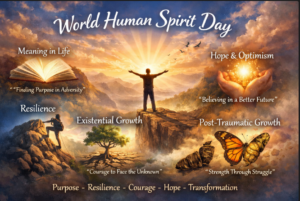
World Human Spirit Day celebrates the strength, dignity, and resilience that allow human beings to endure hardship and still search for meaning, hope, and connection.
From a psychological perspective, the human spirit is not a mystical idea alone — it is reflected in our ability to cope, adapt, grow, and find purpose even in suffering.
Modern psychology links the human spirit with:
- Meaning in life
- Resilience
- Hope and optimism
- Existential awareness
- Post-traumatic growth
This day is therefore deeply connected with mental health, coping, and psychological strength.
1. Meaning in Life: The Core of Human Spirit
One of the strongest psychological interpretations of the human spirit comes from Viktor Frankl, founder of Logotherapy.
Frankl’s Theory of Meaning
Frankl believed:
Human beings can survive almost any suffering if they find meaning in it.
According to Logotherapy, people find meaning through:
- Creative values – what we give to the world (work, service)
- Experiential values – what we receive (love, beauty, relationships)
- Attitudinal values – how we respond to suffering
This explains why some individuals remain psychologically strong even in illness, poverty, or trauma — their sense of purpose sustains the human spirit.
Research shows that meaning in life is linked to:
- Lower depression
- Greater life satisfaction
- Better coping during crisis
2. Resilience: Psychological Strength of the Spirit
Resilience is the capacity to recover from adversity.
It represents the functional expression of the human spirit.
Resilience Theory
Psychologists define resilience as:
Positive adaptation despite significant adversity.
Key protective factors:
- Secure attachment relationships
- Emotional regulation skills
- Social support
- Sense of control
- Future hope
Developmental Perspective
Research in Ann Masten described resilience as:
“Ordinary magic” — meaning resilience is not rare; it comes from normal human adaptive systems.
This supports the idea that the human spirit is not supernatural, but rooted in our biological, social, and psychological design.
3. Existential Psychology: Freedom, Responsibility, and Growth
Existential psychologists argue that the human spirit emerges when people confront life’s deepest realities:
- Death
- Isolation
- Freedom
- Meaninglessness
Existential Theory
Thinkers like Rollo May and Irvin Yalom proposed that:
Psychological growth occurs when individuals face existential anxiety rather than avoid it.
Facing life’s uncertainties can lead to:
- Authentic living
- Self-awareness
- Value-driven choices
- Psychological maturity
Thus, the human spirit is seen as the courage to live meaningfully despite uncertainty.
4. Optimism and Hope: The Cognitive Side of the Spirit
Positive psychology views the human spirit through hope and optimism.
Learned Optimism Theory
Psychologist Martin Seligman showed that people differ in their explanatory styles:
- Optimists view problems as temporary and specific
- Pessimists see them as permanent and global
Optimism predicts:
- Better mental health
- Lower stress response
- Higher achievement
- Stronger coping in illness
Hope Theory
According to Charles Snyder:
Hope has two components:
- Agency – belief that goals can be achieved
- Pathways – ability to generate solutions
Hope fuels perseverance — a core element of the human spirit.
5. Post-Traumatic Growth: When the Spirit Expands After Pain
Psychology now recognises that people may grow after trauma.
Post-Traumatic Growth Theory
Developed by Richard Tedeschi and Lawrence Calhoun, it suggests that adversity can lead to:
- Stronger relationships
- Deeper appreciation of life
- Spiritual growth
- New possibilities
- Greater personal strength
This shows that the human spirit does not only survive trauma — it may transform through it.
Conclusion
World Human Spirit Day reminds us that psychological strength lies not in avoiding suffering, but in responding to it with meaning, courage, hope, and connection.
From Frankl’s search for meaning to modern resilience research, psychology confirms:
The human spirit is the capacity to find purpose, remain hopeful, and continue growing — even in the face of adversity.
This day encourages us to nurture:
- Purpose
- Emotional resilience
- Supportive relationships
- Hopeful thinking
- Self-awareness
Because strengthening the human spirit ultimately strengthens mental health.
FAQ: World Human Spirit Day (Psychological Perspective)
1. What is World Human Spirit Day?
World Human Spirit Day is observed to celebrate human resilience, dignity, inner strength, and the ability to grow despite adversity.
2. How is the human spirit defined in psychology?
In psychology, the human spirit refers to the capacity for meaning-making, resilience, hope, and psychological growth.
3. Why is meaning in life important for mental health?
A sense of purpose is linked with lower depression, better coping skills, and higher life satisfaction.
4. Which psychologist focused on meaning in life?
Viktor Frankl developed Logotherapy, which states that humans are motivated by a search for meaning.
5. What is Logotherapy?
Logotherapy is a therapeutic approach that helps individuals find purpose in life, even during suffering.
6. What is resilience in psychology?
Resilience is the ability to adapt positively and recover from stress, trauma, or life challenges.
7. Can resilience be learned?
Yes. Resilience can be developed through emotional regulation, supportive relationships, problem-solving skills, and positive thinking.
8. What is existential psychology?
Existential psychology focuses on human freedom, responsibility, death awareness, and the search for meaning.
9. How does optimism affect mental health?
Optimism reduces stress, improves coping, strengthens motivation, and is associated with better physical and mental health.
10. What is learned optimism?
Learned optimism is the idea that people can train themselves to think more positively about setbacks.
11. What is Hope Theory?
Hope Theory explains that hope comes from goal motivation (agency) and the ability to find pathways to reach goals.
12. What is post-traumatic growth?
Post-traumatic growth refers to positive psychological changes that occur after trauma, such as stronger relationships and deeper life appreciation.
13. Why is World Human Spirit Day relevant to mental health awareness?
Because it highlights coping, emotional strength, purpose, and growth — all central themes in psychological well-being.
14. How can individuals nurture their human spirit?
By building meaning, maintaining relationships, practicing gratitude, setting goals, and developing emotional resilience.
15. How can counsellors use this day in awareness programs?
They can organize workshops, psychoeducation sessions, resilience training, storytelling events, and meaning-focused therapeutic discussions.
Written by Baishakhi Das
Counselor | Mental Health Practitioner
B.Sc, M.Sc, PG Diploma in Counseling
Reference
-
Viktor Frankl – Man’s Search for Meaning
https://www.goodreads.com/book/show/4069.Man_s_Search_for_Meaning -
American Psychological Association – Resilience
https://www.apa.org/topics/resilience -
Positive Psychology Center (University of Pennsylvania)
https://ppc.sas.upenn.edu -
Snyder’s Hope Theory overview
https://positivepsychology.com/hope-theory -
Post-Traumatic Growth Research Group
https://ptgi.uncc.edu -
Meaning in Life research review
https://www.frontiersin.org/articles/10.3389/fpsyg.2018.01563/full - Food–Mood Connection: How What You Eat Affects How You Feel
This topic performs well due to rising searches around men’s mental health, workplace stress, and burnout recovery. Combining emotional insight with practical steps increases engagement and trust.