

You finally sit down. The work is paused. Your body asks for stillness.
And then—guilt arrives.
It doesn’t come loudly. It creepily creeps in being nearly responsible, like it is being motivated. A tightness in your chest. A restlessness in your hands. There is a faint desire to look into your phone, organize something, be useful once again.
There is a hushed voice that says: You ought to be doing something.
Another says: you have not yet deserved this.
Soon rest ceases to be a care, and begins to be an error.
You look through to-do lists that cannot be seen. Your flesh does not permit to rest. You even stand up in stillness–you are stiffening–you are waiting to be judged–you are waiting.
This is not a personal vice of guilt. It’s learned.
It was taught when rest was disregarded, discouraged or only permitted when fatigued. Where productivity equaled acceptance and slacking equaled lagging. Your nervous system eventually internalized a belief: you should not rest unless you have a reason to.
And then when you stop, your body will feel as though you are violating some unspoken rule. The guilt does not lie in the fact that you are lazy but rather because you were trained to associate the value with performance.
Rest didn’t fail you.
You have been taught to distrust it.
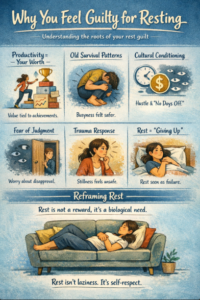
1. Productivity Was Tied to Your Worth
Most of us grew up in such circumstances where we received praise only when we have achieved something, rather than when we are present. Love was conditional-it was when you did something right, acted like an adult and when you met expectations. Useful, responsible, capable, you were appreciated. Being there, lying down, or being a patient hardly ever received equal warmth.
It was the results that made Rest popular.
Gradually, mute, your system was taking a lesson it still studies to-day:
When I fail to be productive, then I am not safe. Provided that I am not performing, I am not appreciated.
This was not a belief that had been developed through logic, it was developed through repetition. By taking chances when doing more resulted in less criticism. When being fatigued was rejected. When it became dangerous to slow down since it could result in disappointment, withdrawal, or shame.
And this way, you no longer sleep knowing that it is something safe to your body.
It interprets it as danger.
Your heart races. Your mind searches for tasks. Guilt is raised, not that rest is evil, but that inertia is against the survival tactic that used to serve your defense.
And it is not a malfunctioning of your body.
It’s remembering.
2. Rest Triggers Old Survival Patterns
To individuals, who had grown up in changeable or emotionally taxing conditions, being busy was not a choice, it was a means to survive. Being busy implied having to be on the alert. Acting in a certain way; in any way, it gave some degree of control over the circumstances where not much could be controlled. Movement meant vigilance. Busyness meant readiness.
In such places, it may feel unsafe to slack. There was tension left by silence. Silentness increased the intensity of feelings. Thus the body got used to being in a state of motion, as motion was more comfortable than rest.
Rest removes distraction.
It deprives it of the doing it is always doing that keeps deeper feelings at bay.
And in case the body eventually slows down what has been put on hold finally starts to emerge, grief, fear, anger, loneliness, unmet needs.
That is why rest may seem oppressive rather than relaxing.
Conscience usually comes to the rescue in the form of guilt. It draws you out of doing nothing, back to familiarity. Higher is the fear which lurks beneath that guilt:
When I take a break, something will overtake me.
A memory. A feeling. One thing you did not even have room to withhold at the time.
Your body is not against taking rest the reason is that it is not broken.
It is fighting against it because rest used to imply exposure-unsafely.
3. Capitalism Trained You to Ignore Your Body
Our culture is the one which glorifies fatigue. Hustle is praised. Burnout is the trophy of pride. Busyness is synonymous with importance, commitments, worthiness. Rest, however, is treated with suspicion, which can only be permitted in case it can be justified, optimized, or transformed into a better productivity in the future.
This framing silently redefines our relationship with ourselves.
It teaches a folly involving danger:
your body is no guide, but a hindrance.
There was something to get at, to conquer, to smother.
Fatigue becomes weakness. To make it slow is to make failures. Listening to the end is like running in a race which has no finish line.
And when your body wants to rest, with its heaviness and headaches, loss of concentration, emotional bombardment, your mind does not listen to it and say it is wisdom. It hears it as a flaw. And it responds with shame.
You say yourself that you ought to be stronger. More disciplined. More motivated. You overrule the signal and not respect it.
But it is your body that is betraying you.
It’s communicating.
And the embarrassment you experience is not an indication that you are doing something wrong, it is rather a sign of a culture that trained you to feel distrust of your needs.
4. You Learned to Anticipate Judgment
Most people sleep even when nobody is around just in case someone may come in and frown on them. Your muscles remain half-corded, your brain on the alert, as though you had to protect your sleep at any hour. You are not entirely at ease you keep watch of yourself.
This is internalized policing.
After some time, the voices of parents, teachers, bosses, and the society move in. You have no longer to rely on external pressure; it is in you. Before it occurs, you expect to be judged. You put yourself in the right beforehand. You hurry your sleep, excuse it or make it take a pass.
In a sense even solitude is performative, something that you can only do under specific circumstances.
It is not really the guilt over rest.
It concerns the perceived outcomes of being caught taking a break.
Being labeled lazy. Irresponsible. Ungrateful. Falling behind. Losing approval. Losing worth.
Your nervous system got to know that visibility and rest is the same as risk. So the guilt comes in and tells you to go back into the world of productivity where you are safe being approved.
Nothing is wrong with you.
You are reacting to rules which have been written when you were still young.
5. Rest Feels Unsafe When You’re Trauma-Conditioned
Controlled nervous system will enable rest to be nourishing. Stillness is a feeling of ease in that state. The body is able to relax without fear and the rest does not disturb but invigorates.
The manifestation of dysregulated nervous system stillness is extremely different. Having clustering to be formed by a chronic stress, unpredictability or emotional danger, calm does not feel safe, it feels alien. And unaccustomed, to the nervous system, is often dangerous.
Rest may be very uncomfortable in case you use your system to fight, fly or freeze. The quiet is too loud. It is the slackening that is exposing. Your body will remain on edge anticipating the next thing that will go wrong.
Guilt comes in to play in such situations as a form of coping. It creates urgency. It starts you again into action, into action, into habits of doing, into habits of acting, which even when they are wearying are familiar. Motion is safer than inactivity since it is the way your nervous system is accustomed to.
This is not a deficiency in discipline or attentiveness.
It is a nervous system doing just what it had been trained to do to survive.
Not by trying to make yourself relax does Rest become healing; but gradually by degrees your body is learning that motion is not again a threat.
6. You Confuse Rest with Giving Up
Most individuals assume that rest involves ceasing to be- no longer to move forward, to become out-of-shape, to become so old-fashioned or obsolete. Rest becomes confused when he starts giving up and assumes that slowing down entails that one will never get going again.
But rest is not quitting.
It’s repair.
It is rest that enables the stretched muscles, overstrained minds and exhausted nervous systems to adjust. It is not the contrary of effort, but it is that which makes effort possible.
Effort is gradually consumed without rest. You continue, yet more blurred, less tolerant, less good. What once was meaningful becomes encumbrant. Burnout does not come in one moment, it comes gradually in the lack of rest.
Through rest, labor becomes long-term. You come back with greater capacity not by having forcibly imposed yourself but by having given yourself rest. Creativity resurfaces. Focus sharpens. Motivation is not pressurizing but rather a choice.
Rest does not deprive you of something.
It returns to you all that constant doing wears.
By resting you do not end up behind.
You disintegrate by never giving up.
Reframing Rest
You do not work to get rest.
Neither is a reward after surviving or work.
Is a biological need, and as fundamental as breathing, hydration, and safety.
There is no need to have your body take leave. It does not ask you to demonstrate that you have done enough, toiled enough, and donated enough. The fact that one needs a rest is not a sign of moral incompetence, it is a physiological indicator.
You do not have to explain it to someone.
No need to tell you why you are tired.
You do not have to make rest out of self-improvement or efficiency.
Nor do you at all have to be entirely shattered to have a right to it.
You can only learn that it is too late to take care of your body. It is gentleness, consistent, which makes one strong, not weak, which Rest has proposed before.
You may have a break with no excuse.
Granted the liberty to be pitifully tired.
Rest is not indulgence.
It is the self-respect in its most elementary form.
A Gentle Reminder
Feeling guilty about taking a break does not imply that you do not have discipline and motivation. It implies that you were conditioned, either directly or indirectly, to disown yourself so that you can fit in. To conquer your needs, forget about your constriction and continue running even when your body wanted you to quit.
You had heard that the approval was gained by forcing through. That care was conditional. The reason of such pausing must have been.
The process of healing commences with breaking the pattern.
When you can afford to rest–no excuse, no reasons, no conversion of rest to productive employment. When you stick with the pain to demonstrate to your body that nothing horrible occurs when you pursue yourself.
This is not easy work. It is contrary to years of conditioning. However, at every moment of permitted rest the message which your nervous system carries is rewritten.
Because rest isn’t laziness.
It isn’t weakness.
Isn’t it failure.
Rest is self-respect.
Frequently Asked Questions (FAQ)
1. Why do I feel guilty where I know I have to have rest?
Guilt is learnt, not logical. The nervous system of your body can possibly relate rest to danger, judgment, or losing value because of earlier conditioning.
2. Does being guilty of resting make one lazy?
No. Laziness is more of a moral than a psychological diagnosis. Guilt around rest tends to be an indication of chronic stress, trauma conditioning, or self-worth that is based on productivity.
3. Would childhood experiences have any implication on my rest as an adult?
Yes. Childhood experiences define brain reaction. In case of insecurity, lack of attention, or disapproval, even though you were not resting, your body can still have a response of protection by remaining still.
4. And why sometimes will rest make me anxious?
Rest removes distractions. When the body goes slow, they can bring forward repressed emotions and thoughts causing anxiety rather than relief.
5. What does being internalized surveillance mean?
It is when the outer authority (parents, teachers, bosses, society) is internalized. You spy and evaluate yourself even in the absence of a person.
6. What does the hustle culture do to rest guilt?
Hustle culture puts the value of productivity equal to the value of worth and makes burnout a matter of course that people should learn to view rest as a sign of weakness unless it increases output.
7. Do you really need rest to be mentally healthy?
Yes. The nervous system, emotional processing, cognitive enhancement, burnout and depression prevention are under the control of Rest.
8. Why do I not feel safe in my immobility?
An unregulated nervous system can perceive calmness as a new experience. Stillness may be an intimidator in case of your body is trained to fight, fly or freeze.
9. Is guilt a coping mechanism?
Often, yes. The feeling of guilt may force you to resume doing what you are doing because of emotional exposure, uncertainty and the old memories that are awakened when you take a break.
10. Will taking a break make me demotivated and undisciplined?
No. Rest is a proponent of sustainable motivation. Devoid of rest, discipline becomes depletion and burnout.
11. What is the difference between rest and avoidance?
Rest is deliberate recovery. Avoidance is the evading of responsibility. Trauma-informed rest restores the capacity and not diminishes it.
12. Is it possible to treat rest guilt without treatment?
Others are able to do so through awareness, practices of regulating the nervous system and through self-compassion. This process can be fastened and intensified with the help of therapy.
13. What does rest find to be safer?
Start small. Pausing, grounding activities, routine habits, and self- affirming self-talk re-train the nervous system.
14. How come I need to earn my rest?
Since most systems are encouraging performance, and not humanity. You had been taught that rest must be justified and not as a need to be respected.
15. What is my main point which I should keep in mind?
Rest is not a reward.
Is not laziness.
Rest is self-respect.
Written by Baishakhi Das
Counselor | Mental Health Practitioner
B.Sc, M.Sc, PG Diploma in Counseling
References
-
van der Kolk, B. – The Body Keeps the Score
https://www.besselvanderkolk.com/resources/the-body-keeps-the-score -
Polyvagal Theory (Stephen Porges) – Nervous system regulation
https://www.polyvagalinstitute.org -
American Psychological Association (APA) – Stress & burnout
https://www.apa.org/topics/stress -
World Health Organization (WHO) – Burnout as an occupational phenomenon
https://www.who.int/news/item/28-05-2019-burn-out-an-occupational-phenomenon -
Tricia Hersey (The Nap Ministry) – Rest as resistance
https://thenapministry.com -
Cleveland Clinic – Effects of chronic stress on the body
https://health.clevelandclinic.org/effects-of-stress-on-the-body - Procrastination Nobody Talks About
This topic performs well due to rising searches around men’s mental health, workplace stress, and burnout recovery. Combining emotional insight with practical steps increases engagement and trust.