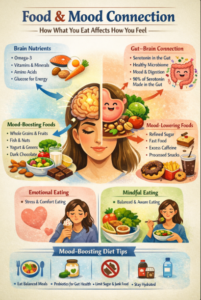
Food–Mood Connection: How What You Eat Affects How You Feel

We often think of food as fuel for the body, something that keeps us physically active and healthy. However, food is not only nourishment for muscles and organs — it is also essential for the brain and emotional well-being. The food–mood connection refers to the powerful relationship between what we eat and how we feel, think, and respond to stress in our daily lives.

In recent years, scientific research in nutrition, psychology, and neuroscience has increasingly shown that diet plays a significant role in mental health. Nutrients from food help regulate brain chemistry, influence hormones, and support the production of neurotransmitters that control mood, sleep, motivation, and concentration. This means that our daily food choices can affect not only our physical energy but also our emotional stability, resilience, and cognitive functioning.

Many traditional cultures have long believed that food affects the mind as well as the body. Today, modern science supports this idea, showing that unhealthy eating patterns may contribute to fatigue, irritability, anxiety, and low mood, while balanced nutrition can support emotional balance, stress tolerance, and overall psychological well-being. In this way, food becomes more than a biological need — it becomes an important tool for mental health care.

1. The Brain Runs on Nutrients

Your brain is an organ that requires continuous nourishment to function effectively. It works 24/7, controlling thoughts, emotions, memory, and behaviour. To maintain mental clarity and emotional balance, the brain depends on several essential nutrients.

1. Glucose for Daily Energy

Glucose is the brain’s main fuel source.

In daily life this means:

  • Skipping breakfast → feeling weak, dizzy, or unable to focus
  • Long gaps between meals → sudden irritability or headache
  • Balanced meals → steady energy and better productivity

2. Amino Acids for Mood Chemicals

Proteins provide amino acids that help produce neurotransmitters such as serotonin, dopamine, and GABA.

In daily life this shows up as:

  • Low protein intake → low motivation, poor mood regulation
  • Balanced protein meals → better emotional control and alertness
  • Students or workers may notice improved focus after protein-rich meals

3. Fatty Acids for Brain Cell Health

Healthy fats, especially omega-3 fatty acids, help build brain cells and support emotional regulation.

In daily life this affects:

  • Diets very low in healthy fats → poor concentration, mood swings
  • Regular intake of nuts, seeds, or fish → improved memory and calmness
  • People under stress often cope better with adequate healthy fats

4. Vitamins and Minerals for Mental Balance

Micronutrients such as B-vitamins, iron, magnesium, and zinc help regulate mood chemicals and nerve functioning.

In daily life this may appear as:

  • Iron deficiency → tiredness, low mood, lack of motivation
  • Low B-vitamins → forgetfulness or mental exhaustion
  • Proper nutrition → sharper thinking and emotional stability

What Happens When the Brain Lacks Nutrients?

When the body does not receive proper nourishment, the brain struggles to function efficiently. This may lead to:

  • Fatigue → feeling tired even after rest
  • Irritability → reacting quickly or feeling emotionally sensitive
  • Brain fog → difficulty thinking clearly or remembering things
  • Low mood → reduced motivation or interest in daily activities
  • Poor concentration → trouble focusing at work, study, or conversations

In everyday life, these symptoms often get blamed on stress or workload, but nutrition plays a major hidden role. Regular balanced meals can significantly improve mental clarity, emotional stability, and overall functioning.

2. Neurotransmitters and Food

Mood is largely controlled by neurotransmitters such as:

  • Serotonin – regulates happiness, calmness, sleep
  • Dopamine – linked to motivation and pleasure
  • GABA – helps reduce anxiety
  • Norepinephrine – affects alertness and focus

These chemicals are made from nutrients found in food.

For example:

  • Tryptophan (from milk, nuts, seeds) → helps produce serotonin
  • Protein (eggs, lentils, fish) → supports dopamine production
  • Omega-3 fatty acids → improve emotional regulation

This means diet directly affects emotional balance.

3. The Gut–Brain Connection

The gut and brain communicate through the gut–brain axis.
The gut contains trillions of bacteria, called the microbiome, which influence:

  • Mood
  • Stress levels
  • Inflammation
  • Cognitive function

In fact, nearly 90% of serotonin is produced in the gut.

Foods that support gut health:

  • Yogurt and fermented foods
  • Fruits and vegetables
  • Whole grains
  • Fiber-rich foods

When gut health is poor, people may experience:

  • Anxiety
  • Low mood
  • Poor sleep
  • Digestive discomfort

4. How Different Foods Affect Mood

Mood-Boosting Foods

These help stabilize emotions and energy:

  • Whole grains → steady glucose supply
  • Fruits and vegetables → antioxidants reduce brain stress
  • Nuts and seeds → healthy fats for brain cells
  • Fish → omega-3 reduces depression risk
  • Dark chocolate → improves serotonin and endorphins

Mood-Lowering Foods

These may worsen emotional stability:

  • Refined sugar → causes energy crashes and irritability
  • Ultra-processed foods → linked with higher depression risk
  • Excess caffeine → increases anxiety and restlessness
  • Skipping meals → leads to mood swings and poor focus

5. Emotional Eating vs. Mindful Eating

Many people use food to cope with emotions such as stress, loneliness, or boredom. This is known as emotional eating.

While it gives temporary comfort, it often leads to:

  • Guilt
  • Poor digestion
  • Energy crashes
  • Weight concerns

In contrast, mindful eating means:

  • Eating slowly
  • Noticing hunger cues
  • Choosing foods that nourish body and mind
  • Understanding emotional triggers

This approach improves both physical and psychological well-being.

6. Practical Tips to Improve Mood Through Food

  • Eat balanced meals (carbs + protein + healthy fats)
  • Do not skip breakfast
  •  Stay hydrated
  •  Include fermented foods for gut health
  •  Reduce refined sugar and junk food
  •  Eat at regular times
  •  Pay attention to how food affects your emotions

Conclusion

Food is more than nutrition — it is a psychological tool. A balanced diet supports emotional regulation, improves brain chemistry, and strengthens resilience against stress. While food alone cannot treat mental illness, it plays a powerful role in overall mental well-being.

Taking care of what you eat is, in many ways, taking care of how you feel.

FAQs: Food–Mood Connection

1. Can food really affect mental health?

Yes. Nutrients influence brain chemistry, neurotransmitter production, and inflammation levels, all of which affect mood and emotional stability.


2. Which foods help improve mood naturally?

Foods rich in omega-3s, whole grains, fruits, vegetables, nuts, seeds, and fermented foods support emotional balance and brain health.


3. Can skipping meals affect mood?

Yes. Skipping meals can cause low blood sugar, leading to irritability, fatigue, poor concentration, and mood swings.


4. Is there a link between sugar and anxiety?

High sugar intake may cause rapid energy spikes and crashes, which can increase restlessness, irritability, and anxiety-like symptoms.


5. Does caffeine influence mood?

Moderate caffeine may improve alertness, but excess intake can increase anxiety, sleep problems, and emotional instability.


6. How does gut health affect mental health?

The gut produces many neurotransmitters, including serotonin. Poor gut health is linked with stress sensitivity, anxiety, and low mood.


7. Can diet help with depression?

A healthy diet alone cannot replace treatment, but balanced nutrition can support brain function and improve overall emotional well-being.


8. What nutrients are most important for mental health?

Omega-3 fatty acids, B-vitamins, iron, magnesium, zinc, protein, and fiber are particularly important for brain and emotional health.


9. Can dehydration affect mood?

Yes. Even mild dehydration may cause fatigue, headaches, poor focus, and irritability.


10. Is emotional eating harmful?

Occasional comfort eating is normal, but frequent emotional eating may lead to guilt, weight issues, and unstable energy levels.


11. Does breakfast really matter for mood?

Yes. A balanced breakfast helps stabilize glucose levels, improving attention, patience, and emotional regulation during the day.


12. Can children’s behaviour be influenced by diet?

Yes. Nutritional deficiencies and high sugar intake may affect attention, energy levels, and emotional control in children.


13. How long does it take for diet changes to affect mood?

Some effects, like stable energy, may appear within days, while long-term mood improvement may take weeks of consistent healthy eating.


14. Are processed foods linked to mental health problems?

Research suggests that diets high in ultra-processed foods are associated with higher risk of depression, inflammation, and low energy.


15. What is one simple step to improve the food–mood connection?

Start by eating regular balanced meals with protein, whole grains, and vegetables to stabilize energy and support brain function.

Written by Baishakhi Das

Counselor | Mental Health Practitioner
B.Sc, M.Sc, PG Diploma in Counseling


Reference

  1. Harvard Health Publishing
    https://www.health.harvard.edu
    (Articles on diet, brain health, and mood)

  2. World Health Organization – Nutrition & Mental Health
    https://www.who.int

  3. American Psychological Association – Nutrition & Mental Health
    https://www.apa.org

  4. National Institute of Mental Health (NIMH)
    https://www.nimh.nih.gov

  5. Frontiers in Nutrition Journal (Diet and Depression research)
    https://www.frontiersin.org/journals/nutrition

  6. The Lancet Psychiatry – Food and Mental Health Studies
    https://www.thelancet.com/psychiatry

  7. Gut–Brain Axis Research Overview (Nature Reviews Gastroenterology)
    https://www.nature.com

  8. Importance of Secure Attachment in Childhood

This topic performs well due to rising searches around men’s mental health, workplace stress, and burnout recovery. Combining emotional insight with practical steps increases engagement and trust.
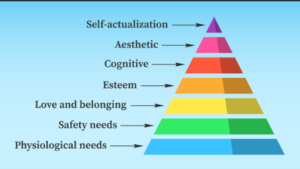
Maslow’s Hierarchy of Needs in Modern Life:

A Deep Psychological Perspective

Maslow’s Hierarchy of Needs is one of the most enduring frameworks in psychology. Proposed by Abraham Maslow, the theory explains what motivates human behavior—not through pathology or illness, but through human potential, growth, and meaning.

In modern life—marked by digital overload, economic uncertainty, social comparison, and emotional burnout—Maslow’s theory feels more relevant than ever. However, the way these needs are met today looks very different from Maslow’s original context.

This article explores each level of Maslow’s hierarchy, how it appears in contemporary life, and why unmet needs often show up as stress, anxiety, relationship issues, and emotional exhaustion.


Understanding Maslow’s Hierarchy of Needs

Maslow proposed that human needs are organized in a hierarchical structure, often represented as a pyramid. According to the theory:

  • Lower-level needs must be reasonably satisfied before higher-level needs become dominant

  • Human motivation is driven by unmet needs

  • Psychological health is not just the absence of illness, but the presence of growth

The five classic levels are:

  1. Physiological Needs

  2. Safety Needs

  3. Love and Belonging

  4. Esteem

  5. Self-Actualization

(Modern psychology also recognizes Self-Transcendence as an extension.)

1. Physiological Needs: Survival in a Fast-Paced World

Core needs

Food, water, sleep, shelter, rest, physical health

Expanded Modern-Life Reality

On the surface, many people appear to meet these needs. However, modern life often satisfies quantity but neglects quality.

People may have:

  • Food, but not nutritional balance

  • Shelter, but not restful sleep

  • Medical access, but not preventive care

  • Beds, but not true rest

Late-night screen use, irregular work hours, financial stress, and constant mental stimulation keep the nervous system in a state of physiological overdrive. The body remains alert when it should be restoring.

Many individuals normalize exhaustion, headaches, gut issues, hormonal imbalance, and chronic pain—treating them as “part of life” rather than warning signals.

Expanded Psychological Impact

When physiological needs are compromised:

  • The brain’s emotional regulation system weakens

  • Stress tolerance drops sharply

  • Small problems feel overwhelming

  • Anxiety intensifies because the nervous system lacks stability

  • Concentration, memory, and decision-making decline

From a therapeutic perspective, psychological insight cannot integrate into a dysregulated body. Talk therapy, motivation techniques, and self-help strategies often fail because the foundation—biological stability—is missing.

💡 Many symptoms labeled as “mental illness” reduce significantly when sleep cycles, nutrition, hydration, and rest are restored consistently.

2. Safety Needs: Emotional and Psychological Security Today

Core needs

Physical safety, financial security, health stability, predictability

Expanded Modern-Life Reality

Unlike earlier eras, danger today is often chronic, invisible, and psychological rather than immediate or physical.

Modern insecurity comes from:

  • Unstable employment and income uncertainty

  • Rising healthcare costs and fear of illness

  • Relationship unpredictability and emotional inconsistency

  • Constant exposure to distressing global news

  • Unresolved childhood trauma resurfacing under adult stress

Even when life appears “stable,” the body may not feel safe. For many adults, early experiences of neglect, abuse, or chaos create a permanent internal alarm system.

Expanded Psychological Impact

When safety needs are unmet, the nervous system remains in survival mode:

  • Generalized anxiety and constant worry emerge

  • Hypervigilance becomes normal

  • Control issues develop as a way to feel safe

  • Trust becomes difficult, even in healthy relationships

  • Emotional numbness replaces vulnerability as self-protection

🔍 Clinically, many high-functioning individuals are unknowingly stuck at the safety level, chasing success or relationships while their nervous system is still focused on survival, not growth.

3. Love and Belonging: Connection in the Age of Isolation

Core needs

Love, affection, intimacy, friendship, belongingness

Expanded Modern-Life Reality

Modern society offers connection without closeness.

People may have:

  • Hundreds of contacts but no emotional safety

  • Online visibility but offline loneliness

  • Relationships based on roles, performance, or utility

  • Fear of vulnerability due to past attachment wounds

Many individuals learned early that love was conditional—earned through obedience, achievement, or emotional suppression. As adults, this translates into people-pleasing, fear of abandonment, or avoidance of intimacy.

Expanded Psychological Impact

When belonging needs are unmet:

  • Loneliness persists even in relationships

  • Depression deepens due to emotional isolation

  • Trauma bonds feel intense and “addictive”

  • Individuals tolerate disrespect to avoid being alone

  • Self-worth becomes externally regulated

❤️ From a healing perspective, humans are biologically wired to heal in safe connection. Emotional safety is not dependency—it is a core developmental need.

4. Esteem Needs: Self-Worth in a Comparison Culture

Core needs

Self-respect, confidence, recognition, competence, autonomy

Maslow distinguished between:

  • Internal esteem: self-worth, mastery, autonomy

  • External esteem: validation, praise, status

Expanded Modern-Life Reality

Today’s culture heavily prioritizes external esteem:

  • Likes, followers, visibility

  • Salary, productivity, titles

  • Achievement over authenticity

Social comparison has become constant and unavoidable. People are exposed to curated success stories without seeing effort, failure, or emotional cost.

Expanded Psychological Impact

When esteem needs are unmet or externally dependent:

  • Imposter syndrome becomes chronic

  • Perfectionism masks deep insecurity

  • Burnout develops from overcompensation

  • Fear of failure prevents exploration

  • Approval becomes addictive

⚠️ When self-worth depends entirely on external validation, emotional stability becomes fragile—rising and falling with feedback.

5. Self-Actualization: Becoming Who You Truly Are

Core needs

Purpose, creativity, authenticity, personal growth, meaning

Self-actualization is not about achievement—it is about alignment between inner values and outer life.

Expanded Modern-Life Reality

Many people appear successful but feel internally disconnected:

  • Careers chosen for security, not meaning

  • Creativity suppressed for approval

  • Identity shaped by expectations

  • A persistent sense of “something is missing”

This level is often blocked not by lack of ability, but by unresolved lower-level needs—especially safety, belonging, and esteem.

Expanded Psychological Impact

Blocked self-actualization often shows up as:

  • Existential anxiety

  • Midlife or identity crises

  • Emotional numbness despite comfort

  • Chronic dissatisfaction without clear cause

🌱 True self-actualization requires:

  • Emotional awareness and honesty

  • Healing unresolved trauma

  • Permission to be authentic

  • Autonomy and self-acceptance

  • Psychological safety to explore identity

Beyond Maslow: Self-Transcendence in Modern Psychology

Later in life, Maslow proposed Self-Transcendence—going beyond the self.

Examples include:

  • Service to others

  • Spiritual growth

  • Contribution to community

  • Legacy and meaning beyond personal gain

In modern therapy, this appears as:

  • Values-based living

  • Compassion-focused work

  • Purpose-driven careers

  • Healing not just for self, but for others

Why Maslow’s Theory Still Matters Today

Maslow’s hierarchy reminds us that:

  • Positive thinking cannot replace a lack of safety.
  • Emotional healing is impossible in a state of exhaustion.
  • Purpose cannot emerge in the absence of human connection.

Mental health struggles are often needs deficits, not personal failures.

Clinical Insight 

As a counselor, you may notice:

  • Anxiety clients often struggle with safety needs

  • Depressed clients often lack belonging or esteem

  • Burnout clients are blocked from self-actualization

  • Trauma survivors are stuck in survival mode

Effective healing requires meeting unmet needs—not just managing symptoms.

Final Reflection

Maslow’s Hierarchy of Needs is not outdated—it is misunderstood.

Modern life pushes people to chase the top of the pyramid while ignoring the foundation. True psychological well-being comes from alignment, safety, connection, self-worth, and meaning—in that order, and often repeatedly.

Healing is not about climbing the pyramid once.
It is about learning where you are—and giving yourself what you need.

Frequently Asked Questions (FAQ)

1. What is Maslow’s Hierarchy of Needs in simple terms?

Maslow’s Hierarchy of Needs explains human motivation as a progression of needs—from basic survival (food, sleep, safety) to higher psychological growth (self-esteem, purpose, self-actualization). People are motivated to meet unmet needs, starting from the most basic.


2. Is Maslow’s Hierarchy still relevant in modern life?

Yes. While lifestyles have changed, human needs have not. In modern life, unmet needs often appear as stress, anxiety, burnout, relationship issues, and emotional emptiness, making Maslow’s framework highly relevant for mental health and counseling.


3. Can higher needs be pursued without meeting basic needs?

Partially—but not sustainably. For example, someone may pursue success or relationships while lacking sleep or emotional safety, but this often leads to burnout, anxiety, or dissatisfaction. Long-term well-being requires a stable foundation.


4. How does Maslow’s theory relate to mental health problems?

Many mental health symptoms are not disorders but signals of unmet needs:

  • Anxiety → unmet safety needs

  • Depression → unmet belonging or esteem needs

  • Burnout → blocked self-actualization
    Therapy becomes more effective when these needs are addressed holistically.


5. What is self-actualization in real life?

Self-actualization means living in alignment with your values, abilities, and authentic self. It includes creativity, purpose, personal growth, and meaning—not perfection or constant happiness.


6. Why do people feel empty even after achieving success?

Because success without emotional safety, connection, and self-worth does not meet deeper psychological needs. This often reflects unmet belonging, esteem, or self-actualization needs.


7. How can therapy help with unmet needs?

Therapy helps identify where a person is stuck in the hierarchy, regulate the nervous system, heal past trauma, improve relationships, rebuild self-worth, and support purposeful living.

Written by Baishakhi Das

Counselor | Mental Health Practitioner
B.Sc, M.Sc, PG Diploma in Counseling


Reference

Abraham Maslow – Original theory
https://www.simplypsychology.org/maslow.html