
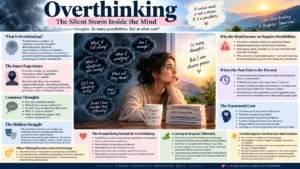
Overthinking: The Silent Storm Inside the Mind
Overthinking rarely announces itself. It often begins quietly—with a simple question, a small doubt, or a moment of uncertainty. Then one thought leads to another until the mind becomes trapped in endless analysis, worry, and imagined possibilities.
While everyone overthinks occasionally, persistent overthinking can become emotionally exhausting and interfere with decision-making, relationships, sleep, and everyday life. A person may appear calm on the outside while internally replaying conversations, questioning decisions, analyzing others’ behavior, and imagining what could go wrong.
The problem is not simply having many thoughts. It is becoming trapped inside them—searching for certainty in situations where certainty may not exist.
The Inner Experience of an Overthinker
From the outside, an overthinker may appear calm, responsible, thoughtful, and capable. They may carefully choose their words, anticipate problems, and consider how their actions might affect others.
Yet internally, the experience can be very different.
They may constantly question themselves, fear making mistakes, worry about disappointing others, or struggle to let go of past experiences. Even ordinary situations can become mentally exhausting when the mind keeps searching for something that might go wrong.
An overthinker may silently wonder:
- “Did I say something wrong?”
- “Why did they respond differently today?”
- “Should I have handled that differently?”
- “What if I make a mistake?”
- “What if something happens that I haven’t prepared for?”
The outside world may see composure, while the person internally experiences uncertainty and mental chaos.
That is what makes overthinking so difficult to recognize. There may be no visible sign of distress. The person continues working, talking, smiling, socializing, and fulfilling their responsibilities—all while carrying an internal conversation that no one else can hear.
When Thinking Becomes a Survival Strategy
The human mind is naturally designed to anticipate problems. Imagining consequences, learning from past experiences, and preparing for future challenges are essential parts of functioning.
The difficulty begins when this protective ability becomes excessive. Instead of preparing for a realistic problem, the mind may begin generating one hypothetical threat after another. A possibility starts to feel like a probability, and eventually, that probability can feel like a certainty.
This can turn overthinking into a self-perpetuating cycle. Uncertainty triggers more thinking. More thinking creates more possibilities. More possibilities create even greater uncertainty, which then fuels even more thinking. In this way, thinking becomes an attempt to create safety.
A person may believe, consciously or unconsciously, that if they analyze every detail carefully enough, they can prevent pain, rejection, failure, embarrassment, or loss. Yet the more they try to control uncertainty through thought, the more uncertain they may ultimately feel.
The Emotional Cost of Overthinking
Persistent overthinking can gradually change the way a person experiences everyday life. Even moments that should feel peaceful may be interrupted by thoughts about what could happen next. Positive experiences can also become difficult to fully enjoy when part of the mind remains focused on the possibility of losing them.
- While some laugh, they still worry.
- People may love, but fear losing.
- They may succeed, but immediately wonder whether it was enough.
- They may make a decision, only to question it again later.
Over time, this constant mental activity can lead to emotional exhaustion. Confidence may gradually weaken because every decision is repeatedly questioned, while peace of mind becomes harder to access because the mind is always searching for something that needs to be solved.
A painful cycle can develop:
- The more you think, the less you trust yourself.
- The less you trust yourself, the more you think.
Eventually, a person may begin to believe that thinking is safer than acting—because action carries uncertainty, while thinking creates the illusion of control.
But endless thinking does not always create safety. Sometimes, it simply keeps a person from moving forward.
Why Does the Mind Keep Returning to Negative Possibilities?
One reason overthinking can become so negative is that the human mind is highly sensitive to potential threats. Negative experiences often demand more attention because they may contain information that could help us avoid similar experiences in the future.
This tendency can become stronger after psychological trauma, chronic stress, or repeated experiences of rejection, criticism, betrayal, or loss. When a person has experienced something painful in the past, the mind may become more alert to signs that a similar experience could happen again. In this sense, overthinking can sometimes function as an attempt to anticipate danger before it arrives.
As a result, a single criticism may occupy the mind for hours, even when a person has received several positive comments that same day. One awkward conversation may be replayed repeatedly, while dozens of ordinary conversations are quickly forgotten. One possibility of failure may feel more significant than many possibilities of success.
For someone with a history of difficult experiences, the mind may repeatedly scan for what could go wrong. A delayed message, a change in someone’s tone, or a small mistake may be interpreted as a possible warning sign—not necessarily because danger is actually present, but because the brain has learned that being prepared may feel safer than being surprised.
This can create a hypervigilant pattern, in which the person remains mentally alert for possible threats even when the immediate environment is relatively safe.
The mind is, in a sense, saying: “If I notice the danger early enough, perhaps I can prevent the pain this time.”
The intention may be protective. The result, however, can be exhausting.
What once helped the person cope with uncertainty may eventually keep them trapped in it. The mind continues scanning, predicting, and analyzing—not because the person wants to suffer, but because some part of them has learned that constant vigilance feels safer than letting their guard down.
When the Past Enters the Present
Sometimes, the situation that triggers overthinking is not the true source of the emotional reaction. Instead, something happening in the present may activate emotions, memories, or fears connected to the past.
A delayed message may seem like a small event, yet it can create intense worry in someone who has previously experienced rejection, abandonment, or relational loss. Similarly, a minor mistake at work may feel overwhelming to someone who has learned to associate mistakes with criticism, humiliation, or failure.
This can be especially noticeable after psychological trauma or prolonged emotional stress. When painful experiences have taught the mind to expect danger, it may become highly alert to anything that resembles the past. A change in someone’s tone, a period of silence, or an uncertain situation can therefore feel more threatening than it objectively is.
In such moments, the present may become a doorway to the past. This is why overthinking is sometimes less about what is happening now and more about what the person is afraid might happen again.
- A person may not simply be asking: “What does this situation mean?”
- At a deeper level, they may be asking: “Am I about to experience that pain again?”
Recognizing this distinction can create a more compassionate understanding of overthinking. Instead of criticizing ourselves for thinking too much, we can begin asking what the mind is trying to protect us from.
Sometimes, beneath the endless questions, there is an old fear quietly saying: “I don’t want to be hurt like that again.”
The Human Being Behind the Overthinking
People who overthink are often described as anxious, indecisive, overly sensitive, or difficult to reassure. However, these labels can easily reduce a complex psychological pattern to a personality flaw. Behind the overthinking is a person.
They may be deeply caring and thoughtful. They may carefully choose their words because they do not want to hurt others. They may replay conversations because relationships matter to them. They may consider every possible outcome because they genuinely want to make responsible decisions.
The problem is not that these qualities are negative. It is what happens when they become excessive.
- Care can become excessive worry.
- Responsibility can become perfectionism.
- Self-reflection can become self-criticism.
- Planning can become an endless search for certainty.
In some cases, these patterns may also develop as ways of coping with past emotional experiences, chronic stress, or psychological trauma. What once helped a person feel prepared or protected can gradually become a source of mental exhaustion.
Therefore, the goal is not to eliminate thinking. Thinking is an essential human ability. The goal is to recognize when useful reflection has crossed the line into repetitive mental rumination—and to learn how to step out of that cycle.
Learning to Respond Differently
Changing the pattern of overthinking does not begin with forcing the mind to become completely quiet. In fact, trying to suppress every unwanted thought can sometimes make us more aware of it. A more helpful starting point is learning to notice what the mind is doing without immediately accepting every thought as true.
When we are caught in overthinking, thoughts can feel surprisingly convincing. A possibility can begin to feel like a prediction, an assumption can feel like a fact, and uncertainty can feel like a warning that something is wrong. However, having a thought does not mean that the thought accurately reflects reality.
This is where awareness becomes important. When the mind begins moving repeatedly through the same worry, we can pause and gently examine what is actually happening. What do I really know right now? What am I assuming? Is there something here that I can realistically solve, or am I trying to achieve a level of certainty that life cannot provide?
We can also ask ourselves what is within our control. Sometimes there is a practical action we can take, and taking that action is more useful than continuing to analyze the situation. At other times, there is nothing more to solve. The uncertainty simply has to be tolerated.
It can also be helpful to look beneath the surface of the thought and ask, “What am I afraid this situation means?” A concern about a delayed response, for example, may not actually be about the response itself. It may be connected to a deeper fear of rejection, failure, abandonment, or losing control.
These questions do not immediately remove difficult emotions. Their purpose is to create space between the thought and the reaction. Within that space, we have an opportunity to observe the thought rather than automatically follow it.
Over time, this can change our relationship with our own mind. We begin to understand that every thought does not require an answer, every possibility does not require preparation, and every uncertainty does not require immediate resolution.
The goal, therefore, is not to stop thinking. It is to learn when thinking is helping—and when it is keeping us trapped.
Overthinking Does Not Mean Your Mind Is Broken
Perhaps the most important thing an overthinker needs to understand is that their mind is not broken simply because it thinks deeply. The ability to analyze, anticipate, imagine, remember, and reflect is an important part of being human. These abilities can help us learn from experience, prepare for challenges, and make thoughtful decisions. The difficulty arises when the mind continues using them long after they have stopped being helpful.
Sometimes, an overactive mind is simply trying too hard to protect us. It keeps scanning for possible problems, predicting what might happen, preparing for what could go wrong, and returning again and again to the question, “What if?”
And beneath many of those questions may be a much simpler fear: “I don’t want to get hurt.”
Recognizing this does not mean accepting overthinking as something that must control your life. Instead, it allows us to look at the pattern with greater compassion. Rather than asking only, “Why can’t I stop thinking?”, we can begin asking a deeper question: “What is my mind trying to protect me from?”
That shift can change the way we understand ourselves. It moves us away from self-criticism and toward awareness. We begin to recognize that some thoughts are attempts to create safety, even when they ultimately leave us feeling more anxious and exhausted.
Healing does not necessarily begin when the mind becomes completely quiet. Sometimes, it begins when we understand that not every thought requires an answer, not every possibility requires preparation, and not every uncertainty is a threat.
The mind may continue to think. It may still ask questions, imagine possibilities, and occasionally return to old fears. But gradually, we can learn that we do not have to follow every thought. And perhaps that is where peace begins—not when the storm disappears completely, but when we learn that we can stand within it without being carried away.
Frequently Asked Questions About Overthinking
1. What is overthinking?
Overthinking is a pattern of repetitive thinking in which a person repeatedly analyzes situations, decisions, past experiences, or future possibilities without reaching a satisfying resolution. It often involves excessive worry, doubt, and a constant search for certainty.
2. Why do I overthink everything?
Overthinking can develop for many reasons, including fear of making mistakes, uncertainty, perfectionism, chronic stress, difficult past experiences, or a strong desire to prevent negative outcomes. In some cases, psychological trauma can also make the mind more alert to potential threats.
3. Is overthinking a sign of anxiety?
Overthinking can occur alongside anxiety, but they are not exactly the same thing. Anxiety involves emotional and physical responses to perceived threat, while overthinking refers more specifically to repetitive and often unproductive thinking. Persistent overthinking may, however, contribute to or intensify anxiety.
4. Can trauma cause overthinking?
Trauma can contribute to patterns of overthinking, particularly when past experiences have made a person more alert to possible danger. The mind may repeatedly analyze situations in an attempt to anticipate or prevent similar pain in the future. However, not all overthinking is caused by trauma.
5. Why does my mind focus more on negative thoughts?
The human mind is naturally sensitive to potential threats. Negative experiences may receive more attention because identifying danger can help us avoid it. After chronic stress or painful experiences, this tendency can become stronger, causing the mind to repeatedly scan for what might go wrong.
6. How can I stop overthinking?
Rather than trying to completely stop thinking, it can be more helpful to recognize when thinking has become repetitive and unproductive. Asking what you actually know, what you are assuming, what is within your control, and whether there is a practical problem to solve can help create distance from the cycle.
7. Does overthinking mean something is wrong with my mind?
No. Thinking deeply, analyzing situations, and anticipating possible outcomes are normal human abilities. The difficulty arises when these abilities become excessive and continue even when they are no longer useful.
8. How do I know whether I am reflecting or overthinking?
Reflection usually moves toward understanding or action, while overthinking tends to move in circles. If repeatedly analyzing something is not producing clarity, a decision, or a useful next step, it may have shifted from reflection into rumination.
9. Can overthinking affect everyday life?
Yes. Persistent overthinking can contribute to emotional exhaustion and may interfere with decision-making, relationships, sleep, concentration, confidence, and the ability to enjoy the present moment.
10. When should I seek professional help for overthinking?
If repetitive thoughts become persistent, overwhelming, significantly interfere with sleep or daily functioning, or are accompanied by severe anxiety or emotional distress, speaking with a qualified mental-health professional can be helpful. Professional support can help identify the underlying patterns and develop healthier ways of responding to them.
Reference
- Smith & Alloy (2009) — A Roadmap to Rumination
Read the full article on PMC - Watkins & Roberts (2020) — Reflecting on Rumination
Read on PubMed - Watkins (2008) — Constructive and Unconstructive Repetitive Thought
Read the full article on PMC - Ehring (2021) — Thinking Too Much: Rumination and Psychopathology
Read the full article on PMC - How to stop Overthinking
- Why i overthinking