

“When words fail, connection heals — nurture Parent–Child Communication with presence.”
Healthy communication is the foundation of a strong parent–child relationship. When children feel heard, understood, and emotionally safe, they grow into confident, secure, and emotionally intelligent individuals.
Communication is not just talking—it is deep emotional connection.
Introduction
Healthy communication is the foundation of a strong parent–child relationship. It is through everyday conversations—big or small—that children learn to trust, express themselves, and understand the world around them. 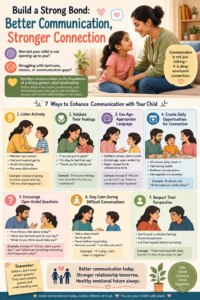 When children feel truly heard, understood, and valued, they develop a deep sense of emotional safety. This safety becomes the base from which confidence grows.
Children who experience open and respectful communication at home are more likely to share their thoughts without fear, ask questions, seek help when they need it, and turn to their parents during difficult moments. As a result, they become more confident, emotionally secure, and receptive to parental guidance.
Good communication does more than strengthen the bond—it helps shape a child’s emotional and behavioural patterns. It improves behaviour by reducing frustration and misunderstandings, supports emotional regulation by helping children label and manage their feelings, and nurtures overall mental well-being by creating a supportive environment where they feel seen and validated.
In essence, communication is not just talking—it is connecting.
Here are effective, psychology-backed ways to enhance communication with children.
1. Listen Actively
Children communicate best when they feel safe. Active listening fosters trust and connection. It shows them that you are truly present.
- How to Practice
- Maintain eye contact
- Nod or respond with gentle verbal cues
- Avoid interrupting
- Put away distractions (phone, TV)
2. Why It Matters
Active listening shows children that their thoughts and feelings matter, encouraging them to express themselves more freely.
Example: If your child says, “I don’t want to go to school,” instead of immediately giving solutions, pause, look at them, and say, “Tell me what happened.”
This opens the door for honest conversation.
2. Validate Their Feelings
Children may express emotions in ways adults don’t understand—crying, tantrums, silence, or frustration.
- What to Say
- “I can see you’re really upset.”
- “It’s okay to feel sad or angry.”
- “Thank you for telling me.”
2. Why It Matters
Validation teaches children that emotions are normal and manageable. It builds emotional intelligence and reduces emotional outbursts.
Example: If a child cries because a friend didn’t play with them, instead of saying “Don’t cry about small things,” say “It hurt your feelings when they didn’t include you. I understand.”
This strengthens emotional trust.
3. Use Age-Appropriate Language
Your communication style should match your child’s developmental stage.
- Tips
- For toddlers: use simple, direct words
- School-age kids: ask open-ended questions
- For teens: use respectful, collaborative language
Example: Instead of “Why did you do that?”
Say: “Help me understand what happened.”
This prevents defensiveness and encourages explanation.
4. Create Daily Opportunities for Connection
Consistent small interactions build strong communication habits.
- Ways to Connect
- 10-minute daily check-in
- Talking during walks
- Bedtime conversations
- Eating a meal together without screens
These moments create safe spaces for children to open up about their day.
Example: During dinner, ask: “What made you smile today?” This simple ritual often leads to deeper sharing over time.

5. Encourage Open-Ended Questions
Open-ended questions invite deeper conversation.
Examples
- “How did you feel about today?”
- “What was the best part of your day?”
- “do you think what would help you?”
This helps children think, reflect, and communicate clearly.
Example: Instead of asking, “Did you have a good day?” (which leads to a yes/no answer), ask, “What was something interesting that happened today?”
6. Stay Calm During Difficult Conversations
Children shut down when parents react with anger, judgment, or sarcasm.
- How to Stay Calm
- Take a deep breath
- Speak gently
- Pause before responding
- Remind yourself: “I am the safe adult.”
Calm communication teaches children how to handle conflict constructively.
Example: If a child spills something by mistake, instead of shouting, say, “It’s okay. Let’s clean it together.”
This keeps the conversation open instead of fear-based.
7. Respect Their Perspective
Even if their worries seem small to adults, they are big to them.
- Show Respect By
- Not mocking or dismissing feelings
- Avoiding comparisons (“Your brother never does this”)
- Giving them a chance to explain before correcting
Respect builds confidence and trust.
Example: If a teenager says, “My friends ignored me,” don’t say “Stop overreacting.”
Instead: “That must have felt really hurtful. Do you want to talk about it?”
8. Use Positive Communication Techniques
Your tone and choice of words matter.
- Instead of saying: “You never listen.”
Say: “Let’s try to understand each other better.”
2. Instead of: “Stop crying.”
Say: “Take your time. I’m here.”
Positive communication models emotional maturity.
Example: A child struggling with homework may say, “I can’t do this.”
Instead of “You’re just being lazy,” try:
“I know it’s tough, but I’m here to help you through it.”
9. Be Honest and Transparent
Children appreciate honesty. When parents model truthful communication, children learn to do the same.
Tips
- Admit mistakes
- Apologize when necessary
- Explain situations clearly
Honesty strengthens respect and trust.
Example: If you accidentally lost your temper, say, “I’m sorry I shouted earlier. I should have spoken calmly. I’ll try better.”
This teaches accountability.
10. Make Time for Play and Shared Activities
Play is a child’s natural language.
Activities
- Board games
- Drawing
- Outdoor activities
- Cooking together
During play, children talk more freely and build emotional connection.
Example: While playing a board game, a child may casually say, “Someone teased me today.”
This type of sharing often happens during relaxed play, not formal conversations.

Why Good Communication Matters (Parent–Child Communication)
Strong communication helps children in multiple powerful ways. When children feel truly heard and understood, it influences their emotional, social, and cognitive development. Here’s how:
• Build self-esteem
When parents listen with empathy, children feel valued. They begin to trust their own thoughts and ideas, which boosts confidence and self-worth.
• Develop emotional intelligence
Open conversations help children learn to name, understand, and manage their emotions. They observe how parents communicate and gradually develop empathy, self-awareness, and emotional control.
• Improve problem-solving
Talking through challenges teaches children how to think, reflect, and explore solutions instead of reacting impulsively. They learn important skills like decision-making and logical thinking.
• Strengthen relationships
A child who communicates comfortably at home is more likely to build strong bonds outside—whether with friends, teachers, or family members. Healthy communication at home becomes their internal model for all relationships.
• Reduce behavioural issues
Many behavioural problems come from frustration, fear, or feeling misunderstood. When communication flows smoothly, children feel safe expressing themselves, which reduces anger, defiance, and emotional outbursts.
• Feel secure and understood
Knowing that their parents listen without judgment gives children emotional security. This security becomes the foundation for resilience, trust, and healthy coping skills.
Final Thoughts
Improving parent–child communication is not about being perfect—it is about being present, patient, and emotionally available. Children do not need flawless parents; they need parents who try, who listen, and who show up with warmth. When children feel respected, loved, and supported, they naturally open up, share more honestly, and connect more deeply.
Even simple, everyday gestures—a few minutes of listening, gentle reassurance, or a calm response during stress—can make a significant difference. These small, consistent efforts gradually build trust, strengthen the parent–child bond, and create a home environment where emotions are welcomed rather than feared.
Over time, these moments nurture a strong emotional foundation, shaping children into confident, secure, and emotionally intelligent individuals. Good communication is not a one-time skill—it is a lifelong practice that transforms relationships and helps families grow closer with every conversation.
Frequently Asked Questions (FAQs)
1. Why is communication important in parenting (Parent–Child Communication)?
It builds trust, emotional security, and strong relationships.
2. What are signs of poor communication with a child (Parent–Child Communication)?
Silence, aggression, fear, or lack of sharing.
3. How can I make my child open up (Parent–Child Communication)?
Listen without judgment and validate feelings.
4. Should I be strict or friendly (Parent–Child Communication)?
Balanced—firm but emotionally supportive.
5. How do I talk to a child who doesn’t listen (Parent–Child Communication)?
Stay calm, use simple language, and avoid shouting.
6. Can communication reduce tantrums (Parent–Child Communication)?
Yes. Understanding emotions reduces behavioral issues.
7. How much time should I talk to my child daily (Parent–Child Communication)?
At least 10–15 minutes of focused attention.
8. Is it okay to apologize to children (Parent–Child Communication)?
Yes. It builds trust and emotional maturity.
9. How does communication affect mental health (Parent–Child Communication)?
Good communication improves emotional regulation and reduces anxiety.
10. When should I seek professional help (Parent–Child Communication)?
If communication breakdown leads to severe behavior or emotional issues.
Reference
American Psychological Association, (2025), “Parenting and child development”, Available at https://www.apa.org/topics/parenting
Centers for Disease Control and Prevention, (2025), “Child development”, Available at https://www.cdc.gov/child-development
United Nations Children’s Fund (UNICEF), (2026), “Parenting resources”, Available at https://www.unicef.org/parenting
Child Mind Institute, (2026), “Emotional and behavioural health”, Available at https://childmind.org/topics/concerns/
Monoprova Counselling, (2026), “Contact Us”,
Monoprova Counselling, (2026). “About Us”,
This article is written for knowledge purposes, aiming to help readers understand the topic better and gain useful insights for learning and awareness.

Pingback: Screen Time & ADHD-Like Symptoms in Children