
Introduction
In today’s digital age, screens are woven into nearly every aspect of childhood. Smartphones, tablets, televisions, online classes, gaming consoles, and social media have become common companions for children of all ages. While technology offers educational benefits and entertainment, increasing research and clinical observations have raised concerns about the relationship between excessive screen time and ADHD-like symptoms in children, particularly difficulties with attention, impulse control, and self-regulation.
Parents often report concerns such as:
- “My child can’t focus on homework.”
- “They’re restless all the time.”
- “They get bored instantly unless a screen is involved.”
- “Teachers say my child behaves like they have ADHD.”
These observations naturally raise an important question: Is screen time causing ADHD—or can excessive screen use contribute to ADHD-like behaviors?
The answer, however, is more nuanced than a simple yes or no. ADHD is a neurodevelopmental disorder, and current evidence does not establish that screen exposure directly causes ADHD. Instead, research suggests that problematic or excessive digital media use and ADHD symptoms can be associated in complex, potentially bidirectional ways. In other words, children who already have attention or self-regulation difficulties may be more vulnerable to problematic screen use, while certain patterns of digital media use may also be associated with later attention difficulties.
Furthermore, a 2025 systematic review found that several studies linked increased screen use with worsening symptoms, such as inattention, irritability, and hyperactivity, particularly among children and adolescents with ADHD. However, association does not prove causation, and the type, duration, context, and purpose of screen use all matter.
Understanding ADHD vs. ADHD-Like Symptoms
What Is ADHD?
Attention-Deficit/Hyperactivity Disorder (ADHD) is a neurodevelopmental condition characterized by persistent patterns of:
- Inattention
- Hyperactivity
- Impulsivity
Importantly, these symptoms are not simply occasional behaviors. Rather, they are persistent and developmentally inappropriate patterns that can significantly affect a child’s daily functioning.
These symptoms typically:
- Begin in early childhood
- Are present across multiple settings, such as home, school, and social environments
- Interfere significantly with academic, social, or everyday functioning
- Are not explained solely by environmental factors or temporary circumstances
Furthermore, ADHD has strong genetic and neurological foundations, which is why it should be understood as a neurodevelopmental condition rather than simply a behavioral problem.
What Are ADHD-Like Symptoms?
In contrast, ADHD-like symptoms refer to behaviors that resemble ADHD but may be situational, temporary, reversible, or influenced by environmental and lifestyle factors.
For example, a child may experience:
- A short attention span
- Difficulty sitting still
- Impulsive reactions
- Emotional dysregulation
- Poor frustration tolerance
However, the presence of these behaviors alone does not necessarily mean that a child has ADHD. In some cases, such symptoms may be associated with factors such as excessive screen exposure, inadequate sleep, limited physical activity, stress, or overstimulation.
Moreover, when these difficulties are primarily linked to lifestyle or environmental factors, they may improve when those underlying factors are addressed. Therefore, it is important to look at the pattern, duration, severity, and context of the symptoms rather than focusing on individual behaviors in isolation.
This distinction is crucial because a child’s inattentive, restless, or impulsive behavior in certain situations does not, by itself, establish an ADHD diagnosis. Instead, a comprehensive clinical evaluation can determine whether the symptoms are consistent with ADHD or whether other developmental, psychological, environmental, or lifestyle factors better explain them.
Ultimately, understanding the difference between ADHD and ADHD-like behaviors can help parents avoid premature labeling, seek appropriate assessment, and choose interventions that address the child’s actual needs.
How Screen Time Affects the Developing Brain
Children’s brains are highly plastic, meaning they are shaped by repeated experiences and interactions with their environment. Therefore, the kinds of activities children engage in regularly can influence how they develop attention, self-regulation, learning, and other cognitive skills. Because screens are now a routine part of childhood, the content, pace, and context of digital experiences may, in turn, influence how children respond to stimulation and reward.
The Attention System: Why Screens Are So Powerful
In particular, many digital platforms are designed to capture and maintain attention through features such as:
- Rapid scene changes
- Bright colors and visually engaging content
- Instant rewards
- Novel stimuli
- Reward-based feedback loops
As a result, children may become increasingly accustomed to environments that provide frequent novelty, immediate feedback, and rapid changes in stimulation.
Over time, this can make slower-paced activities feel comparatively less engaging. For example, reading, listening to a teacher, completing homework, or solving a problem may require sustained effort without providing immediate rewards. Consequently, some children may find these everyday tasks more difficult or less motivating after prolonged exposure to highly stimulating digital content.
However, this does not mean that screen use automatically causes attention problems or ADHD. Rather, the concern is that repeated exposure to highly stimulating content may shape attentional habits, particularly when screen use consistently replaces activities that require patience, sustained attention, active play, and real-world interaction.
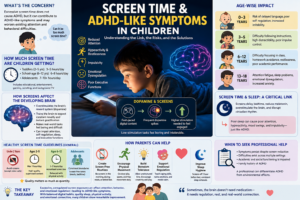
Dopamine, Screens, and Attention Regulation
Dopamine is a neurotransmitter involved in several important processes, including:
- Motivation
- Reward processing
- Attention
- Learning
In particular, many fast-paced digital experiences are built around frequent rewards, novelty, and immediate feedback. Games, short-form videos, and other highly engaging platforms can therefore provide repeated opportunities for reward-related dopamine activity.
However, it is important to be precise here: screen use does not simply “deplete” dopamine or permanently make the brain less sensitive to it. Instead, repeated exposure to highly stimulating and rewarding content may influence reward expectations and attentional habits, especially when such content becomes a dominant source of stimulation.
Consequently, children who become accustomed to rapid rewards and constant novelty may find slower-paced activities comparatively less engaging. For example, reading a book, completing homework, listening in class, or waiting for a delayed reward may require considerably more sustained effort.
This pattern can resemble some features associated with ADHD, particularly difficulties with sustained attention, motivation, and impulse control. Nevertheless, the underlying mechanisms are not necessarily the same.
ADHD is a neurodevelopmental condition with complex genetic and neurological foundations, whereas environmental habits, sleep, activity levels, and a child’s daily routine can influence attention difficulties associated with excessive or poorly regulated screen use.
Therefore, rather than assuming that screens directly alter dopamine and cause ADHD-like symptoms, we should examine how repeated exposure to highly stimulating digital environments may interact with attention, reward sensitivity, and self-regulation.
Age-Wise Impact of Screen Time on ADHD-Like Symptoms
The potential effects of screen use can also vary depending on a child’s developmental stage. Because attention, language, self-regulation, sleep patterns, and executive functions develop gradually throughout childhood and adolescence, the same pattern of screen use may affect different age groups in different ways.
Toddlers (0–3 Years)
During the first few years of life, the brain systems involved in attention, language, social interaction, and self-regulation are developing rapidly. Therefore, experiences during this period are particularly important for supporting healthy development.
Excessive or poorly supervised screen exposure has been associated with:
- Delayed language development
- Difficulties with self-regulation
- Reduced opportunities for joint attention and social interaction
- Increased irritability
However, these associations do not mean that screen exposure directly causes developmental problems. Rather, heavy screen use may sometimes replace important experiences such as talking with caregivers, interactive play, physical exploration, and face-to-face social engagement.
Preschoolers (3–5 Years)
As children enter the preschool years, attention and self-control continue to develop. Consequently, excessive or poorly regulated screen use may be associated with behaviors such as:
- Difficulty following instructions
- High distractibility
- Poor impulse control
- Reduced opportunities for imaginative play
Importantly, these behaviors may have multiple causes. For example, sleep difficulties, temperament, family routines, stress, and developmental differences can all influence attention and behavior. Therefore, reducing screen use may help some children, but improvement should not be assumed in every case.
School-Age Children (6–12 Years)
During the school years, ADHD-like difficulties may become more noticeable because children are expected to sustain attention, follow instructions, manage homework, and regulate their behavior for longer periods. As a result, common concerns may include:
- Difficulty focusing in class
- Homework avoidance
- Restlessness
- Teacher concerns about attention or behavior
- Reduced academic engagement or performance
At the same time, screens may amplify existing vulnerabilities. For example, a child who already has difficulties with attention or self-regulation may find it particularly challenging to transition away from highly stimulating digital activities and return to schoolwork or other less immediately rewarding tasks.
Adolescents (13–18 Years)
During adolescence, increasing independence, academic demands, social media, gaming, and other digital activities can substantially increase screen exposure. Consequently, excessive or poorly regulated use may be associated with:
- Attention fatigue
- Insufficient or disrupted sleep
- Emotional dysregulation
- Increased anxiety or emotional distress
- Reduced academic engagement
Furthermore, frequent multitasking between schoolwork, messaging, social media, videos, and other digital activities may make sustained attention more difficult. Rather than improving the ability to multitask, constantly switching between tasks can increase attentional demands and reduce the quality of sustained focus.
Screen Time and Sleep: A Critical Link
Sleep deserves particular attention because insufficient or disrupted sleep can itself produce behaviors that resemble ADHD, including difficulties with attention, impulse control, mood regulation, and activity level.
Screens may interfere with healthy sleep in several ways, including:
- Delaying bedtime
- Exposure to light in the evening, which can affect melatonin secretion and circadian timing
- Emotional or cognitive stimulation before bedtime
- Encouraging prolonged engagement that makes it difficult to disengage
As a result, children who do not get adequate, consistent sleep may experience:
- Poor attention
- Increased activity or restlessness
- Emotional volatility
- Impulsivity
Therefore, sleep should always be considered when evaluating ADHD-like behaviors. In some children, improving sleep routines may lead to noticeable improvements in attention, mood, and behavior. However, persistent symptoms should not automatically be attributed to poor sleep alone.
ADHD-like symptoms: Can Screen Time Cause ADHD?
This is one of the most important questions for parents. Current evidence does not establish that screen time directly causes ADHD. ADHD is a neurodevelopmental condition with substantial genetic and neurological contributions. At the same time, research has identified associations between problematic or excessive digital media use and attention-related difficulties.
Therefore, excessive screen exposure may:
- Worsen existing ADHD symptoms in some children
- Make underlying attention difficulties more noticeable
- Contribute to ADHD-like behaviors through disrupted sleep, reduced physical activity, overstimulation, or changes in daily routines
- Complicate assessment when environmental factors are not considered
However, it would be misleading to describe these behaviors simply as “screen-induced ADHD.” If symptoms improve after changes in screen habits, sleep, physical activity, and daily routines, this may suggest that environmental factors were contributing to the difficulties. Conversely, if significant symptoms persist across settings and over time, a comprehensive professional assessment is important.
Ultimately, the goal is not to blame screens or assume that every child with attention difficulties has ADHD. Instead, parents and professionals should look at the whole picture—including developmental history, symptom patterns, sleep, family environment, school functioning, physical activity, and digital media habits—to understand what may be contributing to the child’s difficulties.
ADHD-Like Symptoms Linked to Excessive Screen Time
Excessive or poorly regulated screen use may be associated with several behaviors that resemble features of ADHD. However, these behaviors should not automatically be interpreted as evidence of ADHD. Instead, it is important to consider their frequency, duration, context, and whether they improve when screen habits and other lifestyle factors change.
1. Reduced Attention Span
First, children who are frequently exposed to highly stimulating digital content may experience difficulty sustaining attention during slower-paced activities. They may:
- Struggle to sustain focus
- Jump quickly between tasks
- Abandon activities easily
- Require frequent prompts to remain engaged
Consequently, everyday activities that require sustained effort may feel less engaging. This may reflect changes in attentional habits or conditioning rather than neurological ADHD itself.
2. Hyperactivity and Restlessness
Similarly, some children with heavy screen exposure may appear unusually restless or have difficulty remaining physically settled. For example, they may:
- Fidget frequently
- Pace, squirm, or seek constant movement
- Have difficulty sitting through meals or classes
- Become restless when asked to participate in less stimulating activities
However, it would be inaccurate to conclude that screens directly cause hyperactivity. Rather, prolonged sedentary screen use may reduce opportunities for physical movement and active play, while highly stimulating content may make transitions to quieter activities more challenging.
3. Impulsivity and Poor Self-Control
In addition, children who frequently engage with rapidly rewarding digital content may have difficulty tolerating delays or stopping an enjoyable activity. This may appear as:
- Difficulty waiting
- Strong demands for immediate rewards
- Emotional outbursts when screens are removed
- Acting quickly without considering consequences
Although these behaviors can resemble ADHD-related impulsivity, they may also be influenced by learned expectations around immediate rewards, inconsistent boundaries, or difficulty with transitions. Therefore, context matters when interpreting these behaviors.
4. Emotional Dysregulation
Furthermore, excessive or poorly regulated screen use may be associated with emotional difficulties, particularly around stopping or limiting screen activities. Children may display:
- Irritability
- Low frustration tolerance
- Anger when interrupted
- Emotional meltdowns
Screens may sometimes become a convenient way to distract or soothe a distressed child. However, when screens become the primary strategy for managing boredom, frustration, or difficult emotions, children may have fewer opportunities to practice other forms of emotional regulation. As a result, transitions away from screens may become increasingly difficult.
5. Difficulty with Executive Functions
Finally, executive functions are essential cognitive skills that help children manage goal-directed behavior. These include:
- Planning
- Organizing
- Task initiation
- Working memory
- Inhibitory control
Excessive screen use may be associated with difficulties in these areas, particularly when screen-based activities consistently replace opportunities to practice effortful, self-directed tasks. For example, children may have fewer opportunities to:
- Persist with challenging activities
- Solve problems independently
- Organize their own tasks
- Practice delaying gratification
Overall, these behaviors can resemble ADHD symptoms. Nevertheless, resemblance does not mean equivalence. If difficulties persist across multiple settings, significantly interfere with daily functioning, and continue even after improving sleep, routines, screen habits, and other environmental factors, a professional assessment may be appropriate.
ADHD-like symptoms: How Much Screen Time Are Children Getting Today?
In today’s increasingly digital environment, children are exposed to screens across many parts of their daily lives. As a result, overall screen exposure can quickly add up, particularly when educational activities, entertainment, gaming, social media, and background television are all considered together.
Studies consistently show that many children are exposed to screens beyond recommended limits.
Average Screen Time (Approximate)
- Toddlers (2–5 years): 3–5 hours/day
- School-age children: 6–8 hours/day
- Adolescents: 7–10+ hours/day
This exposure may include:
- Educational screens
- Entertainment, such as YouTube, cartoons, and gaming
- Passive scrolling
- Background television
However, it is important to remember that screen exposure is not necessarily harmful simply because a screen is involved. The type of content, duration of use, context, and what screen time replaces—such as sleep, physical activity, play, social interaction, or family time—can all influence its potential impact.
Furthermore, children’s brains are still developing and are highly responsive to repeated experiences. Therefore, prolonged exposure to highly stimulating digital content may create an environment in which constant novelty and rapid rewards become more familiar than slower-paced everyday activities.
Consequently, understanding how much screen time children receive, what they are doing on screens, and what activities may be displaced by that screen use is more informative than looking at screen duration alone. The developing brain is continually shaped by its environment; therefore, creating a balanced routine that includes sleep, movement, play, learning, and real-world social interaction remains essential.
ADHD vs Screen-Induced Attention Problems: Key Differences
| ADHD | Screen-Induced Symptoms |
|---|---|
| Present across all settings | Mostly screen-heavy contexts |
| Persistent since early childhood | Develop after increased screen use |
| Genetic component | Lifestyle-driven |
| Does not resolve easily | Often improves with screen reduction |
| Requires clinical assessment | Responds to behavioral changes |
A thorough evaluation is essential before labeling a child.
ADHD-like symptoms: Warning Signs Parents Should Watch For
- Child can focus on screens for hours but not on other tasks
- Extreme irritability when screens are removed
- Boredom intolerance
- Reduced interest in non-screen activities
- Declining academic performance
- Sleep problems
- Emotional meltdowns after screen use

ADHD-like symptoms: Healthy Screen Time Guidelines (General)
While exact limits vary, general recommendations include:
- Under 2 Years: Avoid screens (except video calls)
- Ages 2–5: Max 1 hour/day, High-quality, supervised content
- Ages 6–12: 1–2 hours/day recreational screen time, Balanced with physical activity
- Adolescents: Consistent boundaries, Screen-free times (meals, bedtime)
Quality matters as much as quantity.
How Parents Can Reduce ADHD-Like Symptoms Linked to Screens
1. Create Screen-Free Routines
- Morning and bedtime screen-free
- No screens during meals
- Screen-free homework time
2. Encourage Physical Movement
- Outdoor play
- Sports
- Free movement
Movement helps regulate attention and emotions.
3. Build Boredom Tolerance
- Allow unstructured time
- Resist immediate screen replacement
- Encourage creativity
Boredom is essential for attention development.
4. Support Emotional Regulation
- Name emotions
- Teach coping strategies
- Model calm responses
Screens should not be the primary calming tool.
5. Improve Sleep Hygiene
- Screens off at least 1 hour before bed
- Consistent sleep schedule
- Screen-free bedrooms
When to Seek Professional Help
Consult a child psychologist if:
- Symptoms persist despite screen reduction
- Difficulties exist across multiple settings
- Academic and social functioning is impaired
- There is a family history of ADHD
A professional can differentiate ADHD from environmental effects.
Conclusion
Screen time is not inherently harmful—but excessive, unregulated screen exposure can significantly affect attention, behavior, and emotional regulation in children, often producing ADHD-like symptoms.
Understanding this distinction empowers parents to:
- Avoid premature labeling
- Make informed lifestyle changes
- Support healthy brain development
By creating balanced digital habits, prioritizing sleep and movement, and fostering emotional connection, many children show remarkable improvement in attention and behavior. Sometimes, the brain doesn’t need medication—it needs regulation, rest, and real-world connection.
Reference
-
CDC – Child Development & Media Use
👉 https://www.cdc.gov/childdevelopment
Anchor: child development and screen time -
American Academy of Pediatrics – Media Guidelines
👉 https://www.healthychildren.org
Anchor: AAP screen time guidelines -
Harvard Center on the Developing Child
👉 https://developingchild.harvard.edu
Anchor: brain development and attention -
NIMH – ADHD in Children
👉 https://www.nimh.nih.gov/health/topics/attention-deficit-hyperactivity-disorder-adhd
Anchor: ADHD in children -
How to Improve Parent–Child Communication