


Emotions influence everything—from the way we think and act to the way we connect with people and experience life. But when emotions become overwhelming, intense, or difficult to manage, they can affect mental health, decision-making, and relationships.
Cognitive Behavioral Therapy (CBT) is one of the most effective psychological approaches to emotional regulation. It teaches you to understand your thoughts, identify unhelpful patterns, and develop healthier ways to respond to difficult emotions.
This guide will help you understand:
- How emotions work
- Why some emotions feel unmanageable
- How CBT techniques help regulate emotional responses
- Step-by-step CBT tools you can start using today
- Long-term strategies for emotional resilience
1. What Is Emotional Regulation?
Emotional regulation means:
- Understanding your emotions
- Managing them in a healthy way
- Responding instead of reacting
- Staying calm enough to think clearly
- Making choices aligned with your values
It does not mean suppressing emotions or pretending everything is fine.
Healthy regulation allows you to feel emotions without being controlled by them.
Examples of regulated emotional responses include:
- Taking deep breaths instead of yelling
- Pausing before reacting
- Reframing negative thoughts
- Choosing a healthy coping strategy
- Creating distance from triggers
Emotion regulation is a skill—and CBT provides the tools to learn it.
2. How CBT Helps With Emotional Regulation
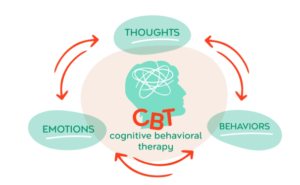
Cognitive Behavioral Therapy is based on a simple but powerful connection:
Thoughts → Feelings → Behaviors
This means:
- Thoughts create emotions
- Emotions influence behaviors
- Behaviors reinforce beliefs
CBT helps you identify this cycle and change unhelpful patterns.
How CBT supports emotional regulation:
- It identifies emotional triggers
- It challenges distorted thinking
- It replaces negative thoughts with realistic ones
- It reduces emotional intensity
- It strengthens coping skills
- It prevents emotional spirals
Over time, CBT rewires the brain to respond more calmly and rationally.
3. Why Emotions Become Hard to Regulate
Certain emotional patterns make regulation difficult. Examples:
3.1 Cognitive Distortions
- Catastrophizing
- Black-and-white thinking
- Personalization
- Mind reading
- Overgeneralization
These distortions make emotions stronger and more painful.
3.2 Unprocessed Trauma
Old wounds create emotional sensitivity.
3.3 Poor Boundaries
Saying yes when you want to say no leads to resentment and frustration.
3.4 Chronic Stress or Burnout
A constantly activated nervous system makes emotional regulation harder.
3.5 Lack of Coping Skills
Many people were never taught healthy emotional tools growing up.
CBT addresses these issues and builds emotional awareness and control.
4. Understanding the Cognitive Triangle
At the heart of CBT is the cognitive triangle:
Thoughts → Emotions → Behaviors
Example:
Thought: “I’m going to fail this presentation.”
Emotion: Anxiety
Behavior: Avoid preparing, sleep poorly, freeze during the presentation
CBT helps you modify the thought:
New Thought: “I can prepare well and do my best.”
New Emotion: Confidence
New Behavior: Prepare calmly and perform better
Changing one part of the triangle influences the others.
5. Identifying Emotional Triggers
You cannot regulate what you don’t understand.
Start by identifying triggers—situations, thoughts, or memories that create intense emotions.
Common Triggers:
- Criticism
- Conflict
- Rejection
- Feeling ignored
- High-pressure situations
- Past trauma reminders
- Failure or mistakes
How to Identify Your Triggers
Use journaling prompts:
- What happened?
- What emotion did I feel?
- What thought followed?
- What did I do afterward?
Patterns will emerge.
CBT then helps you change the reaction to these triggers.

6. CBT Techniques for Emotional Regulation
Here are the most powerful CBT tools used by therapists to help clients manage emotions effectively.
Technique 1: Cognitive Restructuring
Cognitive restructuring helps you:
- Identify negative thoughts
- Challenge their accuracy
- Replace them with balanced thoughts
This reduces emotional intensity instantly.
Steps:
- Identify the automatic negative thought (ANT).
- Ask: “Is this thought 100% true?”
- Look for evidence for and against the thought.
- Reframe it into a balanced thought.
Example:
Thought: “Nobody cares about me.”
Balanced Thought: “Some people care about me, even if not everyone shows it.”
This simple shift creates emotional relief.
Technique 2: Thought Challenging (The 5-Question Method)
Ask yourself:
- What is the evidence this thought is true?
- What is the evidence it isn’t true?
- Is there another way of viewing this situation?
- What would I tell a friend in this situation?
- What is the worst that could realistically happen—and how would I handle it?
This technique prevents emotional overreaction.
Technique 3: Identifying Cognitive Distortions
Recognizing distorted thinking helps you detach from emotional spirals.
Examples:
- Catastrophizing: “Everything will go wrong.”
- Mind Reading: “She must be angry with me.”
- Overgeneralizing: “I failed once, I’ll always fail.”
- Personalization: “It must be my fault.”
Once you name the distortion, your brain stops believing it.
Technique 4: Reframing Thoughts
Reframing helps you shift from negative conclusions to realistic perspectives.
Example:
Instead of: “I made a mistake. I’m useless.”
Reframe as: “I made a mistake. Everyone does. I can correct it.”
Reframing builds self-compassion and emotional balance.
Technique 5: The STOP Technique
A simple but powerful tool for emotional emergencies.
S – Stop.
Pause before reacting.
T – Take a breath.
Slow breathing activates the calm system.
O – Observe.
Notice thoughts and emotions without judgment.
P – Proceed mindfully.
Choose a healthy response instead of reacting impulsively.
This technique is excellent for anger, anxiety, and conflict situations.
Technique 6: The ABC Model
Used to break automatic emotional reactions.
A – Activating Event
What happened?
B – Belief
What did you think about it?
C – Consequence
How did you feel and behave?
Goal:
Change B to change C.
Example:
A: Someone didn’t reply to your message
B: “They are ignoring me.”
C: Sadness, anger
Reframed B: “Maybe they’re busy.”
New C: Calm, neutral
Technique 7: Behavioral Activation
This CBT tool teaches you to act opposite to your emotional impulses.
If your sadness tells you to isolate—take action instead: go for a walk, talk to someone, clean your room.
Behaviors shape emotions.
Technique 8: Exposure to Emotional Discomfort
Avoidance fuels emotional dysregulation.
CBT teaches that facing discomfort helps you manage it better.
Examples:
- If you fear conflict → role-play communication
- If you fear rejection → practice asking for small favors
- If you fear failure → attempt new tasks gradually
Small exposures build resilience.
Technique 9: Problem-Solving Skills
Difficult emotions often come from unresolved stress.
CBT teaches structured problem-solving:
- Define the problem
- Brainstorm solutions
- Evaluate pros/cons
- Choose one solution
- Test it
- Review and revise
This reduces anxiety and helplessness.

Technique 10: Journaling (CBT Thought Records)
CBT uses worksheets to analyze and regulate emotional responses.
A thought record includes:
- Situation
- Emotions
- Automatic Thoughts
- Evidence for
- Evidence against
- Alternative thought
- Outcome
Writing helps your brain slow down and think rationally.
Technique 11: Mindfulness & CBT (MBCT)
Mindfulness-Based Cognitive Therapy combines:
- observing emotions
- nonjudgmental awareness
- grounding techniques
This helps regulate intense emotions like:
- anger
- anxiety
- panic
- sadness
Mindfulness reduces the power of intrusive thoughts.
Technique 12: The “Name It to Tame It” Method
When you label your emotion, your brain shifts activity from the emotional center (amygdala) to the logical center (prefrontal cortex).
Say:
- “I’m feeling anxious.”
- “I’m feeling overwhelmed.”
- “I’m feeling hurt.”
Naming emotions reduces intensity.
7. Using CBT to Manage Specific Emotions
Let’s explore how CBT works for individual emotions.
Managing Anxiety With CBT
- Challenge catastrophic thoughts
- Test the feared outcome
- Create realistic predictions
- Use grounding techniques
- Practice breathing exercises
CBT helps break the anxiety cycle quickly.
Managing Anger With CBT
- Identify triggers
- Use STOP technique
- Challenge assumptions
- Reframe interpretations
- Practice assertive communication
CBT helps turn anger into controlled, constructive expression.
Managing Sadness With CBT
- Challenge hopeless thoughts
- Use behavioral activation
- Reconnect with enjoyable activities
- Challenge “all-or-nothing” thinking
CBT prevents sadness from becoming depression.
Managing Shame or Guilt With CBT
- Challenge negative self-beliefs
- Reframe self-criticism
- Practice self-compassion
- Separate behavior from identity
Shame dissolves when replaced with self-understanding.

8. Building Long-Term Emotional Resilience Using CBT
Emotional regulation becomes easier when you build resilience.
Long-term CBT strategies:
- Maintain healthy routines
- Sleep properly
- Exercise regularly
- Build supportive relationships
- Practice gratitude
- Set boundaries
- Review thought patterns weekly
- Avoid perfectionism
- Reduce unhealthy coping (alcohol, avoidance, shutting down)
- Celebrate small wins
These practices change your emotional system permanently.
9. CBT Worksheets You Can Use Daily
Here are simple tools you can print or use in a journal:
✔ Thought Record Worksheet
✔ ABC Model Template
✔ Cognitive Distortion Checklist
✔ Trigger Diary
✔ Emotion Intensity Scale
✔ Reframing Exercise
✔ Daily Behavioral Activation Planner
Using these consistently strengthens emotional control.
10. When You Should Seek Therapy
CBT works very well independently, but professional support is helpful if:
- emotions feel unmanageable
- you experience panic attacks
- negative thoughts feel constant
- you struggle with trauma
- burnout feels severe
- relationships are affected
- coping skills aren’t enough
A trained therapist helps apply CBT deeply and safely.
Conclusion
Emotional regulation is not about eliminating feelings—it’s about understanding and managing them in healthy ways. CBT provides a clear, structured, and science-backed approach to:
- identifying triggers
- challenging negative thoughts
- understanding emotional patterns
- reducing emotional intensity
- developing healthier coping strategies
By using CBT techniques consistently, you can cultivate emotional resilience, improve mental well-being, and respond to life’s challenges with clarity and confidence.
CBT teaches a powerful truth:
You may not control everything that happens, but you can control how you think about it—and that changes everything.
Reference
-
https://www.apa.org (American Psychological Association)
- Inner Child Healing
- Contact Us