
People-pleasing may look like kindness on the surface. You’re helpful, dependable, and always there for others. But beneath the smile, there is often exhaustion, resentment, and emotional burnout. You say “yes” when you want to say “no.” Push your own needs aside. You feel guilty when you prioritize yourself. Fear that disappointing others means losing their love or approval.
Yet people-pleasing isn’t a personality trait—it’s a coping mechanism.
And the good news? It can be unlearned.
This in-depth guide helps you understand:
- Why people-pleasing develops
- Emotional, psychological, and relational consequences
- How to set boundaries without guilt
- How to build self-worth that isn’t based on pleasing others
- Practical steps to stop the cycle
What Is People-Pleasing?
People-pleasing is the pattern of putting other people’s needs, wants, and feelings ahead of your own — often to the detriment of your mental and emotional health. On the surface it can look like kindness, cooperation, or generosity, but beneath it usually hides fear, insecurity, and chronic self-neglect.
Common signs of people-pleasing
- Struggling to say no, even when you’re already stretched thin.
- Avoiding conflict at all costs, preferring silence or agreement over honest expression.
- Constantly seeking validation, approval, or reassurance from others.
- Overcommitting to tasks and social obligations until you feel overwhelmed.
- Feeling responsible for other people’s moods or happiness.
- Apologizing excessively, even for small or imagined offenses.
- Fearing rejection or disappointing others, which shapes your choices.
- Suppressing your true feelings, opinions, and needs to keep the peace.
Why it’s a problem
What looks like being helpful often masks self-erasure. Over time, people-pleasing erodes boundaries, increases anxiety and burnout, and prevents you from forming authentic relationships. Recognizing these patterns is the first step toward reclaiming your voice and wellbeing.
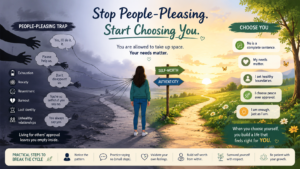
Why people-pleasing develops: psychological roots
People-pleasing doesn’t spring up overnight. It’s learned through relationships, early experiences, and social messages that teach you to trade your needs for safety, approval, or belonging. Here are the main roots and how they shape the habit.
Childhood conditioning
Children raised where affection or safety feels conditional often learn to perform for acceptance. Examples: parents who demanded obedience, caregivers who shamed emotional expression, unpredictable emotional responses, praise only for achievement, or punishment for speaking up. The takeaway beliefs become: “I must please to stay safe” and “I must be good to be loved.” Those rules travel into adulthood and steer many decisions.
Fear of rejection
At the core of people-pleasing is a powerful fear: abandonment or social rejection. Thoughts like “If I say no, they won’t like me” or “If I show my true feelings, I’ll be rejected” push people to suppress boundaries and agree when they don’t want to—all to avoid imagined or remembered loss.
Trauma responses: fawn mode
In trauma-informed models, fawning is a survival response alongside fight, flight, and freeze. Fawning means appeasing or accommodating others to prevent harm or conflict. People who fawn:
- Keep the peace in tense situations
- Diffuse anger or criticism by complying
- Make themselves “less of a problem” so they won’t be targeted
This response is often automatic and feels like the only emotionally safe option.
Low self-worth
When your sense of value depends on what you do for others, you’ll constantly try to earn approval through service and compliance. Beliefs such as “My value comes from helping” or “I must earn love” make it difficult to prioritize your own needs without guilt.
Perfectionism
Perfectionism and people-pleasing feed each other. Perfectionists fear disappointing others, crave being seen as competent or kind, and avoid criticism—so they overcommit, overwork, and hide flaws to uphold an ideal image.
Cultural and social conditioning
Collectivist and hierarchical cultures often prioritize group harmony, respect for elders, and obedience. While these values foster connection, they can also teach that saying “no” is rude or selfish and that individual needs should be suppressed for the group—normalizing people-pleasing as virtue rather than a problem.
Gender expectations
Social norms frequently assign emotional labor and caretaking roles to women, rewarding agreeableness and self-sacrifice. Those expectations increase pressure to please and make it harder to assert needs without social cost.
Codependency patterns
Codependency describes relationships where one person’s identity and wellbeing depend on managing others’ emotions. People-pleasing is a hallmark: you feel responsible for others’ feelings, try to fix them, lose your own boundaries, and fear the consequences of stopping.
How these roots show up in daily life
- You accept extra work rather than ask for help.
- Hide disagreements to avoid rocking the boat.
- You apologize preemptively or for things you didn’t do.
- Feel drained after social interactions that weren’t truly reciprocal.
Understanding the origin helps: people-pleasing is an adaptive strategy that worked in certain contexts (safety, belonging, survival). It becomes problematic when it consistently costs your mental health, autonomy, or authentic relationships.
Signs you might be a people-pleaser
People-pleasing shows up in everyday choices long before you name it. You dread others being upset and often say “yes” automatically, only to regret it later. Apologize frequently—even when you aren’t at fault—and find it hard to ask for what you need. You notice yourself absorbing other people’s emotions, calming tensions by agreeing, or avoiding conflict altogether. Rest feels guilty rather than restorative, and you regularly feel used, unappreciated, or resentful because you give far more than you receive. A recurring worry about being seen as “difficult” shapes how you present yourself and limits honest expression. Over time, this pattern wears on your mental and emotional health, leaving you drained, anxious, and disconnected from your own priorities.
Quick signs to watch for
- You say “yes” reflexively and later feel resentful.
- Apologize often, even when not at fault.
- You avoid conflict or hide your true feelings.
- Feel guilty for resting or prioritizing yourself.
- You take responsibility for others’ emotions or try to fix them.
- Frequently feel used, unappreciated, or emotionally drained.
How people-pleasing affects your life
People-pleasing may look harmless at first, but its consequences accumulate across emotions, mental health, relationships, identity, and the body. Over time the habit that once protected you becomes a source of ongoing harm.
Emotional consequences
People-pleasing commonly leads to burnout, chronic resentment, heightened anxiety, and a muted emotional life. Because you focus on managing others’ feelings, your own needs go unattended—leaving you feeling unseen, chronically low in confidence, and often quietly angry at yourself for not speaking up.
Mental-health consequences
The constant pressure to predict and accommodate others’ reactions increases stress and vulnerability to depression and anxiety disorders. Codependent patterns and identity confusion can develop as you lose touch with your preferences and values. Your mind stays on alert, anticipating social threat rather than resting.
Relationship consequences
When you give without clear boundaries, you can unintentionally attract people who exploit your generosity—narcissists, manipulators, or emotionally unavailable partners. Even well-meaning people may pull away if you appear inauthentic or avoid vulnerability; healthy relationships require reciprocity and honest expression, which people-pleasing undermines.
Identity loss
Sustained people-pleasing reshapes your sense of self. Repeatedly prioritizing others makes questions like “What do I want?” and “What do I believe?” feel unfamiliar. Over time your choices and self-concept reflect other people’s expectations more than your own values.
Physical consequences
The emotional labor of people-pleasing shows up in the body: headaches, insomnia, persistent fatigue, digestive issues, increased cardiovascular strain, emotional or binge eating, and weakened immunity are common. Chronic stress and HPA-axis activation from constantly managing social threat take a real physiological toll.
Clinical note
Because people-pleasing operates across cognitive, emotional, relational, and physiological systems, treatment is most effective when it’s multidimensional: psychotherapy that targets schemas and attachment, skills training for assertiveness and distress tolerance, trauma-informed work if fawning is present, and stress-reduction practices (sleep hygiene, movement, relaxation techniques) to repair the body.
Quick summary
- Emotional: burnout, numbness, resentment.
- Mental: depression, anxiety, identity confusion.
- Relational: exploitation, emotional distance, lack of reciprocity.
- Physical: sleep problems, fatigue, headaches, weakened immunity.

Why saying “no” feels so hard
For a people-pleaser, the word “no” activates more than a choice—it triggers a cascade of learned threats. Early experiences often taught your brain that refusal could mean rejection, conflict, shame, or loss of connection. Over time those lessons get encoded as automatic beliefs: no = danger. So even when your body and values are aligned against something, your mouth may default to “yes” because the cost of saying no feels too high.
Several psychological mechanisms keep “no” from coming out. Attachment insecurity and rejection sensitivity make social exclusion feel urgent and painful; cognitive distortions like mind reading and catastrophizing exaggerate the imagined consequences of refusing; operant conditioning has reinforced compliance whenever it brought praise or avoided punishment; and trauma-related fawning makes appeasement an automatic safety strategy. Biologically, social threat activates the amygdala and stress systems, which favor fast, appeasing responses over reflective action.
Put simply: the difficulty isn’t moral weakness or rudeness—it’s an adaptive response wired by experience. Recognizing that “no” feels dangerous because of learned associations makes it less personal and more treatable.
Quick practical takeaway
Start small: practice saying brief, low-stakes “no”s (for example, “I can’t this time”) and notice the outcome. Repeated, safe experiences of refusal will help rewire your expectations that saying no truly does lead to loss or harm.
How to stop people-pleasing: a full guide
Breaking people-pleasing isn’t about becoming rude or selfish; it’s about returning to balance—honoring both your needs and others’. The work involves changing beliefs, building skills, and practicing new habits until they become second nature.
Recognize that your needs matter
People-pleasing usually rests on the belief that your needs are inconvenient or unimportant. Practice a simple reframing: notice an urge to please, then tell yourself, “My needs deserve attention.” Repeat short affirmations (for example, “I am worthy of care”) and treat them like training wheels for a new, kinder internal voice.
Map your people-pleasing patterns
Awareness is the first tool for change. Keep a brief log for a week: note moments you say yes when you don’t want to, who you’re with, what you feared would happen, and what you hoped to gain (approval, safety, avoidance). Patterns reveal predictable triggers you can work on.
Do inner-child and root healing work
People-pleasing often begins in childhood with messages like “You must perform to be loved.” Gentle inner-child work—acknowledging those early fears, telling your younger self “You are safe now,” and offering compassion—helps loosen long-held rules. Therapy (schema therapy, inner-child focused approaches, or trauma-informed work) supports deeper change when memories or fawning responses are part of the picture.
Challenge automatic thoughts
People-pleasers rely on cognitive shortcuts: mind reading, catastrophizing, and “must” statements. When you catch a thought like “If I say no they’ll hate me,” pause and test it: What is the actual evidence? What’s the worst likely outcome, and could I survive it? Replace rigid predictions with balanced statements such as, “Saying no might disappoint them, but I can handle that.”
Build tolerance for discomfort
Saying no will feel hard at first. Practice small, low-risk refusals (e.g., declining a casual invite). Notice the physical sensations, breathe through them, and remind yourself that discomfort is temporary. Over time, your tolerance grows and the urge to immediately soften or explain diminishes.
Strengthen boundary muscles with scripts
Boundaries are skills you can practice. Use short, neutral scripts until they feel natural: “I can’t commit to that,” “I’m not available,” or “Let me check my schedule and get back to you.” Keep explanations brief; you don’t owe long justifications. Role-play with a trusted friend or therapist to build confidence.
Practice assertive communication
Assertiveness balances clarity and respect. Use “I” statements: “I’m uncomfortable with that,” or “I need time to finish my own priorities.” Assertive language honors both parties and is not the same as aggression. Practicing tone and pacing helps the message land without escalating conflict.
Reduce unnecessary apologies
Over-apologizing trains you to put yourself beneath others. Reserve apologies for real mistakes. Substitute brief neutral phrases for automatic “sorry”s: “Thanks for waiting,” “I can’t right now,” or “I hear you.” Small language shifts change how you and others treat your boundaries.
Audit your relationships
Notice who consistently respects your limits and who doesn’t. People who take advantage of your compliance may continue until you stop enabling them. Stepping back from exploitative or draining relationships (gradually if needed) creates space for reciprocity and healthier connection.
Build self-worth separate from approval
Work on identity and self-worth through practices that don’t rely on others’ praise: set and meet small goals aligned with your values, journal about things you like about yourself, and spend time on activities that remind you who you are. Therapy, values clarification exercises, and behavior experiments that test “I am enough” help rewrite internal measures of worth.
Stop rescuing or fixing others’ emotions
Remind yourself: you are not responsible for someone else’s reactions. When others feel upset by your boundary, respond briefly and calmly: “I understand you’re upset. I’m choosing X for my wellbeing.” Let them process without immediately stepping in to fix it.
Rediscover and protect your true self
Regularly ask yourself: what do I want, enjoy, and value? Schedule time for these things—hobbies, friendships, creative work—and protect that time as you would any other appointment. Reclaiming personal interests strengthens identity and reduces the tendency to define yourself by how much you give.
Practical micro-exercises
- One-minute pause: before saying yes, take one breath and ask, “Do I want this?”
- Two-word boundary: practice “Not now” or “I can’t” in safe situations.
- 5-minute reflection: after a social interaction, note one moment you honored yourself and one you didn’t—no judgment, just data.
- Role-play once a week: rehearse a refusal with a friend or therapist.
When to seek professional help
If people-pleasing is rooted in trauma, causes significant distress, or co-occurs with depression, anxiety, or codependency, consider therapy. Effective approaches include CBT for thought patterns, DBT for interpersonal effectiveness and distress tolerance, schema therapy for deep-rooted beliefs, and trauma-informed modalities (EMDR, somatic therapies) when needed.

Sample Scripts for Saying No
No scripts — ready to use
Tone tip: keep your voice calm, steady, and neutral. Short, clear phrases land better than long explanations.
Polite no (general)
-
“I appreciate the offer, but I can’t right now.”
Boundaried no (firm but respectful)
-
“That doesn’t work for me.”
Delayed response (buy time)
-
“Let me check my schedule and get back to you.”
Firm no (clear, final)
-
“No, I’m not available.”
Emotional boundary (protect feelings)
-
“I’m not comfortable discussing this.”
Work context
- To decline extra work: “I can’t take this on right now; my priorities are.”
- To a meeting invite you don’t need: “I’ll pass on the meeting and read the notes afterward.”
- When a colleague pressures you: “I hear you, but I won’t be able to do that.”
Family context
- To a family request you can’t meet: “I can’t help with that this time, but I can [offer a smaller alternative].”
- Repeated intrusions: “I need some time to myself; I’ll connect later.”
- When pressured about life choices: “I understand you care, but this is my decision.”
Friends / social context
- To invites you don’t want: “Thanks for thinking of me—this time I’ll pass.”
- Boundary testing: “I’d rather not talk about that; let’s change the subject.”
- To being asked for favors often: “I’m not able to do that, but I can help with [smaller option].”
Online / text
- To quick asks: “Not today—thanks for understanding.”
- Persistent messaging: “I need a break from messages; I’ll reply later.”
- To requests that feel invasive: “I prefer not to share that.”
When you feel guilty
- Brief reassurance to yourself or the other person: “I can’t help with that and I’m okay with my choice.”
- If someone pushes: “I’ve made my decision.”
Practice prompt
-
Role-play one script aloud once daily this week. Start with the delayed response script when you feel unsure; it gives you space to decide.
What happens when you stop people-pleasing
At first, change feels uncomfortable. People who have relied on your compliance may react with frustration or confusion, and you’ll likely feel guilt or worry. Your nervous system, tuned to keep you safe through appeasement, will push back—expect tension, anxiety, or second-guessing when you try new boundaries.
Those early reactions don’t mean you’re doing something wrong; they’re signs that you’re shifting old patterns. With consistent practice, the rewards follow: you feel more empowered and begin to trust your own choices. Confidence grows as you repeatedly choose your needs and see that the world does not collapse. Relationships that survive and adapt become more authentic and reciprocal; those built on taking advantage often fade, making room for people who respect your limits.
Over time you stop feeling constantly exhausted and anxious about others’ approval. You reclaim parts of your identity—your preferences, values, and voice—and attract calmer, more respectful connections. Saying “no” becomes easier and more natural, and putting yourself first becomes an accepted, healthy habit rather than a rare exception.
Reassurance for the process
Expect setbacks and some social friction early on. Treat them as information rather than failure—each awkward conversation is practice that rewires expectations (yours and others’). If resistance feels overwhelming, slowing the pace or getting support from a therapist or trusted friend can help.
When to Seek Professional Help
If you’re wondering whether to try self-help or seek professional care, a good rule is this: start with self-help for low-to-moderate distress—practice boundary scripts, small behavior experiments, journaling, and the skills described earlier. If people-pleasing significantly interferes with your work, relationships, or daily functioning, if you feel stuck in patterns despite trying self-help, or if the habit stems from trauma, abuse, or persistent anxiety or depression, reach out to a therapist. Professional support offers targeted interventions (CBT, DBT, schema therapy, trauma-informed work) and a safe space to unpack deep-rooted beliefs—accelerating change and preventing retraumatization when the issues run deep.
Conclusion
People-pleasing grows from a deep fear that your worth depends on what you do for others. It often starts in childhood, is reinforced by emotional conditioning, and becomes a survival habit—but it is not who you are at your core.
You can learn to set boundaries, prioritise yourself, stop apologising for existing, speak your truth, and reclaim your identity. As you practice these skills, your relationships become healthier and saying no without guilt becomes possible.
When you stop people-pleasing, you stop abandoning yourself. You choose authenticity over approval, freedom over fear, and—finally—yourself.
FAQ
What is people-pleasing?
A pattern of prioritizing others’ needs, approval, or comfort over your own, often automatically and at personal cost.
How do I know if I’m a people-pleaser?
You say yes reflexively, apologize a lot, avoid conflict, feel drained or resentful, and feel guilty for prioritizing yourself.
Why did I become a people-pleaser?
Often from childhood (conditional care), reinforced by rewards/punishments, attachment insecurity, trauma (fawning), perfectionism, or cultural/gender expectations.
Is people-pleasing the same as being kind?
No. Kindness is chosen from balance; people-pleasing is compulsive and self-sacrificing, usually to avoid rejection or anxiety.
Will setting boundaries make me selfish or hurt my relationships?
Not in the long run. Boundaries protect your wellbeing and generally lead to healthier, more reciprocal relationships despite short-term discomfort.
What practical steps can I take to stop people-pleasing?
Pause before answering, use short “no” scripts, challenge automatic thoughts, practice assertiveness, and start with small boundary experiments.
When should I seek professional help?
If people-pleasing causes severe anxiety, depression, identity loss, repeats toxic relationships, or stems from trauma—seek a therapist.
Reference
- Contact Us
- Inner Child Healing
- Monoprova Counselling (2026), “About Us”, Available at https://monoprovacounselling.in/
This article is written for knowledge purposes, aiming to help readers understand the topic better and gain useful insights for learning and awareness.
Pingback: CBT Techniques: How to Regulate Emotions Full Guide