
Children’s mental health is shaped long before they know the term—every word, routine, and response quietly teaches them whether children’s mental health is safe, supported, and worthy of care.
Introduction
Children don’t grow only physically—they grow emotionally, socially, and psychologically every single day, often in ways that adults don’t immediately notice. A child’s mind is constantly learning, absorbing, and interpreting the world around them. Long before they understand what “mental health” means, they are already forming beliefs about themselves, others, and life.
From the tone of our voice to the consistency of our routines, from how we handle stress to how we show affection—every interaction becomes a building block of their emotional world. This early environment shapes how a child learns to trust, express feelings, handle disappointments, and connect with others.
As parents and caregivers, the way we respond, communicate, and connect with children becomes the foundation of their emotional resilience. When they feel heard, supported, and valued, they develop confidence and inner strength. When they feel dismissed or misunderstood, confusion and insecurity can take root.
Understanding children’s mental health isn’t about identifying problems—it’s about creating the right environment where children feel safe to grow, explore, fail, try again, and become emotionally intelligent individuals.
Below is a clear, practical guide to understanding and nurturing children’s mental health—so that every child gets the chance to grow not just in height, but in heart, mind, and spirit.
Why Children’s Mental Health Matters
Children experience emotions intensely. Their feelings are often raw, unfiltered, and immediate. While they may not express emotions like adults or have the language to describe what’s happening inside them, they feel deeply — fear that seems overwhelming, frustration that turns into tears, shame that makes them withdraw, excitement that bursts out in laughter, curiosity that drives endless questions, and sadness that they may not know how to explain.
Their emotional world is powerful, and it shapes every aspect of their development.
When children receive the right emotional support, healthy mental development allows them to:
- Build Strong Self-Esteem: They begin to see themselves as capable, valued, and worthy. Confidence grows when their feelings are acknowledged and their efforts are celebrated.
- Form Secure and Trusting Relationships: Children learn to form healthy attachments with caregivers, friends, and teachers when they experience consistent love, safety, and understanding at home.
- Manage Stress and Emotions: With guidance, children learn how to calm themselves, express feelings appropriately, and understand that emotions are temporary and manageable.
- Develop Problem-Solving Skills: When children feel supported, they are more willing to take risks, make decisions, and learn from mistakes — essential steps for cognitive and emotional growth.
- Navigate School, Friendships, and Daily Life” Children with strong emotional grounding adjust better to classroom environments, build healthier friendships, and develop resilience to handle everyday challenges.
On the other hand, when emotional needs go unnoticed or unsupported, the foundation of mental health weakens. This can increase the risk of:
- Anxiety and Depression: Unprocessed emotions often show up later as persistent worry, sadness, or feelings of being overwhelmed.
- Behavioral Issues: Tantrums, aggression, defiance, or withdrawal may appear when children don’t have healthy outlets for expressing their inner struggles.
- Learning Difficulties: Emotional distress reduces concentration, memory, and cognitive processing, affecting academic performance.
- Social Withdrawal: Children may isolate themselves, avoid interactions, or struggle with making and maintaining friendships.
- Low Academic Achievement: Mental health and learning are deeply connected. When emotional well-being suffers, motivation and performance often decline.
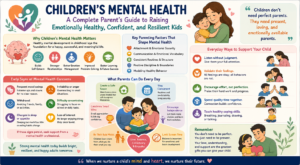
Key Parenting Factors That Shape Mental Health
Attachment & Emotional Security
Attachment is the very first emotional bond a child forms — and it becomes the blueprint for every future relationship. A consistent, comforting, and predictable relationship with caregivers builds a child’s first sense of safety.
Secure attachment is formed when parents are:
- Responsive: They notice the child’s needs and respond in a timely, caring way.
- Warm: They offer affection, gentleness, and reassurance.
- Emotionally available: They listen, validate, and stay present even during a child’s difficult emotions.
When children experience this kind of dependable love, they grow up:
- More confident in themselves
- Empathetic toward others
- More emotionally stable and resilient
- Better at forming healthy relationships
A securely attached child carries an inner belief:
“I am safe. Am loved. I matter.”
Communication & Emotional Vocabulary
Young children feel emotions intensely but often lack the words to explain what they’re going through. This can lead to tantrums, withdrawal, or confusion. Adults play a crucial role in helping children understand and express their inner world.
By labeling feelings, we teach children emotional awareness:
- “I can see you are frustrated.”
- “Are you feeling scared?”
- “It’s okay to be sad. I’m here with you.”
When a child’s emotions are acknowledged without judgment, they learn to:
- Recognize their own feelings
- Express them appropriately
- Understand that emotions are normal and temporary
This builds emotional intelligence (EQ) — which research shows is more predictive of long-term success than IQ. EQ helps children in friendships, academics, communication, leadership, and even future relationships.
Behavior Modeling
Children don’t learn by hearing — they learn by watching.
Parents’ actions become a silent, powerful lesson.
If parents:
- Yell → children learn yelling is a coping mechanism
- Avoid emotions → they learn to suppress feelings
- Communicate calmly → they learn emotional regulation
- Show empathy → they develop empathy
- Apologize when wrong → they learn accountability and humility
Your behavior becomes their roadmap. Every day, in small ways, children absorb how you deal with stress, conflict, love, frustration, and disappointment.
Establishing Boundaries
Boundaries are not about control — they are about safety, structure, and emotional growth. A predictable environment helps children understand what is acceptable and what is not.
Healthy boundaries teach children:
- Self-control → how to pause, think, and respond
- Respect → how to value their own space and others’
- Problem-solving → understanding consequences and making choices
Children actually thrive with boundaries because they provide a sense of stability.
A child with clear limits thinks:
“I know what to expect. Know what is safe. I know my responsibilities.”
Play & Exploration
Play is not entertainment for children — it is their language, their therapy, their brain’s way of growing.
Through play, children:
- Process emotions they don’t yet know how to verbalize
- Improve cognitive skills such as memory, attention, and reasoning
- Build social skills like sharing, negotiation, and cooperation
- Enhance creativity by imagining worlds and solving problems
- Develop resilience as they try, fail, and try again
Unstructured playtime — free play without rules or screens — is essential for healthy brain development. It allows children to explore, imagine, and express themselves freely.
A child who plays freely today becomes an adult who can think flexibly tomorrow.

Warning Signs of Children’s Mental Health Concerns
Children may not always have the words to tell you something is wrong, but their behavior often speaks for them. As caregivers, it’s important to pay attention to emotional and behavioral changes that persist over time.
Seek professional support if you notice any of the following:
- Persistent Sadness or Irritability: If a child seems unusually sad, low, angry, or easily annoyed for weeks, it may indicate deeper emotional distress rather than a “phase.”
- Withdrawal from Friends or Activities: If they stop engaging in things they once enjoyed or avoid social interactions, it may signal anxiety, fear, or emotional overwhelm.
- Changes in Eating or Sleeping Patterns: Sleeping too much or too little, nightmares, loss of appetite, or overeating can all be signs of stress, sadness, or anxiety.
- Difficulty Concentrating: Struggling to focus, forgetting tasks, or zoning out may reflect emotional strain, ADHD symptoms, or learning difficulties.
- Excessive Fear, Worry, or Tantrums: Frequent meltdowns, panic-like reactions, or intense worry about everyday situations are important indicators of emotional imbalance.
- Decline in Academic Performance: A drop in grades or reluctance to attend school often has emotional roots — such as bullying, anxiety, or low self-esteem.
- Aggression or Self-Harm Behaviors: Hitting, extreme anger, risky behaviors, or attempts to harm oneself are urgent warning signs requiring immediate professional help.
Why Early Intervention Matters
Children’s emotional patterns form early.
When challenges are identified and addressed at the right time:
- Emotional struggles become easier to manage
- Behavioral issues reduce
- Learning difficulties can be supported
- Children build confidence and resilience
- Family relationships improve
- Long-term mental health risks decrease
Early intervention can change the trajectory of a child’s life.
It gives them tools to understand their emotions, communicate better, and thrive emotionally, socially, and academically.
What Parents Can Do Every Day
Small, consistent actions at home create a big impact on a child’s emotional world. Here are simple but powerful parenting practices that build emotional strength, confidence, and resilience.
Validate Emotions
Children need to know their feelings are real, acceptable, and safe to express. Emotional validation builds trust and helps them develop healthy emotional expression.
Instead of saying “Don’t cry”, try:
- “I know you’re upset. Let’s talk about it.”
- “We are here. Tell me what happened.”
- “It’s okay to feel sad/angry/frustrated.”
Validation does not mean agreeing with the behavior — it means acknowledging the feeling behind it. When a child feels understood, the intensity of their emotion reduces naturally.
Maintain Routines
Children thrive on predictability. Routines give them a sense of stability and help reduce anxiety because they know what to expect next.
Daily routines such as:
- Bedtime schedules
- Meal times
- Study/playtime
- School preparation
…support emotional regulation and make children feel safe and grounded.
A predictable rhythm brings calm to a child’s mind.
Practice Positive Reinforcement
Praise isn’t just encouragement — it shapes behavior. But how we praise matters.
Focus on effort, not just results.
For example:
- “You worked really hard on this!”
- “I love how patiently you tried again.”
This builds:
- Motivation
- Confidence
- Perseverance
- A growth mindset
Children learn that effort is valuable and mistakes are part of learning.
Encourage Open Conversations
Create a home environment where feelings are welcomed, not judged. When mental health becomes a normal topic, children feel comfortable sharing their fears, questions, and experiences.
Try asking:
- “How was your day? What made you happy today?”
- “Did anything make you upset or confused?”
- “Do you want to talk about something that’s on your mind?”
These small conversations build emotional connection and trust.
Limit Screen Time
Excessive screen use affects:
- Sleep quality
- Attention span
- Mood
- Behavior
- Emotional control
Set healthy boundaries around device use and encourage:
- Outdoor play
- Creative activities
- Family time
- Reading
- Hobbies
Screens should enhance learning, not replace real-life experiences.
Create a Safe Space
Children flourish when they know they won’t be judged or punished for mistakes.
A supportive environment teaches them:
- It’s okay to make errors
- Safe to ask questions
- Learning takes time
- Every problem has a solution
A growth mindset helps children build resilience — the ability to bounce back from challenges.
When home feels safe, a child’s mind feels free to grow.

Parent’s Mental Health Matters Too
A child’s emotional world is deeply connected to their parents’. Children are incredibly perceptive — they notice tone, energy, stress levels, and even the emotions parents try to hide. When parents feel overwhelmed, exhausted, anxious, or unsupported, children silently absorb that emotional atmosphere.
They may not understand why something feels heavy, but they feel the heaviness.
They may not know the source of stress, but they sense the tension.
A child’s emotional safety begins with the emotional stability of the adults around them.
That’s why taking care of your own mental wellbeing is not selfish — it is an act of love.
- When a parent rests, heals, and seeks support, the child benefits.
- A parent is emotionally regulated, the child learns regulation.
- When a parent practices self-care, the child learns that caring for oneself is important.
Your mental health sets the tone for your child’s mental health.
A calm, supported parent creates a calm, supported child.
Nurturing yourself is not a luxury —
It is a gift to your child, to your home, and to your family’s emotional future.
Conclusion
Parenting is not about being perfect; it’s about being present. Children don’t need flawless parents — they need parents who show up, listen, and try their best. What shapes a child’s emotional world is not grand gestures, but the consistent, everyday moments of connection.
A secure, understanding, and emotionally nurturing environment becomes a lifelong asset for a child’s mental health. It teaches them that the world is safe, that they are loved, and that their feelings matter.
Even the smallest daily efforts make a profound difference:
- A moment of listening
- Warm hug
- A gentle validation
- Word of encouragement
- A patient explanation
- Calm response during a meltdown
These tiny acts build strong, emotionally healthy individuals who grow up with confidence, resilience, and healthy relationships.
Children don’t remember perfect parents —
they remember how their parents made them feel.
And your presence, love, and effort are shaping a future filled with emotional strength and wellbeing.
Frequently Asked Questions (FAQs)
1. What is children’s mental health?
It refers to a child’s emotional, psychological, and social well-being.
2. Why is mental health important in children (Children’s Mental Health)?
It helps in emotional regulation, learning, relationships, and overall development.
3. What are early signs of mental health problems in children (Children’s Mental Health)?
Changes in behavior, mood swings, withdrawal, and difficulty concentrating.
4. How can parents support their child’s mental health?
By listening, validating emotions, maintaining routines, and providing a safe environment.
5. What role does attachment play in mental health (Children’s Mental Health)?
Secure attachment builds confidence, trust, and emotional stability.
6. Can screen time affect children’s mental health?
Yes, excessive screen use can impact sleep, mood, and attention.
7. When should parents seek professional help (Children’s Mental Health)?
If symptoms persist for weeks or affect daily functioning.
8. How does parenting style affect mental health (Children’s Mental Health)?
Supportive and responsive parenting improves emotional development.
9. Can play improve mental health in children (Children’s Mental Health)?
Yes, play helps emotional expression, creativity, and problem-solving.
10. Does parent mental health affect children (Children’s Mental Health)?
Yes, children are deeply influenced by their parents’ emotional state.
References
- World Health Organization
👉 https://www.who.int/health-topics/mental-health - UNICEF
👉 https://www.unicef.org/parenting - American Psychological Association
👉 https://www.apa.org/topics/child-development - About Us – Monoprova Counselling
👉 https://monoprovacounselling.in/about-us/ - Contact / Book Appointment – Monoprova Counselling
👉 https://monoprovacounselling.in/contact/
This article is written for knowledge purposes, aiming to help readers understand the topic better and gain useful insights for learning and awareness.