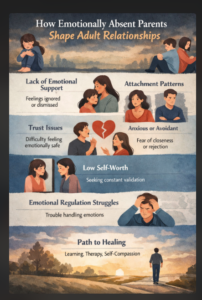
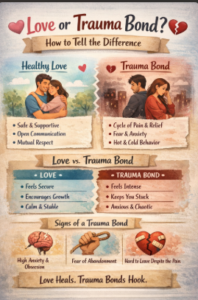
Differences between Love and Trauma Bond

Most individuals endure aching relationships not because they love the pain but the emotional attachment seems to be strong, absorbing and almost unbreakable. The relationship can be addictive and is characterized by a feeling of longingness, hope, fear, and short moments of intimacy that continue to draw them back. And even in situations where the relationship is distressing, anxiety-inducing or self-doubting, it can become more terrifying to quit the relationship than to remain.

This contradiction that is inside creates a very perplexing question:
Is it love, or is it a trauma connection?

The misunderstanding comes in the fact that the bonds of trauma may also disguise as love. Severity is confused with passion, drama and drama for emotions, and bonding with belonging. The inconsistent affection, which is handed over and withheld at random, causes the nervous system to be set into action which strengthens the bond between them by creating an emotional craving instead of emotion safety.

Emotional well-being, healthy attachment, and relational healing relies on the understanding of the distinction between love and trauma bonding. Unconsciously, individuals can carry on with accustoming themselves to pain, turning a blind eye to their needs, or remain in circles that are comfortable but utterly disappointing. Understanding what is occurring under the carpet is usually the initial step towards being able to select relationships that are not only emotionally potent- but emotionally secure.

What Is Love? (From a Psychological Perspective)

New romantic love is based on emotional safety, consistency, and respect. It does not need to be afraid, to be filled with doubts or to win affection. Rather, it builds up a relational atmosphere in which the two individuals feel safe enough to be themselves and vulnerable and emotionally available. Connection is not what you need to pursue in a healthy love it is a gift given without any fee and one of the aspects that are consistently sustained.

This type of love enables the two individuals to develop, both as individuals and as a couple. Personal development does not pose a threat to the relationship but is seen as an enhancement of the relationship. Diversity is considered and needs are addressed and individuality respected instead of being smothered out.

Key features of healthy love include:

  • Emotional availability and open communication – feelings, needs, and concerns can be expressed without fear of dismissal, ridicule, or punishment.

  • Consistency in care and behavior – affection, attention, and respect are stable, not dependent on moods, power, or control.

  • Respect for boundaries – “no” is honored, autonomy is valued, and personal limits are not crossed to maintain closeness.

  • Repair after conflict – disagreements are followed by accountability, understanding, and reconnection, not prolonged withdrawal or emotional punishment.

  • Feeling calm, secure, and valued – the relationship soothes the nervous system rather than constantly activating anxiety or fear.

  • Freedom to be yourself without fear – you don’t have to shrink, perform, or abandon parts of yourself to be loved.

There is no self-abandonment that is required of healthy love to survive. You do not need to repress, endure victimization or demonstrate your value all the time. Rather, love is your emotional safe haven, where association helps to sustain you and not your identity.

What Is a Trauma Bond?

Trauma bond is developed when emotional attachment is developed based on pain and relief repetitive cycles, instead of safety and consistency. The bonds tend to occur in relationships where emotional neglect, unpredictability, or abuse is involved and where there are moments of intimacy and then withdrawal, condemnation, or emotional abuse. Gradually, the nervous system begins to connote connection with distress and reprieve with love.

Psychologically, intermittent reinforcement is the cause of trauma bonding. This is found when affection, validation or attention is provided in varying ways, at one time warm and connecting, and at other times cold and rejecting. Since there is no predictability of the reward, the brain is made as more focused on it. The bonding occurs not due to a healthy relationship but as a result of the nervous system being trapped in the process of anticipation, anxiety and temporary relief.

Passion is confused with intensity and longing with love in the trauma-bonded relationships. The peaks are euphoric and the saddens devastating-forming a strong attachment loop which is hard to lure even in situations where the relationship inflicts great emotional pain.

Common conditions where trauma bonds form include:

  • Emotionally unavailable or inconsistent partners – affection is offered unpredictably, keeping the person in a constant state of hope and anxiety.

  • Relationships involving manipulation, gaslighting, or control – reality is distorted, self-trust erodes, and dependency increases.

  • One-sided emotional labor – one person carries the responsibility for maintaining connection, repair, and emotional stability.

  • Fear of abandonment or rejection – staying feels safer than the perceived pain of being alone, even when the relationship is harmful.

  • Childhood attachment wounds replayed in adulthood – early experiences of inconsistency or neglect shape what feels familiar, even when it is painful.

Trauma bonds do not reflect weakness or inability to make a good judgment. These are survival mechanisms of adaptation that are influenced by the brain and nervous system in a kind of environment where love and pain were brought together. The healing process starts not by self-blame, but by learning and understanding that love is not supposed to hurt in order to be experienced.

Love vs Trauma Bond: Key Differences

Love Trauma Bond
Feels safe and steady Feels intense and chaotic
Encourages growth Keeps you stuck in survival mode
You feel valued You feel anxious about losing them
Needs are acknowledged Needs are minimized or ignored
Conflict leads to repair Conflict leads to fear or withdrawal
Calm nervous system Activated, dysregulated nervous system

How Your Body Tells the Truth

A traumatic bond can be shown by your nervous system, not just your thoughts or feelings, as one of the most evident signs as to whether you are in love or a trauma bond. The truth is something that is usually known by the body much before the mind can comprehend it.

The nervous system of a healthy love is grounded and regulated. Even in the period of conflict or emotional distress, it has a sensual feeling of security. War is not something that soothes that the relationship is at risk. You can calm yourself down, interact, and hope that the bond will be re-established. Love can be rather provoking, but it does not put you in a state of constant fear.

The body in the trauma-bonded relationships always stays alert or in survival mode. This can be accompanied by constant overthinking, hypervigilance, disposition to messages, repeating messages, or tracking tone change. The fear of leaving people is put at the forefront, and the moods are oscillated between a high level of intimacy and a strong sense of distress. The mood swings and mood busts are not indicators of passion, but indicators of imbalance in the nervous system.

The body is able to become accustomed to relating anxiety to affiliation and reprieve to affection, as time passes. It is the reason why the state of being calm may be boring or new, whereas disorder is attractive and seductive. Peace is not always love when it is uncomfortable and instability is exciting and it might be conditioning due to past attachment wounds.

Healing is about educating the nervous system that it is not dull and safe and still, but safe. And that love neither needs fear to live.

Why Trauma Bonds Feel So Strong

Trauma bonds do not indicate personal weakness, bad judgment, and emotional dependency. These are survival strategies of adaptation- the mind/ body attempt to keep connected to those environments where safety and consistency were questionable. With little or unstable care, love, or confirmation, the nervous system comes to learn clinging desperately to whatever relief can be found.

The brain starts relating short episodes of love, warmth or care with elimination of emotional suffering. These occasions serve as emotional terms of consolation, soothing troublingness to an extent that strengthens the bond. This builds a strong commitment cycle whereby the relationship is bound not by constant affection, but by the pain-temporary relief contrast.

The repeated cycle results in the relationship not being built upon any sincerity but a lack of loss, leaving, or emotional retreat. The fear rather than the safety is the cement that binds the bond together. Even in the case where the relationship is most distressing, the prospect of losing the tie may cause a lot of anxiety, grief, or even panic.

This is the reason why it is easier to keep than to leave. To remain means familiarity, predictability and partial relief whereas to leave means to experience emotional free fall. It is essential to learn about this process, not to give oneself an excuse to feel bad but to acknowledge this with the purpose to substitute self-blame with clarity. The process of healing can start when the nervous system gradually gets to know that it does not have to be injured to be connected, that safety can be achieved without hurting.

Breaking the Trauma Bond Begins with Awareness

Healing does not start with blaming yourself or the other person. It begins with recognition.

Ask yourself:

  • Do I feel more anxious than safe in this relationship?

  • Am I staying for connection—or to avoid abandonment?

  • Do I feel seen, or am I constantly trying to be enough?

Choosing emotional safety over familiarity is not giving up on love—it is returning to yourself.


Love Heals. Trauma Bonds Hook.

Love broadens out your self-image.
It promotes interest, self-confidence and emotional expression. You are more yourself in love, not smaller or quieter or less worthy but complete and less airy.

Trauma bonds on the contrary reduce the self.
They make your emotional sphere smaller; about coping with anxiety and preemptive response and maintaining connection at all costs. In the long run, your needs, voice, and identity may be marginalized to the background with survival in the limelight.

Healing is not the fast track of detaching and moving on. It is initiated by self-compassion, which refers to the realization that your to which you were attached was logical considering what you went through. The body gradually discovers a new reality, though, that safety need not be learned by pain, by means of the nervous system control, emotional intuition, and even professional help.

As this healing progresses it is possible to find what seemed magnetic to grow wearying. The anarchy that seemed like unity might become deceptive. And what used to seem strange–or even dull,–the quiet, the sameness, the tranquil existence, may gradually start to represent home.

Frequently Asked Questions (FAQ)

1. Can love and trauma bonding coexist in the same relationship?

Yes. Love may be present in a relationship and yet traumatized. This does not necessarily imply that the bond is healthy because of the presence of a caring individual. It is whether the relationship is sustained on the basis of emotional protection and stability or fear, anxiety and intermittent reinforcement.

2. Why does a trauma bond have more strength than healthy love?

Trauma bonds balance the brain reward system together with the stress system. The uncertainty of affection heightens emotional desire such that the attachment becomes desperate and very strong. Healthy love is smoother and it may not seem exciting at first in case the nerve system is programmed to madness.

3. Can a trauma bond be dissolved without a relationship?

In other instances, recovery is possible when the relationship grows to be reliable, responsible, and responsive in the long run. Nevertheless, the length of trauma bonds might demand physical space or physical separation of the nervous system so that it re-tunes- particularly in the presence of abuse, manipulation, or chronic neglect.

4. Why am I missing the person who abused me?

Not wanting someone who hurt you does not imply you are a weak or disoriented person. The emotional and bodily brain is not the only place of storing attachment but logic. The desire is usually a depiction of unfinished attachment needs, and not the yearning to go back to hurt.

5. What is the duration of healing a trauma bond?

There is no fixed timeline. The factors that determine healing include attachment history, regulation of the nervous system, emotional support and work therapy. Consciousness and understanding are slowly reduced, and the mind becomes clearer.

6. Is it true that therapy is beneficial to trauma bonding?

Yes. Therapy, particularly attachment-informed, trauma-informed or somatic treatment, assists people to comprehend patterns, manage the nervous system, repair self-trust and create more healthy templates of relationships.

7. What are some of the signs that I am heading to healthy love?

There are indications such as being relaxed instead of anxious, being able to communicate needs without fear, confidence in consistency, and the absence of mistaking intensity and intimacy. Peace starts to get safe, not tedious.

Written by Baishakhi Das

Counselor | Mental Health Practitioner
B.Sc, M.Sc, PG Diploma in Counseling


References & Further Reading

  • American Psychological Association (APA)
    https://www.apa.org
    (Attachment, trauma, relationship psychology)

  • National Institute of Mental Health (NIMH)
    https://www.nimh.nih.gov
    (Trauma, emotional regulation, mental health)

  • Bowlby, J. (1988). A Secure Base: Parent-Child Attachment and Healthy Human Development
    (Foundational attachment theory)

  • Herman, J. L. (1992). Trauma and Recovery
    (Psychological trauma and relational impact)

  • van der Kolk, B. (2014). The Body Keeps the Score
    (Trauma, nervous system, and healing)

  • Linehan, M. (2015). DBT Skills Training Manual
    (Emotion regulation and interpersonal effectiveness)

  • Why You Miss People Who Hurt You

This topic performs well due to rising searches around men’s mental health, workplace stress, and burnout recovery. Combining emotional insight with practical steps increases engagement and trust.
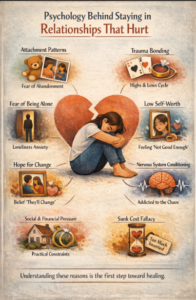
Psychology Behind Staying in Relationships That Hurt

It is a question that persists among many individuals as to why a person would continue to be in a relationship that brings in emotional hurt or neglect. It is a matter of mere words, it appears that it is not so complicated, and when it hurts, one should leave. Psychology however demonstrates that maintaining is hardly weakness. They are aware that they are being hurt, they can feel it in over and over disappointments, need denials and emotional lack of companionship. Leaving is not only a logical process; it is also an emotional process and a process of the nervous system.

In the everyday life, this usually appears in the form of excuse-making over rudeness, clinging to tiny surfaces of tenderness, or wishing that things could go back to their old ways. Pain is familiar to a number of people since the relationships they had in early stages of life taught them that love is inconsistent or emotionally taxing. The unknown may be unsafe in comparison with what is familiar.

The fear of being alone, self-doubt and social pressure may silently hold people back. They could downsize the needs over the years, evade conflict, and modify themselves to the relationship. Knowledge of these patterns can be used to find an alternative to self-blame of self-compassion-and the initial step to recovery and better relationships.

1. Attachment Patterns Formed in Childhood

The experiences of being close to someone in our adulthood are influenced by our first relationships. The attachment theory states that the manner in which our emotions, needs, and distress were addressed by caregivers was a template to love and connection that would be kept as an internal record.

  • In anxious attachment,
    relationships usually make life worryful and prone to thinking. The fear of being deserted can be very strong due to a delay in the response, a change in the tone, or distance in nature. Human beings can be in painful relationships, as the fear of losing an individual being felt more than the pain of remaining. They can be over-giving, people-pleasing or bury their needs to ensure that the relationship remains alive.
  • In the avoidant attachment,
    emotional distance may seem normal. Such one can manifest itself in everyday communication (reducing self-importance, not talking deeply or too closely). Negligence or emotional unavailability is not necessarily experienced as an issue since an early teaching of independence and emotional self-reliance was a source of defense.
  • Fearful-avoidant attachment

    tends to be confusing in push-pull fashion. Someone might want to be intimate, reassured, and close, but when he or she does, he/she will feel overwhelmed and unsafe. In real life, this might present itself as the desire to connect and then withdraw after emotional experiences, initiating fights after intimacy, or being ambivalent about remaining or leaving.

In cases where love during childhood was absent, or lacking, or conditional, the nervous system learns to be vigilant. Emotional instability can be comfortable to adults, whereas stability can be alien and even boring. What is familiar may become familiar as right, even in cases where it is painful, not because it is healthy, but because it is familiar.

Knowing these patterns of attachment makes individuals understand that their relationship problems are not personal failures, but acquired emotional reactions, and that such patterns can be addressed with understanding and secure connection.

2. Trauma Bonding and Intermittent Reinforcement

Trauma bonding is one of the potent psychological traps, as a cycle of emotional pain, after which there is a short period of affection, apology, or hope. In our everyday lives, this can be in form of constant quarrels, emotional withdrawal, and offensive behavior, followed by brief bursts of kindness, vows to change, or extreme intimacy. Such brief good moments may be a relief and very significant following a period of pain.

This tendency operates based on the intermittent reinforcement, which is the same psychological process that is observed in gambling. Since love and care cannot be forecasted, the mind will be preoccupied with the next good time to occur. The doubt leaves an individual emotionally engaged even in a case where the relationship is largely torturous.

The brain releases dopamine when one chooses to reconcile, an apology, a loving message or even when you physically get closer to a person, this is what creates a feeling of relief and emotional reward. It can even be a relief, as love. The bond becomes even stronger with time, and the reason is not that the relationship is healthy, but due to the conditioning of the nervous system to find some relief against distress.

As time passes, the relationship turns less about caring about each other and more about suffering in that quest to expand on those short periods of intercourse. Knowing about trauma bonding can make people understand that they are not addicted to an individual, it is just that they have gotten stuck in a strong cycle of psychology, which can be freed with awareness, safety, and support.

3. Fear of Loneliness and Abandonment

To a great number of individuals, the prospect of being alone is more terrifying than living in emotional distress. Loneliness may trigger profound survival anxiety, particularly in the persons who were conditioned at their early years of life that they are loved and needed and are chosen. Solitude will not only be uncomfortable, but unsafe.

This fear manifests itself in daily life in silent forms such as, at least I am not alone or this is a lot better than nothing. Individuals can remain at such relationships when they feel unnoticed or emotionally deprived just because the company of a person is better than being lonely. Common practices, communications, or even complaints may seem as comforting as nothing at all.

The relationship eventually becomes an antidote to loneliness and not a place of actual connection. The feeling needs gradually grow smaller, self-esteem is bound to the presence of the relationship, and suffering is accepted to not be alone. Coming to terms with this fear can make individuals realize that survival is frequently about being strong, rather than being weak, and that learning to feel safe on your own is a strong move towards healthier relationships.

4. Low Self-Worth and Internalized Beliefs

People who stay in hurtful relationships often carry internalized beliefs such as:

  • “I don’t deserve better”

  • “This is the best I can get”

  • “Love always hurts”

Such beliefs might be a result of criticism experienced in the past, emotional neglect or repeated invalidation. The normalization of pain and healthy love may be strange and undeserving over time.

5. Hope for Change and the “Potential” Trap

People tend to stay in the agonizing relationships due to the fact that they are in love with whom the individual would be, rather than with whom he/she would remain to be all the time. They desperately cling to the memories of how things used to be in the start or to the few occasions when the partner takes care, is warm or understanding. In everyday life, this manifests itself as waiting until the better side of the individual comes back and that love, patience or sacrifice will one day result in an enduring change.

Mental images like the ones that state that they have not always been that way or that they will change in case one loves them sufficiently can have one emotionally involved even after being disappointed many times. With every minor change or a note of apology, hope is strengthened, although the general trend is the same.

This is psychologically reinforced by cognitive dissonance. The mind is torn between two painful truths at the same time that someone is both loved and hurting at the same time many times. The mind dwells on potential, intentions or promises in the future instead of current conduct to minimize this inner conflict. Hope is developed as a coping mechanism.

This might overtime make people become tolerant to some circumstances that they would never recommend other people to tolerate. Knowing this tendency can assist in moving the focus off of what one may be to how the relationship actually is day after day- and knowing it it tends to happen can be the first step to change.

6. Nervous System Conditioning

The nervous system of a person might become dysregulated when he/she lives in the state of chronic emotional stress and gets used to the level of tension, uncertainty, or emotional ups and downs. With time, the body gets to be on high alert. In everyday life, this can manifest itself in the form of constantly anticipating a conflict, overthinking the approach or mannerism, or being anxious when there would be nothing to be bad.

Consequently, disorder and emotional instability come to be normal and predictable, stable, steady relationships may become foreign or even dangerous. Others refer to healthy relationships as being boring not that it is not a connection, but due to the fact that a nervous system is not used to being calm.

That is why individuals might be uncomfortable in steady respectful relationships there is no adrenaline, no emotional hunt, and no necessity to remain hyper-vigilant. The body mixes passion with passion and indifference with apathy. The healing process consists of gradually reconditioning the nervous system to perceive safety, balance and emotional expression as indicators of authentic connection and not threat.

7. Social, Cultural, and Practical Pressures

Beyond internal psychology, external factors also play a role:

  • Societal expectations around marriage or commitment

  • Fear of judgment, especially for women

  • Financial dependence or shared responsibilities

  • Concern for children or family reputation

These pressures can reinforce endurance over emotional safety, making leaving feel like failure rather than self-preservation.

8. Emotional Investment and the Sunk Cost Fallacy

And the longer a relationship spans the more difficult it may be to quit. In the long run, common memories, emotional commitment, sacrifices, habits, and even a collective identity form a sense of duty. The concept of leaving can be daunting, because one learns to live in the day, routine, family ties, dreams and aspirations, and it seems that they lose a part of themselves in the process.

In this case, the sunk cost fallacy becomes influential. One might be tempted to believe that he/she has already devoted so much of his/her time, love, and effort to it, and, by departing, he/she will only render it pointless. The history of investment starts justifying the current suffering. Rather than inquiring about the healthiness of the relationship at the moment, the question is how much has been lost already.

This in real life can manifest itself in terms of staying a little more, hoping that things will get better to make the hard work worth it. Endurance is not an indicator of psychological well being. Surviving is not an indication of strength or love. The process of healing starts when individuals give themselves permission to select emotional safety and self-respect in place of the stress to make past hurt count.

Moving Toward Healing

Remaining in a painful relationship does not imply that one is weak. In more instances, it refers to the fact that they had to learn to survive on the basis of attachment, hope and perseverance. These tendencies used to make them feel secure, related or less isolated-although now they are painful. What appears as a case of staying too long to the external world is in most cases an internal struggle to defend the self emotionally.

It starts with consciousness during healing. Self-blame gives way to self-compassion when individuals see the reason why they remain. Awareness introduces the spaciousness to challenge traditional patterns and hear emotional requirements and envision relationships that are not because they are familiar but safe. Through this, change can be effected not by coercion, but through enlightenment and nurturing.

Helpful steps include:

  • Exploring attachment patterns through therapy

  • Learning nervous system regulation

  • Rebuilding self-worth and boundaries

  • Redefining love as safety, consistency, and emotional presence

Closing Thought

You do not hang about because you are mended. It remain because sometime in your life your brain and body have come to realize that love came with conditions. You were taught to adapt, wait, bear the pain, and hope, as these were the methods used to enable you to feel a part of or not so lonely. What seems to be endurance in these days was in the past a survival.

When love was forced to wait, or to keep still, or to sacrifice oneself, your system had been taught to believe that work is equal to value. You might have been taught to downplay your requirements, question your emotions, or hold that pangs are just part of intimacy. This can over time make emotional anguish, familiar to the self protection, unfamiliar or even egoistic.

Love should not be made to undermine you. It is not to get you to doubt your value, think on toes or dismiss your emotional reality. Healthy love gives you room to be safe, consistent and care about each other- it does not necessitate you to vanish and keep the relationship alive.

Making a choice is not to give up on oneself. It is not abandoning and losing love. Appreciating the fact that emotional well-being is important. It is the silent gesture of coming back to yourself after having spent years in remaining where you were not noticed. And with that decision, healing commences–not with a dramatic climax, but with an honest, sincere start.

Frequently Asked Questions (FAQ)

1. What provokes people to remain in relationships that are harmful to them?

Since psychological aspects such as attachment styles, fear of abandonment, trauma bonding, and conditioning of the nervous system can make leaving more dangerous than remaining.

2. Does that make one weak to remain in a painful relationship?

No. It is frequently a survival mechanism that is based on previous experiences, unfulfilled emotional needs, and acquired coping mechanisms.

3. What is trauma bonding?

Trauma bonding refers to an emotional bonding derived by the presence of pain and release that the short moments of affection strengthen the attachment in spite of the harm.

4. What is the impact of childhood on relationship in adulthood?

Premature relationships form inner models of affection and protection, which affect the way proximity, discord, and emotional demands are fulfilled in adulthood.

5. How does the attachment theory contribute to unhealthy relationships?

Styles of attachment (anxious, avoidant, fearful-avoidant) influence the way individuals react to intimacy conflict, and emotional availability.

6. What is so addictive about emotional unpredictability?

Intermittent reinforcement stimulates the release of dopamine which the brain becomes preferentially conditioned to seeking relief following distress like addictive behavior.

7. What is so strong about the fear of loneliness?

The loneliness may trigger the deepest of deep-seated survival fears, in part because of the tendency to equate self-worth with being chosen or needed.

8. What is cognitive dissonance within relationships?

It is the emotional uncomfortable nature of loving someone who makes someone suffer, usually being solved by holding onto hope, or possibility as opposed to reality.

9. When do healthy relationships get boring?

The nervous system can regulate itself in a way that considers love as something intense, and calmness and consistency become strange and unsafe.

10. What is sunk cost fallacy in relationships?

One of the beliefs is that breaking away would be a waste of time and effort put in even in the case where the relationship is bad.

11. Is that the unlearnability of such patterns?

Yes. Attachment and nervous system patterns can be cured with awareness, therapy, and safe relationships.

12. Is it necessary to love someone and tolerate pain?

No. Healthy love is about emotional safety, mutual respect and consistency- not self erasure and endurance.

13. Why do individuals wish that their partner should change?

The emotional investment, early bonding and the inability to accept loss or disappointments often lead to hope.

14. Is self-selection equivalent to self-sacrifice?

No. Making a choice in favor of oneself is an expression of self-respect and recovery, but not desertion.

15. In cases where is it appropriate to seek professional assistance?

Repeated patterns are used when the emotional pain seems too great, and it is not possible to get out of the situation despite the persistent harm.

Written by Baishakhi Das

Counselor | Mental Health Practitioner
B.Sc, M.Sc, PG Diploma in Counseling


Reference

  1. American Psychological Association (APA) – Relationships & Attachment
    https://www.apa.org/topics/relationships

  2. Psychology Today – Attachment Theory
    https://www.psychologytoday.com/intl/basics/attachment

  3. Psychology Today – Trauma Bonding
    https://www.psychologytoday.com/intl/basics/trauma-bonding

  4. National Institute of Mental Health (NIMH) – Mental Health & Relationships
    https://www.nimh.nih.gov/health/topics

  5. Harvard Health Publishing – Stress & the Nervous System
    https://www.health.harvard.edu/staying-healthy/understanding-the-stress-response

  6. The Gottman Institute – Healthy vs Unhealthy Relationships
    https://www.gottman.com/blog/category/relationships/

  7. Cleveland Clinic – Trauma Responses
    https://my.clevelandclinic.org/health/diseases/trauma

  8. Mind UK – Emotional Well-being & Relationships
    https://www.mind.org.uk/information-support/relationships/

  9. APA Dictionary of Psychology – Cognitive Dissonance
    https://dictionary.apa.org/cognitive-dissonance

  10. Why Emotionally Unavailable People Feel So Familiar

This topic performs well due to rising searches around men’s mental health, workplace stress, and burnout recovery. Combining emotional insight with practical steps increases engagement and trust.

Attachment Styles Explained Through Daily Relationship Behavior

Attachment styles are not theoretical mental categories- they silently determine the ways we write, debate, pull away, relate and love in a daily basis. They determine whether we will follow up or not, whether we will lean in or shut down in the course of conflict. They are patterns formed at a young age, which is founded upon the feelings of safety, visibility and support as we experienced deepest relationships, particularly in times of distress. As treatment was regular, we got to know that connection is secure. Whenever it was unpredictable, far, or too much, we adapted to it in a manner that could enable us to survive.

These initial relational prototypes never fade away as age advances. They will persistently shape our adult relationships, friendships, and even how we work, in the way we request assistance, accept feedback, establish boundaries, or manage emotional intimacy. Such patterns often become automatic and we do not realize that we are reacting to past and not to present.

The discussion of the attachment styles based on my everyday behavioral patterns assists in changing the narrative of What is wrong with me to What happened to me-and how did I learn to cope? It is this realization that brings us out of the self-blaming mode into the self-compassing mode, out of the unconscious mode, into the conscious healing mode. Once we become aware of our patterns we can have the strength to react differently, establish safer relationships and gradually establish emotional safety we have not experienced previously.

1. Secure Attachment: Comfort in Connection and Independence

Individuals who have secure attachment usually feel safe during intimacy and at ease with the distance. They hope that the relationship does not fade away due to distance alone, lack of agreement and dissimilarity. To them, intimacy is not bulky but solid, and independence does not express rejection.

Daily relationship behaviors often include:

  • Communicating needs openly and directly, without excessive fear of being rejected or abandoned

  • Tolerating disagreements and misunderstandings without assuming the relationship is at risk

  • Feeling emotionally connected without needing constant reassurance or validation

  • Respecting boundaries—both their own and those of others—without guilt or defensiveness

  • Valuing consistency, reliability, and emotional presence more than dramatic highs or intensity

Safe attachment does not imply flawless relationships and conflict free-ness. It involves the ability of emotional regulation, responsibility in conflict situations, healing ruptures thoughtfully, and hope that through caring, the connection can be rebuilt. Secure attachment in its core is the ability to feel safe enough to be real, imperfect, and emotionally present in relationships.

2. Anxious Attachment: Seeking Reassurance to Feel Safe

When early care was intermittent at times warm, at times cold, or unpredictable, then the development of anxious attachment will occur. Love was tentative in such places and therefore the nervous system came to be vigilant to any alterations in proximity. Emotional safety is something as adults that is frequently associated with closeness, reassurance, and responsiveness of others.

Daily relationship behaviors may include:

  • Overthinking texts, tone, or response time, and reading meaning into small shifts in communication

  • Needing frequent reassurance to feel emotionally secure and connected

  • Experiencing intense fear of abandonment during conflict, silence, or physical distance

  • Struggling to tolerate emotional uncertainty or ambiguity in relationships

  • Prioritizing the relationship over personal needs, boundaries, or self-care

Basic to the point, anxious attachment is not neediness or emotional frailty. It is a nervous system that is formed by uncertainty, one that is always searching its safety and contact. Through perception, emotional control and repeated relational encounters, this trend can become softer–enabling proximity to become soothing instead of devouring.

3. Avoidant Attachment: Valuing Independence Over Emotional Exposure

Avoidant attachment is common to situations where emotional needs were rejected, skipped or discouraged. When intimacy was received with indifference, criticism, emotional inaccessibility, the nervous system got to know that relying on others was unsafe. Consequently intimacy in adulthood may be overwhelming, intrusive or even threatening to the autonomy of a person.

Daily relationship behaviors may include:

  • Feeling uncomfortable with emotional dependence, vulnerability, or expressions of need

  • Pulling away or creating distance when relationships become emotionally close or intense

  • Minimizing feelings or explaining them away through logic, distraction, or self-control

  • Preferring self-reliance and independence over asking for or receiving support

  • Shutting down, going silent, or becoming emotionally detached during conflict

Avoidant attachment does not deal with being indifferent, unconcerned or not wanting to relate. It is a defensive mechanism, it is a strategy where emotional security is of the highest priority, and proximity is restricted. Under responding avoidance patterns may be altered with the help of gentle realization and secure relation-experience in which connection may become less threatening and more supportive with time.

4. Fearful-Avoidant (Disorganized) Attachment: Wanting Closeness but Fearing It

This style is commonly referred to as fearful-avoidant or disorganized attachment, and it is usually formed in the environments in which parents were both comforting, as well as frightening. A lesson contradicted by experienced closeness was learnt by the nervous system when it was the same individual who was not supposed to be painful that became painful. Connection turned, therefore, into something much sought and feared, and generated a continued internal struggle.

Daily relationship behaviors may include:

  • An intense desire for emotional closeness followed by sudden withdrawal or shutdown

  • Push–pull dynamics, where one moves toward connection and then abruptly pulls away

  • Difficulty trusting others, while also doubting one’s own feelings and perceptions

  • Emotional highs and lows, often linked to shifts in closeness or perceived safety

  • A fear of intimacy existing alongside an equally strong fear of abandonment

This trend indicates a nervous system that is torn between desire and self-defense, a desire to be connected with and the self-defense against harmful things. The recovery process often means gradual establishment of safety, predictability, and trust in oneself and as one becomes accustomed to it, it will become easier to be close without becoming disruptive.

Attachment Styles Are Adaptations, Not Flaws

The attachment styles are ways of surviving and the way they are developed depends on the early relational experiences. They are not negative aspects of our personalities or fixed labels, but acquired behaviors, which were being used to keep us safe and in touch. And that they were instructed, they may also be disinstructed, softened and cured.

Healing does not entail being different or coerced to be a different person. It implies gradual building of inner and contact safety. It involves:

  • Building emotional awareness—recognizing triggers, needs, and underlying feelings without judgment

  • Learning safe, honest communication that allows needs to be expressed without fear or collapse

  • Developing nervous system regulation so closeness, distance, and conflict feel more manageable

  • Practicing secure behaviors consistently, even when they feel unfamiliar or uncomfortable at first

Attachment patterns may change with wisdom, sensitive empathy, and over and over again, through times of secure connection. Through time, the relationships may change to anxiety and avoidance and confusion to trust, steadiness and emotional safety. Healing is not the perfection, but about making progress, patient and the strength to be present.

Final Reflection

The way you engage in relationships in your day to day life is not accidental. They come out as a silent yet a strong narrative of how you were taught to remain connected, remain safe and remain loved in relationships that have defined you. All patterns, such as drawing nearer and drawing away, or both, once had their reason.

The first thing to do before rewriting that story is to understand it. You have a choice when you get to know the origin of your responses. And with such a decision comes the potential of healthier relationships, more trust, relationships based on safety, authenticity, and even care instead of survival.

Frequently Asked Questions (FAQ)

1. What are attachment styles?

Attachment styles are ways of relating with others which we form early in life depending on the way our care givers reacted to our emotional requirements. These trends determine our ways of interacting, communicating, and managing intimacy during adulthood.

2. Do attachment styles remain constant?

No.
<|human|>No. Attachment styles are not genetic. They are able to evolve with time with awareness, safe relationships, and emotional regulation.

3. Which are the primary attachment styles?

There are four most widely discussed styles, which are secure, anxious, avoidant, and fearful-avoidant (disorganized).

4. Is it possible to possess more than one attachment style?

Yes. Different attachment practices may be exhibited by people in various relationships, or change styles with stress, trauma, or relationship processes.

5. What is the impact of attachment style on romance?

They affect our need expression, conflict management, close seeking, distance responsiveness, and safety or threat of intimacy.

6. Are the attachment styles relevant in the friendships and work relationships?

Yes. Patterns of attachment also define the manner in which we seek assistance, power, limits and feedback reactions within the workplace and social context.

7. What is the cause of anxious attachment?

Anxious attachment is frequently a result of inconsistent caregiving, when the emotional support was inconsistent, and the person was more likely to experience abandonment.

8. What is the etiology of avoidant attachment?

Avoidant attachment is mostly developed as a consequence of dismissing, minimizing, or discouraging emotional needs, where the child learns to depend on self as opposed to depending on others.

9. What is fearful-avoidant (disorganized) attachment?

It evolves when the caregivers were both comforting and frightening to be ambiguous in the intent to be close to them, and it results in push-pull relations.

10. Does being anxious attachment mean being needy?

No. It is not a weak or emotional dependency, rather the nervous system in search of security and reassurance.

11. Do avoidant individuals seem to be emotionally devoid?

No. Avoidant people have a high capacity to feel but have been taught in some ways to maintain or keep their feelings inside them so that they do not become overwhelmed.

12. Is therapy the means of changing attachment styles?

Yes. Attachment healing can be facilitated by attachment-oriented therapy, trauma-informed treatment and regular secure relationships.

13. What is meant by earned secure attachment?

It means creating protective attachment in the adult life with the help of self-work, therapy, and good relationships- even in case early attachment was not safe.

14. What is the duration of healing of the attachment patterns?

The process of healing is non-linear, and different in every individual. Advances are based on awareness, safety, consistency, and regulation of the nervous system.

15. And what is the initial step of attachment healing?

Self-awareness. The knowledge of your patterns, minus self-deprecation is the basis of change and healthier relationship.

Written by Baishakhi Das

Counselor | Mental Health Practitioner
B.Sc, M.Sc, PG Diploma in Counseling


References:

  1. John Bowlby – Attachment and Loss
    https://www.simplypsychology.org/bowlby.html

  2. Mary Ainsworth – Attachment Theory & Strange Situation
    https://www.simplypsychology.org/mary-ainsworth.html

  3. American Psychological Association (APA) – Attachment
    https://www.apa.org/monitor/julaug03/attachment

  4. Levine, A. & Heller, R. – Attached
    https://www.attachedthebook.com

  5. National Institute of Mental Health – Relationships & Mental Health
    https://www.nimh.nih.gov/health/topics/mental-health

  6. Psychology Today – Attachment Styles Overview
    https://www.psychologytoday.com/us/basics/attachment

  7. Siegel, D. J. – Interpersonal Neurobiology & Attachment
    https://drdansiegel.com

  8. Why You Feel Safe With Someone but Still Fear Commitment

This topic performs well due to rising searches around men’s mental health, workplace stress, and burnout recovery. Combining emotional insight with practical steps increases engagement and trust.

Attachment Styles in Adult Relationships

A Deep Psychological Explanation with Clinical Insight

https://www.simplypsychology.org/wp-content/uploads/attachment-working-models.jpg

Attachment styles shape how we love, connect, fight, withdraw, cling, trust, and fear loss in adult relationships. Many relationship struggles are not about incompatibility—but about attachment wounds replaying themselves in adulthood.

Rooted in attachment theory, developed by John Bowlby and expanded by Mary Ainsworth, this framework explains how early emotional bonds become internal working models that guide adult intimacy.

This article explores attachment styles in depth, with a modern, relational, and counseling-oriented lens.

What Is Attachment Theory?

Attachment theory proposes that human beings are biologically wired for connection. From birth, survival depends not only on food and shelter, but on emotional closeness, protection, and responsiveness from significant others—primarily caregivers in early life.

According to attachment theory, children are constantly (and unconsciously) asking three fundamental questions through their experiences with caregivers:

  • Am I lovable and worthy of care?

  • Are others reliable and emotionally available?

  • Is closeness safe, or does it lead to pain, rejection, or loss?

The answers to these questions are not learned through words—but through repeated emotional experiences.

How Attachment Beliefs Form in Childhood

When caregivers are:

  • Emotionally responsive

  • Consistent

  • Attuned to distress

the child learns that:

  • Their needs matter

  • Emotions are safe to express

  • Relationships provide comfort

When caregivers are:

  • Inconsistent

  • Emotionally unavailable

  • Dismissive, frightening, or unpredictable

the child adapts by developing protective strategies—such as clinging, suppressing needs, or staying hyper-alert to rejection.

These adaptations are not conscious choices. They are nervous-system-level learning meant to preserve connection and survival.

Internal Working Models: The Emotional Blueprint

Over time, these early experiences form what attachment theory calls internal working models—deeply ingrained emotional templates about:

  • The self (“Who am I in relationships?”)

  • Others (“What can I expect from people?”)

  • Intimacy (“What happens when I get close?”)

These models operate automatically and shape:

  • Emotional reactions

  • Relationship expectations

  • Conflict behavior

  • Fear of abandonment or intimacy

Attachment Styles in Adulthood

As individuals grow, attachment needs do not disappear—they shift from caregivers to romantic partners, close friends, and significant relationships.

In adulthood, attachment styles become most visible when:

  • There is emotional vulnerability

  • Conflict arises

  • Distance, rejection, or loss is perceived

  • Commitment deepens

This is why romantic relationships often feel so intense—they activate early attachment memories, not just present-day experiences.

A Crucial Clarification

Attachment styles are adaptive, not pathological.
They reflect how a person learned to survive emotionally in their earliest relationships.

What once protected the child may later:

  • Create anxiety

  • Cause emotional distance

  • Lead to repeated relationship patterns

But because attachment is learned, it can also be relearned and healed—through awareness, safe relationships, and therapeutic work.

Key Insight

Attachment theory reminds us that:

Adult relationship struggles are often not about the present partner—
but about old emotional questions still seeking safer answers.

Understanding attachment theory is the first step toward breaking unconscious patterns and building emotionally secure relationships.

The Four Main Attachment Styles in Adults

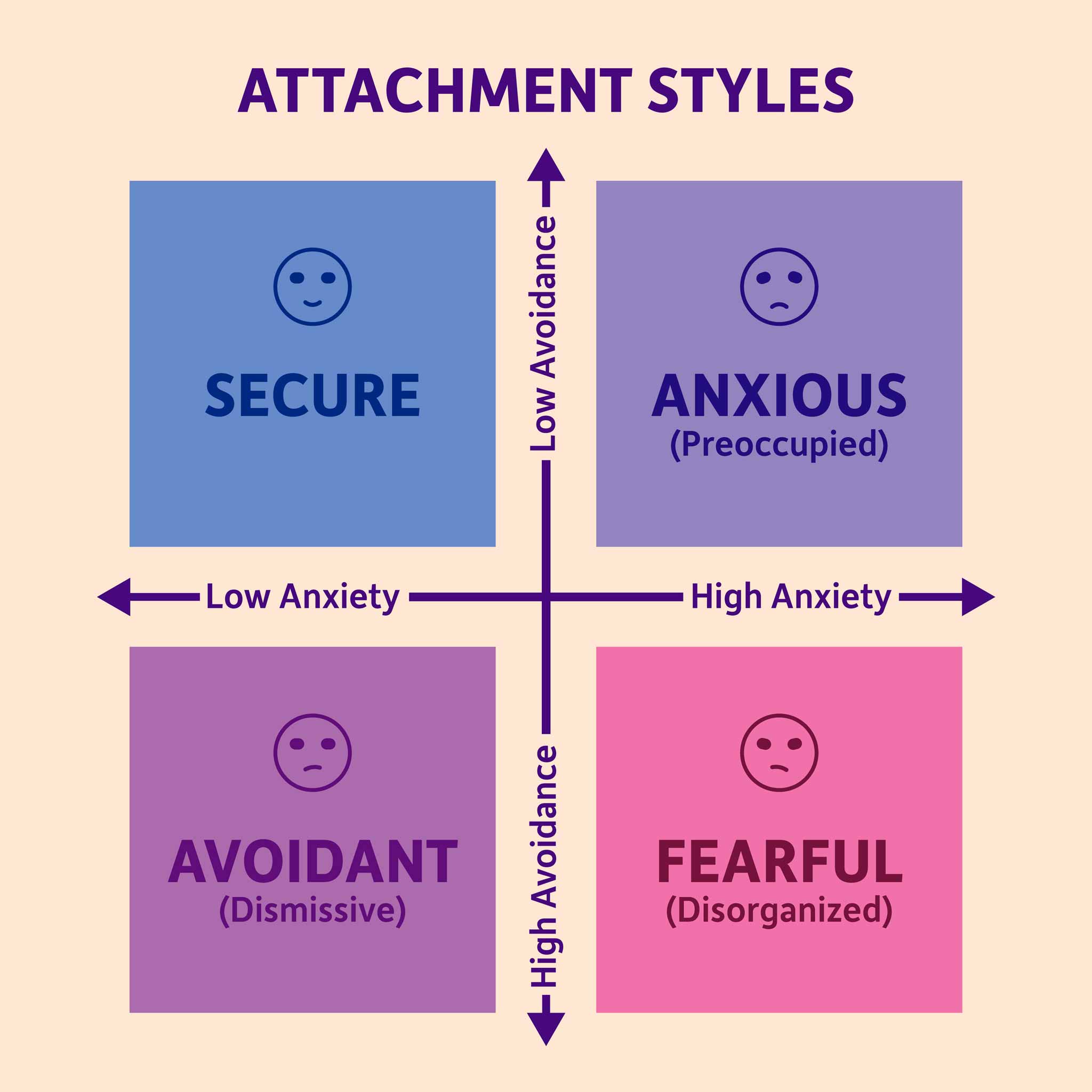
Secure attachment

This style is characterized by a deep sense of inner safety in relationships. Adults with secure attachment hold the belief that they are worthy of love, that others are generally reliable, and that emotional closeness is safe rather than threatening. This style typically develops when caregivers in childhood were emotionally responsive, consistent, and available during moments of distress.

As a result, the nervous system learns to expect comfort rather than rejection in close relationships. In adulthood, securely attached individuals are comfortable with both intimacy and independence. They communicate their needs openly, regulate emotions effectively during conflict, and are able to give and receive support without losing their sense of self. One of the strongest psychological strengths of secure attachment is the ability to repair after conflict—disagreements do not threaten the bond, but are experienced as manageable and temporary.

Anxious (preoccupied) attachment

This style develops when early caregiving was inconsistent or emotionally unpredictable—sometimes nurturing, sometimes unavailable. The child learns that love is uncertain and must be closely monitored. As adults, individuals with anxious attachment often believe they may be abandoned and that reassurance is necessary to feel safe. Closeness becomes strongly associated with security, which can lead to heightened emotional sensitivity.

In relationships, this shows up as fear of abandonment, overthinking messages or tone, and a constant need for reassurance. Self-soothing is difficult, so emotional regulation often depends on the partner’s responses. Common behaviors include clinging, people-pleasing, and emotional protest such as crying, anger, or threats of leaving. Internally, anxiously attached adults often feel “too much,” emotionally dependent, and chronically insecure—even when they are loved and cared for.

Avoidant (dismissive) attachment

This style is shaped by childhood environments where caregivers were emotionally distant, dismissive of feelings, or overly critical and demanding. In such settings, the child learns that expressing needs leads to rejection or disappointment, and that self-sufficiency is the safest strategy.

Adults with avoidant attachment tend to believe they can only rely on themselves, that needing others is risky, and that closeness threatens autonomy or control. In relationships, they often feel uncomfortable with emotional intimacy and struggle to express vulnerability. They value independence highly, withdraw during conflict, and may shut down emotionally when situations become intense. Common patterns include emotional distancing, avoiding difficult conversations, minimizing personal needs, or ending relationships when intimacy deepens. Although they may appear confident and self-reliant, avoidantly attached individuals often feel overwhelmed by emotions, fearful of dependence, and uncomfortable when others rely on them.

Fearful-avoidant (disorganized) attachment

It reflects a profound inner conflict around closeness. It often develops in the context of childhood trauma, abuse, neglect, or caregiving that was both comforting and frightening. In these early experiences, the child learns that the source of safety is also a source of fear, creating deep confusion.

Adults with fearful-avoidant attachment hold contradictory beliefs: they long for closeness but experience it as dangerous, associate love with pain, and struggle to know whom to trust. In relationships, this results in intense attraction followed by sudden withdrawal, push–pull dynamics, and difficulty trusting even loving partners. Emotional volatility is common. Behaviors may include sudden shutdowns, self-sabotage, and simultaneous fear of intimacy and abandonment. Internally, these individuals experience a powerful longing for connection mixed with fear, shame, and confusion, making relationships feel both deeply desired and deeply threatening.

Together, these attachment styles explain why people respond so differently to intimacy, conflict, and emotional closeness in adult relationships—and why many relationship struggles are rooted not in the present, but in early emotional learning.


Attachment Styles in Relationship Dynamics

Anxious + Avoidant: The Pursue–Withdraw Cycle

  • Anxious partner seeks closeness

  • Avoidant partner withdraws

  • Anxiety increases → pursuit intensifies

  • Avoidance deepens → distance grows

This cycle feels intense and addictive—but is emotionally exhausting.

Secure + Insecure

Secure partners can offer co-regulation, but only if boundaries and awareness exist.

Attachment Styles and Mental Health

Unresolved attachment wounds often manifest as:

  • Anxiety disorders

  • Depression

  • Trauma responses

  • Emotional dysregulation

  • Codependency

  • Fear of intimacy or abandonment

Many relationship conflicts are attachment triggers, not actual relationship problems.

Can Attachment Styles Change?

Yes. Attachment styles are learned—and therefore modifiable.

Healing occurs through:

  • Emotionally safe relationships

  • Therapy (especially attachment-informed or trauma-informed)

  • Developing self-awareness

  • Learning emotional regulation

  • Corrective relational experiences

Earned secure attachment is possible—even after trauma.

Attachment Styles in Counseling Practice

In therapy, attachment work involves:

  • Identifying attachment patterns

  • Understanding emotional triggers

  • Regulating the nervous system

  • Reworking internal working models

  • Practicing safe emotional expression

The therapeutic relationship itself often becomes the first secure base.

Key Takeaway

Attachment styles explain why love can feel safe, overwhelming, distant, or terrifying.

Relationships don’t trigger us randomly.
They activate old attachment memories asking to be healed.

Understanding your attachment style is not about blame—it is about awareness, compassion, and change.

Frequently Asked Questions (FAQ)

1. What are attachment styles in adult relationships?

Attachment styles are patterns of emotional bonding formed in early childhood that influence how adults experience intimacy, trust, conflict, and emotional closeness in relationships.


2. Can attachment styles change in adulthood?

Yes. Attachment styles are learned patterns, not fixed traits. Through self-awareness, emotionally safe relationships, and therapy, individuals can develop earned secure attachment.


3. What is the most common attachment style?

Secure attachment is the healthiest but not always the most common. Many adults show anxious, avoidant, or fearful-avoidant patterns due to early relational experiences.


4. Why do anxious and avoidant partners attract each other?

Anxious and avoidant styles often form a pursue–withdraw cycle, where one seeks closeness and the other seeks distance. The pattern feels familiar at a nervous-system level, even when it is distressing.


5. How do attachment styles affect conflict in relationships?

Attachment styles shape how people respond to threat:

  • Anxious styles intensify emotions to regain closeness

  • Avoidant styles withdraw to regain control

  • Secure styles seek repair and communication


6. Is attachment theory only about romantic relationships?

No. While attachment styles are most visible in romantic relationships, they also influence friendships, family dynamics, parenting, and even therapeutic relationships.


7. How does therapy help with attachment issues?

Therapy provides a secure relational space where clients can explore emotions, regulate the nervous system, and revise internal working models through corrective emotional experiences.

Written by Baishakhi Das

Counselor | Mental Health Practitioner
B.Sc, M.Sc, PG Diploma in Counseling


Reference 

Anxious–Avoidant Relationship Cycle Explained

https://clearbehavioralhealth.com/wp-content/uploads/2023/10/what-are-attachment-styles.jpg

The anxious–avoidant relationship cycle is one of the most common—and emotionally painful—patterns seen in intimate relationships. It occurs when two people with opposing attachment styles repeatedly activate each other’s deepest emotional fears. One partner seeks closeness and reassurance to feel safe, while the other seeks distance and autonomy to regulate overwhelm. This creates a recurring cycle of pursuit, withdrawal, misunderstanding, conflict, and emotional distance.

Over time, both partners feel increasingly unseen and misunderstood. The anxious partner may feel rejected or unimportant, while the avoidant partner may feel pressured or emotionally trapped. Each reaction unintentionally intensifies the other, reinforcing the cycle and making resolution feel harder with every repetition.

Importantly, this dynamic is not about lack of love or commitment. In many cases, it appears in relationships where both partners care deeply and genuinely want connection. The struggle arises because each person’s way of seeking emotional safety directly conflicts with the other’s. What feels like closeness to one feels like suffocation to the other, and what feels like space to one feels like abandonment to the other.

Without awareness, this pattern can slowly erode emotional security, trust, and intimacy. With understanding and intentional change, however, the cycle can be interrupted—allowing both partners to move toward a more balanced, emotionally safe relationship.

Understanding Attachment Styles 

Attachment styles develop early in life based on how caregivers consistently responded to a child’s emotional needs—such as comfort, availability, responsiveness, and emotional safety. Through these early interactions, children form internal beliefs about themselves (“Am I worthy of care?”) and others (“Are people reliable and emotionally available?”). These beliefs later guide how adults approach closeness, intimacy, conflict, and emotional regulation in their relationships.

According to the American Psychological Association, attachment patterns strongly influence how individuals regulate emotions, respond to perceived threats in relationships, and seek or avoid connection in close bonds. When emotional needs feel threatened, attachment systems activate automatically—often outside conscious awareness.

The anxious–avoidant relationship cycle most commonly involves two contrasting attachment styles:

  • Anxious attachment in one partner, characterized by a heightened need for closeness, reassurance, and emotional responsiveness. This partner is highly sensitive to signs of distance or disconnection and tends to move toward the relationship during stress.

  • Avoidant attachment in the other partner, characterized by discomfort with emotional dependency and a strong need for independence and self-reliance. This partner tends to move away from emotional intensity to regulate stress.

When these two styles interact, their opposing strategies for emotional safety collide—setting the stage for the pursue–withdraw cycle that defines the anxious–avoidant dynamic.

The Anxious Partner: Fear of Abandonment

People with an anxious attachment style tend to crave closeness and reassurance. Their core fear is abandonment or emotional rejection.

Common traits include:

  • Heightened sensitivity to emotional distance

  • Strong need for reassurance

  • Overthinking messages, tone, or changes in behavior

  • Fear of being “too much” yet feeling unable to stop reaching out

When they sense distance, their nervous system activates and they move toward their partner for safety.

The Avoidant Partner: Fear of Engulfment

People with an avoidant attachment style value independence and emotional self-reliance. Their core fear is loss of autonomy or emotional overwhelm.

Common traits include:

  • Discomfort with intense emotional closeness

  • Tendency to shut down during conflict

  • Difficulty expressing vulnerability

  • Belief that needing others is unsafe or weak

When emotional demands increase, their nervous system activates and they move away to regain control and calm.

How the Anxious–Avoidant Cycle Begins

The cycle usually unfolds in predictable stages:

1. Trigger

A small event—delayed reply, distracted tone, disagreement—activates attachment fears.

  • Anxious partner feels: “I’m being abandoned.”

  • Avoidant partner feels: “I’m being pressured.”

2. Pursue–Withdraw Pattern

  • The anxious partner pursues: calls, texts, questions, emotional discussions.

  • The avoidant partner withdraws: silence, distraction, emotional shutdown.

Each reaction intensifies the other.

3. Escalation

  • Anxious partner becomes more emotional, critical, or pleading.

  • Avoidant partner becomes colder, distant, or defensive.

Both feel misunderstood and unsafe.

4. Emotional Exhaustion

The relationship enters a phase of:

  • Repeated arguments

  • Emotional numbness

  • Feeling disconnected despite being together

The cycle may temporarily stop when one partner gives up or shuts down—but it resumes when closeness returns.

Why This Cycle Feels So Addictive

Paradoxically, anxious–avoidant relationships often feel intensely magnetic, especially in the early stages. The emotional highs and lows can create a powerful sense of connection that is easily mistaken for passion or deep compatibility.

This addictive pull exists because:

  • Familiar emotional patterns feel “normal,” even when painful.
    Attachment systems are shaped early in life. When a relationship recreates familiar emotional dynamics—such as chasing closeness or retreating for safety—it feels recognizable and psychologically compelling, even if it causes distress.

  • Intermittent closeness reinforces hope.
    Periods of emotional warmth followed by distance create a pattern similar to intermittent reinforcement. Occasional connection keeps hope alive, making partners believe that if they try harder, closeness will return and stay.

  • Each partner unconsciously attempts to heal old attachment wounds through the relationship.
    The anxious partner seeks reassurance that they are lovable and won’t be abandoned. The avoidant partner seeks closeness without feeling overwhelmed or losing autonomy. Both are trying to resolve unmet emotional needs—without realizing they are repeating the same pattern.

Without awareness and conscious change, this cycle slowly becomes emotionally exhausting and unstable. What once felt exciting begins to feel confusing, draining, and unsafe, increasing anxiety, withdrawal, and relational burnout rather than intimacy.

Psychological Impact of the Cycle

Over time, the anxious–avoidant cycle takes a significant psychological toll on both partners. Because emotional needs are repeatedly unmet, the relationship begins to feel unsafe, unpredictable, and exhausting.

This pattern can lead to:

  • Chronic anxiety or emotional numbness
    The anxious partner may remain in a constant state of worry, hypervigilance, and fear of abandonment, while the avoidant partner may cope by shutting down emotionally, leading to numbness and detachment.

  • Low self-esteem and self-blame
    Both partners often internalize the conflict. The anxious partner may believe they are “too much,” while the avoidant partner may see themselves as emotionally inadequate or incapable of closeness.

  • Increased conflict and misunderstanding
    Conversations become reactive rather than constructive. Small issues escalate quickly because attachment fears—not the present problem—are driving the interaction.

  • Emotional burnout within the relationship
    Repeated cycles of hope, disappointment, and disconnection drain emotional energy, leaving both partners feeling tired, resentful, or disengaged.

Many couples interpret these struggles as fundamental incompatibility or lack of love. In reality, the distress is often the result of unresolved attachment wounds being activated and replayed within the relationship. With awareness and support, this pattern can be understood—and interrupted—before it causes lasting emotional damage.

How to Break the Anxious–Avoidant Cycle

Breaking the cycle requires awareness, emotional regulation, and new relational skills.

1. Name the Pattern

Recognizing “We are in the pursue–withdraw cycle” reduces blame and increases insight.

2. Regulate Before Communicating

Attachment reactions are nervous-system responses. Pausing, grounding, and calming the body is essential before discussion.

3. Practice Secure Behaviors

  • Anxious partner: Practice self-soothing and tolerating space

  • Avoidant partner: Practice staying emotionally present during discomfort

Security is built through behavior, not intention.

4. Use Clear, Non-Blaming Language

Replace accusations with needs:

  • “I feel anxious when we disconnect; reassurance helps me.”

  • “I feel overwhelmed when emotions escalate; I need calm communication.”

5. Seek Professional Support

Attachment-based therapy or couples counseling can help both partners:

  • Understand their attachment wounds

  • Develop emotional safety

  •  Break unconscious patterns

Final Reflection

The anxious–avoidant cycle is not about one partner being “needy” and the other being “cold.”
It is about two nervous systems responding to threat and seeking safety in opposite ways—one through closeness, the other through distance.

When these protective strategies collide, both partners suffer, even though both are trying to preserve the relationship in the only way they know how.

With awareness, patience, and the right support, this cycle does not have to define the relationship. As partners learn to recognize their attachment patterns, regulate emotional responses, and communicate needs safely, the dynamic can soften—and in many cases, transform into a more secure, stable, and emotionally safe connection.

Healing begins not with blame, but with understanding.

Frequently Asked Questions (FAQ)

1. What is the anxious–avoidant relationship cycle?

The anxious–avoidant cycle is a recurring relationship pattern where one partner seeks closeness and reassurance (anxious attachment), while the other seeks distance and emotional space (avoidant attachment). Each partner’s coping strategy unintentionally triggers the other’s deepest emotional fears, leading to repeated conflict and disconnection.


2. Does this cycle mean the relationship is unhealthy or doomed?

Not necessarily. The presence of this cycle does not mean a lack of love or compatibility. It often reflects unresolved attachment wounds rather than conscious choices. With awareness, emotional regulation, and support, many couples are able to soften or break the cycle.


3. Why does the anxious partner keep pursuing?

The anxious partner’s nervous system is highly sensitive to emotional distance. Pursuing closeness, reassurance, or communication is an unconscious attempt to restore emotional safety and reduce fear of abandonment.


4. Why does the avoidant partner withdraw?

The avoidant partner experiences intense emotional closeness as overwhelming or threatening. Withdrawing helps them regulate stress, regain a sense of control, and protect their autonomy—even though it may unintentionally hurt their partner.


5. Can two people with these attachment styles have a healthy relationship?

Yes. Healing is possible when both partners:

  • Recognize the pattern

  • Take responsibility for their emotional responses

  • Practice secure behaviors

  • Learn to communicate needs without blame

Professional support often helps accelerate this process.


6. Is the anxious–avoidant cycle related to childhood experiences?

Yes. Attachment styles typically develop in early childhood based on caregiver responsiveness and emotional availability. These early experiences shape how adults approach intimacy, conflict, and emotional safety in relationships.


7. When should couples seek professional help?

Couples should consider therapy when:

  • The same conflicts repeat without resolution

  • Emotional distance or anxiety keeps increasing

  • Communication feels unsafe or reactive

  • One or both partners feel emotionally exhausted

Attachment-based or couples therapy can help identify patterns and create healthier relational dynamics.

Written by Baishakhi Das

Counselor | Mental Health Practitioner
Qualifications: B.Sc in Psychology | M.Sc  | PG Diploma in Counseling

Reference 

  1. American Psychological Association
    Attachment and close relationships
    https://www.apa.org/monitor/julaug09/attachment

  2. Bowlby, J. (1988).
    A Secure Base: Parent-Child Attachment and Healthy Human Development.
    https://psycnet.apa.org/record/1988-97390-000

  3. Hazan, C., & Shaver, P. R. (1987).
    Romantic love conceptualized as an attachment process. Journal of Personality and Social Psychology.
    https://psycnet.apa.org/record/1987-28436-001

  4. Johnson, S. M. (2019).
    Attachment Theory in Practice: Emotionally Focused Therapy (EFT).
    https://www.guilford.com/books/Attachment-Theory-in-Practice/Susan-Johnson/9781462538249

  5. Levine, A., & Heller, R. (2010).
    Attached: The New Science of Adult Attachment.
    https://www.attachedthebook.com

  6. Emotional Burnout: Symptoms You Shouldn’t Ignore


Attachment Theory: How Childhood Bonds Shape Adult Relationships

Human beings are wired for connection. From the moment we are born, our emotional survival depends on the quality of our earliest relationships. Attachment Theory explains how these early bonds—especially with primary caregivers—shape the way we love, trust, depend on others, and manage closeness throughout our lives.

Developed by John Bowlby and later expanded through research by Mary Ainsworth, attachment theory is now one of the most influential frameworks in developmental psychology, psychotherapy, and relationship counseling.

This article explores attachment theory in depth—its origins, attachment styles, psychological mechanisms, and how childhood bonding patterns continue to influence adult romantic relationships, emotional regulation, and mental health.

What Is Attachment Theory?

Attachment theory explains that early emotional bonds with caregivers shape an “internal working model”—a deeply ingrained psychological framework that guides how individuals perceive themselves, others, and relationships throughout life. This concept was originally proposed by John Bowlby, who emphasized that these models are formed in infancy through repeated interactions with primary caregivers.

What Is an Internal Working Model?

An internal working model is not a conscious belief system. Rather, it is an emotional and relational blueprint that answers some of life’s most fundamental questions:

    • How safe is the world?
      Early caregiving teaches a child whether the environment is predictable or threatening. Consistent care fosters a sense of safety, while neglect or unpredictability can create chronic anxiety or hypervigilance.

  • Are other people reliable and responsive?
    When caregivers respond sensitively, the child learns that others can be depended on. When responses are inconsistent, rejecting, or frightening, the child may learn to expect disappointment, abandonment, or emotional danger.

  • Am I worthy of love and care?
    The way a child’s needs are met (or dismissed) shapes self-worth. Attuned caregiving supports a sense of inherent worth, whereas repeated invalidation can lead to feelings of being “too much,” unimportant, or unlovable.

  • How should closeness and separation feel?
    Children learn whether closeness is comforting or overwhelming, and whether separation is tolerable or terrifying. These early lessons later influence how adults handle intimacy, distance, conflict, and loss.

How These Models Influence Adult Relationships

These internal working models do not disappear as we grow older. Instead, they operate quietly in the background, shaping adult relationship patterns—often without conscious awareness. They become especially active during emotionally charged moments such as:

  • Romantic conflict

  • Perceived rejection or abandonment

  • Deep intimacy or vulnerability

  • Grief, loss, or major life stress

For example:

  • Someone who learned that love is unpredictable may become anxious and clingy in relationships.

  • Someone who learned that emotions are ignored may suppress needs and avoid closeness.

  • Someone whose early bonds were frightening may both crave and fear intimacy at the same time.

What often appears as “overreacting,” “emotional distance,” or “relationship insecurity” is frequently the activation of an old attachment model, not a reaction to the present situation alone.

Why This Insight Is So Important

Attachment theory shifts the narrative from self-blame to understanding. It helps individuals recognize that many relationship behaviors are learned adaptations, not character flaws. These patterns once served a purpose—emotional survival in early relationships—even if they no longer serve well in adulthood.

In Simple Terms

How we were loved teaches us how to love.
But just as importantly, attachment theory reminds us that what was learned in early relationships can be unlearned, reshaped, and healed through awareness, emotionally safe relationships, and therapeutic support.

The Role of Early Caregivers

Infants are biologically programmed to seek closeness to caregivers for safety and comfort. Crying, clinging, and following are not “bad habits”—they are survival behaviors.

When caregivers respond with:

  • Consistency

  • Emotional attunement

  • Physical and emotional availability

the child learns:

“I am safe. My needs matter. Others can be trusted.”

When caregiving is inconsistent, rejecting, frightening, or absent, the child adapts by developing protective attachment strategies. These strategies help the child survive emotionally—but may later interfere with adult relationships.

The Four Main Attachment Styles

1. Secure Attachment

Childhood Experience

  • Caregivers are emotionally available and responsive

  • Child feels safe exploring and returning for comfort

Adult Relationship Patterns

  • Comfortable with intimacy and independence

  • Able to communicate needs clearly

  • Trusts partners and manages conflict constructively

Core Belief

“I am worthy of love, and others can be trusted.”

Secure attachment is associated with healthier relationships, emotional regulation, and psychological resilience.

  1. Anxious (Preoccupied) Attachment

Childhood Experience

  • Inconsistent caregiving

  • Love feels unpredictable

Adult Relationship Patterns

  • Fear of abandonment

  • Constant need for reassurance

  • Hypervigilance to partner’s moods

  • Difficulty tolerating distance

Core Belief

“I must stay close to be loved, or I will be abandoned.”

Anxious attachment often shows up as people-pleasing, emotional dependency, and intense relationship anxiety.

  1. Avoidant (Dismissive) Attachment

Childhood Experience

  • Emotionally distant or rejecting caregivers

  • Emotional needs minimized or ignored

Adult Relationship Patterns

  • Discomfort with closeness

  • Strong independence

  • Emotional withdrawal during conflict

  • Difficulty expressing vulnerability

Core Belief

“Depending on others is unsafe; I must rely on myself.”

Avoidant attachment is often mistaken for confidence, but it is rooted in emotional self-protection.

  1. Fearful-Avoidant (Disorganized) Attachment

Childhood Experience

  • Caregivers are frightening, abusive, or unpredictable

  • Child experiences both comfort and fear from the same figure

Adult Relationship Patterns

  • Desire for closeness combined with fear of it

  • Push–pull relationship dynamics

  • Emotional chaos, mistrust

  • Higher risk of trauma-related symptoms

Core Belief

“I want connection, but it is dangerous.”

This style is strongly linked to childhood trauma and unresolved emotional wounds.

How Attachment Styles Shape Adult Romantic Relationships

Attachment patterns are often most clearly expressed in close romantic relationships, because these relationships activate the same emotional systems that were shaped in early caregiving. Romantic partners unconsciously become attachment figures, which means old emotional expectations are easily reawakened—especially during moments of threat or uncertainty.

When Attachment Patterns Become Most Visible

Attachment behaviors tend to intensify when:

1. There Is Emotional Vulnerability

Moments of openness—such as expressing needs, sharing fears, or depending on a partner—can activate deep attachment responses. For securely attached individuals, vulnerability feels connecting. For insecurely attached individuals, it may trigger fear of rejection, engulfment, or emotional exposure.

For example:

  • Anxiously attached individuals may seek constant reassurance

  • Avoidantly attached individuals may withdraw or minimize emotions

  • Fearfully attached individuals may oscillate between closeness and distance

screenshot 2025 11 20 000712

  1. Conflict Arises

Conflict signals a potential threat to connection. During disagreements, attachment systems become highly active, often overriding logic and calm communication.

  • Anxious attachment may show as heightened emotional expression, protest behaviors, or fear-driven arguments

  • Avoidant attachment may show as emotional shutdown, defensiveness, or avoidance of discussion

  • Secure attachment allows for disagreement without fear of abandonment

Conflict is rarely just about the topic—it is about whether the bond feels safe.

  1. Separation or Rejection Is Perceived

Actual or imagined separation—missed calls, emotional distance, delayed responses, or perceived indifference—can strongly trigger attachment fears.

  • Anxious individuals may experience intense distress and fear abandonment

  • Avoidant individuals may detach emotionally to regain control

  • Fearful individuals may experience confusion, mistrust, and emotional chaos

Even minor events can feel overwhelming when they echo early attachment wounds.

Common Relationship Dynamics Explained

Anxious–Avoidant Dynamic: The Pursuit–Withdrawal Pattern

This is one of the most common and painful relationship patterns.

  • The anxious partner seeks closeness, reassurance, and emotional engagement

  • The avoidant partner experiences this as pressure and pulls away

  • The more one pursues, the more the other withdraws

Both partners are trying to feel safe—but using opposite strategies shaped by early attachment experiences.

Fearful Attachment: Intense and Unstable Relationships

Individuals with fearful (disorganized) attachment often crave closeness but fear it at the same time.

This can lead to:

  • Push–pull dynamics

  • Sudden emotional shifts

  • Difficulty trusting partners

  • High emotional intensity followed by withdrawal

These relationships are often marked by passion, confusion, and repeated ruptures.

Secure Attachment: Emotional Safety and Repair

Securely attached partners are not conflict-free, but they are repair-oriented.

They tend to:

  • Communicate needs openly

  • Tolerate vulnerability

  • Take responsibility during conflict

  • Reconnect after emotional ruptures

The key difference is not the absence of problems, but the ability to repair and reconnect.

Why Many Conflicts Are About the Past, Not the Present

Many relationship arguments appear to be about:

  • Tone of voice

  • Texting frequency

  • Time spent together

  • Minor disagreements

But underneath, they are often driven by old attachment fears such as:

  • “I will be abandoned”

  • “My needs don’t matter”

  • “Closeness is unsafe”

  • “I will lose myself if I depend on someone”

When these fears are triggered, partners react from a younger emotional state, responding not only to the present partner but to past relational experiences.

A Therapeutic Perspective

Understanding attachment dynamics helps individuals and couples shift from blame to insight. Instead of asking:

“Why are we always fighting about this?”

They can ask:

“What attachment need is being threatened right now?”

This shift opens the door to empathy, emotional safety, and lasting change.

screenshot 2025 11 24 000049

Attachment styles strongly influence how adults manage emotions:

  • Secure attachment → balanced emotional regulation

  • Anxious attachment → emotional overwhelm

  • Avoidant attachment → emotional suppression

  • Disorganized attachment → emotional dysregulation

This explains why some people:

  • Shut down during conflict

  • Become emotionally reactive

  • Struggle to express needs

  • Feel numb or overwhelmed in relationships

Attachment, Trauma, and Mental Health

Attachment theory is central to trauma-informed care. Early neglect, abuse, or chronic emotional invalidation disrupt attachment security and increase vulnerability to:

  • Anxiety disorders

  • Depression

  • Complex trauma

  • Relationship burnout

  • Emotional numbness

Importantly, attachment adaptations are not flaws—they are survival responses.

Can Attachment Styles Change?

Yes. Attachment is not fixed.

Attachment styles can shift through:

  • Secure romantic relationships

  • Psychotherapy (especially attachment-based therapy)

  • Self-awareness and emotional skills training

  • Corrective emotional experiences

Therapy often provides what was missing earlier: consistency, safety, validation, and emotional attunement.

Attachment Theory in Counseling and Psychotherapy

Mental health professionals use attachment theory to:

  • Understand relationship patterns

  • Address fear of abandonment or intimacy

  • Heal childhood emotional wounds

  • Improve emotional regulation

  • Strengthen relational security

It is widely integrated into:

  • Psychodynamic therapy

  • Emotionally Focused Therapy (EFT)

  • Trauma-informed approaches

Why Attachment Theory Matters

Attachment theory helps us move away from self-blame and toward understanding. It reframes struggles as learned relational patterns, not personal defects.

It answers powerful questions:

  • Why do I fear closeness?

  • Why do I chase unavailable partners?

  • Why does intimacy feel overwhelming or unsafe?

And most importantly, it offers hope:

What was learned in relationship can be healed in relationship.

Final Reflection

Attachment theory reminds us that love is not just an emotion—it is a developmental experience. Our earliest bonds shape how we connect, protect ourselves, and seek comfort. But they do not define our destiny.

With awareness, supportive relationships, and therapeutic work, individuals can move toward earned secure attachment, building healthier, safer, and more fulfilling relationships across adulthood.

Frequently Asked Questions (FAQ): Attachment Theory & Adult Relationships


1. What is attachment theory?

Attachment theory explains how early emotional bonds with caregivers shape our expectations of safety, closeness, and trust in relationships. It was developed by John Bowlby and expanded through research by Mary Ainsworth.


2. What is an “internal working model”?

An internal working model is a mental–emotional blueprint formed in childhood that influences:

  • How safe the world feels

  • Whether others can be trusted

  • How worthy we feel of love

  • How we experience closeness and separation

These models guide adult relationship behavior, often outside conscious awareness.


3. What are the main attachment styles?

The four commonly described attachment styles are:

  • Secure – comfortable with intimacy and independence

  • Anxious (Preoccupied) – fears abandonment, seeks reassurance

  • Avoidant (Dismissive) – values independence, avoids vulnerability

  • Fearful-Avoidant (Disorganized) – desires closeness but fears it


4. How do attachment styles affect adult romantic relationships?

Attachment styles influence how people:

  • Communicate needs

  • Handle conflict

  • Respond to emotional closeness

  • React to distance or rejection

For example, anxious partners may pursue reassurance, while avoidant partners may withdraw, creating a pursue–withdraw cycle.


5. Why do small conflicts feel so intense in some relationships?

Because conflicts often activate old attachment fears, such as abandonment, rejection, or loss of control. The emotional reaction may be less about the present issue and more about earlier relational experiences being triggered.


6. Can attachment styles change over time?

Yes. Attachment styles are not fixed traits. They can shift through:

  • Secure and emotionally responsive relationships

  • Psychotherapy (especially attachment-based or trauma-informed therapy)

  • Increased self-awareness and emotional regulation skills

Many adults develop what is called earned secure attachment.


7. Is insecure attachment a sign of weakness?

No. Insecure attachment patterns are adaptive survival strategies learned in response to early environments. They helped individuals cope emotionally at the time, even if they create difficulties later.


8. How is attachment theory used in therapy?

Therapists use attachment theory to:

  • Understand relationship patterns

  • Address fear of abandonment or intimacy

  • Improve emotional regulation

  • Heal childhood emotional wounds

It is commonly integrated into psychodynamic therapy, Emotionally Focused Therapy (EFT), and trauma-informed care.


9. Does attachment theory apply only to romantic relationships?

No. Attachment patterns influence all close relationships, including friendships, parent–child bonds, and even therapeutic relationships. Romantic partnerships simply activate attachment systems more strongly.


10. What is the key message of attachment theory?

The central message is hopeful:
How we learned to love can be relearned.
Early relationships shape us, but they do not define our future. With awareness, safety, and support, healthier patterns of connection are always possible.

Reference


Why Jab We Met Is So Relatable: A Psychological Analysis of Aditya, Geet & Their Emotional Compatibility

Even years after its release, Jab We Met continues to feel deeply personal for audiences. It is quoted, revisited, and emotionally remembered not just as a romantic film, but as a mirror to our inner emotional world.
The reason for this timeless relatability lies not in grand romance — but in psychological truth.

At its core, Jab We Met is not a love story.
It is a story of two nervous systems, two attachment styles, and two wounded individuals finding emotional balance through connection.

Why Does Jab We Met Feel So Personal?

Most Bollywood romances idealize love. Jab We Met humanizes it.

People don’t relate to Aditya and Geet because they are perfect —
they relate because they are emotionally real.

  • Aditya represents emotional shutdown, burnout, and silent suffering.

  • Geet represents emotional intensity, impulsivity, and hidden insecurity.

Together, they reflect the two extremes most people oscillate between at different phases of life.

Aditya Kashyap: The Silent, Emotionally Wounded Personality

1. Psychological Profile of Aditya

Aditya begins the movie emotionally withdrawn, numb, and directionless. Psychologically, this reflects:

  • Situational depression

  • Emotional suppression

  • Learned helplessness

  • Loss of self-worth after relational rejection

He is not weak — he is emotionally exhausted.

2. Personality Traits

  • Introverted

  • Highly conscientious

  • Responsible and disciplined

  • Emotionally intelligent but emotionally closed

Aditya feels deeply but does not express pain outwardly. This inward processing is often misinterpreted as coldness, but in psychology, it reflects internalized coping.

3. Attachment Style: Secure but Temporarily Wounded

Despite his shutdown, Aditya shows signs of a secure attachment style:

  • He does not chase validation

  • He respects boundaries

  • He offers emotional safety

  • He remains stable during emotional chaos

His silence is not avoidance — it is emotional overload.

4. Aditya’s Growth Arc: Post-Traumatic Growth

Through Geet, Aditya experiences post-traumatic growth:

  • Reconnecting with joy

  • Regaining confidence

  • Rediscovering purpose

  • Reclaiming emotional expression

He does not change his personality —
he returns to himself.

Geet Dhillon: The Loud, Emotionally Intense Personality

1. Psychological Profile of Geet

Geet is expressive, impulsive, energetic, and emotionally driven. But beneath her confidence lies:

  • Fear of rejection

  • Fear of abandonment

  • Emotional dependency

  • Identity tied to relationships

Her loudness is not arrogance — it is emotional survival.

2. Personality Traits

  • Highly extroverted

  • Emotion-focused decision making

  • Expressive and spontaneous

  • Emotionally sensitive

Geet feels everything at full intensity — joy, love, excitement, and pain.

3. Attachment Style: Anxious-Preoccupied

Geet perfectly reflects the anxious attachment style:

  • Seeks reassurance

  • Fears being left

  • Loves intensely

  • Struggles with emotional regulation

Her positivity, jokes, and constant talking act as defense mechanisms to mask insecurity.

4. Emotional Collapse: When the Mask Breaks

When Geet’s relationship collapses, her entire identity collapses with it. This moment reveals a key psychological truth:

Loud people don’t feel less — they feel more.

Her breakdown shows emotional burnout, grief, and abandonment trauma surfacing once her emotional anchor disappears.

Why Aditya and Geet Work Together: Compatibility Psychology

1. Secure + Anxious Attachment Compatibility

Psychologically, their bond works because:

  • Geet’s anxious attachment finds safety in Aditya’s secure presence

  • Aditya’s emotional numbness is softened by Geet’s warmth

  • One regulates emotion; the other activates emotion

This is co-regulation, not dependence.

2. Emotional Balance, Not Emotional Rescue

Aditya does not “save” Geet.
Geet does not “fix” Aditya.

Instead:

  • Geet helps Aditya feel again

  • Aditya helps Geet feel safe

Healthy relationships don’t change personalities —
they stabilize nervous systems.

3. Anchor & Fire Dynamic

  • Aditya is the anchor — grounding, steady, calm

  • Geet is the fire — energetic, expressive, passionate

Fire without an anchor burns out.
An anchor without fire stays unmoved.

Together, they create emotional balance.

Why Modern Audiences Still Relate

In today’s world:

  • Many people feel emotionally numb like Aditya

  • Many feel emotionally overwhelmed like Geet

Jab We Met validates both experiences without judgment.

It shows:

  • You don’t need to be emotionally perfect to be loved

  • Healing happens through safety, not intensity

  • Emotional maturity is quieter than passion

The Deeper Message of Jab We Met

The film subtly teaches that:

  • Love should calm your nervous system, not confuse it

  • Emotional safety is more powerful than emotional drama

  • Compatibility is psychological, not just romantic

Conclusion: A Love Story That Heals, Not Hurts

Jab We Met remains relatable because it reflects real emotional struggles:

  • Silent suffering

  • Emotional chaos

  • Attachment wounds

  • Healing through connection

Aditya and Geet are not ideal lovers.
They are emotionally human — and that’s why they stay with us.

Sometimes love doesn’t arrive to excite you —
it arrives to regulate you.

Reference

Attachment Theory

Psychology Today – Attachment Styles
https://www.psychologytoday.com/us/basics/attachment

Verywell Mind – Anxious vs Secure Attachment
https://www.verywellmind.com/attachment-styles-2795344