
Why These Foundations Matter Clinically
Understanding the core principles of Erikson’s theory gives mental health professionals a developmental framework for understanding psychological struggles rather than viewing them simply as symptoms or personal shortcomings. In practice, this perspective can help clinicians:
- Normalize clients’ struggles as part of psychological development rather than personal failures.
- Identify possible developmental roots of recurring emotional and behavioral patterns.
- Understand how earlier experiences may influence present relationships, self-esteem, and coping.
- Frame healing as an ongoing developmental process rather than a quick “fix.”
- Recognize strengths and resilience alongside psychological difficulties.
- Most importantly, instill hope that growth and psychological change remain possible at every stage of life.
In essence, Erikson’s theory tells us this: You are not broken—you are still developing.
Your struggles may reflect unfinished developmental work, unmet emotional needs, or patterns learned through earlier experiences—not personal weakness.
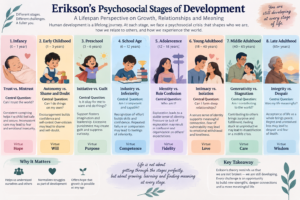
Erikson’s Psychosocial Stages
Stage 1: Trust vs. Mistrust (Infancy | 0–1 year)
Central Question: Can I trust the world?
To begin with, infancy marks the foundation of psychosocial development. During this stage, the child gradually develops basic trust when caregivers consistently respond to essential needs such as feeding, comfort, warmth, protection, and emotional responsiveness.
In other words, the infant begins learning whether the world is a relatively safe and predictable place. When caregivers respond consistently, the child develops an expectation that distress will be noticed and needs will be addressed.
Healthy Resolution
When caregiving is sufficiently consistent and responsive:
- The child develops a sense of safety and security.
- The child begins to expect that basic needs will be met.
- As a result, the child develops greater confidence in the reliability of the environment.
- This stage contributes to the virtue of Hope.
Unhealthy Resolution
However, when caregiving is consistently inconsistent, neglectful, frightening, or unresponsive:
- The child may develop mistrust toward the environment.
- The child may experience greater emotional insecurity and difficulty expecting reliable care.
- Over time, this may contribute to heightened fear or difficulty relying on others.
Adult Impact:
Although adult behavior cannot be explained by a single developmental stage, unresolved difficulties around trust may later appear as difficulty depending on others, relationship insecurity, fear of abandonment, or difficulty feeling emotionally safe in close relationships.
Stage 2: Autonomy vs. Shame and Doubt (Early Childhood | 1–3 years)
Central Question: Can I do things on my own?
Following the development of basic trust, children begin seeking greater independence. As toddlers develop motor, language, and self-care abilities, they increasingly want to make choices and exercise control over their environment. Everyday behaviors—such as choosing clothes, attempting to feed themselves, exploring independently, and repeatedly saying “no”—are therefore important expressions of emerging autonomy.
Healthy Resolution
When caregivers provide appropriate encouragement, patience, and reasonable boundaries:
- The child gains opportunities to make age-appropriate choices.
- Consequently, the child develops greater confidence and self-control.
- Mistakes become opportunities for learning rather than sources of humiliation.
- This stage contributes to the virtue of Will.
Unhealthy Resolution
On the other hand, excessive criticism, punishment, overcontrol, or constant correction may cause the child to doubt their abilities.
- The child may begin to associate mistakes with shame.
- As a result, the child may become hesitant to explore or make independent choices.
- Repeated messages that they are incapable may contribute to self-doubt.
Adult Impact:
Later in life, these patterns may appear as low self-confidence, excessive dependence on others’ decisions, perfectionistic tendencies, difficulty asserting needs, or fear of making mistakes.
Stage 3: Initiative vs. Guilt (Preschool | 3–6 years)
Central Question: Is it okay for me to want and do things?
As children become more independent, they begin taking greater initiative. They create games, ask questions, imagine different roles, make plans, and experiment with influencing the world around them. Through these experiences, they gradually learn whether their curiosity and self-directed actions are welcomed or discouraged.
Healthy Resolution
When adults encourage curiosity while providing appropriate limits:
- Children become more comfortable initiating activities.
- Furthermore, they develop imagination, planning, and early leadership skills.
- They learn that having desires and taking action can be acceptable.
- This stage contributes to the virtue of Purpose.
Unhealthy Resolution
However, excessive punishment, criticism, or discouragement may cause children to associate their desires and actions with guilt.
- The child may become afraid of doing something “wrong.”
- Consequently, curiosity and spontaneous exploration may be suppressed.
- The child may hesitate to express needs, ideas, or ambitions.
Adult Impact:
These patterns may later be reflected in chronic guilt, difficulty asserting personal needs, excessive concern about disappointing others, or hesitation when taking initiative.
Stage 4: Industry vs. Inferiority (School Age | 6–12 years)
Central Question: Am I competent and capable?
As children enter the school years, their social world expands considerably. Academic tasks, extracurricular activities, peer relationships, feedback from teachers, and comparison with others increasingly shape their understanding of competence.
At this stage, children begin evaluating themselves in relation to what they can accomplish. Therefore, repeated experiences of effort, learning, and mastery can strengthen confidence, whereas persistent criticism or comparison may contribute to feelings of inadequacy.
Healthy Resolution
When children receive appropriate encouragement and recognition for their efforts:
- They develop confidence in their abilities and skills.
- Moreover, successful experiences encourage persistence when tasks become difficult.
- The child gradually develops a sense of competence.
- This stage contributes to the virtue of Competence.
Unhealthy Resolution
In contrast, repeated failure, harsh criticism, unrealistic expectations, or constant comparison may contribute to feelings of inferiority.
- The child may begin to believe they are “not good enough.”
- As a result, they may avoid challenging situations to protect themselves from further failure.
- Their self-worth may become overly dependent on achievement or external approval.
Adult Impact:
Later, this may appear as workplace insecurity, fear of failure, excessive comparison, achievement-related anxiety, or impostor-like feelings.
Stage 5: Identity vs. Role Confusion (Adolescence | 12–18 years)
Central Question: Who am I?
Building on the earlier development of competence, adolescence brings a major shift toward identity formation. During this period, young people begin exploring their beliefs, values, relationships, future goals, career aspirations, and sense of belonging.
Rather than simply accepting identities assigned by family or society, adolescents need opportunities to explore, question, experiment, and gradually develop a coherent sense of self.
Healthy Resolution
When adolescents receive sufficient space for exploration along with appropriate guidance and social support:
- Exploration can contribute to a more stable and coherent identity.
- Furthermore, the individual becomes increasingly able to distinguish personal values from external expectations.
- A stronger sense of self supports more authentic decision-making.
- This stage contributes to the virtue of Fidelity.
Unhealthy Resolution
However, excessive pressure, rigid expectations, rejection, or limited opportunities for exploration may contribute to role confusion.
- The adolescent may become uncertain about who they are or what they value.
- As a result, they may become heavily dependent on others’ expectations or approval.
- Identity may feel unstable, fragmented, or difficult to define.
Adult Impact:
These difficulties may later appear as chronic self-doubt, career uncertainty, difficulty making autonomous choices, unstable relationships, or an unclear sense of personal values and direction.
Stage 6: Intimacy vs. Isolation (Young Adulthood | 18–40 years)
Central Question: Can I form deep relationships?
Once individuals develop a stronger sense of identity, the developmental focus increasingly shifts toward intimacy and meaningful connection. Young adults may seek deeper romantic relationships, friendships, emotional bonds, and forms of mutual commitment.
Importantly, intimacy involves more than simply being in a relationship. It requires the ability to remain emotionally connected while maintaining a sense of self, allowing vulnerability, reciprocity, trust, and mutual respect.
Healthy Resolution
When individuals can combine a reasonably secure sense of identity with emotional openness:
- They become more capable of forming secure and reciprocal relationships.
- Moreover, they can experience vulnerability without completely losing their sense of self.
- They develop the capacity for meaningful emotional connection.
- This stage contributes to the virtue of Love.
Unhealthy Resolution
On the other hand, fear of vulnerability, difficulty trusting others, unresolved identity struggles, or repeated relational rejection may contribute to isolation.
- The individual may avoid emotional closeness.
- Consequently, they may withdraw from relationships or struggle to sustain meaningful connections.
- Prolonged emotional isolation may contribute to loneliness and dissatisfaction.
Clinical Insight:
Relationship difficulties should not automatically be attributed to one developmental stage. Nevertheless, Erikson’s framework can help clinicians explore whether current intimacy difficulties are connected to earlier struggles involving trust, autonomy, or identity.
Stage 7: Generativity vs. Stagnation (Middle Adulthood | 40–65 years)
Central Question: Am I contributing to the world?
As adulthood progresses, the focus often expands beyond personal achievement toward contribution, responsibility, and meaningful involvement in the lives of others. Erikson described this developmental orientation as generativity.
Generativity may involve raising children, mentoring younger people, contributing to a community, creating meaningful work, teaching, caregiving, or investing in something that extends beyond the self.
Healthy Resolution
When individuals experience opportunities to contribute meaningfully:
- They develop a sense of productivity and purpose.
- Furthermore, they may experience greater satisfaction from nurturing people, projects, or communities.
- Their attention increasingly includes the well-being of future generations.
- This stage contributes to the virtue of Care.
Unhealthy Resolution
However, when individuals feel disconnected from meaningful contribution:
- They may experience stagnation, dissatisfaction, or a sense of being stuck.
- Over time, life may begin to feel repetitive or emotionally empty.
- Excessive self-focus without meaningful engagement with others may contribute to reduced purpose.
Adult Impact:
These struggles may be reflected in burnout, dissatisfaction with work or relationships, loss of direction, emotional emptiness, or questions about whether one’s life is making a meaningful contribution.
Stage 8: Integrity vs. Despair (Late Adulthood | 65+ years)
Central Question: Was my life meaningful?
Finally, in late adulthood, individuals may increasingly engage in life review and reflection. They may look back on relationships, accomplishments, failures, losses, choices, and missed opportunities while also confronting aging and mortality.
The central task is not to decide whether life was perfect. Rather, it involves developing a sense that one’s life can be accepted as a whole, including both meaningful experiences and painful limitations.
Healthy Resolution
When individuals can integrate their life experiences with a sense of acceptance:
- They may develop a greater sense that their life has meaning and coherence.
- Moreover, they may experience greater peace regarding both accomplishments and limitations.
- Acceptance can reduce the need to deny difficult experiences or idealize the past.
- This stage contributes to the virtue of Wisdom.
Unhealthy Resolution
In contrast, when life review becomes dominated by regret, bitterness, unresolved loss, or profound dissatisfaction:
- The individual may become preoccupied with what cannot be changed.
- As a result, they may experience despair, hopelessness, or intense fear surrounding mortality.
- A persistent sense that life was wasted or meaningless can make this stage particularly painful.
In this final stage, Erikson’s lifespan perspective comes full circle: development ultimately involves not only growing, achieving, and connecting, but also integrating the entire life story and finding meaning within it.
Erikson’s Psychosocial Stages: Why Erikson’s Theory Still Matters Today
Erik Erikson designed his psychosocial model not only as a theory of development, but as a practical framework for understanding human suffering, resilience, and growth. Because it links emotional difficulties to developmental experiences, Erikson’s model is widely used across multiple mental health and helping professions.
Below is an expanded explanation of how and why Erikson’s model is applied in these fields, and how unresolved psychosocial crises often appear in adult psychological struggles.
1. Psychotherapy and Counseling
In psychotherapy, Erikson’s model helps clinicians understand where emotional development may have stalled.
Therapists often use the stages to:
- Identify core emotional wounds (e.g., mistrust, shame, identity confusion)
- Understand recurring relationship patterns
- Explore early caregiving experiences without blame
- Frame problems developmentally rather than pathologically
Clinical Examples
- Chronic fear of abandonment → unresolved Trust vs. Mistrust
- Excessive self-criticism → unresolved Autonomy vs. Shame
- Lack of direction or emptiness → unresolved Identity vs. Role Confusion
Using Erikson’s framework allows therapy to focus on repairing developmental needs, not just reducing symptoms. This aligns well with psychodynamic, attachment-based, and integrative therapeutic approaches.
2. Child Development and Parenting Guidance
In child psychology and parenting education, Erikson’s stages offer clear age-appropriate emotional tasks.
Professionals use the model to:
- Help parents understand normal developmental behaviors
- Prevent over-control or excessive criticism
- Encourage autonomy, initiative, and competence
- Reduce shame-based parenting practices
Practical Parenting Insights
- Toddlers need choices to develop autonomy
- Preschoolers need encouragement, not punishment, for curiosity
- School-age children need recognition of effort, not comparison
By aligning parenting strategies with psychosocial stages, caregivers can support emotionally secure and confident children, reducing the risk of later mental health difficulties.
3. Career Counseling and Vocational Guidance
Erikson’s theory is highly relevant in career counseling, especially during adolescence, early adulthood, and midlife.
Career counselors apply the model to:
- Understand identity struggles behind career indecision
- Address fear of failure rooted in inferiority
- Support career transitions and midlife re-evaluation
- Help clients connect work with meaning and contribution
Developmental Lens in Career Issues
- Frequent job changes → identity confusion
- Fear of leadership roles → unresolved inferiority
- Midlife burnout → stagnation vs. generativity conflict
Rather than pushing quick career choices, Erikson’s model encourages identity exploration and value clarification, leading to more sustainable career paths.
4. Geriatric Mental Health
In geriatric psychology, Erikson’s final stage—Integrity vs. Despair—is central to emotional well-being in later life.
Mental health professionals use this stage to:
- Support life review and meaning-making
- Address regret, grief, and fear of death
- Reduce depression and existential distress
- Promote acceptance and wisdom
Therapeutic Applications
- Reminiscence therapy
- Narrative therapy
- Meaning-centered interventions
Helping older adults integrate life experiences—both successes and failures—supports emotional peace and dignity in aging.
5. Trauma-Informed Care
Trauma often disrupts psychosocial development by interfering with safety, trust, autonomy, and identity. Erikson’s model is therefore especially valuable in trauma-informed care.
Practitioners use it to:
- Understand trauma as developmental interruption
- Avoid blaming clients for survival adaptations
- Create corrective emotional experiences
- Restore a sense of control, connection, and meaning
Trauma and Development
- Childhood abuse → mistrust and shame
- Chronic neglect → emotional numbness
- Complex trauma → fragmented identity
Erikson’s framework helps clinicians meet clients at the developmental level where trauma occurred, rather than focusing only on adult symptoms.
Erikson’s Psychosocial Stages: Understanding Adult Psychological Struggles Through Erikson’s Lens
Many adult difficulties are not random—they are developmental echoes:
- Relationship difficulties often reflect unresolved trust or intimacy conflicts
- Low self-worth frequently stems from shame or inferiority
- Emotional numbness can be a defense developed during earlier unmet emotional needs
By identifying which psychosocial crisis remains unresolved, therapy can move from “What’s wrong with me?” to “What developmental need was unmet?”
Erikson’s Psychosocial Stages :Why This Model Remains Clinically Powerful
Erikson’s theory is still widely used because it:
- Humanizes psychological distress
- Normalizes struggle as part of development
- Integrates well with modern therapeutic approaches
- Offers hope that healing is possible at any stage of life

Erikson’s Psychosocial Stages : Clinical and Counseling Applications
As a counselor or mental health practitioner, Erikson’s stages help:
- Identify developmental wounds
- Understand recurring behavioral patterns
- Tailor interventions based on life stage
- Normalize clients’ struggles as developmental, not personal failures
Conclusion
Erik Erikson’s psychosocial theory offers a deeply compassionate and hopeful view of human development. At its core, it reminds us that growth does not stop at childhood or adolescence—it continues throughout the entire lifespan, shaped by relationships, reflection, and lived experience.
Frequently Asked Questions (FAQ): Erikson’s Psychosocial Theory
1. Who proposed the psychosocial theory of development (Erikson’s Psychosocial Stages)?
Erikson’s psychosocial theory was proposed by Erik Erikson, a German-American developmental psychologist. He expanded earlier psychoanalytic ideas by emphasizing the role of social relationships and culture in shaping personality across the entire lifespan.
2. How many stages are there in Erikson’s psychosocial theory (Erikson’s Psychosocial Stages)?
Erikson proposed eight psychosocial stages, spanning from infancy to late adulthood. Each stage involves a central psychological conflict that must be negotiated for healthy emotional development.
3. What is meant by a “psychosocial crisis” (Erikson’s Psychosocial Stages)?
A psychosocial crisis refers to a developmental conflict between two opposing tendencies (for example, trust vs. mistrust or intimacy vs. isolation). These crises are not disasters; they are normal psychological challenges that promote growth when addressed constructively.
4. What happens if a Erikson’s Psychosocial Stages is not resolved properly?
If a stage is not resolved in a healthy way, it may lead to:
- Emotional insecurity
- Low self-esteem
- Relationship difficulties
- Identity confusion
However, Erikson emphasized that unresolved stages are not permanent failures. They can be revisited and healed later in life through insight, supportive relationships, and therapy.
5. Can adults revisit and resolve earlier Erikson’s Psychosocial Stages (Erikson’s Psychosocial Stages)?
Yes. One of the most important aspects of Erikson’s theory is that development is lifelong. Adults often revisit earlier stages during:
- Romantic relationships
- Career transitions
- Parenthood
- Therapy
- Major life crises
These moments provide opportunities for corrective emotional experiences and psychological healing.
6. How is Erikson’s theory used in psychotherapy and counseling (Erikson’s Psychosocial Stages )?
Therapists use Erikson’s framework to:
- Identify developmental roots of emotional struggles
- Understand recurring relationship patterns
- Normalize clients’ difficulties as developmental, not pathological
- Guide therapeutic goals such as rebuilding trust, autonomy, or identity
It is especially useful in psychodynamic, attachment-based, and trauma-informed approaches.
7. Why is Erikson’s theory important for parenting (Erikson’s Psychosocial Stages )?
Erikson’s stages help parents understand age-appropriate emotional needs, such as:
- Trust in infancy
- Autonomy in toddlerhood
- Initiative in preschool years
- Competence in school-age children
This understanding reduces harmful practices like overcontrol, excessive criticism, or unrealistic expectations.
8. How does Erikson’s theory explain identity confusion in adolescents (Erikson’s Psychosocial Stages )?
During adolescence, individuals face the crisis of Identity vs. Role Confusion. Without adequate exploration and social support, adolescents may struggle with:
- Self-doubt
- Peer pressure
- Career indecision
- Unstable self-image
Healthy identity formation requires time, experimentation, and acceptance.
9. Is Erikson’s theory relevant in old age (Erikson’s Psychosocial Stages )?
Yes. The final stage, Integrity vs. Despair, is central to geriatric mental health. It focuses on:
- Life review
- Acceptance of one’s life story
- Coping with regret and mortality
- Developing wisdom and emotional peace
This stage is especially relevant in counseling older adults.
10. What is the main message of Erikson’s psychosocial theory (Erikson’s Psychosocial Stages )?
The core message is that human development is about meaning, not perfection. Growth continues throughout life, and healing is always possible. Psychological struggles often reflect unfinished developmental work, not personal weakness.
Reference
-
Verywell Mind – Erikson’s Stages of Development
A clear summary of all eight stages and how they shape personality across the lifespan.
👉 https://www.verywellmind.com/erik-eriksons-stages-of-psychosocial-development-2795740 -
Simply Psychology – Erik Erikson’s Psychosocial Theory
An easy-to-understand article explaining the theory, conflicts, virtues, and lifespan perspective.
👉 https://www.simplypsychology.org/erik-erikson.html -
StatPearls (NCBI) – Erikson’s Stages of Psychosocial Development
A clinical overview of the theory, including biological and social influences.
👉 https://www.ncbi.nlm.nih.gov/books/NBK556096/ -
Social Sci LibreTexts – Erikson’s Psychosocial Theory
Academic overview suitable for students and educators.
👉 https://socialsci.libretexts.org/Courses/Western_Technical_College/ECE%3A_Infant_and_Toddler_Development/01%3A_Introduction_to_Infant_and_Toddler_Development/1.06%3A_Erik_Eriksons_Psychosocial_Theory - Neo-Freudians: How Jung, Adler & Horney Modified Freud
Pingback: Attachment Theory: Childhood Bond Shape Adult Relationship
Pingback: Piaget’s Cognitive Development Theory: 4 Stages Explained with Examples – MonoProva Healing
Pingback: Piaget’s Theory of Cognitive Development: 4 Stages Explained
Pingback: The Right Way to Talk to Kids About Sex psychological Guide