

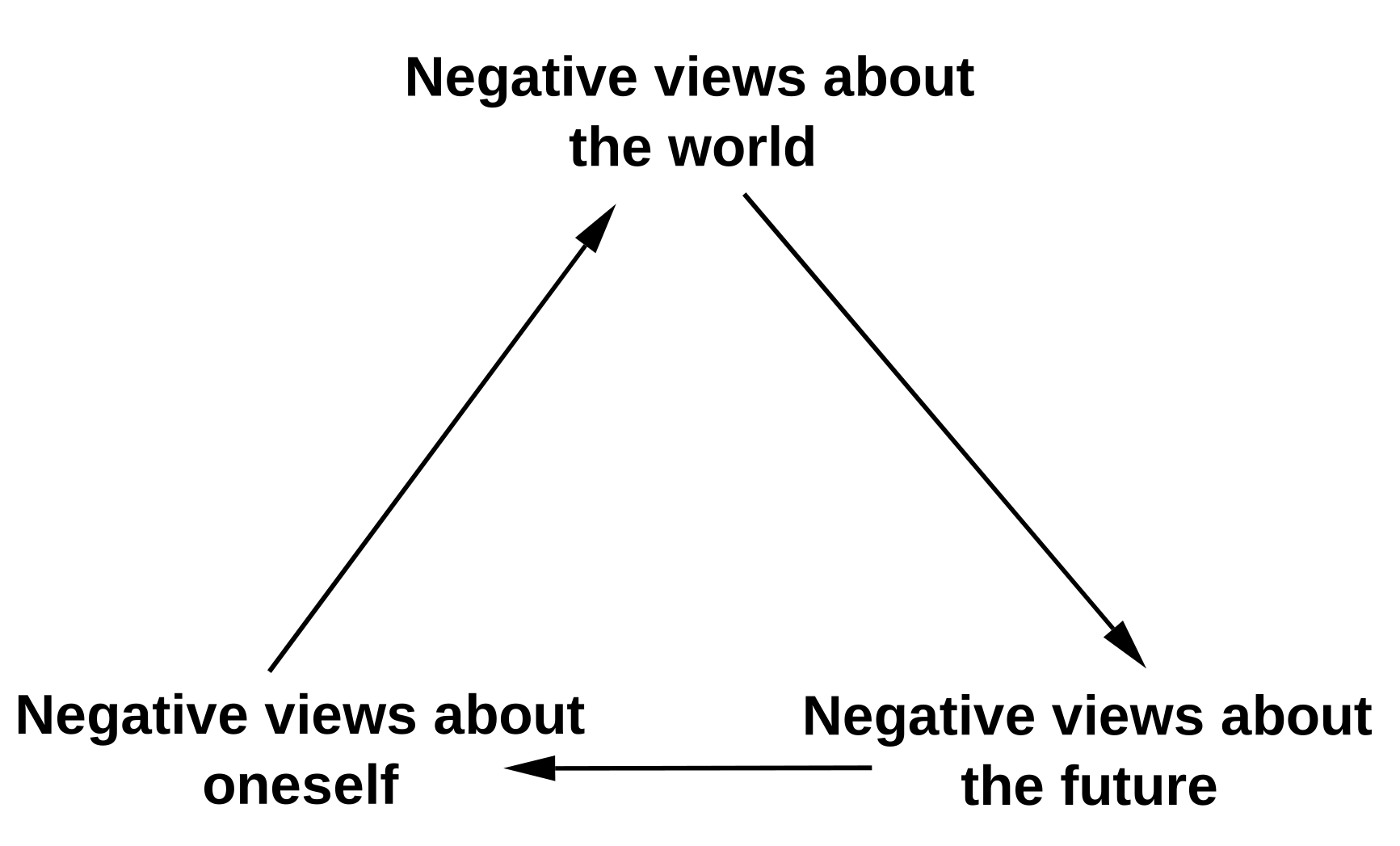
Beck’s Cognitive Model of Depression is one of the most influential psychological frameworks for understanding why depression develops, persists, and often returns even after periods of improvement. Developed by Aaron T. Beck, this model shifted the understanding of depression away from viewing it solely as a mood disorder or a biological imbalance.
Instead, Beck proposed that depression is fundamentally a cognitive disorder, rooted in habitual patterns of distorted thinking that shape how individuals perceive themselves, their life experiences, and their future. These thinking patterns influence emotional reactions and behavioral choices, gradually creating and maintaining the depressive state.
At its core, the model proposes a powerful and clinically significant idea:
Depression is maintained by persistent negative interpretations of the self, life experiences, and the future.
According to Beck, these interpretations are not random or temporary thoughts. They are structured, predictable, and often automatic cognitive patterns that operate outside conscious awareness. Over time, they become deeply ingrained, making depression feel overwhelming, inevitable, and difficult to escape.
This article explores Beck’s Cognitive Model of Depression in depth—examining its theoretical structure, underlying psychological mechanisms, clinical relevance in therapy, and real-life implications for understanding and treating depressive disorders.
The Foundation of Beck’s Cognitive Model
Beck’s Cognitive Model emerged as a direct challenge to earlier psychological theories that explained depression primarily in terms of unconscious conflicts, unresolved childhood dynamics, or purely biological imbalances. While acknowledging that biological and developmental factors play a role, Beck argued that these explanations alone could not fully account for how depression is experienced and maintained in everyday life.
Through careful clinical observation, Aaron T. Beck noticed a consistent pattern among individuals suffering from depression: they tended to interpret themselves, their experiences, and their future through a systematically negative cognitive lens. These were not occasional pessimistic thoughts, but stable and repetitive thinking errors that appeared across situations.
According to Beck:
-
Depressed individuals do not perceive reality objectively
Neutral or even positive events are often interpreted negatively, while successes are minimized or dismissed. -
Their thinking follows predictable negative patterns
These patterns include habitual self-criticism, pessimism, and rigid conclusions that resist contradictory evidence. -
These cognitive patterns directly generate depressive emotions
Feelings of sadness, hopelessness, guilt, and worthlessness arise as logical emotional responses to these distorted interpretations.
From this perspective, depression is not caused simply by external stressors or internal emotional weakness. Instead, emotional suffering emerges because thoughts shape emotional experience.
Thus, in Beck’s model, thoughts are not merely symptoms of depression—they are central mechanisms that create and maintain it. By identifying and modifying these maladaptive thought patterns, individuals can reduce emotional distress and regain psychological functioning, forming the foundation for cognitive-based therapeutic intervention.
The Cognitive Triad: The Core of Depression
The heart of Beck’s model is the Cognitive Triad, which consists of three interrelated negative belief systems:
1. Negative View of the Self
“I am defective, unworthy, or inadequate.”
Common thoughts:
-
“I am a failure.”
-
“There is something wrong with me.”
-
“I’m not good enough.”
This leads to:
-
Low self-esteem
-
Shame and guilt
-
Self-criticism
2. Negative View of the World
“The world is unfair, demanding, or rejecting.”
Common thoughts:
-
“People don’t care about me.”
-
“Nothing ever works out.”
-
“Life is against me.”
This creates:
-
Withdrawal from relationships
-
Loss of interest in activities
-
Emotional numbness
3. Negative View of the Future
“Things will never get better.”
Common thoughts:
-
“Nothing will change.”
-
“There’s no point trying.”
-
“The future is hopeless.”
This fuels:
-
Helplessness
-
Loss of motivation
-
Suicidal ideation in severe cases
➡️ These three views reinforce each other, creating a closed depressive loop.
Automatic Thoughts: The Moment-to-Moment Triggers
Automatic thoughts are immediate, involuntary mental responses that arise spontaneously in reaction to everyday situations. They occur so rapidly that individuals are often unaware of their presence, experiencing only the emotional impact that follows. In Beck’s Cognitive Model, these thoughts are considered the moment-to-moment triggers that translate life events into emotional distress.
In depression, automatic thoughts tend to share several defining characteristics:
-
Negative – They focus on loss, failure, or inadequacy
-
Absolute – They are framed in extreme, all-or-nothing terms
-
Emotionally convincing – They feel true, regardless of evidence
-
Taken as facts – They are rarely questioned or examined
Because these thoughts arise automatically, they bypass rational evaluation and directly activate emotional responses.
Example
-
Situation: A mistake at work
-
Automatic thought: “I ruin everything.”
-
Emotion: Sadness, shame, worthlessness
-
Behavior: Withdrawal, avoidance, reduced effort
In this sequence, the emotional pain is not caused by the mistake itself, but by the interpretation of the mistake. A single error is cognitively transformed into a global judgment about the self.
Crucially, these thoughts occur so quickly and effortlessly that individuals often believe they are reacting emotionally to reality. In truth, they are reacting to their interpretation of reality. Over time, repeated automatic thoughts strengthen depressive beliefs, deepen emotional distress, and reinforce avoidant or withdrawn behavior—maintaining the depressive cycle.
Identifying and challenging automatic thoughts is therefore a central therapeutic task in cognitive-based interventions, as even small shifts in interpretation can lead to meaningful emotional relief.
Cognitive Distortions in Depression
Beck identified specific thinking errors that dominate depressive cognition:
-
All-or-nothing thinking
“If I fail once, I’m a total failure.” -
Overgeneralization
“This always happens to me.” -
Mental filtering
Focusing only on negative details and ignoring positives. -
Personalization
“It’s my fault, even when it isn’t.” -
Catastrophizing
Expecting the worst possible outcome.
These distortions systematically bias perception toward negativity.
Core Beliefs and Schemas: The Deep Structure
Beyond surface thoughts, Beck emphasized core beliefs (schemas)—deep, rigid assumptions formed early in life.
Common depressive core beliefs:
-
“I’m not good enough to be loved.”
-
“Nothing I do changes anything.”
-
“I don’t have much worth.”
These schemas often develop through:
-
Childhood criticism or neglect
-
Emotional abuse
-
Repeated failure experiences
-
Insecure attachment
When life events activate these schemas, depressive thinking is triggered automatically.
The Depression Maintenance Cycle
Beck’s model explains why depression persists even when circumstances improve.
-
Negative core beliefs shape perception
-
Automatic thoughts interpret events negatively
-
Depressive emotions emerge
-
Withdrawal and inactivity increase
-
Reduced positive experiences confirm negative beliefs
This self-reinforcing loop explains chronic and recurrent depression.
Behavioral Consequences of Depressive Thinking
Depression is not only cognitive—it is behavioral.
Common behaviors include:
-
Social withdrawal
-
Reduced activity
-
Avoidance of responsibility
-
Procrastination
These behaviors:
-
Reduce opportunities for pleasure or mastery
-
Increase isolation
-
Strengthen beliefs of inadequacy
Thus, behavior becomes evidence for distorted thoughts.
Therapeutic Implications: Why the Model Works
Beck’s model became the foundation of Cognitive Behavioral Therapy (CBT) because it is:
-
Structured and practical
-
Focused on present functioning
-
Collaborative and empowering
-
Skills-based and measurable
CBT targets:
-
Automatic thoughts
-
Cognitive distortions
-
Core beliefs
-
Avoidant behaviors
By modifying thinking patterns, emotional relief follows naturally.
Strengths of Beck’s Cognitive Model
-
Empirically supported across cultures
-
Effective for mild to severe depression
-
Teaches lifelong coping skills
-
Reduces relapse risk
It reframes depression from a personal failure to a treatable thinking pattern.
Limitations and Considerations
-
Severe depression may require medication alongside CBT
-
Trauma-based depression may need additional emotional processing
-
Cultural beliefs can shape cognitive content
Still, Beck’s model remains one of the most clinically effective frameworks in mental health.
Final Reflection
Beck’s Cognitive Model of Depression offers a compassionate yet structured framework for understanding psychological suffering. It reframes depression not as a personal flaw, weakness, laziness, or lack of gratitude, but as the result of maladaptive patterns of thinking that are learned, reinforced, and maintained over time—often in response to life experiences, relationships, and early environments.
This perspective is deeply validating. It removes moral judgment from depression and replaces it with understanding. When suffering is seen as a product of cognitive patterns rather than character defects, individuals can approach their struggles with curiosity instead of self-blame.
Most importantly, Beck’s model delivers hope grounded in psychology, not optimism alone:
If thoughts are learned, they can be unlearned.
And if thinking can change, recovery is possible.
Through awareness, reflection, and therapeutic intervention, individuals can learn to question automatic thoughts, soften rigid beliefs, and develop more balanced ways of interpreting themselves and the world. In doing so, emotional relief becomes not only possible—but sustainable.
Healing, in this model, is not about changing who you are.
It is about changing how you relate to your thoughts—and reclaiming agency over your inner life.
Frequently Asked Questions (FAQ)
1. What is Beck’s Cognitive Model of Depression?
Beck’s Cognitive Model explains depression as a result of persistent negative thinking patterns rather than personal weakness or only biological imbalance. It emphasizes how distorted thoughts about the self, world, and future create and maintain depressive emotions and behaviors.
2. Who developed the Cognitive Model of Depression?
The model was developed by Aaron T. Beck, the founder of Cognitive Therapy and one of the most influential figures in modern psychotherapy.
3. What is the Cognitive Triad in depression?
The cognitive triad refers to three interconnected negative beliefs:
- A negative view of the self
“I am inadequate or not good enough.” - A negative view of the world
“The world is demanding, rejecting, or unfair.” - A negative view of the future
“Nothing will change, and improvement is unlikely.”
These beliefs reinforce one another and deepen depressive symptoms.
4. Are negative thoughts a symptom or a cause of depression?
According to Beck’s model, negative thoughts are central causes, not just symptoms. Automatic thoughts and core beliefs directly shape emotional responses and behaviors that maintain depression.
5. What are automatic thoughts?
Automatic thoughts are immediate, involuntary interpretations that arise in response to situations. In depression, these thoughts are usually negative, absolute, and emotionally convincing, and they strongly influence mood and behavior.
6. Can Beck’s model help with severe depression?
Yes. Research shows Cognitive Behavioral Therapy (CBT), based on Beck’s model, is effective for mild, moderate, and severe depression, often in combination with medication for more severe cases.
7. How does CBT use Beck’s model in therapy?
CBT helps individuals:
-
Identify automatic negative thoughts
-
Recognize cognitive distortions
-
Challenge unhelpful beliefs
-
Replace them with balanced, realistic thoughts
This process leads to emotional relief and healthier behavior patterns.
8. Is Beck’s Cognitive Model scientifically supported?
Yes. Beck’s model is one of the most empirically supported frameworks in psychology, with decades of research validating its effectiveness across cultures and age groups.
Written by Baishakhi Das
Counselor | Mental Health Practitioner
Qualifications: B.Sc in Psychology | M.Sc | PG Diploma in Counseling
Reference
-
Beck, A. T. (1976). Cognitive Therapy and the Emotional Disorders.
https://www.google.com/books/edition/Cognitive_Therapy_and_the_Emotional_Disor/ -
Beck, J. S. (2011). Cognitive Behavior Therapy: Basics and Beyond (2nd ed.).
https://www.guilford.com/books/Cognitive-Behavior-Therapy/Judith-Beck/9781609185046 -
American Psychiatric Association. (2022). Depression Overview.
https://www.psychiatry.org/patients-families/depression -
National Institute of Mental Health (NIMH). Depression.
https://www.nimh.nih.gov/health/topics/depression -
World Health Organization (WHO). Depression Fact Sheet.
https://www.who.int/news-room/fact-sheets/detail/depression - Anxious–Avoidant Relationship Cycle Explained