
The Foundation of Beck’s Cognitive Model
Beck’s Cognitive Model emerged as a significant shift from earlier psychological theories that explained depression primarily in terms of unconscious conflicts, unresolved childhood dynamics, or purely biological imbalances. Although Beck acknowledged that biological and developmental factors can contribute to depression, he argued that these factors alone could not fully explain how depressive symptoms are experienced, maintained, and reinforced in everyday life.
Instead, through careful clinical observation, Aaron T. Beck identified a consistent pattern among individuals experiencing depression. They frequently interpreted themselves, their experiences, and their future through a systematically negative cognitive lens. Importantly, these were not simply occasional pessimistic thoughts. Rather, they were repetitive and relatively stable patterns of thinking that could appear across different situations.
According to Beck’s Cognitive Model:
- Depressed individuals may interpret reality through a negative cognitive lens
For example, neutral or even positive events may be interpreted negatively, while personal successes may be minimized, overlooked, or dismissed. - Their thinking may follow predictable negative patterns
These patterns can include habitual self-criticism, pessimistic expectations, and rigid conclusions that remain difficult to modify even when contradictory evidence is available. - These cognitive patterns influence emotional responses
As a result, feelings such as sadness, hopelessness, guilt, and worthlessness may emerge or intensify in response to negative interpretations of experiences.
Furthermore, Beck’s Cognitive Model emphasizes that depression cannot be understood solely in terms of external stressors or emotional weakness. Instead, the way an individual interprets an experience plays an important role in shaping the emotional response to that experience. In other words, the same situation can produce different emotional reactions depending on how it is perceived and interpreted.
For example, experiencing a mistake at work does not automatically mean that a person will feel worthless. However, if the mistake is interpreted as “I am completely incompetent”, the resulting thought may contribute to feelings of shame, sadness, or hopelessness. Therefore, the interpretation of an event can become more psychologically significant than the event itself.
Thus, within Beck’s Cognitive Model, thoughts are not merely passive symptoms of depression. Rather, maladaptive cognitive patterns are considered important mechanisms involved in the development and maintenance of depressive distress. Consequently, identifying, examining, and modifying these patterns became a central principle of cognitive-based therapeutic interventions.
By helping individuals recognize negative interpretations, evaluate the evidence supporting them, and develop more balanced perspectives, therapy can reduce emotional distress and support healthier behavioral functioning. Therefore, Beck’s Cognitive Model provides an important theoretical foundation for understanding how cognition, emotion, and behavior interact in depression.
The Cognitive Triad: The Core of Depression
At the heart of Beck’s Cognitive Model of Depression is the Cognitive Triad, which describes three interconnected patterns of negative thinking about the self, the world, and the future. Rather than operating independently, these three perspectives influence one another and can gradually reinforce depressive thoughts, emotions, and behaviors.
1. Negative View of the Self
The first component involves a negative perception of oneself. A person may begin to view themselves as defective, unworthy, inadequate, or incapable.
“I am defective, unworthy, or inadequate.”
For example, common thoughts may include:
- “I am a failure.”
- “There is something wrong with me.”
- “I’m not good enough.”
As these thoughts become repetitive, they can contribute to:
- Low self-esteem
- Shame and guilt
- Persistent self-criticism
Consequently, a person may begin to interpret ordinary mistakes or setbacks as evidence of a fundamental personal flaw.
2. Negative View of the World
The second component involves a negative interpretation of the person’s environment, relationships, and everyday experiences. The world may begin to appear unfair, demanding, rejecting, or unsupportive.
“The world is unfair, demanding, or rejecting.”
Common thoughts may include:
- Nevertheless, people don’t care about me.
- “Nothing ever works out.”
- “Life is against me.”
Because these interpretations can make social interactions feel unrewarding or threatening, the person may gradually:
- Withdraw from relationships
- Lose interest in previously enjoyable activities
- Experience emotional numbness
Furthermore, social withdrawal can reduce opportunities for positive experiences and support. As a result, the individual’s negative perception of the world may become further reinforced.
3. Negative View of the Future
The third component involves a pessimistic interpretation of what lies ahead. The person may believe that their current difficulties will continue and that meaningful improvement is unlikely.
“Things will never get better.”
Common thoughts include:
- “Nothing will change.”
- “There’s no point trying.”
- “The future is hopeless.”
As a result, this negative view of the future can contribute to:
- Helplessness
- Loss of motivation
- Suicidal ideation in severe cases
When someone believes that their circumstances cannot improve, they may see little reason to make efforts toward change. Therefore, hopeless expectations can further reduce motivation and reinforce depressive patterns.
How the Three Components Reinforce Each Other
How the Three Components Reinforce Each Other
Importantly, Beck’s Cognitive Model does not view these three negative perspectives as completely separate. Instead, they interact continuously and can strengthen one another. As a result, a negative belief about one area can gradually influence how a person interprets the other two.
For example, a person who believes “I am not good enough” may interpret rejection as evidence that “people do not care about me.” This belief may then contribute to the expectation that “nothing will improve in the future.” In turn, this sense of hopelessness can further reinforce the original negative belief about the self.
Therefore, the Cognitive Triad can function as a self-reinforcing cycle:
Negative view of the self → Negative view of the world → Negative view of the future → Reinforcement of negative beliefs
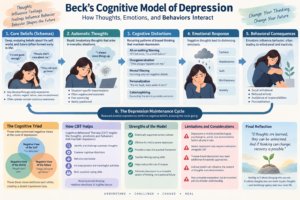
In this way, the three components of the Cognitive Triad can interact to create and maintain a closed depressive loop, which is a central concept within Beck’s Cognitive Model of Depression.
However, these broader negative beliefs do not operate only at a general level. They can also appear in response to specific situations in everyday life. This is where automatic thoughts become particularly important.
Automatic Thoughts: The Moment-to-Moment Triggers
Automatic thoughts are immediate, involuntary mental responses that arise spontaneously in reaction to everyday situations. Unlike broader core beliefs, which tend to represent deeper and more enduring assumptions, automatic thoughts are often situation-specific interpretations that occur rapidly and may influence how a person feels and behaves in that particular moment.
In Beck’s Cognitive Model, automatic thoughts help explain how deeper negative beliefs can become activated during everyday experiences. For example, a person with a core belief such as “I am not good enough” may experience a minor mistake at work and immediately think, “I always mess things up.” Although the thought may appear to be a simple reaction to the situation, it can reflect and reinforce the deeper negative belief.
Because automatic thoughts occur so quickly, individuals may not always notice them consciously. Instead, they may simply experience the emotional reaction that follows. Consequently, the thought can feel less like an interpretation and more like an objective fact.
Characteristics of Automatic Thoughts in Depression
In depression, automatic thoughts tend to share several common characteristics:
- Negative – They often focus on loss, failure, rejection, inadequacy, or hopelessness.
- Absolute – They may be expressed in extreme or all-or-nothing terms, such as “I always fail” or “Nothing ever works.”
- Emotionally convincing – Although they may not accurately reflect the available evidence, they can feel completely true in the moment.
- Taken as facts – Because they arise automatically, they are often accepted without being questioned or examined.
Furthermore, these thoughts can influence emotions and behavior almost immediately. A negative interpretation may increase sadness, shame, anxiety, or hopelessness and may subsequently lead to avoidance, withdrawal, or reduced effort.
Example: How an Automatic Thought Can Influence Emotion and Behavior
Consider the following everyday situation:
- Situation: A person makes a mistake at work.
- Automatic thought: “I ruin everything.”
- Emotion: Sadness, shame, or worthlessness.
- Behavior: Withdrawal, avoidance, or reduced effort.
At first glance, the emotional reaction may appear to have been caused directly by the mistake. However, according to Beck’s Cognitive Model, the person’s interpretation of the mistake plays an important role in shaping the emotional response.
A single error is therefore transformed into a broader judgment about the self. Instead of thinking, “I made a mistake,” the person may conclude, “I am a failure.” Consequently, a specific event becomes connected to a much more global negative belief.
Crucially, automatic thoughts can occur so quickly and effortlessly that individuals may believe they are responding directly to reality. In reality, they are responding to their interpretation of that reality. Over time, repeated negative interpretations can strengthen underlying depressive beliefs, intensify emotional distress, and reinforce avoidant or withdrawn behaviors.
As this process continues, the relationship between thoughts, emotions, and behaviors can become increasingly self-reinforcing. Therefore, identifying automatic thoughts is an important step in understanding the mechanisms through which depressive patterns are maintained.
Why Identifying Automatic Thoughts Matters in Therapy
For this reason, identifying and examining automatic thoughts is a central component of cognitive-based interventions. Once an individual becomes aware of these rapid interpretations, they can begin to examine the evidence supporting them, consider alternative explanations, and develop more balanced ways of interpreting situations.
Even a small change in interpretation can sometimes produce a meaningful change in emotional and behavioral responses. Thus, within Beck’s Cognitive Model of Depression, automatic thoughts provide an important link between deeper beliefs, everyday experiences, emotional responses, and behavior.
Cognitive Distortions in Depression
While automatic thoughts describe the rapid interpretations that occur in specific situations, cognitive distortions refer to recurring patterns of biased or unhelpful thinking that can contribute to depressive distress. In the context of Beck’s Cognitive Model, these patterns can influence how individuals interpret themselves, their experiences, and their future.
Common examples include:
- All-or-nothing thinking
Viewing situations in extreme, either-or terms.
“If I fail once, I’m a total failure.” - Overgeneralization
Drawing broad conclusions from a single or limited experience.
“This always happens to me.” - Mental filtering
Focusing predominantly on negative aspects of an experience while overlooking positive or neutral information. - Personalization
Automatically assuming excessive personal responsibility for an event, even when other factors are involved.
“It’s my fault, even when it isn’t.” - Catastrophizing
Anticipating highly negative outcomes or interpreting difficulties as more threatening than the available evidence suggests.
Consequently, these patterns can systematically influence attention, interpretation, and judgment in a negative direction. However, recognizing a cognitive distortion does not mean that every negative thought is automatically inaccurate. Rather, the therapeutic goal is to examine whether a thought is accurate, balanced, and supported by available evidence.
Core Beliefs and Schema s: The Deep Structure
Although automatic thoughts occur at the surface level of everyday experience, Beck’s Cognitive Model also emphasizes deeper cognitive structures known as core beliefs and schemas. These represent relatively enduring assumptions that individuals may hold about themselves, other people, and the world.
For example, depressive core beliefs may include:
- “I’m not good enough to be loved.”
- “Nothing I do changes anything.”
- “I don’t have much worth.”
These deeper beliefs do not necessarily remain consciously active at all times. However, particular experiences can activate them. For instance, criticism, rejection, failure, or interpersonal conflict may trigger an existing negative belief and subsequently produce a series of automatic negative thoughts.
Such cognitive patterns may be influenced by a person’s developmental and interpersonal experiences, including:
- Childhood criticism or neglect
- Emotional abuse
- Repeated experiences of failure or rejection
- Insecure attachment experiences
Nevertheless, these experiences should not be understood as automatic or sufficient causes of depression. Rather, within a cognitive framework, they may contribute to the development of beliefs and schemas that influence how later experiences are interpreted.
Therefore, when a relevant life event activates a negative schema, automatic negative thinking may become more likely, contributing to depressive emotions and behavioral responses.
The Depression Maintenance Cycle
One of the important contributions of Beck’s Cognitive Model is its explanation of how depressive patterns can become self-reinforcing. In other words, depression may continue even when the original circumstances that contributed to the person’s distress have changed.
The process can be understood as follows:
- Negative core beliefs influence perception
- Automatic thoughts interpret situations negatively
- Depressive emotions emerge or intensify
- Withdrawal, avoidance, or inactivity may increase
- Reduced opportunities for positive experiences reinforce existing negative beliefs
For example, a person who believes “I am not good enough” may interpret a minor mistake as evidence of personal failure. This interpretation can produce shame or sadness, which may then lead to withdrawal or reduced activity. As a result, the person may experience fewer opportunities for positive experiences, achievement, or social connection.
Consequently, the lack of positive experiences may appear to confirm the original belief, strengthening the cycle further.
Thus, the depression maintenance cycle illustrates how cognition, emotion, and behavior can interact over time rather than operating as isolated processes.
Behavioral Consequences of Depressive Thinking
Importantly, depression is not only a cognitive experience. Behavior also plays an important role in maintaining depressive patterns.
Common behavioral changes may include:
- Social withdrawal
- Reduced activity
- Avoidance of responsibilities or challenging situations
- Procrastination
Although these behaviors may initially provide temporary relief from difficult emotions, they can have unintended consequences over time. For example, withdrawing from others may reduce access to emotional support, while reduced activity may limit opportunities for pleasure, achievement, or a sense of mastery.
As a result, these behavioral changes can:
- Reduce opportunities for positive experiences
- Increase social isolation
- Reinforce feelings of inadequacy or helplessness
Therefore, behavior can sometimes appear to provide confirming evidence for existing negative beliefs. A person who withdraws because they believe “Nobody wants me around” may subsequently experience less social contact, which can make the original belief feel even more convincing.
This interaction between cognition and behavior is one reason why behavioral strategies are an important part of cognitive-behavioral interventions.
Therapeutic Implications: How Beck’s Model Informs CBT
The principles of Beck’s Cognitive Model became foundational to Cognitive Behavioral Therapy (CBT). Rather than focusing only on depressive symptoms, CBT examines the relationships among thoughts, emotions, behaviors, and underlying beliefs.
In practice, CBT is typically:
- Structured and goal-oriented
- Focused on current difficulties
- Collaborative
- Skills-based
- Designed to support measurable changes in thinking and behavior
Depending on the individual and treatment plan, CBT may target:
- Automatic thoughts
- Cognitive distortions
- Underlying beliefs and schemas
- Avoidance and withdrawal
- Unhelpful behavioral patterns
For example, a therapist may help a person identify an automatic thought, examine the evidence supporting and contradicting it, consider alternative interpretations, and then practice a more balanced response. At the same time, behavioral strategies may be used to increase engagement in meaningful or rewarding activities.
Therefore, CBT does not simply encourage a person to “think positively.” Instead, it aims to develop thinking that is more balanced, flexible, realistic, and evidence-based, while also addressing behaviors that contribute to ongoing difficulties.
Strengths of Beck’s Cognitive Model
Over several decades, Beck’s Cognitive Model has had a major influence on psychological theory and psychotherapy. Its clinical value comes partly from its structured explanation of how thoughts, emotions, and behaviors can interact.
The model is particularly useful because it:
- Provides a clear framework for understanding depressive thinking
- Can be translated into practical therapeutic strategies
- Encourages individuals to examine their interpretations rather than automatically accepting them as facts
- Provides skills that can continue to be practiced beyond individual therapy sessions
Furthermore, the cognitive-behavioral approach has been extensively studied in the treatment of depression. However, its effectiveness can vary depending on factors such as symptom severity, individual circumstances, morbid conditions, treatment engagement, and the specific intervention used.
Most importantly, the model helps shift the discussion of depression away from moral judgments or personal blame and toward psychological processes that can be understood and addressed therapeutically.
Limitations and Considerations
Although Beck’s Cognitive Model has made an important contribution to understanding depression, it should not be treated as a complete explanation of every depressive disorder or every individual’s experience.
Several considerations are important:
- Depression is multifactorial. Biological, psychological, social, developmental, and environmental factors can all contribute to depression. Therefore, cognitive processes represent one important part of a broader biopsychosocial understanding.
- Severe depression may require additional interventions. Depending on the person’s clinical presentation, treatment may involve psychotherapy, medication, or a combination of approaches under appropriate professional supervision.
- Trauma and other complex experiences may require broader therapeutic approaches. Cognitive restructuring alone may not address every aspect of trauma-related distress or complex psychological difficulties.
- Cultural context matters. Beliefs, relationships, social expectations, and interpretations of experiences can vary considerably across cultures. Therefore, therapists need to understand the individual’s cultural and social context rather than assuming that one interpretation applies universally.
Consequently, Beck’s Cognitive Model is best understood as an influential framework within a broader understanding of depression, rather than as the sole explanation for why depression develops or persists.
Final Reflection
Beck’s Cognitive Model of Depression offers a structured and compassionate framework for understanding how patterns of thinking can contribute to emotional and behavioral difficulties. Rather than framing depression as a personal flaw, weakness, laziness, or lack of gratitude, the model focuses attention on cognitive patterns that can develop, become reinforced, and influence how individuals interpret themselves, their experiences, and their future.
This perspective can be particularly meaningful because it separates the person from the pattern. Instead of thinking, “Something is fundamentally wrong with me,” an individual can begin to recognize that certain thoughts and interpretations may have become habitual.
Furthermore, this shift can reduce self-blame and create space for curiosity. When people learn to observe their thoughts rather than automatically treating every thought as a fact, they may become better able to examine alternative interpretations and respond to difficult situations more flexibly.
Most importantly, the model offers hope grounded in psychological understanding rather than optimism alone: If patterns of thinking can be learned and reinforced, they can also be examined, challenged, and changed.
Through awareness, reflection, and appropriate therapeutic intervention, individuals can learn to identify automatic thoughts, examine rigid beliefs, and develop more balanced ways of interpreting themselves and their experiences. In turn, these changes can support healthier emotional responses and more adaptive behaviors.
Ultimately, healing within this framework is not about changing who you are. Instead, it is about developing a different relationship with your thoughts, understanding the patterns that influence your emotions and behavior, and gradually reclaiming a greater sense of agency over your inner life.
Frequently Asked Questions (FAQ)
1. What is Beck’s Cognitive Model of Depression?
Beck’s Cognitive Model explains depression as a result of persistent negative thinking patterns rather than personal weakness or only biological imbalance. It emphasizes how distorted thoughts about the self, world, and future create and maintain depressive emotions and behaviors.
2. Who developed the Cognitive Model of Depression?
The model was developed by Aaron T. Beck, the founder of Cognitive Therapy and one of the most influential figures in modern psychotherapy.
3. What is the Cognitive Triad in depression?
The cognitive triad refers to three interconnected negative beliefs:
- A negative view of the self
“I am inadequate or not good enough.” - A negative view of the world
“The world is demanding, rejecting, or unfair.” - A negative view of the future
“Nothing will change, and improvement is unlikely.”
These beliefs reinforce one another and deepen depressive symptoms.
4. Are negative thoughts a symptom or a cause of depression?
According to Beck’s model, negative thoughts are central causes, not just symptoms. Automatic thoughts and core beliefs directly shape emotional responses and behaviors that maintain depression.
5. What are automatic thoughts?
Automatic thoughts are immediate, involuntary interpretations that arise in response to situations. In depression, these thoughts are usually negative, absolute, and emotionally convincing, and they strongly influence mood and behavior.
6. Can Beck’s model help with severe depression?
Yes. Research shows Cognitive Behavioral Therapy (CBT), based on Beck’s model, is effective for mild, moderate, and severe depression, often in combination with medication for more severe cases.
7. How does CBT use Beck’s model in therapy?
CBT helps individuals:
- Identify automatic negative thoughts
- Recognize cognitive distortions
- Challenge unhelpful beliefs
- Replace them with balanced, realistic thoughts
This process leads to emotional relief and healthier behavior patterns.
8. Is Beck’s Cognitive Model scientifically supported?
Yes. Beck’s model is one of the most empirically supported frameworks in psychology, with decades of research validating its effectiveness across cultures and age groups.
Reference
-
Beck, A. T. (1976). Cognitive Therapy and the Emotional Disorders.
https://www.google.com/books/edition/Cognitive_Therapy_and_the_Emotional_Disor/ -
Beck, J. S. (2011). Cognitive Behavior Therapy: Basics and Beyond (2nd ed.).
https://www.guilford.com/books/Cognitive-Behavior-Therapy/Judith-Beck/9781609185046 -
American Psychiatric Association. (2022). Depression Overview.
https://www.psychiatry.org/patients-families/depression -
National Institute of Mental Health (NIMH). Depression.
https://www.nimh.nih.gov/health/topics/depression -
World Health Organization (WHO). Depression Fact Sheet.
https://www.who.int/news-room/fact-sheets/detail/depression - Anxious–Avoidant Relationship Cycle Explained
Pingback: Why Your Mind Creates Problems Even When Everything Is Fine
Pingback: Can Inner Peace Reduce Anxiety and Stress?
Mental health is much more than the absence of a psychological disorder. It also involves emotional awareness, healthy coping, meaningful relationships, and the ability to adapt to life’s challenges.