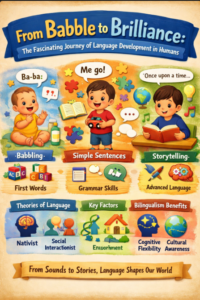
One of the most outstanding skills of human beings is language. It enables us to share thoughts, emotion, needs and ideas, and it is the key to cognitive, social, and emotional development. Language development is a complex dynamic process that depends on biological, psychological and environmental factors and takes place since the first cry of a baby to complex storytelling in a child.
This paper will cover the steps, theories, determining variables and importance of language development giving a holistic idea of how human beings acquire and perfect this vital practise.
What is Language Development?
Language development can be defined as the process by which human beings learn to perceive, produce and utilise words to communicate. It entails receptive language (understanding) and expressive language (speaking or language production).
It has a close association with other spheres of development like cognition, social interaction, and emotional regulation. Language is not about words alone, but it has grammar, syntax, pragmatics, and even non-verbal communication such as gestures and facial expressions.
Stages of Language Development
The language development is normally in a predictable order and though the speed is not always consistent among people.
1. Pre-linguistic Stage (0–12 months)
This is the initial stage of the foundation of language.
- 0-2 months: Reflexive crying and cooing.
- 2–6 months: Cooing and laughter
- 6–9 months: Babbling (e.g., “ba-ba”, “da-da”)
- 9-12 months: Willful communication (gestures, pointing)
At this age, infants get to learn the rhythms and patterns of language. Babbling plays an important role because it trains the vocal apparatus to speech.
2. One-Word Stage (12–18 months)
[Why child not speaking clearly at age 2]
It is also referred to as the holophrastic stage that uses one word, which is a complete thought.
- Example: Milk can have a meaning of I desire milk.
- Vocabulary development is sluggish (approximately 1050 words)
Children use much context, tone, and gestures as a means of communication.
3. Two-Word Stage (18–24 months)
Children start to combine two words in order to form simple sentences.
- Examples: “Mommy go,” “more juice”
- Telegraphic speech (leaving out less significant words)
An initial grasp of syntax and interrelations between the words is noted during this stage.
4. Telegraphic Speech (2–3 years)
Sentences are prolonged but do not contain grammatical marks.
- Example: “Daddy go work”
- Word explosion Rapid vocabulary expansion.
Children start to understand simple rules of grammar, but the mistakes are frequent.
5. Early Multiword Stage (3–5 years)
There is more complexity and structure of language.
- Plural, tense and prepositions.
- Greater use of questions and storeys.
- Children begin to talk and tell storeys.
6. Later Language Development (5+ years)
- Language is more perfected and advanced. The interpretation of metaphors, humour, and abstract ideas.Better grammar and vocabulary. The stage is extended to adolescence when language becomes more subtle. Language Development Theories.
There are various theories that are trying to state how a language is learned:
1. Behaviourist Theory (B.F. Skinner)
Learning of language is done by imitation, reinforcement and conditioning. Children imitate adults. Appropriate answers are reinforced.
- Limit: Not entirely able to describe how new sentences are created.
2. Nativist Theory (Noam Chomsky)
Suggests that humans have an inborn capacity to pick up language. Came up with the concept of Language Acquisition Device (LAD). Lays stress on universal grammar.
- Strength: describes how language is acquired very fast.
- Limitations: Misunderestimates environmental impact.
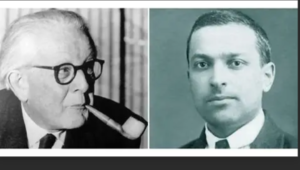
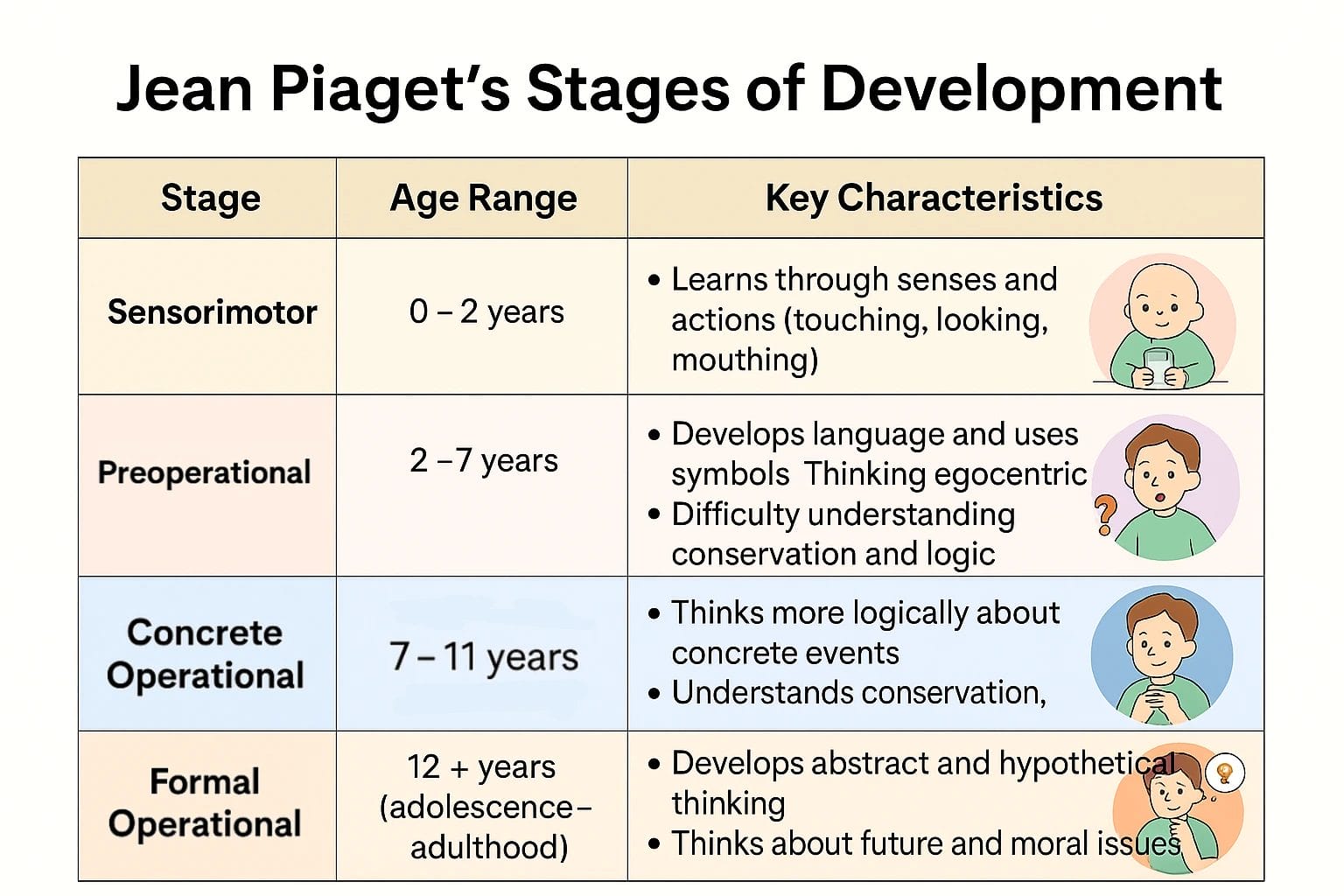
3. Cognitive Theory (Jean Piaget)
Language development is associated with cognitive development. Children need to know ideas first before articulating the ideas. Thinking is manifested in language.
4. Social Interactionist Theory (Lev Vygotsky)
- Language evolves in the socialisation process.
- Plays up importance of caregivers and environment.
- Zone of Proximal Development (ZPD) Concept.
- According to this theory, in language learning, communication is significant.
- Key Components of Language
Language is a complicated mechanism that includes a number of components:
- Phonology: The sounds of language.
- Morphology: Words structure.
- Syntax: Sentence structure
- Semantics: Meaning of words
- Pragmatics: Applications of language in a context.
The components are developed progressively and interact with other components. Aspects that determine the development of language.
There is no developmental language that takes place in a vacuum. It depends on a number of factors:
1. Biological Factors
- Brain maturation
- Genetic predisposition
- Hearing ability
2. Cognitive Development
- Memory, attention and perception.
- Symbolic thinking
3. Social Interaction
- Parent-child communication
- Quality and quantity of language exposure.
4. Socioeconomic Status
- Access to resources
- Educational environment
5. Cultural Context
- Language norms
- Communication styles
- The part of Caregivers in the development of a Language.
Caregivers are very important in the development of language capabilities:
- Children speech (motherese): Minimal, exaggerated speech.
- Reading stories
- Encouraging conversation
- Reaction to attempts of child to communicate.
The language acquisition is greatly improved by a stimulating and responsive environment.
Language Development and Psychology.
Language is much related to psychological processes:
1. Cognitive Development: Language assists in solving problems and reasoning.
2. Emotional Expression: Feelings are expressed using language by children, which minimises frustration.
3. Social Development: Through language, one can interact, build relationships and understand socially.
4. Identity Formation: Language adds to self concept and culture.
Common Language Development Disorders.
Other children can have delays or problems:
1. Speech Delay: Delayed speech onset, no other developmental problems.
2. Specific Language Impairment (SLI): Language problems even with intellectual ability.
3. Autism spectrum disorder (ASD): It is a condition that manifests in infancy and is characterised by difficulties in social interaction, language skills, and communication.<|human|>Autism Spectrum Disorder (ASD)
Difficulties in interaction and communication.
4. Hearing Impairment: Impairs language perception/production. It is important to identify and intervene early so as to improve.
Bilingualism and Language Development.
To learn two or more languages may be helpful:
- Improves mental malleability.
- Enhances executive functioning.
- Enhances sensitivity to culture.
Bilingualism does not confuse children, as it is contrary to myths. They are able to distinguish languages successfully.
Critical Period Hypothesis
According to this idea, language can be taught in the best time (early childhood).
- It is more difficult to learn a language beyond the age of puberty.
- Based on the instances of language deprivation.
- This brings out the significance of early exposure.
- Contemporary Views on the Development of Language.
Researchers today consider language development to be a multi factorial process that involves:
- Biological readiness
- Cognitive growth
- Social interaction
- Environmental input
There is no one theory which can explain language acquisition, but rather an integrated approach is preferred.
Knowledge of language development is critical in the development of:
- Parents and caregivers
- Educators
- Counsellors and psychologists.
- How to encourage the development of language.
- Talk to children frequently
- Read books daily
- Encourage questions
- Limit screen time
- Create an environment full of language.
Conclusion
The process of language development is an amazing process, which makes a helpless baby to become a talking and thinking person. It does not only refer to acquiring of words but to cognition of the world, establishment of connexions and asserting identity.
Starting with the babbling sounds and progressing to the meaningful conversational levels, each of the language development stages is characterised by the complex interplay of biology, cognition, and the environment. This is not only valuable as caregivers, educators, and mental health professionals must facilitate this development as it is vital to their holistic development.
Ultimately, language is not just communication, but the basis of human interaction, thinking and culture.
FAQs on Language Development
1. What is language development?
Language development refers to the process through which children acquire knowledge of how to understand and use language to communicate such as speaking, listening, and social interaction.
2. How does language develop? What are the key phases of language development?
The major stages include:
- Pre-linguistic stage
- One-word (holophrastic) stage
- Two-word stage
- Telegraphic speech
- Multi-word/advanced stage
3. When do children begin to talk?
The majority of children start speaking their first words at the age of 12 months, but the process of language comprehension begins long before that period in infancy.
4. What is the “vocabulary spurt”?
It is the fast learning of words which occur at an age of about 18 months to 2 years when children develop their vocabulary at rapid rates.
5. What do we have in the important theories of language development?
- Behaviorist Theory (Skinner)
- Nativist Theory (Chomsky)
- Cognitive Theory (Piaget)
- Vygotsky Social Interactionist Theory.
6. What is the role of environment in the development of language?
The environment such as the interaction of the caregivers, language exposure and social interaction is a key determinant of language skills.
7. What is so significant about language development?
The language development facilitates:
- Cognitive growth
- Emotional expression
- Social relationships
- Academic learning
8. Is bilingualism a delaying factor in language development?
No, bilingualism does not retard development. It is possible to learn two or more languages with children and even demonstrate cognitive benefits.
9. What are typical language development disorders?
- Speech delay
- Specific Language impairment (SLI)
- Communication problems associated with autism.
- Hearing-related issues
- Early intervention is significant in favourable results.
10. What can parents do to encourage language development?
- Communicate with children a lot.
- Read books daily
- Encourage questions
- Receive communication efforts.
Written by Baishakhi Das
Counselor | Mental Health Practitioner
B.Sc, M.Sc, PG Diploma in Counseling
Reference
- The Psychology of Care: Inside the Minds of Certified Nurses Balancing Empathy, Burnout, and Healing
This article is written for knowledge purposes, aiming to help readers understand the topic better and gain useful insights for learning and awareness.