International Mother Language Day (UNESCO) – A Psychological Perspective
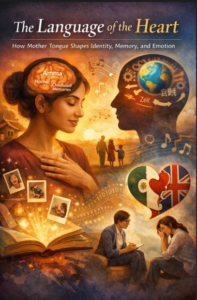
The linguistic diversity and cultural heritage are celebrated in the world each year on the International Mother Language Day. However, our mother tongue is not only relevant in communication, it has an immense influence on the way we think, feel, remember and know ourselves. Language is not merely a means according to psychology, it is also closely connected to identity, thinking, and emotional life.
Mother Tongue and Linguistic Identity
Since childhood, language turns into one of the most powerful bases of identity. Welcome, security and inclusion are the words that a child overhears most of the time when it is first uttered. Psychologists refer to such linguistic self identity the sense of self which is developed based on the native language.
Speaking one’s mother tongue often brings:
- A stronger sense of cultural belonging
- Emotional security
- Intergenerational connection
- Continuity of traditions and values
When people are unable to use their native language, they may experience identity conflict, cultural disconnection, or even lowered self-esteem.
The Sapir-Whorf Hypothesis: Does Language Shape Thought?
The Sapir-Whorf Hypothesis, also known as linguistic relativity, suggests that the language we speak influences how we perceive reality.
For example:
- Some languages have multiple words for emotions that other languages lack.
- Certain cultures describe time spatially (ahead/behind) while others use vertical metaphors.
- Emotional vocabulary richness can affect emotional awareness.
Although there is controversy over strong determinism, it is advocated by modern psychology that there are moderate positions:
Thought is not entirely governed by language, however, it determines how experience is perceived, how it is classified and interpreted.
To put it briefly, language offers us a conceptual system with the help of which we interpret the world.
Mother Language and Memory Encoding
Research in cognitive psychology shows that memories are often encoded in the language in which the event occurred.
This means:
- Childhood memories are more vivid in one’s native language
- People recall autobiographical events more easily when prompted in their mother tongue
- Emotional memories feel closer and more sensory-rich in native language
This phenomenon is called language-dependent memory.
For bilingual individuals, switching languages can sometimes feel like switching mental worlds — each language unlocks different memories and emotional tones.
Emotional Processing in Native Language
One of the most fascinating findings in psychology is that emotions are processed differently across languages.
Studies show:
- Swear words feel stronger in native language
- Trauma narratives sound more emotionally intense in mother tongue
- Therapy in native language often leads to deeper emotional expression
- Decision-making in a second language can feel more detached and rational
This happens because the native language is tied to early emotional learning, family interactions, and attachment experiences.
In counselling psychology, therapists often encourage clients to express deep emotions in their mother tongue because it allows more authentic emotional access.
Language Loss and Psychological Impact
When languages disappear or are discouraged, the impact goes beyond culture — it affects mental health.
Language suppression can lead to:
- Cultural grief
- Identity confusion
- Intergenerational disconnection
- Loss of oral history and collective memory
Conversely, preserving mother languages strengthens:
Community cohesion
Cultural pride
Psychological resilience
Social inclusion
Why Mother Language Day Matters Psychologically
International Mother Language Day is not only about linguistic preservation. It is about protecting:
- Emotional expression
- Cultural identity
- Cognitive diversity
- Human connection
Every language carries a unique worldview. When a language survives, a way of understanding life survives with it.
Conclusion
The first lullaby, our first sense of belonging, first comfort, is in our mother tongue. It influences our ability to recall the past, experience the present and envisage the future.
Promoting mother languages is not only a cultural thing to do, but a psychological one.
The language we grow up with in most aspects becomes our memory, our heart and in a sense our mind.
FAQs: Mother Language, Identity, Memory & Emotion
1. Why is mother tongue important for psychological development?
Mother tongue supports emotional bonding, cognitive development, and identity formation because early learning happens through this language.
2. What is linguistic identity in psychology?
Linguistic identity refers to how a person’s sense of self, belonging, and cultural connection is shaped by the language they grow up speaking.
3. What does the Sapir-Whorf Hypothesis say about language?
It proposes that language influences how people perceive, categorize, and interpret the world.
4. Does language really shape thinking?
Research suggests language does not fully determine thought, but it guides attention, memory organization, and emotional interpretation.
5. What is language-dependent memory?
It means people recall events more easily when the language used during recall matches the language in which the memory was formed.
6. Why do emotions feel stronger in our native language?
Because the native language is learned in emotionally rich contexts like family, attachment, and childhood experiences.
7. Can therapy be more effective in one’s mother tongue?
Yes. Clients often express deeper emotions and trauma narratives more naturally in their native language.
8. Why do bilingual people sometimes feel different in different languages?
Different languages activate different emotional associations, social identities, and memory networks.
9. What psychological impact can language loss cause?
Language loss can lead to identity confusion, cultural grief, reduced belongingness, and intergenerational disconnection.
10. How does mother tongue affect children’s learning ability?
Education in mother tongue improves comprehension, confidence, and cognitive flexibility in early schooling.
11. Does using a second language reduce emotional bias?
Studies show people may make more rational and less emotionally driven decisions in a non-native language.
12. Why is International Mother Language Day important for mental health awareness?
It highlights the link between language, cultural belonging, emotional expression, and social inclusion.
13. Can language influence emotional vocabulary?
Yes. Languages with richer emotion words can help people identify and regulate feelings more accurately.
14. What role does language play in cultural memory?
Language preserves stories, rituals, meanings, and shared experiences that form collective psychological identity.
15. How can people preserve their mother tongue psychologically?
By using it at home, teaching children, writing, storytelling, and including it in education and therapy spaces.
Written by Baishakhi Das
Counselor | Mental Health Practitioner
B.Sc, M.Sc, PG Diploma in Counseling
Reference
-
UNESCO – International Mother Language Day
https://www.unesco.org/en/days/mother-language -
American Psychological Association – Language and Cognition
https://www.apa.org -
Boroditsky, L. (2011). How language shapes thought (Scientific American)
https://www.scientificamerican.com/article/how-language-shapes-thought/ -
Pavlenko, A. (2005). Emotions and Multilingualism
https://doi.org/10.1017/CBO9780511584304 -
Marian & Neisser (2000) – Language-dependent memory in bilinguals
https://doi.org/10.1037/0278-7393.26.3.703 -
NHS / Cross-cultural therapy research summaries
https://www.nhs.uk -
UNICEF – Mother tongue-based education research
https://www.unicef.org - Why Fairness Feels Personal: The Psychology Behind World Day of Social Justice
This topic performs well due to rising searches around men’s mental health, workplace stress, and burnout recovery. Combining emotional insight with practical steps increases engagement and trust.