
Introduction
Cancer is not only a physical illness but also a deeply psychological and emotional experience. From diagnosis to treatment and survivorship (or end-of-life care), patients often face fear, uncertainty, depression, pain, financial stress, and changes in identity. Psychological counselling plays a vital role in improving patients’ quality of life, treatment adherence, and emotional resilience. While counselling does not cure cancer medically, it significantly supports healing, coping, and overall well-being.
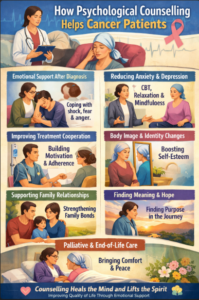
Emotional Support After Diagnosis
A cancer diagnosis represents one of life’s most profound psychological shocks because it fundamentally disrupts a person’s sense of safety, continuity, and control . The threat extends beyond physical health—it challenges core identity, disrupts future planning, and forces confrontation with mortality . Patients rarely experience single emotions; instead, they navigate complex, overlapping emotional states that may shift moment to moment.
Common Emotional Reactions
Shock and Denial
The initial diagnosis often triggers emotional numbness—a protective response where the mind temporarily refuses to process overwhelming information . Patients describe feeling disconnected from reality, as if hearing about someone else’s diagnosis. This psychological defense mechanism serves an important function: it prevents complete emotional collapse while the person gradually absorbs the reality .
Denial manifests in various ways: minimizing symptom severity, avoiding medical appointments, refusing to discuss the illness with loved ones, or delaying critical treatment decisions . While persistent denial becomes dangerous when it prevents necessary care, temporary denial allows the psyche to adjust incrementally rather than shattering completely. Some patients intellectually acknowledge the diagnosis while emotionally keeping it at arm’s length—a phenomenon called “emotional insulation.”
Fear of Death
Existential fear emerges powerfully after diagnosis, forcing confrontation with mortality that most people habitually avoid . This isn’t merely abstract worry—it manifests as visceral terror about physical suffering, progressive weakness, and ultimate loss of self. Patients fear the dying process itself: uncontrolled pain, loss of dignity, becoming a burden, or dying alone.
Beyond personal extinction, patients agonize over relational losses . Parents with young children experience gut-wrenching fear about leaving them unprotected. Patients worry about spouses facing life alone, elderly parents losing their caregiver, or dreams and projects remaining forever incomplete. These attachment-based fears often prove more distressing than death itself, reflecting our fundamental need for connection and meaning.
Anxiety About Treatment
Treatment anxiety combines fear of the known with terror of the unknown. Chemotherapy, radiation, and surgery carry well-documented side effects that patients dread: hair loss threatening self-image, debilitating nausea and fatigue, surgical disfigurement, or cognitive changes (“chemo brain”) . These aren’t vanity concerns—they represent fears about losing bodily autonomy and recognizable identity.
Treatment uncertainty amplifies anxiety: Will this work? What if it fails? Can I endure the side effects? Financial toxicity adds another layer—worries about affording treatment, losing employment, or bankrupting family members. The treatment journey itself becomes overwhelming: navigating complex medical systems, making countless decisions with incomplete information, and tolerating ongoing physical assault on the body in hopes of survival.
Anger, Helplessness, and “Why Me?” Feelings
Anger represents a natural response to profound injustice and loss of control . Patients direct rage at multiple targets: the randomness of disease (“Why me and not someone else?”), medical systems that failed to detect cancer earlier, their own bodies for betraying them, or even loved ones whose normal lives continue unchanged.
This anger often masks deeper helplessness—the terrifying realization that willpower, goodness, or careful living cannot guarantee safety . Cancer shatters the comforting illusion of control that structures daily life. Patients who previously managed careers, families, and responsibilities now face situations where effort alone cannot determine outcomes. This powerlessness triggers existential despair, sometimes manifesting as bargaining (“If I survive, I’ll…”) or rumination about past behaviors that might have prevented illness.
Hopelessness emerges when the future—once assumed and planned—becomes uncertain or shortened . Goals lose meaning, achievements feel hollow, and the question “What’s the point?” haunts daily activities. This isn’t weakness but a rational response to genuine threat.
How Counselling Helps in the Early Stage
Psychological counselling provides structured emotional support that creates a container for overwhelming feelings, helping patients gradually integrate the reality of their diagnosis without becoming psychologically fragmented. In the early post-diagnosis period, when emotions feel chaotic and unmanageable, counselling offers stabilization and direction.
Key Therapeutic Functions:
Helps Patients Process the Diagnosis Gradually
Counsellors normalize the emotional chaos patients experience, explaining that shock, denial, anger, and fear represent healthy psychological responses to genuine threat—not signs of weakness or mental illness. This psychoeducation reduces shame about “falling apart” and validates the legitimacy of distress.
Through paced exploration, counsellors guide patients to absorb diagnostic information in manageable doses rather than forcing immediate full acceptance. This prevents emotional flooding—when distress exceeds the person’s capacity to process it. By controlling the pace of reality-testing, counselling allows the psyche to build tolerance incrementally, much like gradually adjusting to cold water rather than plunging in suddenly.
Provides Safe Space to Express Emotions
The therapeutic relationship creates a confidential, non-judgmental environment where patients can release emotions they suppress elsewhere. Many patients feel pressure to appear “strong” for worried family members or “grateful” to medical teams working to save them. This emotional performance exhausts internal resources.
In counselling, patients can sob without comforting others, rage without apologizing, or voice death fears without triggering panic in loved ones. This authentic emotional expression prevents the toxic buildup that occurs when feelings remain chronically suppressed. The consistent, boundaried therapeutic relationship builds trust—patients learn their counsellor won’t abandon them when emotions intensify or become “ugly.”
Reduces Panic and Catastrophic Thinking
Cancer diagnosis often triggers cognitive distortions where the mind jumps to worst-case scenarios: “I’ll die within months,” “Treatment will be unbearable,” or “My life is over.” These catastrophic thoughts amplify distress beyond what circumstances warrant.
Counsellors use Cognitive Behavioral Therapy (CBT) techniques to identify these automatic negative thoughts and reality-test them. For example, replacing “I will die immediately” with “I have a diagnosis that requires treatment; my prognosis depends on many factors we’re still learning about.” This isn’t false optimism—it’s balanced thinking that acknowledges uncertainty without defaulting to catastrophe.
By distinguishing realistic concerns from anxiety-driven distortions, counselling helps patients locate themselves accurately in their situation rather than living in imagined worst futures.
Helps Patients Feel Heard and Understood
Active listening—where counsellors reflect, validate, and demonstrate genuine understanding of patients’ experiences—provides profound relief in an often isolating journey. Cancer creates existential loneliness; even loving family members cannot fully comprehend the internal experience of facing mortality.
When counsellors accurately mirror patients’ emotions and experiences, it breaks through this isolation. Feeling truly heard and understood strengthens psychological resilience by restoring the sense of human connection that trauma threatens. This validation communicates: “Your experience matters. Your feelings make sense. You’re not alone in this.”
This therapeutic witnessing becomes a foundation for emotional regulation and meaning-making as treatment progresses.
Why Early Emotional Stabilization is Important
Early psychological intervention functions as emotional triage—it prevents acute distress from calcifying into chronic mental health conditions that complicate the entire cancer journey. Just as medical teams immediately stabilize physical symptoms, counselling stabilizes psychological functioning when it’s most vulnerable.
Preventive Benefits of Early Support
Untreated emotional shock can spiral into clinical depression or anxiety disorders that persist throughout treatment and survivorship. When initial distress receives no therapeutic attention, patients may develop maladaptive coping patterns: emotional numbing, social withdrawal, substance use, or persistent hopelessness that becomes entrenched.
Early counselling interrupts this trajectory by teaching healthy emotional regulation skills when the mind is still plastic and responsive. Patients learn to identify and process difficult emotions as they arise rather than letting them accumulate into overwhelming psychological burden. This early intervention reduces the likelihood of developing post-traumatic stress disorder (PTSD), which affects significant percentages of cancer patients who lack adequate emotional support.
Improves Treatment Cooperation
Psychological stability directly influences medical compliance. Patients overwhelmed by fear, hopelessness, or anger may miss appointments, delay treatments, or refuse recommended interventions. Depression saps the motivation needed for the demanding treatment regimen; anxiety creates avoidance of medical settings.
When counselling helps patients regulate emotions and develop realistic hope, they become active participants in their care rather than passive or resistant. They ask questions, voice concerns appropriately, and engage collaboratively with medical teams. This cooperation improves treatment outcomes—not through mystical “positive thinking,” but through practical adherence and informed decision-making.
Enhances Decision-Making Ability
Cancer requires countless complex decisions under time pressure: treatment options, clinical trials, surgical approaches, fertility preservation, advance directives. Extreme emotional distress impairs cognitive functioning—particularly executive functions like weighing options, anticipating consequences, and tolerating uncertainty.
Early counselling reduces emotional interference in decision-making by containing panic and catastrophic thinking. When patients feel psychologically supported, their prefrontal cortex can engage more effectively with complex information. They make choices aligned with their values rather than decisions driven purely by fear or urgency.
Builds Coping Strength for the Long Treatment Journey
Cancer treatment unfolds over months or years, demanding sustained psychological endurance. Early counselling establishes coping infrastructure before patients face the cumulative stress of repeated treatments, side effects, scan anxiety, and uncertainty.
Patients learn specific skills: distress tolerance techniques, cognitive reframing, communication strategies with loved ones, and methods for maintaining quality of life despite illness. These become psychological resources they draw upon throughout treatment when challenges intensify. Early emotional stabilization creates resilience rather than fragility—patients develop confidence in their ability to survive difficult feelings without being destroyed by them.
Reducing Anxiety, Depression, and Distress
Cancer patients commonly experience clinical depression, health anxiety, sleep disturbances, and profound hopelessness that interfere with daily functioning and quality of life. These aren’t merely understandable reactions—they represent diagnosable mental health conditions requiring targeted intervention.
Psychological counselling employs evidence-based techniques:
Cognitive Behavioral Therapy (CBT) identifies and restructures catastrophic thoughts (“I’m dying” becomes “I’m facing a serious illness with treatment options”). CBT challenges cognitive distortions that amplify suffering beyond what circumstances warrant, helping patients develop balanced, realistic thinking patterns.
Relaxation training teaches physiological calming through progressive muscle relaxation, diaphragmatic breathing, and body scanning. These techniques activate the parasympathetic nervous system, directly counteracting the chronic stress response that cancer triggers.
Mindfulness techniques reduce rumination—the repetitive, unproductive worry that characterizes anxiety and depression. By anchoring attention in present-moment experience rather than catastrophic futures or regretful pasts, mindfulness breaks the cycle of distress amplification.
Supportive therapy provides consistent emotional validation and encouragement, strengthening patients’ belief in their capacity to endure difficulty. This therapeutic relationship becomes a secure base from which patients can face treatment challenges.
Research demonstrates that reduced psychological distress improves immune functioning, increases pain tolerance, and enhances treatment response—the mind-body connection operates bidirectionally, where psychological health supports physical healing.
Improving Treatment Cooperation and Medical Outcomes
Many patients experience paralyzing fear of chemotherapy, radiation, or surgery; doubt about treatment effectiveness; and exhaustion from prolonged medical procedures. These psychological barriers create treatment non-adherence that compromises survival.
Counselling addresses these obstacles by helping patients understand treatment realistically—neither minimizing challenges nor catastrophizing outcomes. Therapists build intrinsic motivation by connecting treatment adherence to patients’ core values (living for children, completing meaningful work, experiencing cherished moments).
Counsellors teach psychological management of side effects: cognitive strategies for nausea anticipation, distraction techniques during procedures, and structured coping routines that create predictability amid chaos. Patients with consistent psychological support demonstrate higher treatment completion rates, better medical advice adherence, and sustained hope throughout the cancer journey.
Managing Body Image and Identity Changes
Cancer treatment assaults physical identity: hair loss, dramatic weight changes, surgical scars, mastectomies, colostomies, and profound loss of physical strength. These aren’t superficial concerns—they represent threats to recognizable selfhood and social belonging.
Patients may avoid mirrors, withdraw from social contact, or experience shame about their transformed bodies. Counselling creates space to grieve these losses while gradually rebuilding self-concept beyond physical appearance. Therapists help patients separate core identity from bodily changes, discovering that “I am still myself” despite visible transformations.
Through gradual exposure and cognitive reframing, counselling reduces shame and isolation. Patients practice re-entering social situations, developing responses to others’ reactions, and reclaiming confidence. This work prevents the social withdrawal that compounds psychological suffering.
Supporting Family and Social Relationships
Cancer reverberates through entire family systems, altering roles, responsibilities, and relational dynamics. Spouses become caregivers, children assume adult responsibilities, and patients struggle with dependency after lifetimes of self-sufficiency.
Counselling improves communication between patients and families, teaching vulnerable expression of needs and fears. It addresses caregiver burnout—the exhaustion and resentment that accumulate when support people neglect their own wellbeing. Therapists help families navigate guilt (survivors’ guilt, patients’ guilt about burdening others) and dependency conflicts.
Family counselling often reduces destructive conflict while increasing genuine emotional intimacy. When families learn to share fears honestly rather than protecting each other through silence, connection deepens even amid crisis.
Helping Patients Find Meaning and Hope
Existential questions inevitably arise: “Why me?” “What meaning does my life have now?” “What happens to those I love?” These aren’t answerable through logic—they require meaning-making processes.
Existential therapy explores how patients can exercise choice and agency despite circumstances beyond control. Logotherapy (meaning-focused therapy developed by Viktor Frankl) helps patients discover purpose through creative work, loving relationships, or the attitude they adopt toward unavoidable suffering. Spiritual counselling addresses questions of faith, transcendence, and connection to something larger than self.
This meaning-making profoundly influences psychological adjustment. Patients who find purpose—even in illness—experience less despair, greater resilience, and improved quality of life regardless of prognosis.
Counselling in Palliative and End-of-Life Care
When cancer advances beyond cure, counselling shifts focus toward quality of remaining life: managing death anxiety, addressing unfinished goals, facilitating family closure, and providing emotional comfort.
Therapists help patients accept reality gradually without abandoning hope—hope shifts from cure to comfort, from longevity to meaningful connection. Counselling reduces existential suffering by creating space for life review, forgiveness work, and expression of love. It strengthens final emotional connections while helping patients experience dignity and peace.
This work extends to bereaved families, providing grief support and meaning-making after loss.
Conclusion
Psychological counselling does not medically cure cancer, but it plays a powerful healing role in patients’ experience of illness and recovery. While medical treatments target malignant cells, counselling addresses devastating psychological wounds—shattered futures, eroded identity, and profound isolation. Through evidence-based interventions, it reduces emotional distress, equips patients with practical coping skills like cognitive reframing and stress management, and strengthens family relationships when illness threatens to fracture them.
Most critically, counselling helps patients maintain hope and dignity—not false optimism, but authentic hope rooted in meaning and connection despite devastating circumstances. By addressing psychological dimensions alongside physical symptoms, counselling ensures cancer care becomes truly holistic—treating the whole person, not just the diseased body. This integrated approach transforms cancer care from purely biomedical intervention into genuine healing that addresses human suffering in its full complexity.
FAQs: Psychological Counselling for Cancer Patients
1. Can psychological counselling cure cancer?
No. Counselling does not medically cure cancer, but it improves emotional well-being, coping ability, treatment adherence, and quality of life.
2. Why do cancer patients need counselling?
Because diagnosis and treatment often cause anxiety, depression, fear of death, body-image issues, and family stress. Counselling helps patients adjust emotionally.
3. When should counselling start for a cancer patient?
Ideally from the time of diagnosis. Early counselling prevents severe distress and helps patients make informed treatment decisions.
4. What psychological problems are most common in cancer patients?
- Anxiety
- Depression
- Fear of recurrence
- Sleep problems
- Hopelessness
- Social withdrawal
5. Which counselling approaches are used for cancer patients?
Common approaches include:
- Cognitive Behaviour Therapy (CBT)
- Supportive psychotherapy
- Mindfulness-based therapy
- Family counselling
- Existential therapy
- Psychoeducation
6. Does counselling help reduce treatment fear?
Yes. Counselling explains procedures, manages uncertainty, and teaches coping strategies, which reduces fear of chemotherapy, surgery, and side effects.
7. Can counselling improve treatment success?
Indirectly yes. Patients who receive psychological support are more likely to follow medical advice, attend treatment regularly, and maintain motivation.
8. How does counselling help with depression in cancer patients?
It helps patients express emotions, challenge negative thoughts, build hope, improve social support, and develop coping skills.
9. Does counselling help family members too?
Yes. Family counselling improves communication, reduces caregiver stress, and helps relatives support the patient effectively.
10. Can counselling help terminal cancer patients?
Yes. In palliative care, counselling reduces fear of death, helps emotional closure, strengthens relationships, and promotes dignity and peace.
11. How many counselling sessions does a cancer patient need?
There is no fixed number. It depends on emotional needs, illness stage, and treatment duration. Some need short-term support, others long-term therapy.
12. Is group counselling useful for cancer patients?
Yes. Support groups reduce isolation, increase hope, and allow patients to share experiences with others facing similar challenges.
13. Does counselling help with body-image issues after treatment?
Yes. It helps patients accept physical changes, rebuild confidence, and reconnect with their sense of identity.
14. Who provides counselling for cancer patients?
- Clinical psychologists
- Psycho-oncologists
- Psychiatric social workers
- Counsellors trained in medical settings
15. Is psychological counselling part of modern cancer care?
Yes. Most hospitals now follow a biopsychosocial approach, where emotional care is considered an essential part of treatment.
Reference
-
World Health Organization – Cancer Supportive Care
https://www.who.int/news-room/fact-sheets/detail/cancer -
National Cancer Institute – Coping with Cancer
https://www.cancer.gov/about-cancer/coping -
American Cancer Society – Emotional Support for Cancer Patients
https://www.cancer.org/treatment/treatments-and-side-effects/emotional-side-effects.html -
NHS – Cancer Psychological Support
https://www.nhs.uk/conditions/cancer/living-with-cancer/ -
Psycho-Oncology Journal (research source)
https://onlinelibrary.wiley.com/journal/10991611 - World Human Spirit Day: Psychological Meaning of the Human Spirit
This topic performs well due to rising searches around men’s mental health, workplace stress, and burnout recovery. Combining emotional insight with practical steps increases engagement and trust.
Pingback: World Day of Social Justice Inequality Affect the Human Mind