
Why You Miss People Who Hurt You

It is degrading to miss the person who injured you. You might be wondering yourself, why do I miss them when they hurt me? That question can make one doubt himself, feel guilty, or even get angry at him/herself. But this is no more, or less, psychological an experience than it appears.

The fact that you miss a person who has hurt you does not mean that the harm was not real, neither does it imply that you are romanticizing the pain and forgetting what actually took place. Neither does it imply that you are yearning back to the pain. I mean by that that there is something more than logic responding, your nervous system, and emotional brain.

The emotional and physical brain makes a human being attached and not the rational mind. The fact that a relationship turns unhealthy does not make that system to switch off. It clings to familiarity, emotional investment, moments together and the significance you had previously attached to the individual. It happens that though your rational brain knows why this relationship was bad, your emotional brain is still mourning the loss.

Starting the healing process is as simple as ceasing to judge yourself in not missing them and realizing what you feel is attempting to process. The pull becomes less hard with time, safety, and self-compassion. What used to be confusing becomes clearat one does not miss the pain but is shedding an attachment that had a role to play, though it may have been toxic.

1. The Brain Bonds Before It Judges

1. Attachment Is About Connection, Not Fairness

Connection is what motivates human attachment, as opposed to the healthiness or equality of the relationship. The brain releases the chemicals such as dopamine and oxytocin when emotional intimacy is created among them through intimacy, vulnerability, or through a high frequency of interaction. These generate a sense of comfort, safety and familiarity of emotion. Gradually the brain becomes used to that individual as a relief and emotional crutch.

2. How Everyday Moments Build Attachment

Attachment grows in ordinary, repeated moments:

  • good morning messages

  • calls after work

  • evening tea

  • feeling understood in daily life

It is these trivial habits that condition the nervous to anticipate the appearance of someone. Brain is not logical, but pattern: emotional damage does not necessarily wipe out attachment.

3. Why Attachment Remains Even When It Becomes Painful

The emotional brain will grab what is familiar to it just as we grab our comfort food when we are under stress. You might wish to send them text messages when you feel overwhelmed, consider them even when you are just sitting and missing them the most during night-time- the time when the relationship used to be the most alive.

4. What You’re Really Missing

You are not missing how they hurt you. You are missing:

  • the emotional habit

  • their role in your daily rhythm

  • the sense of belonging your system learned

This is why longing can exist even after you understand the relationship was unhealthy.

5. What Longing Actually Means

Desire does not mean that the suffering was justified. It is an indication that your brain is untraining an attachment that you once depended on. Your nervous system develops new configurations with time and experience of constant safety. What seemed impossible to give was less and less hard, more natural and less difficult to hold on.

2. Intermittent Care Creates Stronger Attachment

1. Why They Don’t Look “Bad” All the Time

Most of the painful relationships are not harmful at any given time. Sometimes the individual listens, consoles you, or makes you feel very deeply understood. At other periods they draw back, condemn, overlook, or put you to the question of your value.
This back and forth does not bring clarity, it brings about emotional confusion.

2. Living According to Their Mood

Over time, the relationship begins to depend on their emotional state. You may find yourself thinking:

  • If I say the right thing today, maybe they’ll be kind again.

  • They were loving yesterday—maybe this time it will last.

Because the warmth is unpredictable, it feels especially powerful when it appears.

3. How the Brain Becomes Conditioned

Such inconsistency conditions the emotional brain to pay attention to the positive moments as opposed to doubting the bad. The nervous system does not inquire about the repeated occurrence of the pain, but awaits the next occurrence of love.
This benevolence is more precious, just due to the fact that it is not obligatory.

4. What You Actually Miss

Frequently it is not the relationship itself which you miss, but the potential which you retained. You mourn the incarnation of them that was responsive, kind and emotionally available, the one that manifested itself frequently enough to keep the hope alive.
Releasing will mean mourning over that hope and that may be more difficult than mourning the human.

5. Why This Is Not Your Fault

This insight minimizes self-blame. You were not “too attached.”
You were reacting to an order which conditioned your nervous system to gum through the thick and thin. The attachment was in fact conditioning.

3. Familiar Pain Feels Safer Than Unknown Peace

1. How Childhood Patterns Shape Safety

In case your childhood was marked by emotional inconsistency, neglect, or invalidation, your nervous system might have been conditioned to perceive this to be normal. You might have unconsciously thus taken in messages like:

  • love means waiting

  • It means adjusting yourself

  • love means staying quiet or earning attention

These early experiences shape what your body later recognizes as connection.

2. Why Healthy Love Can Feel Uncomfortable

This may manifest as intolerance in the adult life in the form of stable and consistent relationships. Reliable and calm, emotional, and available individuals will be dull, strange, and even unsafe.
Meanwhile, when relationships become emotionally turbulent you can experience it as intense, meaningful, or real not because it is a healthy relationship, but because it is the kind of relationship that your nervous system tells you it is.

3. The Lack of any Familiarity, not the Person.

A familiar pattern is lost with the end of a painful relationship as well as is the person. Even malicious familiarity may be secure as compared to the unfamiliar. This is the reason why you will miss a person who abused you more than a person who was good to you.

4. What You’re Really Learning

You might not miss them as they suited you. You might overlook them since your nervous system is yet to be taught a new meaning of safety. Healing does not have to do with pushing yourself to heal more quickly, but rather about learning to teach your system gradually that, with no anxiousness, self-abandonment, or fear, relationships can be calmed, respectful, and emotionally secure.

5. How Change Happens Over Time

Over time, there may be stability, familiarity and secure connection making what previously was foreign start to be secure. And that which was once, though hurtful, normal, may finally begin to slip.

4. You Miss the Version of Yourself You Were

1. Missing the Role You Played

Sometimes it is not the other person that you miss, it is the image of yourself that you were in the relationship.
You can afford not to have been the one who made the attempt and waited and appeared and did more than you got. It is painful, but that could have provided you with a sense of purpose, identity, or value, in emotion.

2. Missing the Intensity

You even might be deprived of that emotion life the relationship gave. Great emotional moods may render life significant, melodramatic, and vivid. Once such intensity has gone, the silence that remains may seem hollow or disturbing.
This is not that the relationship was healthy but rather it took up a high emotional space.

3. Why Letting Go is Like Losing Yourself.

Breaking-up the relationship may seem like losing a part of yourself, particularly when you had built your thoughts, habits, future plans, or sense of self around it. It is not merely a relational loss, but rather an existential loss. You are being challenged to recreate yourself minus the struggle, the story and the hope that used to make you what you were.

4. Grieving the Versions of You

People we do not only grieve, versions of ourselves:

  • the hopeful self
  • loyal self
  • the self who had hoped he would finally be safe in love.

Healing is to respect those versions with compassion and then giving oneself a chance to become someone different someone who does not have to be hurt to experience reality and does not have to suffer to feel connected and significant.

5. Missing Is Not the Same as Wanting Them Back

1. Missing Is Not Proof the Relationship Was Healthy

Craving one’s presence does not imply that the relationship was safe and going back is the most appropriate choice. It is just that your emotional system is functioning in the manner in which it is programmed to- process loss.

2. Logic and the Nervous System Don’t Move Together

When a connection ends, the mind and body don’t immediately align with logic. Your nervous system is losing:

  • a relationship

  • a familiar habit

  • emotional stimulation

  • a known pattern of relating

Feelings of longing, sadness, or nostalgia are not signals to go back—they are signs that attachment is slowly unraveling.

3. Why Memories Appear Suddenly

Memories can be replicated in the ordinary activities of life, at night or when revived by something. Such times do not imply that you have not healed. They do not refer to your system as integrating the past, but avoiding it.

4. What Healing Actually Looks Like

Healing is not forgetting, blocking out, or minimizing what the relationship meant. Healing is:

  • remembering without being pulled back

  • holding the truth of what you felt and what you know

  • choosing distance with clarity, not denial

5. What Changes With Time

Over time, the ache softens. Memories lose their emotional charge. What once felt like a command to return becomes a passing thought. This is not weakness—it is growth.

6. Why Logic Alone Doesn’t Stop the Ache

1. Knowing and Longing Can Coexist

You may intellectually understand that the relationship was unhealthy and still long deeply for the person. This can feel confusing or discouraging, but it is a natural human response.

2. Two Parts of the Brain

The thinking brain holds logic, reasoning, and insight.
Attachment lives in the emotional and bodily brain, where memories are stored as feelings, sensations, and patterns.

3. Why the Body Reacts

Even when the mind understands, the body may respond with heaviness in the chest, restlessness, or sudden longing. These are not signs of going backward—they show the nervous system releasing an attachment that once felt necessary.

4. Healing Is More Than Understanding

Awareness explains the experience but doesn’t always calm the body. Healing happens through nervous system regulation, self-compassion without shame, and repeated experiences of safe, emotionally available relationships.

5. What Changes Over Time

With consistent safety, the emotional brain learns what the thinking brain already knows:
connection does not have to hurt to be real.
Longing softens because the system no longer needs it to feel secure.

7. What Helps When You Miss Someone Who Hurt You

  • Name the truth gently: “I miss the connection, not the harm.”

  • Allow the feeling without judgment: Missing is a feeling, not a decision.

  • Strengthen your present safety: Consistent routines, supportive people, grounding practices.

  • Grieve fully: Closure comes from processing, not suppressing.

  • Redefine love: Over time, emotional consistency will begin to feel more comforting than intensity.

A Closing Thought

You can talk it over mentally that the relationship was unhealthy, but you still long to have the person. This may be confusing or even demoralizing, but it is a very normal human reaction.

Logic, reasoning and insight are the functions of the thinking brain. This is the place where you realize, “This did not work out well with me.
Attachment, however, exists in the emotional and bodily brain where the memories are stored in the form of sensation, feeling and pattern of emotion.

And this is why your body might continue to need to respond with tightness in the chest, restlessness or a sudden rush to miss them. Such reactions do not indicate that you are going regressive. They indicate that it is a gradual release of an attachment that you once needed by your nervous system.

Knowledge does not work wonders. No sense has a way of making you know what you are going through but that does not necessarily soothe the body. The process of healing occurs by regulating the nervous system, with self-compassion devoid of shame, and by repetition in safe and consistent, emotionally available relationships.

Over time, the emotional brain learns what the thinking brain already knows:
connection does not have to hurt to be real.

FAQs — Why You Miss People Who Hurt You

1. Why should I miss someone who abused me?

You can lose the emotional connection, familiarity and the pattern of attachment and not the actual treatment. Our nervous system develops strong ties even in unfaithful or malicious relationships.

2. Does the fact that one misses another person imply that the relationship was good?

No — it does not mean that the relationship was healthy when one misses a person. It is possible to have emotional attachment and grief even when the experience was detrimental.

3. What is a trauma bond?

A trauma bond is a psychological attachment resulting when the abuse and new positive experiences are repeated in contact and your brain has learned to stand by the unpredictability.

4. Why can it be more difficult to let go of good ones?

Random acts of positivity bring intermittent positive reinforcement, which leaves a stronger impression of attachment than regular acts of kindness would.

5. Can it be normal to miss another person after leaving him?

Yes – – even when the relationship is finished the nervous system can be in withdrawal and desire familiarity.

6. Why is it that serene and emotional safety is so strange?

In case the early attachment was inconsistent or neglected, the emotional system might view stability as something foreign or uncomfortable.

7. Are there any such things as trauma bonds in friendship or simply in romantic relationships?

Trauma bonds are possible in any type of relationship, not only romantic relationships, when one person gets emotionally dependent despite abuse.

8. Are the absence of them that I desire them?

Not necessarily. You will not miss the pain or the presence of the other person, but the bond, comfort, hope and identity associated with the relationship.

9. Which theory of attachment (psychological) is applicable?

The John Bowlby theory of attachment demonstrates that human beings are designed to seek relationships to ensure their safety and survival in life, however, inconsistent, or painful.

10. What is so difficult about heartbreak, body-wise?

Separations cause emotional pain which results in brain activation of similar areas as those of physical pain- since loss of attachment is perceived by the nervous system as a threat.

11. Is it possible to be trauma bonded and not abused?

Trauma bonding is generally associated with harmful relationships, but neglect, inconsistency, or emotional volatility also can be unhealthy attachment.

12. What is the time taken to miss them?

No specific timeline exists, and the healing, regulation, new safe experience, and time are the factors that would help to restore equilibrium.

13. How is the difference between love and attachment?

Love within healthy relationships is not something to worry about, and attachment within harmful relationships is usually something to be addictive and uncertain.

14. Can therapy help with this?

Yes, therapy and treatment in particular, trauma-informed or attachment-based treatment could serve to unpack patterns and establish emotional safety.

15. Does it make one weak when he or she misses someone?

No — the feeling of missing someone who hurt you is not a moral weakness, it is a human emotional process. It is a part of the unraveling of old patterns in the brain with time.

Written by Baishakhi Das

Counselor | Mental Health Practitioner
B.Sc, M.Sc, PG Diploma in Counseling


Reference 

This topic performs well due to rising searches around men’s mental health, workplace stress, and burnout recovery. Combining emotional insight with practical steps increases engagement and trust.
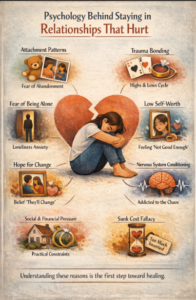
Psychology Behind Staying in Relationships That Hurt

It is a question that persists among many individuals as to why a person would continue to be in a relationship that brings in emotional hurt or neglect. It is a matter of mere words, it appears that it is not so complicated, and when it hurts, one should leave. Psychology however demonstrates that maintaining is hardly weakness. They are aware that they are being hurt, they can feel it in over and over disappointments, need denials and emotional lack of companionship. Leaving is not only a logical process; it is also an emotional process and a process of the nervous system.

In the everyday life, this usually appears in the form of excuse-making over rudeness, clinging to tiny surfaces of tenderness, or wishing that things could go back to their old ways. Pain is familiar to a number of people since the relationships they had in early stages of life taught them that love is inconsistent or emotionally taxing. The unknown may be unsafe in comparison with what is familiar.

The fear of being alone, self-doubt and social pressure may silently hold people back. They could downsize the needs over the years, evade conflict, and modify themselves to the relationship. Knowledge of these patterns can be used to find an alternative to self-blame of self-compassion-and the initial step to recovery and better relationships.

1. Attachment Patterns Formed in Childhood

The experiences of being close to someone in our adulthood are influenced by our first relationships. The attachment theory states that the manner in which our emotions, needs, and distress were addressed by caregivers was a template to love and connection that would be kept as an internal record.

  • In anxious attachment,
    relationships usually make life worryful and prone to thinking. The fear of being deserted can be very strong due to a delay in the response, a change in the tone, or distance in nature. Human beings can be in painful relationships, as the fear of losing an individual being felt more than the pain of remaining. They can be over-giving, people-pleasing or bury their needs to ensure that the relationship remains alive.
  • In the avoidant attachment,
    emotional distance may seem normal. Such one can manifest itself in everyday communication (reducing self-importance, not talking deeply or too closely). Negligence or emotional unavailability is not necessarily experienced as an issue since an early teaching of independence and emotional self-reliance was a source of defense.
  • Fearful-avoidant attachment

    tends to be confusing in push-pull fashion. Someone might want to be intimate, reassured, and close, but when he or she does, he/she will feel overwhelmed and unsafe. In real life, this might present itself as the desire to connect and then withdraw after emotional experiences, initiating fights after intimacy, or being ambivalent about remaining or leaving.

In cases where love during childhood was absent, or lacking, or conditional, the nervous system learns to be vigilant. Emotional instability can be comfortable to adults, whereas stability can be alien and even boring. What is familiar may become familiar as right, even in cases where it is painful, not because it is healthy, but because it is familiar.

Knowing these patterns of attachment makes individuals understand that their relationship problems are not personal failures, but acquired emotional reactions, and that such patterns can be addressed with understanding and secure connection.

2. Trauma Bonding and Intermittent Reinforcement

Trauma bonding is one of the potent psychological traps, as a cycle of emotional pain, after which there is a short period of affection, apology, or hope. In our everyday lives, this can be in form of constant quarrels, emotional withdrawal, and offensive behavior, followed by brief bursts of kindness, vows to change, or extreme intimacy. Such brief good moments may be a relief and very significant following a period of pain.

This tendency operates based on the intermittent reinforcement, which is the same psychological process that is observed in gambling. Since love and care cannot be forecasted, the mind will be preoccupied with the next good time to occur. The doubt leaves an individual emotionally engaged even in a case where the relationship is largely torturous.

The brain releases dopamine when one chooses to reconcile, an apology, a loving message or even when you physically get closer to a person, this is what creates a feeling of relief and emotional reward. It can even be a relief, as love. The bond becomes even stronger with time, and the reason is not that the relationship is healthy, but due to the conditioning of the nervous system to find some relief against distress.

As time passes, the relationship turns less about caring about each other and more about suffering in that quest to expand on those short periods of intercourse. Knowing about trauma bonding can make people understand that they are not addicted to an individual, it is just that they have gotten stuck in a strong cycle of psychology, which can be freed with awareness, safety, and support.

3. Fear of Loneliness and Abandonment

To a great number of individuals, the prospect of being alone is more terrifying than living in emotional distress. Loneliness may trigger profound survival anxiety, particularly in the persons who were conditioned at their early years of life that they are loved and needed and are chosen. Solitude will not only be uncomfortable, but unsafe.

This fear manifests itself in daily life in silent forms such as, at least I am not alone or this is a lot better than nothing. Individuals can remain at such relationships when they feel unnoticed or emotionally deprived just because the company of a person is better than being lonely. Common practices, communications, or even complaints may seem as comforting as nothing at all.

The relationship eventually becomes an antidote to loneliness and not a place of actual connection. The feeling needs gradually grow smaller, self-esteem is bound to the presence of the relationship, and suffering is accepted to not be alone. Coming to terms with this fear can make individuals realize that survival is frequently about being strong, rather than being weak, and that learning to feel safe on your own is a strong move towards healthier relationships.

4. Low Self-Worth and Internalized Beliefs

People who stay in hurtful relationships often carry internalized beliefs such as:

  • “I don’t deserve better”

  • “This is the best I can get”

  • “Love always hurts”

Such beliefs might be a result of criticism experienced in the past, emotional neglect or repeated invalidation. The normalization of pain and healthy love may be strange and undeserving over time.

5. Hope for Change and the “Potential” Trap

People tend to stay in the agonizing relationships due to the fact that they are in love with whom the individual would be, rather than with whom he/she would remain to be all the time. They desperately cling to the memories of how things used to be in the start or to the few occasions when the partner takes care, is warm or understanding. In everyday life, this manifests itself as waiting until the better side of the individual comes back and that love, patience or sacrifice will one day result in an enduring change.

Mental images like the ones that state that they have not always been that way or that they will change in case one loves them sufficiently can have one emotionally involved even after being disappointed many times. With every minor change or a note of apology, hope is strengthened, although the general trend is the same.

This is psychologically reinforced by cognitive dissonance. The mind is torn between two painful truths at the same time that someone is both loved and hurting at the same time many times. The mind dwells on potential, intentions or promises in the future instead of current conduct to minimize this inner conflict. Hope is developed as a coping mechanism.

This might overtime make people become tolerant to some circumstances that they would never recommend other people to tolerate. Knowing this tendency can assist in moving the focus off of what one may be to how the relationship actually is day after day- and knowing it it tends to happen can be the first step to change.

6. Nervous System Conditioning

The nervous system of a person might become dysregulated when he/she lives in the state of chronic emotional stress and gets used to the level of tension, uncertainty, or emotional ups and downs. With time, the body gets to be on high alert. In everyday life, this can manifest itself in the form of constantly anticipating a conflict, overthinking the approach or mannerism, or being anxious when there would be nothing to be bad.

Consequently, disorder and emotional instability come to be normal and predictable, stable, steady relationships may become foreign or even dangerous. Others refer to healthy relationships as being boring not that it is not a connection, but due to the fact that a nervous system is not used to being calm.

That is why individuals might be uncomfortable in steady respectful relationships there is no adrenaline, no emotional hunt, and no necessity to remain hyper-vigilant. The body mixes passion with passion and indifference with apathy. The healing process consists of gradually reconditioning the nervous system to perceive safety, balance and emotional expression as indicators of authentic connection and not threat.

7. Social, Cultural, and Practical Pressures

Beyond internal psychology, external factors also play a role:

  • Societal expectations around marriage or commitment

  • Fear of judgment, especially for women

  • Financial dependence or shared responsibilities

  • Concern for children or family reputation

These pressures can reinforce endurance over emotional safety, making leaving feel like failure rather than self-preservation.

8. Emotional Investment and the Sunk Cost Fallacy

And the longer a relationship spans the more difficult it may be to quit. In the long run, common memories, emotional commitment, sacrifices, habits, and even a collective identity form a sense of duty. The concept of leaving can be daunting, because one learns to live in the day, routine, family ties, dreams and aspirations, and it seems that they lose a part of themselves in the process.

In this case, the sunk cost fallacy becomes influential. One might be tempted to believe that he/she has already devoted so much of his/her time, love, and effort to it, and, by departing, he/she will only render it pointless. The history of investment starts justifying the current suffering. Rather than inquiring about the healthiness of the relationship at the moment, the question is how much has been lost already.

This in real life can manifest itself in terms of staying a little more, hoping that things will get better to make the hard work worth it. Endurance is not an indicator of psychological well being. Surviving is not an indication of strength or love. The process of healing starts when individuals give themselves permission to select emotional safety and self-respect in place of the stress to make past hurt count.

Moving Toward Healing

Remaining in a painful relationship does not imply that one is weak. In more instances, it refers to the fact that they had to learn to survive on the basis of attachment, hope and perseverance. These tendencies used to make them feel secure, related or less isolated-although now they are painful. What appears as a case of staying too long to the external world is in most cases an internal struggle to defend the self emotionally.

It starts with consciousness during healing. Self-blame gives way to self-compassion when individuals see the reason why they remain. Awareness introduces the spaciousness to challenge traditional patterns and hear emotional requirements and envision relationships that are not because they are familiar but safe. Through this, change can be effected not by coercion, but through enlightenment and nurturing.

Helpful steps include:

  • Exploring attachment patterns through therapy

  • Learning nervous system regulation

  • Rebuilding self-worth and boundaries

  • Redefining love as safety, consistency, and emotional presence

Closing Thought

You do not hang about because you are mended. It remain because sometime in your life your brain and body have come to realize that love came with conditions. You were taught to adapt, wait, bear the pain, and hope, as these were the methods used to enable you to feel a part of or not so lonely. What seems to be endurance in these days was in the past a survival.

When love was forced to wait, or to keep still, or to sacrifice oneself, your system had been taught to believe that work is equal to value. You might have been taught to downplay your requirements, question your emotions, or hold that pangs are just part of intimacy. This can over time make emotional anguish, familiar to the self protection, unfamiliar or even egoistic.

Love should not be made to undermine you. It is not to get you to doubt your value, think on toes or dismiss your emotional reality. Healthy love gives you room to be safe, consistent and care about each other- it does not necessitate you to vanish and keep the relationship alive.

Making a choice is not to give up on oneself. It is not abandoning and losing love. Appreciating the fact that emotional well-being is important. It is the silent gesture of coming back to yourself after having spent years in remaining where you were not noticed. And with that decision, healing commences–not with a dramatic climax, but with an honest, sincere start.

Frequently Asked Questions (FAQ)

1. What provokes people to remain in relationships that are harmful to them?

Since psychological aspects such as attachment styles, fear of abandonment, trauma bonding, and conditioning of the nervous system can make leaving more dangerous than remaining.

2. Does that make one weak to remain in a painful relationship?

No. It is frequently a survival mechanism that is based on previous experiences, unfulfilled emotional needs, and acquired coping mechanisms.

3. What is trauma bonding?

Trauma bonding refers to an emotional bonding derived by the presence of pain and release that the short moments of affection strengthen the attachment in spite of the harm.

4. What is the impact of childhood on relationship in adulthood?

Premature relationships form inner models of affection and protection, which affect the way proximity, discord, and emotional demands are fulfilled in adulthood.

5. How does the attachment theory contribute to unhealthy relationships?

Styles of attachment (anxious, avoidant, fearful-avoidant) influence the way individuals react to intimacy conflict, and emotional availability.

6. What is so addictive about emotional unpredictability?

Intermittent reinforcement stimulates the release of dopamine which the brain becomes preferentially conditioned to seeking relief following distress like addictive behavior.

7. What is so strong about the fear of loneliness?

The loneliness may trigger the deepest of deep-seated survival fears, in part because of the tendency to equate self-worth with being chosen or needed.

8. What is cognitive dissonance within relationships?

It is the emotional uncomfortable nature of loving someone who makes someone suffer, usually being solved by holding onto hope, or possibility as opposed to reality.

9. When do healthy relationships get boring?

The nervous system can regulate itself in a way that considers love as something intense, and calmness and consistency become strange and unsafe.

10. What is sunk cost fallacy in relationships?

One of the beliefs is that breaking away would be a waste of time and effort put in even in the case where the relationship is bad.

11. Is that the unlearnability of such patterns?

Yes. Attachment and nervous system patterns can be cured with awareness, therapy, and safe relationships.

12. Is it necessary to love someone and tolerate pain?

No. Healthy love is about emotional safety, mutual respect and consistency- not self erasure and endurance.

13. Why do individuals wish that their partner should change?

The emotional investment, early bonding and the inability to accept loss or disappointments often lead to hope.

14. Is self-selection equivalent to self-sacrifice?

No. Making a choice in favor of oneself is an expression of self-respect and recovery, but not desertion.

15. In cases where is it appropriate to seek professional assistance?

Repeated patterns are used when the emotional pain seems too great, and it is not possible to get out of the situation despite the persistent harm.

Written by Baishakhi Das

Counselor | Mental Health Practitioner
B.Sc, M.Sc, PG Diploma in Counseling


Reference

  1. American Psychological Association (APA) – Relationships & Attachment
    https://www.apa.org/topics/relationships

  2. Psychology Today – Attachment Theory
    https://www.psychologytoday.com/intl/basics/attachment

  3. Psychology Today – Trauma Bonding
    https://www.psychologytoday.com/intl/basics/trauma-bonding

  4. National Institute of Mental Health (NIMH) – Mental Health & Relationships
    https://www.nimh.nih.gov/health/topics

  5. Harvard Health Publishing – Stress & the Nervous System
    https://www.health.harvard.edu/staying-healthy/understanding-the-stress-response

  6. The Gottman Institute – Healthy vs Unhealthy Relationships
    https://www.gottman.com/blog/category/relationships/

  7. Cleveland Clinic – Trauma Responses
    https://my.clevelandclinic.org/health/diseases/trauma

  8. Mind UK – Emotional Well-being & Relationships
    https://www.mind.org.uk/information-support/relationships/

  9. APA Dictionary of Psychology – Cognitive Dissonance
    https://dictionary.apa.org/cognitive-dissonance

  10. Why Emotionally Unavailable People Feel So Familiar

This topic performs well due to rising searches around men’s mental health, workplace stress, and burnout recovery. Combining emotional insight with practical steps increases engagement and trust.
Feeling Behind “Not Good Enough”

It is a silent thought, a thought that hardly a person speaks about at a certain point in life:

“I’m not good enough.”

It does not necessarily come in the form of a theatrical meltdown or a high-volume self-doubting situation. In practice more frequently it creeps in unobtrusively and presents itself as an outwardly productive or responsible behavior. It can present itself as overworking to demonstrate its value, people-pleasing to evade rejection, procrastination because of fear of failure, or a general worry of being found out as a scammer even when it can be seen that it is capable.

Otherwise, this thought is veiled with perfectionism or self-criticism that is initially feels encouraging to you, as it drives you to perform better, exert more, be better. However, as time goes, this internal pressure gradually destroys the self-worth, and in its place, the confidence is substituted with fatigue and the trust in self is substituted with doubt.

The point to note is that, the experience of not being good enough is not an individual failure or character flaw. It is a mental process, a pattern, and in most cases, these patterns were formed in early age and reinforced by experience, relationships and social expectations and misinterpreted as a lack of confidence or competence.

In order to remedy it, we must go beyond outward conduct and self-occurrence and have a look at what is occurring under the surface.

1. “Not Good Enough” Is Rarely About Ability

There are numerous individuals who find themselves battling the sense of incompetence but in actuality, they are capable, intelligent, and emotionally competent. They may possess abilities, competence, and even external authentication, but people feel like they are not good enough. The reason is that it is not often a failure in capability. Rather it is the way the brain has been conditioned to assess safety, belonging and self worth.

Psychologically, competence is not the main concern of the mind. It is preoccupied with survival.

So it doesn’t ask:

  • “Am I capable?”
  • It asks:
  • “Am I safe, accepted, and valued?”

Once the acceptance, particularly during initial relationships, is perceived as conditional, then the brain will start identifying value as performance. Love, approval or attention are something one feels deserved not innate. This builds within it an internal perception that one needs to prove, achieve or live up to expectations in order to be valued.

Subsequently, even competent people can be left constantly feeling under competent not due to their ineptitude, but simply because their nervous system was taught that it is necessary to earn a place by performance.

2. Conditional Love and Early Programming

Among the most potent and the most neglected sources of inadequacy feeling is the conditional validation through childhood. As long as care, love, or emotional security was tied to some behavior, performance or emotional control, then the growing nervous system learned to tie love to performance.

Depended on when love, attention, or praise is required:

  • being well-behaved
  • achieving results
  • meeting expectations
  • not communicating hard, troublesome, and awkward feelings.

the child did not consciously believe that there is something wrong with the environment. Rather the mind evolved by creating a strong internal law:

I am supposed to be worthy when I do something right.

This conviction is not instilled in the mind, but in the nervous-system system. It sets an internal score board that never stops running – it measures behavior, tracks reactions and assesses whether one is doing enough to remain accepted.

The brain still searches to find indicators of approval or disapproval even in adulthood when the original environment is no longer the same:

  • Did I say the right thing?
  • Was I impressive enough?
  • Did I disappoint someone?

This self-monitoring constantly is mistaken with insecurity or having low confidence. Or, more accurately, it is survival learning the system which is created to preserve connection preventing the emotional loss.

3. The Inner Critic Is a Protective Voice, Not an Enemy

That terrible voice within that says:

  • “You should be better.”
  • “Others are ahead of you.”
  • “Don’t mess this up.”

is usually weighted down with misunderstanding. The majority efforts are making it silent, arguing with it or being ashamed to have it at all. Yet psychologically, the critic within did not evolve to your detriment, he evolved to your advantage.

The inner critic develops in early life as a defense against rejection, shame, punishment or failure. It thinks that, through keeping you alert, self-critical and striving at all times, it can assist you to escape emotional pain. To its reasoning, pressure is safety.

In the eyes of the nervous system, criticism is safer than getting taken unawares.

The issue does not lie in the presence of the inner critic. The problem is that:

  • it never renews its strategy.
  • is not aware that things have changed.
  • it knows not when you are now more familiar, more mature, more able.

So it proceeds to push, threaten and squeeze tighter- even after the real threat has passed. What at one time served to sustain your life now holds you in the fear, self-doubt and emotional exhaustion.

The process of healing does not start by fighting with the inner critic, but by knowing the reasons behind why it had learnt to talk that way in the first place.

4. Social Comparison Hijacks the Brain

The contemporary world makes inadequacy feelings significantly heavier with social comparison at all times. Although comparison is a common human behavior, the brain has never been created to handle the magnitude and frequency of occurrence of the act today.

The development of the human brain was such that it was developed to compare itself in small and familiar groups where context, mutual struggle and real life interactions could be seen. To-day however, the brain is expected to compare:

  • your behind-the-scenes life
  • and highlights of other people carefully edited.
  • This disproportion fills the nervous system.

Instead of causing motivation or development, constant comparison leads to the brain turning on the system of threat-detection that uses the same mechanism that identifies danger. When the brain thinks of others as being in front, it fails to give it out as a neutral information. It interprets it as risk.

Comparison results in most cases in lieu of inspiration:

  • shame
  • self-doubt
  • emotional apathy or closure.

A more profound level of interpretation of a fall behind by the brain is that it is a possible loss of belonging. And to a social nervous system, to lose belonging is very unsafe, almost the danger of being killed.

That is why comparison does not only damage confidence; it causes a disturbance in the emotional security.

5. Trauma and Emotional Neglect Amplify the Belief

The second belief is that I am not good enough, which is particularly widespread in the group of people who experienced in their childhood:

emotional neglect

variable or irregular care giving.

chronic criticism

minor nullification of feelings, needs or perceptions.

In such settings, lack of emotional sensitivity usually becomes more harmful than direct injury. When the emotions of the child are disregarded, downplayed, or misinterpreted, the child does not result in concluding that there is something wrong with the caregivers. Rather the growing psyche assimilates a much more agonistic conviction:

“Something about me is wrong.”

This ideology does not stay in childhood. Gradually it becomes incorporated into self-concept the prism through which experiences, relationships, even achievements are perceived. Success feels fragile. Connection feels uncertain. Acceptance feels temporary.

The nervous system is usually on alert even in secure supportive surrounding later in life. It still searches signals of rejection, disapproval, abandonment, not that danger exists, but that it has been taught to expect danger.

This is not oversensitivity. It is the print of a nervous system that is developed under not fulfilled emotional needs, and it is still attempting to defend itself.

6. Why Achievements Don’t Heal the Feeling

Many people carry the belief:

“Once I achieve more, I’ll finally feel enough.”

It is reasonable and even inspirational. However, in practice, success without emotional security does not even cure the sense of inadequacy, it simply does not pay much attention to it.

When success is attained, it may offer temporary relief, confirmation, or power. However, since the belief about the worth is the same, the relief is not permanent. The mind instantly puts the bar higher again, in quest of the next goal, next demonstration, next assurance.

The fundamental dogma is not changed:

  • worth is still conditional
  • rest still feels undeserved
  • success is still so very precarious and can be stolen.

Consequently, even the major achievements can be empty or distressing. Success may create more pressure, rather than confidence, -Now I have to keep it up.

That is why the struggles of many high-achievers are silent:

  • chronic anxiety
  • emotional emptiness
  • imposter syndrome
  • fear of being revealed when there is a show of competency.

Achievement is reduced to a treadmill instead of a fulfillment unless the deeper drive behind safety and unconditional self-worth is met.

7. Healing Begins with Safety, Not Self-Improvement

The postulation of non-goodness cannot be cured by being better, more robust or successful. It is cured being made safer in oneself. Once safety is achieved, it is not necessary to earn self-worth anymore.

Psychological healing does not mean forcing the change, but rather letting it gradually loosen. It involves:

  • the innermost critic being observed without being obeyed as of course.
  • validation of self-correction where self-correction was formerly the rule.
  • value to be divided off performance, productivity or approval.
  • the perfect regulation of the nervous-system, being peacefully constructed by unity and care.

The inner need to repair, demonstrate or defend starts to reduce as the security level rises. There is no longer a need to ensure that the system remains on high alert.

With time, the internal question is automatically changed. Instead of asking:

“How can I fix myself?”

a more profound, more sympathetic question arises:

What went on that taught my system I was not enough?

This reversal redefines everything not due to a problem being solved but because the individual is not being handled as the problem.

8. You Were Never Broken—You Adapted

A sense of being not good enough is not being weak, failure or lacking. It is evidence of adaptation. What your nervous system did was what it was supposed to do, it learned how to survive in a place where safety, love, consistency or validation was not so sure.

The mind also adapted through alertness, self monitoring and protection. Essays like overthinking, perfectionism, people-pleasing or emotional withdrawal were not weaknesses; they were clever reactions to situations which demanded carefulness.

What used to assist you to cope, no longer need be needed at this moment-but that is no fault in it. It only implies that your system has not yet been demonstrated that there is another way of being safe.

and that can be unlearned that had been learned. Awareness rather than self-blame, compassion rather than judgment, support rather than isolation, and these allow the nervous system to update its beliefs progressively.

You were never broken. You adjusted–and the first step towards healing is to be understood.

A Reframe Worth Remembering

You are not feeling insufficient since you are being underprivileged, broken, or lagging.

You are not good enough since your nervous system has been conditioned to believe that being worthy of living means being worthy of survival, and it was taught at a very young age. It discovered that to be accepted, loved, or safe, one had to be on his or her guard, act, or correct himself.

Such a belief could seem very real as it was needed at one time. But necessity is not truth.

and that belief, as powerful and perennial and persuasive as it may be, is not the truth of yourself. It is an acquired reaction, rather than an identity.

The nervous system, with the help of awareness, compassion and safety may learn something new:
that worth is not earned,
conditioned belonging is not,
and you were always enough.

Frequently Asked Questions (FAQs)

1. Why do I feel “not good enough” even when I’m doing well?

Because this feeling is rarely about ability. It is rooted in how your nervous system learned to associate worth with safety, acceptance, or performance—often early in life.

2. Is feeling “not good enough” a sign of low self-esteem?

Not always. Many people with this feeling are capable and confident in skills but struggle with conditional self-worth, not low ability.

3. Can childhood experiences really affect adult self-worth?

Yes. Early emotional environments shape attachment, nervous-system responses, and core beliefs about worth and belonging.

4. What is conditional love in psychology?

Conditional love occurs when affection or approval depends on behavior, achievement, or emotional compliance rather than being freely given.

5. Why does my inner critic feel so harsh?

The inner critic often develops as a protective mechanism to prevent rejection, shame, or failure—not to hurt you.

6. Is the inner critic bad or harmful?

It becomes harmful when it goes unexamined, but originally it formed to keep you safe in emotionally uncertain environments.

7. Why doesn’t success or achievement make me feel enough?

Because achievement doesn’t address the underlying belief that worth must be earned. Without emotional safety, success feels temporary and fragile.

8. Is this related to imposter syndrome?

Yes. Imposter syndrome often emerges from conditional self-worth and fear of losing belonging despite competence.

9. How does social media increase feelings of inadequacy?

It encourages constant comparison between your real life and others’ curated highlights, activating the brain’s threat system.

10. What role does emotional neglect play?

Emotional neglect teaches the child that their feelings don’t matter, often leading to the belief that something is inherently wrong with them.

11. Is this feeling a trauma response?

It can be. Chronic emotional invalidation, criticism, or inconsistency can leave trauma imprints even without obvious abuse.

12. Can this belief be unlearned?

Yes. With awareness, nervous-system regulation, therapy, and self-compassion, these patterns can change.

13. What does “healing through safety” mean?

It means creating internal and external conditions where the nervous system no longer feels threatened—rather than trying to “fix” yourself.

14. Do I need therapy to heal this?

Therapy can be very helpful, especially trauma-informed or attachment-based approaches, but healing can also begin through awareness and supportive relationships.

15. What’s the most important thing to remember?

You were never broken. You adapted. And adaptation can be gently unlearned.

Written by Baishakhi Das

Counselor | Mental Health Practitioner
B.Sc, M.Sc, PG Diploma in Counseling

References 

  1. Bessel van der KolkThe Body Keeps the Score
    https://www.besselvanderkolk.com/resources/the-body-keeps-the-score

  2. John Bowlby – Attachment Theory Overview
    https://www.simplypsychology.org/attachment.html

  3. Kristin Neff – Self-Compassion Research
    https://self-compassion.org/the-research/

  4. Pete Walker – Complex PTSD & Inner Critic
    https://www.pete-walker.com/shrinkingInnerCritic.htm

  5. Stephen Porges – Polyvagal Theory
    https://www.polyvagalinstitute.org/whatispolyvagaltheory

  6. APA – Trauma and Stress-Related Disorders
    https://www.apa.org/topics/trauma

Why Your Brain Won’t Stop Replaying Past Conversations

This topic performs well due to rising searches around men’s mental health, workplace stress, and burnout recovery. Combining emotional insight with practical steps increases engagement and trust.

You’re Not Lazy — You’re Emotionally Exhausted

Many people carry a quiet shame around productivity. You promise yourself you’ll get things done, yet find it hard to start. You procrastinate, feel drained, and then criticize yourself for being “lazy.” But what if laziness isn’t the problem at all? What if what you’re experiencing is emotional exhaustion?

Emotional exhaustion doesn’t always look dramatic. It doesn’t have to involve burnout from a high-powered job or a visible breakdown. Often, it shows up quietly—in the inability to focus, the constant urge to scroll, the heaviness in your body, or the sense that even small tasks feel overwhelming. From the outside, it may look like avoidance. On the inside, it feels like you have nothing left to give.

Emotional Exhaustion Is Not a Lack of Willpower

We tend to treat motivation as a moral quality. If you’re productive, you’re seen as disciplined, responsible, and capable. If you’re not, the label quickly becomes “lazy.” This way of thinking ignores how the nervous system actually works. Motivation does not come from force or pressure; it arises when there is enough emotional and psychological energy available to engage with life.

When you are emotionally exhausted, your system is no longer oriented toward growth or achievement. It is operating in survival mode. The brain shifts its priorities from long-term goals to immediate safety. Instead of asking, “What should I achieve today?” it asks, “How do I get through this without collapsing?” Focus narrows, energy drops, and even simple decisions can feel heavy.

In this state, behaviors like resting, zoning out, procrastinating, or withdrawing socially are not signs of weakness or failure. They are automatic, protective responses of a system that has been overextended for too long. The body is trying to conserve energy, reduce stimulation, and prevent further emotional overload. Judging these responses as laziness only deepens the exhaustion, while understanding them creates the conditions for real recovery.

How Emotional Exhaustion Builds Up

Emotional exhaustion is often the result of long-term emotional load rather than a single event. Constant responsibility, unresolved stress, people-pleasing, emotional neglect, or growing up in environments where your feelings were minimized can slowly drain your internal resources.

Many people learn early that they must stay strong, quiet, or useful to be accepted. Over time, this leads to chronic self-monitoring—always being alert, careful, and emotionally restrained. Even when life becomes calmer, the body doesn’t automatically relax. The exhaustion remains.

You may notice that you can function well for others but struggle to do things for yourself. Or that you feel tired even after resting. This is because emotional exhaustion is not cured by sleep alone; it requires emotional safety, validation, and release.

Why You Feel Stuck Instead of Rested

When you’re emotionally exhausted, resting doesn’t always feel refreshing. Instead of feeling restored, you may feel numb, guilty, or restless. This happens because your system never fully powers down. There is a background hum of stress—unfinished emotional business that hasn’t been acknowledged.

Your mind may keep replaying conversations, worries, or self-criticism. Your body may feel heavy or tense. In this state, starting tasks feels impossible, not because you don’t care, but because your system is already overloaded.

Calling yourself lazy in these moments only adds another layer of pressure. Shame is not motivating; it is draining. The more you criticize yourself, the more your system retreats.

The Difference Between Laziness and Exhaustion

Laziness is often misunderstood, but at its core, it reflects a lack of interest without inner conflict. There is little emotional struggle involved. A lazy state does not usually carry guilt, shame, or a deep wish to change. Emotional exhaustion, however, is marked by distress. It comes with frustration, self-criticism, and the painful awareness that you are not functioning the way you want to.

If you wish you could be more engaged, more focused, more active—but feel unable to access that energy—this is not laziness. This inner conflict is a key sign of exhaustion. You care, but your system is depleted. The desire is present; the capacity is not.

Emotionally exhausted

Emotionally exhausted people often care deeply about their work, relationships, and responsibilities. They want to show up, contribute, and live meaningfully. Many of them have spent years being reliable, emotionally available, or strong for others. Over time, this continuous emotional output drains internal resources. The problem is not a lack of values or discipline; it is a lack of emotional capacity after prolonged strain.

Another important difference lies in how the body responds. Laziness does not involve a stressed nervous system. Exhaustion does. When emotionally exhausted, the body may feel heavy, tense, foggy, or numb. Starting tasks feels overwhelming not because of unwillingness, but because the nervous system is already overloaded.

Understanding this distinction is crucial, because treating exhaustion as laziness leads to shame-based motivation—which only deepens burnout. Recognizing exhaustion allows space for compassion, rest, and repair.

Laziness Emotional Exhaustion
Lack of interest without distress Strong desire to do better accompanied by distress
No significant guilt or self-criticism High levels of guilt, frustration, and self-blame
Motivation is absent, but not missed Motivation is deeply wanted but inaccessible
Nervous system is relatively calm Nervous system is overloaded or in survival mode
Tasks are avoided casually Tasks feel overwhelming and draining
Rest feels neutral or pleasant Rest often feels unrefreshing or guilt-filled
Does not question self-worth Often questions self-worth and competence

What Actually Helps

Recovery from emotional exhaustion does not begin with pushing harder or trying to become more disciplined. It begins with listening differently. Instead of asking, “What’s wrong with me?” a more helpful and regulating question is, “What have I been carrying for too long without support?” This shift alone reduces shame and allows the nervous system to soften.

Emotional exhaustion develops when effort continues without adequate emotional processing, rest, or validation. Healing, therefore, is not about doing more—it is about repairing what has been depleted.

Small acts of self-compassion matter far more than productivity hacks or motivational strategies. Naming your feelings instead of suppressing them, setting gentle boundaries instead of over-explaining, and allowing yourself to slow down without guilt are not indulgences. They are essential repairs to a system that has been running on empty.

What genuinely helps includes:

  • Acknowledging exhaustion without self-judgment. Simply recognizing that you are emotionally tired—not lazy or broken—reduces internal resistance and shame.
  • Emotional naming and expression. Putting words to what you feel helps regulate the nervous system. Feelings that are acknowledged move through; feelings that are ignored accumulate.
  • Reducing emotional over-responsibility. Learning to say no, pause, or delegate protects emotional energy and prevents further depletion.
  • Rest that is intentional, not avoidant. True rest involves permission. It is not scrolling to escape guilt, but allowing your body and mind to settle without self-criticism.
  • Lowering unrealistic self-expectations.

    Exhaustion often comes from holding yourself to standards that ignore your current capacity.

  • Creating emotional safety. Spending time with people or environments where you do not have to perform, explain, or stay strong restores energy more effectively than isolation.

Therapeutic support can play a crucial role, especially when exhaustion is rooted in long-standing patterns, trauma, people-pleasing, or emotional neglect. Therapy offers something rest alone cannot: a space where your inner experience is witnessed, validated, and made sense of. This relational safety helps the nervous system move out of survival mode and gradually rebuild emotional capacity.

Recovery is rarely instant. Energy returns slowly, in moments of softness, understanding, and permission. But when exhaustion is met with compassion instead of pressure, the system begins to heal—and functioning becomes possible again.

A Reframe Worth Remembering

If you are struggling to function the way you think you should, it doesn’t mean you are weak or lazy. It may mean you are tired in a way that hasn’t been acknowledged yet.

You don’t need more pressure. You need understanding—especially from yourself. When emotional exhaustion is met with compassion instead of criticism, energy slowly returns. Not all at once, but enough to begin again.

And that is not laziness. That is healing.

Written by Baishakhi Das

Counselor | Mental Health Practitioner
B.Sc, M.Sc, PG Diploma in Counseling

Frequently Asked Questions (FAQ)

1. Is emotional exhaustion the same as burnout?
Emotional exhaustion is a core component of burnout, but it can exist even without work-related burnout. It may come from caregiving roles, emotional neglect, chronic stress, or long-term people-pleasing.

2. Can emotional exhaustion happen without a stressful job?
Yes. Emotional exhaustion often develops from invisible emotional labor, unresolved trauma, relationship strain, or growing up in emotionally unsafe environments.

3. How do I know if I’m emotionally exhausted or just unmotivated?
If you want to function better but feel unable to access energy—and this causes guilt or distress—it is more likely exhaustion than lack of motivation.

4. Why do I feel tired even after resting?
Because emotional exhaustion is not only physical. Without emotional safety, validation, and nervous system regulation, rest alone may not feel restorative.

5. Is procrastination a sign of emotional exhaustion?
Often, yes. Procrastination can be a protective response when the nervous system feels overwhelmed or overloaded.

6. Can emotional exhaustion cause physical symptoms?
Yes. Headaches, body heaviness, muscle tension, brain fog, digestive issues, and frequent fatigue are common.

7. Does emotional exhaustion mean I’m weak?
No. It usually means you have been strong for too long without enough support.

8. How long does recovery from emotional exhaustion take?
Recovery is gradual and varies by individual. Healing depends on reducing ongoing stress, increasing emotional safety, and receiving adequate support.

9. Can emotional exhaustion affect relationships?
Yes. It may lead to withdrawal, irritability, numbness, or difficulty communicating needs.

10. Is emotional exhaustion a mental illness?
No. It is a psychological and physiological state. However, if unaddressed, it can contribute to anxiety or depression.

11. Can therapy really help with emotional exhaustion?
Yes. Therapy helps identify patterns, process unresolved emotions, and regulate the nervous system—restoring emotional capacity over time.

12. What if I can’t afford therapy?**
Low-cost counseling services, support groups, self-help resources, and trauma-informed content can still be beneficial starting points.

13. Should I push myself to stay productive while exhausted?
Pushing through exhaustion often worsens it. Sustainable functioning comes from pacing, not pressure.

14. Can emotional exhaustion come from childhood experiences?
Yes. Emotional neglect, excessive responsibility, or lack of emotional safety in childhood can lead to chronic exhaustion in adulthood.

15. Will my motivation ever come back?
Yes. When exhaustion is met with compassion, boundaries, and support, motivation gradually returns.

References 

World Health Organization (WHO) – Burnout and mental health
Protecting health and care workers’ mental health and well-being: Technical Consultation Meeting

American Psychological Association (APA) – Stress, burnout, and emotional regulation
Stress in America™ 2025: A Crisis of Connection

National Institute of Mental Health (NIMH) – Mental health and emotional well-being
Caring for Your Mental Health – National Institute of Mental Health (NIMH)

How Childhood Silence Creates Emotionally Detached Adults

This topic performs well due to rising searches around men’s mental health, workplace stress, and burnout recovery. Combining emotional insight with practical steps increases engagement and trust.

 

Growing Up With Emotionally Immature Parents

https://i0.wp.com/www.additudemag.com/wp-content/uploads/2025/11/Growing-Up-with-Emotionally-Immature-Parents-Marlow-Macoy-art1-1-scaled.png?quality=1&w=1024

Many adults struggle with anxiety, guilt, people-pleasing, or emotional numbness without fully understanding where these patterns began. Often, the root does not lie in dramatic abuse or obvious neglect—but in growing up with emotionally immature parents. The pain is subtle, not explosive, and that is exactly why it often goes unrecognized for so long.

These parents may have provided food, education, and structure, yet failed to offer consistent emotional attunement, validation, and psychological safety. They may have struggled to recognize a child’s feelings, respond with empathy, or tolerate emotional closeness. Over time, this absence of emotional maturity shapes how a child learns to relate to themselves and others—teaching them to minimize their needs, doubt their feelings, and rely on self-protection rather than connection.

Because this environment often appears “functional” from the outside, many children grow up blaming themselves for feeling unseen or unsupported. The effects, however, can quietly persist into adulthood, influencing self-worth, relationships, and the ability to feel emotionally safe with others.

What Does Emotional Immaturity Mean?

Emotional immaturity refers to an adult’s limited capacity to engage with emotions in a healthy, regulated, and relational way. Emotionally immature adults may function well in practical areas of life, yet struggle deeply with emotional awareness, responsibility, and connection—especially in close relationships with their children.

It often includes difficulty in the ability to:

  • Regulate emotions
    Becoming overwhelmed, reactive, explosive, or withdrawn when emotions arise

  • Take responsibility for behavior
    Blaming others, minimizing harm, or avoiding accountability

  • Respond empathically
    Struggling to validate or understand another person’s emotional experience

  • Tolerate emotional discomfort
    Avoiding difficult conversations, feelings, or vulnerability

  • See the child as a separate emotional being
    Treating the child as an extension of themselves rather than an individual with their own needs, feelings, and limits

Emotionally immature parents tend to react rather than reflect. Instead of pausing, listening, and responding thoughtfully, they act from impulse, fear, or unresolved emotional wounds. They often prioritize their own moods, needs, or insecurities over the child’s inner world, leaving the child feeling unseen, invalidated, or emotionally unsafe.

This framework was widely popularized by psychologist Adult Children of Emotionally Immature Parents, which helped many adults understand that their struggles with relationships, self-worth, or emotional regulation are not signs of personal weakness. Rather, they are the result of unmet developmental needs in childhood—needs for empathy, consistency, and emotional presence that were never fully fulfilled.

Recognizing emotional immaturity is often the first step toward self-compassion, clarity, and healing.

Common Traits of Emotionally Immature Parents

Emotionally immature parents may not intend harm, but their limitations consistently affect the child.

Common patterns include:

  • Difficulty handling emotions (anger, shame, sadness)

  • Defensiveness when confronted

  • Emotional unpredictability

  • Self-centered conversations

  • Invalidation of feelings (“You’re overreacting”)

  • Expecting the child to manage the parent’s emotions

  • Avoiding accountability

These parents often feel overwhelmed by emotional closeness and may withdraw, explode, or guilt the child instead.

How Children Adapt to Emotional Immaturity

Children instinctively adapt to survive emotionally. When parents cannot offer consistent safety, empathy, or emotional regulation, children do not question the environment—they change themselves. These adaptations are not conscious choices; they are survival strategies shaped by the child’s need for connection and safety.

Common adaptations include:

1. Becoming the “Good” Child

The child suppresses their needs, emotions, and opinions to avoid conflict, criticism, or rejection. They learn that approval comes from compliance, maturity, or being “easy to handle.”

2. Emotional Self-Reliance

The child learns, “I can’t depend on anyone,” and gradually stops seeking comfort or reassurance. They turn inward, relying on themselves even when support is needed.

3. Hypervigilance

The child constantly monitors the parent’s moods, tone, or behavior to anticipate emotional shifts and stay safe. This creates a heightened state of alertness that often continues into adulthood.

4. Parentification

The child takes on the role of emotional caretaker, mediator, or problem-solver—managing the parent’s feelings instead of having their own needs met.

These adaptations help the child cope and survive in childhood. However, what once ensured emotional safety often becomes a source of struggle in adulthood—affecting boundaries, relationships, self-worth, and the ability to rest or receive care.

Long-Term Effects in Adulthood

Adults raised by emotionally immature parents often experience:

  • Chronic guilt and self-doubt

  • Fear of emotional closeness

  • Difficulty setting boundaries

  • People-pleasing and over-responsibility

  • Emotional numbness or shutdown

  • Attracting emotionally unavailable partners

  • Feeling unseen even in relationships

  • A strong inner critic

Many describe a persistent sense of emptiness or loneliness—even when surrounded by others.

Why This Is So Hard to Identify

Emotional immaturity often goes unnoticed because:

  • The parent “did their best”

  • There was no obvious abuse

  • The child appeared independent or successful

  • The family looked functional from the outside

Because the harm is emotional and relational, it rarely receives validation. Many adults blame themselves instead.

Emotional Neglect vs Abuse

It’s important to understand a few key truths:

  • Emotional immaturity is not always intentional abuse.
    Many parents act from their own unresolved trauma, limited emotional skills, or lack of awareness—not from a desire to harm.

  • However, a lack of emotional responsiveness still causes developmental harm.
    When a child’s feelings are ignored, dismissed, or misunderstood over time, the impact on attachment, self-worth, and emotional regulation can be profound.

  • A child does not need perfect parents—but they do need emotionally available ones.
    Consistent presence, empathy, and willingness to repair matter far more than perfection.

Intent does not erase impact.
Even well-meaning parents can leave emotional wounds when they are unable to meet a child’s core emotional needs.

Healing the Impact of Emotional Immaturity

Healing Begins With Clarity—Not Blame

Healing from the effects of emotional immaturity does not require blaming your parents or reliving anger endlessly. It begins with clarity—clearly recognizing what was missing, how it shaped your emotional world, and what you need now. This clarity helps shift the focus away from self-blame and toward understanding, compassion, and growth. From that place, meaningful change becomes possible.

1. Name the Experience

Recognizing that your emotional needs were unmet helps shift the narrative from “Something is wrong with me” to “Something important was missing.” This awareness reduces shame and self-blame.

2. Separate Reality From Hope

Accept who your parent truly is, rather than who you hoped they would become. Letting go of unrealistic expectations protects you from repeated disappointment and emotional injury.

3. Develop Emotional Awareness

Learn to identify, tolerate, and validate your own feelings. Emotions that were once ignored or dismissed deserve attention and care now.

4. Set Emotional Boundaries

Understand that you are not responsible for regulating your parent’s emotions, solving their problems, or absorbing their distress. Boundaries create emotional safety.

5. Reparent Yourself

Begin offering yourself the empathy, protection, reassurance, and validation you didn’t receive. Self-compassion becomes a corrective emotional experience.

6. Seek Therapy

Trauma-informed or attachment-based therapy provides a safe space to process grief, anger, and loss—and to build healthier relational patterns.

Healing is not about rewriting the past.
It’s about giving yourself what you needed then—and still deserve now.

A Gentle Truth

If you grew up with emotionally immature parents, nothing was “wrong” with you. You adapted to an environment that could not meet your emotional needs.

You learned to survive quietly.
You learned to stay strong alone.
You learned to ask for little.

Healing means learning something new:
That your emotions matter.
That your needs are valid.
That connection can be safe.

You deserved emotional presence then.
You still deserve it now.

Frequently Asked Questions (FAQ)

1. What are emotionally immature parents?

Emotionally immature parents struggle with empathy, emotional regulation, accountability, and seeing their child as a separate emotional individual. They often react impulsively rather than responding with understanding.


2. Is emotional immaturity the same as abuse?

Not always. Emotional immaturity is not necessarily intentional abuse, but chronic emotional unavailability or invalidation can still cause significant developmental harm.


3. How does growing up with emotionally immature parents affect adulthood?

Common effects include people-pleasing, difficulty setting boundaries, emotional numbness, fear of intimacy, chronic guilt, anxiety, and choosing emotionally unavailable partners.


4. Why do children blame themselves?

Children are wired to preserve attachment. When emotional needs go unmet, they assume the problem lies within themselves rather than the caregiver.


5. Can emotionally immature parents change?

Some may develop insight and grow emotionally, but many do not. Healing often requires accepting the parent as they are rather than waiting for them to change.


6. Can therapy help with emotional neglect?

Yes. Trauma-informed and attachment-based therapies help process grief, build emotional awareness, and develop healthier relational patterns.

Written by Baishakhi Das

Counselor | Mental Health Practitioner
B.Sc, M.Sc, PG Diploma in Counseling


Reference 

Parentification Trauma: Signs You Grew Up Too Fast

https://www.cjcareconsulting.com/wp-content/uploads/2024/12/When_a_Child_becomes_the_caregiver.jpg

Childhood should be a time of care, guidance, play, and emotional safety—a phase when a child’s main role is to grow, explore, and feel protected. Yet for many people, childhood slowly turned into something else entirely. Instead of receiving care, they learned to give it. Instead of receiving guidance, they became emotionally alert, responsible, and self-reliant far too early.

For these individuals, childhood involved responsibility, emotional labor, and silent survival. They learned to stay strong, suppress their needs, and handle situations that never belonged to them. If you often think, “I never really got to be a child,” you may carry the long-term emotional effects of parentification trauma.

This article explores what parentification truly is, how growing up too fast affects psychological and emotional development, the subtle yet powerful signs that often appear in adulthood, and—most importantly—how healing and reclaiming your unmet needs is possible.

What Is Parentification?

Parentification happens when caregivers place a child in a parental role—emotionally, practically, or both. Instead of receiving consistent care, protection, and guidance, the child takes responsibility for meeting the emotional, physical, or psychological needs of adults or siblings. This role reversal pushes the child to mature prematurely and often disrupts their emotional development.

Family systems theorist Ivan Boszormenyi-Nagy introduced the concept, explaining how disrupted family roles and emotional imbalance interfere with healthy attachment, identity formation, and self-worth. When adults expect a child to function as a caregiver, the child loses the safety of dependence—even though dependence forms a core developmental need in childhood.

It’s important to understand that parentification is not about occasional help or learning responsibility. Helping with chores, caring for a sibling briefly, or supporting a parent during a short-term crisis can be part of healthy development when adequate support and boundaries exist.

Parentification becomes traumatic when:

  • The responsibility is chronic and ongoing, not temporary

  • The child’s emotional needs are consistently ignored or minimized

  • The role is developmentally inappropriate for the child’s age

  • There is no reliable adult backup, guidance, or emotional safety

In these situations, the child learns that their value lies in being useful, mature, or emotionally strong—rather than being cared for. Over time, this shapes how they see themselves, relationships, and their right to rest, need, or vulnerability.

Parentification is not a character flaw or strength—it is an adaptive response to unmet needs.

Types of Parentification

1. Emotional Parentification

The child becomes the emotional support system for the parent.

Examples:

  • Listening to a parent’s marital problems

  • Regulating a parent’s emotions

  • Acting as a confidant, mediator, or therapist

  • Feeling responsible for a parent’s happiness

2. Instrumental Parentification

The child takes on adult-level practical responsibilities.

Examples:

  • Caring for siblings daily

  • Managing finances, cooking, or household duties

  • Acting as a substitute spouse or co-parent

  • Making adult decisions too early

Both forms often coexist and reinforce each other.

Why Parentification Is Traumatic

Children are not neurologically, emotionally, or psychologically equipped to carry adult responsibilities. Their brains and nervous systems are still developing, and they rely on caregivers for regulation, safety, and guidance. When a child is forced into an adult role, their nervous system shifts into survival mode—prioritizing vigilance, control, and emotional containment over healthy growth and exploration.

Instead of learning who they are, the child learns how to manage others. Instead of feeling safe enough to express emotions, they learn to suppress them. This adaptation may help the child cope in the moment—but it comes at a long-term psychological cost.

Over time, parentification can lead to:

  • Chronic hypervigilance
    Constantly scanning for others’ moods, needs, or potential conflict

  • Emotional suppression
    Learning that feelings are inconvenient, unsafe, or secondary

  • Difficulty identifying personal needs
    Feeling disconnected from one’s own desires, limits, and bodily signals

  • A belief that love must be earned through usefulness
    Equating worth with responsibility, sacrifice, or emotional labor

Because these patterns often look like maturity, competence, or strength from the outside, they are frequently misunderstood and even praised. But beneath the surface, the child was never given the freedom to be vulnerable, dependent, or cared for.

This is not resilience.
This is adaptive survival—a child doing whatever was necessary to stay emotionally safe in an unsafe environment.

Signs You Grew Up Too Fast (Adult Indicators)

1. You Feel Responsible for Everyone

You automatically take care of others, even at your own expense. Rest feels uncomfortable or undeserved.

2. You Struggle to Identify Your Own Needs

When asked, “What do you want?”—your mind goes blank or you feel anxious.

3. You’re Emotionally Mature but Deeply Exhausted

You’re “strong,” “wise,” and “reliable,” yet internally burned out.

4. You Fear Burdening Others

You avoid asking for help because you learned early that your needs were secondary.

5. You Feel Guilty When You Rest or Say No

Boundaries trigger guilt, anxiety, or fear of rejection.

6. You Were “The Good Child”

You were praised for being understanding, independent, or low-maintenance—but never truly seen.

7. You Attract One-Sided Relationships

You often become the caretaker, fixer, or emotional anchor in friendships and romantic relationships.

8. You Feel Older Than Your Age—Or Younger Inside

You may appear highly responsible externally while feeling emotionally stuck, playful, or deprived internally.

Parentification vs Healthy Responsibility

Healthy Responsibility Parentification
Age-appropriate tasks Adult-level roles
Choice and flexibility Obligation and pressure
Emotional support available Emotional neglect
Child’s needs prioritized Child’s needs ignored

The key difference is choice, balance, and emotional safety.

Long-Term Psychological Effects

Untreated parentification trauma may contribute to:

  • Anxiety and chronic stress

  • Depression and emotional numbness

  • Codependency

  • Burnout and compassion fatigue

  • Difficulty with intimacy

  • Perfectionism

  • Suppressed anger and resentment

Many adults only recognize the impact later in life—often after emotional collapse, relationship difficulties, or burnout.

Why Parentification Often Goes Unrecognized

Parentification is frequently overlooked and misunderstood, because its effects often appear positive on the surface. In many families and cultures, the behaviors created by parentification are not only accepted—but actively encouraged.

Parentification is frequently:

  • Praised as maturity
    The child is labeled “wise beyond their years,” “responsible,” or “so strong,” reinforcing the idea that their premature adulthood is a virtue rather than a burden.

  • Normalized in families under stress
    In households affected by illness, poverty, addiction, conflict, or single parenting, role reversal is often seen as necessary for survival—making the child’s sacrifice invisible.

  • Culturally reinforced (especially in caregiving roles)
    In many cultures, children—particularly eldest daughters—are expected to care, adjust, and emotionally accommodate, blurring the line between responsibility and emotional neglect.

  • Hidden behind success or competence
    Many parentified children grow into high-functioning adults: reliable, high-achieving, and outwardly “fine.” Their internal exhaustion is rarely questioned.

Because the child functioned well, no one asked whether they were hurting.
Because they didn’t fall apart, their unmet needs were overlooked.

The absence of visible dysfunction does not mean the absence of trauma—it often means the child learned to survive quietly.

Healing From Parentification Trauma

Healing does not mean blaming caregivers—it means reclaiming your unmet childhood needs.

Key Steps Toward Healing

1. Name the Experience
Understanding that this was not your responsibility is the first step.

2. Allow Grief
Grieve the childhood you didn’t receive. This grief is valid.

3. Learn to Identify Needs
Start small: What do I feel? What do I need right now?

4. Practice Boundaries Without Guilt
Boundaries are not rejection—they are self-respect.

5. Reparent Yourself
Offer yourself the care, safety, and permission you never had.

6. Seek Trauma-Informed Therapy
A trained mental health professional can help process role reversal, suppressed emotions, and attachment wounds safely.

A Compassionate Reminder

If you were parentified, you were not “too sensitive,” “too serious,” or “too responsible.”
You were a child who adapted to survive.

Growing up too fast may have kept you safe then—but healing allows you to finally live, rest, and receive now.

Care is not something you have to deserve.
Strength does not mean doing it all alone.
You were always worthy of support, rest, and protection.

Frequently Asked Questions (FAQ)

1. Is parentification always abusive?

Not always intentionally abusive, but it can still be psychologically harmful. Even when parents are overwhelmed rather than malicious, chronic role reversal can disrupt a child’s emotional development.


2. What is the difference between responsibility and parentification?

Healthy responsibility is age-appropriate, temporary, and supported by adults. Parentification is ongoing, emotionally demanding, and places adult-level expectations on a child without adequate support.


3. Can parentification affect adulthood?

Yes. Adults who were parentified often struggle with boundaries, people-pleasing, burnout, anxiety, emotional numbness, and difficulty asking for help.


4. Why do parentified children often become “high achievers”?

Because their nervous system learned that safety and love come from performance, usefulness, and reliability—not from simply being themselves.


5. Can parentification trauma be healed?

Yes. With awareness, boundary work, self-compassion, and trauma-informed therapy, individuals can reconnect with their needs and heal attachment wounds.


6. Is parentification common in certain cultures?

Yes. In many collectivist or caregiving-focused cultures, emotional and instrumental parentification—especially of eldest children or daughters—is often normalized.

Written by Baishakhi Das

Counselor | Mental Health Practitioner
B.Sc, M.Sc, PG Diploma in Counseling

Reference