Introduction
Becoming a mother is often narrated as one of life’s most beautiful transitions. Yet for many Indian women, the period after childbirth brings not just physical exhaustion, but also emotional turbulence, fear, and a profound sense of guilt — especially when they consider asking for help.
This guilt is not merely an internal feeling: it is shaped by deep cultural beliefs, gendered expectations, family dynamics, and systemic neglect of maternal mental health. In India, where motherhood is idealized and women are expected to shoulder responsibilities selflessly, asking for support — emotional, physical, or psychological — can trigger feelings of inadequacy, shame, or fear of judgment.
This article explores why Indian mothers feel guilty asking for help after childbirth, examining cultural narratives, family pressures, gender norms, and the psychological impacts of this guilt. Along the way, we’ll also look at consequences for maternal mental health and child outcomes, offering evidence-based insights and pathways toward healing and support.
Understanding Postpartum Help-Seeking Guilt
After childbirth, mothers may need support in many forms — from help with household tasks to emotional reassurance and clinical care. Asking for help should be a normal part of postpartum care. However, for many Indian mothers, it becomes entangled with guilt, fear, and self-blame.
What Is Help-Seeking Guilt?
Help-seeking guilt refers to the distress or self-criticism one feels when seeking assistance, often rooted in internalized expectations about self-sufficiency, duty, and social approval.
In postpartum contexts, help-seeking guilt can appear as:
-
“I should be able to handle this on my own.”
-
“If I ask for help, people will think I’m weak.”
-
“This is my duty; others have suffered more.”
-
“My family will judge me or reject me.”
Cultural Roots of Motherhood in India
In the Indian cultural imagination, motherhood is idealized. Mothers are expected to be nurturing, self-sacrificing, resilient, and uncomplaining. These norms have deep historical and religious roots — from ancient texts celebrating the mother as the “giver of life” to modern social expectations of motherhood as unconditional love.
The “Good Mother” Ideal
Indian society often measures a woman’s worth in terms of how well she performs her roles:
-
Good wife
-
Good daughter-in-law
-
Good mother
These roles carry moral weight, where failure to meet expectations can lead to criticism, gossip, or loss of respect. In this context, asking for help may be misinterpreted as weakness, incompetence, or a failure to fulfill one’s duty.
Gender Norms and Domestic Labor
In India, domestic labor and childcare are disproportionately performed by women. Even in families with paid help, emotional and managerial labor often falls on the mother. The structural expectation that women manage:
-
feeding,
-
bathing,
-
night awakenings,
-
household chores,
-
and emotional labor,
without complaint, contributes directly to guilt when they seek help.
A classic question many mothers silently wrestle with is:
“If I can’t handle this, what does that say about me as a woman?”
This is not just personal — it is shaped by societal norms that condition women to equate personal worth with caregiving competence.

Family Expectations & Honor Culture
Many Indian families operate within an honor-based framework, where family reputation matters deeply — not just for the individual mother, but for the entire household.
When a new mother expresses struggle or requests help:
-
It may be seen as airing family “problems” publicly.
-
It may be interpreted as a failure of the family to support her.
-
It may trigger blame or shame directed at the mother.
This dynamic is especially pronounced in extended or joint families, where:
-
mothers live with in-laws,
-
hierarchical norms expect deference,
-
and emotional expression is often discouraged.
These pressures make it harder for mothers to say:
“I need help.”
Motherhood and Self-Sacrifice as Social Currency
In many Indian cultures, motherhood is associated with self-sacrifice — the idea that a “good” mother puts everyone else’s needs above her own.
Statements such as:
-
“Motherhood is sacrifice.”
-
“A real mother sleeps when the baby sleeps.”
-
“If you need rest, you’re weak.”
are commonly normalized in families, media, and even healthcare settings.
As a result, mothers internalize:
✔ Help-seeking = selfishness
✔ Endurance = moral strength
✔ Complaints = incompetence
This deeply affects not only behavior, but also emotional self-regulation, leading to:
-
self-silencing,
-
emotional suppression,
-
delayed help-seeking,
-
and isolation.
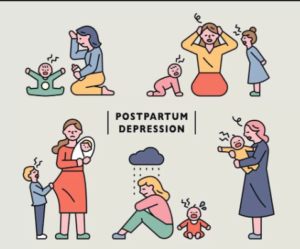
The Silent Burden of Postpartum Depression
Postpartum depression (PPD) is estimated to affect roughly 15–25% of Indian mothers, although rates vary by region, socio-economic status, and screening methods.¹ ²
Yet many women do not seek help because:
-
they fear stigma,
-
they don’t recognize their own symptoms,
-
they consider their distress “normal,”
-
or they view asking for help as a personal failure.
Even healthcare providers may underestimate or normalize symptoms unless directly asked.
This silence can turn treatable emotional distress into prolonged mental health challenges that affect:
-
maternal quality of life,
-
mother–infant bonding,
-
marital relationships,
-
child development.
Why Guilt Becomes a Barrier to Care
Let’s unpack the psychological mechanisms of help-seeking guilt in postpartum women.
1. Internalized Expectations
From childhood, girls are socialized to be caregivers, peacemakers, and nurturers. When reality challenges these internalized norms (e.g., fatigue, anxiety, sadness), guilt emerges.
2. Fear of Judgment
Mothers may avoid asking for help because:
-
family members may criticize them,
-
friends or relatives may compare them to other mothers,
-
community gossip may follow.
This fear of negative evaluation is a powerful deterrent.
3. Self-Blame
Even when physical exhaustion or mental health symptoms are present, mothers often blame themselves:
“I’m weak.”
“I shouldn’t feel this way.”
“Other mothers manage better.”
This self-blame reinforces guilt and delays help-seeking.
4. Normalization of Pain
When families or cultures normalize distress (“It’s just how it is”), mothers begin to believe that seeking help indicates failure or ingratitude.
5. Lack of Emotional Vocabulary
Limited discussion of emotions in some families means mothers lack words to articulate their inner distress. Without language, they cannot ask for support.
Family Dynamics That Intensify Guilt
A. Hierarchy and In-Law Power
Within many families, elders — especially mothers-in-law — control routines, childcare strategies, and household expectations. A new mother who asks for help may be perceived as challenging authority.
B. Role Conflict
Mothers are expected to:
-
care for everyone,
-
adapt quickly,
-
follow advice from elders,
-
not complain.
Conflicting cues from family members contribute to confusion and guilt.
C. Marital Dynamics
Some partners may lack awareness of maternal mental health, believing that asking for help should be unnecessary. This can reinforce the mother’s sense of inadequacy.
Cultural Narratives That Reinforce Guilt
Several cultural narratives contribute to this guilt:
1. Motherhood as Divine Duty
In many spiritual traditions, motherhood is depicted as:
-
sacred,
-
instinctive,
-
effortless.
This leaves little room for acknowledging distress.
2. Ratings of Motherhood
In everyday conversation:
-
“She’s such a good mother!”
-
“She manages everything so gracefully!”
These social comparisons further pressure mothers to suppress vulnerability.
3. Taboos Around Emotional Struggle
Mental health is often taboo in many Indian communities. Seeking help may be seen as complaining or weakness, reinforcing guilt.
Consequences of Help-Seeking Guilt
Failing to seek help when needed can lead to serious outcomes:
A. Worsening Mental Health
Untreated PPD can last months or years, increasing:
-
depression severity,
-
anxiety,
-
risk of chronic mental health issues.
B. Impaired Mother–Infant Bonding
Depressed mothers may struggle to engage with their infants emotionally, affecting attachment.
C. Family Strain
Unaddressed distress can spill into:
-
marital conflict,
-
tension with in-laws,
-
reduced overall family wellbeing.
D. Physical Health Consequences
Guilt and stress can exacerbate physical postpartum issues (pain, fatigue, sleep problems).
Breaking the Guilt Cycle: Towards Healthy Help-Seeking
1. Mental Health Education
Mothers, families, and communities need education about:
-
postpartum depression,
-
normal vs abnormal symptoms,
-
the importance of support.
2. Normalize Vulnerability
Changing narratives from:
“A good mother should manage everything”
to
“It’s human to need help”
can shift emotional norms.
3. Encourage Open Conversations
Family members should ask:
-
“How are you feeling?”
-
“Do you need help?”
without judgment.
4. Involve Partners
Fathers should be educated on maternal mental health and encouraged to share responsibilities.
5. Professional Support
Healthcare providers should screen routinely for postpartum distress and normalize referrals to counseling.
Interventions That Reduce Help-Seeking Guilt
A. Psychoeducation for Families
Teaching families about postpartum mental health reduces stigma and promotes empathy.
B. Peer Support Groups
Connecting with other mothers can:
-
validate experiences,
-
reduce isolation,
-
encourage help-seeking.
C. Culturally Sensitive Counseling
Sessions that respect cultural values while encouraging emotional expression improve outcomes.
D. Primary Healthcare Integration
Routine screenings during postnatal checkups ensure early identification.
Case Example (Composite)
Anita, 26, lives with her in-laws after childbirth. Despite feeling overwhelmed, anxious, and exhausted, she avoids asking for help. She believes her mother-in-law sees need for help as weakness. Over time, her mood worsens, she avoids social contact, and experiences guilt for not enjoying motherhood. Only after a health worker asks her directly about her emotional state does she open up and receive support.
This case illustrates how cultural, familial, and internalized pressures intersect to delay help-seeking.
Why This Matters: Child and Family Outcomes
When mothers delay help-seeking:
-
Child development outcomes may be affected.
-
Marital satisfaction decreases.
-
Maternal wellbeing deteriorates.
Communities benefit when mothers thrive — emotionally, physically, socially.
Conclusion
Indian mothers often feel guilty asking for help after childbirth because they are embedded in cultural narratives — of duty, self-sacrifice, and idealized motherhood — that stigmatize support-seeking as weakness. Gender norms, family dynamics, mental health stigma, and lack of emotional validation create a powerful guilt cycle that delays care, worsens mental health, and affects whole families.
Breaking this cycle requires:
-
Education,
-
Empathy,
-
Healthcare integration,
-
Cultural narrative change.
Supporting mothers is not a luxury — it is essential for healthier families, children, and communities.
References
-
World Health Organization. (2022). Perinatal / Maternal Mental Health. https://www.who.int/teams/mental-health-and-substance-use/promotion-prevention/maternal-mental-health.
-
Upadhyay, R. P., et al. (2017). Postpartum depression in India: a systematic review and meta-analysis. Journal of Affective Disorders, 218, 39–46. https://pmc.ncbi.nlm.nih.gov/articles/PMC5689195/
-
Fisher, J., et al. (2012). Prevalence and determinants of common perinatal mental disorders in women in low- and lower-middle-income countries. Bulletin of the World Health Organization, 90(2), 139–149. https://pmc.ncbi.nlm.nih.gov/articles/PMC3302553/
-
Patel, V., et al. (2018). The burden of mental disorders in India and globally. Lancet Psychiatry, 5(2), 148–161. https://pubmed.ncbi.nlm.nih.gov/30314863/
-
Stewart, D. E., & Vigod, S. (2016). Postpartum depression. New England Journal of Medicine, 375, 2177–2186. https://www.nejm.org/doi/full/10.1056/NEJMcp1607649
-
Husain, N., et al. (2024). Culturally adapted CBT for postnatal depression in South Asian women. The Lancet. https://www.thelancet.com/journals/lancet/article/PIIS0140-6736(24)01612-X/fulltext
- Hormonal Changes After Pregnancy & Their Impact on Mental Health