Psychology Behind Staying in Relationships That Hurt

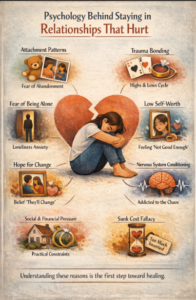
It is a question that persists among many individuals as to why a person would continue to be in a relationship that brings in emotional hurt or neglect. It is a matter of mere words, it appears that it is not so complicated, and when it hurts, one should leave. Psychology however demonstrates that maintaining is hardly weakness. They are aware that they are being hurt, they can feel it in over and over disappointments, need denials and emotional lack of companionship. Leaving is not only a logical process; it is also an emotional process and a process of the nervous system.

In the everyday life, this usually appears in the form of excuse-making over rudeness, clinging to tiny surfaces of tenderness, or wishing that things could go back to their old ways. Pain is familiar to a number of people since the relationships they had in early stages of life taught them that love is inconsistent or emotionally taxing. The unknown may be unsafe in comparison with what is familiar.

The fear of being alone, self-doubt and social pressure may silently hold people back. They could downsize the needs over the years, evade conflict, and modify themselves to the relationship. Knowledge of these patterns can be used to find an alternative to self-blame of self-compassion-and the initial step to recovery and better relationships.

1. Attachment Patterns Formed in Childhood

The experiences of being close to someone in our adulthood are influenced by our first relationships. The attachment theory states that the manner in which our emotions, needs, and distress were addressed by caregivers was a template to love and connection that would be kept as an internal record.

  • In anxious attachment,
    relationships usually make life worryful and prone to thinking. The fear of being deserted can be very strong due to a delay in the response, a change in the tone, or distance in nature. Human beings can be in painful relationships, as the fear of losing an individual being felt more than the pain of remaining. They can be over-giving, people-pleasing or bury their needs to ensure that the relationship remains alive.
  • In the avoidant attachment,
    emotional distance may seem normal. Such one can manifest itself in everyday communication (reducing self-importance, not talking deeply or too closely). Negligence or emotional unavailability is not necessarily experienced as an issue since an early teaching of independence and emotional self-reliance was a source of defense.
  • Fearful-avoidant attachment

    tends to be confusing in push-pull fashion. Someone might want to be intimate, reassured, and close, but when he or she does, he/she will feel overwhelmed and unsafe. In real life, this might present itself as the desire to connect and then withdraw after emotional experiences, initiating fights after intimacy, or being ambivalent about remaining or leaving.

In cases where love during childhood was absent, or lacking, or conditional, the nervous system learns to be vigilant. Emotional instability can be comfortable to adults, whereas stability can be alien and even boring. What is familiar may become familiar as right, even in cases where it is painful, not because it is healthy, but because it is familiar.

Knowing these patterns of attachment makes individuals understand that their relationship problems are not personal failures, but acquired emotional reactions, and that such patterns can be addressed with understanding and secure connection.

2. Trauma Bonding and Intermittent Reinforcement

Trauma bonding is one of the potent psychological traps, as a cycle of emotional pain, after which there is a short period of affection, apology, or hope. In our everyday lives, this can be in form of constant quarrels, emotional withdrawal, and offensive behavior, followed by brief bursts of kindness, vows to change, or extreme intimacy. Such brief good moments may be a relief and very significant following a period of pain.

This tendency operates based on the intermittent reinforcement, which is the same psychological process that is observed in gambling. Since love and care cannot be forecasted, the mind will be preoccupied with the next good time to occur. The doubt leaves an individual emotionally engaged even in a case where the relationship is largely torturous.

The brain releases dopamine when one chooses to reconcile, an apology, a loving message or even when you physically get closer to a person, this is what creates a feeling of relief and emotional reward. It can even be a relief, as love. The bond becomes even stronger with time, and the reason is not that the relationship is healthy, but due to the conditioning of the nervous system to find some relief against distress.

As time passes, the relationship turns less about caring about each other and more about suffering in that quest to expand on those short periods of intercourse. Knowing about trauma bonding can make people understand that they are not addicted to an individual, it is just that they have gotten stuck in a strong cycle of psychology, which can be freed with awareness, safety, and support.

3. Fear of Loneliness and Abandonment

To a great number of individuals, the prospect of being alone is more terrifying than living in emotional distress. Loneliness may trigger profound survival anxiety, particularly in the persons who were conditioned at their early years of life that they are loved and needed and are chosen. Solitude will not only be uncomfortable, but unsafe.

This fear manifests itself in daily life in silent forms such as, at least I am not alone or this is a lot better than nothing. Individuals can remain at such relationships when they feel unnoticed or emotionally deprived just because the company of a person is better than being lonely. Common practices, communications, or even complaints may seem as comforting as nothing at all.

The relationship eventually becomes an antidote to loneliness and not a place of actual connection. The feeling needs gradually grow smaller, self-esteem is bound to the presence of the relationship, and suffering is accepted to not be alone. Coming to terms with this fear can make individuals realize that survival is frequently about being strong, rather than being weak, and that learning to feel safe on your own is a strong move towards healthier relationships.

4. Low Self-Worth and Internalized Beliefs

People who stay in hurtful relationships often carry internalized beliefs such as:

  • “I don’t deserve better”

  • “This is the best I can get”

  • “Love always hurts”

Such beliefs might be a result of criticism experienced in the past, emotional neglect or repeated invalidation. The normalization of pain and healthy love may be strange and undeserving over time.

5. Hope for Change and the “Potential” Trap

People tend to stay in the agonizing relationships due to the fact that they are in love with whom the individual would be, rather than with whom he/she would remain to be all the time. They desperately cling to the memories of how things used to be in the start or to the few occasions when the partner takes care, is warm or understanding. In everyday life, this manifests itself as waiting until the better side of the individual comes back and that love, patience or sacrifice will one day result in an enduring change.

Mental images like the ones that state that they have not always been that way or that they will change in case one loves them sufficiently can have one emotionally involved even after being disappointed many times. With every minor change or a note of apology, hope is strengthened, although the general trend is the same.

This is psychologically reinforced by cognitive dissonance. The mind is torn between two painful truths at the same time that someone is both loved and hurting at the same time many times. The mind dwells on potential, intentions or promises in the future instead of current conduct to minimize this inner conflict. Hope is developed as a coping mechanism.

This might overtime make people become tolerant to some circumstances that they would never recommend other people to tolerate. Knowing this tendency can assist in moving the focus off of what one may be to how the relationship actually is day after day- and knowing it it tends to happen can be the first step to change.

6. Nervous System Conditioning

The nervous system of a person might become dysregulated when he/she lives in the state of chronic emotional stress and gets used to the level of tension, uncertainty, or emotional ups and downs. With time, the body gets to be on high alert. In everyday life, this can manifest itself in the form of constantly anticipating a conflict, overthinking the approach or mannerism, or being anxious when there would be nothing to be bad.

Consequently, disorder and emotional instability come to be normal and predictable, stable, steady relationships may become foreign or even dangerous. Others refer to healthy relationships as being boring not that it is not a connection, but due to the fact that a nervous system is not used to being calm.

That is why individuals might be uncomfortable in steady respectful relationships there is no adrenaline, no emotional hunt, and no necessity to remain hyper-vigilant. The body mixes passion with passion and indifference with apathy. The healing process consists of gradually reconditioning the nervous system to perceive safety, balance and emotional expression as indicators of authentic connection and not threat.

7. Social, Cultural, and Practical Pressures

Beyond internal psychology, external factors also play a role:

  • Societal expectations around marriage or commitment

  • Fear of judgment, especially for women

  • Financial dependence or shared responsibilities

  • Concern for children or family reputation

These pressures can reinforce endurance over emotional safety, making leaving feel like failure rather than self-preservation.

8. Emotional Investment and the Sunk Cost Fallacy

And the longer a relationship spans the more difficult it may be to quit. In the long run, common memories, emotional commitment, sacrifices, habits, and even a collective identity form a sense of duty. The concept of leaving can be daunting, because one learns to live in the day, routine, family ties, dreams and aspirations, and it seems that they lose a part of themselves in the process.

In this case, the sunk cost fallacy becomes influential. One might be tempted to believe that he/she has already devoted so much of his/her time, love, and effort to it, and, by departing, he/she will only render it pointless. The history of investment starts justifying the current suffering. Rather than inquiring about the healthiness of the relationship at the moment, the question is how much has been lost already.

This in real life can manifest itself in terms of staying a little more, hoping that things will get better to make the hard work worth it. Endurance is not an indicator of psychological well being. Surviving is not an indication of strength or love. The process of healing starts when individuals give themselves permission to select emotional safety and self-respect in place of the stress to make past hurt count.

Moving Toward Healing

Remaining in a painful relationship does not imply that one is weak. In more instances, it refers to the fact that they had to learn to survive on the basis of attachment, hope and perseverance. These tendencies used to make them feel secure, related or less isolated-although now they are painful. What appears as a case of staying too long to the external world is in most cases an internal struggle to defend the self emotionally.

It starts with consciousness during healing. Self-blame gives way to self-compassion when individuals see the reason why they remain. Awareness introduces the spaciousness to challenge traditional patterns and hear emotional requirements and envision relationships that are not because they are familiar but safe. Through this, change can be effected not by coercion, but through enlightenment and nurturing.

Helpful steps include:

  • Exploring attachment patterns through therapy

  • Learning nervous system regulation

  • Rebuilding self-worth and boundaries

  • Redefining love as safety, consistency, and emotional presence

Closing Thought

You do not hang about because you are mended. It remain because sometime in your life your brain and body have come to realize that love came with conditions. You were taught to adapt, wait, bear the pain, and hope, as these were the methods used to enable you to feel a part of or not so lonely. What seems to be endurance in these days was in the past a survival.

When love was forced to wait, or to keep still, or to sacrifice oneself, your system had been taught to believe that work is equal to value. You might have been taught to downplay your requirements, question your emotions, or hold that pangs are just part of intimacy. This can over time make emotional anguish, familiar to the self protection, unfamiliar or even egoistic.

Love should not be made to undermine you. It is not to get you to doubt your value, think on toes or dismiss your emotional reality. Healthy love gives you room to be safe, consistent and care about each other- it does not necessitate you to vanish and keep the relationship alive.

Making a choice is not to give up on oneself. It is not abandoning and losing love. Appreciating the fact that emotional well-being is important. It is the silent gesture of coming back to yourself after having spent years in remaining where you were not noticed. And with that decision, healing commences–not with a dramatic climax, but with an honest, sincere start.

Frequently Asked Questions (FAQ)

1. What provokes people to remain in relationships that are harmful to them?

Since psychological aspects such as attachment styles, fear of abandonment, trauma bonding, and conditioning of the nervous system can make leaving more dangerous than remaining.

2. Does that make one weak to remain in a painful relationship?

No. It is frequently a survival mechanism that is based on previous experiences, unfulfilled emotional needs, and acquired coping mechanisms.

3. What is trauma bonding?

Trauma bonding refers to an emotional bonding derived by the presence of pain and release that the short moments of affection strengthen the attachment in spite of the harm.

4. What is the impact of childhood on relationship in adulthood?

Premature relationships form inner models of affection and protection, which affect the way proximity, discord, and emotional demands are fulfilled in adulthood.

5. How does the attachment theory contribute to unhealthy relationships?

Styles of attachment (anxious, avoidant, fearful-avoidant) influence the way individuals react to intimacy conflict, and emotional availability.

6. What is so addictive about emotional unpredictability?

Intermittent reinforcement stimulates the release of dopamine which the brain becomes preferentially conditioned to seeking relief following distress like addictive behavior.

7. What is so strong about the fear of loneliness?

The loneliness may trigger the deepest of deep-seated survival fears, in part because of the tendency to equate self-worth with being chosen or needed.

8. What is cognitive dissonance within relationships?

It is the emotional uncomfortable nature of loving someone who makes someone suffer, usually being solved by holding onto hope, or possibility as opposed to reality.

9. When do healthy relationships get boring?

The nervous system can regulate itself in a way that considers love as something intense, and calmness and consistency become strange and unsafe.

10. What is sunk cost fallacy in relationships?

One of the beliefs is that breaking away would be a waste of time and effort put in even in the case where the relationship is bad.

11. Is that the unlearnability of such patterns?

Yes. Attachment and nervous system patterns can be cured with awareness, therapy, and safe relationships.

12. Is it necessary to love someone and tolerate pain?

No. Healthy love is about emotional safety, mutual respect and consistency- not self erasure and endurance.

13. Why do individuals wish that their partner should change?

The emotional investment, early bonding and the inability to accept loss or disappointments often lead to hope.

14. Is self-selection equivalent to self-sacrifice?

No. Making a choice in favor of oneself is an expression of self-respect and recovery, but not desertion.

15. In cases where is it appropriate to seek professional assistance?

Repeated patterns are used when the emotional pain seems too great, and it is not possible to get out of the situation despite the persistent harm.

Written by Baishakhi Das

Counselor | Mental Health Practitioner
B.Sc, M.Sc, PG Diploma in Counseling


Reference

  1. American Psychological Association (APA) – Relationships & Attachment
    https://www.apa.org/topics/relationships

  2. Psychology Today – Attachment Theory
    https://www.psychologytoday.com/intl/basics/attachment

  3. Psychology Today – Trauma Bonding
    https://www.psychologytoday.com/intl/basics/trauma-bonding

  4. National Institute of Mental Health (NIMH) – Mental Health & Relationships
    https://www.nimh.nih.gov/health/topics

  5. Harvard Health Publishing – Stress & the Nervous System
    https://www.health.harvard.edu/staying-healthy/understanding-the-stress-response

  6. The Gottman Institute – Healthy vs Unhealthy Relationships
    https://www.gottman.com/blog/category/relationships/

  7. Cleveland Clinic – Trauma Responses
    https://my.clevelandclinic.org/health/diseases/trauma

  8. Mind UK – Emotional Well-being & Relationships
    https://www.mind.org.uk/information-support/relationships/

  9. APA Dictionary of Psychology – Cognitive Dissonance
    https://dictionary.apa.org/cognitive-dissonance

  10. Why Emotionally Unavailable People Feel So Familiar

This topic performs well due to rising searches around men’s mental health, workplace stress, and burnout recovery. Combining emotional insight with practical steps increases engagement and trust.

The Cost of Always Being the Strong One

People come to you when everything goes wrong.
You remain composed when things are out of control and even when your own chest is tight.
You are a good listener, able to listen without interruption, a good non-judgemental holder of space, a problem-solver who is quiet enough to have your own feelings on the backburner.

And nobody seems to see when you are tired–because you have perfected concealing it.

It is commonly endorsed as resilience, maturity, or emotional intelligence to be the strong one. Your composure and steadiness is the admiration of people. However, under the admiration, there is an emotional price that is seldom realized. When strength becomes a role rather than a choice, it gradually becomes a burden, a burden that you bear without any more than an expression, without any protest, because that is what you are supposed to bear.

Your own strength, previously your safeguard, and formerly your strength, starts to suck you out. And not because you are weak, but because the greatest nervous system, the strongest system, must rest and have care and be supported.

The Invisible Contract of Strength

Most individuals grow up to be the strong one at a young age not necessarily of their choice, but due to circumstances. Grit was not an option; rather it was a coping mechanism of survival.

  • You learned that you must not cry as it was the reliance of others that demanded you not to cry and express yourself, as it was unsafe or inconvenient.
  • learned to contain emotions, instead of displaying them and turn feelings into something that could be controlled, and not shared.
  • You were taught that you could postpone meeting your needs–sometimes forever–because keeping it together was the first before you put in your clothes.

This gradually leads to the establishment of an unwritten agreement with the world: I will remain calm in order to make other people feel safe.
You are the one that sticks, the one that can be depended on, the one that does not disintegrate at least not before anyone can notice.

With time, strength ceases to be a characteristic one draws and a character one lives within. And identities and those which are founded on survival are difficult to get out of, even when they have begun to cost you, your rest, your tenderness, and your feeling of being taken care of.

Emotional Labor Without Rest

Being the strong one can be doing all the time emotional work, the work that goes unseen, unpaid, and unrecognized.

  • You also control your emotions so that you do not disturb other people and learn to make your pain as insignificant as possible to make their life comfortable.
  • Take on the burden of other people without offloading your own, to be the vessel that holds the unhappy feelings that no one can express.
  • You are the safe haven of the rest of them but you seldom get heard.

Slowly your nervous system is kept in a kind of silent watchfulness–in a permanent state of alertness, in an intermittent state of rest. You are held in position even when you are not in motion, trying to figure out what is going to happen next.

This is not draining you emotionally because you are weak, but this is not the purpose of human beings to shoulder emotional burden alone. Connection is to be two-way. The exhaustion is not a vice when the support is flowing in one way only: it is a biological and emotional phenomenon.

When Support Becomes One-Directional

Powerful individuals are commonly believed to be fine. Their silence is interpreted as the fact that nothing is amiss, and their quietness is perceived as power instead of the struggle.

  • No one, then, looks deep in–enquiries are superficial–asked at all.

  • we are silent, therefore, thinking that it is stable and that we are not talking about pain, that it is not there.
  • Your limits are hardly ever questioned, as it is believed that you can do more, be more, take more.

Gradually, the requesting of assistance can gradually cease to occur, not because the need has been fulfilled, but because it no longer feels necessary to strain others, or because there are times when assistance has come at all when it has been requested. Needs are privatised, expectations are reduced and self-sufficiency is the surest way out.

Isolating emotionally is created gradually, not with a bang, but with a whimper, in the name of being independent. At first sight, it can seem to be strength. On the one hand, it can be rather like being alone with too much to be carried.

The Hidden Grief of the Strong

It is sorrowful to be the strong one–sorrow that is not much spoken, and is seldom named, and has to be borne by the individual.

  • Sorrow in the embrace that you did not have at the time you needed it the most.
  • The sweetness which you had delayed, and said you would sleep by and by, and feel by and by, and be by and by.
  • Sorrow over the weakness you ingested, knowing since you were young that weakness can be neither safe nor desirable to express.

Accomplishing this sadness, there might also be guilt in desiring rest as though fatigue is a personal vice. Shame can be experienced in being tired when you are managing everything. And confusion may come to rest in where nothingness appears despite doing everything and keeping it all together.

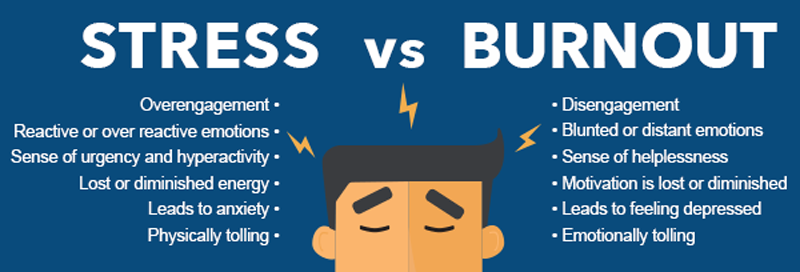
But emotional exhaustion is not failure–it is a message. A silent communication of your nervous system requesting you to be noticed, nurtured and given to take a break after carrying too much far too long.

Strength Is Not the Absence of Need

Emotional suppression is not a strength.
It is not being quiet, accepting whatever, or doing it by any means.
Emotional honesty is the real strength and that is the strength to be truthful to what is in your heart.

It is permitting oneself to say, without any explanation or apology:

  • “I’m not okay today.”
  • “need support too.”
  • “I don’t have to earn rest.”

The process of healing starts with strength being loose instead of hard, with stamina being soft as well as strong, with self-reliance allowing connection. You do not need to work hard to earn your safety, when you permit yourself to be grasped, not to grasp others, your nervous system comes to understand that you do not need to work hard to get safety. There are cases when it is just received.

Relearning Balance

When you are the strong, ask yourself–ask him–ask me–ask him:

And when I am not okay, where did I get to know that I always have to be okay?
What will I be when I cease to act out resilience and permit myself to exist?
What do you think it would be like to have that same care, patience and understanding given to me with the same free hand that I so readily dispense to others?

Such questions are not to be answered in a short period. They are entreaties to observe that which has long been carried.

  • Resting does not make you lose your power.
  • Do not shrink into ineptitude by seeking assistance.
  • It is not being a human that disappoints anyone.

Power was not supposed to entail self-abandonment. It was to be combined with tenderness, support and rest.

A Reframe Worth Remembering

You are not so tough in that you can take everything and not break.

You are tough since you evolved-because you studied to live in places where you needed to be strong before you were prepared to be strong.

  • Now you may have something new.
  • Connection over endurance.
  • Support over silence.
  • Power.

When you rest you do not lose your strength. It evolves. It is something that you live on, not something that you pay on.

FAQs

1. Why is it so emotionally exhausting to be the strong one?

Since it is a matter of constant emotional control, personal needs repression, and one-sided aid, exhausting the nervous system in the long run.

2. Does emotional exhaustion mean one is weak?

No. Emotional exhaustion is a biological and mental reaction to the stress and to unmet emotion needs over a long period of time.

3. Why do powerful individuals hardly obtain support?

They are presumed to be fine and that is why other people forget that they need to be cared about and have emotional check-ins.

4. Is there a role of childhood experiences that forms the strong one?

Yes. Strength is taken by many as an early survival tactic in an emotionally unsafe or demanding environment.

5. What is emotional labor?

Emotional labor is the process of controlling emotions – yours and those of other people – to ensure stability, comfort or harmony.

6. What is the impact of emotion suppression on mental health?

It exerts more stress, emotional numbness, anxiety, burnout, and may lead to depression in the long run.

7. Why has it happened that tough individuals are guilty of taking a break?

Since being useful, enduring, or responsible has already associated the self-worth of the person, rest might feel unworthy.

8. What is it like to experience nervous system exhaustion?

Constant fatigue, emotional detachment, irritability, hyper vigilance, inability to relax or being empty.

9. Is it always healthy to be independent?

Not when it covers emotional isolation. The capacity to be assisted is also a part of healthy independence.

10. How can powerful individuals embark on seeking assistance?

Their small steps can help them: first naming their feelings, selective sharing, and reminding themselves that support is not their responsibility.

11. What does it mean by trauma-informed strength?

Power which is flexible, emotional integrity, rest and relationship as opposed to perpetual effort.

12. Do we need therapy among people who are always strong?

Yes. In therapy there is a safe space where suppressed emotions are relieved and learning reciprocal care re-learned.

13. Why is it that being strong causes burnout?

The continuous self-control in the absence of emotional discharge is too much to the mind and body.

14. What is your ratio of strength and softness?

Trying to be vulnerable, demarcating boundaries and providing yourself with the kind of care you provide to others.

15. How do you begin healing the emotional fatigue?

Not being ashamed of feeling tired and allowing yourself to require assistance.

Written by Baishakhi Das

Counselor | Mental Health Practitioner
B.Sc, M.Sc, PG Diploma in Counseling


✅ Reference

  1. American Psychological Association – Stress & Burnout
    https://www.apa.org/topics/stress

  2. National Institute of Mental Health – Coping With Stress
    https://www.nimh.nih.gov/health/topics/stress

  3. Polyvagal Theory & Nervous System Regulation – Dr. Stephen Porges
    https://www.polyvagalinstitute.org

  4. Emotional Labor & Mental Health – Psychology Today
    https://www.psychologytoday.com/us/basics/emotional-labor

  5. Trauma and the Body – Bessel van der Kolk
    https://www.traumaresearchfoundation.org

  6. Feeling Behind “Not Good Enough”

This topic performs well due to rising searches around men’s mental health, workplace stress, and burnout recovery. Combining emotional insight with practical steps increases engagement and trust.
Skinner’s Reinforcement Theory in Parenting & Education

How consequences shape behavior in healthy, ethical ways

https://biasbehavioral.com/wp-content/uploads/2020/03/Positive-R-IG-Post.jpg

Introduction

Children are not born with an understanding of which behaviors are acceptable, effective, or socially appropriate. Instead, they learn gradually through everyday interactions—by observing responses, receiving feedback, and experiencing the consequences of their actions. Each response from caregivers, teachers, and the environment sends a message about what behaviors are encouraged and which are discouraged.

One of the most influential explanations of this learning process comes from B. F. Skinner, whose reinforcement theory forms the backbone of modern behavior management in parenting and education. Skinner proposed that learning does not happen primarily through instruction or moral reasoning alone, but through patterns of consequences that follow behavior.

Skinner’s theory emphasizes a simple yet powerful idea:
👉 Behavior that is reinforced tends to repeat, and behavior that is not reinforced gradually fades.

In practical terms, when a child receives attention, praise, or encouragement for a behavior, that behavior becomes more likely to occur again. Conversely, when a behavior does not receive reinforcement—or leads to a loss of privilege—it slowly loses its strength. Over time, this process shapes habits, self-control, and social understanding.

When applied thoughtfully and ethically, reinforcement theory allows adults to guide children’s behavior without fear, force, or emotional harm. Rather than relying on punishment or intimidation, it encourages learning through support, consistency, and emotional safety. This approach not only improves behavior in the short term but also helps children develop confidence, responsibility, and intrinsic motivation—skills that support healthy development well beyond childhood.

Understanding Skinner’s Reinforcement Theory

B. F. Skinner proposed that behavior is shaped primarily by its consequences, not by intentions, explanations, or moral reasoning alone. According to his view, children do not learn what to do simply because they are told—it is the outcome of their actions that teaches them which behaviors are effective and worth repeating.

Children learn by closely observing what happens after they act:

  • Do they receive attention or praise?

  • Is the behavior ignored?

  • Do they lose a privilege or face discomfort?

Over time, these repeated consequences create clear behavior patterns.

According to this theory:

  • Behaviors followed by positive outcomes increase because they are experienced as rewarding

  • Behaviors followed by unpleasant outcomes or lack of reward decrease because they no longer feel beneficial

This learning process occurs gradually and often unconsciously, shaping habits, self-discipline, and social behavior.

A key strength of Skinner’s approach is its focus on observable behavior rather than internal thoughts or emotions. Because behaviors can be seen, measured, and responded to, reinforcement theory becomes highly practical and applicable in real-life settings such as homes, classrooms, and therapeutic environments. It provides caregivers and educators with clear, actionable strategies to guide behavior while maintaining consistency and emotional safety.

Reinforcement vs Punishment: Skinner’s Emphasis

B. F. Skinner strongly advocated for reinforcement over punishment as the primary method for shaping behavior. His reasoning was both practical and psychological.

  • Reinforcement teaches children what to do

  • Punishment only tells children what not to do

Punishment may stop an unwanted behavior in the moment, but it rarely explains or builds the desired alternative. Reinforcement, on the other hand, guides learning, strengthens motivation, and supports emotional safety. Over time, it leads to lasting habits rather than temporary compliance.

Application in Parenting

1. Encouraging Positive Behavior

In parenting, reinforcement helps children learn desirable behaviors naturally and willingly, rather than through fear or pressure.

Examples:

  • Praising a child for sharing toys

  • Giving attention when a child communicates calmly

  • Rewarding effort rather than perfection

This builds:

  • Self-confidence – children feel capable and valued

  • Emotional security – behavior is linked to connection, not fear

  • Internal motivation – children begin to feel proud of their actions

Children instinctively repeat behaviors that bring warmth, attention, and approval, making reinforcement a powerful teaching tool.

2. Using Reinforcement Instead of Fear

Traditional parenting often relies on threats, warnings, or harsh punishment. Skinner’s theory offers a healthier alternative that focuses on guidance rather than control.

Key principles include:

  • Catching and reinforcing good behavior

  • Reinforcing cooperation instead of punishing mistakes

  • Using consistent and predictable responses

This approach reduces:

  • Power struggles between parent and child

  • Fear-based obedience, where children comply only when watched

  • Emotional distance, preserving trust and attachment

Children learn best when they feel safe, not scared.

3. Discipline Without Emotional Harm

Skinner’s approach supports discipline that is firm yet respectful—without humiliation or intimidation.

Effective strategies include:

  • Calmly removing privileges (negative punishment)

  • Ignoring minor attention-seeking misbehavior

  • Reinforcing calm behavior after emotional regulation

These methods:

  • Teach responsibility and self-control

  • Reduce emotional reactivity

  • Preserve trust, attachment, and dignity

Discipline becomes a learning experience, not a threat.

Application in Education

1. Positive Reinforcement in Classrooms

In educational settings, reinforcement plays a crucial role in both learning and behavior management.

Common practices include:

  • Verbal praise for participation and effort

  • Marks, stars, or certificates

  • Recognition of improvement, not just high achievement

Such reinforcement:

  • Increases student engagement

  • Reduces disruptive behavior

  • Builds a growth-oriented mindset

Students are more willing to participate when effort is acknowledged.

2. Token Economy Systems

A token economy is a structured reinforcement system where students earn tokens for positive behavior, which can later be exchanged for rewards.

Commonly used in:

  • Classroom discipline programs

  • Special education settings

  • Behavior intervention plans

Psychological benefits include:

  • Clear and predictable expectations

  • Immediate feedback

  • Motivation through structure and consistency

When used ethically, token systems support learning rather than manipulation.

3. Creating Safe Learning Environments

Skinner’s theory supports classrooms where:

  • Mistakes are treated as part of learning

  • Fear is not used as a motivator

  • Feedback is timely, specific, and constructive

Children learn best when they feel safe, valued, and capable, not judged or threatened.

Motivation: Beyond Rewards

A common misunderstanding is that reinforcement creates dependency on rewards. Skinner emphasized the gradual fading of rewards:

  • Begin with external reinforcement

  • Slowly shift toward verbal praise and acknowledgment

  • Encourage self-satisfaction and intrinsic motivation

When applied correctly, reinforcement supports autonomy rather than undermining it, helping children internalize values and self-discipline.

Ethical Considerations

Modern psychology highlights clear ethical boundaries in applying reinforcement theory:

  • Reinforcement must be age-appropriate, fair, and consistent

  • Punishment should never involve fear, shame, or physical harm

  • Emotional well-being matters as much as behavior control

The ultimate goal is not obedience, but guidance, growth, and psychological safety.

Final Insight

Skinner’s reinforcement approach reminds us that children do not need to be controlled—they need to be understood, supported, and guided. When behavior management prioritizes reinforcement over punishment, learning becomes not only effective, but humane.

Limitations of Skinner’s Theory

While Skinner’s Reinforcement Theory is highly effective for shaping observable behavior, it does have important limitations—especially when applied to complex human development.

Reinforcement theory does not fully explain:

  • Emotions behind behavior
    Children may behave in certain ways due to fear, sadness, insecurity, or unmet emotional needs—factors that reinforcement alone cannot address.

  • Trauma-related responses
    Behaviors shaped by trauma (such as withdrawal, aggression, or hypervigilance) are often survival responses, not habits learned through rewards or punishment.

  • Internal thought processes
    Beliefs, self-talk, perceptions, and meaning-making play a major role in behavior, yet Skinner’s theory focuses only on what is externally observable.

Because of these limitations, modern parenting and education do not rely on reinforcement alone. Instead, Skinner’s ideas are integrated with emotional understanding, attachment theory, cognitive development, and trauma-informed approaches. This combination allows adults to address both what a child does and why they do it.

Conclusion

Skinner’s Reinforcement Theory remains one of the most practical and influential tools for shaping behavior in parenting and education. Its strength lies in its simplicity, clarity, and real-world applicability.

When applied with empathy, consistency, and ethical awareness, reinforcement helps children develop:

  • Responsibility

  • Self-control

  • Confidence

  • Motivation

—all without fear, force, or emotional harm.

Children do not need to be controlled or intimidated to learn.

They need to be understood.
They need to be guided.
And they need to be reinforced.

This balance—between structure and emotional safety—is where healthy learning and development truly begin.

Frequently Asked Questions (FAQ)

1. What is Skinner’s Reinforcement Theory?

Skinner’s Reinforcement Theory explains how behavior is shaped by consequences, where reinforced behaviors increase and unrewarded behaviors gradually decrease.

2. Who developed Reinforcement Theory?

The theory was developed by B. F. Skinner, a key figure in behaviorism.

3. Why did Skinner prefer reinforcement over punishment?

Reinforcement teaches desired behavior, while punishment only suppresses unwanted behavior temporarily.

4. How is reinforcement used in parenting?

Through praise, attention, rewards, and consistent consequences to encourage positive behavior without fear.

5. How does reinforcement help children emotionally?

It builds self-confidence, emotional security, and internal motivation by linking behavior with support rather than threat.

6. What is positive reinforcement in education?

It includes praise, recognition, marks, or rewards given to encourage participation, effort, and learning.

7. What is a token economy system?

A structured system where children earn tokens for positive behavior that can be exchanged for rewards.

8. Is reinforcement better than punishment for discipline?

Yes. Reinforcement promotes learning and emotional safety, while punishment often creates fear or resentment.

9. Can reinforcement reduce intrinsic motivation?

Excessive rewards can reduce intrinsic motivation, which is why gradual fading of rewards is recommended.

10. What are the limitations of Skinner’s theory?

It does not fully explain emotions, trauma responses, or internal thought processes.

11. Is reinforcement theory useful for trauma-affected children?

It is helpful when combined with trauma-informed and emotionally supportive approaches.

12. How is reinforcement used in classrooms?

Teachers use praise, feedback, certificates, and structured reward systems to manage behavior and learning.

13. Is Skinner’s theory still relevant today?

Yes. It remains highly practical when integrated with modern developmental and emotional psychology.

14. What are the ethical concerns in using reinforcement?

Reinforcement must be fair and age-appropriate; punishment should never involve fear, shame, or harm.

15. What is the main goal of reinforcement-based guidance?

To guide behavior through understanding, consistency, and emotional safety—not control or intimidation.

Written by Baishakhi Das

Counselor | Mental Health Practitioner
B.Sc, M.Sc, PG Diploma in Counseling


Reference 

  1. Skinner, B. F. (1953). Science and Human Behavior.

  2. Skinner, B. F. (1938). The Behavior of Organisms.

  3. American Psychological Association (APA) – Learning & Behavior
    https://www.apa.org

  4. McLeod, S. A. (2023). Operant Conditioning. Simply Psychology
    https://www.simplypsychology.org

  5. Domjan, M. (2018). The Principles of Learning and Behavior. Cengage Learning.

  6. Anger Issues in Men: What’s Really Going On


Why Men Struggle to Talk About Their Feelings

https://restorationpsychology.com/userfiles/2556/images/mens-mental-health.png?t=20240606110643

A Psychological and Social Perspective

Many men experience deep emotions—fear, sadness, loneliness, love, and vulnerability—but struggle to put these feelings into words. This difficulty is not a personal flaw, emotional weakness, or lack of emotional capacity. Rather, it develops over time through social conditioning, cultural expectations, and learned coping strategies that teach men how they are supposed to feel and behave. From an early age, many men learn that emotional control is valued more than emotional expression, shaping how they relate to their inner world.

Understanding why men struggle to express their feelings is essential—not only for improving individual mental health, but also for creating healthier relationships, more emotionally safe workplaces, and stronger families. When emotional silence is misinterpreted as disinterest or strength, genuine needs go unnoticed. Greater awareness allows space for empathy, early support, and meaningful connection—helping men feel seen, heard, and understood rather than judged or overlooked.

Emotional Silence Is Learned, Not Inborn

Boys are not born emotionally closed or disconnected. In early childhood, boys and girls express emotions with similar intensity, openness, and range. They cry, seek comfort, show fear, and express joy freely. Over time, however, many boys begin to receive clear social messages—both spoken and unspoken—about which emotions are acceptable and which are not.

Common messages include:

  • “Be strong.”

  • “Don’t cry.”

  • “Handle it yourself.”

  • “Man up.”

These repeated messages gradually teach boys that vulnerability is a weakness and that emotional expression may lead to criticism, shame, or rejection. As a result, emotions are not explored or understood—they are suppressed, minimized, or hidden. What begins as adaptation to social expectations can later become emotional silence, making it difficult for men to recognize, express, or seek support for their inner experiences.

The Narrow Emotional Range Allowed to Men

Culturally, men are often permitted to express only a restricted set of emotions, most commonly those associated with strength or control, such as:

  • Anger

  • Pride

  • Confidence

In contrast, emotions like fear, sadness, shame, loneliness, or grief are frequently discouraged, ignored, or labeled as signs of weakness. When these vulnerable emotions arise, many men do not feel safe expressing them openly. Instead, they learn to translate emotional pain into anger—which is more socially acceptable—or into silence, which feels safer and less exposing.

Over time, this narrowing of emotional expression limits emotional awareness and connection. The original feelings remain unresolved, but their expression becomes indirect, making it harder for men to understand their own needs and for others to recognize their distress.

Lack of Emotional Language

Many men were never taught how to identify, label, or describe emotions beyond a few basic terms such as “fine,” “stressed,” or “angry.” When emotional vocabulary is limited, internal experiences remain vague and difficult to understand. As a result:

  • Feelings become confusing and hard to organize

  • Emotional expression feels overwhelming or unsafe

  • Silence becomes the easiest response

Simply put, what cannot be named cannot be shared, and unspoken emotions often remain unresolved.

Fear of Judgment and Rejection

For many men, opening up emotionally feels risky. There is often a fear that vulnerability will lead to:

  • Being seen as weak

  • Losing respect or authority

  • Burdening others

  • Being misunderstood, dismissed, or minimized

Past experiences—where emotions were mocked, ignored, or punished—strengthen the belief that silence is safer than honesty. Over time, emotional withholding becomes a protective habit rather than a conscious choice.

Identity Tied to Function, Not Feelings

Many men are taught to define their self-worth through what they do, rather than what they feel. Identity becomes closely linked to:

  • Productivity and achievement

  • Providing and responsibility

  • Problem-solving

  • Strength, control, and reliability

When identity is built around functioning and performance, emotions may be viewed as distractions, weaknesses, or failures, rather than important signals that require attention and care.

Emotional Expression Was Never Modeled

If a man grew up in a family where:

  • Emotions were ignored or dismissed

  • Conflict was avoided rather than addressed

  • Vulnerability was absent

He may never have witnessed healthy emotional expression. Without role models demonstrating how emotions can be shared safely, emotional openness can feel unfamiliar, uncomfortable, or even threatening in adulthood.

Emotional Suppression as Survival

For many men, emotional silence once served an important purpose. It may have:

  • Reduced conflict

  • Prevented shame or criticism

  • Ensured acceptance

  • Maintained a sense of control

However, coping strategies that were once protective can become harmful over time. Long-term suppression often contributes to:

  • Depression

  • Anxiety

  • Anger

  • Emotional numbness

  • Disconnection in relationships

What once helped a man survive can later prevent him from fully living.

The Cost of Not Talking

When emotions are not expressed, they do not disappear—they often find other outlets. Suppressed feelings may surface as:

  • Irritability or sudden rage

  • Physical symptoms such as fatigue or chronic pain

  • Substance use or unhealthy coping behaviors

  • Emotional withdrawal from relationships

  • Unexpected emotional breakdowns

Silence may feel safe in the short term, but it carries a significant long-term cost to mental health, relationships, and overall well-being.

Why Talking Feels Hard—even When Support Exists

Even in emotionally supportive environments, many men still struggle to open up. This difficulty is not due to unwillingness or lack of trust, but because emotional expression often feels unfamiliar and unsafe. Vulnerability can trigger deep feelings of shame, especially for those who were taught that emotions should be controlled or hidden.

For many men, words simply do not come easily. Emotional experiences are often held in the body first—as tension, restlessness, or discomfort—long before they are translated into language. When the body reacts before the mind can organize meaning, silence becomes the default response. This is not resistance or avoidance; it is conditioning shaped over years.

What Helps Men Begin to Open Up

Change rarely begins by forcing emotional expression. Instead, it develops gradually in the presence of:

  • Safety, where emotions are not judged or dismissed

  • Patience, allowing expression to unfold at its own pace

  • Non-judgment, removing fear of criticism or weakness

  • Listening without fixing, where being heard matters more than solutions

Often, men begin to open up through actions, shared activities, or subtle signals before they are able to put feelings into words. Trust grows first; language follows.

A Healthier Definition of Strength

Emotional silence is not a measure of strength.
True strength lies in self-awareness.
Reaching out for support reflects courage.
Being able to name what hurts is a sign of growth.

Talking about feelings is not a loss of control—it is a movement toward emotional balance, clarity, and connection.

Final Thoughts

Men struggle to talk about their feelings not because emotions are absent—but because they were taught not to show them.

When emotional expression is normalized and supported, men do not become weaker. They become more present, more connected, and more resilient.

Creating space for men to speak—without pressure, judgment, or expectations—is not just good psychology.
It is essential for mental health, healing, and human connection.

Frequently Asked Questions (FAQ): Why Men Struggle to Talk About Their Feelings

1. Why do many men find it hard to talk about their feelings?

Many men struggle because emotional expression was discouraged during childhood, leading emotions to be suppressed rather than understood or shared.

2. Is difficulty expressing emotions a biological trait in men?

No. Emotional silence is learned through social and cultural conditioning, not determined by biology.

3. Do men feel emotions less intensely than women?

No. Men experience emotions just as deeply, but they are often taught to hide or control emotional expression.

4. Why is anger more commonly expressed by men?

Anger is socially accepted as a “masculine” emotion, making it a safer outlet for underlying feelings like fear, sadness, or shame.

5. Can lack of emotional language affect mental health?

Yes. When emotions cannot be named or expressed, they may contribute to stress, anxiety, depression, or physical symptoms.

6. Why does vulnerability feel unsafe for many men?

Past experiences of being judged, mocked, or dismissed for emotional openness reinforce the belief that vulnerability leads to rejection.

7. Does emotional suppression protect men?

In the short term, suppression may reduce conflict or shame, but long-term suppression often harms mental health and relationships.

8. Can supportive environments alone help men open up?

Support helps, but conditioning may still make expression difficult. Safety and patience over time are essential.

9. Why do men express emotions through actions rather than words?

For many men, emotional awareness develops through behavior first because language for emotions was never modeled or encouraged.

10. Is silence a sign that a man doesn’t trust others?

Not necessarily. Silence often reflects learned coping patterns rather than lack of trust.

11. How does emotional suppression affect relationships?

It can lead to emotional distance, misunderstandings, unresolved conflict, and reduced intimacy.

12. Can therapy help men who struggle to talk about feelings?

Yes. Therapy provides a safe space to build emotional awareness, language, and expression gradually.

13. Does talking about feelings make men weaker?

No. Emotional expression supports resilience, self-awareness, and psychological strength.

14. What helps men begin to express emotions safely?

Non-judgmental listening, patience, emotional safety, and validation—without pressure to “open up.”

15. Can men learn emotional expression later in life?

Absolutely. Emotional skills can be learned and strengthened at any age.

Written by Baishakhi Das

Counselor | Mental Health Practitioner
B.Sc, M.Sc, PG Diploma in Counseling


Reference 


Classical Conditioning: Pavlov’s Theory in Real Life

https://www.simplypsychology.org/wp-content/uploads/Pavlovs-Dogs-Experiment.jpg

A Clear and Detailed Psychological Explanation

Classical conditioning is one of the most foundational concepts in psychology because it explains how learning can occur automatically through association, without conscious intention or deliberate effort. Both humans and animals constantly absorb patterns from their environment, linking events that repeatedly occur together. As a result, many emotional reactions—such as fear, comfort, attraction, or anxiety—are not logical choices, but learned responses that develop over time through repeated experiences. Once formed, these responses can be triggered instantly, often before rational thinking has a chance to intervene.

This theory was introduced by Ivan Pavlov and has had a lasting impact far beyond laboratory experiments. It helps explain everyday behaviors such as emotional triggers, habits, preferences, and aversions. Today, classical conditioning continues to influence modern psychology, education, therapy, marketing, and daily life, offering valuable insight into how past experiences shape present reactions—and how those reactions can be understood, modified, and healed through awareness and intervention.

What Is Classical Conditioning?

Classical conditioning is a form of learning through association, in which a stimulus that initially has no meaning gradually becomes linked to a stimulus that naturally produces a response. Over time, this association causes the previously neutral stimulus to evoke a learned reaction on its own.

In simple terms:
👉 When two events repeatedly occur together, the brain connects them.

Once this connection is established, the neutral stimulus no longer remains neutral. It becomes capable of triggering the response even in the absence of the original stimulus. This is why certain sounds, smells, places, or situations can automatically evoke emotions or physical reactions without conscious thought.

Pavlov’s Original Experiment Explained

The Discovery

While conducting research on digestion, Ivan Pavlov observed an unexpected pattern in his laboratory dogs. His original goal was to measure salivation as a physiological response to food. However, he noticed that the dogs began to salivate even before the food appeared. The response occurred when the dogs heard familiar sounds, such as the footsteps of the lab assistant, or when they saw visual cues that signaled feeding time.

This was a crucial observation because salivation was happening in the absence of food, which meant the response could not be explained by biology alone. The dogs had learned to associate certain environmental cues with feeding. Pavlov realized that learning was taking place through repeated pairing of events, rather than conscious decision-making. This insight shifted the focus of psychology toward observable behavior and measurable learning processes.

The Experiment Setup

To test this learning process under controlled conditions, Pavlov designed a series of structured experiments. Each component of the experiment had a specific role:

  • Food was used as a natural stimulus because it automatically caused salivation without any prior learning.

  • Salivation was measured carefully, as it was a clear, observable, and quantifiable response.

  • A bell sound was introduced as a neutral stimulus, meaning it did not initially trigger salivation or any meaningful response.

Pavlov then followed a precise sequence. The bell was rung immediately before the food was presented. This pairing was repeated many times across different trials. Gradually, the dogs began to anticipate the food as soon as they heard the bell. Their bodies responded automatically, producing saliva even before the food appeared.

Eventually, Pavlov tested the association by ringing the bell without presenting food. Remarkably, the dogs still salivated. This confirmed that the bell had become a meaningful signal through learning.

Why This Experiment Was Revolutionary

Pavlov’s experiment demonstrated that:

  • Learning can occur without conscious thought

  • Neutral stimuli can acquire emotional or physiological meaning

  • Responses can be shaped by experience and repetition

This challenged earlier beliefs that behavior was driven only by instinct or conscious reasoning. Pavlov’s work laid the foundation for behaviorism and influenced later psychological theories related to anxiety, trauma, habit formation, and emotional responses.

Lasting Impact

The significance of Pavlov’s experiment extends far beyond dogs and bells. It helps explain:

  • Why certain sounds, places, or smells trigger strong emotions

  • How fears and phobias develop

  • Why past experiences influence present reactions

Pavlov’s discovery showed that learning is deeply connected to experience, and that understanding these associations is key to understanding human behavior.

Key Components of Classical Conditioning

Classical conditioning is built on a clear sequence of stimuli and responses. Each component plays a specific role in how learning through association occurs.

1. Unconditioned Stimulus (UCS)

The unconditioned stimulus is something that naturally and automatically triggers a response, without any prior learning or conditioning. It has inherent meaning for the organism.

Example:
Food naturally causes salivation.

2. Unconditioned Response (UCR)

The unconditioned response is the automatic, involuntary reaction that occurs in response to the unconditioned stimulus. This response is innate and does not need to be learned.

Example:
Salivation that occurs when food is presented.

3. Neutral Stimulus (NS)

A neutral stimulus is something that initially does not trigger the target response. Before conditioning, it holds no particular significance in relation to the response.

Example:
A bell sound before any learning takes place does not cause salivation.

4. Conditioned Stimulus (CS)

After repeated pairing with the unconditioned stimulus, the neutral stimulus becomes a conditioned stimulus. At this stage, it has acquired meaning through association.

Example:
The bell sound after being repeatedly paired with food.

5. Conditioned Response (CR)

The conditioned response is the learned reaction that occurs when the conditioned stimulus is presented alone. Although it resembles the unconditioned response, it is now produced by learning rather than biology.

Example:
Salivation triggered by the bell sound, even when no food is present.

Together, these components explain how new responses are learned and why previously neutral cues can later evoke strong emotional or physical reactions.

Classical Conditioning in Real Life

https://themarketingagenda.com/wp-content/uploads/2013/11/coca-cola-classical-conditioning.png
Classical conditioning is not limited to laboratories—it operates constantly in daily life. 

Classical Conditioning in Real Life: Detailed Applications

1. Fear and Phobias

Many fears are not learned through logic or reasoning but through direct or indirect associations. When a frightening experience occurs alongside a specific stimulus, the brain links the two.

Example:

  • A child is bitten by a dog, experiencing pain and intense fear

  • The dog becomes associated with danger

  • Later, even seeing or hearing a dog triggers anxiety

This explains why phobias often feel irrational yet emotionally overwhelming. The reaction is not a conscious decision—it is a conditioned response stored in memory and the nervous system.

2. Anxiety and Panic Responses

In anxiety disorders, neutral places or situations can become powerful triggers due to conditioning.

Example:

  • A panic attack occurs in a crowded mall

  • The intense physical sensations pair the mall with danger

  • Future visits to malls trigger anxiety—even when no real threat exists

The body reacts first because the association was formed at a physiological level, bypassing rational thought. This is why reassurance alone often fails to reduce anxiety.

3. Hospital and Medical Anxiety

Medical settings commonly evoke conditioned fear responses.

  • Painful injections or procedures (Unconditioned Stimulus) → fear (Unconditioned Response)

  • Hospital smells, white coats, or medical equipment (Conditioned Stimulus) → fear (Conditioned Response)

As a result, some people feel anxious simply entering a clinic, even when no painful procedure is planned.

4. Food Preferences and Aversions

Classical conditioning strongly influences eating behavior, often beginning in childhood.

  • Sweets paired with celebrations → happiness and comfort

  • Food poisoning after a meal → long-term disgust or avoidance

Taste, smell, and emotion become tightly linked, explaining why certain foods trigger pleasure or nausea instantly.

5. Advertising and Branding

Marketing frequently relies on classical conditioning principles.

  • Pleasant music, attractive visuals, or admired celebrities evoke positive emotions

  • These emotions are repeatedly paired with a product

  • Eventually, the product alone triggers good feelings

This is why certain brands feel appealing even when we cannot logically explain why.

6. Relationships and Emotional Triggers

Emotional responses in relationships are often conditioned by past experiences.

Example:

  • Raised voices were previously paired with conflict, criticism, or harm

  • A loud tone now triggers fear, shutdown, or defensiveness—even in safe relationships

These reactions are learned and automatic, not intentional or reflective of current reality.

Key Processes in Classical Conditioning

Acquisition : The stage during which learning occurs. Repeated pairing of stimuli strengthens the association.

Extinction : When the conditioned stimulus appears repeatedly without the unconditioned stimulus, the learned response gradually weakens.

Example:
Bell rings repeatedly without food → salivation decreases over time.

Spontaneous Recovery: After extinction, the conditioned response may briefly return, even without new learning.

Generalization: Stimuli similar to the original conditioned stimulus trigger the same response.

Example:
Fear of one dog → fear of all dogs.

Discrimination: Learning to respond only to specific stimuli while ignoring similar ones.

Clinical and Therapeutic Importance

In psychology and counseling, classical conditioning helps explain:

  • Trauma responses

  • Anxiety disorders

  • Phobias

  • Emotional triggers

  • Somatic (body-based) reactions

Therapeutic approaches such as exposure therapy and systematic desensitization work by retraining conditioned associations, allowing the nervous system to relearn safety.

What Classical Conditioning Does Not Mean

  • Reactions are not a matter of conscious choice

  • Conditioned responses do not indicate weakness

  • Learned reactions are not permanent

Because they are learned, they can be modified or unlearned.

Why Pavlov’s Theory Still Matters

Classical conditioning helps us understand:

  • Why emotions arise automatically

  • Why certain triggers feel uncontrollable

  • How past experiences shape present reactions

Most importantly, it shows that behavior is deeply shaped by experience—and experience can be reshaped.

Final Thoughts

Classical conditioning reveals that the mind is constantly forming associations—some supportive, others limiting. When these patterns become conscious, individuals can:

  • Understand their emotional reactions

  • Reduce self-blame

  • Heal conditioned fears

  • Develop healthier responses

Learning may begin unconsciously—but healing begins with awareness.

Frequently Asked Questions (FAQ) 

1. What is classical conditioning?

Classical conditioning is defined as a learning process in which associations are formed between stimuli, leading to automatic responses being produced without conscious effort.

2. Who was classical conditioning introduced by?

The theory of classical conditioning was introduced by Ivan Pavlov through experiments conducted on dogs.

3. How is learning explained in classical conditioning?

Learning is explained as the result of repeated pairing between a neutral stimulus and a meaningful stimulus, through which a new response is gradually acquired.

4. Are conditioned responses consciously chosen?

Conditioned responses are not consciously chosen; they are triggered automatically once associations have been learned.

5. Can fears and phobias be explained using classical conditioning?

Yes, many fears and phobias are understood as conditioned responses formed after frightening or painful experiences are paired with specific stimuli.

6. Why do anxiety triggers feel irrational?

Anxiety triggers feel irrational because responses are activated by learned associations in the nervous system, rather than by conscious reasoning.

7. How is classical conditioning used in therapy?

Classical conditioning principles are applied in therapies such as exposure therapy and systematic desensitization, where conditioned fear responses are gradually weakened.

8. Can conditioned responses be unlearned?

Yes, conditioned responses can be reduced or eliminated through extinction, repeated safe exposure, and therapeutic intervention.

9. Is classical conditioning limited to animals?

No, classical conditioning is observed in humans as well and influences emotions, habits, relationships, preferences, and behavior.

10. Does classical conditioning explain all human behavior?

Classical conditioning does not explain all behavior, but it provides a foundational framework for understanding automatic emotional and physiological reactions.

11. Why is classical conditioning still relevant today?

Classical conditioning remains relevant because emotional learning, trauma responses, and anxiety patterns continue to be shaped through associative learning.

12. Is classical conditioning related to trauma?

Yes, trauma responses are often maintained through conditioned associations between cues and fear responses.

Written by Baishakhi Das

Counselor | Mental Health Practitioner
B.Sc, M.Sc, PG Diploma in Counseling


Reference 


People-Pleasing as a Trauma Response

https://sp-ao.shortpixel.ai/client/to_webp%2Cq_glossy%2Cret_img%2Cw_1024%2Ch_683/https%3A//newperspectivescs.com/wp-content/uploads/2024/04/image.png
Introduction

People-pleasing is often misunderstood as kindness, politeness, or being “too nice.”
But psychologically, chronic people-pleasing can be something much deeper—a trauma response.

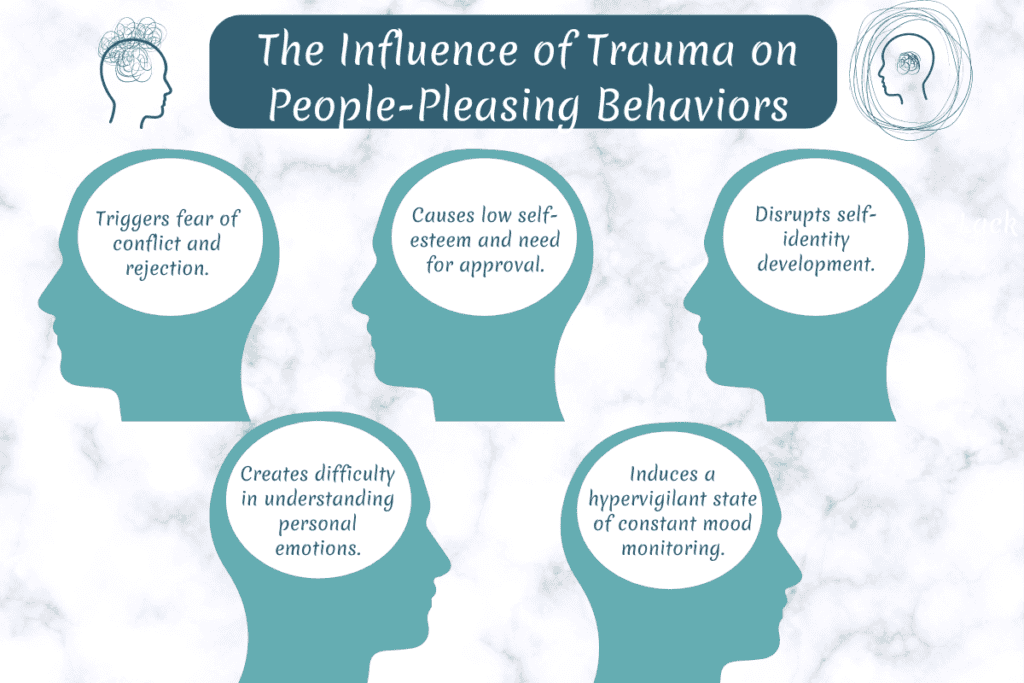
Many people who constantly prioritize others’ needs, avoid conflict, and fear disappointing anyone are not doing so by choice. They learned, often early in life, that safety, love, or acceptance depended on keeping others happy.

This article explains how people-pleasing develops as a trauma response, why it persists into adulthood, how it affects mental health and relationships, and what healing looks like.

What Is People-Pleasing?

People-pleasing is a behavioral pattern characterized by:

  • Excessive need for approval

  • Difficulty saying “no”

  • Fear of conflict or rejection

  • Over-responsibility for others’ emotions

  • Suppressing one’s own needs, feelings, or opinions

Occasional consideration for others is healthy. Chronic people-pleasing, however, is driven by fear rather than choice.

Trauma and Survival Responses

Trauma—especially relational or developmental trauma—changes how the nervous system responds to threat.

In addition to the well-known fight, flight, and freeze responses, trauma psychology recognizes a fourth response:

The Fawn Response

The fawn response involves appeasing, pleasing, or submitting to others to avoid harm.

For a child growing up in an unsafe emotional environment, pleasing others may have been the safest option available.

People-pleasing is not weakness—it is adaptation.

How Trauma Creates People-Pleasing

1. Childhood Emotional Insecurity

People-pleasing often develops in environments where:

  • Love was conditional

  • Caregivers were emotionally unpredictable

  • Anger, criticism, or withdrawal felt threatening

  • The child had to “read the room” to stay safe

The child learns:

“If I keep everyone happy, I won’t be hurt or abandoned.”

2. Parentification and Emotional Responsibility

Some children grow up taking care of adults’ emotions—comforting, mediating, or preventing conflict.

This creates a belief that:

  • Others’ feelings are my responsibility

  • My needs are less important

  • Saying no is selfish or dangerous

These beliefs persist into adulthood.

3. Fear-Based Attachment Patterns

People-pleasing is closely linked to anxious attachment and fearful-avoidant attachment.

Common attachment fears include:

  • Anxiety around abandonment
  • Sensitivity to rejection
  • Conflict-associated loss anxiety

As adults, these individuals may sacrifice authenticity to preserve connection.

Signs of Trauma-Based People-Pleasing

Not all people-pleasing is trauma-based. Trauma-related patterns often include:

  • Intense anxiety when setting boundaries

  • Guilt after saying “no”

  • Over-explaining decisions

  • Difficulty identifying personal needs

  • Resentment followed by self-blame

  • Emotional exhaustion and burnout

  • Feeling valued only for usefulness

Externally, such individuals appear “easy-going.” Internally, they are often hypervigilant and emotionally depleted.

Psychological Cost of People-Pleasing

1. Loss of Self-Identity

When survival required adapting to others, the individual may lose touch with:

  • Personal preferences

  • Desires

  • Values

Many people-pleasers ask:

“I know who others want me to be—but who am I?”

2. Chronic Anxiety and Burnout

Constant monitoring of others’ reactions keeps the nervous system in a state of alert.

This leads to:

  • Anxiety

  • Emotional fatigue

  • Irritability

  • Depression

3. Unbalanced Relationships

People-pleasers often attract:

  • Emotionally unavailable people

  • Controlling partners

  • One-sided friendships

Because boundaries are weak, reciprocity is low.

Why People-Pleasing Is So Hard to Stop

People-pleasing is reinforced because it once worked.

  • Helped avoid confrontation
  • It kept relationships intact
  • It offered short-term emotional security

The nervous system remembers this—even when the danger is no longer present.

Saying “no” may trigger:

  • Fear

  • Guilt

  • Shame

  • A sense of threat

Healing requires nervous system safety, not just willpower.

Healing People-Pleasing Patterns

1. Recognizing It as a Trauma Response

The first step is reframing:

“This behavior kept me safe once. I don’t need to punish myself for it.”

Self-compassion is essential.

2. Learning to Tolerate Discomfort

Healthy boundaries initially feel unsafe to a traumatized nervous system.

Healing involves slowly learning that:

  • Discomfort ≠ danger

  • Disapproval ≠ abandonment

3. Reconnecting With Personal Needs

Trauma recovery includes asking:

  • Current emotional state: ______
  • Primary unmet need: ______
  • Personal desire (self-directed): ______

This process often feels unfamiliar and requires patience.

4. Therapy and Trauma-Informed Support

Trauma-focused therapy helps:

  • Regulate the nervous system

  • Process attachment wounds

  • Build boundary tolerance

  • Develop a stable sense of self

People-pleasing is not a personality flaw—it is a learned survival strategy that can be unlearned.

Healthy Care vs People-Pleasing

Healthy Care Trauma-Based People-Pleasing
Choice-based Fear-based
Includes self Self-neglect
Has boundaries Boundary collapse
Reciprocal One-sided
Flexible Compulsive

Conclusion

People-pleasing is not about being “too nice.”
It is often about being afraid to lose safety, connection, or worth.

When viewed through a trauma lens, people-pleasing becomes understandable—and treatable.

Healing does not mean becoming selfish.
It means learning that your needs, feelings, and boundaries are safe to have.

True connection begins where self-abandonment ends.

FAQ

Q1. What does people-pleasing mean in psychology?
People-pleasing refers to a pattern of prioritizing others’ needs over one’s own to gain approval, avoid conflict, or prevent rejection.

Q2. How is people-pleasing related to trauma?
In many cases, people-pleasing develops as a trauma response, especially after childhood emotional neglect, abuse, or unstable caregiving.

Q3. What is the fawn response?
The fawn response is a trauma-based survival reaction where a person appeases or pleases others to avoid perceived threat or harm.

Q4. Is people-pleasing always caused by trauma?
No. Some people-pleasing is learned socially, but chronic, fear-driven people-pleasing is often trauma-related.

Q5. What kind of trauma leads to people-pleasing?
Common causes include emotional neglect, verbal abuse, parentification, conditional love, and unpredictable caregivers.

Q6. How does people-pleasing affect mental health?
It is linked to anxiety, burnout, resentment, depression, low self-worth, and emotional exhaustion.

Q7. Why do people-pleasers feel guilty when they say no?
Because the nervous system associates boundaries with danger, rejection, or abandonment based on past experiences.

Q8. Is people-pleasing linked to attachment styles?
Yes. It is commonly associated with anxious and fearful-avoidant attachment patterns.

Q9. How can I tell if my people-pleasing is trauma-based?
Signs include intense fear of conflict, identity confusion, emotional hypervigilance, and feeling valued only when useful.

Q10. Why is people-pleasing hard to stop?
Because it once worked as a survival strategy. The body remembers it as a way to stay safe.

Q11. Does healing mean becoming selfish?
No. Healing means learning healthy boundaries while still being caring and empathetic.

Q12. Can therapy help with people-pleasing?
Yes. Trauma-informed therapy helps regulate the nervous system and rebuild a sense of safety around boundaries.

Q13. What are healthy alternatives to people-pleasing?
Assertive communication, self-validation, boundary-setting, and reciprocal relationships.

Q14. How long does it take to heal people-pleasing patterns?
Healing is gradual and non-linear. Progress depends on safety, support, and self-compassion.

Q15. Can people-pleasing return under stress?
Yes. Under stress, old trauma responses may resurface, but awareness allows conscious choice instead of automatic reaction.

Written by Baishakhi Das

Counselor | Mental Health Practitioner
B.Sc, M.Sc, PG Diploma in Counseling


🔗 Reference


Conditions of Worth & Self-Esteem Development

https://www.mollypotter.com/wp-content/uploads/2022/01/conditions-of-worthvv.png

A Deep Psychological Exploration

Self-esteem does not develop in isolation. Relationships—especially in childhood—shape, reinforce, and sometimes fracture it. One of the most powerful yet often overlooked influences on self-esteem development is the concept of conditions of worth.

Many adults struggle with chronic self-doubt, perfectionism, people-pleasing, fear of failure, or a persistent sense of “not being enough.” These struggles rarely reflect personality flaws. Instead, they reflect the emotional legacy of growing up believing that love, acceptance, or safety had to be earned.

This article examines conditions of worth in depth—explaining what they are, how they develop, how they shape self-esteem across the lifespan, how they appear in adulthood and relationships, and how healing becomes possible.

Understanding Conditions of Worth

The concept of conditions of worth comes from humanistic psychology, particularly the work of Carl Rogers. Rogers argued that every person enters the world with an innate drive toward growth, authenticity, and self-actualization—a natural motivation to become their true self. This developmental process, however, relies heavily on the emotional environment of childhood, especially the quality and consistency of acceptance offered by caregivers.

When caregivers provide warmth, empathy, and acceptance, children learn that their value exists simply because they exist. In contrast, when acceptance becomes inconsistent or conditional, children begin to form internal rules about what makes them “worthy.” Over time, these rules shape how children relate to themselves, evaluate their emotions, and measure their own value.

What Are Conditions of Worth?

Conditions of worth are the deeply internalized beliefs that one is worthy of love, acceptance, or respect only if certain conditions are met. These beliefs form early and often operate outside conscious awareness, quietly shaping self-esteem, motivation, and emotional expression.

They often sound like:

    • “Love feels available to me only when I behave well.”

    • “I feel valued mainly when I succeed.”

    • “I feel acceptable when I keep others comfortable.”

    • “Care feels earned, not given freely.”

Over time, these conditions teach the child to monitor, edit, and suppress parts of themselves to maintain connection. Emotions, needs, or traits that threaten approval are pushed aside, while approved behaviors are amplified. When love becomes conditional, the child learns a painful lesson: their authentic self is not enough—and worth must be earned rather than inherent.

Unconditional Positive Regard vs Conditional Acceptance

Carl Rogers emphasized the importance of unconditional positive regard—accepting and valuing a person regardless of behavior, success, or failure.

Unconditional Positive Regard

  • Love is consistent

  • Emotions are validated

  • Mistakes are tolerated

  • The child feels safe being authentic

Conditional Acceptance (Conditions of Worth)

  • Love is withdrawn or reduced when expectations aren’t met

  • Approval depends on performance or obedience

  • Emotions are judged or dismissed

  • The child learns to self-censor

When children receive conditional acceptance, they internalize the idea that worth must be earned.

How Conditions of Worth Develop in Childhood

Children are biologically wired for attachment. From the earliest years of life, their survival—both physical and emotional—depends on maintaining closeness with caregivers. To preserve this connection, children instinctively adapt themselves emotionally and behaviorally. They do not question whether the environment is healthy; instead, they change who they are to stay connected.

Conditions of worth typically develop in environments where acceptance feels uncertain, conditional, or unpredictable.

1. Love Is Performance-Based

When praise and attention are given mainly for achievements, good behavior, obedience, or emotional restraint, children begin to associate worth with performance.

Commonly rewarded traits include:

  • Academic success or talent

  • Being “well-behaved” or compliant

  • Meeting adult expectations

  • Suppressing strong emotions

Over time, the child learns: “I am valued for what I do, not for who I am.” 

2. Emotions Are Invalidated

When caregivers dismiss or criticize emotional expression, children learn that certain feelings make them less acceptable.

Messages such as:

  • “Stop crying.”

  • “You’re too sensitive.”

  • “Good children don’t get angry.”

teach the child to suppress emotions rather than understand them. Emotional expression becomes linked with shame or rejection.

3. Approval Is Inconsistent

When affection depends on a parent’s mood, stress level, or circumstances, children cannot rely on emotional safety. As a result, they become hypervigilant—constantly scanning for cues about how to behave to stay accepted.

This unpredictability teaches the child that love must be carefully managed.

4. Comparison Is Frequent

Being compared to siblings, peers, or ideal standards creates external benchmarks for worth. The child learns to evaluate themselves through others’ approval rather than inner experience.

Self-esteem becomes competitive rather than stable.

5. Parentification or Emotional Immaturity Exists

In families marked by emotional immaturity or role reversal, children may feel responsible for meeting adult emotional needs. They learn that their value lies in being helpful, mature, or emotionally accommodating—rather than simply being themselves.

In these environments, conditions of worth form quietly but deeply, shaping how the child understands love, safety, and self-acceptance well into adulthood.

Psychological Impact on Self-Esteem Development

Fragmented Self-Concept

When children must deny or hide parts of themselves in order to gain acceptance, the self gradually becomes divided. They learn that some feelings, needs, or traits are welcome—while others are not. Over time, this creates an internal split:

  • Real self – the child’s authentic feelings, needs, impulses, and desires

  • Ideal self – the version of themselves they believe they must become to be loved, accepted, or approved of

The greater the distance between these two selves, the more fragile self-esteem becomes. Living from the ideal self requires constant self-monitoring and suppression, leaving the person feeling disconnected from who they truly are.

Externalized Self-Worth

As conditions of worth take hold, self-esteem shifts from an inner sense of value to an external one. Worth becomes something to be measured and confirmed by others.

Self-esteem begins to depend on:

  • Validation from authority figures or peers

  • Achievement and productivity

  • Praise and positive feedback

  • Approval and acceptance

Without continuous external reinforcement, the individual may experience emptiness, anxiety, or a sudden collapse in self-worth. Confidence becomes unstable because it is no longer self-generated.

Fear-Based Motivation

Instead of acting from curiosity, interest, or joy, behavior becomes driven by fear. Choices are made not because they feel meaningful, but because they feel necessary for acceptance or safety.

This fear-based motivation often includes:

  • Rejection or loss of acceptance
  •  Failure and loss of worth
  • Fear of disappointing others and losing approval

Over time, this undermines intrinsic motivation and emotional well-being. Life becomes about avoiding loss rather than pursuing growth, leaving the person chronically tense, self-critical, and disconnected from genuine satisfaction.

How Conditions of Worth Appear in Adulthood

Conditions of worth do not disappear with age—they transform.

1. Perfectionism

Mistakes feel intolerable because they threaten worth, not just performance.

2. People-Pleasing

Saying “yes” becomes a survival strategy to maintain approval.

3. Chronic Self-Criticism

An internalized critical voice replaces external judgment.

4. Difficulty Receiving Love

Affection feels uncomfortable unless “earned.”

5. Emotional Suppression

Certain emotions still feel “unacceptable.”

6. Imposter Syndrome

Success never feels secure or deserved.

Conditions of Worth in Relationships

In adult relationships, conditions of worth often show up as:

  • Over-functioning to keep relationships stable

  • Fear of expressing needs or boundaries

  • Believing conflict equals rejection

  • Staying in unhealthy relationships to feel valued

  • Confusing self-sacrifice with love

Many relationship struggles are rooted not in incompatibility, but in conditional self-worth.

The Nervous System Connection

Conditions of worth shape not only thoughts, but also the nervous system.

When worth feels conditional:

  • The body stays in alert mode

  • Rejection feels threatening

  • Criticism triggers shame responses

  • Approval brings temporary relief, not safety

This keeps individuals stuck in cycles of anxiety and self-monitoring.

Self-Esteem vs Self-Worth

A critical distinction:

  • Self-esteem often depends on evaluation (“How good am I?”)

  • Self-worth is inherent (“Am I worthy?”)

Conditions of worth undermine self-worth, replacing it with fragile, performance-based esteem.

Cultural and Social Reinforcement

Conditions of worth are often reinforced by:

  • Academic pressure

  • Gender roles

  • Productivity culture

  • Social media validation

  • Comparison-driven environments

These forces normalize conditional value, making it harder to recognize the original wound.

Healing Conditions of Worth

Healing does not mean rejecting all standards or responsibilities. It means decoupling worth from performance.

1. Awareness

Identify internal “if–then” beliefs:

  • “If I fail, then I am worthless.”

  • “If I disappoint, then I will be rejected.”

2. Emotional Validation

Practice acknowledging feelings without judgment.

3. Self-Compassion

Replace self-criticism with understanding.

4. Reparenting

Offer yourself unconditional acceptance, especially in moments of failure.

5. Boundary Development

Learn that saying no does not equal losing worth.

6. Therapy

Humanistic, trauma-informed, or attachment-based therapy can help rebuild unconditional self-worth.

The Role of Therapy in Repair

Therapy provides what was missing:

  • Consistent acceptance

  • Emotional safety

  • Non-judgmental presence

  • Permission to be authentic

Over time, this helps integrate the real self and ideal self.

A Gentle Truth

If your self-esteem feels fragile, it does not mean you lack confidence.
It means your worth was made conditional before you had a choice.

You were not born believing you had to earn love.
You learned it.

And what is learned—can be unlearned.

Your value does not increase with success.
It does not decrease with mistakes.
It does not disappear when you rest.

Your worth was never conditional.
It was always inherent.

Frequently Asked Questions (FAQ)

1. What are conditions of worth in psychology?

Conditions of worth are internal beliefs that a person is worthy of love or acceptance only when certain expectations are met, such as good behavior, achievement, or emotional restraint.


2. Who introduced the concept of conditions of worth?

The concept comes from humanistic psychology and was introduced by Carl Rogers, who emphasized the importance of unconditional positive regard in healthy development.


3. How do conditions of worth affect self-esteem?

They make self-esteem fragile and externalized. Self-worth becomes dependent on approval, success, or validation rather than an inner sense of value.


4. Can conditions of worth exist without abuse?

Yes. Conditions of worth often develop in well-meaning families through emotional invalidation, high expectations, comparison, or inconsistent approval—even without overt abuse.


5. What is the difference between self-esteem and self-worth?

Self-esteem often reflects evaluation (“How well am I doing?”), while self-worth refers to inherent value (“Am I worthy?”). Conditions of worth undermine self-worth.


6. How do conditions of worth show up in adulthood?

They may appear as perfectionism, people-pleasing, fear of failure, chronic self-criticism, difficulty resting, or feeling undeserving of care or love.


7. Can conditions of worth be healed?

Yes. Through awareness, emotional validation, self-compassion, boundary-setting, and therapy, individuals can rebuild a sense of unconditional self-worth.

Written by Baishakhi Das

Counselor | Mental Health Practitioner
B.Sc, M.Sc, PG Diploma in Counseling


Reference 

Automatic Thoughts & Cognitive Distortions in Anxiety

https://static.wixstatic.com/media/28dab0_94961311c1d24d97921c7e7c11eb7da3~mv2.jpg/v1/fill/w_1000%2Ch_777%2Cal_c%2Cq_85%2Cusm_0.66_1.00_0.01/28dab0_94961311c1d24d97921c7e7c11eb7da3~mv2.jpg

Anxiety is not only a physiological response or an emotional state—it is also a cognitive experience. While symptoms such as a racing heart, restlessness, or muscle tension are commonly recognized, the mental component of anxiety is often overlooked. People with anxiety frequently describe their mind as constantly busy, hyper-alert, or trapped in repetitive “what if” thinking, where potential threats are endlessly anticipated and replayed.

Cognitive psychology explains this experience through the interaction of automatic thoughts and cognitive distortions. These rapid, involuntary thoughts interpret situations as dangerous or overwhelming, while distorted thinking patterns exaggerate risk and minimize coping ability. Together, they create a mental environment in which anxiety is repeatedly triggered, sustained, and intensified—even in the absence of real or immediate danger.

This understanding is rooted in Cognitive Behavioral Theory developed by Aaron T. Beck. Beck’s framework helps explain why anxiety feels so real, convincing, and difficult to switch off. Because these thoughts arise automatically and feel believable, individuals often respond as if the threat is certain. Recognizing anxiety as a cognitive process, rather than merely an emotional or physical one, is a crucial step toward effective psychological intervention and long-term relief.

Understanding Automatic Thoughts in Anxiety

What Are Automatic Thoughts?

Automatic thoughts are immediate, involuntary interpretations that arise spontaneously in response to internal or external situations. They occur reflexively, without conscious effort or deliberate reasoning, and often pass so quickly that individuals are unaware of their presence. Yet, despite their subtlety, these thoughts have a powerful influence on emotional and physiological reactions.

In anxiety, automatic thoughts are typically threat-focused. The mind constantly scans for potential danger, uncertainty, or loss of control, interpreting even neutral situations as risky. Because these thoughts arise automatically and feel convincing, they trigger anxiety responses before logical evaluation can take place.

Common Features of Anxious Automatic Thoughts

  • Fast and repetitive
    They appear instantly and often repeat in a loop, making the mind feel busy or stuck.

  • Oriented toward danger or uncertainty
    Thoughts focus on “what if something goes wrong?” rather than what is actually happening.

  • Emotionally intense
    They provoke fear, tension, and unease, activating the body’s stress response.

  • Treated as facts rather than possibilities
    These thoughts are rarely questioned and are experienced as truths instead of hypotheses.

In effect, anxious automatic thoughts function like an internal alarm system that is oversensitive. While designed to protect, this alarm rarely switches off, sending repeated signals of threat even when no real danger exists. Over time, this constant activation maintains anxiety, exhausts mental resources, and reinforces the belief that the world is unsafe.

Recognizing automatic thoughts as mental events—not objective reality—is a crucial first step in reducing anxiety and restoring cognitive balance.

How Automatic Thoughts Trigger Anxiety

Automatic thoughts in anxiety usually involve overestimating threat and underestimating coping ability.

Example

  • Situation: Heart rate increases

  • Automatic thought: “Something is wrong with my heart.”

  • Emotion: Fear, panic

  • Behavior: Checking pulse, avoidance, reassurance-seeking

The anxiety is not caused by the bodily sensation itself, but by the interpretation of that sensation as dangerous.

Over time, this pattern conditions the mind to respond with fear even in neutral situations.

Cognitive Distortions: The Thinking Errors Behind Anxiety

Cognitive distortions are systematic errors in thinking that bias perception toward threat, danger, or catastrophe. In anxiety disorders, these distortions become habitual and automatic.

Below are the most common cognitive distortions seen in anxiety.

1. Catastrophizing

Assuming the worst possible outcome will occur.

“If I make a mistake, everything will fall apart.”

This distortion keeps the nervous system in a constant state of anticipation and fear.

2. Probability Overestimation

Overestimating how likely a feared event is.

“This will definitely go wrong.”

Even low-risk situations feel dangerous because the mind inflates threat probability.

3. Intolerance of Uncertainty

Believing uncertainty itself is unbearable.

“If I don’t know what will happen, I can’t cope.”

This drives excessive planning, reassurance-seeking, and avoidance.

4. Mind Reading

Assuming others are judging or criticizing you.

“They must think I’m incompetent.”

This distortion fuels social anxiety and self-consciousness.

5. Emotional Reasoning

Believing that feeling anxious means danger is real.

“I feel scared, so something must be wrong.”

Here, emotion becomes evidence, bypassing rational evaluation.

6. Selective Attention to Threat

Focusing only on signs of danger while ignoring safety cues.

An anxious mind scans constantly for threat, reinforcing hypervigilance.

The Anxiety Maintenance Cycle

Automatic thoughts and cognitive distortions work together to create a self-reinforcing loop that keeps anxiety active over time. This cycle explains why anxiety often persists even when situations are objectively safe and why temporary relief rarely leads to lasting change.

The cycle typically unfolds as follows:

  1. Trigger (internal or external)
    A trigger may be external (a situation, place, or interaction) or internal (a bodily sensation, memory, or thought). Even neutral stimuli can become triggers once anxiety is established.

  2. Automatic threat-based thought
    The mind immediately generates a threat-focused interpretation such as, “Something is wrong,” or “I won’t be able to handle this.” This thought arises automatically and is rarely questioned.

  3. Anxiety response (physical + emotional)
    The thought activates the body’s fight-or-flight response, leading to symptoms like increased heart rate, muscle tension, restlessness, and intense fear or worry.

  4. Safety behaviors (avoidance, checking, reassurance-seeking)
    To reduce distress, individuals engage in behaviors aimed at preventing danger or gaining certainty—avoiding situations, repeatedly checking, or seeking reassurance from others.

  5. Short-term relief
    These behaviors provide temporary comfort, reinforcing the belief that the threat was real and successfully avoided.

  6. Long-term increase in anxiety
    Because the feared outcome is never tested or disproven, the mind learns that safety depends on these behaviors. Anxiety becomes stronger, more frequent, and more generalized over time.

Crucially, safety behaviors prevent the disconfirmation of fear, meaning the individual never gets the opportunity to learn that the situation could be tolerated or was not truly dangerous. As a result, anxiety remains alive and self-perpetuating.

Understanding this cycle is essential in anxiety treatment, as lasting improvement comes not from eliminating anxiety triggers, but from gradually breaking the loop—especially by reducing safety behaviors and challenging threat-based interpretations.

Core Beliefs Underlying Anxiety

Beneath automatic thoughts lie core beliefs, often formed early in life:

  • “The world is dangerous.”

  • “I am not safe.”

  • “I cannot cope.”

These beliefs prime the mind to interpret ambiguous situations as threatening, making anxiety feel constant and uncontrollable.

Why Anxious Thoughts Feel So Convincing

Anxiety activates the fight-or-flight system, which prioritizes survival over accuracy. In this state:

  • The brain favors speed over logic

  • Threat interpretations dominate

  • Rational counter-arguments feel weak

This is why reassurance often provides only temporary relief—because the problem lies in how thoughts are generated, not whether they are logical.

Therapeutic Implications: How CBT Helps Anxiety

Cognitive Behavioral Therapy targets anxiety by working with both thoughts and behaviors.

Key CBT strategies include:

  • Identifying automatic thoughts

  • Labeling cognitive distortions

  • Evaluating threat realistically

  • Reducing safety behaviors

  • Increasing tolerance of uncertainty

Importantly, CBT does not aim to eliminate anxiety entirely—but to change the relationship with anxious thoughts.

Real-Life Impact of Cognitive Change

When automatic thoughts are recognized as mental events rather than facts:

  • Anxiety intensity decreases

  • Confidence in coping increases

  • Avoidance reduces

  • Emotional flexibility improves

This shift restores a sense of control and psychological safety.

Final Reflection

Automatic thoughts and cognitive distortions are not signs of weakness, lack of intelligence, or “overthinking.” They are learned cognitive habits shaped by life experiences, biological sensitivity, and environmental conditioning. Over time, the mind becomes trained to prioritize threat detection, even in situations that are objectively safe.

Anxiety persists not because danger is everywhere, but because the brain has learned to interpret the world through a lens of risk and uncertainty. When this lens remains unexamined, anxious thoughts feel automatic, convincing, and uncontrollable.

The hopeful message of cognitive psychology is this:

If anxious thoughts are learned, they can be questioned.
And when thinking changes, anxiety no longer has to control life.

Through awareness, practice, and therapeutic support, individuals can learn to recognize anxious thoughts as mental events rather than facts. As this shift occurs, the mind gradually regains flexibility, the nervous system settles, and anxiety loses its power to dominate daily life.

Change does not mean eliminating fear—it means learning that fear does not have to decide how you live.

Frequently Asked Questions (FAQ)

1. What are automatic thoughts in anxiety?

Automatic thoughts are immediate, involuntary interpretations that arise in response to situations, bodily sensations, or emotions. In anxiety, these thoughts are usually threat-focused and trigger fear before conscious reasoning can occur.


2. How are automatic thoughts different from worrying?

Automatic thoughts are brief, fast, and reflexive, while worry is more prolonged and repetitive. Automatic thoughts often trigger worry by signaling danger or uncertainty.


3. What are cognitive distortions in anxiety?

Cognitive distortions are systematic thinking errors that exaggerate threat and underestimate coping ability. Common distortions in anxiety include catastrophizing, probability overestimation, emotional reasoning, and intolerance of uncertainty.


4. Why do anxious thoughts feel so real and convincing?

Anxious thoughts activate the body’s fight-or-flight response, which prioritizes survival over accuracy. In this state, emotions feel like evidence, making thoughts seem factual even when they are not.


5. What are safety behaviors, and why do they maintain anxiety?

Safety behaviors (avoidance, checking, reassurance-seeking) reduce anxiety temporarily. However, they prevent the mind from learning that the feared situation is manageable, reinforcing anxiety in the long term.


6. Can anxiety exist without real danger?

Yes. Anxiety often persists not because danger is present, but because the mind has learned to interpret neutral or uncertain situations as threatening based on past experiences.


7. How does Cognitive Behavioral Therapy (CBT) help anxiety?

CBT helps by:

  • Identifying automatic thoughts

  • Recognizing cognitive distortions

  • Challenging threat-based interpretations

  • Reducing safety behaviors

  • Increasing tolerance of uncertainty

This breaks the anxiety maintenance cycle.


8. Are automatic thoughts a sign of weakness?

No. Automatic thoughts are learned cognitive habits, shaped by biology, environment, and experience. They are common and treatable, not signs of personal failure.

Written by Baishakhi Das

Counselor | Mental Health Practitioner
Qualifications: B.Sc in Psychology | M.Sc  | PG Diploma in Counseling

Reference 


Beck’s Cognitive Model of Depression: An In-Depth Explanation

https://upload.wikimedia.org/wikipedia/commons/0/0d/Beck%27s_CognitiveTriad.svg

Beck’s Cognitive Model of Depression is one of the most influential psychological frameworks for understanding why depression develops, persists, and often returns even after periods of improvement. Developed by Aaron T. Beck, this model shifted the understanding of depression away from viewing it solely as a mood disorder or a biological imbalance.

Instead, Beck proposed that depression is fundamentally a cognitive disorder, rooted in habitual patterns of distorted thinking that shape how individuals perceive themselves, their life experiences, and their future. These thinking patterns influence emotional reactions and behavioral choices, gradually creating and maintaining the depressive state.

At its core, the model proposes a powerful and clinically significant idea:

Depression is maintained by persistent negative interpretations of the self, life experiences, and the future.

According to Beck, these interpretations are not random or temporary thoughts. They are structured, predictable, and often automatic cognitive patterns that operate outside conscious awareness. Over time, they become deeply ingrained, making depression feel overwhelming, inevitable, and difficult to escape.

This article explores Beck’s Cognitive Model of Depression in depth—examining its theoretical structure, underlying psychological mechanisms, clinical relevance in therapy, and real-life implications for understanding and treating depressive disorders.

The Foundation of Beck’s Cognitive Model

Beck’s Cognitive Model emerged as a direct challenge to earlier psychological theories that explained depression primarily in terms of unconscious conflicts, unresolved childhood dynamics, or purely biological imbalances. While acknowledging that biological and developmental factors play a role, Beck argued that these explanations alone could not fully account for how depression is experienced and maintained in everyday life.

Through careful clinical observation, Aaron T. Beck noticed a consistent pattern among individuals suffering from depression: they tended to interpret themselves, their experiences, and their future through a systematically negative cognitive lens. These were not occasional pessimistic thoughts, but stable and repetitive thinking errors that appeared across situations.

According to Beck:

  • Depressed individuals do not perceive reality objectively
    Neutral or even positive events are often interpreted negatively, while successes are minimized or dismissed.

  • Their thinking follows predictable negative patterns
    These patterns include habitual self-criticism, pessimism, and rigid conclusions that resist contradictory evidence.

  • These cognitive patterns directly generate depressive emotions
    Feelings of sadness, hopelessness, guilt, and worthlessness arise as logical emotional responses to these distorted interpretations.

From this perspective, depression is not caused simply by external stressors or internal emotional weakness. Instead, emotional suffering emerges because thoughts shape emotional experience.

Thus, in Beck’s model, thoughts are not merely symptoms of depression—they are central mechanisms that create and maintain it. By identifying and modifying these maladaptive thought patterns, individuals can reduce emotional distress and regain psychological functioning, forming the foundation for cognitive-based therapeutic intervention.

The Cognitive Triad: The Core of Depression

The heart of Beck’s model is the Cognitive Triad, which consists of three interrelated negative belief systems:

1. Negative View of the Self

“I am defective, unworthy, or inadequate.”

Common thoughts:

  • “I am a failure.”

  • “There is something wrong with me.”

  • “I’m not good enough.”

This leads to:

  • Low self-esteem

  • Shame and guilt

  • Self-criticism

2. Negative View of the World

“The world is unfair, demanding, or rejecting.”

Common thoughts:

  • “People don’t care about me.”

  • “Nothing ever works out.”

  • “Life is against me.”

This creates:

  • Withdrawal from relationships

  • Loss of interest in activities

  • Emotional numbness

3. Negative View of the Future

“Things will never get better.”

Common thoughts:

  • “Nothing will change.”

  • “There’s no point trying.”

  • “The future is hopeless.”

This fuels:

  • Helplessness

  • Loss of motivation

  • Suicidal ideation in severe cases

➡️ These three views reinforce each other, creating a closed depressive loop.

Automatic Thoughts: The Moment-to-Moment Triggers

Automatic thoughts are immediate, involuntary mental responses that arise spontaneously in reaction to everyday situations. They occur so rapidly that individuals are often unaware of their presence, experiencing only the emotional impact that follows. In Beck’s Cognitive Model, these thoughts are considered the moment-to-moment triggers that translate life events into emotional distress.

In depression, automatic thoughts tend to share several defining characteristics:

  • Negative – They focus on loss, failure, or inadequacy

  • Absolute – They are framed in extreme, all-or-nothing terms

  • Emotionally convincing – They feel true, regardless of evidence

  • Taken as facts – They are rarely questioned or examined

Because these thoughts arise automatically, they bypass rational evaluation and directly activate emotional responses.

Example

  • Situation: A mistake at work

  • Automatic thought: “I ruin everything.”

  • Emotion: Sadness, shame, worthlessness

  • Behavior: Withdrawal, avoidance, reduced effort

In this sequence, the emotional pain is not caused by the mistake itself, but by the interpretation of the mistake. A single error is cognitively transformed into a global judgment about the self.

Crucially, these thoughts occur so quickly and effortlessly that individuals often believe they are reacting emotionally to reality. In truth, they are reacting to their interpretation of reality. Over time, repeated automatic thoughts strengthen depressive beliefs, deepen emotional distress, and reinforce avoidant or withdrawn behavior—maintaining the depressive cycle.

Identifying and challenging automatic thoughts is therefore a central therapeutic task in cognitive-based interventions, as even small shifts in interpretation can lead to meaningful emotional relief.

Cognitive Distortions in Depression

Beck identified specific thinking errors that dominate depressive cognition:

  • All-or-nothing thinking
    “If I fail once, I’m a total failure.”

  • Overgeneralization
    “This always happens to me.”

  • Mental filtering
    Focusing only on negative details and ignoring positives.

  • Personalization
    “It’s my fault, even when it isn’t.”

  • Catastrophizing
    Expecting the worst possible outcome.

These distortions systematically bias perception toward negativity.

Core Beliefs and Schemas: The Deep Structure

Beyond surface thoughts, Beck emphasized core beliefs (schemas)—deep, rigid assumptions formed early in life.

Common depressive core beliefs:

  • “I’m not good enough to be loved.”

  • “Nothing I do changes anything.”

  • “I don’t have much worth.”

These schemas often develop through:

  • Childhood criticism or neglect

  • Emotional abuse

  • Repeated failure experiences

  • Insecure attachment

When life events activate these schemas, depressive thinking is triggered automatically.

The Depression Maintenance Cycle

Beck’s model explains why depression persists even when circumstances improve.

  1. Negative core beliefs shape perception

  2. Automatic thoughts interpret events negatively

  3. Depressive emotions emerge

  4. Withdrawal and inactivity increase

  5. Reduced positive experiences confirm negative beliefs

This self-reinforcing loop explains chronic and recurrent depression.

Behavioral Consequences of Depressive Thinking

Depression is not only cognitive—it is behavioral.

Common behaviors include:

  • Social withdrawal

  • Reduced activity

  • Avoidance of responsibility

  • Procrastination

These behaviors:

  • Reduce opportunities for pleasure or mastery

  • Increase isolation

  • Strengthen beliefs of inadequacy

Thus, behavior becomes evidence for distorted thoughts.

Therapeutic Implications: Why the Model Works

Beck’s model became the foundation of Cognitive Behavioral Therapy (CBT) because it is:

  • Structured and practical

  • Focused on present functioning

  • Collaborative and empowering

  • Skills-based and measurable

CBT targets:

  • Automatic thoughts

  • Cognitive distortions

  • Core beliefs

  • Avoidant behaviors

By modifying thinking patterns, emotional relief follows naturally.

Strengths of Beck’s Cognitive Model

  • Empirically supported across cultures

  • Effective for mild to severe depression

  • Teaches lifelong coping skills

  • Reduces relapse risk

It reframes depression from a personal failure to a treatable thinking pattern.

Limitations and Considerations

  • Severe depression may require medication alongside CBT

  • Trauma-based depression may need additional emotional processing

  • Cultural beliefs can shape cognitive content

Still, Beck’s model remains one of the most clinically effective frameworks in mental health.

Final Reflection

Beck’s Cognitive Model of Depression offers a compassionate yet structured framework for understanding psychological suffering. It reframes depression not as a personal flaw, weakness, laziness, or lack of gratitude, but as the result of maladaptive patterns of thinking that are learned, reinforced, and maintained over time—often in response to life experiences, relationships, and early environments.

This perspective is deeply validating. It removes moral judgment from depression and replaces it with understanding. When suffering is seen as a product of cognitive patterns rather than character defects, individuals can approach their struggles with curiosity instead of self-blame.

Most importantly, Beck’s model delivers hope grounded in psychology, not optimism alone:

If thoughts are learned, they can be unlearned.
And if thinking can change, recovery is possible.

Through awareness, reflection, and therapeutic intervention, individuals can learn to question automatic thoughts, soften rigid beliefs, and develop more balanced ways of interpreting themselves and the world. In doing so, emotional relief becomes not only possible—but sustainable.

Healing, in this model, is not about changing who you are.
It is about changing how you relate to your thoughts—and reclaiming agency over your inner life.

Frequently Asked Questions (FAQ)

1. What is Beck’s Cognitive Model of Depression?

Beck’s Cognitive Model explains depression as a result of persistent negative thinking patterns rather than personal weakness or only biological imbalance. It emphasizes how distorted thoughts about the self, world, and future create and maintain depressive emotions and behaviors.


2. Who developed the Cognitive Model of Depression?

The model was developed by Aaron T. Beck, the founder of Cognitive Therapy and one of the most influential figures in modern psychotherapy.


3. What is the Cognitive Triad in depression?

The cognitive triad refers to three interconnected negative beliefs:

  • A negative view of the self
    “I am inadequate or not good enough.”
  • A negative view of the world
    “The world is demanding, rejecting, or unfair.”
  • A negative view of the future
    “Nothing will change, and improvement is unlikely.”

These beliefs reinforce one another and deepen depressive symptoms.


4. Are negative thoughts a symptom or a cause of depression?

According to Beck’s model, negative thoughts are central causes, not just symptoms. Automatic thoughts and core beliefs directly shape emotional responses and behaviors that maintain depression.


5. What are automatic thoughts?

Automatic thoughts are immediate, involuntary interpretations that arise in response to situations. In depression, these thoughts are usually negative, absolute, and emotionally convincing, and they strongly influence mood and behavior.


6. Can Beck’s model help with severe depression?

Yes. Research shows Cognitive Behavioral Therapy (CBT), based on Beck’s model, is effective for mild, moderate, and severe depression, often in combination with medication for more severe cases.


7. How does CBT use Beck’s model in therapy?

CBT helps individuals:

  • Identify automatic negative thoughts

  • Recognize cognitive distortions

  • Challenge unhelpful beliefs

  • Replace them with balanced, realistic thoughts
    This process leads to emotional relief and healthier behavior patterns.


8. Is Beck’s Cognitive Model scientifically supported?

Yes. Beck’s model is one of the most empirically supported frameworks in psychology, with decades of research validating its effectiveness across cultures and age groups.

Written by Baishakhi Das

Counselor | Mental Health Practitioner
Qualifications: B.Sc in Psychology | M.Sc  | PG Diploma in Counseling

Reference 


Stress vs Burnout: How to Tell the Difference

https://doctorondemand.com/wp-content/uploads/2022/04/stress-vs-burnout.png

In today’s fast-paced world, feeling overwhelmed has become almost a normal part of daily life. Long work hours, constant digital connectivity, financial pressures, and growing personal responsibilities have blurred the line between productivity and exhaustion. As a result, many people use the terms stress and burnout interchangeably—but psychologically, they are not the same experience.

Understanding the difference between stress and burnout is crucial because they affect the mind and body in very different ways and require different responses. Stress is often a short-term reaction to pressure and can sometimes be managed with rest or problem-solving. Burnout, however, develops gradually from prolonged, unmanaged stress and leads to deep emotional, mental, and physical exhaustion.

When burnout is mistaken for ordinary stress and addressed only with quick fixes—such as taking a short break or pushing harder—it can silently worsen. Over time, this may contribute to anxiety, depression, physical illness, emotional numbness, and a loss of meaning or motivation.

What Is Stress?

Stress is the body’s natural response to pressure, challenge, or perceived demand. It arises when external situations or internal expectations feel greater than one’s current coping capacity. From a psychological perspective, stress is not inherently harmful—it is a signal, alerting the mind and body to mobilize resources for adaptation.

Stress is usually:

  • Situational – tied to a specific circumstance or phase of life

  • Short- to medium-term – it rises and falls as demands change

  • Demand-linked – connected to identifiable tasks, responsibilities, or pressures

Common stressors include work deadlines, academic exams, financial strain, caregiving roles, relationship conflicts, health concerns, or major life transitions. These stressors activate the body’s stress response system (sympathetic nervous system), preparing a person to respond, solve, or endure.

Psychological Experience of Stress

Psychologically, stress is often experienced as:

  • Feeling overwhelmed but still mentally engaged

  • Persistent worry, tension, or irritability

  • Racing or repetitive thoughts, especially about “what needs to be done”

  • Heightened alertness and a strong sense of urgency

  • Difficulty relaxing, even during rest periods

Despite discomfort, motivation is usually still present. The person may feel exhausted yet continues to push forward, believing effort will resolve the situation.

A key cognitive belief commonly seen in stress is:

“Once this situation improves, I’ll feel better.”

This belief reflects an important distinction:
Under stress, people generally retain hope and purpose. They expect relief once the pressure eases, which is why stress—though uncomfortable—often remains psychologically manageable in the short term.

When stress becomes chronic or unrelenting, however, this belief can begin to fade, increasing the risk of emotional exhaustion and burnout.

What Is Burnout?

Burnout is a state of chronic emotional, mental, and physical exhaustion that develops after prolonged exposure to stress that has not been adequately managed or relieved. It is most commonly associated with work, caregiving, and helping professions, where demands are continuous and recovery is limited or absent.

Unlike stress—which involves overactivation—burnout reflects depletion. The system no longer has enough emotional or psychological resources to respond.

The World Health Organization defines burnout as an occupational phenomenon characterized by three core dimensions:

  • Emotional exhaustion – feeling completely drained, depleted, and unable to give more

  • Mental distance, cynicism, or depersonalization – emotional withdrawal from work or responsibilities, often expressed as negativity or indifference

  • Reduced sense of effectiveness – feeling incompetent, unproductive, or that one’s efforts no longer matter

Burnout does not occur suddenly. It develops gradually, often disguised as “just being tired” or “having a bad phase,” and frequently goes unrecognized until daily functioning, relationships, or physical health are significantly affected.

Psychological Experience of Burnout

Psychologically, burnout is experienced very differently from stress:

  • Emotional numbness or emptiness, rather than anxiety

  • Detachment and cynicism, especially toward work, people, or responsibilities once cared about

  • Profound loss of motivation, meaning, and purpose

  • Feeling trapped, helpless, or stuck, with no sense of agency

  • Reduced emotional reactivity—both positive and negative feelings feel muted

While stressed individuals are often still striving and hoping for relief, burned-out individuals feel psychologically disconnected. Tasks that once felt manageable now feel pointless or unbearable.

A defining cognitive belief in burnout is:

“Nothing will change—even if the pressure stops.”

This belief reflects learned helplessness and emotional shutdown. Even rest or time off may not bring relief, because the nervous system and sense of meaning are already depleted.

Key Psychological Difference from Stress

  • Stress → “Too much to handle, but I must keep going.”

  • Burnout → “I have nothing left to give, and it doesn’t matter anymore.”

Burnout is not a personal failure or lack of resilience—it is a systemic response to prolonged overload without recovery, support, or control. Recovery therefore requires more than rest; it involves restoring meaning, boundaries, autonomy, and emotional safety.

Stress vs Burnout: Key Differences

Aspect Stress Burnout
Duration Short-term or episodic Long-term, chronic
Energy Overactive, tense Depleted, exhausted
Emotions Anxiety, irritability Hopelessness, numbness
Motivation Still present Significantly reduced
Engagement Over-engaged Disengaged
Recovery Improves with rest Persists despite rest

Emotional Signs: How They Feel Different

Stress Feels Like

  • “Everything feels urgent.”
  • “There’s no space to pause.”
  • “If I rest, I’ll fall behind.”

Burnout Feels Like

  • “I don’t care anymore”

  • “I’m empty”

  • “I’m done, but I can’t leave”

Stress pushes you to keep going.
Burnout makes you want to stop altogether.

Behavioral Differences

Under Stress

  • Overworking

  • Difficulty relaxing

  • Short temper

  • Sleep problems

Under Burnout

  • Procrastination or withdrawal

  • Reduced performance

  • Emotional detachment

  • Avoidance of responsibility

Burnout often looks like laziness from the outside—but psychologically, it is exhaustion, not lack of effort.

Physical Symptoms

Both stress and burnout affect the body, but differently:

Stress

  • Headaches

  • Muscle tension

  • Rapid heartbeat

  • Digestive issues

Burnout

  • Chronic fatigue

  • Frequent illness

  • Sleep disturbances

  • Body aches with no clear cause

Burnout weakens the immune system due to prolonged nervous system overload.

Why Stress Turns Into Burnout

Stress becomes burnout when:

  • Recovery time is insufficient

  • Emotional needs are ignored

  • Boundaries are consistently crossed

  • Effort is high but control or reward is low

Caregiving professionals, healthcare workers, counselors, parents, and corporate employees are especially vulnerable.

Can You Be Stressed and Burned Out at the Same Time?

Yes. Many people experience high stress on top of burnout. This feels like:

  • Emotional emptiness + anxiety

  • Exhaustion + pressure to perform

  • Detachment + guilt

This combination significantly increases the risk of depression and anxiety disorders.

How to Respond: Stress vs Burnout

If It’s Stress

  • Time management

  • Short breaks

  • Relaxation techniques

  • Problem-solving

  • Temporary rest

If It’s Burnout

  • Reducing demands (not just resting)

  • Emotional support or therapy

  • Re-evaluating roles and boundaries

  • Restoring meaning and autonomy

  • Long-term lifestyle changes

Burnout cannot be healed by a weekend break.

When to Seek Professional Help

Consider professional support if:

  • Emotional numbness lasts weeks or months

  • You feel detached from people or work

  • Motivation does not return after rest

  • Physical symptoms persist without cause

The American Psychological Association emphasizes early intervention to prevent long-term mental health consequences.

Key Takeaways

  • Stress is about too much

  • Burnout is about nothing left

  • Stress responds to rest

  • Burnout requires deeper change

  • Recognizing the difference protects mental health

Final Reflection

Stress says:
“I can’t slow down.”

Burnout says:
“I can’t go on.”

Stress reflects pressure within capacity—painful, but still fueled by urgency and hope. Burnout reflects depletion beyond capacity—where motivation, meaning, and emotional energy are exhausted.

Listening carefully to this internal shift is critical. When “pushing through” turns into emotional numbness, detachment, or hopelessness, the body and mind are signaling the need for deeper intervention—not just rest.

Recognizing this difference early can prevent long-term emotional collapse, protect mental health, and create space for recovery before functioning is severely compromised.

Frequently Asked Questions (FAQ)

1. Is stress always harmful?

No. Stress is a normal psychological and physiological response to challenges. Short-term stress can improve focus and performance. It becomes harmful when it is chronic, intense, and unmanaged, increasing the risk of anxiety, depression, and burnout.


2. How is burnout different from stress?

Stress involves over-engagement—too much pressure and urgency. Burnout involves disengagement—emotional exhaustion, cynicism, and loss of meaning. Stress says “I must keep going,” while burnout says “I have nothing left.”


3. Can stress turn into burnout?

Yes. Prolonged stress without adequate rest, control, emotional support, or recovery can gradually develop into burnout. Burnout is often the result of long-term stress that feels unavoidable.


4. Is burnout a mental illness?

Burnout is not classified as a mental disorder. According to the World Health Organization, it is an occupational phenomenon. However, burnout can increase vulnerability to depression, anxiety disorders, and physical health problems.


5. Can taking a break cure burnout?

Short breaks may help stress, but burnout usually requires deeper changes, such as:

  • Reducing ongoing demands

  • Restoring boundaries and autonomy

  • Reconnecting with meaning and values

  • Psychological support or counseling

Without these, symptoms often return quickly.


6. Who is most at risk of burnout?

People in high-responsibility or caregiving roles, such as healthcare workers, counselors, teachers, parents, corporate employees, and caregivers—especially when there is high demand and low support.


7. When should someone seek professional help?

Professional support is recommended when symptoms include:

  • Persistent emotional numbness or hopelessness

  • Loss of motivation lasting weeks or months

  • Withdrawal from work or relationships

  • Physical symptoms (sleep issues, fatigue, frequent illness)

  • Feeling trapped or helpless

Early intervention can prevent long-term psychological and occupational damage.


Written by Baishakhi Das

Counselor | Mental Health Practitioner
B.Sc, M.Sc , PG Diploma in Counseling

Reference 

  1. World Health Organization (WHO)
    Burn-out an occupational phenomenon
    https://www.who.int/news/item/28-05-2019-burn-out-an-occupational-phenomenon

  2. American Psychological Association (APA)
    Stress effects on the body
    https://www.apa.org/topics/stress/body

  3. National Institute for Occupational Safety and Health (NIOSH)
    Stress at work
    https://www.cdc.gov/niosh/topics/stress

  4. Maslach, C., & Leiter, M. P. (2016).
    Understanding the burnout experience. World Psychiatry
    https://onlinelibrary.wiley.com/doi/10.1002/wps.20311

  5. Harvard Health Publishing
    Burnout: Symptoms and prevention
    https://www.health.harvard.edu/blog/burnout-modern-affliction-or-human-condition-2017071912199

  6. Why You Feel Emotionally Numb: When You Can’t Feel What You Know You Should  
  7. Emotional Burnout: Symptoms You Shouldn’t Ignore