Why Arguments Keep Repeating in Relationships

A Deep Psychological Explanation of the Cycle Behind Ongoing Conflicts
https://images.squarespace-cdn.com/content/v1/66995d250fb2563a64b63587/7be74318-75c8-4a6b-bc1c-8bb6b785d15c/Add%2Ba%2Blittle%2Bbit%2Bof%2Bbody%2Btext%2B%283%29.png
Introduction

Many couples share a frustrating experience: the same argument keeps coming back, even after apologies, discussions, or temporary resolutions. Although the topic may change—money, time, family, communication—the emotional fight feels identical. This repetition is not a sign that partners are immature or incompatible. Instead, it reflects unresolved psychological patterns operating beneath the surface of the relationship.

To understand why arguments repeat, we must look beyond words and focus on emotions, attachment needs, learned coping styles, and unmet expectations.

1. Repeated Arguments Are About Needs, Not Topics

At a surface level, couples argue about:

  • Time

  • Attention

  • Responsibilities

  • Trust

  • Boundaries

However, beneath these topics lie unmet emotional needs, such as:

When these needs r

  • Emotional validation
  • Psychological safety
  • Attentive understanding
  • Mutual respect

emain unmet, the mind keeps reusing the same conflict as a way to signal distress.

👉 Key insight:
Arguments repeat because the need behind them has not been addressed.

2. The Role of Attachment Styles

Attachment theory plays a central role in recurring conflicts.

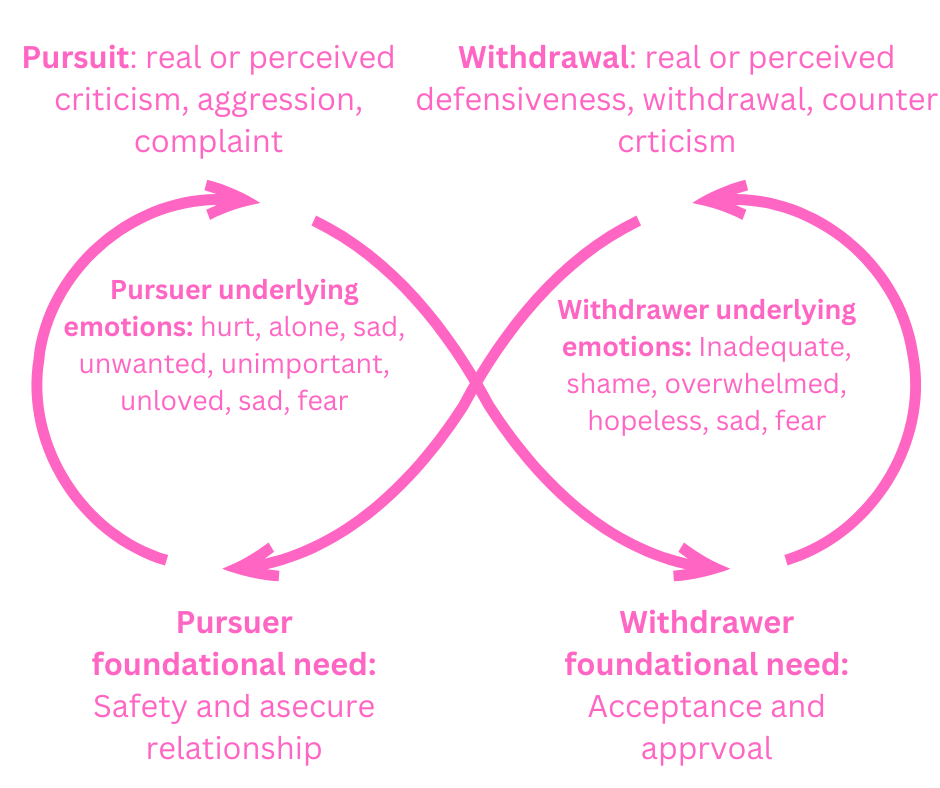
Common Pattern: The Pursue–Withdraw Cycle

  • One partner seeks closeness, reassurance, or discussion (anxious response)

  • The other retreats, shuts down, or avoids conflict (avoidant response)

This creates a loop:

  • The more one pursues → the more the other withdraws

  • The more one withdraws → the more the other escalates

Neither partner feels safe, heard, or understood.

👉 Over time, this pattern becomes automatic, not intentional.

3. Emotional Triggers from Past Experiences

Many arguments are not about the present moment, but about old emotional wounds being activated.

Common triggers include:

  • Childhood emotional neglect

  • Past relationship betrayal

  • Criticism or rejection experiences

  • Feeling controlled or abandoned earlier in life

When triggered:

  • The nervous system reacts as if the past is happening again

  • Logic shuts down

  • Emotional intensity increases rapidly

This is why couples often say:

“We keep fighting, but I don’t even know why anymore.”

4. Poor Repair, Not Poor Communication

Many couples communicate frequently—but repair poorly.

Repair refers to:

  • Taking responsibility

  • Acknowledging hurt

  • Offering emotional reassurance

  • Rebuilding safety after conflict

When repair is missing:

  • The argument ends, but the emotional injury remains

  • Resentment quietly accumulates

  • The same issue resurfaces later with greater intensity

👉 Unrepaired conflict always returns. 

5. Cognitive Distortions That Fuel Repetition

Certain thinking patterns make arguments cyclical:

  • Mind reading: “You don’t care about me.”

  • All-or-nothing thinking: “You never listen.”

  • Personalization: “You’re doing this to hurt me.”

  • Catastrophizing: “This relationship is doomed.”

These distortions turn disagreements into threats to the relationship, making calm resolution nearly impossible.

6. Emotional Regulation Difficulties

When one or both partners struggle to regulate emotions:

  • Anger escalates quickly

  • Shutdown or stonewalling occurs

  • Defensive reactions replace listening

As a result:

  • The nervous system remains in fight-or-flight mode

  • Conversations become reactive rather than reflective

  • The same arguments repeat because regulation never occurs 

7. Power, Control, and Unspoken Roles

Repeated arguments often hide struggles around:

  • Decision-making power

  • Emotional labor

  • Gender or cultural role expectations

  • Feeling dominated or invisible

When these dynamics are not openly discussed, they surface indirectly through repeated conflict.

8. Why “Solving the Problem” Doesn’t Work

Couples often try to:

  • Find logical solutions

  • Prove who is right

  • End the argument quickly

However, emotional problems cannot be solved logically.

What partners usually need instead:

  • Validation before solutions

  • Emotional safety before compromise

  • Understanding before agreement

Without this, solutions fail—and the argument returns.

9. How Repeating Arguments Affect Relationships

Over time, unresolved cycles lead to:

  • Emotional distance

  • Loss of intimacy

  • Chronic resentment

  • Feeling lonely within the relationship

  • Questioning the relationship’s future

Importantly, many couples who separate say:

“It wasn’t one big fight—it was the same fight over and over.”

10. Breaking the Cycle: What Actually Helps

1. Identify the Pattern, Not the Person

Shift from:

“You are the problem”
to
“This pattern is the problem.”

2. Name the Underlying Need

Ask:

  • “What am I really needing right now?”

  • “What fear is driving this reaction?”

3. Slow Down the Nervous System

  • Pause heated conversations

  • Return when emotions settle

  • Focus on regulation before resolution

4. Practice Repair Conversations

  • Acknowledge hurt

  • Validate emotions

  • Reassure commitment and care

5. Seek Professional Support

Couples therapy helps:

  • Identify unconscious patterns

  • Improve emotional safety

  • Teach regulation and repair skills

Conclusion

Arguments repeat in relationships not because partners are incapable, but because unmet emotional needs, unresolved wounds, and automatic patterns keep replaying. Until these deeper layers are addressed, the mind uses conflict as a signal for connection and safety.

Healing begins when couples stop asking:

“How do we stop fighting?”

and start asking:

“What is this fight trying to tell us?”

Frequently Asked Questions (FAQ)

1. Why do the same arguments keep repeating in relationships?

Arguments repeat because the underlying emotional need or unresolved issue is not addressed. Even if the topic changes, the same emotional trigger—such as feeling unheard, unsafe, or unvalued—keeps resurfacing.


2. Are repeating arguments a sign of incompatibility?

Not necessarily. Repeating arguments usually reflect unresolved emotional patterns, attachment styles, or communication cycles, rather than lack of compatibility.


3. What role do attachment styles play in repeated conflicts?

Attachment styles strongly influence conflict patterns. For example, an anxious partner may seek reassurance, while an avoidant partner may withdraw, creating a pursue–withdraw cycle that repeats over time.


4. Why do arguments feel emotionally intense even over small issues?

Small disagreements often activate old emotional wounds or past experiences, causing the nervous system to react as if there is a serious threat. This makes conflicts feel bigger than the situation itself.


5. Why doesn’t logical problem-solving stop repeated arguments?

Because most recurring conflicts are emotion-based, not logic-based. Without emotional validation and repair, solutions fail and the same argument returns.


6. How does emotional regulation affect relationship conflicts?

When emotional regulation is poor, partners react impulsively, shut down, or become defensive. Without regulation, healthy communication and repair are impossible, leading to repeated arguments.


7. Can repeated arguments damage a relationship long term?

Yes. Over time, unresolved conflict cycles can lead to emotional distance, resentment, reduced intimacy, and relationship burnout, even if love is still present.


8. How can couples break the cycle of repeating arguments?

Breaking the cycle involves:

  • Identifying the pattern, not blaming the person

  • Understanding the emotional need behind the conflict

  • Practicing emotional regulation and repair

  • Seeking professional help when needed


9. When should couples seek therapy for recurring conflicts?

Couples should seek therapy when:

  • The same arguments repeat without resolution

  • Conflicts escalate quickly

  • Emotional shutdown or withdrawal becomes common

  • Both partners feel unheard or hopeless


10. Can repeating arguments be a sign of trauma or past experiences?

Yes. Trauma, childhood neglect, or previous relationship wounds often contribute to automatic emotional reactions, making conflicts repeat even in otherwise healthy relationships.

Written by Baishakhi Das

Counselor | Mental Health Practitioner
B.Sc, M.Sc, PG Diploma in Counseling


Reference

  1. American Psychological Association – Relationships & Conflict
    https://www.apa.org/topics/relationships

  2. Gottman Institute – Why Couples Fight Repeatedly
    https://www.gottman.com/blog

  3. Simply Psychology – Attachment Theory in Relationships
    https://www.simplypsychology.org/attachment.html

  4. National Institute of Mental Health – Emotional Regulation
    https://www.nimh.nih.gov/health/topics

  5. World Health Organization – Mental Health and Relationships
    https://www.who.int/teams/mental-health-and-substance-use

  6. Cognitive Behavioral Theory: How Thoughts Control Emotions
  7. Attachment Theory: How Childhood Bonds Shape Adult Relationships

Attachment Theory: How Childhood Bonds Shape Adult Relationships

Human beings are wired for connection. From the moment we are born, our emotional survival depends on the quality of our earliest relationships. Attachment Theory explains how these early bonds—especially with primary caregivers—shape the way we love, trust, depend on others, and manage closeness throughout our lives.

Developed by John Bowlby and later expanded through research by Mary Ainsworth, attachment theory is now one of the most influential frameworks in developmental psychology, psychotherapy, and relationship counseling.

This article explores attachment theory in depth—its origins, attachment styles, psychological mechanisms, and how childhood bonding patterns continue to influence adult romantic relationships, emotional regulation, and mental health.

What Is Attachment Theory?

Attachment theory explains that early emotional bonds with caregivers shape an “internal working model”—a deeply ingrained psychological framework that guides how individuals perceive themselves, others, and relationships throughout life. This concept was originally proposed by John Bowlby, who emphasized that these models are formed in infancy through repeated interactions with primary caregivers.

What Is an Internal Working Model?

An internal working model is not a conscious belief system. Rather, it is an emotional and relational blueprint that answers some of life’s most fundamental questions:

    • How safe is the world?
      Early caregiving teaches a child whether the environment is predictable or threatening. Consistent care fosters a sense of safety, while neglect or unpredictability can create chronic anxiety or hypervigilance.

  • Are other people reliable and responsive?
    When caregivers respond sensitively, the child learns that others can be depended on. When responses are inconsistent, rejecting, or frightening, the child may learn to expect disappointment, abandonment, or emotional danger.

  • Am I worthy of love and care?
    The way a child’s needs are met (or dismissed) shapes self-worth. Attuned caregiving supports a sense of inherent worth, whereas repeated invalidation can lead to feelings of being “too much,” unimportant, or unlovable.

  • How should closeness and separation feel?
    Children learn whether closeness is comforting or overwhelming, and whether separation is tolerable or terrifying. These early lessons later influence how adults handle intimacy, distance, conflict, and loss.

How These Models Influence Adult Relationships

These internal working models do not disappear as we grow older. Instead, they operate quietly in the background, shaping adult relationship patterns—often without conscious awareness. They become especially active during emotionally charged moments such as:

  • Romantic conflict

  • Perceived rejection or abandonment

  • Deep intimacy or vulnerability

  • Grief, loss, or major life stress

For example:

  • Someone who learned that love is unpredictable may become anxious and clingy in relationships.

  • Someone who learned that emotions are ignored may suppress needs and avoid closeness.

  • Someone whose early bonds were frightening may both crave and fear intimacy at the same time.

What often appears as “overreacting,” “emotional distance,” or “relationship insecurity” is frequently the activation of an old attachment model, not a reaction to the present situation alone.

Why This Insight Is So Important

Attachment theory shifts the narrative from self-blame to understanding. It helps individuals recognize that many relationship behaviors are learned adaptations, not character flaws. These patterns once served a purpose—emotional survival in early relationships—even if they no longer serve well in adulthood.

In Simple Terms

How we were loved teaches us how to love.
But just as importantly, attachment theory reminds us that what was learned in early relationships can be unlearned, reshaped, and healed through awareness, emotionally safe relationships, and therapeutic support.

The Role of Early Caregivers

Infants are biologically programmed to seek closeness to caregivers for safety and comfort. Crying, clinging, and following are not “bad habits”—they are survival behaviors.

When caregivers respond with:

  • Consistency

  • Emotional attunement

  • Physical and emotional availability

the child learns:

“I am safe. My needs matter. Others can be trusted.”

When caregiving is inconsistent, rejecting, frightening, or absent, the child adapts by developing protective attachment strategies. These strategies help the child survive emotionally—but may later interfere with adult relationships.

The Four Main Attachment Styles

1. Secure Attachment

Childhood Experience

  • Caregivers are emotionally available and responsive

  • Child feels safe exploring and returning for comfort

Adult Relationship Patterns

  • Comfortable with intimacy and independence

  • Able to communicate needs clearly

  • Trusts partners and manages conflict constructively

Core Belief

“I am worthy of love, and others can be trusted.”

Secure attachment is associated with healthier relationships, emotional regulation, and psychological resilience.

  1. Anxious (Preoccupied) Attachment

Childhood Experience

  • Inconsistent caregiving

  • Love feels unpredictable

Adult Relationship Patterns

  • Fear of abandonment

  • Constant need for reassurance

  • Hypervigilance to partner’s moods

  • Difficulty tolerating distance

Core Belief

“I must stay close to be loved, or I will be abandoned.”

Anxious attachment often shows up as people-pleasing, emotional dependency, and intense relationship anxiety.

  1. Avoidant (Dismissive) Attachment

Childhood Experience

  • Emotionally distant or rejecting caregivers

  • Emotional needs minimized or ignored

Adult Relationship Patterns

  • Discomfort with closeness

  • Strong independence

  • Emotional withdrawal during conflict

  • Difficulty expressing vulnerability

Core Belief

“Depending on others is unsafe; I must rely on myself.”

Avoidant attachment is often mistaken for confidence, but it is rooted in emotional self-protection.

  1. Fearful-Avoidant (Disorganized) Attachment

Childhood Experience

  • Caregivers are frightening, abusive, or unpredictable

  • Child experiences both comfort and fear from the same figure

Adult Relationship Patterns

  • Desire for closeness combined with fear of it

  • Push–pull relationship dynamics

  • Emotional chaos, mistrust

  • Higher risk of trauma-related symptoms

Core Belief

“I want connection, but it is dangerous.”

This style is strongly linked to childhood trauma and unresolved emotional wounds.

How Attachment Styles Shape Adult Romantic Relationships

Attachment patterns are often most clearly expressed in close romantic relationships, because these relationships activate the same emotional systems that were shaped in early caregiving. Romantic partners unconsciously become attachment figures, which means old emotional expectations are easily reawakened—especially during moments of threat or uncertainty.

When Attachment Patterns Become Most Visible

Attachment behaviors tend to intensify when:

1. There Is Emotional Vulnerability

Moments of openness—such as expressing needs, sharing fears, or depending on a partner—can activate deep attachment responses. For securely attached individuals, vulnerability feels connecting. For insecurely attached individuals, it may trigger fear of rejection, engulfment, or emotional exposure.

For example:

  • Anxiously attached individuals may seek constant reassurance

  • Avoidantly attached individuals may withdraw or minimize emotions

  • Fearfully attached individuals may oscillate between closeness and distance

screenshot 2025 11 20 000712

  1. Conflict Arises

Conflict signals a potential threat to connection. During disagreements, attachment systems become highly active, often overriding logic and calm communication.

  • Anxious attachment may show as heightened emotional expression, protest behaviors, or fear-driven arguments

  • Avoidant attachment may show as emotional shutdown, defensiveness, or avoidance of discussion

  • Secure attachment allows for disagreement without fear of abandonment

Conflict is rarely just about the topic—it is about whether the bond feels safe.

  1. Separation or Rejection Is Perceived

Actual or imagined separation—missed calls, emotional distance, delayed responses, or perceived indifference—can strongly trigger attachment fears.

  • Anxious individuals may experience intense distress and fear abandonment

  • Avoidant individuals may detach emotionally to regain control

  • Fearful individuals may experience confusion, mistrust, and emotional chaos

Even minor events can feel overwhelming when they echo early attachment wounds.

Common Relationship Dynamics Explained

Anxious–Avoidant Dynamic: The Pursuit–Withdrawal Pattern

This is one of the most common and painful relationship patterns.

  • The anxious partner seeks closeness, reassurance, and emotional engagement

  • The avoidant partner experiences this as pressure and pulls away

  • The more one pursues, the more the other withdraws

Both partners are trying to feel safe—but using opposite strategies shaped by early attachment experiences.

Fearful Attachment: Intense and Unstable Relationships

Individuals with fearful (disorganized) attachment often crave closeness but fear it at the same time.

This can lead to:

  • Push–pull dynamics

  • Sudden emotional shifts

  • Difficulty trusting partners

  • High emotional intensity followed by withdrawal

These relationships are often marked by passion, confusion, and repeated ruptures.

Secure Attachment: Emotional Safety and Repair

Securely attached partners are not conflict-free, but they are repair-oriented.

They tend to:

  • Communicate needs openly

  • Tolerate vulnerability

  • Take responsibility during conflict

  • Reconnect after emotional ruptures

The key difference is not the absence of problems, but the ability to repair and reconnect.

Why Many Conflicts Are About the Past, Not the Present

Many relationship arguments appear to be about:

  • Tone of voice

  • Texting frequency

  • Time spent together

  • Minor disagreements

But underneath, they are often driven by old attachment fears such as:

  • “I will be abandoned”

  • “My needs don’t matter”

  • “Closeness is unsafe”

  • “I will lose myself if I depend on someone”

When these fears are triggered, partners react from a younger emotional state, responding not only to the present partner but to past relational experiences.

A Therapeutic Perspective

Understanding attachment dynamics helps individuals and couples shift from blame to insight. Instead of asking:

“Why are we always fighting about this?”

They can ask:

“What attachment need is being threatened right now?”

This shift opens the door to empathy, emotional safety, and lasting change.

screenshot 2025 11 24 000049

Attachment styles strongly influence how adults manage emotions:

  • Secure attachment → balanced emotional regulation

  • Anxious attachment → emotional overwhelm

  • Avoidant attachment → emotional suppression

  • Disorganized attachment → emotional dysregulation

This explains why some people:

  • Shut down during conflict

  • Become emotionally reactive

  • Struggle to express needs

  • Feel numb or overwhelmed in relationships

Attachment, Trauma, and Mental Health

Attachment theory is central to trauma-informed care. Early neglect, abuse, or chronic emotional invalidation disrupt attachment security and increase vulnerability to:

  • Anxiety disorders

  • Depression

  • Complex trauma

  • Relationship burnout

  • Emotional numbness

Importantly, attachment adaptations are not flaws—they are survival responses.

Can Attachment Styles Change?

Yes. Attachment is not fixed.

Attachment styles can shift through:

  • Secure romantic relationships

  • Psychotherapy (especially attachment-based therapy)

  • Self-awareness and emotional skills training

  • Corrective emotional experiences

Therapy often provides what was missing earlier: consistency, safety, validation, and emotional attunement.

Attachment Theory in Counseling and Psychotherapy

Mental health professionals use attachment theory to:

  • Understand relationship patterns

  • Address fear of abandonment or intimacy

  • Heal childhood emotional wounds

  • Improve emotional regulation

  • Strengthen relational security

It is widely integrated into:

  • Psychodynamic therapy

  • Emotionally Focused Therapy (EFT)

  • Trauma-informed approaches

Why Attachment Theory Matters

Attachment theory helps us move away from self-blame and toward understanding. It reframes struggles as learned relational patterns, not personal defects.

It answers powerful questions:

  • Why do I fear closeness?

  • Why do I chase unavailable partners?

  • Why does intimacy feel overwhelming or unsafe?

And most importantly, it offers hope:

What was learned in relationship can be healed in relationship.

Final Reflection

Attachment theory reminds us that love is not just an emotion—it is a developmental experience. Our earliest bonds shape how we connect, protect ourselves, and seek comfort. But they do not define our destiny.

With awareness, supportive relationships, and therapeutic work, individuals can move toward earned secure attachment, building healthier, safer, and more fulfilling relationships across adulthood.

Frequently Asked Questions (FAQ): Attachment Theory & Adult Relationships


1. What is attachment theory?

Attachment theory explains how early emotional bonds with caregivers shape our expectations of safety, closeness, and trust in relationships. It was developed by John Bowlby and expanded through research by Mary Ainsworth.


2. What is an “internal working model”?

An internal working model is a mental–emotional blueprint formed in childhood that influences:

  • How safe the world feels

  • Whether others can be trusted

  • How worthy we feel of love

  • How we experience closeness and separation

These models guide adult relationship behavior, often outside conscious awareness.


3. What are the main attachment styles?

The four commonly described attachment styles are:

  • Secure – comfortable with intimacy and independence

  • Anxious (Preoccupied) – fears abandonment, seeks reassurance

  • Avoidant (Dismissive) – values independence, avoids vulnerability

  • Fearful-Avoidant (Disorganized) – desires closeness but fears it


4. How do attachment styles affect adult romantic relationships?

Attachment styles influence how people:

  • Communicate needs

  • Handle conflict

  • Respond to emotional closeness

  • React to distance or rejection

For example, anxious partners may pursue reassurance, while avoidant partners may withdraw, creating a pursue–withdraw cycle.


5. Why do small conflicts feel so intense in some relationships?

Because conflicts often activate old attachment fears, such as abandonment, rejection, or loss of control. The emotional reaction may be less about the present issue and more about earlier relational experiences being triggered.


6. Can attachment styles change over time?

Yes. Attachment styles are not fixed traits. They can shift through:

  • Secure and emotionally responsive relationships

  • Psychotherapy (especially attachment-based or trauma-informed therapy)

  • Increased self-awareness and emotional regulation skills

Many adults develop what is called earned secure attachment.


7. Is insecure attachment a sign of weakness?

No. Insecure attachment patterns are adaptive survival strategies learned in response to early environments. They helped individuals cope emotionally at the time, even if they create difficulties later.


8. How is attachment theory used in therapy?

Therapists use attachment theory to:

  • Understand relationship patterns

  • Address fear of abandonment or intimacy

  • Improve emotional regulation

  • Heal childhood emotional wounds

It is commonly integrated into psychodynamic therapy, Emotionally Focused Therapy (EFT), and trauma-informed care.


9. Does attachment theory apply only to romantic relationships?

No. Attachment patterns influence all close relationships, including friendships, parent–child bonds, and even therapeutic relationships. Romantic partnerships simply activate attachment systems more strongly.


10. What is the key message of attachment theory?

The central message is hopeful:
How we learned to love can be relearned.
Early relationships shape us, but they do not define our future. With awareness, safety, and support, healthier patterns of connection are always possible.

Reference