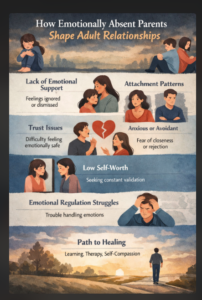
How Emotionally Absent Parents Shape Adult Relationships

Emotional basis of the life of a person is the relationships between parents and children. Although the parents can offer physical attention like food, shelter and protection, the presence of emotional attention is vital in a healthy psychological growth. The children rely on caregivers to make them perceive and cope with their feelings, to teach them that they are not alone in their emotions, and that they feel safe and accepted.

Emotional absence does not necessarily imply apparent and unintentional neglect. Parents can be physically in the presence, accountable and affectionate, but detached emotionally or unwilling to assist a child with his or her emotional demands. They can place more emphasis on discipline, duties or performance and in the process forget about the emotional attachment. This is sometimes due to their stress levels, upbringing or due to emotional constraints.

Children raised with the lack of emotional support, tend to adapt to this by either repressing their emotions, or develop an over-interest in seeking approval. These childhood experiences may influence how they will conceptualise love, trust and relationships in their adulthood, and at times, grow up making emotional closeness to be perplexing or hard to sustain.

What Emotional Absence Looks Like

Parents who lack emotional presence will find it difficult to justify or give attention to the emotions of their child. The emotional experiences that the child undergoes may be eluded, avoided or misconstrued. Parents can emphasise on either discipline, achievement in school, or physical care giving and end up neglecting emotional attachment. With time, the children can start perceiving that their feelings are not important or become heavy, a fact that renders them incapable of grasping and expressing feelings in adulthood.

Common Signs of Emotional Absence

• Emotional Dismissal
Parents may minimise or ignore a child’s feelings by saying things like “Stop crying,” “You are overreacting,” or “It’s not a big deal.” This can make children feel invalidated and hesitant to share emotions.

• Limited Emotional Communication
There may be little space for open conversations about feelings. Children may not receive guidance on how to name, express, or manage their emotions.

• Overemphasis on Achievement or Behaviour
Some parents focus mainly on performance, discipline, or responsibilities, while emotional connection and reassurance receive less attention.

• Lack of Affection or Emotional Warmth
Parents may provide practical support but struggle to show affection, comfort, or empathy during emotional distress.

In other families, there can be discouragement of any expression of emotions. Children can be taught that it is not safe, weak, and or unnecessary to share feelings. Consequently, they can either repress emotions or have difficulties in relationships of being vulnerable. Other people may have parents who were stressed out, mentally challenged, or they had not resolved their own trauma. Such parents might not purposefully close their eyes to the feelings of their children but their personal challenges might restrict them to offer them regular emotional presence.

The Impact on Emotional Development

Children naturally rely on caregivers to acquire knowledge about understanding, expression and regulation of emotion. As a result of everyday socialisation, children can see how adults react to emotions, which can be fear, sadness, anger, or joy. When the caregivers are patient, comforting, and guiding, the children will learn slowly that it is safe to have emotions and express them. Nevertheless, in cases where emotional support is inconsistent or non-existent, children tend to adjust to be able to stay linked with caregivers.

Other children have a way of coping by holding down their feelings, getting trained to conceal sadness, fear or disappointment so that they are not rejected or criticised. Others can be too independent, and since they do not feel safe or effective to seek comfort, they end up taking up problems by themselves. Other children become highly approval seeking because they feel that they have to win the affection and the interest of others by good behaviour, achievements or obeying the expectations at all times.

These coping mechanisms may end up being deeply rooted emotional patterns over time. Individuals can have difficulty identifying or prioritising their emotional needs as adults. They can struggle to request help, establish limits, and be vulnerable in relationships. On the one hand, they can be not comfortable relying on other people, and on the other hand, they can be too dependent on external validation. These dynamics are frequently acquired as defence mechanisms during the childhood stage but may determine subsequent emotional attachment and relationship satisfaction.

Attachment Patterns and Adult Relationships

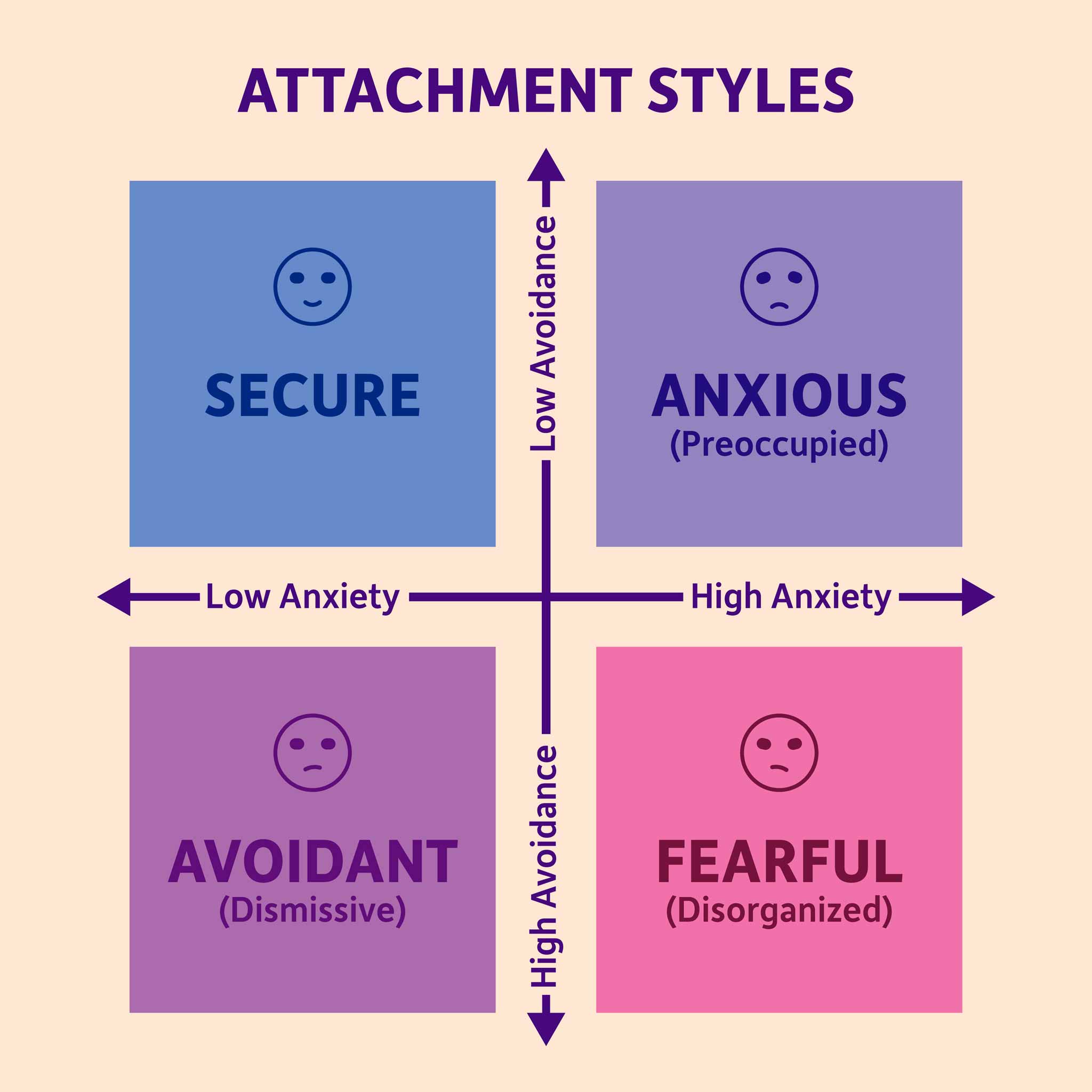
Attachment styles are highly determined by the emotional experiences in early childhood and they define the way people develop and sustain relationships in adulthood. With emotionally sensitive and stable caregivers, the children tend to feel secure within relationships. Nevertheless, the children brought up by parents with low emotional availability can acquire insecure attachments like anxious, avoidant, or fearful attachments. These patterns tend to demonstrate how children learnt to deal with the lack of emotional consistency or distance.

Types of Insecure Attachment Patterns

• Anxious Attachment

Individuals with anxious attachment often seek closeness but carry a strong fear of abandonment.

Common characteristics:

  • Constant need for reassurance and validation
  • Sensitivity to rejection or emotional distance
  • Overthinking partner’s behaviour or communication
  • Fear of being left or replaced
  • Difficulty feeling secure even in stable relationships

• Avoidant Attachment

Individuals with avoidant attachment tend to value independence and may feel uncomfortable with emotional intimacy.

Common characteristics:

  • Difficulty expressing emotions or vulnerability
  • Preference for emotional distance and self-reliance
  • Feeling overwhelmed when relationships become emotionally close
  • Avoiding deep emotional conversations or conflicts
  • Struggling to depend on others for support

• Fearful (Disorganised) Attachment

Some individuals develop a mixed pattern where they desire emotional closeness but also fear it.

Common characteristics:

  • Strong desire for connection combined with fear of getting hurt
  • Alternating between seeking closeness and withdrawing
  • Difficulty trusting others emotionally
  • Feeling confused or conflicted in relationships
  • Experiencing intense emotional highs and lows

They are not personality defects but rather emotionally adjusted strategies that have been formed because of the early attachment experiences. Through emotional sensitivity, positive relationships, and at times therapeutic support, people will be able to slowly build more secure and stable pattern of relationships.

Difficulty Trusting Emotional Safety

Those who have not been able to receive emotional needs in their childhood years might find it hard to consider relationships as a source of true safety and stability. Devoid of early emotional assurances, trust and solace, they might be brought up uncertain of having to rely on others. Therefore, they might become attracted to emotionally unavailable partners since such a relationship pattern is well known to them even when it hurts or is not satisfying.

How This Pattern May Appear in Adult Relationships

• Attraction to Emotional Unavailability
Individuals may feel drawn to partners who are distant, inconsistent, or difficult to connect with emotionally because this pattern feels familiar and emotionally recognisable.

• Difficulty Trusting Stability
When relationships are calm, consistent, and emotionally safe, individuals may feel unsure or uncomfortable because they are not used to experiencing steady emotional support.

• Fear of Vulnerability
Emotional openness may feel risky or overwhelming. Individuals may struggle to express needs or feelings due to fear of rejection or emotional disappointment.

• Confusing Intensity with Connection
Emotionally unstable or unpredictable relationships can feel intense and emotionally stimulating, which may sometimes be mistaken for deep love or passion.

The relationships that are healthy, that is, emotionally open, consistent, and supportive, might be initially alien. With time, emotional sensitivity, and positive experiences, one can learn to interpret emotional safety as a state of comfort and not discomfort, which leads to the development of healthier and more stable relationships.

Struggles With Self-Worth and Validation

The lack of emotional parenting may have a great impact on self-esteem. Children who are raised in the lack of the emotional confirmation can start wondering about their value or feeling that their emotions are too intense or uninsignificant. When emotional needs are not addressed over an extended period of time, the children tend to believe that they have to transform themselves to be accepted or loved. These attitudes may persist into adulthood and influence the way people perceive themselves and relationship.

How Self-Esteem May Be Affected

• Seeking External Validation
Adults may depend heavily on partners or others for reassurance and approval to feel valued or secure.

• Over-Prioritising Relationships
Individuals may place others’ needs above their own, believing maintaining the relationship is more important than personal well-being.

• Fear of Rejection or Conflict
Expressing personal needs or disagreements may feel threatening, leading individuals to avoid confrontation even when they feel hurt or uncomfortable.

• Difficulty Setting Boundaries
Some individuals may struggle to say no, express limits, or protect their emotional space due to fear of losing connection or approval.

These are tendencies that are commonly formed during childhood as defence mechanisms. Through awareness, self-reflection, and positive relationships, the user can progressively develop better self-esteem, know how to appreciate their needs (emotional), and grow confident in establish respectful boundaries.

Emotional Regulation Challenges

It is the responsibility of the parent to teach the child the way to read and handle emotions. With help of the supportive and responsive interactions children learn how to cope with stress, how to deal with disappointments and how to express feelings in a healthy manner. Lacking regular emotional counselling, people will have difficulty controlling emotions in stressful or conflict situations or even relationship difficulties. They can have strong emotional responses of anger, nervousness or depression. Sometimes they can become emotionally numb and are unable to identify or relate to their emotions.

How Emotional Regulation Difficulties May Appear

• Strong Emotional Reactions
Individuals may feel overwhelmed during disagreements or stressful situations and struggle to calm themselves.

• Emotional Suppression or Numbness
Some may avoid or disconnect from their feelings as a way to protect themselves from emotional discomfort.

• Difficulty Expressing Feelings Clearly
They may struggle to communicate emotional needs or may express emotions in ways that are misunderstood by others.

• Challenges in Conflict Resolution
Emotional overwhelm or avoidance can make it difficult to manage disagreements in a calm and constructive way.

Such issues have the potential to affect communication, emotional intimacy, and trust in adult relations. Through emotional awareness, conducive conditions, and even treatment support, people can eventually acquire better means of learning how to perceive, express, and control their emotions.

The Possibility of Healing

Even though early emotional absence may have an effect on relationship patterns, these patterns are not incurable. The emotional development of humans is not rigid and individuals can acquire other forms of cognizing and experiencing relationships in the course of life. The awareness is the first step of healing. As soon as people start to realise the influence of childhood experiences on their emotional reactions, they become capable of making their relationship decisions to be more conscious and healthy.

Steps That Support Healing

• Developing Emotional Awareness
Learning to recognise, name, and understand personal emotions helps individuals respond to feelings rather than suppress or avoid them.

• Practicing Vulnerability
Gradually learning to express thoughts, fears, and emotional needs can help build deeper and more authentic relationships.

• Building Supportive Relationships
Connecting with emotionally safe and understanding people helps create new experiences of trust and stability.

• Seeking Professional Support
Counselling or therapy can provide guidance in understanding attachment patterns, emotional regulation, and self-worth.

Eventually, one might start to realise that his or her emotional needs are legitimate, and they require to be addressed. Through patience and positive experience, they will be able to build a relationship that is safe, respectful, and emotionally satisfying.

A Compassionate Perspective

Parents who are emotionally absent are not necessarily always bad on purpose. Most parents bring up children with their own emotional baggage, stress or unresolved experiences which, to some extent, influence their capacity to offer regular emotional support. Such knowledge does not imply the lack of attention to the role of emotional absence but can assist people in processing their childhood issues with more distinctness, stability, and self-pity than resentment.

The understanding that the childhood emotional environments determine relationships in adulthood provides a chance to change. Once people know about these patterns, they are able to start interrupting their unhealthy emotional patterns and start to build new and healthier patterns of relating to others. Through awareness, support, and emotional development, individuals will be able to create relationships founded on safety, respect and understanding, not only providing more healthy relationships themselves, but also providing more emotionally secure surroundings to their future generations.

Frequently Asked Questions (FAQ)

1. What is the meaning of emotionally absent parenting?

Emotionally absent parenting is a condition where parents are able to provide physical needs yet fail to address emotional needs of a child like validation, comfort and emotional support.

2. Do emotionally absent parents love their children?

Yes. Numerous parents who lack emotions in their lives love their children and cannot express their feelings because of stress, upbringing, and personal issues that are hard to overcome.

3. What are the impacts of emotional absence on the development of a child?

It may have an influence on emotional regulation, self-esteem, attachment patterns, and the capability of establishing emotionally safe relationships in adulthood.

4. Which attachment theories are associated with emotional absence?

The absence of emotion can be linked to anxious, avoidant, or fearful (disorganised) attachment styles.

5. Why are emotionally absent parents a problem with intimacy among adults?

Emotional intimacy can be strange or dangerous to them since they have not experienced emotional reassurance throughout their upbringing.

6. Do emotionally absent parents have an influence on self-esteem?

Yes. A child that lacks emotional validation can mature up questioning his/her value or believing that his/her feelings are irrelevant.

7. What is the reason why others become enticed to emotionally unavailable partners?

There is a tendency of people to become attracted to patterns of emotions they were familiar with in childhood, and they may be unhealthy.

8. Is it possible to be emotionally neglected without being intentional?

Yes. Emotional neglect can be very common when parents are stressed, traumatised or suffer mental issues instead of intentionally causing harm.

9. What is the influence of emotional absence on emotional regulation?

People can have problems of coping with stress, emotional expression, and relationship conflict management.

10. What are emotional neglect symptoms as a child?

Symptoms typical of this type are a sense that they are not listened to, that they are not able to express their feelings, fear of being vulnerable, and the need to be liked all the time.

11. Is it possible to recover emotionally when one was neglected?

Yes. Through awareness, empathetic relationships and in some cases professional counselling, one can come up with a more healthy pattern of emotions.

12. What is the role of therapy in people with emotionally absent parents?

Therapy makes people realise the ways they are attached to other people, enhance their emotional control, develop positive self-perception, and have better relationship behaviours.

13. Does the emotionally absentee parenting influence future parenting styles?

Yes. Others might have a habit of repeating emotional patterns unconsciously whereas others might make an effort to be emotionally available to their children.

14. What should one do to develop safe relationships after being neglected emotionally?

Through the creation of emotional awareness, vulnerability, boundary creation, and the creation of a relationship founded on trust and consistency.

15. Why is it significant to know childhood emotional experiences?

The knowledge of the early emotional experiences enables people to identify patterns, disrupt dysfunctional cycles, and establish more positive relationships in the adult stage.

Written by Baishakhi Das

Counselor | Mental Health Practitioner
B.Sc, M.Sc, PG Diploma in Counseling


Reference

  1. Bowlby, J. (1988). A Secure Base: Parent-Child Attachment and Healthy Human Development.

  2. Ainsworth, M. D. S. (1979). Infant-Mother Attachment. American Psychologist.

  3. Siegel, D. J. (2012). The Developing Mind: How Relationships and the Brain Interact to Shape Who We Are.

  4. Perry, B. D., & Szalavitz, M. (2017). The Boy Who Was Raised as a Dog.

  5. Schore, A. N. (2003). Affect Regulation and the Repair of the Self.

  6. American Psychological Association – Emotional Neglect & Attachment Research
    https://www.apa.org

  7. National Child Traumatic Stress Network – Emotional Neglect Resources
    https://www.nctsn.org

  8. Differences between Love and Trauma Bond

This topic performs well due to rising searches around men’s mental health, workplace stress, and burnout recovery. Combining emotional insight with practical steps increases engagement and trust.

Why You Feel Safe With Someone but Still Fear Commitment

You feel calm around them.
You are softening your body, not holding it together.
Your nervous system does not over drive.
You do not have to act like you are yourself, you do not have to pretend, do not have to think carefully before saying the words so as to remain accepted.

The relationship is easy. Silence doesn’t feel awkward. Presence feels grounding.

And yet, as the relationship is flowing in the direction of commitment: labels, future planning, emotional permanence, there is a feeling deep within you that is pulling away. Not in a dramatic but in a timorous way. A tightening in the chest. A sudden urge for distance. An idea which is incompletely elaborable: I need space.

This internal conflict is even very perplexing.

Whom can be so safe, and, at the same time, so frightening?

The fact is that such experience is much more widespread than one may care to admit- and has little to do with not liking a person enough, inability to get emotionally involved, lack of depth. It is so frequently the nervous system reacting to a history that it remembers in some way.

Being relaxed around a person is a means that your body is confident in the moment.
Being afraid of commitment is that your body would be in doubt of what would happen in case the moment turns permanent.

To most people, intimacy with time has been succeeded by some form of loss, disappointment or emotional hurts. And as a relationship begins to grow into anything more, the system that had been protecting you takes action once again and slowly drags you back, not to destroy love, but to save you the pain that this system had learned to fear.

It’s not a lack of desire.
A protective pause.

And knowing that difference has the power of transforming your image of yourself and your relationships completely.

Safety and Commitment Are Not the Same to the Nervous System

To feel safe with a person it is as though your body is not under imminent danger. Your muscles are being relaxed, your breath is being huffed up, your nervous system is calmed down to the present moment. One does not have to be on watch, to look around and guard against possible emotional attack.

To be afraid of being committed, though, usually implies that your nervous system has learned to perceive intimacy over the years as a threat. It is not that it is wrong today, but the history of your body has demonstrated to you that whatever is safe today might turn painful later. The promise of sustainability, addiction and emotional vulnerability- and in the case of a trauma-forming nervous system, the promise can cause fear.

To most individuals and most especially to the ones with relational trauma, safety lies in the present. The present seems to be manageable. But dedication is to the future and the future is to remember loss, abandonment, emotional uncertainty or betrayal. And you may say in your head, This man is good. this is well, says your body, What happens when you are fixed?

This is why fear may also manifest itself in safe, loving relationships. It is not about the individual opposite you, it is a record of what has been locked up under the conscious mind.

The mind is forgetful of what your body will recall.
And it is not responding to logic, but to the habits of surviving that it had learnt long before.

When Safety Was Once Conditional

In case your background was such that love was not always there, conditional, emotionally intermittent, or was followed by abandonment, criticism, or neglect, your nervous system was taught a valuable lesson that connection was not to be trusted.

It had also learned that without warning one could have love taken away.
Pain may come after that intimacy.
Clinging was to be at risk of loss or hurt of feeling.

So your body adapted. It aroused the alertness, self-defensive and suspiciousness towards protracted intimacy. Although love may be good at that time, your nervous system will remain on alert of what is yet to happen. It is not pessimism it is experience-conditioned survival intelligence.

This may manifest itself in form of being safe with someone as an adult but not able to commit fully. Your head might desire intimacy, but your body is recalling the moment when love was something that had its consequences. To cause a distance, or hesitation, or doubt,–not to destroy happiness, but in order that a sort of hurt familiarity might be averted.

What you previously used to survive with, now presents itself as fear.
And knowing this is the initial healing of it.

Connection is good–but never lasts.

Thus, when a relationship begins to become more serious, the body is ready to be hit- even in case the individual is gentle.

This isn’t self-sabotage.
It is self-defense through experience.

Fear of Commitment Is Often Fear of Loss

It is not the fear of commitment that many people have.
They are afraid of commitment as it used to be.

They are afraid of relying on someone and be betrayed when that support runs out.
They are afraid to open up to others only to find themselves abandoned after they are completely observed.
They are afraid of losing their independence, reducing their demands, scopes or selfhood in order to preserve a relationship.
They are afraid of repeating some emotional trauma they had endured in the past without knowing it.

Commitment requires a faith in the continuity: the faith that care will be there, that relationship will no longer break down, that affection will be drawn away when it is most needed. Trauma disrupts this belief. It reminds the nervous system that nothing is ever to be expected particularly people.

Even in the safe, stable, and gentle relationships, the nervous system can remain sensitive. It does not respond to reassurances as such, but it responds to regularities acquired with time. And with devotion comes the murmuring question, the accustomed, a reassuring question:

What happens in the case I become attached and it gets hurty again?

This question does not indicate the rejection of love.
It is a resonance of a wound that is not yet healed that this may be the case.

Emotional Safety Can Feel Boring to a Trauma-Wired Brain

When disorder was a natural part of childhood, order may be alien even disturbing.

And once your early relationships were characterized by uncertainty, emotional ups and downs or continuous tension, what your brain came to know was intensity as connection. Love was emphatic, desperate, or emotional. Adrenaline, anxiety and hypervigilance turned accordingly to be attachment signals.

Stability, however, lacked an explicit point of reference. In case a relationship seems stable, dignified, and emotionally secure, your nervous system might not and cannot respond as it used to learn about love. It has the comfort, but not the hurry. Safety, but not the spike.

This discongruence might produce guilt and framing doubt:
Why should I be drawing out of a person who does me well?
“What’s wrong with me?”

Nothing is wrong with you.

The lack of disorder does not imply the lack of contact. It is an experience of novelty to your nervous system. It is the education that love does not need to be passionate so that it is real, and that being quiet does not mean being dangerous or dull.

It is not an absence of love, it is just a nervous system getting used to a new language, the language where there is peace instead of survival, safety instead of fear.

Commitment Means Being Seen Long-Term

Dedication does not consist of picking a person.
It is being comfortable to be known- day in day out, in depth, and with time.

This type of intimacy is intensely revealing to those who have been conditioned to survive by remaining emotionally closed/low maintenance or by not having needs. Being seen in their entirety may become a danger instead of a relief when your safety previously relied on not demanding much, not occupying space, and not being dependent.

Independence in such situations was not a personality characteristic, it was defense. The needs were reduced to prevent disappointment. All the emotions were kept private to avoid repulsion. When commitment is the call to collective vulnerability, emotional dependence, long-lasting presence, then the nervous system will rebel.

Safety now seems manageable. You can appear, unite, love and then withdraw back into you. However, having your vulnerabilities, gaps, and needs noticed over time can be horrifying. It implies remaining open without knowing the consistency with which you will be received.

This is not the fear of not wanting to be close.
It is the part of knowing, of knowledge, learning to know that being well-known does not necessarily mean being wounded.

Healing Isn’t Forcing Yourself to Commit

Healing does not involve forced relationships; it does not involve committed relationships just to show that you are growing. Stress can only inform the nervous system that intimacy entails submergence.

Healing is knowing your styles of attachment- not judging them as being dysfunctional but realizing that they were your survival mechanisms in the past. It is to hear with interest rather than pounce judgment on fear and letting it tell you everything without giving it the last word.

It implies training to be able to tolerate proximity over time: remaining longer, revealing more, noticing that it is possible to feel safe without needing to withdraw. This is not a rush process, since trust is developed by repetitions of consistency.

Most of all, the healing is in establishing security within yourself and not solely putting the responsibility of security on any other human being. When you discover how to self-calm, establish limits and respect your pace, relationships cease to be a challenge to your sense of self-sufficiency.

There is no need to hurry to make a commitment to show that you are healed.
The process of healing involves the choice of your own pace.

You Are Not Broken for Wanting Safety and Space

It is possible to care about a person and have time.
Can be safe and be scared at the same time.
You might desire to love so much, but you are not prepared to commit it.

These experiences are not contradictions–they are indications. They are the manifestations of a nervous system striving to adjust the desire to connect with a conditioned necessity to protect.

The fear of commitment is not something bad or wrong. It’s information. It narrates an account of how propinquity once charged you and how your flesh remains to protect against. This fear does not necessarily have to turn into avoidance as long as it is approached with compassion rather than judgment, both towards yourself, and towards others. It can soften.

Fear starts to slip its knots with time, patience, comprehension, and repeated experiences of safety. Not a single time, but gradually, in the ways that are bearable and natural.

Since it is not about forcing yourself to be there and going beyond your capabilities.
The idea is to train your nervous system to relax, every time, it is possible to remain safe.

Frequently Asked Questions (FAQ)

1. Am I emotionally safe enough to be afraid of commitment?

Yes. Present moment emotional safety and fear of long term attachment may coincide particularly when the nervous system links long term proximity to previous pain.

2. Does commitment phobia imply that I do not love the individual enough?

No. The fear to commit is usually based on self-defense, rather than on absence of love or interest.

3. Are attachment styles connected with fear of commitment?

Yes. It is typically linked to avoidant or fearful-avoidant attachment patterns that were developed in the early relationships.

4. Why will commitment cause anxiety even in healthy relationships?

Since commitment is a form of future vulnerability, dependency, and emotional exposure, which can be marked off as unsafe by trauma.

5. Does childhood experience influence adult commitment phobias?

Absolutely. The inconsistency, conditional, or unpredictable caregiving has a significant effect on the response of the nervous system to proximity in adulthood.

6. Why is it so that calm is even dull or even uncomfortable?

When chaos was a childhood way of life then the brain can equate intensity with love and confuse stillness with emotional distance or danger.

7. Does this mean that they are emotionally unavailable?

Not necessarily. Most individuals afraid of commitment are emotionally rich and loving but apprehensive because of the wounds in relationships in the past.

8. Is there something that can be done to overcome fear of commitment?

Yes. Fear can be managed by using trauma-informed therapy, attachment-based therapy, and somatic approaches to establish relational safety.

9. Am I obliged to make myself get over the fear?

No. Coerced commitment may cause more distress of the nervous system. The healing process occurs through consensual intimacy.

10. What do I do when I am not sure that my fear is intuitition or trauma?

The emotion of intuition is so peaceful and serene; the fear caused by trauma is so pressing, disorienting, and connected to the past and not to the facts on the ground.

11. Is fears of commitment manifested strictly after relationships get serious?

Yes. Most find it okay to date casually but find it tricky when emotional permanence or planning of future is introduced.

12. Does it require space so that I will never be able to commit?

No. Requirement of space usually implies that your system is self-regulating. Safety and awareness can make capacity to commit increase.

13. Is it possible that a supportive partner would help decrease this fear?

Yes–but the partner cannot be depended upon alone in the work. In-house safety and self-regulation are a necessity.

14. Is commitment phobia here to stay?

No. It is an acquired reaction, not a personality. As a person heals, the nervous system is able to adapt.

15. What is the purpose of mending the fear to commit?

Not being overbearing to remain, but teaching your nervous system to allow intimacy to be safe with time.

Written by Baishakhi Das

Counselor | Mental Health Practitioner
B.Sc, M.Sc, PG Diploma in Counseling


References 

Attached – Amir Levine & Rachel Heller
https://www.attachedbook.com

  1. The Body Keeps the Score – Dr. Bessel van der Kolk
    https://www.besselvanderkolk.com/resources

  2. Polyvagal Theory – Dr. Stephen Porges
    https://www.polyvagalinstitute.org

  3. Adult Attachment Theory – Psychology Today
    https://www.psychologytoday.com/us/basics/attachment

  4. Trauma and the Nervous System – NICABM
    https://www.nicabm.com

  5. Somatic Experiencing – Peter A. Levine
    https://traumahealing.org

  6. Why You Feel Guilty for Resting

This topic performs well due to rising searches around men’s mental health, workplace stress, and burnout recovery. Combining emotional insight with practical steps increases engagement and trust.

Triangular Theory of Love – Robert Sternberg

https://s3.amazonaws.com/microsite-cuny-prod/media/courseware/openstax/m49134/CNX_Psych_12_07_love.jpg

The Triangular Theory of Love, proposed by Robert Sternberg, is one of the most influential psychological models for understanding romantic relationships because it explains love as a multidimensional and dynamic experience, rather than a single feeling. Sternberg argued that love develops through the interaction of three fundamental psychological components—Intimacy, Passion, and Commitment—each contributing in a unique way to how individuals experience and sustain relationships.

According to this theory, different relationships contain these components in varying degrees, and it is the balance or imbalance among them that determines both the type of love (such as romantic, companionate, or consummate love) and the overall quality and stability of the relationship. For example, a relationship high in passion but low in commitment may feel intense yet unstable, while one rich in intimacy and commitment may feel emotionally secure but less exciting.

Importantly, Sternberg emphasized that love is not static. The proportions of intimacy, passion, and commitment often change over time due to life circumstances, personal growth, stress, or relational challenges. Healthy and satisfying relationships usually require conscious effort to nurture all three components, making love not just something that happens, but something that is actively maintained through emotional connection, physical closeness, and deliberate choice.

The Three Components of Love

According to the Triangular Theory of Love proposed by Robert Sternberg, love is built from three interrelated components—Intimacy, Passion, and Commitment. Each component represents a different psychological process, and together they shape how love is experienced and expressed within a relationship.

1. Intimacy

Intimacy refers to emotional closeness, bonding, and a sense of connectedness between partners. It forms the emotional foundation of love and is associated with feelings of trust, care, understanding, and mutual respect. Intimacy allows individuals to feel emotionally safe and accepted for who they truly are.

This component develops gradually through shared experiences, honest communication, empathy, and emotional vulnerability. When intimacy is strong, partners are able to support each other emotionally, validate each other’s feelings, and maintain a deep sense of companionship.

Examples of intimacy include:

  • Feeling genuinely understood and emotionally validated by your partner
  • Sharing personal fears, dreams, insecurities, and life goals
  • Experiencing emotional safety, comfort, and reassurance in the relationship

2. Passion

Passion involves physical attraction, sexual desire, and intense emotional arousal. It is often the most noticeable component during the early stages of romantic relationships and is closely linked to physiological arousal and excitement. Passion is driven by biological and motivational forces and is associated with romance, desire, and longing for physical closeness.

Although passion can be intense and exhilarating, it is also the most fluctuating component of love. Over time, passion may decrease or transform, especially as novelty fades or daily responsibilities increase. However, it can be rekindled through emotional connection, novelty, and intentional effort.

Examples of passion include:

  • Strong physical and sexual attraction
  • Romantic excitement and longing for the partner
  • Desire for physical closeness, touch, and affection

3. Commitment

Commitment is the cognitive and conscious decision to love someone and to maintain that love over time. Unlike intimacy and passion, which are largely emotional, commitment is primarily a decision-making process. It reflects responsibility, loyalty, and the willingness to sustain the relationship even during difficult periods.

Sternberg described commitment as having two dimensions:

  • Short-term commitment: the decision that one loves another person
  • Long-term commitment: the decision to stay with that person and build a shared future despite challenges, conflicts, or changes

Commitment provides stability and predictability in relationships and is especially important for long-term partnerships.

Examples of commitment include:

  • Choosing to stay together during stressful or challenging phases
  • Making plans for a shared future (marriage, family, long-term goals)
  • Demonstrating loyalty, responsibility, and dedication to the relationship

Together, intimacy nurtures emotional closeness, passion fuels attraction and desire, and commitment sustains the relationship over time. The unique balance among these three components determines not only the type of love experienced but also the depth, satisfaction, and longevity of the relationship.

Types of Love According to Sternberg

According to the Triangular Theory of Love proposed by Robert Sternberg, different combinations of intimacy, passion, and commitment give rise to seven distinct types of love. These types help explain why relationships can feel emotionally fulfilling, exciting, stable—or sometimes incomplete. Each form of love reflects a particular balance of the three components.

1. Liking (Intimacy only)

Liking is characterized by emotional closeness and mutual understanding without physical passion or long-term commitment. Individuals feel connected, comfortable, and emotionally supported, but there is no romantic or sexual involvement.

  • A strong emotional bond without passion or commitment
  • Common in close friendships and platonic relationships

2. Infatuation (Passion only)

Infatuation involves intense physical attraction and emotional arousal without deeper emotional connection or commitment. It often appears suddenly and may fade quickly if not supported by intimacy or commitment.

  • Intense attraction without emotional closeness or commitment
  • Often described as “love at first sight”

3. Empty Love (Commitment only)

Empty love exists when commitment remains, but intimacy and passion are absent. Partners may stay together due to social pressure, obligation, or habit rather than emotional connection.

  • Commitment without intimacy or passion
  • Seen in stagnant long-term relationships or emotionally disconnected arranged marriages

4. Romantic Love (Intimacy + Passion)

Romantic love combines emotional closeness with physical attraction. While the bond is deep and emotionally fulfilling, it may lack long-term commitment, making it vulnerable to instability.

  • Emotional closeness combined with physical attraction
  • Typical in early stages of romantic relationships

5. Companionate Love (Intimacy + Commitment)

Companionate love involves deep emotional intimacy and a strong sense of commitment, but passion may be reduced or absent. It reflects warmth, trust, and long-term partnership.

  • Deep emotional bond and long-term commitment
  • Common in long-term marriages and enduring relationships

6. Fatuous Love (Passion + Commitment)

Fatuous love arises when commitment is made quickly on the basis of passion alone, without sufficient emotional intimacy. Such relationships may feel intense but are often unstable.

  • Commitment driven mainly by passion
  • Common in impulsive or rushed relationships

7. Consummate Love (Intimacy + Passion + Commitment)

Consummate love is the most complete and balanced form of love, incorporating all three components. It represents emotional closeness, physical attraction, and long-term dedication.

  • The ideal and complete form of love
  • Difficult to achieve and even harder to maintain over time

These seven types illustrate that love exists on a continuum rather than as a single fixed experience. Relationships may shift from one type to another as intimacy, passion, and commitment grow or decline, highlighting the dynamic nature of love across the lifespan.

Love as a Dynamic Process

Robert Sternberg emphasized that love is not static or fixed, but a dynamic psychological process that changes across time and life circumstances. As individuals grow, face stressors, or transition through different relationship stages, the three components of love—intimacy, passion, and commitment—often shift in intensity.

  • Passion may decrease as novelty fades and routine sets in, especially in long-term relationships.
  • Intimacy can deepen through shared experiences, emotional disclosure, and mutual support over time.
  • Commitment may strengthen or weaken depending on relationship satisfaction, external pressures, and personal values.

Healthy and satisfying relationships require active and ongoing effort to rebalance these components. This includes open communication, emotional attunement, empathy, conflict resolution, and the creation of shared meaning and goals. Love, in this sense, is not just a feeling but a continuous practice.

Importance in Counseling and Mental Health

The Triangular Theory of Love is widely applied in clinical and applied settings, particularly in:

  • Couple counseling
  • Marriage and family therapy
  • Relationship assessment and evaluation
  • Psychoeducation and premarital counseling

For mental health professionals, this model offers a clear framework to help clients:

  • Understand sources of relationship dissatisfaction
  • Identify missing or imbalanced components of love
  • Set realistic expectations about romantic relationships
  • Improve emotional insight and relational awareness

By mapping relationship concerns onto intimacy, passion, and commitment, therapists can guide couples toward targeted interventions rather than vague problem-solving.

Criticism and Limitations

Despite its wide influence and practical value, the Triangular Theory of Love has certain limitations:

  • Cultural differences in defining and expressing love are not fully addressed
  • Love experiences may not always fit neatly into fixed categories
  • Emotional experiences often overlap, fluctuate rapidly, and resist classification

Nevertheless, the model remains clinically relevant and practically useful, especially as a psychoeducational tool. Its simplicity, flexibility, and applicability make it a valuable guide for understanding romantic relationships across different stages of life.

Conclusion

The Triangular Theory of Love offers a clear, structured, and psychologically grounded framework for understanding the complexity of romantic relationships. By recognizing the distinct yet interconnected roles of intimacy, passion, and commitment, individuals and couples can better understand how love is formed, maintained, and transformed over time. This perspective highlights that love is not merely an emotion but a dynamic interaction of feelings, motivations, and conscious decisions.

Awareness of these components allows people to identify strengths and gaps within their relationships, make sense of relational dissatisfaction, and set more realistic expectations of themselves and their partners. For couples, it provides a roadmap for nurturing emotional closeness, sustaining attraction, and strengthening long-term dedication. Ultimately, the Triangular Theory of Love encourages a more balanced, intentional, and emotionally healthy approach to building and sustaining meaningful romantic connections.

Frequently Asked Questions (FAQ) – Triangular Theory of Love

1. What is the Triangular Theory of Love?

The Triangular Theory of Love is a psychological model proposed by Robert Sternberg that explains love as a combination of intimacy, passion, and commitment.

2. Why is it called a “triangular” theory?

It is called triangular because love is conceptualized as having three components, represented as the three sides of a triangle. Different combinations form different types of love.

3. Is consummate love the most ideal form of love?

Yes, consummate love includes all three components—intimacy, passion, and commitment—but it is difficult to achieve and requires continuous effort to maintain.

4. Can a relationship survive without passion?

Yes. Relationships based on intimacy and commitment (companionate love) often survive long-term, even if passion declines.

5. Does passion always fade over time?

Passion often decreases with time, but it can be rekindled through emotional closeness, novelty, and intentional relationship efforts.

6. What type of love is common in friendships?

Friendships usually involve liking, which is based on intimacy alone without passion or commitment.

7. Is infatuation real love?

Infatuation involves intense passion but lacks intimacy and commitment. It may feel powerful but is often short-lived if not supported by other components.

8. Can love types change over time?

Yes. Relationships are dynamic, and love can shift from one type to another as intimacy, passion, and commitment change.

9. How is this theory useful in couple counseling?

It helps therapists identify missing or imbalanced components in a relationship and design targeted interventions.

10. Is the theory applicable across cultures?

The theory is widely used, but it does not fully account for cultural variations in how love is defined and expressed.

11. What is empty love?

Empty love consists of commitment without intimacy or passion, often seen in emotionally disconnected or obligation-based relationships.

12. Can arranged marriages fit into this theory?

Yes. Some arranged marriages may begin with commitment and gradually develop intimacy and passion over time.

13. Why is commitment important in long-term relationships?

Commitment provides stability, security, and continuity, especially during conflicts or challenging life phases.

14. Is this theory supported by research?

Yes. Numerous studies in relationship psychology have supported and expanded upon Sternberg’s model.

15. What is the main takeaway from the Triangular Theory of Love?

Love is not just a feeling—it is a balance of emotional closeness, physical desire, and conscious choice, all of which require ongoing care.

Written by Baishakhi Das

Counselor | Mental Health Practitioner
B.Sc, M.Sc, PG Diploma in Counseling

Reference 

This topic performs well due to rising searches around men’s mental health, workplace stress, and burnout recovery. Combining emotional insight with practical steps increases engagement and trust.


Why You Attract Emotionally Unavailable Partners

A Deep Psychological Explanation

https://www.loveontheautismspectrum.com/wp-content/uploads/2025/08/Emotionally-Unavailable-Partner-1080x675.png
Many people ask this question with confusion, frustration, or self-blame:

“Why do I keep attracting emotionally unavailable partners?”

From a psychological perspective, this pattern is not accidental, nor is it a sign of poor judgment or low intelligence. It is usually the result of unconscious emotional learning, shaped by early attachment experiences, nervous system conditioning, and unmet emotional needs.

This article explains the pattern in depth, without blame—only awareness.

Understanding Emotional Unavailability

An emotionally unavailable partner often struggles to engage in relationships at a deeper emotional level, even if they appear caring or charming on the surface. They may avoid vulnerability and meaningful emotional conversations, steering discussions away from feelings, needs, or relational depth. During moments of conflict or emotional tension, they are likely to withdraw, shut down, or become distant, leaving issues unresolved rather than working through them together.

Affection from an emotionally unavailable partner is often inconsistent—warm and attentive at times, then suddenly distant or detached. This unpredictability can create confusion and emotional insecurity for the other person. They may also prioritize work, independence, hobbies, or external distractions over emotional intimacy, not necessarily because they value these things more, but because closeness feels overwhelming or threatening.

A common pattern is that they appear highly interested at the beginning of a relationship, when emotional demands are low and novelty is high. As intimacy deepens and emotional closeness is expected, they may begin to pull away, lose interest, or create distance, often without clear explanation.

Importantly, emotionally unavailable individuals are not always unkind, uncaring, or intentionally hurtful. In many cases, emotional unavailability is a form of self-protection. It often develops from unresolved attachment wounds, early experiences of emotional neglect, inconsistency, or relationships where closeness led to pain. To avoid vulnerability—and the risk of being hurt again—they learn to keep emotional distance, even when they desire connection.

Understanding this does not mean tolerating emotional neglect, but it helps reframe emotional unavailability as a psychological defense, not a personal rejection.

The Psychological Root: Attachment Theory

Attachment theory, developed by John Bowlby and later expanded through observational research by Mary Ainsworth, explains that our earliest emotional bonds shape how we experience love, safety, and closeness throughout life.

From infancy, human beings are biologically programmed to seek proximity to caregivers—not just for physical survival, but for emotional regulation and security. When a caregiver responds consistently and sensitively, the child’s nervous system learns that distress can be soothed through connection. When responses are inconsistent, dismissive, or frightening, the child adapts in order to preserve the relationship.

Over time, these repeated experiences form what attachment theory calls an internal working model—a deeply ingrained emotional blueprint about relationships. This model operates largely outside conscious awareness and becomes the lens through which we interpret intimacy, rejection, conflict, and emotional needs.

At its core, the internal working model answers three unconscious but powerful questions:

  • Am I worthy of love and care?
    This shapes self-worth and how much love a person believes they deserve.

  • Are others emotionally available and reliable?
    This influences trust, dependency, and expectations from partners.

  • Is closeness safe, or does it lead to pain, rejection, or loss?
    This determines comfort with intimacy versus emotional distance.

These beliefs do not remain in childhood. They quietly guide adult relationship choices, influencing whom we feel attracted to, how we respond to emotional closeness, how we handle conflict, and what we tolerate in relationships. Often, people are not drawn to what is healthiest—but to what feels emotionally familiar to their nervous system.

Understanding attachment theory helps explain why relationship patterns repeat, why certain dynamics feel irresistible despite being painful, and why emotional unavailability can feel strangely compelling. These patterns are not conscious decisions—they are learned emotional strategies, shaped early in life and carried forward until they are gently questioned and healed.

1. Familiar Pain Feels Safer Than Unknown Safety

One of the strongest psychological reasons people attract emotionally unavailable partners is emotional familiarity.

If, in childhood:

  • Love was inconsistent

  • Caregivers were emotionally distant, preoccupied, or unpredictable

  • Affection had to be earned

then emotional unavailability becomes normal, even if painful.

The nervous system learns:

“This is what love feels like.”

As adults, emotionally available partners may feel:

  • “Too boring”

  • “Too intense”

  • “Uncomfortable”

  • “Unfamiliar”

While emotionally unavailable partners feel recognizable—and familiarity is often mistaken for chemistry.

2. Anxious Attachment and the Need for Reassurance

People with anxious attachment are especially drawn to emotionally unavailable partners.

Psychologically:

  • Emotional distance activates attachment anxiety

  • The brain confuses longing with love

  • Intermittent affection increases emotional fixation

When a partner pulls away, the anxious nervous system responds with:

  • Overthinking

  • People-pleasing

  • Emotional pursuit

  • Self-doubt

This creates a pursue–withdraw cycle, where anxiety intensifies attraction rather than reducing it.

3. Trying to Heal Old Wounds Through New Relationships


As repetition compulsion—the tendency to replay unresolved emotional wounds in hopes of a different outcome.

The unconscious belief is:

“If I can make this emotionally unavailable person love me,
it will prove I am worthy.”

The relationship becomes less about the partner—and more about repairing the past.

4. Low Emotional Self-Worth (Not Low Self-Esteem)

Attraction to emotionally unavailable partners is often linked to emotional self-worth, not confidence.

You may:

  • Be successful and competent externally

  • Still feel internally unchosen or replaceable

  • Believe your needs are “too much”

  • Feel guilty for wanting consistency

Emotionally unavailable partners reinforce these beliefs—not because you deserve it, but because it matches your internal narrative.

5. Fear of True Intimacy (Often Unconscious)

Ironically, being drawn to unavailable partners can also reflect a fear of real intimacy.

Emotionally available relationships require:

  • Vulnerability

  • Being truly seen

  • Emotional accountability

  • Mutual dependence

For some, this feels unsafe.

Emotionally unavailable partners allow:

  • Distance with connection

  • Desire without deep exposure

  • Control without surrender

The relationship feels intense—but emotionally contained.

6. Trauma Bonding and Intermittent Reinforcement

Emotionally unavailable relationships often involve:

  • Hot–cold behavior

  • Inconsistent affection

  • Unpredictable closeness

Psychologically, this creates trauma bonding, where the brain becomes addicted to relief after emotional deprivation.

The cycle looks like:
Distance → Anxiety → Small reassurance → Relief → Stronger attachment

This is neurobiological conditioning, not weakness.

7. What This Pattern Is NOT

It is NOT:

  • This pattern is not a reflection of your worth
  • This pattern is shaped by emotional learning, not poor choices
  • They are responses to emotional conditioning, not failure
  • They arise from protection, not self-harm or suffering

It IS:

  • Learned emotional conditioning

  • Attachment-based attraction

  • Nervous system familiarity

How the Pattern Can Change

Attraction patterns shift when internal safety increases.

Psychological healing involves:

  • Identifying your attachment style

  • Learning to regulate emotional anxiety

  • Separating familiarity from compatibility

  • Building emotional self-worth

  • Tolerating the discomfort of healthy closeness

  • Experiencing safe, consistent relationships (including therapy)

With healing, emotionally unavailable partners stop feeling attractive—not because you force yourself to avoid them, but because your nervous system no longer recognizes them as “home.”

A Key Therapeutic Insight

You don’t attract emotionally unavailable partners because something is wrong with you.
You attract them because something familiar is asking to be healed.

Closing Reflection

Emotionally unavailable partners mirror unmet emotional needs, not personal failure. When you understand the psychology behind attraction, shame dissolves—and choice becomes possible.

Awareness is not the end of healing.
But it is always the beginning.

Frequently Asked Questions (FAQ)

1. What is attachment theory in psychology?

Attachment theory explains how early emotional bonds with caregivers shape a person’s sense of safety, love, and connection. These early experiences form patterns that continue to influence adult relationships, especially romantic ones.


2. Who developed attachment theory?

Attachment theory was developed by John Bowlby and later expanded by Mary Ainsworth, whose research identified different attachment styles based on caregiver responsiveness.


3. What is an internal working model?

An internal working model is an unconscious emotional blueprint formed in childhood that shapes beliefs about:

  • Self-worth

  • Emotional availability of others

  • Safety of closeness

It guides how individuals approach intimacy, conflict, and emotional needs in adulthood.


4. How does attachment theory affect adult relationships?

Attachment theory influences partner selection, emotional expression, fear of abandonment, comfort with intimacy, and reactions during conflict. Many adult relationship struggles reflect early attachment patterns rather than present-day problems.


5. Why do people repeat unhealthy relationship patterns?

People are often drawn to what feels emotionally familiar, even if it is painful. This familiarity comes from early attachment experiences and nervous system conditioning, not conscious choice.


6. Can attachment patterns be changed?

Yes. Attachment patterns are learned and can be reshaped through self-awareness, emotionally safe relationships, and therapeutic work. Many people develop earned secure attachment later in life.


7. How is attachment theory used in counseling?

In counseling, attachment theory helps identify relational patterns, emotional triggers, and unmet needs. The therapeutic relationship itself often becomes a corrective emotional experience.

Written by Baishakhi Das

Counselor | Mental Health Practitioner
B.Sc, M.Sc, PG Diploma in Counseling


 Reference 


Attachment Styles in Adult Relationships

A Deep Psychological Explanation with Clinical Insight

https://www.simplypsychology.org/wp-content/uploads/attachment-working-models.jpg

Attachment styles shape how we love, connect, fight, withdraw, cling, trust, and fear loss in adult relationships. Many relationship struggles are not about incompatibility—but about attachment wounds replaying themselves in adulthood.

Rooted in attachment theory, developed by John Bowlby and expanded by Mary Ainsworth, this framework explains how early emotional bonds become internal working models that guide adult intimacy.

This article explores attachment styles in depth, with a modern, relational, and counseling-oriented lens.

What Is Attachment Theory?

Attachment theory proposes that human beings are biologically wired for connection. From birth, survival depends not only on food and shelter, but on emotional closeness, protection, and responsiveness from significant others—primarily caregivers in early life.

According to attachment theory, children are constantly (and unconsciously) asking three fundamental questions through their experiences with caregivers:

  • Am I lovable and worthy of care?

  • Are others reliable and emotionally available?

  • Is closeness safe, or does it lead to pain, rejection, or loss?

The answers to these questions are not learned through words—but through repeated emotional experiences.

How Attachment Beliefs Form in Childhood

When caregivers are:

  • Emotionally responsive

  • Consistent

  • Attuned to distress

the child learns that:

  • Their needs matter

  • Emotions are safe to express

  • Relationships provide comfort

When caregivers are:

  • Inconsistent

  • Emotionally unavailable

  • Dismissive, frightening, or unpredictable

the child adapts by developing protective strategies—such as clinging, suppressing needs, or staying hyper-alert to rejection.

These adaptations are not conscious choices. They are nervous-system-level learning meant to preserve connection and survival.

Internal Working Models: The Emotional Blueprint

Over time, these early experiences form what attachment theory calls internal working models—deeply ingrained emotional templates about:

  • The self (“Who am I in relationships?”)

  • Others (“What can I expect from people?”)

  • Intimacy (“What happens when I get close?”)

These models operate automatically and shape:

  • Emotional reactions

  • Relationship expectations

  • Conflict behavior

  • Fear of abandonment or intimacy

Attachment Styles in Adulthood

As individuals grow, attachment needs do not disappear—they shift from caregivers to romantic partners, close friends, and significant relationships.

In adulthood, attachment styles become most visible when:

  • There is emotional vulnerability

  • Conflict arises

  • Distance, rejection, or loss is perceived

  • Commitment deepens

This is why romantic relationships often feel so intense—they activate early attachment memories, not just present-day experiences.

A Crucial Clarification

Attachment styles are adaptive, not pathological.
They reflect how a person learned to survive emotionally in their earliest relationships.

What once protected the child may later:

  • Create anxiety

  • Cause emotional distance

  • Lead to repeated relationship patterns

But because attachment is learned, it can also be relearned and healed—through awareness, safe relationships, and therapeutic work.

Key Insight

Attachment theory reminds us that:

Adult relationship struggles are often not about the present partner—
but about old emotional questions still seeking safer answers.

Understanding attachment theory is the first step toward breaking unconscious patterns and building emotionally secure relationships.

The Four Main Attachment Styles in Adults

Secure attachment

This style is characterized by a deep sense of inner safety in relationships. Adults with secure attachment hold the belief that they are worthy of love, that others are generally reliable, and that emotional closeness is safe rather than threatening. This style typically develops when caregivers in childhood were emotionally responsive, consistent, and available during moments of distress.

As a result, the nervous system learns to expect comfort rather than rejection in close relationships. In adulthood, securely attached individuals are comfortable with both intimacy and independence. They communicate their needs openly, regulate emotions effectively during conflict, and are able to give and receive support without losing their sense of self. One of the strongest psychological strengths of secure attachment is the ability to repair after conflict—disagreements do not threaten the bond, but are experienced as manageable and temporary.

Anxious (preoccupied) attachment

This style develops when early caregiving was inconsistent or emotionally unpredictable—sometimes nurturing, sometimes unavailable. The child learns that love is uncertain and must be closely monitored. As adults, individuals with anxious attachment often believe they may be abandoned and that reassurance is necessary to feel safe. Closeness becomes strongly associated with security, which can lead to heightened emotional sensitivity.

In relationships, this shows up as fear of abandonment, overthinking messages or tone, and a constant need for reassurance. Self-soothing is difficult, so emotional regulation often depends on the partner’s responses. Common behaviors include clinging, people-pleasing, and emotional protest such as crying, anger, or threats of leaving. Internally, anxiously attached adults often feel “too much,” emotionally dependent, and chronically insecure—even when they are loved and cared for.

Avoidant (dismissive) attachment

This style is shaped by childhood environments where caregivers were emotionally distant, dismissive of feelings, or overly critical and demanding. In such settings, the child learns that expressing needs leads to rejection or disappointment, and that self-sufficiency is the safest strategy.

Adults with avoidant attachment tend to believe they can only rely on themselves, that needing others is risky, and that closeness threatens autonomy or control. In relationships, they often feel uncomfortable with emotional intimacy and struggle to express vulnerability. They value independence highly, withdraw during conflict, and may shut down emotionally when situations become intense. Common patterns include emotional distancing, avoiding difficult conversations, minimizing personal needs, or ending relationships when intimacy deepens. Although they may appear confident and self-reliant, avoidantly attached individuals often feel overwhelmed by emotions, fearful of dependence, and uncomfortable when others rely on them.

Fearful-avoidant (disorganized) attachment

It reflects a profound inner conflict around closeness. It often develops in the context of childhood trauma, abuse, neglect, or caregiving that was both comforting and frightening. In these early experiences, the child learns that the source of safety is also a source of fear, creating deep confusion.

Adults with fearful-avoidant attachment hold contradictory beliefs: they long for closeness but experience it as dangerous, associate love with pain, and struggle to know whom to trust. In relationships, this results in intense attraction followed by sudden withdrawal, push–pull dynamics, and difficulty trusting even loving partners. Emotional volatility is common. Behaviors may include sudden shutdowns, self-sabotage, and simultaneous fear of intimacy and abandonment. Internally, these individuals experience a powerful longing for connection mixed with fear, shame, and confusion, making relationships feel both deeply desired and deeply threatening.

Together, these attachment styles explain why people respond so differently to intimacy, conflict, and emotional closeness in adult relationships—and why many relationship struggles are rooted not in the present, but in early emotional learning.


Attachment Styles in Relationship Dynamics

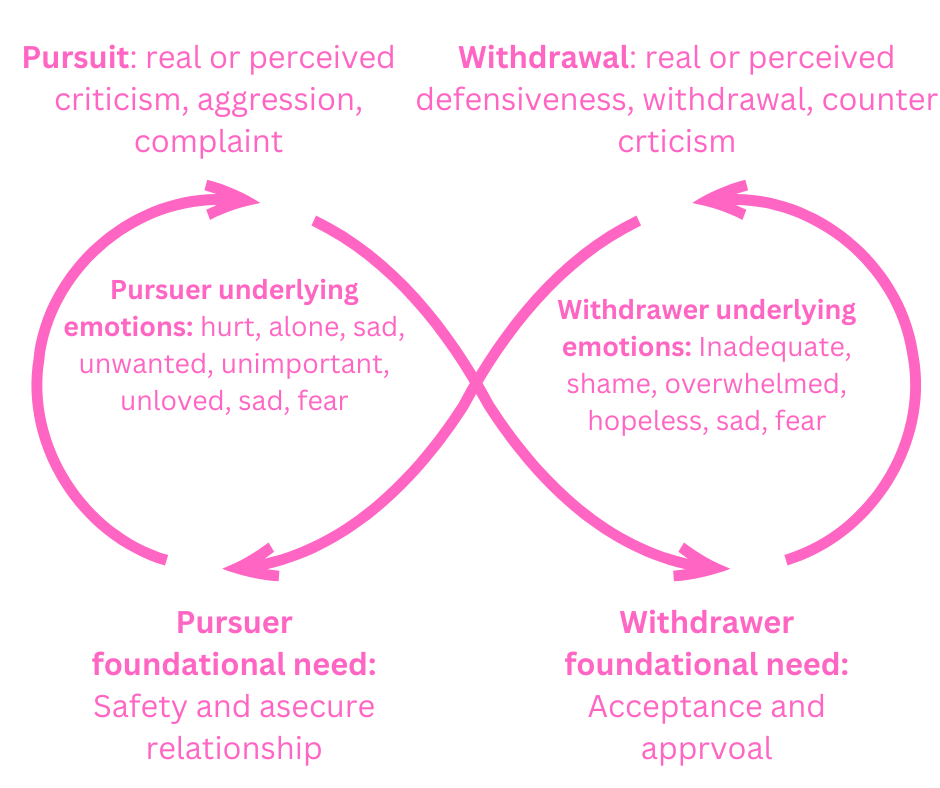
Anxious + Avoidant: The Pursue–Withdraw Cycle

  • Anxious partner seeks closeness

  • Avoidant partner withdraws

  • Anxiety increases → pursuit intensifies

  • Avoidance deepens → distance grows

This cycle feels intense and addictive—but is emotionally exhausting.

Secure + Insecure

Secure partners can offer co-regulation, but only if boundaries and awareness exist.

Attachment Styles and Mental Health

Unresolved attachment wounds often manifest as:

  • Anxiety disorders

  • Depression

  • Trauma responses

  • Emotional dysregulation

  • Codependency

  • Fear of intimacy or abandonment

Many relationship conflicts are attachment triggers, not actual relationship problems.

Can Attachment Styles Change?

Yes. Attachment styles are learned—and therefore modifiable.

Healing occurs through:

  • Emotionally safe relationships

  • Therapy (especially attachment-informed or trauma-informed)

  • Developing self-awareness

  • Learning emotional regulation

  • Corrective relational experiences

Earned secure attachment is possible—even after trauma.

Attachment Styles in Counseling Practice

In therapy, attachment work involves:

  • Identifying attachment patterns

  • Understanding emotional triggers

  • Regulating the nervous system

  • Reworking internal working models

  • Practicing safe emotional expression

The therapeutic relationship itself often becomes the first secure base.

Key Takeaway

Attachment styles explain why love can feel safe, overwhelming, distant, or terrifying.

Relationships don’t trigger us randomly.
They activate old attachment memories asking to be healed.

Understanding your attachment style is not about blame—it is about awareness, compassion, and change.

Frequently Asked Questions (FAQ)

1. What are attachment styles in adult relationships?

Attachment styles are patterns of emotional bonding formed in early childhood that influence how adults experience intimacy, trust, conflict, and emotional closeness in relationships.


2. Can attachment styles change in adulthood?

Yes. Attachment styles are learned patterns, not fixed traits. Through self-awareness, emotionally safe relationships, and therapy, individuals can develop earned secure attachment.


3. What is the most common attachment style?

Secure attachment is the healthiest but not always the most common. Many adults show anxious, avoidant, or fearful-avoidant patterns due to early relational experiences.


4. Why do anxious and avoidant partners attract each other?

Anxious and avoidant styles often form a pursue–withdraw cycle, where one seeks closeness and the other seeks distance. The pattern feels familiar at a nervous-system level, even when it is distressing.


5. How do attachment styles affect conflict in relationships?

Attachment styles shape how people respond to threat:

  • Anxious styles intensify emotions to regain closeness

  • Avoidant styles withdraw to regain control

  • Secure styles seek repair and communication


6. Is attachment theory only about romantic relationships?

No. While attachment styles are most visible in romantic relationships, they also influence friendships, family dynamics, parenting, and even therapeutic relationships.


7. How does therapy help with attachment issues?

Therapy provides a secure relational space where clients can explore emotions, regulate the nervous system, and revise internal working models through corrective emotional experiences.

Written by Baishakhi Das

Counselor | Mental Health Practitioner
B.Sc, M.Sc, PG Diploma in Counseling


Reference 

Trauma Bond vs Love: How to Tell the Difference

Understanding Attachment, Control, and Emotional Safety in Relationships

https://cdn.prod.website-files.com/61258807d2d4f9553cc9d3e6/66e33823113138397e2be541_66e33815e5ee0a673dab7370_Stages%2520of%2520Trauma%2520Bonding.webp

Introduction

Many people remain in painful relationships not because they enjoy suffering, but because the connection feels intense, familiar, and emotionally gripping. The bond may feel deeply meaningful, even when it is harmful, making it incredibly difficult to walk away. This is where confusion often arises between trauma bonding and love. Both can feel powerful and consuming, creating a strong emotional pull that is difficult to ignore. However, psychologically, they are fundamentally different experiences with very different emotional and relational outcomes.

Understanding this difference is crucial. Trauma bonds are built through cycles of pain, relief, fear, and hope, which keep individuals emotionally stuck and dependent. In contrast, love is rooted in safety, consistency, and mutual respect, allowing individuals to feel secure, valued, and supported. While trauma bonds trap people in survival mode, love encourages emotional growth, self-worth, and freedom of choice. Recognizing this distinction is often the first step toward healing and reclaiming healthy connection.

What Is a Trauma Bond?

A trauma bond is an emotional attachment formed through cycles of harm and relief, often seen in abusive, neglectful, or highly unstable relationships. The bond is strengthened not by safety, but by intermittent reinforcement—periods of pain followed by moments of affection, apology, or closeness.

Common Features of Trauma Bonds

  • Emotional highs followed by deep lows

  • Apologies after hurtful behavior

  • Fear of abandonment mixed with longing

  • Feeling “addicted” to the relationship

  • Staying despite harm, disrespect, or fear

Trauma bonds are not about love; they are about survival, attachment, and hope for relief.

What Does Healthy Love Look Like?

Healthy love is built on emotional safety, consistency, and mutual respect. While all relationships have conflict, love does not require suffering to feel real.

Core Features of Healthy Love

  • Emotional stability

  • Mutual respect and care

  • Open communication

  • Repair after conflict

  • Feeling safe being yourself

Love may feel deep, but it does not feel consuming, chaotic, or fear-driven.

Key Differences: Trauma Bond vs Love

Although trauma bonds and love can feel equally intense, they operate on very different emotional systems. Understanding these differences helps clarify whether a relationship is rooted in survival and fear or in safety and growth.

1. Intensity vs Stability

  • Trauma bond: Intense, overwhelming, emotionally dramatic

  • Love: Calm, steady, and grounding

Trauma bonds often feel stronger because the nervous system is constantly activated—moving between anxiety, hope, relief, and fear. This emotional roller coaster creates intensity that can be mistaken for passion. Love, on the other hand, feels quieter and less dramatic, but it offers emotional stability and safety. What feels less intense may actually be more secure.

2. Fear vs Safety

  • Trauma bond: Fear of losing the person, fear of conflict, fear of being alone

  • Love: Emotional safety, trust, and reassurance

In trauma bonds, fear plays a central role. You may stay because you are afraid of abandonment, loneliness, or emotional collapse. In love, there is a sense of safety—even during disagreements. If fear is the primary reason you remain in a relationship, it is likely rooted in trauma bonding rather than love.

3. Control vs Choice

  • Trauma bond: One person holds emotional power; you feel trapped or dependent

  • Love: Both partners choose each other freely

Trauma bonds often involve subtle or overt control, where one partner’s moods, approval, or presence determines your emotional state. Love is based on mutual choice, not obligation or fear. Healthy love does not rely on guilt, emotional pressure, or power imbalance to keep the relationship intact.

4. Confusion vs Clarity

  • Trauma bond: Constant self-doubt—“Is it my fault?”

  • Love: Emotional clarity and mutual understanding

Trauma bonds create confusion. You may constantly question your perceptions, blame yourself for problems, or feel unsure about where you stand. Love brings clarity. Even during conflict, you feel seen, understood, and emotionally anchored. Love helps you understand yourself better; trauma bonds make you question your worth.

5. Survival Mode vs Growth

  • Trauma bond: Focus on keeping peace, avoiding conflict, or earning love

  • Love: Growth, healing, and emotional support

In trauma bonds, much of your energy goes into survival—preventing conflict, managing the other person’s emotions, or proving your worth. Love allows space for growth. You feel supported to evolve, heal, and become more fully yourself. Love expands your world, while trauma bonds gradually shrink it.

Core Takeaway

The difference between trauma bonding and love is not how deeply you feel—but how safe, free, and whole you feel in the relationship.
Love does not require you to abandon yourself to stay connected.

Why Trauma Bonds Feel So Powerful

Trauma bonds activate the brain’s stress–reward cycle:

  • Stress hormones during conflict

  • Dopamine release during reconciliation

  • Relief mistaken for love

Over time, the nervous system learns:

“Pain followed by relief equals connection.”

This is conditioning, not love.

Common Signs You’re in a Trauma Bond

When everything is quiet, you might experience restlessness, or a state of being on edge, as emotional stability is something that is strange or unsafe. You can either justify or downplay habitual destructive behavior, and in many cases come up with justifications to do so. You step into an unnecessary and excessively big role of mending the relationship, when it is not your fault. The fear of terminating the relationship is more serious than the fear of continuing to get emotionally hurt, and the feeling of separation or being alone is more frightening than the feeling of being in a painful or unhealthy position. Love does not diminish your personality.

Can Trauma Bonds Exist Without Physical Abuse?

Yes. Trauma bonds often form through:

  • Emotional manipulation

  • Inconsistent affection

  • Silent treatment

  • Gaslighting

  • Chronic emotional neglect

Physical violence is not required for a trauma bond to develop.

Why People Confuse Trauma Bonds with Love

  • Familiarity from childhood patterns

  • Cultural messages equating pain with passion

  • Fear of loneliness

  • Hope that love will “heal” the other person

However, love is not proven by endurance of pain.

How to Break a Trauma Bond

Breaking a trauma bond is difficult—but possible.

Helpful Steps:

  • Name the pattern without self-blame

  • Reduce contact if possible

  • Strengthen external support systems

  • Work with a trauma-informed therapist

  • Relearn what emotional safety feels like

Healing involves rewiring both emotional beliefs and nervous system responses.

How to Move Toward Healthy Love

Healthy love feels:

  • Respectful, even during conflict

  • Predictable, not volatile

  • Supportive of boundaries

  • Safe for vulnerability

If love requires you to abandon yourself, it isn’t love.

Conclusion

The difference between trauma bonding and love is not how strong the connection feels—but how safe it is.

  • Trauma bonds keep you stuck in cycles of pain and hope.

  • Love offers consistency, care, and emotional security.

Real love does not ask you to suffer to belong.
It allows you to rest, grow, and be whole.

Frequently Asked Questions (FAQ)

1. What is the main difference between a trauma bond and love?

The key difference lies in emotional safety. Trauma bonds are driven by fear, inconsistency, and cycles of pain and relief, whereas love is built on stability, respect, and emotional security.


2. Can a relationship have both love and a trauma bond?

Yes. Many trauma-bonded relationships include genuine feelings of care. However, the bond is maintained by fear, hope, and emotional dependency, rather than mutual growth and safety.


3. Why does a trauma bond feel so intense?

Trauma bonds activate the brain’s stress–reward cycle, where emotional pain is followed by relief or affection. This intermittent reinforcement creates a powerful attachment that can feel stronger than love.


4. Is trauma bonding the same as being in an abusive relationship?

Trauma bonding often occurs in abusive relationships, but abuse does not have to be physical. Emotional manipulation, neglect, gaslighting, or inconsistent affection can also create trauma bonds.


5. How can I tell if I’m staying because of fear rather than love?

If you stay mainly because you fear abandonment, loneliness, or emotional collapse—and your self-worth has decreased over time—it may indicate a trauma bond rather than healthy love.


6. Can trauma bonds form without intention or awareness?

Yes. Trauma bonds are unconscious psychological responses. People do not choose them deliberately; they develop through repeated emotional conditioning.


7. Why do trauma bonds feel familiar?

Trauma bonds often mirror early attachment experiences, especially if love and pain were intertwined in childhood. Familiarity can be mistaken for compatibility.


8. Can trauma bonds be broken?

Yes. Trauma bonds can be broken through awareness, emotional regulation, reduced contact, supportive relationships, and trauma-informed therapy. Healing takes time but is absolutely possible.


9. What does healthy love feel like emotionally?

Healthy love feels calm, safe, consistent, respectful, and supportive. Conflict exists, but fear, control, and emotional chaos do not dominate the relationship.


10. When should someone seek professional help?

Professional support is recommended if the relationship involves emotional harm, repeated cycles of breakup and reunion, fear-driven attachment, or loss of self-worth.

Written by Baishakhi Das
Counselor / Mental Health Practitioner

Qualification: B.Sc, MSc, PG Diploma In counselling psychology


Reference

  1. American Psychological Association – Trauma and Relationships
    https://www.apa.org/topics/trauma

  2. Simply Psychology – Trauma Bonding
    https://www.simplypsychology.org/trauma-bonding.html

  3. National Institute of Mental Health – Trauma & Stress Disorders
    https://www.nimh.nih.gov/health/topics/post-traumatic-stress-disorder-ptsd

  4. Gottman Institute – Healthy vs Unhealthy Relationships
    https://www.gottman.com/blog

  5. World Health Organization – Interpersonal Violence & Mental Health
    https://www.who.int/teams/mental-health-and-substance-use

  6. Signs You Are Emotionally Unavailable


Signs You Are Emotionally Unavailable (Even If You Care)

Understanding the Invisible Barriers to Emotional Connection

Introduction

Many people assume that being emotionally unavailable means not caring. In reality, emotional unavailability often exists alongside genuine care, loyalty, and commitment. You may deeply care about your partner, family, or friends—yet still struggle to connect emotionally, express vulnerability, or stay present during emotional moments.

Emotional unavailability is rarely intentional. Instead, it is usually a protective pattern, shaped by past experiences, attachment styles, and learned coping mechanisms.

What Does Emotional Unavailability Really Mean?

Emotional unavailability refers to difficulty in:

  • Accessing your own emotions

  • Expressing feelings openly

  • Responding to others’ emotional needs

  • Tolerating emotional closeness or vulnerability

It does not mean you lack empathy or love. Rather, it means emotional closeness feels unsafe, overwhelming, or unfamiliar.

1. You Care, but You Shut Down During Emotional Conversations

You may genuinely want to support others; however, when conversations become emotionally intense, you begin to feel overwhelmed or internally tense. As a result, you might go quiet, change the topic, or emotionally withdraw. In some moments, you may also feel a strong urge to fix the problem quickly, rather than staying present and listening.

This response is often not a lack of care, but a protective reaction to emotional overload or discomfort with vulnerability.

This shutdown is often a nervous system response, not disinterest.

2. You Struggle to Express Your Own Feelings

You might know something is wrong, but struggle to put it into words. Common experiences include:

  • Saying “I’m fine” when you’re not

  • Feeling emotionally numb or blank

  • Needing time alone to process emotions

This difficulty often develops when emotions were dismissed, punished, or ignored earlier in life.

3. You Avoid Vulnerability, Even With People You Trust

Even with close partners or loved ones, you may:

  • Avoid talking about fears, insecurities, or needs

  • Feel exposed or weak when opening up

  • Downplay your emotional pain

Vulnerability may feel risky because your system has learned:

“Depending on others is unsafe.”

4. You Prioritize Independence Over Emotional Connection

While independence is healthy, emotional unavailability often looks like:

  • Discomfort with relying on others

  • Preferring to handle everything alone

  • Feeling trapped when emotional closeness increases

You may value connection, yet fear losing control or autonomy through emotional dependence.

5. You Feel Drained by Others’ Emotional Needs

When someone expresses strong emotions, you may:

  • Feel pressured, guilty, or irritated

  • Feel responsible for fixing their feelings

  • Pull away to protect your own emotional space

This does not mean you lack compassion. It often reflects emotional overload or limited emotional capacity.

6. You Intellectualize Feelings Instead of Feeling Them

Rather than experiencing emotions, you analyze them:

  • Explaining emotions logically

  • Staying “calm” but disconnected

  • Talking about feelings instead of from feelings

Intellectualization is a common defense that creates distance from emotional pain.

7. You Keep Relationships at a Safe Emotional Distance

You may:

  • Be present physically but distant emotionally

  • Avoid deep emotional bonding

  • Feel restless or disconnected when intimacy increases

As closeness grows, your system may unconsciously activate emotional walls.

8. You Feel Guilty for Not “Showing Up Emotionally”

Many emotionally unavailable people experience:

  • Guilt for not being more expressive

  • Fear of disappointing loved ones

  • Confusion about why caring doesn’t translate into closeness

This inner conflict can be deeply distressing.

Why Emotional Unavailability Develops

Common underlying causes include:

  • Childhood emotional neglect

  • Inconsistent caregiving

  • Past relationship trauma

  • Fear of rejection or abandonment

  • Avoidant attachment patterns

At its core, emotional unavailability is often a learned survival strategy.

The Impact on Relationships

Over time, emotional unavailability can lead to:

  • Partners feeling unseen or disconnected

  • Repeated relationship conflicts

  • Loneliness within relationships

  • Misunderstandings about love and care

Often, one partner feels:

“You care—but I don’t feel close to you.”

Can Emotional Unavailability Change?

Yes. Emotional unavailability is not a fixed trait.

Healing involves:

  • Developing emotional awareness

  • Learning safe vulnerability

  • Regulating emotional overwhelm

  • Building trust gradually

  • Sometimes, working with a therapist

Change happens slowly and compassionately, not through pressure or blame.

Gentle Questions for Self-Reflection

  • What emotions feel hardest for me to express?

  • When did I learn that emotions were unsafe or inconvenient?

  • What happens in my body when someone needs me emotionally?

Awareness is the first step toward connection.

Conclusion

Being emotionally unavailable does not mean you are broken, uncaring, or incapable of love. It means your emotional system learned to protect you—perhaps too well.

With understanding, patience, and support, emotional availability can be developed, allowing care and connection to finally meet.

Frequently Asked Questions (FAQ)

1. What does it mean to be emotionally unavailable?

Emotional unavailability refers to difficulty accessing, expressing, or responding to emotions, especially in close relationships. It does not mean a lack of love or care, but rather discomfort with emotional closeness or vulnerability.


2. Can someone be emotionally unavailable and still care deeply?

Yes. Many emotionally unavailable individuals genuinely care about others but struggle to express emotions, stay present during emotional moments, or tolerate vulnerability. Caring and emotional availability are not the same.


3. What causes emotional unavailability?

Common causes include:

  • Childhood emotional neglect

  • Inconsistent or dismissive caregiving

  • Past relationship trauma

  • Fear of rejection or abandonment

  • Learned coping or avoidant attachment patterns

Emotional unavailability is often a protective response, not a conscious choice.


4. Is emotional unavailability the same as avoidant attachment?

They are closely related but not identical. Avoidant attachment is one attachment style, while emotional unavailability is a broader pattern that can result from attachment issues, trauma, or emotional overload.


5. How does emotional unavailability affect relationships?

It can lead to:

  • Emotional distance

  • Repeated conflicts

  • Partners feeling unheard or unseen

  • Loneliness within the relationship

Often, partners report feeling that the person cares—but is not emotionally present.


6. Can emotionally unavailable people change?

Yes. Emotional unavailability is learned and reversible. With awareness, emotional skill-building, and safe relational experiences—often supported by therapy—people can become more emotionally available.


7. Does emotional unavailability mean someone is emotionally immature?

Not necessarily. Many emotionally unavailable individuals are responsible, intelligent, and caring. The issue lies in emotional safety and regulation, not maturity or intent.


8. How can someone start becoming more emotionally available?

Helpful steps include:

  • Increasing emotional awareness

  • Learning to name feelings

  • Practicing small acts of vulnerability

  • Developing emotional regulation skills

  • Seeking therapy or counseling support

Change happens gradually and requires compassion, not pressure.


9. When should someone seek professional help?

Professional help is recommended when emotional unavailability:

  • Repeatedly harms relationships

  • Causes guilt, loneliness, or confusion

  • Is linked to trauma or emotional numbness

  • Leads to avoidance of intimacy or connection


10. Is emotional unavailability a mental disorder?

No. Emotional unavailability is not a diagnosis. It is a relational and emotional pattern shaped by experiences and can exist without any mental illness.

Written by Baishakhi Das

Counselor | Mental Health Practitioner
Qualifications: B.Sc in Psychology | M.Sc  | PG Diploma in Counseling


Reference

  1. American Psychological Association – Attachment and Relationships
    https://www.apa.org/monitor/2011/02/attachment

  2. Simply Psychology – Avoidant Attachment Style
    https://www.simplypsychology.org/avoidant-attachment.html

  3. National Institute of Mental Health – Emotional Regulation
    https://www.nimh.nih.gov/health/topics

  4. World Health Organization – Mental Health and Relationships
    https://www.who.int/teams/mental-health-and-substance-use

  5. Attachment Theory: How Childhood Bonds Shape Adult Relationships

Why Arguments Keep Repeating in Relationships

A Deep Psychological Explanation of the Cycle Behind Ongoing Conflicts

https://images.squarespace-cdn.com/content/v1/66995d250fb2563a64b63587/7be74318-75c8-4a6b-bc1c-8bb6b785d15c/Add%2Ba%2Blittle%2Bbit%2Bof%2Bbody%2Btext%2B%283%29.png
Introduction

Many couples share a frustrating experience: the same argument keeps coming back, even after apologies, discussions, or temporary resolutions. Although the topic may change—money, time, family, communication—the emotional fight feels identical. This repetition is not a sign that partners are immature or incompatible. Instead, it reflects unresolved psychological patterns operating beneath the surface of the relationship.

To understand why arguments repeat, we must look beyond words and focus on emotions, attachment needs, learned coping styles, and unmet expectations.

1. Repeated Arguments Are About Needs, Not Topics

At a surface level, couples argue about:

  • Time

  • Attention

  • Responsibilities

  • Trust

  • Boundaries

However, beneath these topics lie unmet emotional needs, such as:

When these needs r

  • Emotional validation
  • Psychological safety
  • Attentive understanding
  • Mutual respect

emain unmet, the mind keeps reusing the same conflict as a way to signal distress.

👉 Key insight:
Arguments repeat because the need behind them has not been addressed.

2. The Role of Attachment Styles

Attachment theory plays a central role in recurring conflicts.

Common Pattern: The Pursue–Withdraw Cycle

  • One partner seeks closeness, reassurance, or discussion (anxious response)

  • The other retreats, shuts down, or avoids conflict (avoidant response)

This creates a loop:

  • The more one pursues → the more the other withdraws

  • The more one withdraws → the more the other escalates

Neither partner feels safe, heard, or understood.

👉 Over time, this pattern becomes automatic, not intentional.

3. Emotional Triggers from Past Experiences

Many arguments are not about the present moment, but about old emotional wounds being activated.

Common triggers include:

  • Childhood emotional neglect

  • Past relationship betrayal

  • Criticism or rejection experiences

  • Feeling controlled or abandoned earlier in life

When triggered:

  • The nervous system reacts as if the past is happening again

  • Logic shuts down

  • Emotional intensity increases rapidly

This is why couples often say:

“We keep fighting, but I don’t even know why anymore.”

4. Poor Repair, Not Poor Communication

Many couples communicate frequently—but repair poorly.

Repair refers to:

  • Taking responsibility

  • Acknowledging hurt

  • Offering emotional reassurance

  • Rebuilding safety after conflict

When repair is missing:

  • The argument ends, but the emotional injury remains

  • Resentment quietly accumulates

  • The same issue resurfaces later with greater intensity

👉 Unrepaired conflict always returns. 

5. Cognitive Distortions That Fuel Repetition

Certain thinking patterns make arguments cyclical:

  • Mind reading: “You don’t care about me.”

  • All-or-nothing thinking: “You never listen.”

  • Personalization: “You’re doing this to hurt me.”

  • Catastrophizing: “This relationship is doomed.”

These distortions turn disagreements into threats to the relationship, making calm resolution nearly impossible.

6. Emotional Regulation Difficulties

When one or both partners struggle to regulate emotions:

  • Anger escalates quickly

  • Shutdown or stonewalling occurs

  • Defensive reactions replace listening

As a result:

  • The nervous system remains in fight-or-flight mode

  • Conversations become reactive rather than reflective

  • The same arguments repeat because regulation never occurs 

7. Power, Control, and Unspoken Roles

Repeated arguments often hide struggles around:

  • Decision-making power

  • Emotional labor

  • Gender or cultural role expectations

  • Feeling dominated or invisible

When these dynamics are not openly discussed, they surface indirectly through repeated conflict.

8. Why “Solving the Problem” Doesn’t Work

Couples often try to:

  • Find logical solutions

  • Prove who is right

  • End the argument quickly

However, emotional problems cannot be solved logically.

What partners usually need instead:

  • Validation before solutions

  • Emotional safety before compromise

  • Understanding before agreement

Without this, solutions fail—and the argument returns.

9. How Repeating Arguments Affect Relationships

Over time, unresolved cycles lead to:

  • Emotional distance

  • Loss of intimacy

  • Chronic resentment

  • Feeling lonely within the relationship

  • Questioning the relationship’s future

Importantly, many couples who separate say:

“It wasn’t one big fight—it was the same fight over and over.”

10. Breaking the Cycle: What Actually Helps

1. Identify the Pattern, Not the Person

Shift from:

“You are the problem”
to
“This pattern is the problem.”

2. Name the Underlying Need

Ask:

  • “What am I really needing right now?”

  • “What fear is driving this reaction?”

3. Slow Down the Nervous System

  • Pause heated conversations

  • Return when emotions settle

  • Focus on regulation before resolution

4. Practice Repair Conversations

  • Acknowledge hurt

  • Validate emotions

  • Reassure commitment and care

5. Seek Professional Support

Couples therapy helps:

  • Identify unconscious patterns

  • Improve emotional safety

  • Teach regulation and repair skills

Conclusion

Arguments repeat in relationships not because partners are incapable, but because unmet emotional needs, unresolved wounds, and automatic patterns keep replaying. Until these deeper layers are addressed, the mind uses conflict as a signal for connection and safety.

Healing begins when couples stop asking:

“How do we stop fighting?”

and start asking:

“What is this fight trying to tell us?”

Frequently Asked Questions (FAQ)

1. Why do the same arguments keep repeating in relationships?

Arguments repeat because the underlying emotional need or unresolved issue is not addressed. Even if the topic changes, the same emotional trigger—such as feeling unheard, unsafe, or unvalued—keeps resurfacing.


2. Are repeating arguments a sign of incompatibility?

Not necessarily. Repeating arguments usually reflect unresolved emotional patterns, attachment styles, or communication cycles, rather than lack of compatibility.


3. What role do attachment styles play in repeated conflicts?

Attachment styles strongly influence conflict patterns. For example, an anxious partner may seek reassurance, while an avoidant partner may withdraw, creating a pursue–withdraw cycle that repeats over time.


4. Why do arguments feel emotionally intense even over small issues?

Small disagreements often activate old emotional wounds or past experiences, causing the nervous system to react as if there is a serious threat. This makes conflicts feel bigger than the situation itself.


5. Why doesn’t logical problem-solving stop repeated arguments?

Because most recurring conflicts are emotion-based, not logic-based. Without emotional validation and repair, solutions fail and the same argument returns.


6. How does emotional regulation affect relationship conflicts?

When emotional regulation is poor, partners react impulsively, shut down, or become defensive. Without regulation, healthy communication and repair are impossible, leading to repeated arguments.


7. Can repeated arguments damage a relationship long term?

Yes. Over time, unresolved conflict cycles can lead to emotional distance, resentment, reduced intimacy, and relationship burnout, even if love is still present.


8. How can couples break the cycle of repeating arguments?

Breaking the cycle involves:

  • Identifying the pattern, not blaming the person

  • Understanding the emotional need behind the conflict

  • Practicing emotional regulation and repair

  • Seeking professional help when needed


9. When should couples seek therapy for recurring conflicts?

Couples should seek therapy when:

  • The same arguments repeat without resolution

  • Conflicts escalate quickly

  • Emotional shutdown or withdrawal becomes common

  • Both partners feel unheard or hopeless


10. Can repeating arguments be a sign of trauma or past experiences?

Yes. Trauma, childhood neglect, or previous relationship wounds often contribute to automatic emotional reactions, making conflicts repeat even in otherwise healthy relationships.

Written by Baishakhi Das

Counselor | Mental Health Practitioner
B.Sc, M.Sc, PG Diploma in Counseling


Reference

  1. American Psychological Association – Relationships & Conflict
    https://www.apa.org/topics/relationships

  2. Gottman Institute – Why Couples Fight Repeatedly
    https://www.gottman.com/blog

  3. Simply Psychology – Attachment Theory in Relationships
    https://www.simplypsychology.org/attachment.html

  4. National Institute of Mental Health – Emotional Regulation
    https://www.nimh.nih.gov/health/topics

  5. World Health Organization – Mental Health and Relationships
    https://www.who.int/teams/mental-health-and-substance-use

  6. Cognitive Behavioral Theory: How Thoughts Control Emotions
  7. Attachment Theory: How Childhood Bonds Shape Adult Relationships

Anxious–Avoidant Relationship Cycle Explained

https://clearbehavioralhealth.com/wp-content/uploads/2023/10/what-are-attachment-styles.jpg

The anxious–avoidant relationship cycle is one of the most common—and emotionally painful—patterns seen in intimate relationships. It occurs when two people with opposing attachment styles repeatedly activate each other’s deepest emotional fears. One partner seeks closeness and reassurance to feel safe, while the other seeks distance and autonomy to regulate overwhelm. This creates a recurring cycle of pursuit, withdrawal, misunderstanding, conflict, and emotional distance.

Over time, both partners feel increasingly unseen and misunderstood. The anxious partner may feel rejected or unimportant, while the avoidant partner may feel pressured or emotionally trapped. Each reaction unintentionally intensifies the other, reinforcing the cycle and making resolution feel harder with every repetition.

Importantly, this dynamic is not about lack of love or commitment. In many cases, it appears in relationships where both partners care deeply and genuinely want connection. The struggle arises because each person’s way of seeking emotional safety directly conflicts with the other’s. What feels like closeness to one feels like suffocation to the other, and what feels like space to one feels like abandonment to the other.

Without awareness, this pattern can slowly erode emotional security, trust, and intimacy. With understanding and intentional change, however, the cycle can be interrupted—allowing both partners to move toward a more balanced, emotionally safe relationship.

Understanding Attachment Styles 

Attachment styles develop early in life based on how caregivers consistently responded to a child’s emotional needs—such as comfort, availability, responsiveness, and emotional safety. Through these early interactions, children form internal beliefs about themselves (“Am I worthy of care?”) and others (“Are people reliable and emotionally available?”). These beliefs later guide how adults approach closeness, intimacy, conflict, and emotional regulation in their relationships.

According to the American Psychological Association, attachment patterns strongly influence how individuals regulate emotions, respond to perceived threats in relationships, and seek or avoid connection in close bonds. When emotional needs feel threatened, attachment systems activate automatically—often outside conscious awareness.

The anxious–avoidant relationship cycle most commonly involves two contrasting attachment styles:

  • Anxious attachment in one partner, characterized by a heightened need for closeness, reassurance, and emotional responsiveness. This partner is highly sensitive to signs of distance or disconnection and tends to move toward the relationship during stress.

  • Avoidant attachment in the other partner, characterized by discomfort with emotional dependency and a strong need for independence and self-reliance. This partner tends to move away from emotional intensity to regulate stress.

When these two styles interact, their opposing strategies for emotional safety collide—setting the stage for the pursue–withdraw cycle that defines the anxious–avoidant dynamic.

The Anxious Partner: Fear of Abandonment

People with an anxious attachment style tend to crave closeness and reassurance. Their core fear is abandonment or emotional rejection.

Common traits include:

  • Heightened sensitivity to emotional distance

  • Strong need for reassurance

  • Overthinking messages, tone, or changes in behavior

  • Fear of being “too much” yet feeling unable to stop reaching out

When they sense distance, their nervous system activates and they move toward their partner for safety.

The Avoidant Partner: Fear of Engulfment

People with an avoidant attachment style value independence and emotional self-reliance. Their core fear is loss of autonomy or emotional overwhelm.

Common traits include:

  • Discomfort with intense emotional closeness

  • Tendency to shut down during conflict

  • Difficulty expressing vulnerability

  • Belief that needing others is unsafe or weak

When emotional demands increase, their nervous system activates and they move away to regain control and calm.

How the Anxious–Avoidant Cycle Begins

The cycle usually unfolds in predictable stages:

1. Trigger

A small event—delayed reply, distracted tone, disagreement—activates attachment fears.

  • Anxious partner feels: “I’m being abandoned.”

  • Avoidant partner feels: “I’m being pressured.”

2. Pursue–Withdraw Pattern

  • The anxious partner pursues: calls, texts, questions, emotional discussions.

  • The avoidant partner withdraws: silence, distraction, emotional shutdown.

Each reaction intensifies the other.

3. Escalation

  • Anxious partner becomes more emotional, critical, or pleading.

  • Avoidant partner becomes colder, distant, or defensive.

Both feel misunderstood and unsafe.

4. Emotional Exhaustion

The relationship enters a phase of:

  • Repeated arguments

  • Emotional numbness

  • Feeling disconnected despite being together

The cycle may temporarily stop when one partner gives up or shuts down—but it resumes when closeness returns.

Why This Cycle Feels So Addictive

Paradoxically, anxious–avoidant relationships often feel intensely magnetic, especially in the early stages. The emotional highs and lows can create a powerful sense of connection that is easily mistaken for passion or deep compatibility.

This addictive pull exists because:

  • Familiar emotional patterns feel “normal,” even when painful.
    Attachment systems are shaped early in life. When a relationship recreates familiar emotional dynamics—such as chasing closeness or retreating for safety—it feels recognizable and psychologically compelling, even if it causes distress.

  • Intermittent closeness reinforces hope.
    Periods of emotional warmth followed by distance create a pattern similar to intermittent reinforcement. Occasional connection keeps hope alive, making partners believe that if they try harder, closeness will return and stay.

  • Each partner unconsciously attempts to heal old attachment wounds through the relationship.
    The anxious partner seeks reassurance that they are lovable and won’t be abandoned. The avoidant partner seeks closeness without feeling overwhelmed or losing autonomy. Both are trying to resolve unmet emotional needs—without realizing they are repeating the same pattern.

Without awareness and conscious change, this cycle slowly becomes emotionally exhausting and unstable. What once felt exciting begins to feel confusing, draining, and unsafe, increasing anxiety, withdrawal, and relational burnout rather than intimacy.

Psychological Impact of the Cycle

Over time, the anxious–avoidant cycle takes a significant psychological toll on both partners. Because emotional needs are repeatedly unmet, the relationship begins to feel unsafe, unpredictable, and exhausting.

This pattern can lead to:

  • Chronic anxiety or emotional numbness
    The anxious partner may remain in a constant state of worry, hypervigilance, and fear of abandonment, while the avoidant partner may cope by shutting down emotionally, leading to numbness and detachment.

  • Low self-esteem and self-blame
    Both partners often internalize the conflict. The anxious partner may believe they are “too much,” while the avoidant partner may see themselves as emotionally inadequate or incapable of closeness.

  • Increased conflict and misunderstanding
    Conversations become reactive rather than constructive. Small issues escalate quickly because attachment fears—not the present problem—are driving the interaction.

  • Emotional burnout within the relationship
    Repeated cycles of hope, disappointment, and disconnection drain emotional energy, leaving both partners feeling tired, resentful, or disengaged.

Many couples interpret these struggles as fundamental incompatibility or lack of love. In reality, the distress is often the result of unresolved attachment wounds being activated and replayed within the relationship. With awareness and support, this pattern can be understood—and interrupted—before it causes lasting emotional damage.

How to Break the Anxious–Avoidant Cycle

Breaking the cycle requires awareness, emotional regulation, and new relational skills.

1. Name the Pattern

Recognizing “We are in the pursue–withdraw cycle” reduces blame and increases insight.

2. Regulate Before Communicating

Attachment reactions are nervous-system responses. Pausing, grounding, and calming the body is essential before discussion.

3. Practice Secure Behaviors

  • Anxious partner: Practice self-soothing and tolerating space

  • Avoidant partner: Practice staying emotionally present during discomfort

Security is built through behavior, not intention.

4. Use Clear, Non-Blaming Language

Replace accusations with needs:

  • “I feel anxious when we disconnect; reassurance helps me.”

  • “I feel overwhelmed when emotions escalate; I need calm communication.”

5. Seek Professional Support

Attachment-based therapy or couples counseling can help both partners:

  • Understand their attachment wounds

  • Develop emotional safety

  •  Break unconscious patterns

Final Reflection

The anxious–avoidant cycle is not about one partner being “needy” and the other being “cold.”
It is about two nervous systems responding to threat and seeking safety in opposite ways—one through closeness, the other through distance.

When these protective strategies collide, both partners suffer, even though both are trying to preserve the relationship in the only way they know how.

With awareness, patience, and the right support, this cycle does not have to define the relationship. As partners learn to recognize their attachment patterns, regulate emotional responses, and communicate needs safely, the dynamic can soften—and in many cases, transform into a more secure, stable, and emotionally safe connection.

Healing begins not with blame, but with understanding.

Frequently Asked Questions (FAQ)

1. What is the anxious–avoidant relationship cycle?

The anxious–avoidant cycle is a recurring relationship pattern where one partner seeks closeness and reassurance (anxious attachment), while the other seeks distance and emotional space (avoidant attachment). Each partner’s coping strategy unintentionally triggers the other’s deepest emotional fears, leading to repeated conflict and disconnection.


2. Does this cycle mean the relationship is unhealthy or doomed?

Not necessarily. The presence of this cycle does not mean a lack of love or compatibility. It often reflects unresolved attachment wounds rather than conscious choices. With awareness, emotional regulation, and support, many couples are able to soften or break the cycle.


3. Why does the anxious partner keep pursuing?

The anxious partner’s nervous system is highly sensitive to emotional distance. Pursuing closeness, reassurance, or communication is an unconscious attempt to restore emotional safety and reduce fear of abandonment.


4. Why does the avoidant partner withdraw?

The avoidant partner experiences intense emotional closeness as overwhelming or threatening. Withdrawing helps them regulate stress, regain a sense of control, and protect their autonomy—even though it may unintentionally hurt their partner.


5. Can two people with these attachment styles have a healthy relationship?

Yes. Healing is possible when both partners:

  • Recognize the pattern

  • Take responsibility for their emotional responses

  • Practice secure behaviors

  • Learn to communicate needs without blame

Professional support often helps accelerate this process.


6. Is the anxious–avoidant cycle related to childhood experiences?

Yes. Attachment styles typically develop in early childhood based on caregiver responsiveness and emotional availability. These early experiences shape how adults approach intimacy, conflict, and emotional safety in relationships.


7. When should couples seek professional help?

Couples should consider therapy when:

  • The same conflicts repeat without resolution

  • Emotional distance or anxiety keeps increasing

  • Communication feels unsafe or reactive

  • One or both partners feel emotionally exhausted

Attachment-based or couples therapy can help identify patterns and create healthier relational dynamics.

Written by Baishakhi Das

Counselor | Mental Health Practitioner
Qualifications: B.Sc in Psychology | M.Sc  | PG Diploma in Counseling

Reference 

  1. American Psychological Association
    Attachment and close relationships
    https://www.apa.org/monitor/julaug09/attachment

  2. Bowlby, J. (1988).
    A Secure Base: Parent-Child Attachment and Healthy Human Development.
    https://psycnet.apa.org/record/1988-97390-000

  3. Hazan, C., & Shaver, P. R. (1987).
    Romantic love conceptualized as an attachment process. Journal of Personality and Social Psychology.
    https://psycnet.apa.org/record/1987-28436-001

  4. Johnson, S. M. (2019).
    Attachment Theory in Practice: Emotionally Focused Therapy (EFT).
    https://www.guilford.com/books/Attachment-Theory-in-Practice/Susan-Johnson/9781462538249

  5. Levine, A., & Heller, R. (2010).
    Attached: The New Science of Adult Attachment.
    https://www.attachedthebook.com

  6. Emotional Burnout: Symptoms You Shouldn’t Ignore


Attachment Theory: How Childhood Bonds Shape Adult Relationships

Human beings are wired for connection. From the moment we are born, our emotional survival depends on the quality of our earliest relationships. Attachment Theory explains how these early bonds—especially with primary caregivers—shape the way we love, trust, depend on others, and manage closeness throughout our lives.

Developed by John Bowlby and later expanded through research by Mary Ainsworth, attachment theory is now one of the most influential frameworks in developmental psychology, psychotherapy, and relationship counseling.

This article explores attachment theory in depth—its origins, attachment styles, psychological mechanisms, and how childhood bonding patterns continue to influence adult romantic relationships, emotional regulation, and mental health.

What Is Attachment Theory?

Attachment theory explains that early emotional bonds with caregivers shape an “internal working model”—a deeply ingrained psychological framework that guides how individuals perceive themselves, others, and relationships throughout life. This concept was originally proposed by John Bowlby, who emphasized that these models are formed in infancy through repeated interactions with primary caregivers.

What Is an Internal Working Model?

An internal working model is not a conscious belief system. Rather, it is an emotional and relational blueprint that answers some of life’s most fundamental questions:

    • How safe is the world?
      Early caregiving teaches a child whether the environment is predictable or threatening. Consistent care fosters a sense of safety, while neglect or unpredictability can create chronic anxiety or hypervigilance.

  • Are other people reliable and responsive?
    When caregivers respond sensitively, the child learns that others can be depended on. When responses are inconsistent, rejecting, or frightening, the child may learn to expect disappointment, abandonment, or emotional danger.

  • Am I worthy of love and care?
    The way a child’s needs are met (or dismissed) shapes self-worth. Attuned caregiving supports a sense of inherent worth, whereas repeated invalidation can lead to feelings of being “too much,” unimportant, or unlovable.

  • How should closeness and separation feel?
    Children learn whether closeness is comforting or overwhelming, and whether separation is tolerable or terrifying. These early lessons later influence how adults handle intimacy, distance, conflict, and loss.

How These Models Influence Adult Relationships

These internal working models do not disappear as we grow older. Instead, they operate quietly in the background, shaping adult relationship patterns—often without conscious awareness. They become especially active during emotionally charged moments such as:

  • Romantic conflict

  • Perceived rejection or abandonment

  • Deep intimacy or vulnerability

  • Grief, loss, or major life stress

For example:

  • Someone who learned that love is unpredictable may become anxious and clingy in relationships.

  • Someone who learned that emotions are ignored may suppress needs and avoid closeness.

  • Someone whose early bonds were frightening may both crave and fear intimacy at the same time.

What often appears as “overreacting,” “emotional distance,” or “relationship insecurity” is frequently the activation of an old attachment model, not a reaction to the present situation alone.

Why This Insight Is So Important

Attachment theory shifts the narrative from self-blame to understanding. It helps individuals recognize that many relationship behaviors are learned adaptations, not character flaws. These patterns once served a purpose—emotional survival in early relationships—even if they no longer serve well in adulthood.

In Simple Terms

How we were loved teaches us how to love.
But just as importantly, attachment theory reminds us that what was learned in early relationships can be unlearned, reshaped, and healed through awareness, emotionally safe relationships, and therapeutic support.

The Role of Early Caregivers

Infants are biologically programmed to seek closeness to caregivers for safety and comfort. Crying, clinging, and following are not “bad habits”—they are survival behaviors.

When caregivers respond with:

  • Consistency

  • Emotional attunement

  • Physical and emotional availability

the child learns:

“I am safe. My needs matter. Others can be trusted.”

When caregiving is inconsistent, rejecting, frightening, or absent, the child adapts by developing protective attachment strategies. These strategies help the child survive emotionally—but may later interfere with adult relationships.

The Four Main Attachment Styles

1. Secure Attachment

Childhood Experience

  • Caregivers are emotionally available and responsive

  • Child feels safe exploring and returning for comfort

Adult Relationship Patterns

  • Comfortable with intimacy and independence

  • Able to communicate needs clearly

  • Trusts partners and manages conflict constructively

Core Belief

“I am worthy of love, and others can be trusted.”

Secure attachment is associated with healthier relationships, emotional regulation, and psychological resilience.

  1. Anxious (Preoccupied) Attachment

Childhood Experience

  • Inconsistent caregiving

  • Love feels unpredictable

Adult Relationship Patterns

  • Fear of abandonment

  • Constant need for reassurance

  • Hypervigilance to partner’s moods

  • Difficulty tolerating distance

Core Belief

“I must stay close to be loved, or I will be abandoned.”

Anxious attachment often shows up as people-pleasing, emotional dependency, and intense relationship anxiety.

  1. Avoidant (Dismissive) Attachment

Childhood Experience

  • Emotionally distant or rejecting caregivers

  • Emotional needs minimized or ignored

Adult Relationship Patterns

  • Discomfort with closeness

  • Strong independence

  • Emotional withdrawal during conflict

  • Difficulty expressing vulnerability

Core Belief

“Depending on others is unsafe; I must rely on myself.”

Avoidant attachment is often mistaken for confidence, but it is rooted in emotional self-protection.

  1. Fearful-Avoidant (Disorganized) Attachment

Childhood Experience

  • Caregivers are frightening, abusive, or unpredictable

  • Child experiences both comfort and fear from the same figure

Adult Relationship Patterns

  • Desire for closeness combined with fear of it

  • Push–pull relationship dynamics

  • Emotional chaos, mistrust

  • Higher risk of trauma-related symptoms

Core Belief

“I want connection, but it is dangerous.”

This style is strongly linked to childhood trauma and unresolved emotional wounds.

How Attachment Styles Shape Adult Romantic Relationships

Attachment patterns are often most clearly expressed in close romantic relationships, because these relationships activate the same emotional systems that were shaped in early caregiving. Romantic partners unconsciously become attachment figures, which means old emotional expectations are easily reawakened—especially during moments of threat or uncertainty.

When Attachment Patterns Become Most Visible

Attachment behaviors tend to intensify when:

1. There Is Emotional Vulnerability

Moments of openness—such as expressing needs, sharing fears, or depending on a partner—can activate deep attachment responses. For securely attached individuals, vulnerability feels connecting. For insecurely attached individuals, it may trigger fear of rejection, engulfment, or emotional exposure.

For example:

  • Anxiously attached individuals may seek constant reassurance

  • Avoidantly attached individuals may withdraw or minimize emotions

  • Fearfully attached individuals may oscillate between closeness and distance

screenshot 2025 11 20 000712

  1. Conflict Arises

Conflict signals a potential threat to connection. During disagreements, attachment systems become highly active, often overriding logic and calm communication.

  • Anxious attachment may show as heightened emotional expression, protest behaviors, or fear-driven arguments

  • Avoidant attachment may show as emotional shutdown, defensiveness, or avoidance of discussion

  • Secure attachment allows for disagreement without fear of abandonment

Conflict is rarely just about the topic—it is about whether the bond feels safe.

  1. Separation or Rejection Is Perceived

Actual or imagined separation—missed calls, emotional distance, delayed responses, or perceived indifference—can strongly trigger attachment fears.

  • Anxious individuals may experience intense distress and fear abandonment

  • Avoidant individuals may detach emotionally to regain control

  • Fearful individuals may experience confusion, mistrust, and emotional chaos

Even minor events can feel overwhelming when they echo early attachment wounds.

Common Relationship Dynamics Explained

Anxious–Avoidant Dynamic: The Pursuit–Withdrawal Pattern

This is one of the most common and painful relationship patterns.

  • The anxious partner seeks closeness, reassurance, and emotional engagement

  • The avoidant partner experiences this as pressure and pulls away

  • The more one pursues, the more the other withdraws

Both partners are trying to feel safe—but using opposite strategies shaped by early attachment experiences.

Fearful Attachment: Intense and Unstable Relationships

Individuals with fearful (disorganized) attachment often crave closeness but fear it at the same time.

This can lead to:

  • Push–pull dynamics

  • Sudden emotional shifts

  • Difficulty trusting partners

  • High emotional intensity followed by withdrawal

These relationships are often marked by passion, confusion, and repeated ruptures.

Secure Attachment: Emotional Safety and Repair

Securely attached partners are not conflict-free, but they are repair-oriented.

They tend to:

  • Communicate needs openly

  • Tolerate vulnerability

  • Take responsibility during conflict

  • Reconnect after emotional ruptures

The key difference is not the absence of problems, but the ability to repair and reconnect.

Why Many Conflicts Are About the Past, Not the Present

Many relationship arguments appear to be about:

  • Tone of voice

  • Texting frequency

  • Time spent together

  • Minor disagreements

But underneath, they are often driven by old attachment fears such as:

  • “I will be abandoned”

  • “My needs don’t matter”

  • “Closeness is unsafe”

  • “I will lose myself if I depend on someone”

When these fears are triggered, partners react from a younger emotional state, responding not only to the present partner but to past relational experiences.

A Therapeutic Perspective

Understanding attachment dynamics helps individuals and couples shift from blame to insight. Instead of asking:

“Why are we always fighting about this?”

They can ask:

“What attachment need is being threatened right now?”

This shift opens the door to empathy, emotional safety, and lasting change.

screenshot 2025 11 24 000049

Attachment styles strongly influence how adults manage emotions:

  • Secure attachment → balanced emotional regulation

  • Anxious attachment → emotional overwhelm

  • Avoidant attachment → emotional suppression

  • Disorganized attachment → emotional dysregulation

This explains why some people:

  • Shut down during conflict

  • Become emotionally reactive

  • Struggle to express needs

  • Feel numb or overwhelmed in relationships

Attachment, Trauma, and Mental Health

Attachment theory is central to trauma-informed care. Early neglect, abuse, or chronic emotional invalidation disrupt attachment security and increase vulnerability to:

  • Anxiety disorders

  • Depression

  • Complex trauma

  • Relationship burnout

  • Emotional numbness

Importantly, attachment adaptations are not flaws—they are survival responses.

Can Attachment Styles Change?

Yes. Attachment is not fixed.

Attachment styles can shift through:

  • Secure romantic relationships

  • Psychotherapy (especially attachment-based therapy)

  • Self-awareness and emotional skills training

  • Corrective emotional experiences

Therapy often provides what was missing earlier: consistency, safety, validation, and emotional attunement.

Attachment Theory in Counseling and Psychotherapy

Mental health professionals use attachment theory to:

  • Understand relationship patterns

  • Address fear of abandonment or intimacy

  • Heal childhood emotional wounds

  • Improve emotional regulation

  • Strengthen relational security

It is widely integrated into:

  • Psychodynamic therapy

  • Emotionally Focused Therapy (EFT)

  • Trauma-informed approaches

Why Attachment Theory Matters

Attachment theory helps us move away from self-blame and toward understanding. It reframes struggles as learned relational patterns, not personal defects.

It answers powerful questions:

  • Why do I fear closeness?

  • Why do I chase unavailable partners?

  • Why does intimacy feel overwhelming or unsafe?

And most importantly, it offers hope:

What was learned in relationship can be healed in relationship.

Final Reflection

Attachment theory reminds us that love is not just an emotion—it is a developmental experience. Our earliest bonds shape how we connect, protect ourselves, and seek comfort. But they do not define our destiny.

With awareness, supportive relationships, and therapeutic work, individuals can move toward earned secure attachment, building healthier, safer, and more fulfilling relationships across adulthood.

Frequently Asked Questions (FAQ): Attachment Theory & Adult Relationships


1. What is attachment theory?

Attachment theory explains how early emotional bonds with caregivers shape our expectations of safety, closeness, and trust in relationships. It was developed by John Bowlby and expanded through research by Mary Ainsworth.


2. What is an “internal working model”?

An internal working model is a mental–emotional blueprint formed in childhood that influences:

  • How safe the world feels

  • Whether others can be trusted

  • How worthy we feel of love

  • How we experience closeness and separation

These models guide adult relationship behavior, often outside conscious awareness.


3. What are the main attachment styles?

The four commonly described attachment styles are:

  • Secure – comfortable with intimacy and independence

  • Anxious (Preoccupied) – fears abandonment, seeks reassurance

  • Avoidant (Dismissive) – values independence, avoids vulnerability

  • Fearful-Avoidant (Disorganized) – desires closeness but fears it


4. How do attachment styles affect adult romantic relationships?

Attachment styles influence how people:

  • Communicate needs

  • Handle conflict

  • Respond to emotional closeness

  • React to distance or rejection

For example, anxious partners may pursue reassurance, while avoidant partners may withdraw, creating a pursue–withdraw cycle.


5. Why do small conflicts feel so intense in some relationships?

Because conflicts often activate old attachment fears, such as abandonment, rejection, or loss of control. The emotional reaction may be less about the present issue and more about earlier relational experiences being triggered.


6. Can attachment styles change over time?

Yes. Attachment styles are not fixed traits. They can shift through:

  • Secure and emotionally responsive relationships

  • Psychotherapy (especially attachment-based or trauma-informed therapy)

  • Increased self-awareness and emotional regulation skills

Many adults develop what is called earned secure attachment.


7. Is insecure attachment a sign of weakness?

No. Insecure attachment patterns are adaptive survival strategies learned in response to early environments. They helped individuals cope emotionally at the time, even if they create difficulties later.


8. How is attachment theory used in therapy?

Therapists use attachment theory to:

  • Understand relationship patterns

  • Address fear of abandonment or intimacy

  • Improve emotional regulation

  • Heal childhood emotional wounds

It is commonly integrated into psychodynamic therapy, Emotionally Focused Therapy (EFT), and trauma-informed care.


9. Does attachment theory apply only to romantic relationships?

No. Attachment patterns influence all close relationships, including friendships, parent–child bonds, and even therapeutic relationships. Romantic partnerships simply activate attachment systems more strongly.


10. What is the key message of attachment theory?

The central message is hopeful:
How we learned to love can be relearned.
Early relationships shape us, but they do not define our future. With awareness, safety, and support, healthier patterns of connection are always possible.

Reference